Antiquariat.de

123 résultats
1731902626AGAmsterdam:, Westersteins en Smith, 1731. Kupferstich 28,5 x 19,5 cm (hoch), Blattgröße 39,5 x 24,5 cm (hoch).
1790910839CGAmsterdam:, Westersteins en Smith, [um 1790]. Kupferstich 29 x 20 cm, Blattgröße 39 x 25 cm.
174948747The map is 10 cm by 12.7 cm. with explanation on right side and title above upper margin The presence of Moses Harris among the first settlers with his draughting abilities resulted in the first outline plan of Halifax being published in 1749 and followed by this very similar map published in the same year. This simple plan of Halifax was then used as an inset in a series of maps by T. Jefferys in 1750 and by numerous cartographers through to Bellin in his "Le Petit Atlas Maritime" of 1764. Kershaw Vol. III-p.119 The Gentleman's Magazine unknown
176051014AB1. - 8. Band (von 12). Leipzig, verlegts Johann Gottfried Dyck, 1760, 1758 - 1762. 8°. Ca. 3000 S., mit 8 gestochenen Porträtfrontispiz und einer jeweils wiederholten gestochenen Titelvignette. Halblederbände der Zeit mit goldgeprägten blassroten Rückenschildern.
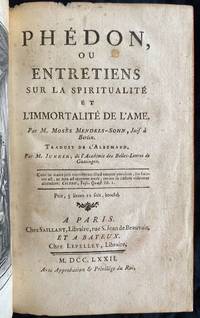
177243257Paris et Bayeux chez Saillant et Lepelley 1772. 1st French-language edition. Period full leather binding with gilt spine and red edges with original marbled endpapers 8vo. Includes frontis copperplate etching. XXIV 342 1 pages. “Traduit de l’Allemand par M. Junker de l’Académie des Belles-Lettres de Goettingen.â€<br> This first French edition appeared 5 years after the first German edition of 1767<br> <br> "Phaedon or On the Immortality of the Soul" Phaedon Oder Ueber Die Unsterblichkeit Der Seele In Drey Gespraechen is one of Mendelssohn's 1729-1786 most famous publications establishing his reputation as the "German Socrates of Berlin." It is a philosophical interpretation of the Platonic dialogue "Phaedo" and is preceded by a biography on "The Life and Character of Socrates." The important German-Jewish philosopher was one of the most important representatives of the Enlightenment in Prussia and throughout Germany.<br> <br> Mendelssohn's Phaedon is a “classic of rational psychology on the immortality of the human soul a defining work by this leading enlightenment philosopher who launched the Jewish thinking of the modern age" with his tribute to Socrates modeled on Plato's dialogue the Phaedo.<br> Mendelssohn used Plato's famous dialogue the Phaedo as a model to publish Phädon oder über die Unsterblichkeit der Seele. With this seminal work "he reached the heights of fame" Wigoder Dictionary of Jewish Biography 342. <br> The work unites Mendelssohn's "paean to Socrates with an elaboration of the dreadful personal moral and political implications if a person's life is her 'highest good'… <br> This 'classic of rational psychology' as Dilthey put it also contains an argument for the simplicity and immortality of the human soul explicitly singled out for criticism by Kant in the 2nd edition of the Critique of Pure Reason. Mendelssohn supports the notion that the soul is simple and thus indestructible by noting that certain features of the soul namely the unifying character of consciousness and the identity of self-consciousness cannot be derived from anything composite whether those composite parts be capable or not of thinking… <br> As for the human soul's fate after death Mendelssohn appeals to divine goodness and providence which perhaps explains why following the publication of the Phaedo he finds himself needing to revisit the proofs for God's existence" Stanford Encyclopedia.<br> According to Mendelssohn’s modern biographer Alexander Altmann “The work that would establish Mendelssohn's world-wide renown and win him the title 'the German Socrates' was the dialogue Phaedon which was published in 1767. In this work he presented Socratic wisdom from the mouth of the ancient philosopher but in the language of the Enlightenment that is in his own words as a modern philosopher. <br> The work drew both praise and criticism but was on the whole popular in intellectual circles. It demonstrates Mendelssohn's unique ability as a Jew to be comfortable in the realm of both classical and enlightened philosophy not to mention languages. David Sorkin remarks ‘What is ironic is that Mendelssohn was known and revered as much for the quality of his prose as for his thought.†<br> Mendelssohn was himself often referred to as the German Plato or the German Socrates. <br> And “As a Jew living in Germany Moses Mendelssohn 1729-1786 stands at a pivotal point in the history of Jewish emancipation in Europe. There were Jews before him who had access to the corridors of power in Germany and elsewhere in Europe but Mendelssohn represents the first to be socially accepted to a significant extent within enlightened German culture without converting. <br> He not only conformed to the culture of the German Enlightenment in many ways but also helped shape the culture through his philosophical contributions. At the same time Mendelssohn refused to turn away from traditional Judaism. He attempted to become a full- fledged member of society during the emergence of modern Europe while remaining a proponent of Judaism as a revealed religion. Moreover he sought to use his place of influence to encourage Jewish acculturation in Germany and to speak on behalf of the emancipation of Jewish people…. <br> The traditional mentality of the European Jews prior to Mendelssohn's time included a kind of resignation to the incompatibility of Jewish learning and 'worldly' philosophy. This resignation contributed to Jewish cultural isolation. Alfred Jospe describes the conundrum in which a Jew found himself if he wished to enter the culture of the non-Jewish world: The Jew could gain access to the culture of the world only by rebelling against the traditional repudiation of all mundane wisdom. <br> It is just at this point that Mendelssohn broke the mold. He not only acquired modern German culture but did so by means of his understanding of and contributions to the philosophy that shaped that culture. In his monumental biographical study Alexander Altmann focuses as much on Mendelssohn's philosophy and his answers to contemporary critics as he does on the details of the events and influences of his life. Altmann states with appropriate admiration that “Considering the state of degradation in which the Jewish population lived in eighteenth-century Germany. Mendelssohn's rise to fame and his acceptance into the republic of letters was an amazing feat of personal achievement.†<br> The amazing feature of Mendelssohn's achievement is that he accomplished it as an avowedly traditional Jew. Mendelssohn has been rightly described as a rabbinic scholar but he made his reputation in non-Jewish intellectual circles as a literary critic and philosopher….with the help of both Gotthold Lessing and the Berlin publisher Friedrich Nicolai he was accepted into the inner circle of the Berlin Aufklärung. <br> His essays reviews and translations earned him tremendous status among German intellectuals. <br> The favorable comparison made by Lessing between the quintessential German poet Goethe and Mendelssohn is a mark of the esteem in which he was held. ‘Lessing told Friedrich Heinrich Jacobi that once Goethe regained his reason he would be hardly more than an ordinary man. At the very same time he said of Mendelssohn that he was the most lucid thinker the most excellent philosopher and the best literary critic of the century’" Clark 2005. P. 57-58. <br> OCLC: 19939219. <br> Very light edgewear to front endpapers touch of spotting a gorgeous copy in the original leather binding with tooled gilt spine with raised bands and leather label. Beautiful and scarce. B KH-10-30-RLB-’e. Paris et Bayeux, chez Saillant et Lepelley unknown
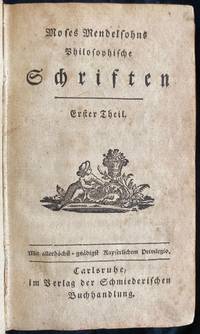
178043258Carlsruhe: im Verlag der Schmiederischen Buchhandlung 1780. No Date 1780s. Period laquered boards with leather spine label. 12mo. XXIV 278; 283 pages. In German. Title translates as “Writings.†Includes 2 different title vignettes 1 on each title page.<br> <br> Goedeke IV 1 488 6. Meyer 108; Dorn 105-107; Holzmann/Bohatta Deutsches Anomymen-Lexikon IV no. 1559. <br> <br> Early printing of Mendelssohn’s second work in which he "began his formulation of a new psychological theory that stressed the autonomy of aesthetics logic and ethics relative to each other." Merriam-Webster's Encyclopedia of World Religions p. 710. <br> <br> Contents:<br> <br> Vol. 1. Vorrede. <br> I. Ueber die Empfindungen.<br> II. Gespräche; <br> <br> Vol. 2. I. Rhapsodie oder Zusätze zu den Briefen über die Empfindungen. <br> II. Ueber die Hauptgrundsätze der schönen Künste und Wissenschaften. <br> III. Ueber das Erhabene und Naive in den schönen Wissenschaften. <br> IV. Ueber die Wahrscheinlichkeit. <br> <br> Also includes bibliographical references.<br> <br> Included within these is a series of writings on aesthetics which influenced Lessing and Schiller with Lessing noting“We have to thank him Mendelssohn for the true theory of mixed sensations.â€<br> <br> Moses Mendelssohn Moses of Dessau; 1729–1786 was a philosopher of the German Enlightenment in the pre-Kantian period early Maskil and a renowned Jewish figure in the 18th century. Mendelssohn was fluent in German and Hebrew and learned Latin Greek English French and Italian. His early teachers were young broadly educated Jews and he met the writer and dramatist G.E. Lessing 1754 and a deep and lifelong friendship developed between them. Throughout his life he worked as a merchant while carrying out his literary activities and widespread correspondence in his free time. In 1754 Mendelssohn began to publish – at first with the assistance of Lessing – philosophical writings and later also literary reviews. <br> He also started a few literary projects for example the short-lived periodical Kohelet Musar in order to enrich and change Jewish culture and took part in the early Haskalah. In 1763 he was awarded the first prize of the Prussian Royal Academy of Sciences for his work Abhandlung über die Evidenz in metaphysischen Wissenschaften "Treatise on Evidence in Metaphysical Knowledge". However when the academy elected him as a member in 1771 King Frederick II refused to ratify its decision. <br> <br> In 1769 he became embroiled in a dispute on the Jewish religion and from then on he confined most of his literary activity to the sphere of Judaism. His most notable and enduring works in this area included the translation into German and commentary on the Pentateuch Sefer Netivot ha-Shalom "Book of the Paths of Peace" 1780–83 and his Jerusalem: oder Ueber religiöse Macht und Judenthum "Jerusalem or On Religious Power and Judaism" 1783 this work the first polemical defense of Judaism in the German language and one of the pioneering works of modern Jewish philosophy. <br> <br> An active intermediary on behalf of his own people in difficult times and a participant in their struggle for equal rights he was at the same time a forceful defender of the Enlightenment against the opposition to it which gained strength toward the end of his life. In the midst of a literary battle against one of the leading figures of the counter-Enlightenment he died in 1786 EJ. <br> <br> SUBJECTS: Philosophy -- Early works to 1800. Philosophie -- Ouvrages avant 1800. Philosophy. OCLC: 1352546328. <br> <br> Light wear to original boards more so at spine but solid and attractive light spotting as expected About Very Good- Condition an attractive 18th Century copy. B KH-10-31. Carlsruhe: im Verlag der Schmiederischen Buchhandlung unknown
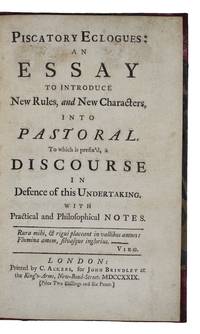
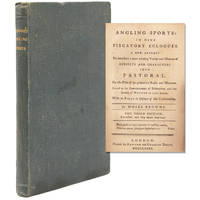
1729AQ26633London: Printed by C. Ackers for John Brindley 1729. 14 129pp 1. Later red straight-grain half-morocco marbled paper boards ruled and lettered in gilt. Lightly rubbed and marked. Marbled endpapers title page browned. The first edition of poet and Church of England clergyman Moses Browne's 1704- 1787 highly naturalistic angling pastorals that include the first avowed imitation of Milton's 'Lycidas'. The didactic portions are adapted from Izaak Walton's Compleat Angler a work which Browne was to edit and republish for the first time since 1676 in 1750 at the suggestion of his friend Samuel Johnson. The nine poems were reprinted under the title Angling Sports in 1773. ESTC records copies at five locations in the British Isles BL Cambridge Leeds NLS and Oxford and a further 11 in North America California Harvard Huntington Illinois NYPL Newberry North Carolina Pennsylvania Princeton Virginia and Yale. ESTC T55150. First edition. 8vo. Printed by C. Ackers, for John Brindley hardcover
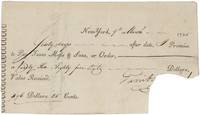
179542478New York 1795. paperback. Single leaf 4x7 inches. Printed on one side with blanks filled in in manuscript and signature obscured by cancellation tear-off; “Isaac Moses & Sons†penned on blank side in period hand. Early American Jewish merchants Isaac Moses & Sons operated on Greenwich Street.Isaac Moses 1742-1818 was born in Giessen Germany but moved to New York in 1764 and in 1766 he became a “freeman†of New York City. He became a prominent businessman and American patriot. He worked in his uncle's Hayman Levy's mercantile firm until he established Isaac Moses & Company with two new business partners in 1775. This firm supported the revolutionary army by accepting $20000 in Continental paper dollars in exchange for $20000 in hard currency thereby financing the war effort. The firm also traded for military supplies internationally and sold guns and ammunition to the army. When the British occupied New York Isaac Moses left for Philadelphia and ran the firm from there. In 1783 he returned to New York City and continued his commercial enterprises. He was generally financially successful establishing Isaac Moses & Sons an international trading company. He was also a founder and major stockholder in the Bank of New York  a Mason in New York City's Union Lodge and an important member of the New York City Chamber of Commerce. Isaac Moses was also president of Congregation Shearith Israel in New York the oldest Synagogue in American and the only Jewish congregation in New York City until 1820. He was also one of the principle organizers of the Congregation Mikveh Israel in Philadelphia. His descendants were prominent Jewish businessmen in New York who traveled internationally and served in the Union Army during the Civil War AJHS & Wikipedia. For more on Isaac Moses see the JTA’s report on the donation of his portrait by John Wesley Jarvis to the Museum of the City of New York in 1934 https://www.jta.org/archive/painting-of-isaac-moses-patriot-of-revolution- given-to-museum. Portraits of Moses can be viewed online at https://loebjewishportraits.com/portrait/isaac-moses/ and https://loebjewishportraits.com/portrait/isaac-moses-2/. An indenture signed by his heirs after his death in 1818 sold for $3500 plus commissions at auction in 2019 https://www.sothebys.com/en/auctions/ecatalogue/2019/fine-manuscripts-prin ted-americana-n10002/lot.2180.html. Promiser’s signature torn of as cancellation as often found otherwise Very Good Condition BK5 AMR-67-39. New York unknown
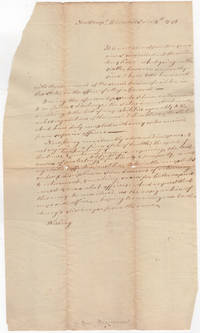
179844770Haverhill NH 1798. Very good two chipped corners light tearing and soiling along folds contents slightly faded but clean. 1 sheet. 7.75 x 13 inches. Dated June 4th 1798 Haverhill NH. Unsigned draft of a resignation letter to Governor John Taylor Gilman requesting to be discharged from service with the New Hampshire State Militia. "It is now almost fourteen years since I was called into the military line: And going on the sixth however unworthy - since I have been honoured with the command of the second division of militia in this state in the office of Major General. Now being considerably advanced in years & not enjoying a firm state of health. I am desirous of returning to retirement & making room for the better experienced & more alert officers."<br /> <br /> Moses Dow 1747-1811 born in Haverhill graduated Harvard in 1769 took up law was Kings Attorney 1774-5 under the Royal Governor and served in the New Hampshire colonial legislature1775-6. a Revolutionary War soldier state senator for the Fourth Provincial Congress president of the Senate; postmaster registrar of probate and Justice of the Peace. He served in the state militia from 1784 to 1798 with his final service as Major-General and though elected to Congress by the New Hampshire Assembly he wrote to Gilmore that he could not accept as in this case based on his ill health.<br /> <br /> References: Hamilton Child: Gazetteer of Grafton county N. H. 1709-1886 Syracuse NY. Syracuse Journal Company 1886; Francis Parkinson Keyes: "Moses Dow Citizen of Haverhill†Granite Monthly 3rd Quarterly Issue 1918 pp 141-144; Chandler E. Potter: Military History of the State of New Hampshire from its Settlement in 1623 to the Rebellion in 1861 Concord NH : McFarland and Jenks 1866Vol I; Dartmouth has his papers. unknown
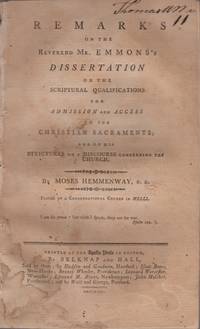
179435177Boston: Printed at the Apollo Press 1794. First Edition. Wraps. Good. Disbound wraps. Trimmed. 86 pages. Title page is page 1. Rear blank wrap present but detached. First 6 pages starting to detach. Pages 83-86 and the back cover detached. Old ink name top of the title page. Light toning to the contents. <br /> <br /> Evans 27110. Printed at the Apollo Press unknown
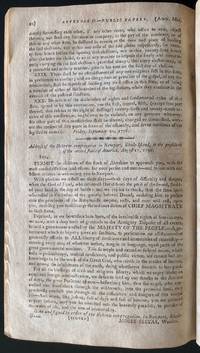
179143202Philadelphia: Mathew Carey; Carey Stewart and Co. No. 188 Market-street 1791. Original Sewn Binding without outer wrappers or boards 8vo pages 285-344 1-48 1-40 1-48 total 196 pages with different sections correctly paginated for this issue.<br> With Moses Seixas’ famous letter to President George Washington<br> Seixas wrote to President Washington on behalf of the Newport congregation whose home is the Touro Synagogue the oldest synagogue still standing in America. This letter which appears on p 40 of Appendix II and Washington's reply comprise one of the most famous statements on religious freedom of this period. <br> Here published in America’s first literary magazine George Washington’s famous phrase describing a government that "gives to bigotry no sanction and to persecution no assistance" was originally coined by Seixas in this very letter. It is a moving Biblically toned greeting to the president and was repeated by Washington in his reply assuring it a place among the most cherished in the American historical vocabulary.<br> George Washington's visit to Newport Rhode Island August 17-18 1790 ranks among the seminal episodes in the history of American Jewish religious liberty. Washington left Rhode Island off his travel itinerary the previous year in response to the state's failure to ratify the Constitution. By 1790 after becoming the last state to ratify Washington visited Newport along with members of his administration including Thomas Jefferson. <br> Moses Seixas 1744-1809 a Newport merchant warden of Kaal Kadosh Yeshuat Israel Newport Hebrew Congregation and a prominent Mason was one of the civic leaders who met with Washington. Seixas had a long history as a revolutionary patriot: he remained in the city after it was occupied by the British during the war and signed a document during the occupation pledging loyalty to the patriotic cause. <br> Additionally his brother Rabbi Gershon Mendes Seixas minister of New York's Shearith Israel Congregation known as the "patriot rabbi" was one of fourteen clerygymen officiating at Washington's 1789 Presidential inauguration. <br> Finally as a fellow Mason he and Washington would have had a natural connection. Seixas' eloquent message reads in part: <br> "Deprived as we heretofore have been of the invaluable rights of free Citizens we now with a deep sense of gratitude to the Almighty Disposer of all events behold a Government erected by the MAJESTY OF THE PEOPLE – a Government which to bigotry gives no sanction to persecution no assistance – but generously affording to ALL Liberty of conscience and immunities of Citizenship: – deeming every one of whatever Nation tongue or language equal parts of the great governmental Machine: – This so ample and extensive Federal Union whose basis is Philanthropy Mutual confidence and Public Virtue we cannot but acknowledge to be the work of the Great God who ruleth in the Armies of Heaven and among the Inhabitants of the Earth doing whatever seemeth him good." <br> Grounding religious freedom in natural rights and echoing Seixas' words Washington later replied with an echo of Seixas' language regarding religious freedom: <br> "The Citizens of the United States of America have a right to applaud themselves for having given to mankind examples of an enlarged and liberal policy: a policy worthy of imitation. All possess alike liberty of conscience and immunities of citizenship. It is now no more that toleration is spoken of as if it was by the indulgence of one class of people that another enjoyed the exercise of their inherent natural rights. For happily the Government of the United States which gives to bigotry no sanction to persecution no assistance requires only that they who live under its protection should demean themselves as good citizens in giving it on all occasions their effectual support."<br> See JE Vol. IX pp. 294-295; EJ. Vol. XIV p. 1117; J.L. Blau and S.W. Baron The Jews of the United States 1790-1840 A Documentary History Vol. 1 1963 pp. 8-10.<br> Other pieces of interest include notes on the slave trade by Benjamin Franklin and notes on the Revolutionary War. <br> “The American Museum or Repository of Ancient and Modern Fugutive Pieces &c. Prose and Poetical “title changed to “The American Museum or Universal Magazine†in January 1790 was America's first literary magazine featuring early printings of the US Constitution the Bill of Rights various State constitutions Alexander Hamilton's Report on Manufactures and parts of the Federalist Papers. <br> Complete issue in original sewn binding. Overall condition is very good with scattered darkening and foxing though paper and binding remain nice and strong with clean crisp edges including the notable page containing the address to Washington<br> A Cornerstone of American Judaica. BAMR-69-7A. Philadelphia: Mathew Carey; Carey, Stewart, and Co. No. 188 Market-street unknown
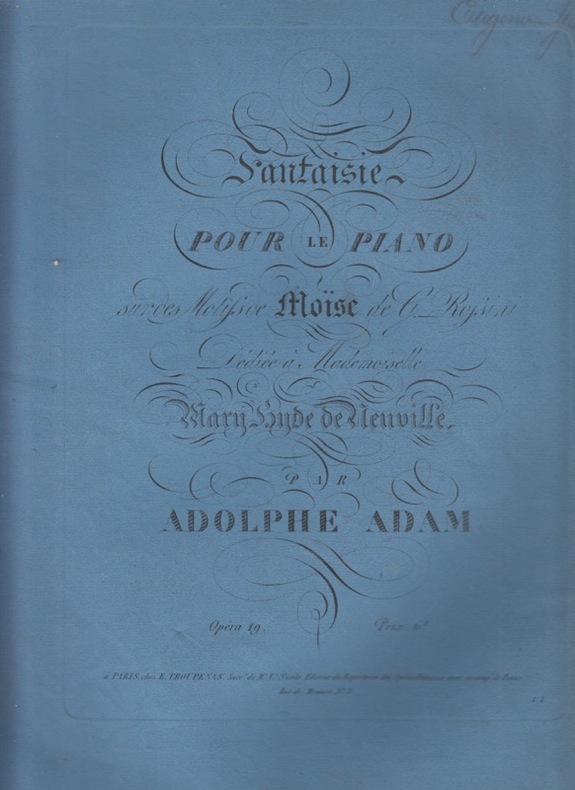
1800267401800 P.- TROUPENAS sd (vers 1800),MUSIQUE GRAVEE in folio broché,couverture bleue,14p.-213,bon etat,rare
179817799Dedham: Mann and Adams 1798. Disbound. 28pp minor foxing. Attractive ornamentation at top of page 3. Very Good. Adams warns Wright that "the spirit of the times creates and promotes much bitterness in society highly unfavorable to religion." He faces the possibility of "persecution"; mean-spirited people hope American ministers will "meet the same treatment which has been dealt to the clergy in France." FIRST EDITION. Evans 33265. Not in Jenkins. Mann and Adams unknown books
179817799Dedham: Mann and Adams 1798. Disbound. 28pp minor foxing. Attractive ornamentation at top of page 3. Very Good. Adams warns Wright that "the spirit of the times creates and promotes much bitterness in society highly unfavorable to religion." He faces the possibility of "persecution"; mean-spirited people hope American ministers will "meet the same treatment which has been dealt to the clergy in France." FIRST EDITION. Evans 33265. Not in Jenkins. Mann and Adams unknown
17712004280011Philadelphia : William & Thomas Bradford 1771. First Edition. Hardcover. Acceptable. Early American Science: Governor Simon Snyder's copy interesting Pennsylvania Provenance Quarto. Bound in early American 1/4 calf over marbled boards. Rebacked with modern leather spine original spine label conserved. Snyder's leather name plate on front cover but chipped at the end. xxii 3 xxiv-xxviii xix 1 116 72 1 118-340 pages. Defective copy. Illustrated with only 3 of 7 engraved plates lacking plates 3-5 7. Preliminary pages have old dampstaining including title and laws of the society. Includes a list of members and subscribers. Founded by Benjamin Franklin the American Philosophical Society was one of the first scientific societies in America. <br> Provenance: Simon Snyder 1759-1819 was the third Governor of Pennsylvania. This volume includes his morocco book plate on the front and his signature is on the title page. Snyder led the Commonwealth during the War of 1812. <br> Evans 11959; Sabin 1181. <br> Contents in this volume: A Description of an Orrery executed on a new plan finished by David Rittenhouse; Calculations of the Transit of Venus; Cultivations of the vine and the making and preserving of wine.suitable to North America by Edward Antill. Philadelphia : William & Thomas Bradford hardcover
1711045339Berlin: Meschullam Zalman ben Wolf Fischhof 1711. Second Edition. Hardcover rebound in cloth. Fair Condition. Rebound in plain green cloth early and late leaves chipped at the edges with some repairs occasionally touching the text. Browned throughout. Rare work by the 17th century Cabalist. 28ff. Size: Octavo 8vo. Quantity Available: 1. Shipped Weight: Under 1 kilo. Category: Religion & Theology; Magic Paranormal & Occult. Inventory No: 045339. <br/><br/> Meschullam Zalman ben Wolf Fischhof hardcover books
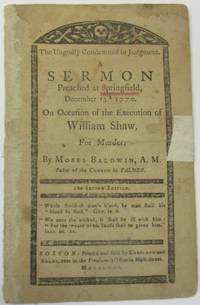
177139601Boston: Printed and Sold by Kneeland and Adams next to the Treasurer's Office in Milk-Street 1771. 24pp but lacking the half title. Death's Head ornamentation on title page. Disbound and uniformly toned. Closed tear to title leaf no loss repaired; evidence of repair at outer margin. Inner margin of title page and page 24 with old wrapper remnants. Good.<br /> <br /> Shaw bludgeoned Edward East to death while both were inmates of the Springfield prison. This is the second of three editions of this title all issuing in 1771; AAS does not own our edition. Reverend Baldwin scolds Mr. Shaw "for the sin of intemperance. Have you not hereby dishonoured God and abused his bounty and goodness; wronged your own soul and body; wasted your substance; brought your self and family to poverty and distress. . . You are verily guilty of the crying sin of MURDER."<br /> Evans 11974. ESTC W1508.5- Yale NYHS Boston Public Williams Peabody-Essex. Printed and Sold by Kneeland and Adams, next to the Treasurer's Office in Milk-Street unknown
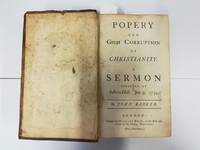
1735002177London: Printed for Richard Hett 1735. 1st Edition . Hardcover. Fair/No Jacket. 8vo - over 7¾ - 9¾" tall. 17 Sermons and a Conference bound together followed by contemporary hand written list of contents; full calf Cambridge binding with raised bands etc. Worn; scuffed; hinges/joints broken; ffep absent; pp. 848. Contents: 1 Popery; The Great Corruption of Christianity Barker 1735 pp. 34. 2 The Notes of the Church Considered 2nd ed. Chandler1735 pp. 57. 3 A Second Treatise on the Notes of the Church Chandler 1735 pp. 60. 4 The Supremacy of St Peter and the Bishops of Rome his Successors 2nd ed. Neal 1735 pp. 40. 5 The Church of Rome's Claim of Authority and Infallibility Examined Smyth 1735 pp. 71. 6 Scripture and Tradition Considered Wright 1735 pp. 54. 7 A discourse Concerning Transubstantiation: In jWhich the Words of the Institution of the Lord's Supper are Particularly Considered. Harris 1735 pp. 46. 8 A Second Discourse Concernign Tansubstantiation; in Which the Sixth Chapter of St John's Gospel is Particularly Considered. Harris 1735 pp. 38. 9 The Veneration of Saints and Images as Taught and Practis'd in the Church of Rome Examined. Hughes 1735 pp. 58. 10 The Sources of Corrupting both Natural and Revealed Religion Exemplified in the Romish Doctrine of Penance and Pilgrimages. Hunt 1735 pp. 40. 11 The Church of Rome's Doctrine and Practise with Relation to the Worship of God in an Unknown Tongue examin'd. Bayes 1735 pp. 48. 12 The Popish Doctrine of Auricular Confession and Priestly Absolution Considered. Burroughs 1735 pp. 48. 13 The Popish Doctrine of Merit and Justification Considered Newman 1735 pp. 48. 14 The Popish Doctrine of Purgatory Repugnant to the Scripture account of Remission through the Blood of Christ. Earle 1735 pp. 52. 15 The Principles of Popery Schismatical. Lowman 2nd ed. 1735 pp. 48. 16 Persecution and Cruelty in the Principles Practices and Spirit of the Romish Church Grosvenor 2nd ed. 1735 pp. 39. 17 The Reasons and Necessity of the Reformation Leavesly 1735 pp. 40. 18 Two Conferences.at the Bell Tavern.Between two Romish Priests a Divine fo the Church of England and Mr. Chandler and Dr. Hunt Dissenting Divines on the following Subjects. the Blashemy of many Popish Writers.Transubstantiation; Praying to Saints and Angels. 1735 pp. 28. 19 Pp. 2 hand written list of sermons. Rather a lovely volume if worn. <br/> <br/> Printed for Richard Hett hardcover
170129560Paris, Andreas Pralard, 1701. 8vo. Mit Holzschnitt-Titelvign. 32 Bl., 317, 215 S.; 1 Bl., 553 S. Ldr. d. Zt. auf 5 Bünden m. dekorativer Rückengoldprägung. Gesprenkelter Schnitt.
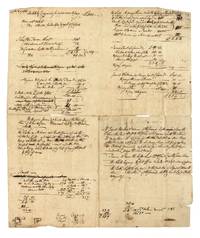
178655770Providence 1786. Folio sheet approx. 15" x 12" docketed on the verso; previous folds with splits no loss; overall toning; good. Brigadier General James Angell 1723-1785 descendant of one of the first settlers of Providence died February 2 1785. This inventory was taken by Moses Brown 1736-1838 executor of the will and both a friend and relative. The Angell's daughter Abigail married a Goddard relatives of the Brown family. Among assets listed are Angell's Johnston farm lot 160 acres of Vermont land a third of an acre lot in North Providence; "we to give James and Jacob a Deed of the Whole of remd of Johnston farm & North Providence lott." James Angell was town clerk of Providence until 1775 and Theodore Foster said of him "I became intimately acquainted with the said James Angell and many of his Family Connexions among whom was the Honorable Stephen Hopkins Esq. whose Sister married the said James Angell." Documentary History of R.I. Angell was also appointed chairman of the committee to revise laws of the state. <br/><br/> unknown books
178655770Providence 1786. Folio sheet approx. 15" x 12" docketed on the verso; previous folds with splits no loss; overall toning; good. Brigadier General James Angell 1723-1785 descendant of one of the first settlers of Providence died February 2 1785. This inventory was taken by Moses Brown 1736-1838 executor of the will and both a friend and relative. The Angell's daughter Abigail married a Goddard relatives of the Brown family. Among assets listed are Angell's Johnston farm lot 160 acres of Vermont land a third of an acre lot in North Providence; "we to give James and Jacob a Deed of the Whole of remd of Johnston farm & North Providence lott." James Angell was town clerk of Providence until 1775 and Theodore Foster said of him "I became intimately acquainted with the said James Angell and many of his Family Connexions among whom was the Honorable Stephen Hopkins Esq. whose Sister married the said James Angell." Documentary History of R.I. Angell was also appointed chairman of the committee to revise laws of the state. unknown
17738107London: Printed for Edward and Charles Dilly 1773. Third edition. Frontispiece. 1 vols. 8vo. Contemporary calf new spine small portion of free endpaper gone light marginal waterstains on first few prelims else internally fine. Third edition. Frontispiece. 1 vols. 8vo. The author a poetical mainstay of "The Gentleman's Magazine" was a friend of Dr. Johnson. Westwood and Satchell p. 43-44 Printed for Edward and Charles Dilly unknown books
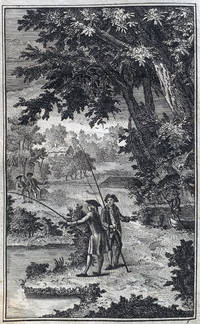
1773240394London: Printed for Edward and Charles Dilly 1773. Third edition. Engraved frontispiece of men fishing. xxxvii 2 136 pp. 1 vols. 8vo. Bound in three quarters green morocco t.e.g. Bookplate of Arnold Wood. Third edition. Engraved frontispiece of men fishing. xxxvii 2 136 pp. 1 vols. 8vo. The author a poetical mainstay of "The Gentleman's Magazine" was a friend of Dr. Johnson and editor of The Complete Angler. Westwood and Satchell p. 43-44 Printed for Edward and Charles Dilly unknown books
1773S13775London:: Printed for Edward and Charles Dilly 1773. 1773. Sm. 8vo. xxxvii 3 136 pp. Engraved frontispiece. On page 121: "Inscribed to Mr. Betteroth". Original calf rebacked with handsome new spine and red morocco gilt-stamped spine label. Bookplate of Hastings Nathaniel Middleton. Some minor ink annotations to the title. Very good. Originally issued in 1729 under a slightly different title and then again reissued in 1739. This is the third edition. "Brown was an enthusiastic angler and in 1750 at the suggestion of Dr. Johnson brought out an edition of Walton and Cotton's "Compleat Angler". . . MOSES BROWNE 1704 – September 1787 was a pen-cutter from Clerkenwell London England who became a poet and eventually rose amongst the ranks of the Church of England. He made various contributions to the Gentleman's Magazine founded by Edward Cave at St. John's Gate in 1731 who awarded Browne several prizes for his contributions. Browne mixed with some distinguished literary figures of his time including befriending Samuel Johnson. Browne was appointed vicar of Olney Buckinghamshire in 1753. In 1764 Browne took on the post of Chaplain at Morden College in Blackheath London. He remained vicar of Olney at the same time as vicar of Sutton Lincolnshire until his death in 1787. See: John Bartlett Catalogue of Books on Angling: Including Ichthyology . . . 1882 page 15; DNB III pp. 52-3; Thomas Westwood Thomas Satchell Bibliotheca piscatoria a catalogue of books on angling. . . 1883 pp. 43-4. Printed for Edward and Charles Dilly, 1773. unknown books
1773352513London: Printed for Edward and Charles Dilly 1773. Third edition. Engraved frontispiece of men fishing. xxxvii 2 136 pp. 1 vols. 8vo. Later green cloth. From the Library of Mr. L. Prouty. Third edition. Engraved frontispiece of men fishing. xxxvii 2 136 pp. 1 vols. 8vo. Westwood and Satchell p. 43-44 Printed for Edward and Charles Dilly unknown