SAWYER, Moses HBiblio.com
463 résultats
1861381919Portland: Published by the Author. For Sale by Bailey & Noyes 1861. Hardcover. Very Good. First edition. Octavo. 349 1 errata pp. Publisher's brown cloth gilt. Contemporary owner's name slight nicks at the crown a handsome very good copy. Published by the Author. For Sale by Bailey & Noyes hardcover
185921503Detroit: Barnes French & Way Printers 1859. 1859. 8vo. 16 pp. Original printed green wrappers. Some cover wear very good. Uncommon. 1st Edition. Soft cover. Very Good. Detroit: Barnes, French & Way, Printers, 1859. paperback
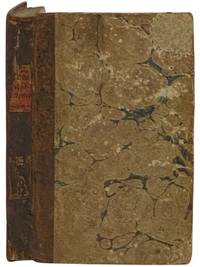
186731821Stettin Szczecin/ Lviv: A. Druker 1867. Third edition. Hardcover. fair to good. Large octavo. Unpaginated. 146 double-sided leaves. Period brown marbled paper boards protected in modern glassine. Contains four title pages one for the work in total at the front followed by three individual title pages for each of the three parts of the work. Each title page with decorative woodblock borders. Two of the title pages state Stettin as the location of publication while the other two state Lvov Lviv. The title pages state this as the "third edition". Text throughout printed on blue paper following the first title page.<br /> <br /> This historically important work is a treatise and reference work on the natural sciences which is famous for its numerous woodcut illustrations and figures. It was the first Hebrew book of its kind to be published. It's author was the early Enlightenment Polish-Jewish physician Tobias Cohen aka Toviyyah ben Moshe ha-Kohen or Toviyah Kats 1652-1729. The work was first published in Venice in 1707 and is divided into three parts covering covers numerous topics including medicine physiology anatomy hygiene botany zoology cosmology and astronomy. Includes at total of 26 black woodblock illustrated figures and diagrams throughout outlining creation depicting the geocentric and heliocentric models of the solar system the four elements plants insects physical phenomena and ships sailing on the the spherical globe of the world among others. The third part is the most notable for its famous illustrated figure known as "The House of the Body" which shows the detailed interior anatomy of the human body and a multi-story house side by side relating and comparing the organs of the body to the divisions of the house. The work is also includes theology and cosmology from a Jewish context and discusses Sabbatianism.<br /> <br /> Text in Hebrew. <br /> <br /> Binding with rubbing to the extremities as well as abrasions and scratches to the paper boards. Front board starting to crack at the top of the front hinge. Starting following the second title page and at the interior rear cover. Contains copious period ink notes in Hebrew and English on the interior covers and endpapers. Printed ex-libris of a previous owner pasted on the front free endpaper. Library stamp from another previous owner Jacob Franklin on the bottom of the third page. Rippling to endpapers. Some sporadic minor to light stains and smudges. Title page of part 2 with a small tear resulting in minor loss of text and some light chipping to the very edge of the final leaf of part 2. Binding in fair to good- interior in good condition overall. Quite scarce. Hebrew title: מעשה טוביה<br /> Author: טוביה קץ/ טוביה כהן/ טוביה הכהן/ טוביה הרופ×<br /> Publication: לבוב/שטעטין ×. דר×קיר תרכ״ז<br /> Alternate transliterations: Mase Towija 2nd title page Ma'aseh Tobiyah Ma'aseh Tuvyah Ma'aseh Toviyyah Ma'aseh Tovia. A. Druker hardcover
186436882np 1864. 4to. Written in ink and signed at the end by Royce on the verso of a single leaf. Several small holes text unaffected a few closed tears two archival tape repairs. Very Good. <br /> <br /> This unusual insightful document illuminates the laws of war applicable to the Civil War. Royce's Petition seeks justice for Confederate Captain Frank R. Gurley. Royce sent it to the Confederate Commission of Exchange. Its author Confederate Captain Moses Strong Royce was captured in Tennessee and imprisoned at Nashville. Gurley Royce's cell-mate had killed Union General Robert McCook of Ohio near Huntsville Alabama in August 1862. <br /> In October 1863 Union forces captured Gurley and charged him with murdering McCook. Gurley Union officials claimed was a guerrilla who shot McCook while the General was lying in an ambulance. Southerners claimed that Gurley was not a guerrilla but a regular soldier in the Confederacy's 4th Alabama Cavalry; and that he killed McCook according to the laws of war. <br /> Harper's Weekly and Frank Leslie's Illustrated Newspaper fanned the flames claiming that lawless Confederate guerrillas murdered the general; feelings ran high. "US General Grant wrote CS General Hardee in December of 1863 and said that although Gurley was a member of the Confederate army that did not preclude him from being tried for having committed a foul murder" online Huntsville-Madison County Public Library essay 'Frank B. Gurley's 1866 Diary'.<br /> Having escaped from prison in March 1864 Royce pleads Gurley's case. "He was confined in a cell for sixty-eight days and allowed only about one hour a day for exercise and was put upon trial for the killing of Genl. McCook. He was obliged to employ counsel to defend himself at an expense of 2500 dollars in greenbacks. The evidence produced completely exonerated him of anything like murder and the argument of his counsel was a complete vindication of his right as a soldier and an officer to do all that he did in bringing Genl. McCook to his death. <br /> "When the trial was nearly ended four communications by flag of truce were sent to the court and were there read - one from Lt. Col. Hambrick one from Genl. Forrest one from Genl. Hardee and one from Genl. Johnston" assuring that Gurley was not a guerrilla but a duly enrolled member of the Confederate military forces. Nevertheless Gurley was found guilty and sentenced to death.<br /> "The undersigned believes that if an effort were to be made by the Confederate Commission of Exchange to have Capt. Gurley exchanged the Federal authorities would immediately send him forward for that purpose and as a friend of Capt. Gurley the undersigned respectfully requests General Johnston to use his influence in procuring the exchange of Capt. Gurley. Respectfully submitted M. S. Royce." <br /> Even after War's end the dispute continued. Gurley having been released from prison in an administrative snafu was re-arrested charged but finally released and placed on parole in April 1866. unknown
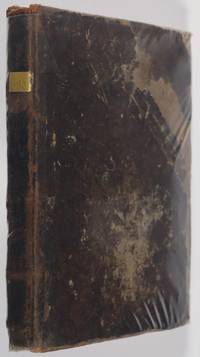
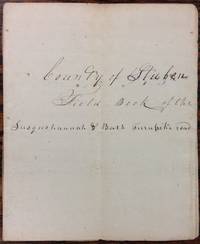
1805BOOKS288628--/No Dustjacket. 1805. 8vo. self wraps 6 leaves. A survey beginning at an oak tree on the line of Tioga County. This is for mile 82 going west to mile 104 and to a post in Morris Street in Bath. The ink records on 6 pages show Bearings Distance and Remarks. Most of the remarks are from trees. This is certified by Moses Van Campen and T. N. Miller Commissioners on August 30th. 1805. . paperback
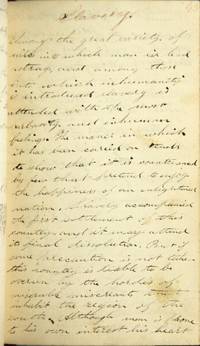
183248338Pembroke CT 1832. 8vo pp. 2 100 2; 6 leaves of mounted dried flowers mostly perished at back; 1 extra bifolium laid in containing three pages of "wandering thoughts"; contemporary quarter red calf over marbled paper-covered boards; upper joint cracked at the top boards rubbed and bumped; very good. A manuscript notebook full of pontification on a variety of subjects some rather mundane "Friendship is an acquisition which is very necessary and needful in life" and some on more colorful topics: the autobiography of a hat Yankee peddlers "Among the variety of imposters which we daily meet the yanks peddlers must be the first which comes under our observation"; slavery; the plight of the Indians; fashion "Where the old fashioned knee-buckles have been turned into some article of fancy; the sheepskin pantaloons and horn buttons have given place to morocco shoes and shell combs". Thirty-three entries are provided in all. One describes the town of Pembroke CT; there seems little otherwise to indicate where these essays were published if at all. unknown
183248338Pembroke CT 1832. 8vo pp. 2 100 2; 6 leaves of mounted dried flowers mostly perished at back; 1 extra bifolium laid in containing three pages of "wandering thoughts"; contemporary quarter red calf over marbled paper-covered boards; upper joint cracked at the top boards rubbed and bumped; very good. A manuscript notebook full of pontification on a variety of subjects some rather mundane "Friendship is an acquisition which is very necessary and needful in life" and some on more colorful topics: the autobiography of a hat Yankee peddlers "Among the variety of imposters which we daily meet the yanks peddlers must be the first which comes under our observation"; slavery; the plight of the Indians; fashion "Where the old fashioned knee-buckles have been turned into some article of fancy; the sheepskin pantaloons and horn buttons have given place to morocco shoes and shell combs". Thirty-three entries are provided in all. One describes the town of Pembroke CT; there seems little otherwise to indicate where these essays were published. <br/><br/> hardcover books
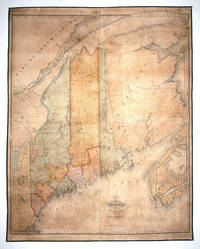
18298887Portland 1829. No Binding. Very Good. 50 ¾ x 40 ¼ inches. Steel engraving. Original wash color refreshed; expertly conserved re-mounted on new linen; a few cracks & marginal mends but fine for this kind. The very rare three copies cited in OCLC first edition of this excellent map of Maine by the state's first mapmaker. An exceptionally well-preserved example. Unlike many early American state maps that struggled to get completed Greenleaf's received a warm commendation from the state legislature even before it was published and the mapmaker was granted $1000 to aid him in finishing the map. Greenleaf later received $640 from the legislature for 40 copies of the map that were obtained for state use a remarkable $16 per copy. Perhaps the large number of copies sold for official rather than private use helps account for the map's present rarity. The map was originally intended to accompany an atlas and survey of the state that Greenleaf published the same year but very few complete sets of the three items are known to have survived. Greenleaf appears to have taken special care in the production of this map. Although published in Portland Maine Greenleaf employed as engravers for this work the estimable J. H. Young and F. Dankworth both of whom produced major works for the firms of S. A. Mitchell and others. This precisely detailed map which shows ten counties in different colors provides state county town and township boundary lines. The state's many rivers lakes ponds and even falls are shown as are roads and elevations. The map was re-published in 1844 by Greenleaf's son and namesake from the same plates but with emendations and several times thereafter. Greenleaf published two earlier maps of the state in 1815 and 1820 but the present work was by far his finest. Ristow W. American Maps and Mapmakers pp. 95-96; Catalogue Raisonne Important Maine Maps. Auction Catalogue for Thompson Collection Auction Robert E. Croul 2003 lot 119. unknown
18298887Portland 1829. No Binding. Very Good. 50 ¾ x 40 ¼ inches. Steel engraving. Original wash color refreshed; expertly conserved re-mounted on new linen; a few cracks & marginal mends but fine for this kind. The very rare three copies cited in OCLC first edition of this excellent map of Maine by the state's first mapmaker. An exceptionally well-preserved example. Unlike many early American state maps that struggled to get completed Greenleaf's received a warm commendation from the state legislature even before it was published and the mapmaker was granted $1000 to aid him in finishing the map. Greenleaf later received $640 from the legislature for 40 copies of the map that were obtained for state use a remarkable $16 per copy. Perhaps the large number of copies sold for official rather than private use helps account for the map's present rarity. The map was originally intended to accompany an atlas and survey of the state that Greenleaf published the same year but very few complete sets of the three items are known to have survived. Greenleaf appears to have taken special care in the production of this map. Although published in Portland Maine Greenleaf employed as engravers for this work the estimable J. H. Young and F. Dankworth both of whom produced major works for the firms of S. A. Mitchell and others. This precisely detailed map which shows ten counties in different colors provides state county town and township boundary lines. The state's many rivers lakes ponds and even falls are shown as are roads and elevations. The map was re-published in 1844 by Greenleaf's son and namesake from the same plates but with emendations and several times thereafter. Greenleaf published two earlier maps of the state in 1815 and 1820 but the present work was by far his finest. Ristow W. American Maps and Mapmakers pp. 95-96; Catalogue Raisonne Important Maine Maps. Auction Catalogue for Thompson Collection Auction Robert E. Croul 2003 lot 119. unknown books
186533072Odessa: M. A. Belinson 1865. Reprint. Hardcover. fair. 12mo. xii 192pp. Green paper boards with speckled edges. A dictionary of foreign words used by medieval Jewish writers such as Rashi Maimonides and R. Ashur b. Jacob. Words are ordered based on their appearance in the Bible and Talmud. First printed in 1831 in Prague. A useful tool for the philological study of rabbinic literature. Text in Hebrew Yiddish and French. Corners rubbed. Interior joint separated. Interior leaves stained. Overall in fair to poor condition. M. A. Belinson hardcover
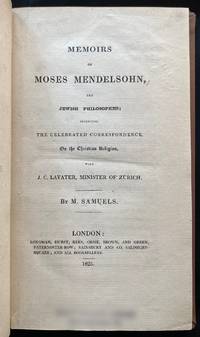
182542471London: Longman Hurst Rees Orme Brown And Green 1825. Hardcover. 1st edition. Later cloth 8vo. 171 pages 22 cm. In English. The first English Biography of Moses Mendelssohn founder of the Jewish Enlightenment or Haskalah See S. Feiner "Moses Mendelssohn: The First English Biography and Translations in: Journal of the History of Philosophy 2004 pp. 112-13. Moses Samuel London 1795 Liverpool 1860 was a clockmaker translator of Hebrew works and writer. SUBJECTS: Christianity and other religions Judaism. Ex-library with usual marks. Otherwise Very Good Condition. RAB-65-5A-RBDEL. London: Longman, Hurst, Rees, Orme, Brown, And Green hardcover
1825276892London : Longman Hurst Rees Orme Brown and Green 1825. First Edition. Softcover. Poor copy in the original stiff-card wrappers; wear and tear as with age. Text remains in fine condition and without blemish. Provenance; from the library of the Seminarii S. Ioannis with its bookplate. Physical description; 1 vii 171 p. ; 23 cm. Notes; Includes bibliographical references. Subjects; Mendelssohn Moses 1729-1786. Christianity and other religions Judaism. Religion. Christianity and other religions Judaism. London : Longman, Hurst, Rees, Orme, Brown, and Green paperback
1819047124New York: D. Fanshaw 1819. Second edition title page dated 1819. Full marbled calf with red spine label spine ruled in gilt 180 pages. Good conditioni with modest wear to corners and spine ends surface split to rear joint cover well attached good hinges sound text block clean pages with consistent light to moderate foxing a name written on the front free endpaper and a different name on the rear free endpaper. . Hard Cover. Good. 24mo - 5" - 5¾" Tall. D. Fanshaw Hardcover
182032332Charleston: G. Clark & Co. Thomas Badger Jr. Printer 1820. Third Edition from the second New York Edition. Hardcover. Good. 12mo. xi 12-180 pages. Brown paper covered boards. Dark leather spine with gilt lines and title. Extremities worn. Light toning to the text. Old ink gift inscription on the verso of the right front flyleaf - "Mary Crossman A Christmas Present From A Friend 1825." Color illustrated bookplate on the front paste down. G. Clark & Co. Thomas Badger, Jr. Printer hardcover
182035190Charleston: G. Clark & Co. Thomas Badger Jr. Printer 1820. Third Edition from the second New York Edition. Hardcover. Fair. 12mo. x 11-180 pages. Brown leather binding with black leather title label on the spine. Leather is rubbed and cracked Title label scuffed. Boards slightly bowed outwards. Light to moderate toning to the contents. Gift inscription written on the front paste down. Fair. G. Clark & Co. Thomas Badger, Jr. Printer hardcover
186247726Berlin: Printed by Julius Sittenfeld 1862. Hardcover. g to vg. Elephant Folio. Original spotted leather with debossed vignette and decorative ruling on cover. Blue endpapers. Title page printed in red and black with engraved vignette. With commentaries by Vidal Yom Tov of Tolosa Abraham ben David of Posquières Joseph ben Ephraim Karo Shem Tov ben Abraham Ibn Gaon Meir ha-Kohen Abraham Hiyya de Boton Judah ben Samuel Rosanes Nehemiah Trebitsch and Nahman Avraham Goldberg.<br /> <br /> The Mishneh Torah is the only Medieval-era work that details all of Jewish observance including those laws that are only applicable when the Holy Temple is in existence. Its title is an appellation originally used for the Biblical book of Deuteronomy and its subtitle "Book of the Strong Hand" derives from its subdivision into fourteen books: the numerical value fourteen when represented as the Hebrew letters Yod 10 Dalet 4 forms the word yad "hand". Maimonides intended to provide a complete statement of the Oral Law so that a person who mastered first the Written Torah and then the Mishneh Torah would not need to refer to any other legal text. Contemporary reaction was mixed with strong and immediate opposition focusing on the absence of sources and the belief that the work appeared to be intended to supersede study of the Talmud. Maimonides responded to these criticisms and the Mishneh Torah endures as an influential work in Jewish religious thought. According to several authorities a decision may not be rendered in opposition to a view of Maimonides even when he differed from the understanding of the Talmudic passage for in such cases the presumption was that the words of the Talmud were incorrectly interpreted. Likewise: "One must follow Maimonides even when the latter opposed his teachers since he surely knew their views and if he decided against them he must have disapproved their interpretation. However despite his stature in Yemen and the Sephardic world the Rabbinic authorities from the 13th century onwards did not base their legal rulings and interpretations of Halicha on Maimonides. The Mishneh Torah was compiled between 1170 and 1180 4930-4940 while Maimonides was living in Egypt and is regarded as Maimonides' magnum opus.<br /> <br /> Text in Hebrew. Bindings with mostly light wear along edges with small chips some scuffing of covers and lightly rubbed. Volume three with two inch crack at lower front joint and chip at head of spine. Volume four with one and a half inch closed tear at head of spine. Few bookworm holes at lower foredge of first few pages of volume one. Brief inked notes on endpapers. bindings in overall good interiors in very good condition. Printed by Julius Sittenfeld hardcover
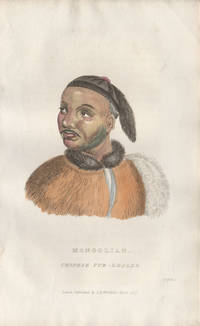
182727581827. Copper-line engraving with original hand-colouring. 215mm by 125mm sheet. From Edward Griffiths 'Animal Kingdom'. Faint waviness to paper and some very slight soiling.<br /> unknown
185097158Victor Lecou Libraire 1850 Victor Lecou, Nouvelle Collection des Moralistes Anciens, demi-chagrin bleu nuit, environ 14x9cm, 1850, 247 p., un ex-libris sur le premier contreplat, bon état.
182838188Salzburg: Arnsteinii et Filiorum 1828. Second edition. Hardcover. fair. Small quarto 12 117 leaves 2 67 leaves 84 leaves; 5 in text illustrations. Contemporary three quarter calf over marbled boards with gilt lettering on green and brown labels on spine. Latin and Hebrew title-pages plus title-pages before each of the 3 sections. Maimonides' "Guide for the Perplexed." First published in 1791 in Berlin and then in 1800 in Salzburg. Translated from Judeo-Arabic by Samuel ibn Tibbon. Commentary by Moses Narbonni and a contemporary commentary "Givat Hamoreh" printed anonymously but actually by the maskil Solomon Maimon. Edited by Isaac Abraham Euchel one of leaders of the moderate wing of the Berlin Haskalah. Prefaces by Narbonni and Maimon. Errata pages after the first and third sections. Explanation of philosophical terms. As with Moses Mendelssohn's Biur project this work exemplifies the moderate strain within the late 18th century German Haskalah which attempted to reform traditional Judaism using the medieval Jewish philosophical tradition exemplified by Maimonides. Text in Hebrew. Head and tail of spine with wear and chipped at head and green label. Leather broken just below brown label and at joints of spine. Corners and boards rubbed. Endpapers with offsetting in corners. Very light and sporadic foxing throughout. Binding in overall fair to good- interior in good condition. Title page info: "Auctore R. Mose Majemonide Arabico idiomate conscriptus a R. Samuele Abben Thibbone in Linguam Hebraeam translatus novis commentaris uno R. Mosis Narbonnensis ex antiquissimis manuscriptis depromto; altero anonymi cujusdam sub nomine Gibeath Hamore adauctus nunc in lucem editus cura et impensis Isaaci Eucheli. Solisbaci in officina arnsteinii et filiorum. MDCCC."<br /> <br /> R. Moses Maimonides Rambam was a 12th century Jewish philosopher and halachic legal scholar. A highly controversial figure both during his lifetime and after his death but generally acknowledged as the preeminent Jewish thinker of the Middle Ages. He was born in Córdoba Spain but fled as a child from the Almohad persecution. He eventually settled in Egypt where he served as a rabbi physician and philosopher. His fourteen-volume Mishneh Torah his only work not in Arabic still carries canonical authority particularly within the Yemenite Jewish community as the codification of Talmudic law. His other work includes a commentary on the Mishnah entitled Kitab al-Siraj Kitab al-Fara'I a book on precepts and the philosophical work Dalalat al-Ha'irin known in Hebrew as the Moreh Nevukhim The Guide to the Perplexed. The major premise is an attempted philosophical/theological reconciliation of the Hebrew Bible and Greek knowledge. This work came to play a central role in all subsequent major controversies over philosophy within the Jewish community during the Middle Ages. Arnsteinii et Filiorum hardcover
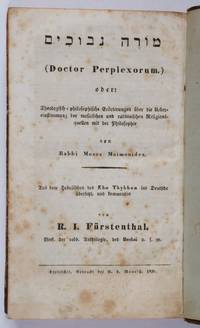
183948414Wien: Krotoschin; printed by B. L. Monasch 1839. Later printing. Hardcover. g to vg. Octavo. 392 3 8pp. Original three-quarter leather over marbled boards with gilt lettering on red label and gilt tooling and ruling on spine. Red edges. Light blue endpapers. Translated into German from Ebn Thybbon's Hebrew translation of the Arabic original annotated and with an epilog on the preface by R. I. Fürstenthal. The publication is an edition of Maimonides seminal work on Jewish philosophy "Guide to the Perplexed" written app. 1190 in Arabic using Hebrew letters and first translated into Hebrew in 1204. Originally written in a three-part letter to his student Joseph ben Juda of Ceuta. It was written to enlighten a religious man according to Maimonides to explain obscure figures appearing in the Prophets; and generally addressed to an elect educated readership. Text in German and Hebrew. <br /> <br /> Binding with wear along edges small chips along edges and red leather label on spine. Marbled boards with light scuffing. Light scuffing at front joint of the spine with light fraying at head. Light foxing of front and back part of block. Binding in overall good interior in good to very good condition. References: Cf. Fürst II p. 305: Krotoschin 1838. Krotoschin; printed by B. L. Monasch hardcover
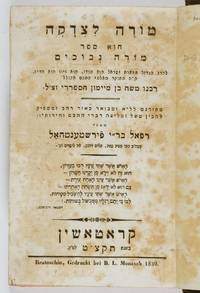
186450647Krotoschin Krotoszyn/ Vienna/ Frankfurt am Main: Printed by B.L. Monasch/ Jacob Schlossberg's Buchhandlung/ Printed by Ferdinand Hauch 1864. First German translations. Hardcover. g to vg-. Octavo. 3/4 black morocco over buckram boards. Gilt lettering and ruling on the spine. Red speckled edges of book block. A complete set of the three parts of Maimonides acclaimed work The Guide for the Perplexed in German and Hebrew bound in one volume. All of the editions included here contain the first German translations of their respective parts of the text.<br /> <br /> Maimonides' intention with this work was to reconcile Aristotelian thought and logic with traditional Rabbinical Jewish theology. Originally written circa 1190 in Judeo-Arabic as Dalalat al-Ha'irin these writings takes the form of a lengthy three-part letter to his student Rabbi Joseph ben Judah of Ceuta and are seen as the main source for understanding Maimonides' philosophic view rather than his strictly being his views on Jewish law. It is the most known of his works in the non-Jewish world. The work's first translation into Hebrew was in 1204 by Rabbi Samuel ben Judah ibn Tibbon c.1150 - c.1230 a contemporary of Maimonides.<br /> <br /> Content:<br /> <br /> Moreh li-Tsedakah. Hu Sefer Moreh Nevukhim FIRST PART. 1839. Second German-language edition. 19 double-sided leaves with Hebrew pagination. 392pp. 3. In 1835 the first part of Maimonides acclaimed work was first translated into German with added commentary in Hebrew by Jacob Raphael Fürstenthal 1781-1855. That first edition featured the German translation printed in Latin script to accompany the Hebrew text. However for this second edition of that translation it is interesting to note that the text of the German is printed in Hebrew script. Content finely printed in double and single-column layouts with commentary printed in Rashi script. Divided in 76 chapters this part of the work contains discussions of an understanding and definition of the nature of God and divine anthropomorphism in the Hebrew bible including a detailed analysis of the Biblical Hebrew of the text to these ends. The final three pages included here contain and index in both Hebrew and German.<br /> <br /> BOUND WITH<br /> More Nebochim. Wegweiser für Berirrte SECOND PART. 1864. First German-language edition. x 99pp. This is the first German translation of the work's second part taken from the original Arabic text by way of the French translation by Salomon Munk 1861. The original Hebrew translation of the text is accompanied throughout by a translation and commentary in German by Max Emanuel Stern 1811-1873. Divided into 48 chapters the second part involves Maimonides discussion of proof of the existence of God the nature of creation the concept of prophecy and an examination of the 26 propositions for Aristotle's metaphysics. The initial pages contain introduction and foreword by Stern. Also included is a fold-out plate containing facsimile text from an original signed manuscript note from the hand of Maimonides himself written in Japhet son of Solomon's corrected manuscript copy of the Mishneh Torah held at Bodleian Library at Oxford MS Hunt.80 leaf 165a. <br /> <br /> AND WITH<br /> Dalalat al Haiirin Burechtweisung der Verirrten. Dritter Theil. THIRD PART. 1838. First German-language edition. viii 9 454pp. 5. This is the first German translation of the work's third part. Simon B. Scheyer 1804-1854 provides the translation and scholarly commentary in German to accompany the Hebrew of the text. This third and final part of Guide for the Perplexed is divided into 54 chapters and is considered the climax of the work and the culmination of Maimonides' previous analysis. Discussed are concepts including Jewish mysticism the Chariot of Ezekiel the moral aspects of the universe the problem of evil free will and the 613 mitzvot of the Torah. The final pages contain a scholarly index in German.<br /> <br /> Binding tight with some rubbing to extremities including the hinges of the spine. Spine and covers lightly sunned. Text throughout with some sporadic minor to light foxing. Much of the text is quite clean. A very few instances of underlining or notes in pencil. Binding in good interior in very good- condition overall. Hebrew title: מורה לצדקה .×”×•× ×¡×¤×¨ מורה × ×‘×•×›×™×/ מורה × ×‘×•×›×™×/ מורה × ×‘×•×›×™×. ×•×”×•× ×¡×¤×¨ דל×לה ×לח×ירין .חלק שלישי<br /> Author: משה בן מימון רפ×ל בר"×™ ×¤Ö¼×™×¨×©×˜×¢× ×˜×”×ל<br /> Publication: ×¤×¨× ×§×¤×•×¨×˜/ קר×ט×שין תקצ״ט<br /> Alternate titles and transliterations: Moreh Nevukim Doctor Perplexorum<br /> <br /> Bibliographic references: PART 1 Vinograd Krotochin 14. PART 3 Vinograd Frankfurt 578<br /> <br /> Provinence: Previously owned by Oxford religion scholar O.H.M. Lehmann dated 1949. Printed by B.L. Monasch/ Jacob Schlossberg's Buchhandlung/ Printed by Ferdinand Hauch hardcover
188224982rlEisleben / Leipzig, Christlicher Verein / Schulze, 1882. einfaches privates Halbleinen, mit möglicherweise der Originalbroschur entnommenem kleinen Ausschnitt des Rückenschildes, ca.DinA 5, 359 Seiten, Einband mit stärkeren Gebrauchsspuren, Knickspuren, berieben und bestoßen, Rücken an den Enden leicht aufgerissen, Schnitt fleckig, gebräunt und bestoßen, Seiten gewellt, Seiten papierbedingt stärker gebräunt, einige Seiten eingerissen, stockfleckig, trotz der deutlichen Gebrauchs- und/oder Altersspuren ausreichender Zustand
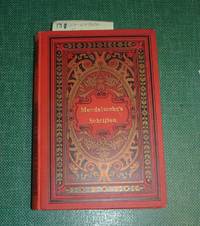
18921149626Breslau: Wilh. Jacobsohn & Co 1892. Neue Titelauflage. VG/no DJ Octavo in red cloth over boards with Victorian filigree and borders gilt lettering on spine. Ex libris name stamp on verso of portrait page. Minor shelf wear and bumping; text clean; 602 pp. Small florette wallpaper endpapers. Spider marbling on edges of text block. In exceptional condition. ---TEXT IN GERMAN. <p>Shelved upstairs in shelves near copier. 1149626. Rockville Non-Retail Listings. Wilh. Jacobsohn & Co unknown
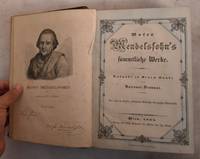
1838192514Wien: M. Schmidl's 1838. Hardcover. Good - Spine strip is peeling significantly; boards are heavily worn; corners are heavily worned; boards are heavily scuffed; inner hinge is cracked; pages are heavily age-toned; pages are foxed; frontispiece has a tear inside near hinge; text block is solid. Leather-bound with gilt lettering and illustration; frontispiece; text block edges are red; 1016 pp.; illustrated. Text in German. This is a interesting collection of the writings of Moses Mendelssohn. M. Schmidl's hardcover
18192329134Ofen: Paul Burian'schen Buchandlung 1819. Hard Cover. Good/No Jacket. German text. Boards rubbed with some loss from corners especially top of front panel internal split to leather of spine causing minor loss from label a few pages faintly stained. 1819 Hard Cover. viii 201 pp. Leather spine with leather spine label marbled boards Volume 4 of Mendelssohn's collected works comprising a brief philosophical history with a sketch of his life and character by D. Jenisch. Mendelssohn was an influential German-Jewish philosopher and theologian who helped launch the Haskalah Jewish Enlightenment of the eighteenth and nineteenth century. Paul Burian'schen Buchandlung hardcover