26 503 résultats
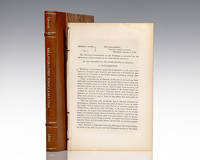
189912434n.p.: n.p. 1899. FIRST EDITION. Bound in half morocco and marbled boards; light creasing and soiling. Judd Stewart's copy with his bookplate. Very good. First edition of this inspirational address. Monaghan 1254. [n.p.] unknown
189244848Concord N.H. October 1892. First edition. contemporary half morocco. Minor rubbing at extremities; a few light spots to cloth; a very nice copy. 8vo. Illustrated from engraved portraits. Inscribed to an old friend "With the compliments of The Author 1893." hardcover
1718102323<p> Newspaper 16" x 22" six columns of text 4 pp. Folded at center several tears and chips at folds and extremities some loss of text Lincoln text less affected some aging and browning and some uneven darkening ; in about fair condition overall for a newspaper from this period. Dated April 17 1865 this is a relatively early account of the Lincoln assassination. Most of the coverage is on the second and third pages of the newspaper. The articles include stories on the "death bed scene" the attacks on Secretary Seward and his son the national reaction and reports on those involved in the plot. Some interesting coverage of a national event in a local newspaper.</p>
1865102324<p>Newspaper 16" x 22" six columns of text small Lincoln engraving 4 pp. Folded at center a few tears and chips at folds and extremities some loss of text at the center fold some aging and browning and a little uneven darkening; despite these faults the paper is in decent condition overall for a newspaper from this period. Dated April 26 1865 this paper provides considerable detail on Lincoln's funeral. The coverage includes an OBIT on Lincoln and a small engraving of the slain president. Most of the coverage is on the second page of the newspaper. The articles include stories on events at the capital to honor Lincoln and the impact of the event on a grieving nation.</p>
1864D16155Baltimore: Cushings & Bailey 1864. First Edition. First and only edition extra-illustrated with approximately 65 inserted portraits. Full red pebbled morocco gilt dated 1882 on the spine rebacked with the original spine laid down the covers panelled in gilt the spine tooled and lettered in gilt with the initials "W.H.W." at the foot. 10 x 8 inches 25.5 x 21 cm; with lithographed title and approximately 65 mostly engraved or lithographed portraits inserted three are original drawings including one of Julia Ward Howe xi lithographed contents 200 pp. lithographed fascsimiles of the handwriting of the authors. Intermittent foxing the inserted portraits have offset to the text leaves opposite rebacked as noted and lightly rubbed. <br/><br/>This volume produced at the time of the 1864 Baltimore Sanitary Fair contains what is considered the first reproduction of the Gettysburg Address in Lincoln's hand. The facsimile was made from what is now known as the "Bliss Copy" of the address the fifth and final manuscript copy of the address that Lincoln executed at the request of the editors of this volume. Other authors represented here include Emerson Poe Melville Hawthorne and many other notables of the period. Cushings & Bailey unknown
1865106234<p>Newspaper folio 21" x 28" eight columns 4 pp. Chips and folds in margins center page crease folded a couple of holes at folds with some loss some soiling aging and darkening; otherwise fair to good. Dated May 31 1865 this local Boston paper carries two stories about the Lincoln assassination. Both articles start on front page. The first discusses the trial of the conspirators and the second deals with the trial also but presents information about the individuals involved. Back page has the usual ads. </p>
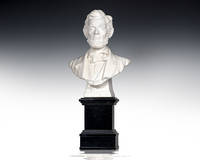
1909148487c. 1909. Painted plaster bust of Abraham Lincoln mounted on a wood pedestal base. After Raffaello Gironi for The Boston Sculpture Company. Signed faintly on reverse of integrated plaster pedestal "R. Gironi." An unpainted plaster of this sculpture is in the collection of the Canadian Museum of History Ottawa. In fine condition. The piece measures 21 inches by 9.5 inches. Abraham Lincoln served as the 16th President of the United States from March 1861 until his assassination in April 1865. He led the United States through its Civil War and in doing so preserved the Union of the United States of America abolished slavery and strengthened the federal government. In his Address at the Sanitary Fair in Baltimore Maryland in April of 1861 Lincoln stated: “The world has never had a good definition of the word liberty and the American people just now are much in want of one. We all declare for liberty; but in using the same word we do not all mean the same thing. With some the word liberty may mean for each man to do as he pleases with himself and the product of his labor; while with others the same word may mean for some men to do as they please with other men and the product of other men’s labor. Here are two not only different but incompatible things called by the same name liberty. And it follows that each of the things is by the respective parties called by two different and incompatible names…liberty and tyranny.†unknown
186017676Columbus Ohio: Follett Foster And Company 1860. First Edition. Cloth. Very good. First edition of Caucasus of 1860: A History of the National Political Conventions of the Current Presidential Campaign by Murat Halstead published in 1860. Octavo 6 232pp 2. Pebbled brown cloth title in gilt on the spine. Previous ownership stamp on the title page and preface blindstamp on the front free endpaper. Includes an ownership inscription on the front free endpaper dated 1860. A few marginalia notes in pencil. Solid text block text generally clean. Rubbing to cloth wear at head of the spine. Sabin 29924 Howes H-102. Murat Halstead's The Caucuses of 1860 published in Columbus by Follett Foster and Company in 1860 provides a detailed eyewitness narrative of the major party conventions that shaped the outcome of the pivotal presidential election. As a reporter and editor for the Cincinnati Commercial Halstead attended the Democratic conventions in Charleston April and Baltimore June where the party split over the issue of slavery-ultimately nominating two different candidates Stephen A. Douglas for the Northern Democrats and John C. Breckinridge for the Southern faction. He also covered the Republican convention in Chicago May describing the nomination of Abraham Lincoln over front-runner William H. Seward in day-by-day reports. The book includes transcriptions of key speeches roll-call votes delegate maneuverings and even floor plans of the convention halls. Follett, Foster And Company unknown
186512437New York: Athenaeum Club 1865. FIRST EDITION. Original printed purple wrappers lightly chipped with sun fading to the front wrapper. Unopened. First edition. One of five hundred copies printed. It contains addresses by T. Bailey Myers Parke Godwin George P. Putnam and others and a poem by Henry T. Tuckerman. Monaghan 379 variant. [Athenaeum Club] unknown
186511541New York: Athenaeum Club 1865. FIRST EDITION. With engraved frontispiece portrait. Original printed purple wrappers housed in a quarter-calf portfolio rear joint splitting; chipping and soiling to wrappers with some splitting at the folds still a very good copy of this large fragile item. First edition number 46 of 50 large paper copies. Monaghan 379. [Athenaeum Club] unknown
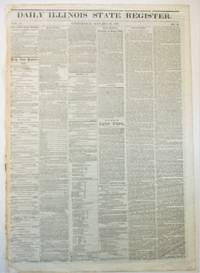
186139392Springfield: Charles H. Lanphier 1861. 4 pp. Folio. 16-1/4" x 23-1/2.". Lightly chipped blank inner edge. Each page printed in six columns each separated by a rule. Very Good.<br /> <br /> The Register no friend of Abraham Lincoln was a Democratic Paper supporting the Crittenden Compromise. Reporting on State and National issues the Register notes "The Crittenden Resolutions have strong friends but the ultra republicans will not take them." Lincoln had insisted that his allies hold firm against Crittenden's Compromise. The Register rebukes Lincoln for his famous declaration that "the Union could not endure permanently part slave and part free." Developments in the fracturing Union are reported. <br /> Lincoln had been elected President nearly three months before the appearance of this issue. His inauguration would occur five weeks later. Paid advertisers include John McClernand and John Stuart who advertise their legal services in the first column of page 1. The large number and variety of advertisements for an array of medical complaints about four columns are surprising- - and a little disturbing. <br /> This issue also reports an incident involving the John Brownites at Boston who were snubbed by British Lord Brougham after inviting him to attend a convention discussing the abolition of slavery. Charles H. Lanphier unknown
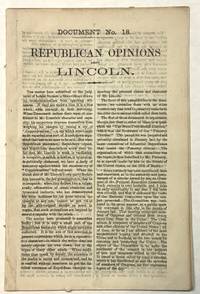
186442090np. 1864. Caption title as issued. 16pp printed in two columns per page. Stitched Very Good. <br /> <br /> This unusual item a Democratic Party campaign pamphlet is a compendium of "Derogatory Republican statements concerning Lincoln's capacity compiled for the campaign of 1864. The Pomeroy circular Fremont's letter of acceptance the Wade-Davis manifesto" Monaghan. It is a forceful reminder of the low esteem in which Lincoln was held during 1864 until Atlanta fell to the Union in September. <br /> FIRST EDITION. Monaghan 349. Sabin 70036. unknown
1863149486Washington: Government Printing Office January 2 1863. Rare first War Department and fifth overall printing of the Emancipation Proclamation. Twelvemo General Orders No. 1 extracted from the larger volume of orders for 1863 4 pages disbound. President Lincoln had intended to issue the order earlier in 1862 but deliberately delayed its release until after the Union's strategic victory at Antietam at which point he announced the Preliminary Emancipation Proclamation. General Order No. 139 September 22 1862 which declared that all slaves held in rebelling states would be forever free from the first day of January 1863. The text of the final Emancipation Proclamation present in this order is noted for its direct and decisive language: "By the President of the United States of America . That on the first day of January in the year of our Lord one thousand eight hundred and sixty-three all persons held as slaves within any State or designated part of a State the people whereof shall then be in rebellion against the United States shall be then thenceforward and forever free; and the Executive Government of the United States including the military and naval authority thereof will recognize and maintain the freedom of such persons and will do no act or acts to repress such persons or any of them in any efforts they may make for their actual freedom." The first printing for the War Department of General Orders No. 1 was distributed to various military outposts and bureaus throughout the United States. Based on the extensive research of Charles Eberstadt the copy for the War Department was the fifth time the final version of the Emancipation Proclamation appeared in print on January of 1863 following three hastily prepared issues for the State Department and another for Lincoln's hometown Illinois States Journal newspaper in Springfield Illinois. A copy of the War Department Printing was included in the Grolier Club's One Hundred Influential American Books Printed before 1900. Eberstadt 12; Grolier Club One Hundred Influential American Books 71; Streeter 1751. In near fine condition. Housed in a custom half morocco case. A scarce work. The Emancipation Proclamation issued by President Abraham Lincoln on January 1 1863 represented a pivotal moment in the trajectory of the American Civil War and the broader struggle over the institution of slavery. Although it did not immediately free all enslaved individuals the proclamation declared that all persons held as slaves in states or parts of states still in rebellion against the United States were to be henceforth free. This executive order grounded in Lincoln's war powers as commander-in-chief was intended primarily as a military measure to weaken the Confederacy by undermining its labor force and discouraging foreign powers from recognizing or supporting the secessionist cause. The proclamation also signaled a significant shift in Union war aims reframing the conflict from a struggle solely to preserve the Union to one explicitly linked to the abolition of slavery. While its immediate legal impact was limited to areas outside Union control the Emancipation Proclamation laid the groundwork for the eventual passage of the Thirteenth Amendment which formally abolished slavery throughout the United States. Government Printing Office unknown
1862100336Newspaper folio unbound 8pp. Dampstained browned at edges with some foxing early owner's ink stamp on top margin some small tears and chips along edges and a little creasing. Still in decent shape overall. This is one of the earliest printings of the Emancipation Proclamation which was issued on September 22 1862. The Emancipation Proclamation declared freedom for all slaves in any Confederate state that didn't return to the Union by January 1 1863. Although this executive order did not actually free a large number of slaves it set the stage for the freedom of all slaves. Coverage of the Emancipation in this newspaper begins in the middle of the first page. This newspaper article represents important coverage of a very significant event in American History. archives government exhibits emancipation website
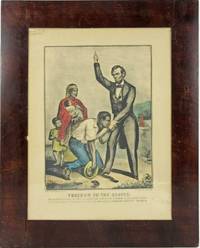
186538499New York: Currier & Ives 1865. Color print 11-3/4" x 15-1/2" by sight. A black man newly freed from slavery kneels at Lincoln's feet his shackles broken. He kisses Lincoln's hand. His wife and babies stand behind him. Lincoln's right arm is raised and pointing heavenward. Light uniform toning but brightly colored. Two blank margin tears at lower right corner one blank margin tear at upper left corner. Framed in wood a few small dings to overall size 16" x 20." Very Good.<br /> <br /> "This commemorative print was issued soon after the assassination of President Lincoln to comfort his supporters. The semi-allegorized representation portrayed the former president as the emancipator of enslaved African Americans guided by divine principles" Description online at The Met. <br /> Entering Richmond in 1865 Lincoln was met by many former slaves who kneeled before him. Lincoln told them to stand and thank God not Lincoln for their freedom. A decade later the Colored People's Educational Monument Association headed by the African-American abolitionist Henry Highland Garnet. created a memorial to Lincoln. The result was a sculpture erected in 1876 in Lincoln Park near Capitol Hill depicting a supplicant slave and a towering Lincoln. Known as the Emancipation Memorial or the Freedmen's Memorial it generated some contemporary criticism for its depiction of the inferior position of the black man. <br /> Gale 2311. Not in LCP Reilly or Weitenkampf. OCLC 1292616124 1- OH Hist. Connection 870219805 1- IN Hist. Soc. as of May 2024. AAS also owns a copy. Currier & Ives unknown
18661009808vo one sheet printed on both sides. Even toning and aging small closed tear to the upper margin; otherwise very good. This is a rather scarce government document that informs the military that the "Thirteenth Amendment" has passed and slavery is officially abolished. Article XIII states "Neither slavery nor involuntary servitude except as a punishment for a crime whereby the party shall have been duly convicted shall exist within the United States or any place subject to their jurisdiction." This document is signed in type by William H. Seward 1801-1872 as the Secretary of State. Congress would follow with a Civil Rights Act of 1866 to give African Americans the same rights as all citizens but this small printed document presenting the essence of the "Thirteenth Amendment" is an important piece of history. ANB.
186512378Philadelphia: John E. Potter 1865. FIRST EDITION. With engraved frontispiece. Gray pebbled cloth decorated in gilt some light wear especially to corners some chipping to head and foot of spine. Aside from a few minor smudges to first couple of pages interior is very good. First edition. An in-depth biography of Lincoln with emphasis on his political career. It contains excerpts from a number of speeches and shorter messages. Interesting as to the contemporary ownership inscription. Monaghan 466. John E. Potter unknown
192611504Chicago: Morris Briggs 1926. FIRST SEPARATE EDITION. Original stiff paper wrappers. First separate edition #1/25 copies printed. The recollections of a boy who grew up in Springfield originally printed in Century Magazine. Though this book has neither publishing information nor imprint Monaghan suggests Morris Briggs had it printed in 1926. Monaghan 2853. [Morris Briggs] unknown
1936142510150071Black Cat Press 1936. Hardcover. Good. 0x0x0. Hardcover. NO DUST JACKET. Pages are clean and unmarked. Covers show light edge wear with rubbing/light scuffing. Binding is tight hinges strong.; 100% Satisfaction Guaranteed! Ships same or next business day! Black Cat Press hardcover
19361848536Black Cat Press 1936. First Edition. Hardcover. Used-Very Good. Red cloth. Octavo. 161 pp. From a limited printing of 300 copies. Mild shelf wear to boards some discoloration to spine. Altogether a copy in Very Good condition. Black Cat Press hardcover
1936L072672Black Cat Press 1936. First Edition. Hardcover. Very Good. 8vo - over 7¾" - 9¾" tall. Slight sunning and fading to spine; slight rubbing and browning to covers chiefly to edges; slight internal browning to edges. 161 2 pages. Editor's introductory note; essays by R. Gerald McMurtry and 9 others; includes bibliographical references chiefly for the last essay 'Abraham Lincoln's Favorite Poem' by M. L. Houser. Monaghan #3529; one of 300 copies the entire edition with design and typography by Norman W. Forgue and printed under the supervision of Nathaniel Roth; bound by Brock & Rankin; completed in August 1936.Decorative Title Page & Headpieces brown/black. Black Cat Press hardcover
190312435n.p.: Printed for Private Distribution 1903. FIRST EDITION. Prospectus laid-in. Original printed wrappers 32 loose caricatures housed in publisher's quarter-cloth portfolio with paper cover label and cloth ties portfolio soiled and chipped and lacking some ties; prospectus soiled and chipped. Text unopened. Caricatures all in nice shape. First edition of this scarce set. Wilson 1865-1949 was a prominent journalist and author. His interest and research made him a recognized Lincoln scholar. These caricatures were reprinted a number of times later in the twentieth century. Monaghan 1429. Printed for Private Distribution unknown
191612448New York: Privately Printed 1916. Original boards head of spine chipped; ex-libris with the usual markings previous owner's signature. Foreword by Meserve. Facsimile of letter. Includes a photograph of Lincoln and one of Ellsworth printed from the original negatives in Meserve's collection. First edition with a foreword by Meserve. Facsimile of Lincoln's letter of condolence to the parents of his friend Colonel Ephraim Elmer Ellsworth the first officer killed in the War of the Rebellion. Includes a photograph of Lincoln and one of Ellsworth printed from the original negatives in Meserve's collection. One of 250 copies printed for the Quill Club. Monaghan 2258. Privately Printed unknown
191312450New York: Isaac Markens 1913. FIRST EDITION. Original printed heavy wrappers with red string tie wrappers soiled with a couple tiny tears. First edition number 100 of 100 inscribed by Markens. A complete review of Lincoln's Gettysburg Address written on the occasion of the fiftieth anniversary of its delivery. Monaghan 2096. Isaac Markens unknown
186423084New York: Sold at 13 Park Row and at all Democratic Newspaper Offices 1864. 8pp caption title disbound a bit of blank margin wear Good. At head of title: 'Document No. 12.' <br /> <br /> This Democratic Party campaign pamphlet portrays President Lincoln as an incompetent military strategist who perpetually "interfered with General McClellan both when he was general-in-chief and afterward when he commanded the brave Army of the Potomac." Worse Lincoln has "The Taint of Disunion." He not McClellan the Democratic presidential candidate supported the Jeffersonian right of revolution in a speech during his single term in Congress. He and other "ultra abolitionists" are the "original secessionists and disunion men." <br /> George McClellan wants the rebel States to return to the Union but Lincoln's policies render that impossible. Lincoln "regards the States as dead and gone. He magnifies and strengthens the position of the Richmond dynasty" by seeking to negotiate "only with Jefferson Davis." <br /> Monaghan 326. Not in LCP. Sold at 13 Park Row, and at all Democratic Newspaper Offices unknown