399 résultats
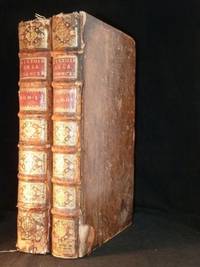
171042386Chez Pierre Emery | à Paris 1710 | 26 x 38.50 cm | 2 volumes reliés
175043277London.: Printed for the Author. 1750. Full reverse calf front and rear boards ruled in blind and with pattern decoration in blind banded spine in seven compartments. Binding worn and rubbed corners bumped joints cracking head and foot of spine worn. Folio. 414 x 270 mm. Printed title 3 leaves with Swan's introduction 10 leaves with text and 60 engraved plates all printed recto only and numbered I - LX the five plates depicting the 'Orders' printed half-page vertically at right with explanatory text at left. PROVENANCE: Unidentified armorial bookplate to front pastedown with the motto 'rapido contrarius orbi'. A good unsophisticated copy of the second edition of Swan's building manual with the explanation of the 'Orders'.Swan's comprehensive work includes the following: 'The work contains: 'I. An easier more intelligible and expeditious Method of drawing the Five Orders than has been hitherto been published by a Scale of Twelve equal Parts free from those troublesome Divisions call'd Aliquot Parts. Shewing also how to glue up their Columns and Capitals.II. Likewise Stair-Cases those most useful ornamental and necessary Parts of a Building though never before sufficiently described in any Book Ancient or Modern; shewing their most convenient Situation and the Form of their Ascending in the most grand Manner: With a great Variety of curious Ornaments whereby any Gentleman may fix on what will suit him best there being Examples of all Kinds; and necessary Directions for such Persons as are unacquainted with the Branch.III. Designs of Arches Doors and Windows.IV. A great Variety of New and Curious Chimney-Pieces in the most elegant and modern Taste.V. Corbels Shields and other beautiful Decorations.VI. Several useful and necessary Rules of Carpentry; with the Manner of Truss'd Roofs and the Nature of a splay'd circular Soffit both in a streight and circular Wall never published before. Together with Raking Cornices Groins and Angle Brackets described.' From the title-page.'This is one of the books that had great influence on the builders and architects of eighteenth-century America.' Fowler.Park 79 first edition 1745 but citing other eds. including the present; Fowler 341 second American edition 1794; Printed for the Author. hardcover
177683281776 A Basle: chez Emanuel Tourneisen, 1776. Complet en 4 vol. in-12: 10 x 17 cm. I/ 2 ff. n. chiff. [titre, table], XXIV pp. [préface], 1 carte dép., 432 pp. + 4 pl. dép.; II/ 3 ff. n. chiff. [titre, table], 444 pp. + 16 pl. dép.; III/ 3 ff. n. chiff. [titre, table], 350 pp. + 12 pl. dép.; IV/ 3 ff. n. chiff. [titre, table], 422 pp. + 4 pl. dép., 1 f. n. chiff. [avis au relieur]. Nouvelle édition bâloise en 4 vol. in-12, après celle dAmsterdam en 1730, bien complète de toutes les 37 planches annoncées. Reliures uniformes de lépoque en basane marbrée. Dos à cinq nerfs avec pièces de titre de basane brune et pièces de tomaison de basane verte, caissons aux petits fers. Deux filets en encadrement des plats. Quelques marques du temps aux reliures: un mors de pied du 1er tome fendu; manque à un mors de tête du 2ème tome, manque à la coiffe de queue du 3ème tome, travail de vers au plat sup du même volume, enfin quelques discrets travaux de vers aux plats du dernier tome. Lintérieur est bien propre, les planches complètes. Létat et délices de la Suisse est une réunion du texte de Ruchat Délices de la Suisse et de Létat de la Suisse par Abraham Stanyan (Amsterdam, 1714), ambassadeur dAngleterre en Suisse (1705-1713). Une première version des Délices de la Suisse de Ruchat parut à Leide en 1714 sous le pseudonyme de Gottlieb Kypsele de Munster. La première édition illustrée date de 1730. (Perret, II: no 3814).
177819980Paris: P-M. Lamy 1778. First edition. leather_bound. Contemporary mottled calf covers rehinged. Two Vols. in one. Very good. 8 & 10 pages in text. 22 x 17 cm. Engraved frontispieces 283 plates. An antiquary of Flemish descent his early interest in gem collecting as part of his cabinet of curiosities eventually spawned interest in Greco-Roman intaglio gems; his collection purchased in 1609 on behalf of Henry Prince of Wales -- with more than a representative sampling of specimens here. His first work "Dactiliotheca" published 1609. BRUNET Vol. II p.1671. Index of plates in each volume generally clean wide margined plate pages book label and small ownership inscription dated 1857 of same individual corner wear raised bands leather spine label spine compartments decorated in blind. P-M. Lamy unknown
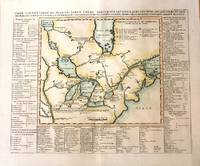
171025803Amsterdam 1710. Copper-engraved map period hand-colouring in outline. Tables upper left and along the right side. Attractive map of North America based upon De L'Isle's highly influential map of North America published in 1700.<br/> <br/> By combining a wealth of information and geographical observation with delicate engraving and an uncomplicated composition this elegant map is a superb example from the golden age of French mapmaking and was published in Chatelain's Atlas Historique an important encyclopaedic historical atlas. California is shown as a peninsula with a number of villages and mountains; the Mississippi River extends far north of its true source. The table along the right side details the various native tribes from each region with lettered references for locating on the map.<br/> <br/> Lowery 263; Phillips 579. unknown
1719M1126Paris c.1719. Very Good;. Notes: From Chatelain's Atlas Historique.<br>This map is based on the 1703 map by Lahontan. The map covers the area of South Hudson Bay and concentrates on the Great Lakes. The St. Laurent is shown running into the Great Lakes from present day Lake Winnipeg. Georgian Bay is named "Baye de Toronto". English French Iroquois treaty is shown and many early settlements forts trading posts missions friendly and hostile Indian Villages are clearly marked. This is a highly significant and informative fur trade map. Surrounding the map are a number of descriptive panels contained lists of the birds fish plants and insects of Canada. Also the Indian tribes of the different regions together with a list of various trade goods including whiskey which were popular among the Indians. Size : 368x458 mm 14.49x18.03 Inches Coloring: Hand Colored Reference: Koeman II: Cha 7; Sellers and Van Ee 2; Kershaw II: 307. Category: Maps Canada; Maps North America Great Lakes; unknown
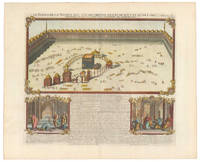
1719NL-02162<p>This is Henri Chatelain's dramatic and detailed capture of the <em>Haram</em> or Sacred Precinct in Mecca—the holiest site in Islam. It provides a detailed view of the historic complex which draws millions of pilgrims annually. In the center of the view the quadratic black Kaaba dominates. According to Islamic tradition this complex stands on the remains of the first temple that Abraham and his son Ishmael built for God.</p><p>In addition to the Kaaba several shrines and other buildings have been drawn in their relative positions and domed porticoes frame the enormous courtyard holding it all. In this manner the view almost takes on the character of a plan. Chatelain brings his view to life by including many worshippers within the complex.</p><p>While the view of the Holy Precinct occupies the upper register of the print in the lower register we find two smaller vignettes depicting the various positions that Muslims assume during prayer. Between the vignettes is a text that includes a legend and key related to the larger view as well as an introduction to the Islamic faith and tradition.</p><p><strong>Census</strong></p><p>The copper-engraved view comes from Chatelain's seminal seven-volume <em>Atlas Historique</em> published in Amsterdam between 1705 and 1720. The atlas combines the finest engraving and cartographic craftsmanship with academic studies of geography history ethnology heraldry and cosmography and it was one of the most widely distributed atlases in the 18th century.</p><p><strong>Context is Everything</strong></p><p>When Chatelain's detailed plan of Mecca was first published it was a true rarity. Few European travelers had ventured so profoundly into Arabia and the accounts of Muslims did not resonate broadly among the European intelligentsia at the time. Western Arabia particularly Mecca had been subjugated by the Ottoman Empire when Selim I defeated and dissolved the Mamluk Sultanate in Egypt. For centuries the Mamluks had controlled access to the sacred cities but now Barakat bin Muhammed the Sharif of Mecca was forced to acknowledge Ottoman supremacy. The only European to ever truly penetrate Mamluk Arabia was the Italian traveler Ludovico di Varthema who in 1502-03 visited Mecca with a Hajj caravan on his journey to India.</p><p>But a French traveler truly opened Western Arabia to the world. The Parisian Jean Chardin 1643-1712 was a distinguished French traveler merchant and polyglot whose extensive travels in the Middle East and beyond significantly impacted the European understanding of Islam and its holy sites in the 18th century. Chardin spent eleven years exploring the Middle East where he gained access to the Persian court being appointed a royal merchant by Shah 'Abbas II. His journeys took him through Persia Turkey India and Georgia before he eventually settled in England. Among the most notable aspects of Chardin's voyages was his attempt to depict Islam's holy places particularly Mecca and Medina. His depictions were mainly based on information he acquired from Muslims who had performed the Hajj.</p><p>Depictions of Islam's holiest sites were virtually non-existent in Europe at his time and Chardin's drawings constitute some of the earliest and best sources available. There is an unfinished manuscript plan of the Prophet's Tomb in Medina at the Royal Society in London. Still the more impactful image was Chardin's completed plan of the Kaaba precinct in Mecca. While this pioneering plan accurately captures the individual buildings and minarets including the colonnaded porticoes surrounding the central courtyard it also conflated elements from Medina and Mecca the circular colonnade around the Kaaba.</p><p>Despite traveling with two professional artists including Grélot the drawings attributed to Chardin were most likely his work demonstrating his engagement with documenting his experiences. His detailed accounts and illustrations were later included in his publication <em>Voyages en Perse et Autres Lieux de l'Orient</em> the first volume published in 1686. Further volumes followed in 1711. These works were praised for their detailed observations and accuracy providing a valuable non-Persian perspective on the Safavid and Ottoman empires and it is clear that they were the source for Chatelain's view.</p><p>Chardin's extensive travels and keen observations earned him a knighthood from Charles II of England for his services to the East India Company. His pioneering contributions remain crucial sources on Persia and Arabia's political history and cultural landscapes.</p><p>Cartographer:</p><p><strong>Henri Abraham Chatelain 1684 – 1743</strong> was a Protestant pastor Huguenot from Paris who due to his faith was forced to flee his native France. He settled first in London and later in Holland where he worked from both The Hague and Amsterdam during the early 18th century. While his primary calling was as a preacher his <em>Atlas Historique</em>became a huge success partly due to the vivacious decoration and abundance of information on his charts.</p>
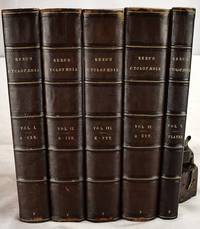
17862106150015London : J.F. & C. Rivington A. Hamilton et al 1786. Hardcover. Good. One of the First Great British Encyclopedias Five volume set. Includes the plate volume. Folio 16 3/4 x 10 inches. Bound in 19th century 3/4 morocco. Marbled endsheets. Approximately 5010 pages. Text printed in two columns. Frontispiece illustrations. Many illustrations in v.5 some folding. Generally clean and sound. Some toning occasional spotting. Small stamp of the Edwin Forrest Home on front pastedown. Volume 5 has 144 engraved plates 3 folding. Wing G1445A. <br> An important British scientific technical and general reference of the late 18th century. Rees edited and greatly expanded Chambers' earlier work. "Rees says that he has added more than 4400 new articles." - Enc.Brit.v.9 374 p. <br> This is an oversized or heavy book which requires additional postage for international delivery outside the US. London : J.F. & C. Rivington, A. Hamilton, et al hardcover
1758135914Paris: Charles-Antoine Jombert 1758. period marbled calf binding marbled endpapers and pastedowns five raised bands all edges stained red. 8vo. period marbled calf binding marbled endpapers and pastedowns five raised bands all edges stained red. xxxii 205 3 pages. The fourth and most extensive edition expanded from the original edition of 1645 by the noted engraved Cochin. Cicognara 255. Bigmore / W. 72. Cohen / R. 177. When issued in 1645 the work was "notable for its completeness for the time of its production and for its plates which have been reproduced by most subsequent writers on the art." This edition has additions by Jombert and Cochin of Bosse's classic work. With an engraved frontispiece and 21 foldout plates. The first page of the dedicatory Epistle entirely engraved in intaglio is taken from the original 1643 edition. Very light shelfwear to the edges and hinges. Spine rubbed lacking the leather spine label with title. Some very light dampstaining in the margins. Textblock split between pages 146 and 147. A good copy of this very scarce work. Charles-Antoine Jombert unknown
1778CLL-133Amsterdam, Marc-Michel Rey, 1778 In-4 de (8)ff., VI, 312pp., 1 f. bl., (19)ff. de table, (1)f. bl., sous couverture d'attente muette, entièrement non rogné.
171042386à Paris: Chez Pierre Emery 1710. Fine. Chez Pierre Emery à Paris 1710 26 x 38.50 cm 2 volumes reliés New expanded edition the first in two volumes with important tables published at the Chancellor's request. The original first appeared in 1676; it was continued in this edition by René Le Comte for the supporting documents for the period 1676-1705 furthermore the material compiled by Tessereau was entirely reworked for this new edition. Contemporary full brown sheep binding. Spine with six raised bands decorated with gilt compartments and fleurons as well as red morocco title and volume labels. All edges speckled red. Spine worn lacking headcaps and with losses to the sheep. Scuffing and corners slightly bumped. Contemporary bookplate pasted on pastedowns. Major source on the history of the Chancellery in France; this institution as ancient as the monarchy was formed by the body of chancellors such as the chancellor the keeper of the seals the great auditors secretaries of the king of the grand college the treasurers controllers wax-heaters and other officers the chancellery being today nothing more than the ministry of justice. Tessereau assembled a collection of precious documents for the historian on the officers of the chancellery their functions and prerogatives on the various chancelleries in the kingdom. It is more a compilation and publication of documents than a historian's work but the work is no less important. Chez Pierre Emery hardcover
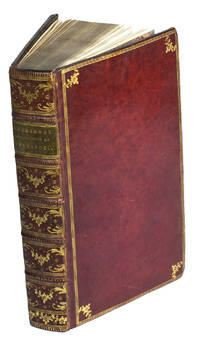
17816457Dordrecht 1781. 8vo. Abraham Blussé and son colophon: printed by Johan Joseph Besseling Utrecht Contemporary red morocco richly gold-tooled spine gold-tooled boards triple fillets with floral ornaments in each corner board edges and turn-ins gilt edges. Bound by the Dutch court bookbinder Abraham van Rossum active in Amsterdam 1812-1854 one of the major binders Storm van Leeuwen of that period with his letterpress ticket on paste-down A.v. Rossum hof-boekbinder. 2 works in 1 volume. 5 1 339 5; 68 pp. Rare first and only edition of the much expanded Dutch translation of a philosophical treatise for law students on natural morality as the basis for all law together with the second edition of the same treatise in the original French. The Monthly review vol. LII 1775 p. 596 praises the author's "penetration wit and erudition" but on the other hand the original treatise "is one of those productions which even an attentive reader totally forgets the very moment he has done perusing it". The Dutch translation is followed by four other philosophical treatises by the author also concerning natural law discussing the problems of divine law moral obligations moral sense and the question whether the existence of God can be proved by reason.Abraham de Perrenot 1726-1784 was a Swiss lawyer of Huguenot-descent who worked as councillor for the Prince of Orange in the Netherlands.With the bookplate of Thomas Otho Travers 1785-1844 friend of Stamford Raffles. With some minor waterstain at the foot of the French treatise and the corners slightly bumped otherwise in very good condition and well bound.l Dekkers Bibl. Belg. juridica p. 133 no. 5; STCN 4 copies; WorldCat 6 copies incl. 3 the same; ad 2: cf. Dekkers p. 133 no. 4 1779 ed.; Quérard VII p. 63 1775 ed.; for Perrenot: V.d. Aa XV p. 205; for the binder: J. Storm van Leeuwen 1725-1830 Bookbinding on www.bibliopolis.nl. hardcover
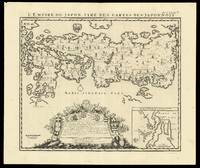
171915847Amsterdam: François L'Honoré & Compagnie Libraries 1719. 440 by 520mm. 17.25 by 20.5 inches. Engraved map. Henri Chatelain's edition of Adrien Reland's important map of Japan 1715 including the place-names in phonetic Dutch. Reland's map of Japan represents a radical departure from prior European maps of Japan and is the first map printed in Japan to use Sino-Japanese characters. Instead of using the existing European geographical sources of Japan Reland utilized Japanese maps most notably a map from the library of Benjamin Dutry 1668-1751 a former director of the Dutch VOC. This was a tremendous leap forward in the geographical depiction of Japan such as in the treatment of Kyushu Island and in naming the 66 provinces. Large inset of the area around Nagasaki and an ornate dedication cartouche with about twenty coats of arms. Published in the fifth volume of the Châtelain family's 'Atlas historique ou Nouvelle introduction à l'Histoire à la Chronologie & à la Géographie Ancienne et Moderne ' 1719 when eventually extended to 7 volumes. With an inset 'Vue de la Ville de Nangasacki & de l'ile'. Zacharie Châtelain d. 1723 was the father of Henri Abraham 1684-1743 and Zacharie Junior 1690-1754. They worked as a partnership publishing the 'Atlas ' under several different Châtelain imprints depending on the Châtelain family partnerships at the time of publication. The atlas was published in seven volumes between 1705 and 1720 with a second edition appearing in 1732. The maps were accompanied by information pertaining to cosmography geography history chronology genealogy topography heraldry and costume of the world. The maps in the "Atlas Historique" were mainly based on those of the French cartographer Guillaume De L'Isle but were presented by the Châtelains in an encyclopaedia form. The accompanying text is in French and often is printed in two columns on the page with maps and other illustrations interspersed. Each map and table is numbered consecutively within its volume and all maps bear the privileges of the States of Holland and West-Friesland. Hubbard 73. François L'Honoré & Compagnie Libraries, unknown
1776133671Milan: Giuseppe Galeazzi 1776. First edition in Italian of part of de Moivre's early and important contribution to the calculus of games of chance and probability theory one of the first instructional texts on the subject which together with the works of Montmort and Bernoulli was one of the most important books written on the subject in the early eighteenth century. His introduction contains an overview of main concepts such as probability conditional probability expectation dependent and independent events the multiplication rule and the binomial distribution. The translator Roberto Gaeto of the University of Pavia translates the parts of de Moivre's work dealing with the application of the doctrine of chance to annuities tontines life expectancies and mortallity tables. Gaeta has added an introduction notes and appendices comparing other European writers on lifetime annuities such as Deparcieux Kersseboom Süssmilch and Bernoulli with a useful bibliography of works of mortality tables and statistics pages lix-lxviii. Two works bound in a single vol. octavo 207 x 130 mm. Printer's woodcut device on title tables and vignettes in the text. Contemporary half mottled calf and sprinkled boards rebacked preserving the original spine red morocco label sprinkled edges. Spine neatly repaired and lined where split recased with new endpapers board edges worn. Second work has the half title cut away. Pale damp mark to lower margin extending into the text in places occasional light foxing marginal worming to last 4 leaves of the second work; good copies of two scarce works. hardcover
1714355Leiden 1714. Avec un Mémoire instructif sur les Causes de la Guerre arrivé en Suisse l'an 1712 par Gottlieb Kypseler de Munster 4 tomes Guter Zustand Originalausgabe Pierre van der Aa Kl.-8°. Ldr. Raetica/ Helvetica unknown
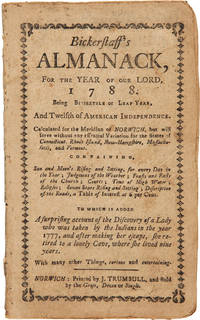
1787713561787. WEST Benjamin. PANTHER Abraham. Bickerstaff's Almanack for the Year of Our Lord 1788. Being Bissextile of Leap Year and Twelfth of American Independence. Norwich. 1787. 24pp. Original plain wrappers stitched as issued. Faint contemporary ink notations on covers. Minor toning light foxing. Very good. A rare and important Bickerstaff's almanac containing the first printing of the famous Abraham Panther Indian Captivity. Titled "A Surprising account of the Discovery of a Lady who was taken by the Indians in the year 1787 and after making her escape she retired to a lonely Cave where she lived nine years" the captivity narrative covers pp.19-24 of the almanac. The captivity account was found to be fictional but was nonetheless popular and reprinted more than twenty times between this first appearance and 1814. Rare with only three copies reported in ESTC. EVANS 20875. DRAKE 416. TRUMBULL 1846. VAIL 767. SABIN 93891. AYER SUPPLEMENT 13. JONES CHECKLIST 608. ESTC W25617. unknown
1756S13188London:: A. Millar 1756. 1756. Quarto. 4 xi 1 errata 348 pp. Portrait medallion vignette on title; mild foxing but barely noticeable. Original full calf red gilt-stamped leather spine label; hinges repaired with calf inner joints strengthened corners worn all preserving original spine. Bookseller's ticket: "Sold by Carpenter & Co. 14 Old Bond Street" London. Early ownership ink signature of Th. Spencer; penciled initials of F.N.D. see below. Very good. A KEY WORK BY THE FATHER OF PROBABILITY THEORY. Third edition. This is a key work by the father of probability theory in which major steps in the measurement of uncertainty were achieved. De Moivre is "best known in statistical circles for his famous large-sample approximation to the binomial distribution whose generalization is now referred to as the Central Limit Theorem. De Moivre was one of the great pioneers of classical probability theory." Bellhouse-Genest p.1. It is the first systematic treatment of probability in English. Abraham De Moivre became with Edmund Halley a founder of English actuarial science. The author's dedicatory letter is address to Lord George Carpenter 1702-1749 the first edition had been dedicated to Newton where the author states emphatically "that this Doctrine is so far from encouraging Play that it is rather a Guard against it. . ." DNB vol. 38 p.116. / "The first edition of this work contains 175 pages the second edition 258 pages and the third 348 pages. The following list will indicate the parts which are new in the third edition: the Remark pages 30/33 and pages 48 & 49 the greater part of the second Corollary pages 64/66 the Examples page 88; the Scholium page 95 the Remark page 149 and pages 151/159 the fourth Corollary page 162 the second Corollary pages 176/179 the note at the foot of page 187 the Remark pages 251/254. The part on life annuities is very much changed. The Introduction is very much fuller than the corresponding part of the first edition. In his third edition De Moivre draws attention to the convenience of approximating to a fraction with a large numerator and denominator by continued fractions which he calls "the Method proposed by Dr. Wallis Huygens and others". He gives the rule for the formation of the successive convergents. This third edition contains 74 problems exclusive of those relating to life annuities in the first edition there were 53 problems. The pages 220/229 contains one of De Moivre's most valuable contributions to mathematics namely that of Recurring series. Pages 261/328 are devoted to Annuities on lives ; an Appendix finishes the book occupying pages 329/348 : this also relates principally to annuities but it contains a few notes on the subject of probability." :: Todhunter. A very full account of the above third edition will be found in Todhunter's History of the theory of probability. / "De Moivre's first book on probability was based upon a short memoir entitled De mensura sortis published in the 1711 volume of the Philosophical Transactions. The 1718 first edition is essentially a gambler's manual giving a systematic presentation of the arithmetic principles upon which are based the solution of problems concerning the advantage of players and size of wager which may be lain in a wide variety of games of chance. Walker. It does not contain De Moivre's work on the normal approximation of the binomial probability distribution which ranks as the most memorable of his discoveries; this discovery was first printed in its entirety in 1733 in a Latin pamphlet which was later translated into English and incorporated in successively expanded versions in the second 1738 and posthumous third 1756 edition of The doctrine of chances." Norman. / In terms of mathematics applied to the human actuarial lifespan "De Moivre French Huguenot mathematician and demographer formulated the hypothesis that among a body of persons over a certain age the successive annual decreases by death are nearly equal." Garrison & Morton. / "De Moivre's work on the theory of probability surpasses anything done by any other mathematician except Laplace. His principal contributions are his investigations respecting the duration of play his theory of recurring series and his extension of the value of Bernouilli's theorem by the aid of Sterling's theorem". Cajori. / De Moivre born at Vitry received a varied education and settled in London as a Huguenot refugee in 1688. In England he continued his study of mathematics while working as a tutor. He is said to have acquired and read a copy of Newton's Principia and even to have carried loose sheets around with him to study at every available moment. This method of study worked so well that not only did he become one of England's foremost mathematicians but Newton in old age was in the habit of referring questions about the Principia to De Moivre. De Moivre's Doctrines of Chance is in fact a revised and expanded translation of his essay De Mensura Sortis which had been published in Latin in the Philosophical Transactions in 1711. In its Latin form it thus preceded Jacob Bernoulli's Ars Conjectandi 1713 by a full two years. / De Moivre was a French mathematician famous for De Moivre's formula which links complex numbers and trigonometry and for his work on the normal distribution and probability theory. He was elected a Fellow of the Royal Society in 1697 and was a friend of Isaac Newton Edmund Halley and James Stirling. Among his fellow Huguenot exiles in England he was a colleague of the editor and translator Pierre des Maizeaux. / Shafer points out that De Moivre one of Jacob Bernoulli's successors was among those who were applying Huygens' theories to both games and economies p. 11. He points out that the 1718 first edition was influenced by Bermoulli in that he used the word "probability" which was a word he did not use in his De mensura sortis. He continues: "We should not exaggerate De Moivre's importance in the eighteenth century. In retrospect he represents the pat that mathematical probability followed but he was hardly a philosopher of Jacob's caliber and Jacob retained a strong influence throughout the century among those who wanted to understand probability philosophically. Jacob's and Hooper's rules survived the whole course of that century in the works of philosophically sophisticated writers such as Lambert and Diderot. They disappeared only after Bayesian alternatives were developed by Laplace." pp. 13-14. Steve Stigler and Lorraine Daston expand on the use of the word "probability" in the eighteenth century. / Theodore Porter UCLA writes that De Moivre introduced the astronomer's law error to probability theory p. 93. "Like most early probability mathematics it first arose in the context of games of chance; it appeared as the limit of the binomial distribution. Because of its usefulness in combination and permutation problems the binomial had become the heart of the doctrine of chances. . . De Moivre then showed in a paper of 1733 reprinted in 1738 in the second edition of his Doctrine of Chances that the exponential error function gave a very good approximation to the distribution of possible outcomes for problems like the result of 1000 coin tosses Now for the first time it was practicable to apply probability theory to indefinitely large numbers of independent events." / PROVENANCE: I Thomas Spencer undetermined. II F.N.D. :: Florence Nightingale David 1909-1993 also known as F. N. David was an English statistician born in Ivington Herefordshire England. She was named after Florence Nightingale who was a friend of her parents. David did not like her forenames and thus always referred to herself as "F. N. David". She attended the Bedford College for Women in London earning her degree in mathematics in 1931. She then joined University College London to work with Karl Pearson who obtained a scholarship for her working as his research assistant resulting in a doctorate received in 1938 Pearson died in 1934. In 1938 her first book was published Tables of the Correlation Coefficient. During that period she was working with Jerzy Neyman. "During World War II she served as Experimental Officer in the Ordnance Board for the Ministry of Supply Senior Statistician for the Research and Experiments Department for the Ministry of Home Security Member of the Land Mines Committee of the Scientific Advisory Council and as Scientific Advisor on Mines to the Military Experimental Establishment. Her work during this time ranged from the study of bombing patterns and damage to the problem of discovering the placement of enemy land mines and a methodology for randomly placing land mines so as to avoid the semblance of any pattern in their placement." Garber et.al. After WWII she came back to University College London and was appointed professor in 1962. Five or six years later she took a position at the University of California Riverside becoming head of the Department of Statistics in 1970. Retiring in 1977 she came to Berkeley and continued her research. this book bears her initials on the Francis Galton Laboratory bookplate; she gave her books to Margaret Stein of Stanford University. See: M. J. Garber D. V. Gokhale J. M. Utts R. J. Beaver Chair "Florence Nightingale David Statistics: Riverside." Obituary; "A conversation with F.N. David" Statistical Science Vol. 4 No. 3235-246 by Nan Laird; J. Utts "Florence Nightingale David 1909-1993: Obituary" Biometrics 1993 49 1289-1291; Norman L. Johnson & Samuel Kotz eds. Leading Personalities in Statistical Sciences from the Seventeenth Century to the Present Wiley 1997 pp. 91-92. / REFERENCES: Babson 181 1st ed.; Ball A short account of the history of mathematics pp. 383-4; BM Readex Vol. 17 p. 751; Cajori History of Mathematics pp. 229-30; DNB vol. 38 p.116; Kress S.2793; Institute of Actuaries 1935 p. 39; Mansutti 504; Norman 1529 1st ed.; Pearson The History of Statistics in the 17th & 18th Centuries. . . pp. 155-60 165-66; Smith Source book in mathematics pp. 440-54; Stigler The History of Statistics: The Measurement of Uncertainty before 1900 1986 p. 70; Todhunter History of the theory of probability; Walker pp. 12-13; Wellcome IV p. 149; Westergaard pp. 104-5. Not in Goldsmiths or Hanson. / See: Raymond Clare Archibald "Abraham de Moivre"; David F.N. Games Gods and Gambling; The origins and history of probability and statistical ideas . . . 1962 pp. 161-178. A. Millar, 1756. hardcover books
1787WRCAM51205Norwich 1787. 24pp. Dbd. Minor toning light foxing. Very good. In a blue cloth clamshell case gilt leather label. A rare and important Bickerstaff's almanac containing the first printing of the famous Abraham Panther Indian captivity. Titled "A Surprising account of the Discovery of a Lady who was taken by the Indians in the year 1787 and after making her escape she retired to a lonely Cave where she lived nine years" the captivity narrative covers pages 19-24 of the almanac. The captivity account was found to be fictional but was nonetheless popular and reprinted more than twenty times between this first appearance and 1814. Rare with only three copies reported in ESTC. EVANS 20875. DRAKE 416. TRUMBULL 1846. VAIL 767. SABIN 93891. AYER SUPPLEMENT 13. JONES CHECKLIST 608. ESTC W25617. hardcover books
175532315-315Altenburg Richter 1755. With engr. title-vignette by G. L. Crusius showing a bearded scholar with a telescope and 22 engr. folding plates. Title 10 unn. leaves 531 pp. 5 pp. table of contents and errata. 4to. Contemp. plain boards somewhat rubbed. Altenburg Richter 1755. First German edition of Robert Smith's 1689-1768 "A compleat system of opticks in four books" 1738. It was translated and revised by Abraham Gotthelf Kästner 1719-1800 professor of mathematics at Leipzig later of mathematics and physics at Göttingen teacher of Lessing and Lichtenberg friend of Gottsched. Smith's work "became probably the most influential optical textbook of the eighteenth century. It was also published in Dutch in 1753 in German in 1755 and in two different French translations in 1767" DSB. The work consists of two books a general text on light reflection the eye colors etc.; and a second book divided into three parts: analytical catoptrics analytical dioptrics and the manufacturing of optical instruments; the remaining texts are Kästner's own contributions. - Light browning throughout otherwise a good wide-margined copy. - Poggendorff I 1219; DSB XII 477 Smith and VII 206 Kästner. SCIENCE: OPTICS ; Altenburg, Richter hardcover
1783787L14London: J F and C Rivington et al 1783-86. Leather. Good. 17" by 10.5". Not Stated. Four volumes of the famous Chambers Cyclopaedia which first began in 1728. This work is Abraham Rees' improved edition of Chambers' Cyclopaedia. He re-edited the original work in 1778 and created the supplements which contained much new matter. His edition was originally published in 1781-6 before a reprint in 1788-91. Therefore this set is a very early edition of Rees' publication. For this edition Rees is said to have added more than 4400 new articles. With an illustrated frontispiece to the first volume.Comprising volumes I and II of the original work and the two supplement volumes. This set is four volumes total. Without the plate volume which is often bound separately. This set is without the plate volume which was issued separately.Volume I is dated 1786 Volume II is dated 1779 Volume III is dated 1781 and Volume IV is dated 1783. Bookplates to the front pastedown 'FW Brydges Esq Tiberton Herefordshire' and 'Robert Henry Lee Warner'. Both of these individuals were from Tyberton Court which was built in 1729 for William Brydges. Robert Henry Lee-Warner was a descendent of the Brydges family and the house passed to the Warner family due to the lack of male heirs during the early nineteenth century. It was inherited by Anne Brydges who married Rev. Henry Lee Warner. A comprehensive encyclopaedia with some tables throughout including one showing the Sun's declination. An important edition of this noted encyclopaedia. In a contemporary half calf binding with paper covered boards. Externally worn to the spines. Loss to the head of the spine to all volumes heavier to volume I. Splits to the joints of all volumes though hinges remain firm. Patches of rubbing to the paper covered boards. Internally firmly bound. Pages are bright. Occasional light spotting to pages. Good J F and C Rivington et al hardcover
1750167Etching and engraving. D.1385 Blum 203. Image: 10 x 12½. Margins: 10½ x 14. books
1750167<p>Etching and engraving. D.1385 Blum 203. Image: 10 x 12½. Margins: 10½ x 14.</p>
1717116<p>4° mm 230x168; ll. 6 pp. 400. Woodcut frontispiece and <strong>100 emblematic woodcuts</strong> each approx. 105×120 mm. Contemporary vellum binding. Small restorations to the title page and pp. 353–54. Overall a fine copy.</p><p>First edition in Italian the original title: <em>Huy und Pfuy der Welt</em> 1707.</p><p>A very interesting richly illustrated book by the Augustinian preacher Abraham a Sancta Clara https://en.wikipedia.org/wiki/Abraham_a_Sancta_Clara. The treatise is a kind of iconographic and textual compendium intended for use by the popular preacher. Its format of emblem commentary 'favola' enables a constellation of homiletic <em>exempla</em> to be committed to memory in keeping with a very ancient rhetorical and visual tradition cfr. L. Bolzoni <em>La rete delle immagini. Predicazione in volgare dalle origini a San Bernardino da Siena</em> Torino 2002.</p><p>"One of the greatest orators Germany has ever produced. People flocked to hear him drawn by the power and vivid clarity of his speech by the inexhaustible wealth of his wit and by the impartial severity with which he denounced the vices of all social classes. He poured his whole being into everything he said. Endowed with extraordinary creativity and inventive originality Abraham blended into his imaginative style fables short stories anecdotes erudite quotations witty sayings colourful and sometimes trivial wordplay sudden asperations personal recollections and vivid genre sketches with flashes of true eloquence—passionate fiery and vibrant. Even when he wrote he stood so to speak at the pulpit and saw his audience before him face to face" L. Bianchi.</p> Per Gio. Parone
1728A6CH5N3RHVIKAmsterdam 1728. 4to. Isaak Tirion Contemporary calf gold-tooled spine and board edges red and blue sprinkled edges. With the title page printed in red and black with 5 of 6 folding engraved maps 11 engraved plates 1 folding 2 woodcut illustrations in text 7 decorated woodcut initials and 6 woodcut tailpieces. 40 392 13 pp. Scarce reissue of the 1727 second and final edition greatly expanded and revised from the first edition of 1720 and with additional plates of a highly esteemed work on whaling. "It is by far the most important of the early authorities on the northern whale fishery and must always be one of the chief sources of information for the early history of the subject. It also gives one of the best figures of the Greenland Right Whale published prior to the present century and also one of the best early figures of the Cachelot" Allen. Unfortunately lacking the frontispiece and the map of Nova Zembla but otherwise a very good copy with some water stains and a tiny wormhole. Binding good though worn at the hinges. The definitive edition of an essential resource for any study of the whaling trade.l Allen 192 note; Sabin 106376; Tiele Bibl. 1241 note; STCN 3 copies. unknown
177876402Chez Samuel Fauche | à Neuchâtel 1778 | 19 x 25 cm | 2 volumes reliés