400 résultats
171548763Augsburg.: Jeremias Wolff. c.1715. Full contemporary blond calf boards with elaborate neo-classical decorative borders composed of rules foliate floral and rope-work tools vase tools at head and foot and mask corner tools all to surround a central lozenge with a decorative composition of floral foliate and mask tools later banded spine with elaborate decorative tooling in gilt in seven compartments turn-ins tooled in gilt red speckled edges. Folio. 554 x 423 mm. Engraved allegorical title with Latin and German text leaf with letterpress text in German in double columns and 56 engraved allegorical plates all after the Deckers by various engravers see below. Sheet size: 435 x 560 mm. An exceptional copy of Decker’s very rare suite of engravings – here in-plano and with exceptional additional colouring and highlighting in gilt by hand – illustrating the battles of the War of the Spanish Succession.Decker’s suite depicts the battles of the complex series of engagements that became known as the War of the Spanish Succession 1701–1714. Prompted by the death of the last of the Spanish Habsburg Kings the childless Charles II and with a shifting group of alliances and a field of warfare that included not only Continental Europe and the Mediterranean but also the Caribbean and North America the War of the Spanish Succession has a case to be a true world war. In part an attempt to check French hegemony the war featured a number of outstanding victories for the Duke of Marlborough and Prince Eugene of Savoy including Blenheim although the war was ultimately at best indecisive.Each of Decker’s magnificent plates features a single engagement depicted in the central portion of the plate the whole image surrounded with a decorative border composed of architectural allegorical and armorial symbols and motifs in the Baroque manner and a descriptive text concerning the battle. Many of the plates feature an additional small vignette of the battlefield keyed to the descriptive text and illustrating the placement of the armies and the most significant figures involved.The colouring and highlighting by hand of the present copy is remarkable. The painstaking detailing and the additional ornamentation in liquid gold is lavish and in combination with the binding suggests this copy was important and worthy of presentation. The printed text 'Kurze Beschreibung des Spanisch Successions-Krieg . &c.' here and unusually in German gives a detailed outline of the origins and history of the conflict and concludes with the list of plates and the engagements they depict. The text appears in other copies in other languages suggesting a commercial flexibility of distribution.It is a measure of the importance attached to Decker’s suite that the painter Ignaz Preissler used Decker’s plates as the basis for the decoration of an important tea service and garniture now at least partly in the collection of the Metropolitan Museum in New York see ‘Repraesentatio Belli ob successionem in Regno Hispanico . A Tea Service and Garniture by the Schwarzlot Decorator Ignaz Preissler’ by Maureen Cassidy-Geiger.‘Such commemorative series were considered works of art as well as encapsulations of recent events and were highly valued by collectors of the period who acquired them for their libraries or print cabinets.’ Maureen Cassidy-Geiger.Decker’s suite is very rare outside Germany: COPAC lists copies at the British Library and V & A only while KVK lists copies at the Polish National Library the Bibliothèque Nationale and the Université de Charles de Gaulle Lille in France and the Rijksmuseum Amsterdam; the only traceable copy in North America is at Brown University. We can locate no other copies with contemporary colouring or highlighting by handBerlin 103 incomplete; Bobins III 1165; Brunet V 626 for the French edition. Jeremias Wolff. hardcover
179912534Paris: Du Pont 1799. Three engraved maps 465 by 420 mm 550 by 340 mm and 530 by 350 mm respectively with fine contemporary hand-colour in full old folds. These maps from the library of the Rochambeau family were published in the first edition of Rochefoucauld-Liancourt's travels in the United States 'Voyage Dans les États-Unis D'Amérique Fait en 1795 1796 et 1797 " Paris 1799 annotated in an early 19th-century hand after Abraham Bradley Junior's 1796 map 'A Map of the United States. Exhibiting Post Roads & Distances'. They are reduced copies of the 1796 first edition of Bradley's map and are therefore the first French edition of these maps. The Comte de Rochambeau 1725-1807 was a battle-hardened French general chosen by King Louis XVI in 1780 to command the expeditionary corps in the United States under the orders of General George Washington. Their combined success at the Siege of Yorktown on the 19th of October 1781 ended the Revolutionary War and secured American independence. 1."Carte générale des États-Unis de l'Amérique Septentrionale divisée en ses 17 provinces" annotated in an early 19th-century hand numbering each of 16 states giving the location of Native American tribes providing a key showing the major post roads from Main to South Carolina all after Abraham Bradley's map of 1796 acknowledged by the inscriber who has replaced the imprint with "par Abraham Bradley Jun.r" This map of the East Coast extends from Quebec south to include part of East and West Florida; the western boundary of Georgia extends to the Mississippi River; a strip of land extending westward between Georgia and Tennessee is designated "United States Territory" having been ceded back to the United States in 1787 from South Carolina; another strip between Georgia and West Florida is "Land claimed by the united states" referring to the ongoing dispute between the United States and Spain; all the land to the west which would become the Louisiana Purchase is "Spanish Territory Louisiana." English captions and French title. Manuscript ink annotations in French indicating the names of the 17 states and the position of the Indian tribes. Ink manuscript inscription to verso "IK 403" shelfmark of Rochambeau family library and as "Etats-Unis en 17 provinces." 2. The "Carte des États-Unis Provinces méridionales" shows Kentucky Virginia Tennessee North and South Carolina Georgia a strip of land between Tennessee and Georgia as "United States Territory" and to the south of Georgia "Land claimed by the united states". 3. The "Carte des États-Unis provinces Septentrionales" shows the states from Main sic to Maryland and Delaware. François Alexandre Frédéric duc de La Rochefoucauld-Liancourt 1747-1827 was a French writer and courtier. A social and scientific reformer he was elected to the Estates-General and pushed for changes to the absolute monarchy of France. Rochefoucauld-Liancourt was the first to warn Louis XVI of the fall of the Bastille; when the king called it a revolt Rochefoucauld Liancourt replied "No sire it is a revolution". Despite being sympathetic to the original aims of the Revolution and serving as the first president of the Constituent Assembly he opposed republicanism and secretly tried to arrange for the escape of the king. Following the storming of the royal palace in August 1792 and the beginning of the September Massacres later that same year precipitated his flight from France and he went into self-imposed exile in America. From London in September 1794 Angelica Schuyler Church wrote to her brother-in-law Alexander Hamilton with a glowing introduction. Liancourt made his was to Philadelphia in November and travelled extensively from "le Haute-Canada" above Lake Ontario to Charleston South Carolina taking notes on everything from the economy to slavery to agriculture. After returning to France in 1799 when Napoleon took power he published his analysis as an eight-volume work in which these maps were published. Related Letters and Historic Background Angelica Church to Alexander Hamilton September 19 1794: "My dear Brother I have very particular and very good motives to ask your kindness for the Duke de Liancourt. he loved Liberty with good sence and moderation; and he meant so well towards his country as to introduce into France a better system of Agriculture and to soften the situation of the Lower class of people there: Virtue has not found its reward for in the many scenes of distress that has afflicted his unfortunate country he like many more good men has been obliged to leave his possessions and seek an Asylum in this country. He goes to America and goes there without a friend unless my dear Brother who is always so good will extend to Monsieur de Liancourt his ease. besides many good Qualities this gentleman is the friend of the Marquis de La Fayette. Angelica Church." On April 10 1795 Liancourt wrote to Hamilton in a letter docketed by the recipient and then later by his widow Elizabeth Schuyler Hamilton. Rough translation from French: "You have allowed me to count on your interest Monsieur and this without complaint a hope for which I am flattered. I am herewith asking you to prove it which I hope will be one for you interest since it seems to me not being a stranger to you. I am at the point of leaving for a voyage that will take me as far as Canada. I will enter the United States through the province of Maine from there for another voyage in the east There are introduction letters to principle places that I am due to visit that I would be more pleased to get from you rather than anyone else. If you agree as I think you will to give them to me would you please send them to General Knox in the province of Maine where I will be until the end of July. I flatter myself that you will excuse my importunity!." Although France and the United States had been allies since 1778 political developments in both countries damaged the relationship. The French Revolution was viewed by Federalists like Alexander Hamilton as a dangerous precedent; and the ensuing wars between Britain and France placed the neutral United States in a precarious position. Relations deteriorated further on the signing of Jay's Treaty 1794 with Great Britain. France ordered the seizure of American ships carrying British goods and in 1796 the French refused to admit American diplomats. This impasse led to the XYZ Affair which provoked Congress in turn to suspend commercial relations with France and to authorize American warships to seize armed French vessels. This undeclared naval war lasted for three years with the United States capturing about eighty-five French vessels Du Pont, unknown
172037027A AMSTERDAM: TOMO 1º 4ª et Dernière Edition corrigée et augmentée Chez Zacharie Chatelain 1739 Avec Privilege; TOMO 2º primera parte Nouvelle Edition Chez L'Honore & Chatelain Libraires 1720; TOMO 3º o segunda parte del tomo segundo Nouvelle Edition Chez L'Honore & Châtelain Libraires 1720; TOMO 4º Nouvelle Edition revue corrigée et considerablement augmentée Chez Zacharie Chatelain 1725; TOMO 5º Seconde Edition corrigée et augmentée Chez Zacharie Châtelain 1732 Avec Privilege; TOMO 6º Seconde Edition corrigée et augmentée Chez Zacharie Chatelain 1732 Avec Privilege; TOMO 7º & dernier Chez Zacharie Chatelain Libraire 1732 Avec Privilege.- CONTIENE CADA VOLUMEN: TOMO 1º 8 h. 8p. 2 h. 2 h. 8 p. 2 h. 9-24 p. 14 h. 25-38 p. 5 h. 39-50 p. 3 h. 51-66 p. 10 h. 67-74 p. 12 h. 75-82 p. 8 h.: Con 46 grabados al cobre a saber 1 in-frontis grabado por B. Picort 26 mapas plegados 19 cuadros genealógicos heráldicos y cuadros sinópticos de historia muchos plegados. TOMO 2º primera parte 8 h. 12 p. 6 h. 13-18 p. 5 h. 19-30 p. 4 h. 31-44 p. 4 h. 45-58 p. 12 h. 59-66 p. 17 h. 67-90 p. 6 h.: Con 37 grabados al cobre a saber 1 in-frontis grabado por Sluyter 12 mapas plegados 25 cuadros genealógicos heráldicos y sÃntesis históricas muchos plegados hasta en tres partes / además 7 textos impresos que van numerados correlativamente con los grabados. TOMO 3º o segunda parte del tomo segundo 6 h. 91-120 p. 20 h. 121-130 p. 6 h. 131-136 p. 17 h. 137-144 p. 10 h. 145-154 p. 4 h. 155-162 p. 8 h. 2 h.: Con 30 grabados al cobre a saber 18 mapas muchos plegados 12 cuadros genealógicos históricos administrativos etc. bellamente ilustrados / además 6 textos impresos con aclaraciones históricas que van numerados correlativamente con los grabados. TOMO 4º 6 h. 14 p. 5 h. 15-62 p. 31 h. 63-70 p. 19 h. 71-86 p. 6 h. 87-98 p. 13 h.: Con 30 grabados al cobre a saber 1 in-frontis por P. Siurter 15 mapas plegados 18 cuadros genealógicos láminas de costumbres y enumeración de muchas casas reales con sus reyes escudos de armas y blasones. TOMO 5º 4 h. IV p. 2 h. 196 p. pero son 198 p. ya que se repite por error el nº 127-128 : Con 58 grabados al cobre a saber 1 in-frontis 13 mapas plegados 44 cuadros genealógicos sinopsis históricas cuadros de costumbres con ilustraciones. TOMO 6º 1 h. IV p. 2 h. 166 p. por error de impresión la página nº 48 figura con el nº 41 pero continúa correctamente la numeración: Con 38 grabados al cobre a saber 16 mapas plegados 22 láminas con sinopsis históricas cuadros de costumbres plantas y animales descripción y planos de ciudades reyes etc. NO TIENE LA LAMINA Nº 30 "CARTE TRES CURIEUSE DE LA MER DU SUD" PERO HA SIDO FIELMENTE REPRODUCIDA EN FACSIMIL Y ESTA BELLAMENTE ILUMINADA. TOMO 7º 2 h. IV p. 2 h. 112 p.: Con 40 grabados al cobre a saber 1 grabado in-frontis por B. Picaut 9 mapas plegados 32 grabados plegados con cuadros genealógicos de las casas reales escudos y blasones órdenes de caballerÃa y sus escudos y cuadros históricos ilustrados / también lleva impresas 4 sÃntesis de Historia Sagrada que van correlativamente numeradas con los grabados; En gran folio 465 x 304 cm.; Excelente impresión a 2 columnas sobre magnÃfico y grueso papel de hilo verjurado; Portada a dos tintas; Texto en francés; Enc. de la época en Plena Piel pasta antigua lomo con 7 nervios y cuajado en oro. La encuadernación tiene las esquinas rozadas y con pequeñas faltas de piel la cabeza y pie de los lomos también con pequeñas faltas. Particularmente al Tomo 3º le falta un trozo de piel al pie del lomo de 35 cm. al Tomo 5º le falta un trozo de piel en la cabeza del lomo de 13 cm. en disminución y una grieta de 10 cm. mas abajo. Todo esto ha sido reparado en lo posible quedando los libros con buen aspecto. El interior en muy buen estado salvo varias hojas en general muy pocas que tienen algunas motas de óxido y la lámina Nº 9 del Tomo 1º que tiene la parte superior del tÃtulo cortada por error del encuadernador. Como ya hemos indicado anteriormente al Tomo 6º le falta la lámina Nº 30 que es un precioso gran mapa plegado y dividido en 2 partes hemisferio norte y hemisferio sur titulado "Carte tres curieuse de la Mer du Sud" pero va incluÃda en su lugar una reproducción facsÃmil a tamaño real del original bellamente iluminada e impresa sobre papel especial. H. A. Chatelain fue un pastor hugonote de origen parisino que vivió en ParÃs St. Martins Londres ca. 1710 La Haya ca. 1721 y Amsterdam ca 1728. Es reconocido como un gran cartógrafo alemán en especial por su gran obra el "Atlas Historique" que fue publicado en Amsterdam entre 1705 y 1720. Innovador para su tiempo por la gran calidad y exactitud cartográfica de sus mapas bellamente grabados al cobre que iban acompañados con gran cantidad de planchas igualmente grabadas al cobre conteniendo multitud de datos históricos genealógicos heráldicos nobiliarios etnográficos cosmográficos todos ellos bellamente ornamentados artÃsticamente con muchas ilustraciones. Cada lámina va numerada individualmente e indicando el número de tomo correspondiente. Los grabados y tablas de esta obra están realizados por los mejores autores del momento como: Dapper Chardin de Bruyn Le Hay y otros. Muchos mapas están basados en los trabajos del gran geógrafo Guillaume de L'Isle. Esta formidable obra fue presentada por la Familia Chatelain en forma de enciclopedia. Los textos van impresos a dos columnas por lo general. Al parecer algunos eruditos dudan de que Henri Abraham Chatelain fuese el único autor de esta magna obra - ya que en el libro solo figuran escritas como autor las iniciales "Mr. C."- y suponen que en su realización colaboró toda la familia en especial su hermano ZacarÃas Chatelain y su padre tambien ZacarÃas. GEOGRAFÃA GUÃAS Y ATLAS DEL EXTRANJERO Livre en français Chez Zacharie Chatelain, Chez L'Honore & Chatelain Libraires hardcover
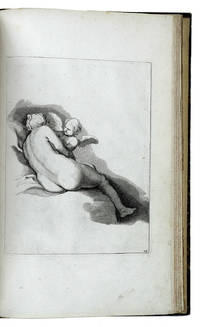
1730D8IBHTPY7SFPAmsterdam 1730. Folio. Reinier & Joachim II Ottens Half mottled sheepskin ca. 1840 sewn on 4 cords the spine has 5 gold-tooled raised bands but the middle one may be merely decorative papier coulé sides red spine-label red sprinkled edges. With a letterpress title page printed in red and black an engraved frontispiece self-portrait of Bloemaert engraved by Joachim Ottens here serving as no. 1 of 140 otherwise numbered engraved plates including illustrated part-titles for parts 2-6 with drawn models of parts of the human body and human figures and characters in various postures movements and scenes. 1 leaf plus plates. Famous drawing book of Abraham Bloemaert 1564-1651 a very influential Dutch painter and art teacher. It contains 140 numbered engraved plates with no text providing models for drawing parts of the human body including eyes ears noses faces hands feet arms legs busts heads hair styles and beards some for men women and children as well as human figures and character types in various postures kinds of movement also including men women and children. Four plates give models for drawing animals and animal's heads including horses cats a dog a fish a lion and cattle. In good condition and with generous margins with a small tear and minor smudges in the title-page the first and last leaves slightly browned and a few unobtrusive restorations. A classic Dutch drawing book providing a storehouse of human forms that influenced many artists for more than a century.l WorldCat 1 or 2 copies; cf. Bolten Method & Practice. Dutch & Flemish drawing books pp. 51-67; Hollstein II p. 86 nos. 36-155 ca. 1650-ca. 1657 F. Bloemaert ed. of parts 1-6. ABE CAT Art History hardcover
173740577London: Chez Jean Brindley Libraire de S. A. R. Monseigeur le Prince de Galles dans New Bond-street 1737. Folio. 17 7/8 x 11 1/4 inches. Complete second edition. 43 double-page engravings after Abraham van Diepenbeke including 42 numbered 1-42 and the unnumbered 1658 title with Anvers imprint. Engraved head-piece to first dedication. Numerous woodcut illustrations throughout the text and woodcut historiated and inhabited initials head- and tail-pieces and printer's ornaments. 12 1-236. 248 pp. Letterpress title with London imprint and four dedications to Henriette Cavendishe-Holles the King of Grande-Bretagne Charles Vicomte de Mansfield and to Cavaliers. Avertissement avant-propos four livres plus an Abbrege de la Cavalerie conclusion additions table des chapitres. Text in French. Contemporary brown full morocco paneled blind with gilt filets on board edges and gilt dentelles seven raised bands forming eight compartments on a richly gilt spine with gilt-lettered red morocco titling-pieces in second and third compartments and gilt foliate tooling in rest marbled endpapers on laid paper all edges gilt<br/> <br/> Cavendish's classic 1737 treatise on equestrianism with 43 splendid double-page engravings: "The illustrations are among the most beautiful to ever grace equestrian literature." Ramsay<br/> <br/> Though considered a country of horse lovers England only produced one early master of classical riding: William Cavendish Duke of Newcastle who was a Royalist living in exile until the restoration of King Charles II. During his exile Cavendish opened a riding school in Belgium and wrote the present work La Méthode et Invention Nouvelle de Dresser les Chevaux. This text was the first of Cavendish's two important books on breeding and training horses and was translated into French from his English manuscript and published in Antwerp in two issues: 1657 and 1658 though many of the 1657 title-pages have been altered by hand to read 1658. The first printing was largely incinerated by a fire in the bookseller's shop and is all but impossible to acquire. Brunet Offered here is the second edition of Cavendish's first book a work long cherished by bibliophiles for its typographical excellence and the masterful quality of its illustrations. It is a work that has been esteemed by countless generations of horsemen and revered by such master riders as La Guérinière Comte d'Aure and Steinbrecht. It is a landmark of equestrianism. Steinkraus Cavendish's book has been called the only really outstanding work on the subject written by an Englishman. Toole-Stott In it Cavendish discusses a wide variety of equine subjects including the recognition of the age and disposition of a horse; the characteristics of various types of horses such as the Spanish the Barb the English horse and the Arabian; methods of maintenance; and instructions on proper riding: "You must in all Airs follow the strength spirit and disposition of the horse and do nothing against nature; for art is but to set nature in order and nothing else." Of the 43 wonderful double-page engraved plates after Abraham van Diepenbeke 24 depict the multiple stages Cavendish and his assistant Captain Mazin employed in training horses in complicated maneuvers. The quality of the impressions in the present 1737 edition surpasses even those of the original edition. Steinkraus This was the first edition of La Méthode et Invention Nouvelle de Dresser les Chevaux to be published in England with engravings pulled from the original 1658 copperplates which were acquired by the publisher Jean Brindley.<br/> <br/> Brunet I 1700. Graesse II 93. Huth 23. Lowndes 1663. Mennessier de la Lance II p. 250. Nissen ZBI 848. Podeschi Mellon Books on the Horse and Horsemanship pp. 26 49. Ramsay "Early Dressage Literature to 1800" IOBA 6.9.03. Steinkraus Introduction to A General System of Horsemanship 2000. Wing N884-87. Chez Jean Brindley, Libraire de S. A. R. Monseigeur le Prince de Galles, dans New Bond-street unknown
171962639/62640<p>original outline-colour copper engravings enhanced hand-colour. EXTREMELY RARE stunning World map in 2 sheets from the extensive multi-volume 'Atlas Historique' vol. 6 no. 30 p. 117; published by Chatelain Amsterdam. One of the most informative decorative and impressive maps centered on the Pacific available. Printed on four large sheets the overall map is of wall-chart proportions and a veritable pictorial encyclopaedia of the World including the Philippines; many famous voyagers' tracks/routes are indicated. A great example of early 18th Century craftsmanship! Condition: 1st sheet - folds as issued small tear on lower centrefold; 2nd sheet - folds as issued; due to imperfect printing the neatlines are not perfectly parallel neither horizontally nor vertically. Otherwise Excellent condition. References: Not in Quirino; Phillips 579; Goss Kartenkunst Taf. 7.5; Ders. North America map 52; Portinaro/Knirsch p. 216/7 all 3 with crude but col. image.; Tooley California No. 80; Tooley Early Maps of Australia No. 66; Wagner NW Coast America Nr. 511; Lowery No. 291 only Northern part; Lietz Insulae India Orientalis p. 132<br /><br /><br /><br /></p> Chatelain, Amsterdam.
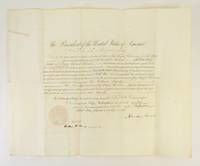
1718ST16605bWashington D.C.: U. S. Government 17 July 1862. 445 x 565 mm. 17 3/4 x 22 1/2". 17 lines of engraved text in copperplate script with names and dates completed in a fine secretarial hand. <br/> Loose as issued in an archival mylar sleeve. ◆Neatly mended two-and-three-quarters-inch tear to one edge well away from text half inch slit to end of one fold three very short separations along two folds only one touching text otherwise A FINE FRESH SPECIMEN clean and bright the signature dark and clear the wax-and-white-paper seal intact.<br/> <br/> This is an excellent example of a presidential document with Lincoln's full signature and with that of his Secretary of State William Henry Seward 1801-72 remembered for negotiating the purchase of Alaska from Russia. The consul appointed in this document Jay Haziel Sherman of Vermont served in Charlottetown Prince Edward Island from 1861 to 1865. It is likely this appointee was Jahaziel Blossom Sherman 1801-65 son of pioneering steamship captain Jahaziel Sherman 1770-1844 and that his unusual Old Testament name was misspelled by the scribe who filled in the appointment form. The younger Sherman died in Nova Scotia in 1865. U. S. Government unknown
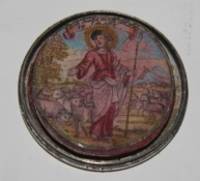
1732004823Amsterdam 1732 or 1733. The panorama or concertina was made we believe in 1732 or 1733 or close to that date. The silver "shraubthaler" or outer casing we assume was made separately at a later date but not long afterward. <br /><br /> books
173741768London: Chez Jean Brindley Libraire de S. A. R. Monseigeur le Prince de Galles dans New Bond-street 1737. Folio. 20 3/4 x 14 1/4 inches. Second edition deluxe large paper issue with wide margins. 43 double-page engravings after Abraham van Diepenbeke including 42 numbered 1-42 and the unnumbered 1658 title with Anvers imprint. Engraved head-piece to first dedication. Numerous woodcut illustrations throughout the text and woodcut historiated and inhabited initials head- and tail-pieces and printer's ornaments. 12 1-236. 248 pp. Letterpress title with London imprint and four dedications to Henriette Cavendishe-Holles the King of Grande-Bretagne Charles Vicomte de Mansfield and to Cavaliers. Avertissement avant-propos four livres plus an Abbrege de la Cavalerie conclusion additions table des chapitres. With incisive manuscript commentary pencilled in the margins in both French and English. Text in French. Bound to style in eighteenth-century half leather over eighteenth-century comb marbled paper-covered boards and marbled endpapers<br/> <br/> Deluxe large paper issue of Cavendish's classic 1737 treatise on equestrianism with 43 splendid double-page engravings: "The illustrations are among the most beautiful to ever grace equestrian literature." Ramsay<br/> <br/> Though considered a country of horse lovers England only produced one early master of classical riding: William Cavendish Duke of Newcastle who was a Royalist living in exile until the restoration of King Charles II. During his exile Cavendish opened a riding school in Belgium and wrote the present work La Méthode et Invention Nouvelle de Dresser les Chevaux. This text was the first of Cavendish's two important books on breeding and training horses and was translated into French from his English manuscript and published in Antwerp in two issues: 1657 and 1658 though many of the 1657 title-pages have been altered by hand to read 1658. The first printing was largely incinerated by a fire in the bookseller's shop and is all but impossible to acquire. Brunet Offered here is the deluxe large paper issue of the second edition of Cavendish's first book a work long cherished by bibliophiles for its typographical excellence and the masterful quality of its illustrations. It is a work that has been esteemed by countless generations of horsemen and revered by such master riders as La Guérinière Comte d'Aure and Steinbrecht. It is a landmark of equestrianism. Steinkraus Cavendish's book has been called the only really outstanding work on the subject written by an Englishman. Toole-Stott In it Cavendish discusses a wide variety of equine subjects including the recognition of the age and disposition of a horse; the characteristics of various types of horses such as the Spanish the Barb the English horse and the Arabian; methods of maintenance; and instructions on proper riding: "You must in all Airs follow the strength spirit and disposition of the horse and do nothing against nature; for art is but to set nature in order and nothing else." Of the 43 wonderful double-page engraved plates after Abraham van Diepenbeke 24 depict the multiple stages Cavendish and his assistant Captain Mazin employed in training horses in complicated maneuvers. The quality of the impressions in the present 1737 edition surpasses even those of the original edition. Steinkraus This was the first edition of La Méthode et Invention Nouvelle de Dresser les Chevaux to be published in England with engravings pulled from the original 1658 copperplates which were acquired by the publisher Jean Brindley.<br/> <br/> Brunet I 1700. Graesse II 93. Huth 23. Lowndes 1663. Mennessier de la Lance II p. 250. Nissen ZBI 848. Podeschi Mellon Books on the Horse and Horsemanship pp. 26 49. Ramsay "Early Dressage Literature to 1800" IOBA 6.9.03. Steinkraus Introduction to A General System of Horsemanship 2000. Toole-Stott Circus and the Allied Arts: A World Bibliography 84. Wing N884-87. Chez Jean Brindley, Libraire de S. A. R. Monseigeur le Prince de Galles, dans New Bond-street unknown
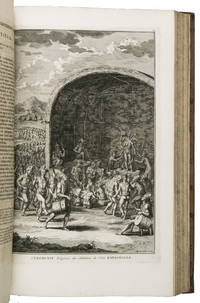
17275737The Hague 1727. Folio. Rutgert Christoffel Alberts vols. 1-3 and Isaac van der Kloot vols. 3-4; Amsterdam Hermannus Uytwerf; Rotterdam Jan Daniel Beman Contemporary gold tooled mottled brown calf with red and black morocco title and volume labels lettered in gold each volume with a central lozenge-shaped ornament on both boards surrounded by two decorative borders gold tooled board edges marbled edges. With an engraved frontispiece 8 title-pages 6 in red and black each with one of 3 different engraved vignettes plus 3 part-titles with a woodcut decoration 224 full-page engraved plates including 1 folding and 38 double-page plates an engraving on the dedication leaf in vol. 1 and a few engravings in the text. Further with several engraved headpieces woodcut tailpieces and a few woodcut decorated initials. 6 volumes vols. 3 4 & 6 in 2 parts each bound as 7. First Dutch edition of Picart's famous and richly illustrated work on religious customs ceremonies and costumes from all over the world. With its six volumes it is the most sumptuous publication ever on the religions of the world richly and beautifully illustrated with large and sometimes double-page or even folding engraved plates by the French engraver Bernard Picart 1673-1733 who lived in Amsterdam from 1708. The text was compiled from a wide range of sources including R. Simon J. Abbadie Dupin Thiers P. le Brun Boulainvilliers and Reland and edited by the Amsterdam publisher Jean Frederic Bernard for a French edition titled Ceremonies et coutumes religieuses de tous le peuples du monde first published in 1723. It was translated into Dutch for the present edition by Abraham Moubach.The first two volumes discuss the religion of the Jews and Roman Catholics including a double-page engraving of the interior of the Portuguese synagoge in Amsterdam. The third and fourth volume deal with the religions of the "heathens" in the Americas including Mexico India Ceylon the Brahmans in India China Japan Africa and the Persians in Iran. The fifth volume concerns the Greek orthodox church and the several groups of Protestants. The last volume describes the Anglicans and smaller groups such as Quakers Mennonites Adamites Freemasons and finally Islam. Altogether the most important 18th-century survey work on the world's religions and their customs lavishly illustrated with very finely executed plates.From the library of Frederick H. Rindge 1859-1905. The boards are somewhat rubbed. The works are slightly browned and foxed throughout with the final leaves of volume 3 affected more than the others. Otherwise in good condition.l Alt-Japan-Katalog 1149; STCN 191420778; cf. Cordier Japonica col. 435; Lipperheide 1808; Sabin 62600 all French ed. hardcover
1708116863Amsterdam, les Frères Chatelain, 1708-1714, 4 vol. in-folio, (18)-8-(4)82, (16)-(10)-162 (pagination continue) et (12)-98 pp, lettrines, culs-de-lampes, reliures plein veau raciné, dos à 6 nerfs guillochés et caissons très ornés, pièces de titre et de tomaison basane naturelle, coupes guillochées, tranches rouges (rel. de l'époque), pet. travail de ver au tome 1 sans perte de texte, coiffes abîmées, qqs épidermures, 1 mors fendu sur 8 cm au tome 3, intérieurs propres, bon état
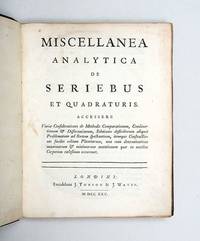
1730153282London: J. Tonson and J. Watts 1730. Binomial expansion First edition containing Moivre's first published attempt at approximating the terms of a binomial expansion. "Moivre's discovery greatly clarified the concept of probability in his own time and became the most fruitful single instrument of discovery used in probability theory and statistics for the next two centuries" Norman. Quarto 243 x 191 mm. Contemporary calf red morocco label red speckled edges. 18th-century armorial bookplate of Thomas Turton to front pastedown. Neat restoration to joints and extremities some scratches to covers light running staining in gutter and at head contents otherwise unmarked. A very good copy. ESTC T96683; Norman 1531. unknown
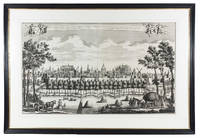
172891I90T01U79OAmsterdam 1728. Leonardus Schenk Framed 82.5 x 121 cm. Large engraved wall print on 2 sheets together 57.5 x 97 cm showing the Leiden city wall between the Koepoort and Zijlpoort with various windmills and prominent buildings in the background identified by name. The title appears in a banderole at the head with putti on either side holding the arms of Leiden and Holland. Leonardus Schenk's name appears as engraver and publisher at the right end of the banderole. Large view of the city of Leiden by the Amsterdam engraver and publisher Leonardus Schenk. The viewer observes the city from the south from between the city's Koe and Zijl gates. In the background several windmills and a few characteristic buildings are identified by name in the engraving including the university the library the Pieterskerk the Town Hall the Mare kerk the "Burcht" the fort and the Hooglandse kerk. On the quay outside the wall groups of people walk sporadically passed by small boats on the nearby city moat. In the foreground we see a typical Dutch landscape with grazing cattle farm workers a loaded hay cart and haystacks in the field. We know of several other wall prints by Schenk depicting local situations with almost photographic detail. Thanks to this detail important socio-historical aspects have been passed on to later generations giving these prints an important cultural meaning today. A few spots formerly folded otherwise in very good condition.l Overvoorde Catalogus van de prentverzameling der Gemeente Leiden 1906 no. 640; Waller Biogr. woordenb. Noord Ned. graveurs p. 287. unknown
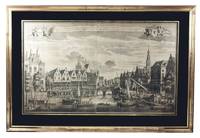
1728A2RGD4WT38YEAmsterdam: Leonardus Schenk 1728. In black passepartout and gilt frame 82 x 121 cm. Large engraved wall print on 2 sheets together 58 x 97 cm the sheets overlapping each other slightly showing the traditional business centre of the city of Leiden. The title both in Dutch and French is printed in a banderole at the head with putti on each side supporting the arms of Leiden and Holland. Leonardus Schenk's name appears as engraver and publisher at the right tip of the banderole. A large engraved wall print in two sheets showing the trading and commercial centre of the city of Leiden at the convergence of the Oude Rijn and Nieuwe Rijn canals. Unlike most other Dutch towns Leiden had no central market square so that the waterways formed the major access routes for merchandise. On the banks of the canals there is a lively market that converges on the bridge central in the print. Market traders and customers come and go. Women from the coastal fishing villages of Katwijk and Noortwijk display fresh fish for sale. Right in the print we see the monumental "Waag" the weigh-house built in 1658 following a plan by the Dutch architect and engraver Pieter Post. The splendid relief designed by Rombout Verhulst that crowns the entrance is reproduced with a sharp eye for detail. In front of the building commercial goods are hoisted up from carts and a number of ships for transport to the weigh-house. Several other ships had moored and now continue to their destination. A boat flying the Dutch flag brings in a prominent party while a herald standing precariously at the bow trumpets for right of way. We know of several other wall prints by Schenk depicting local situations with almost photographic detail. Thanks to this detail important socio-historical aspects have been passed on to later generations giving these prints an important cultural meaning today. With some faint foxing otherwise in very good condition.l Overvoorde Catalogus van de prentverzameling der Gemeente Leiden 1906 no. 964; Waller Biogr. woordenb. Noord Ned. graveurs p. 287. Leonardus Schenk, unknown
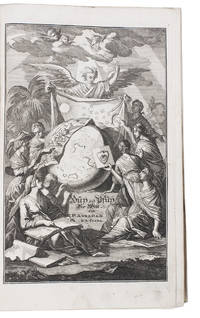
17075C8G6MOZMOJ3Nuremberg Christoph Weigel; 1707. Folio. Würzburg Martin Frantz Hertzen Contemporary vellum with the manuscript title at the head of the spine and a paper shelfmark label at the foot. With an engraved allegorical title-page a letterpress title-page printed in red and black and 100 engraved emblems in the text measuring 10.5 x 12 cm. 10 200 4 pp. & 100 ll. First edition of a German emblem book addressing virtues and vices in 100 emblems compiled by the German preacher Abraham à Sancta Clara born Johan Ulrich Mergerle; 1644 - 1709. As the title states the book's purpose is to refresh the readers virtues and to deter from vices by way of emblems. The concepts are explained in well-known fables and accessible symbols and allegories like the sun moon fire sea weather seasons metals gems animals etc. Each concept is illustrated in an emblem accompanied by a motto in Latin and a poem in German and Latin. The emblems were engraved by Christoph Weigel after illustrations by Caspar and Jan Luyken from the Ethica Naturalis ca. 1700. Each emblem is followed by two pages of text explaining the emblem.With a library inscription on the flyleaf "villae epponis ad bibliothecam". The binding is slightly soiled. Some marginal thumbing occasional foxing and some occasional spots and smudges. Otherwise in good condition.l Landwehr German emblem books 11; Faber du Faur 1125; Goedeke III 25 240. hardcover
17183173London: W. Pearson 1718. First edition. Very Good. Small folio 240 x 200 mm. Collates 4 xiv 175 1 blank: complete with an engraved vignette on title-page numerous engraved head and tail pieces and initials and an engraved vignette headpiece on page 1. With a dedication to Sir Isaac Newton. Contemporary speckled calf rebacked to style. Boards double-ruled in gilt. Spine with a red morocco label lettered and ruled in gilt. All edges speckled brown. Some minor soiling to final two pages. Some light toning from glue on endpaper edges. Previous owner's armorial bookplate on front pastedown. Overall a very good copy. <br/><br/>Abraham De Moivre was a mathematician and a close friend of Sir Isaac Newton to whom he dedicated the first edition of this work. "His work on the theory of probability surpasses anything done by any other mathematician except Laplace" Cajori. "De Moivre's representation of the solutions of the then current problems of games of chance tended to be more general than those of Montmort. In addition he developed a series of algebraic and analytic tools for the theory of probability like a 'new algebra' for the solution of the problem of coincidences which foreshadowed Boolean algebra the method of generating functions or the theory of recurrent series for the solution of differential equations. In the Doctrine de Moivre offered an introduction which contains the main concepts such as probability condition probability expectation dependent and independent events the multiplication rule and the binomial distribution" DNB. Very Good. W. Pearson unknown books
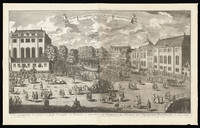
173014402Amsterdam c1730. 565 by 935mm. 22.25 by 36.75 inches. Engraving with etching on two sheets joined. View of the Plantage Muidergracht and the Jonas Daniël Meijerplein. The view shown from the present day Mr. Visserplien the busy intersecti.on in central Amsterdam depicts the Portuguese Synagogue on the left and the High German or Great Synagogue. These momumental buildings now house the Jewish Historical Museum. The first Jews to settle in Amsterdam were the Sephardim who had been expelled from Portugal and Spain in 1493. They were joined in the following decades by the Ashkenazi from Central and Eastern Europe the first of whom had come from Germany in 1600. In those years the only available land for them was at the outskirts of the eastern side of the Centrum the island of Vlooienburg surrounded by the Amstel River and the canals so they settled along the island's main street Breestraat which quickly became known as Jodenbreestraat. The Great Synagogue now the Jewish Historical Museum and the Portuguese-Israelite Synagogue were opened in 1671 and 1675 respectively. The Portuguese Synagogue was the place where Spinoza was placed under the ban by the Sephardic Jewish community in 1656. Pieter Stevensz. van Gunst 1659-1732 also known as Pieter Stevens van Gunst or Petrus Stephani was a Dutch draughtsman copperplate engraver and printmaker active in Amsterdam London 1704 and the Dutch town of Nederhorst 1730-1731. Abraham Rademaker 1677 21 January 1735 was an 18th-century painter and printmaker from the Northern Netherlands. Rademaker was born in Lisse. According to the RKD he was a versatile artist who painted Italianate landscapes but is known mostly for his many cityscapes and drawings of buildings that were made into print. R.W.P. de Vries auction 1925: 295. unknown
17271510220001Amsterdam: Michel Charles Le Cene 1727-01-01. Hardcover. Very Good. Folio. 2 12 439 pp.; 2 pp. 445-808p pagination continuous 43 of 44 plates. 2 Volumes in One Bound in contemporary vellum. 7 raised bands. Leather spine label. Good binding and cover. Spine and hinges restored. Faint soiling to vellum. Pages tanned with a several pages with some offsetting and foxing. Lacks frontis and added title. All 27 plates & 16 maps are present. Brunet IV 178; Cordier Japonica 367-68; Cordier Sinaca 2077; Lust 342 <br><Br> Jean Albert Mandeslo set out in 1636 with the Embassy that the Duke of Holstein sent to Russia and Persia. He visited India Ceylon Madagascar West Africa Congo and returned four years later. His story gives a very vivid picture of luxury vices curiosity and absolute disregard for life under the despotic tyranny of the Moghul Empire under Shah Jahan. In the port of Surat he arrived in April 1638 after he went to Ahmedabad and Agra. Although his observations of life in the capital are useful he apparently did not hear anything about the Taj Mahal which at that time was in the sixth year of building. Amsterdam: Michel Charles Le Cene hardcover
175214421Amsterdam c1752. 565 by 935mm. 21.5 by 36.75 inches. Engraving with etching on two sheets joined. View of the Plantage Muidergracht and the Jonas Daniël Meijerplein. The view shown from the present day Mr. Visserplien the busy intersecti.on in central Amsterdam depicts the Portuguese Synagogue on the left and the High German or Great Synagogue. These momumental buildings now house the Jewish Historical Museum. The first Jews to settle in Amsterdam were the Sephardim who had been expelled from Portugal and Spain in 1493. They were joined in the following decades by the Ashkenazi from Central and Eastern Europe the first of whom had come from Germany in 1600. In those years the only available land for them was at the outskirts of the eastern side of the Centrum the island of Vlooienburg surrounded by the Amstel River and the canals so they settled along the island's main street Breestraat which quickly became known as Jodenbreestraat. The Great Synagogue now the Jewish Historical Museum and the Portuguese-Israelite Synagogue were opened in 1671 and 1675 respectively. The Portuguese Synagogue was the place where Spinoza was placed under the ban by the Sephardic Jewish community in 1656. Pieter Stevensz. van Gunst 1659-1732 also known as Pieter Stevens van Gunst or Petrus Stephani was a Dutch draughtsman copperplate engraver and printmaker active in Amsterdam London 1704 and the Dutch town of Nederhorst 1730-1731. Abraham Rademaker 1677 21 January 1735 was an 18th-century painter and printmaker from the Northern Netherlands. Rademaker was born in Lisse. According to the RKD he was a versatile artist who painted Italianate landscapes but is known mostly for his many cityscapes and drawings of buildings that were made into print. R.W.P. de Vries auction 1925: 295. unknown
1733004823Amsterdam 1733. The panorama or concertina was made we believe in 1732 or 1733 or close to that date. The silver "shraubthaler" or outer casing we assume was made separately at a later date but not long afterward. unknown
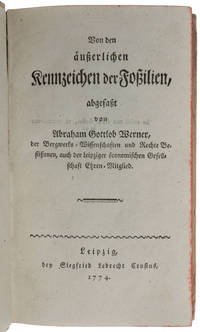
17745615Leipzig: Siegfried Lebrecht Crusius 1774. First edition. <p>First edition rare of Werner's first published work. "This book in which Werner develops a completely new scientific description of minerals is actually the first modern textbook on mineralogy. He was the first to recognize that a true and final classification of minerals should be based on their chemical composition and that it would be possible to identify the various minerals with certainty by their external characters and physical properties" Carozzi. </p>. THE FIRST MODERN TEXTBOOK ON MINERALOGY". <p>First edition rare of Werner's first published work and the first modern textbook of descriptive mineralogy the 'fossils' in the title refer to anything removed from the ground. "Although Werner is best known for his contribution to the founding of geology as a science he first achieved recognition as a mineralogist. He considered mineralogy to be the basis for all study of the earth dividing it into five branches of which geognosy historical geology was one and oryctognosy descriptive mineralogy another. And during all the years in which his theories on geognosy were arousing so much interest and controversy he continued to work on his mineral system the final version of which appeared after his death in 1817. His first important mineralogical work however Von den äusserlichen Kennzeichen der Fossilien was not a mineral system but a classification of external characteristics of minerals designed to aid the worker or the student in the field. In it Werner gave an unprecedented number of external characteristics with definitions usually accompanied by homely examples which could be understood by both the layman and the natural philosopher. He also attempted to establish some standards of quantification and thus to clear away the vagueness in the terminology then in use. As chemistry and crystallography developed mineralogists came to rely more on chemical analysis and less on external characteristics but Von den äusserlichen Kennzeichen der Fossilien published when Werner was twenty-five years old continued to be an important work into the nineteenth century . Werner remained convinced of the importance of external characteristics not only in the identification of minerals but also in the study of their composition. He reasoned that since the appearance of a mineral changes when its chemical composition is changed there should be a correlation between chemical composition and external characteristics" DSB. "Werner was the champion of a geological theory known as Neptunism in which he believed that all minerals precipitated out of water. Neptunists were opposed to believers of Vulcanism a theory that espoused the igneous origin of rocks" Dibner </p> <br /> <p>This book is "one of the most influential writings in the development of the mineralogical sciences. It is the first successful attempt at describing systematically determinative mineralogy. Werner who wrote this book his first as a student at the youthful age of 24 had been around minerals and mining his entire life. He had practical experience in what was needed by the miners to identify minerals and the reasons for identification. Werner had originally intended to publish an annotated translation of the dissertation written by Johann Carl Gehler titled: De Characterivs Fossilivm Externis Lipsiæ 1757. After showing the completed translation to his scientific circle he was advised to that it was better to write a book that was wholly his own. The result was Von den äusserlichen Kennzeichen der Fossilien which took the young Werner only a few months to complete. Based upon this book's merits Werner was appointed to the staff of the Freiberg Bergakademie where he stayed the remainder of his professional life.</p> <br /> <p>"The book is written not as a mineralogical classification system as was then typical but rather as a compendium of external characteristics of a large number of minerals. Werner intended it to be used as a practical guide for mineral identification and proposed that this study be given the name 'oryctognosy' - a term previously applied in a wider sense such as Bertrand's Dictionnaire Oryctologique Universalle Paris 1763. For his book Werner precisely defined an unprecedented number of external characteristics that could be used to accurately identify specimens through hand examination. Included in the distinguishing features identified for use are color luster form streak hardness and specific weight. Werner claimed that determining all of these qualities for a given mineral specimen was enough to identify its species. In fact these same characters are readily found in modern handbooks of determinative mineralogy because in most cases they are enough to distinguish the common species. The landmark character of Werner's work rests on the fact that no one before had so precisely defined the properties used to test minerals and the effect on mineralogical science can be described as revolutionary with many of his former students writing their own texts to spread Werner's theories in a multitude of other languages" Schuh.</p> <br /> <p>"This book in which Werner develops a completely new scientific description of minerals is actually the first modern textbook on mineralogy. He was the first to recognize that a true and final classification of minerals should be based on their chemical composition and that it would be possible to identify the various minerals with certainty by their external characters and physical properties . Upon its publication in 1774 Von den äusserlichen Kennzeichen der Fossilien created an immense scientific interest all over Europe and inspired increased investigations in the particular field it had so brilliantly renovated that is the determination and classification of minerals according to external characters" Carozzi pp. 554-555.</p> <br /> <p>"Werner 1749-1817 was born into a family with a mining tradition; therefore it was expected he should enter the profession. In 1774 as a student at the Freiberg Bergakademie he wrote his first book Von den äußerlichen Kennzeichen der Foßilien and based upon its merit in 1775 Werner was appointed professor of mineralogy at that institution. He remained there the rest of his professional life. He was by accounts an electrifying teacher who devoted himself to developing the sciences of mineralogy and geology. His students many of whom became famous instructors in there own right spread his theories throughout Europe and North America. However Werner's idea that basalt was aqueous in origin sparked the great controversy between his theory and that of Scottish geologist James Hutton 1726-1797. Werner accumulated an extensive personal mineral collection of over 10000 specimens which he sold for 40000 talers to the Freiberg Bergakademie. Today it is together with Werner's library among the earliest of the great collections that still remains intact" Schuh.</p> <br /> <p>Dibner Heralds of Science 81; Norman 2205; Sparrow Milestones of Science 196; Ward & Carozzi 2299. Carozzi 'A Study of Werner's Personal Copy of Von den äusserlichen Kennzeichen der Fossilien 1774' Isis 51 1960 pp. 554-557.</p> <br/> <br/> 8vo 176 x 103 mm pp. 302 2 with 8 folding tables. Contemporary boards a little frayed at head. A fine copy. Custom half leather clamshell box gilt spine. Siegfried Lebrecht Crusius unknown
1718327872London England: W. Pearson for the Author 1718. First edition. Hardcover. Acceptable. London: "Printed by W. Pearson for the Author" MDCCXVIII 1718. Rare first edition of the first textbook on probability. Original boards endpapers and spine. Tooled boards are whole but detached and rubbed heavily at corners. Spine is missing 2 1/2 panels of 6 lightly treated with leather preservative to mitigate flaking. Endpapers are present front endpaper is chipped at front edge. Text block is sound light darkening to edges of pages top and front edges from use- else good copy paper and print quality. Artists engraved creative 'armorial' bookplate of Josiah M.Montague Goodall 1828-1893 of Charles Goodall and Son Card Maker Master Employing 500 People. The book's title came to be synonymous with probability theory and accordingly the phrase was used in Thomas Bayes' famous posthumous paper "An Essay Towards Solving a Problem in the Doctrine of Chances" wherein a version of Bayes' theorem was first introduced. W. Pearson for the Author hardcover
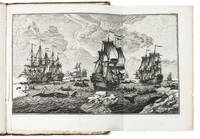
172019012Amsterdam 1720. 4to. Joannes Oosterwyk Contemporary half sheepskin marbled paper sides. With an engraved allegorical frontispiece by J. Folkema after F. Ottens 6 folding engraved maps and 7 engraved plates including 1 folding showing ships at sea by A. Salm after Van der Hem. Further with the title page printed in red and black a small woodcut vignette on the title page some woodcut decorated initials and some large woodcut floral tailpieces. 38 330 14 pp. First edition of the most important early account of whaling in the northern seas. The author a ship's commander in the Dutch Greenland fleet describes the history of the Dutch whaling in the northern seas. Dutch whaling dominating in Europe for most of the 17th and 18th century was not confined to the Greenland waters only but ranged widely across the northern fisheries from the Davis Straits to the Siberian Sea. The work also includes short histories of the northern explorations in Greenland Iceland Spitsbergen Nova Zembla Jan Mayen Island and Strait Davis all accompanied by the newest maps and preceded by a map of the North Pole. The plates show the different whales and ships of the whalers. To Zorgdrager's work detailed lists are added of captains ships equipment and provisions for the ships caught whales the cost of equipment and crew etc. Also the practical and technical aspects of whaling are fully described. The book was used as one of the sources for Melville's Moby Dick.With a printed ex libris bookplate of N. Du Jardin-Van der Avoort mounted on the front pastedown. The spine and boards are somewhat scuffed the corners of the boards are slightly bumped a tear in one leaf some occasional foxing and water staining the edges are slightly frayed. Otherwise a good copy of a rare and interesting work.l Cat. NHSM p. 899; Chavanne 2110; Leclerc 678; Sabin 106374; STCN 201968800 14 copies incl. 1 incomplete; Tiele Bibl. 1241 note; V. Gestel - Van het Schip Maps in books on Russia and Poland 299. ABE CAT Alaska Canada & Greenland hardcover
180037722London 1800. Hand-coloured and colour-printed mezzotint engraving by Dunkerton. The most strikingly beautiful flower plates ever to be printed in England.<br/> <br/>"The plant shown in this picture Selenicereus grandiflorus L. Britton & Rose. is also known as the Moon Cactus from the moon-like appearance of the fully open flower. Thornton also says that. it was sometimes called the `Torch Thistle' as it `exhibits to the observer a figure equally grotesque as terrific with flowers possessing actually the blazing appearance of a torch.' The plant is a native of Jamaica and Cuba. This picture is one of the most arresting in the collection. The plant itself is of interest not only for its large and beautiful flowers but as a representative of those which growing in a hot and dry environment open their flowers at night for pollination by night-flying insects pollinators being scarce in such climates during the heat of the day. This has a curious effect where public botanic gardens are concerned since these are shut at night to visitors who thus never see the plant in full bloom." Ronald King. The Temple of Flora by Robert Thornton. 1981 p.74. Thornton's Temple of Flora is the greatest English colour-plate flower book. ".Thornton inherited a competent fortune and trained as a doctor. He appears to have had considerable success in practice and was appointed both physician to the Marylebone Dispensary and lecturer in medical botany at Guy's and St. Thomas's hospitals. But quite early in his career he embarked on his. great work. What Redouté produced under the patronage of L'Héritier Marie Antoinette the Empress Josephine Charles X and the Duchesse de Berry Thornton set out to do alone. Numerous important artists were engaged. twenty-eight paintings of flowers commissioned from Abraham Pether known as `Moonlight Pether' Philip Reinagle . Sydenham Edwards and Peter Henderson. The result. involved Thornton in desperate financial straits. In an attempt to extricate himself he organized the Royal Botanic Lottery under the patronage of the Prince Regent. it is easy to raise one's eyebrows at Thornton's unworldly and injudicious approach to publishing. But he produced. one of the loveliest books in the world" Alan Thomas Great Books and Book Collecting pp.142-144 First state of plate A. unknown books
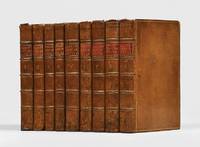
1768150964London: Printed by T. Jones & W. Oliver 1768 & 1777. The complete set of an influential philosophical work First edition a complete set of Tucker's magnum opus which outlined a vast and idiosyncratic philosophical system and which had a noted influence on his philosophical contemporaries. The set pairs the five volumes he published in 1768 with the four-volume continuation posthumously published in 1777 uniformly bound in contemporary calf and very scarce thus. "Although an occasionally eccentric and digressive text The Light of Nature Pursued enjoyed a high reputation from its first appearance. In the introduction to his Moral and Political Philosophy 1785 William Paley emphasized his deep indebtedness to Tucker in expounding his ethical theory. Paley considered Tucker to be a very original thinker. His work was also highly praised by Sir James MacIntosh who had used his ideas in his lectures on ethics. Mildmay had looked to MacIntosh to provide an introduction to his edition of the work but MacIntosh had been too busy to oblige. Hazlitt produced an abridged edition in 1807. Tucker's speculations also had some influence on Malthus whose family were resident in Surrey. Tucker's style is direct conversational and full of deliberately familiar metaphors and analogies. He was very much an amateur metaphysician and The Light of Nature Pursued is noticeably unsystematic and occasionally rambling in tone. His theory of consciousness and knowledge owes a great deal to John Locke though his speculations about the nervous system and the brain are closer to those of David Hartley whom he nevertheless disliked and whose theories he criticized" ODNB. The first five volumes were published under Tucker's pseudonym of "Edward Search" but his daughter Judith discarded this pseudonym when arranging the posthumous publication of the latter four volumes. Together 9 vols octavo 212 x 130 mm. Contemporary calf red morocco labels red speckled edges. Book label of bookseller and bibliographer John Stephens 1948-2006. Some slight wear around extremities occasional light foxing or worming but contents otherwise fresh; a nice set. ESTC T109651 & T153498. unknown