ABRAHAM LINCOLNBiblio.com

774 résultats
186522935<p><b>ABRAHAM LINCOLN.</b>Print. <i>Abraham Lincoln. The Nations Martyr. Assassinated April 14th. 1865.</i> Currier & Ives New York N.Y. 1865. 1 p. 13½ x 18 in. Light toning. </p>By recycling stock images Currier & Ives could issue "rush" prints of important 19th century events thus providing Americans with graphic depictions of current events. Based on Anthony Berger's famed photograph taken in February 1864 this is a fine example of a "rush" print of Lincoln following his assassination to hang in the homes of Americans mourning the loss of their president.<br />
186522935<p><b>ABRAHAM LINCOLN.</b>Print. <i>Abraham Lincoln. The Nations Martyr. Assassinated April 14th. 1865.</i> Currier & Ives New York N.Y. 1865. 1 p. 13½ x 18 in. Light toning. </p>By recycling stock images Currier & Ives could issue "rush" prints of important 19th century events thus providing Americans with graphic depictions of current events. Based on Anthony Berger's famed photograph taken in February 1864 this is a fine example of a "rush" print of Lincoln following his assassination to hang in the homes of Americans mourning the loss of their president.<br /> books
186520323<p><b>ABRAHAM LINCOLN.</b>Currier & Ives. Lithograph New York 1865. In 24 x 29 in. hand-gilt frame. </p><p>From the hairs on Lincoln's head to the fabric of his suit this lithograph is a beautifully detailed rendering and remains even with a few areas of foxing a commanding showpiece.</p><p><b>Historical Background</b></p><p>The copyright date of <i>"1865"</i> along the bottom edge suggests that this oversized portrait was created to honor either Lincoln's second presidential term or his untimely death.</p><p>Lithographer <b>Nathaniel Currier</b> 1813-1888 and artist <b>James Merritt Ives</b>1824-1895 formed Currier & Ives in New York City in 1857 to publish art prints. The company closed in 1907 after the deaths of its founders when business had declined due to new printing technologies and changing artistic tastes.</p><p><b>Condition</b></p><p>There are a few areas of light age toning. It is displayed in a vintage frame not contemporary to 1865 as we bought it so it is not guaranteed to be archival.</p> books
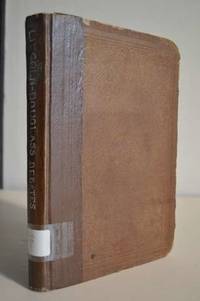
1860SKU1039674Follett Foster and Company 1860. First Edition. hardcover. Acceptable. 0x0x0. This Book is an Ex-Library Book with several library markings. Political debates between Hon. Abraham Lincoln and Hon. Stephen A. Douglas in the celebrated campaign of 1858 in Illinois; including the preceding speeches of each at Chicago Springfield etc.; also the two great speeches of Mr. Lincoln in Ohio in 1859 as carefully prepared by the reporter of each party and published at the times of their delivery. Follett Foster and Company; Columbus 1860. Hardcover. First Edition First Issue. First issue with no advertisements no rule above the publishers imprint on the copyright page and with numeral 2 at the bottom of page 17. An Acceptable brown cloth binding with blind stamped ornate design on boards re-enforced spine with handwritten white ink title and library locations sticker on spine binding shaky starting hinges with partially cracked rear hinge heavy wear to board corners with some loss some scuffing and discoloration to boards abrasions along board margins specifically to rear bit pulpy text block with age toning and scattered foxing throughout rubbing to board and spine edges previous owner handwritten ink info on front free endpaper few small dog-eared pages faint moisture stain on fore-edge and slightly on page margins several library markings include: library bookplate library due date card pocket embossed library stamp ink library stamps few ink and pencil notes barcode sticker without Dust wrapper. 8vooctavo or approx. 6 x 9 inches. 268pp. We pack securely and ship daily with delivery confirmation on every book. The picture on the listing page is of the actual book for sale. Additional Scans are available for any item please inquire. Follett, Foster and Company hardcover
1894112666Lincoln Memorial University 1894. Leather. Very Good. 1894 Lincoln Memorial University Sponsors edition #500 of unstated limitation. 12 volume gilt decorated full leather bindings top edge gilt. Fine condition with no issues. oversized and overweight. B67 Please email for photos. Lincoln Memorial University hardcover
18871002385New York City 1887. Invitation to Walt Whitman's private reception after his celebrated lecture "The Death of Abraham Lincoln" at Madison Square Theatre on April 14 1887. Whitman had given public readings of his Lincoln lecture variously edited since 1879; one version was published in Specimen Days in 1882-1883. Scheduled on the twenty-second anniversary of Lincoln's assassination the 1887 event was staged as a benefit for the ailing Whitman who remained seated throughout his sold-out tribute to the Union's "Martyr Chief": "there is a cement to the whole people subtler more underlying than any thing in written constitution or courts or armies - namely the cement of a death identified thoroughly with that people at its head and for its sake." As William Pannapacker notes Whitman's passionate public identification with Lincoln was central to his emergence as "The Good Gray Poet" a national treasure: "Whitman's experiments in self-creation finally succeeded with a major segment of the public when he enclosed his persona within the halo encircling the martyred President" Revised Lives 22. The New York audience for Whitman's performance included Mark Twain John Hay Augustus St. Gaudens James Russell Lowell and Charles Eliot Norton; Andrew Carnegie could not make it but purchased a box for $350. At the end of his performance Whitman was surprised by a gift of lilacs from poet E.C. Stedman's young granddaughter a reference to his great elegy for Lincoln "When Lilacs Last in the Dooryard Bloom'd." In New York City for a single night Whitman hosted a reception in his rooms at the Westminster Hotel after the lecture; this invitation was printed for the occasion. The evening was an important one for New York literary society a celebration "at least as spectacular as the event itself" according to the New York Sun. Looking "like a painting of Jove" Whitman entertained a constant stream of admirers relieved only by the performance of the Afro-Cuban violinist Claudio Brindis de Salas Garrido "El Paganini Negro" who serenaded Whitman on a seventeenth-century Ruggeri violin: "Walt was mightily pleased with the music." A surprising survival a near-fine artifact of the nineteenth-century American literary scene. Ivory card measuring 2.75 x 3.75 inches printed recto only: "Walt Whitman / At Home -- Thursday Evening / April 14th 1887 / Westminster Hotel Irving Place and 16th St. New York." Penciled bookseller note to verso: "April 14 1887 for his most famous lecture Lincoln / WW in NY for only one 1 night." Card lightly toned; half-inch closed tear to head expertly repaired. Housed in envelope fragment with penciled inventory number bookseller note and collector's note: "Whitman card / gift from Capt. Cohn -- / House of Books / Aug 7 1950.". unknown books
1865228501865. No binding. Fine. Broadside. The Nation's Loss. A Poem on the Life and Death of the Hon. Abraham Lincoln. 1865. 1 p. 9 3/4 x 15 1/4 in. 1/2 inch loss at top not affecting text. Headed by an engraving of Lincoln Reverend Peter W. Brister's mourning poem occupies the first two columns and Lincoln's Emancipation Proclamation is printed in full in the third column. Brister's poem addressed what Lincoln meant to the nation during the Civil War how he saved the Union and freed the slaves. Below the image of Lincoln it reads ""Late President of the United States Who departed this life in Washington D.C. April 15 1865."" unknown
1865228501865. No binding. Fine. Broadside. The Nation's Loss. A Poem on the Life and Death of the Hon. Abraham Lincoln. 1865. 1 p. 9 3/4 x 15 1/4 in. 1/2 inch loss at top not affecting text. Headed by an engraving of Lincoln Reverend Peter W. Brister's mourning poem occupies the first two columns and Lincoln's Emancipation Proclamation is printed in full in the third column. Brister's poem addressed what Lincoln meant to the nation during the Civil War how he saved the Union and freed the slaves. Below the image of Lincoln it reads ""Late President of the United States Who departed this life in Washington D.C. April 15 1865."" unknown books
18874021887. 1st Edition. FIRST EDITION FIRST BRITISH PRINTING of a work haled both as the greatest failed experiment of all time AND as 'one of the greatest achievements in physics of all time' Lightman 130. 'What Michelson and Morley did. was undermine a longstanding belief in something called the luminiferous ether; a stable invisible weightless frictionless. medium that was thought to permeate the universe. Conceived by Descartes embraced by Newton and venerated by nearly everyone ever since the ether held a position of absolute centrality in nineteenth-century physics as a way of explaining how light traveled across the emptiness of space Bryson 117. Prevailing theories held that ether formed an absolute reference with respect to which the rest of the universe was stationary and that ether was a medium for the propagation of light as water waves must have a medium to move across: water. Given the speed of light designing an experiment to detect the presence of ether and its drift or hypothetical motion relative to earth was challenging. To do so Michelson designed an interferometer -- essentially a massive stone block with mirrors and crisscrossing light beams -- capable of measuring the velocity of light with great precision. The device enabled Michelson and Morley to measure the speed of light in different directions enabling them in theory to measure the speed or drift of the ether relative to Earth thus establishing its existence. Michelson and Morley expected to see their light beams shifted by the swift motion of the earth in space thus giving measure to different speeds of light in each direction but "none was observed showing that the earth's motion did not affect the light's speed" Dibner 161. "The failure of this experiment was a serious blow to classical scientific theories because it cast doubts on the existence of the universal ether which had been a basic principle of for example the Newtonian theories of the universe" PMM 401. The result discredited the ether theories "and opened the door to "new standards of reference of time and space from geometry and cosmometry" ultimately leading to Einstein's 1905 proposal that the speed of light is a universal constant" Dibner; Lightman 130. The history of science records the 1887 ether-drift experiment of Albert Michelson and Edward Morley as the turning point at which the energetic "ether of space" was discarded by mainstream physics thereafter replaced with the postulate of "empty space." Michelson and Morley's work sounded the death knell of classical physics' beautifully simple belief in the idea of ether. CONDITION & DETAILS: London: Taylor & Francis. 8.5 x 5.5 inches; 213 x 138mm. Complete. viii 524 9 plates. Michelson & Morley paper: pp. 449-463. Ex-libris bearing a discreet stamp on the title page. Solidly and tightly bound in three quarter brown calf over marbled paper boards. Some scuffing and rubbing at the edge tips and along the spine. Five gilt-ruled raised bands at the spine; gilt armorial devices in the compartments. Gilt-lettered red and black morocco spine labels. Very slight age toning within; largely clean and bright. Very good condition. hardcover
186625617.02<p>An engraving by Alexander Hay Ritchie commemorates the moment Lincoln first presented the Emancipation Proclamation to his Cabinet.</p> <b>ABRAHAM LINCOLN.</b>Print. <i>The First Reading of the Emancipation Proclamation Before the Cabinet</i>. Engraved by Alexander Hay Ritchie after 1864 painting of Francis Bicknell Carpenter. New York: Alexander H. Ritchie 1866. 36 x 24 in.<p><b><br /></b></p><p><b>Francis Bicknell Carpenter</b> 1830-1900 a New York artist was so impressed with Lincoln's bold act that he recruited Illinois Congressman and abolitionist Owen Lovejoy to arrange a White House sitting. Carpenter met Lincoln on February 6 1864 and was allowed to set up a studio in the State Dining Room. Carpenter set his painting in Lincoln's office which also served as the Cabinet Room. Lincoln reportedly told Carpenter where each person was seated on the day he read them the preliminary Emancipation Proclamation. The artist was delighted that their placement was "entirely consistent with my purpose." To the left of Lincoln were Secretary of War Edwin M. Stanton and Secretary of the Treasury Salmon P. Chase the most radical members of his cabinet. A portrait of former Secretary of War Simon Cameron is also on the left of the painting. To the right of Lincoln around the table are Secretary of the Navy Gideon Welles Secretary of the Interior Caleb Smith Secretary of State William H. Seward Postmaster General Montgomery Blair and Attorney General Edward Bates the more conservative members of Lincoln's advisers. Lincoln sat at the head of the table between the two groups "but the uniting point of both" according to Carpenter.</p><p>After a temporary exhibit in the White House and Capitol in 1864 the fifteen-foot wide painting toured the country. Carpenter offered the painting to Congress which refused to make an appropriation for it. In 1877 Elizabeth Thompson of New York purchased the painting for $25000 and offered it to the nation. Congress formally accepted the gift on the sixty-ninth anniversary of Lincoln's birth. It hangs in the U.S. Senate. In 1866 book Carpenter also published a book <i>Six Months at the White House with Abraham Lincoln</i>.</p><p>This lithographic print by Scottish-born <b>Alexander H. Ritchie</b>1822-1895 captured and popularized Carpenter's painting before Carpenter made a series of alterations to the original most significantly in revising Lincoln's head and moving the quill pen from near Seward to in Lincoln's hand.</p><p>The National Portrait Gallery has a ledger page signed by Lincoln Stanton Chase Seward Wells and other members of Lincoln's administration ordering proof copies of Ritchie's print.</p><p><b>Historical Background</b></p><p>On July 22 Lincoln read a draft of his preliminary Emancipation Proclamation to his entire cabinet. In contrast to the Confiscation Acts of 1861 and 1862 the Emancipation Proclamation addressed only property in slaves and liberated all slaves in areas in rebellion not only those of rebellious masters. At Seward's urging Lincoln agreed to withhold announcing it until the Union forces had achieved a victory so that it did not appear especially to European observers to be the desperate act of a losing war effort.</p><p>Two months later when Union troops stopped Confederate General Robert E. Lee's invasion of Maryland at Antietam Creek Lincoln finally had his opportunity. On September 22 1862 Lincoln issued his Preliminary Emancipation Proclamation giving the South 100 days to end the rebellion or face losing their slaves. On both sides of the Mason-Dixon Line Lincoln's order was condemned as a usurpation of property rights and an effort to start racial warfare.</p><p>When the South failed to acquiesce Lincoln as promised issued the final Emancipation Proclamation on January 1 1863. With this Executive Order he took a decisive stand on the most contentious issue in American history redefined the Union's goals and strategy and sounded the death knell for slavery. The full text of his proclamation reveals the major issues of the Civil War: slave labor as a Confederate resource; slavery as a central war issue; the status of African Americans who escaped to Union lines; courting border states; Constitutional and popular constraints on emancipation; hopes of reunion; questions of Northern acceptance of black soldiers; and America's place in a world moving toward abolition. The President took the action "sincerely believed to be an act of justice" knowing that it might cost Republicans in the fall 1862 elections.</p><p>The final Proclamation showed Lincoln's own progression on the issue of slavery and eliminated earlier references to colonizing freed blacks and compensating slave owners for voluntary emancipation. It also added provisions for black military enlistment. Pausing before he signed the final Proclamation Lincoln reportedly said: "I never in my life felt more certain that I was doing right than I do in signing this paper."</p><p><b>Condition</b></p><p>Toned and slightly cropped.</p> books
186525618<p>Frank Leslie published this print as a premium for his new family magazine <i>Frank Leslie's Chimney Corner</i> and copyrighted it on April 8 1865 just a week before Lincoln's death. The image created by engraver Henry B. Major and lithographer Joseph Knapp portrays Lincoln flanked by the First Lady and Vice President Andrew Johnson greeting Julia Dent Grant wife of Lieutenant General Ulysses S. Grant who stands nearby.</p><p>According to a notice printed at the bottom right corner "<i>Every Person who pays Ten Cents each for numbers 1 and 2 of Frank Leslie's Chimney Corner The New Family Paper is entitled to a copy of this PLATE without extra charge</i>" or individuals could purchase the print for $3.</p> <b>ABRAHAM LINCOLN.</b>Lithograph. "Grand Reception of the Notabilities of the Nation at the White House 1865" New York: Frank Leslie April 1865. 1 p. 19 x 23¾ in.<p><br /></p><p>In the first issue of <i>The Chimney Corner</i> Leslie described the "Grand Reception" image as "the most costly gift plate ever presented by any publisher in the United States having been produced at an expense of $10000."</p><p>"Every family should possess this truly national picture and carefully preserve it" Leslie continued "as it will transmit to future generations the men who have restored our great national unity. It is especially valuable as it contains an excellent likeness of our late lamented President introducing General Grant and his wife to Mrs. Lincoln." The picture contains "nearly 100 portraits of our most celebrated Generals Statesmen and Civilians also of many of our most distinguished American ladies. The likenesses are admirable having been taken from photographs by Brady."</p><p>The key giving the names of each individual portrait was published in issue number 4 of the <i>Chimney Corner</i> on June 24.</p><p>Included in the image are Generals Ulysses S. Grant John G. Foster William T. Sherman Hugh J. Kilpatrick Nathaniel P. Banks Philip H. Sheridan Winfield S. Hancock John A. Logan Joseph Hooker Benjamin F. Butler Oliver O. Howard John A. Dix and Henry W. Slocum. Admirals David Farragut and David Dixon Porter represent the Navy. Members of the cabinet include Secretary of War Edwin M. Stanton Secretary of State William H. Seward and Secretary of the Navy Gideon Welles. Members of Congress include Senator Henry B. Anthony of Rhode Island Senator William P. Fessenden of Maine Senator Charles Sumner of Massachusetts and Speaker of the House Schuyler Colfax of Indiana. Chief Justice Salmon P. Chase represents the U.S. Supreme Court. New York newspaper editors Horace Greeley Henry J. Raymond and James Gordon Bennett are also present. Prominent women include First Lady Mary Lincoln Ann S. Stephens dime novelist and magazine editor Miriam Folline Squier wife of Leslie's former editor-in-chief and Leslie's future wife Julia Dent Grant wife of Ulysses S. Grant Kate Chase Sprague daughter of Chief Justice and wife of Rhode Island Senator and Adele Cutts Douglas widow of Stephen A. Douglas. Others identified in the key include Ephraim G. Squier Leslie's former editor-in-chief archaeologist and U.S. commissioner to Peru Governor Andrew G. Curtin of Pennsylvania and Ambassador to Russia Cassius M. Clay of Kentucky.</p><p>Despite Leslie's copyright Anton Hohenstein created a very similar image entitled "Lincoln's Last Reception" which also featured Lincoln's meeting General Ulysses S. Grant's wife Julia. Published by John Smith in Philadelphia in 1865 and hand-colored "Lincoln's Last Reception" also included more than thirty military and political leaders and a few prominent women among the onlookers in the ballroom.</p><p><b><i>Frank Leslie's Chimney Corner</i></b> 1865-1884 was a weekly family newspaper published "every Tuesday" in New York by Frank Leslie. Each illustrated issue of sixteen pages contained serial fiction short stories poetry biographies history travel sketches natural history anecdotes and other subjects. According to the prospectus the newspaper would be "a welcome messenger of instruction and amusement to the young and old in the family and by the fireside—that altar around which cluster our holiest and most cherished recollections." Leslie had copyrighted the title in 1861 but "the great Rebellion now happily closing intervened to put a stop to the enterprise."</p><p><b>Frank Leslie</b> 1821-1880 was born in England as Henry Carter but he adopted the pseudonym of Frank Leslie to keep his artistic activities a secret from his relatives who disapproved. He came to the United States in 1848 and settled in New York in 1853 to engrave woodcuts for P. T. Barnum's <i>Illustrated News</i>. When that publication failed Leslie began work on his own series of illustrated publications including <i>Frank Leslie's Illustrated Newspaper</i> <i>The Budget of Fun</i> <i>Frank Leslie's Chimney Corner</i> and others. At his death he was deeply in debt but his second wife Miriam Folline Squier 1836-1914 continued his publications and again made them profitable even legally changing her name to Frank Leslie in 1881.</p><p><b>Condition</b></p><p>Spot-mounted to modern board mat toning moderate foxing minor edge wear. Would benefit from conservation.</p> Frank Leslie
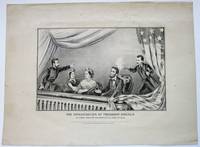
186537441New York: Currier & Ives. 152 Nassau Street 1865. Lithograph print oblong 13-1/2" x 18." Uncolored depicting Booth shooting Lincoln in the back of the head Mrs. Lincoln Miss Harris and Major Rathbone sharing the theater box with him. Minor dusting in the margins. Very Good plus.<br /> <br /> A related print by Currier & Ives lists the names of the occupants in the theater box. See 165 Eberstadt 460. This variant does not list the occupants' names.<br /> "This lithograph records the shocking moment when Abraham Lincoln was shot by John Wilkes Booth. As a famous actor Booth had free access to Ford's Theatre and had gone there to collect his mail on April 14 when he learned of the president's intention to attend a play that evening. Booth was the leader of a group of pro-Confederate conspirators determined to prevent the South's defeat and when Robert E. Lee surrendered to Ulysses S. Grant on April 9 they decided to kill Lincoln and other key Union leaders hoping to destabilize the war effort and allow Confederate armies still in the field to rally. Major Henry Rathbone who rises at left to restrain Booth was subsequently stabbed but survived. Lincoln died the next morning" The MET online.<br /> Currier & Ives Gallery C0291. Not in Reilly. Currier & Ives. 152 Nassau Street unknown
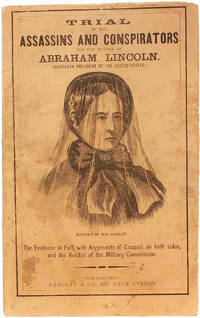
1865005102<p>Philadelphia: Barclay & Co. 1864 1865 1865. FIRST EDITION. 1 vol. 9-1/4" x 5-3/4" original pictorial wrappers illustrated pagination irregular but complete original stitching completely unsophisticated without repairs internally clean and bright mild general handling but surely one of the nicest copies you're going to encounter VERY GOOD. McDade 623 According to RBH only 2 copies have ever appeared at auction. The last one in 2008. Variant issue mentioned by Howes with the illustration of the execution moved to p 96; also with misprint of copyright date as "1864". Featuring engraved portrait of Mary Surratt on cover. The assassination of Lincoln by John Wilkes Booth on the night of April 14 1865 need no retelling. Time however which has its own way with our judgments has raised some doubts about some of these. The unfairness of the military tribunal is now manifest and the guilt of Mrs. Surratt is certainly doubtful. This was amply demonstrated by the fact that only two years after the crime the government could not obtain the conviction of her son John Surratt in the civil courts in Washington.</p> Philadelphia: Barclay & Co., 1864 [1865]
186525618<p>Frank Leslie published this print as a premium for his new family magazine <i>Frank Leslie's Chimney Corner</i> and copyrighted it on April 8 1865 just a week before Lincoln's death. The image created by engraver Henry B. Major and lithographer Joseph Knapp portrays Lincoln flanked by the First Lady and Vice President Andrew Johnson greeting Julia Dent Grant wife of Lieutenant General Ulysses S. Grant who stands nearby.</p><p>According to a notice printed at the bottom right corner "<i>Every Person who pays Ten Cents each for numbers 1 and 2 of Frank Leslie's Chimney Corner The New Family Paper is entitled to a copy of this PLATE without extra charge</i>" or individuals could purchase the print for $3.</p> <b>ABRAHAM LINCOLN.</b>Lithograph. "Grand Reception of the Notabilities of the Nation at the White House 1865" New York: Frank Leslie April 1865. 1 p. 19 x 23¾ in.<p><br /></p><p>In the first issue of <i>The Chimney Corner</i> Leslie described the "Grand Reception" image as "the most costly gift plate ever presented by any publisher in the United States having been produced at an expense of $10000."</p><p>"Every family should possess this truly national picture and carefully preserve it" Leslie continued "as it will transmit to future generations the men who have restored our great national unity. It is especially valuable as it contains an excellent likeness of our late lamented President introducing General Grant and his wife to Mrs. Lincoln." The picture contains "nearly 100 portraits of our most celebrated Generals Statesmen and Civilians also of many of our most distinguished American ladies. The likenesses are admirable having been taken from photographs by Brady."</p><p>The key giving the names of each individual portrait was published in issue number 4 of the <i>Chimney Corner</i> on June 24.</p><p>Included in the image are Generals Ulysses S. Grant John G. Foster William T. Sherman Hugh J. Kilpatrick Nathaniel P. Banks Philip H. Sheridan Winfield S. Hancock John A. Logan Joseph Hooker Benjamin F. Butler Oliver O. Howard John A. Dix and Henry W. Slocum. Admirals David Farragut and David Dixon Porter represent the Navy. Members of the cabinet include Secretary of War Edwin M. Stanton Secretary of State William H. Seward and Secretary of the Navy Gideon Welles. Members of Congress include Senator Henry B. Anthony of Rhode Island Senator William P. Fessenden of Maine Senator Charles Sumner of Massachusetts and Speaker of the House Schuyler Colfax of Indiana. Chief Justice Salmon P. Chase represents the U.S. Supreme Court. New York newspaper editors Horace Greeley Henry J. Raymond and James Gordon Bennett are also present. Prominent women include First Lady Mary Lincoln Ann S. Stephens dime novelist and magazine editor Miriam Folline Squier wife of Leslie's former editor-in-chief and Leslie's future wife Julia Dent Grant wife of Ulysses S. Grant Kate Chase Sprague daughter of Chief Justice and wife of Rhode Island Senator and Adele Cutts Douglas widow of Stephen A. Douglas. Others identified in the key include Ephraim G. Squier Leslie's former editor-in-chief archaeologist and U.S. commissioner to Peru Governor Andrew G. Curtin of Pennsylvania and Ambassador to Russia Cassius M. Clay of Kentucky.</p><p>Despite Leslie's copyright Anton Hohenstein created a very similar image entitled "Lincoln's Last Reception" which also featured Lincoln's meeting General Ulysses S. Grant's wife Julia. Published by John Smith in Philadelphia in 1865 and hand-colored "Lincoln's Last Reception" also included more than thirty military and political leaders and a few prominent women among the onlookers in the ballroom.</p><p><b><i>Frank Leslie's Chimney Corner</i></b> 1865-1884 was a weekly family newspaper published "every Tuesday" in New York by Frank Leslie. Each illustrated issue of sixteen pages contained serial fiction short stories poetry biographies history travel sketches natural history anecdotes and other subjects. According to the prospectus the newspaper would be "a welcome messenger of instruction and amusement to the young and old in the family and by the fireside—that altar around which cluster our holiest and most cherished recollections." Leslie had copyrighted the title in 1861 but "the great Rebellion now happily closing intervened to put a stop to the enterprise."</p><p><b>Frank Leslie</b> 1821-1880 was born in England as Henry Carter but he adopted the pseudonym of Frank Leslie to keep his artistic activities a secret from his relatives who disapproved. He came to the United States in 1848 and settled in New York in 1853 to engrave woodcuts for P. T. Barnum's <i>Illustrated News</i>. When that publication failed Leslie began work on his own series of illustrated publications including <i>Frank Leslie's Illustrated Newspaper</i> <i>The Budget of Fun</i> <i>Frank Leslie's Chimney Corner</i> and others. At his death he was deeply in debt but his second wife Miriam Folline Squier 1836-1914 continued his publications and again made them profitable even legally changing her name to Frank Leslie in 1881.</p><p><b>Condition</b></p><p>Spot-mounted to modern board mat toning moderate foxing minor edge wear. Would benefit from conservation.</p> Frank Leslie books
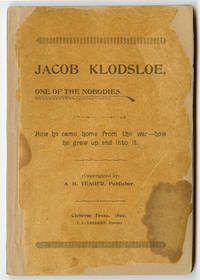
189944062Cleburne TX: A.H. Yeager publisher T. L. Saunders printer 1899. 12mo.; 129pp. Original printed gray wrappers some wear to spine; text paper somewhat browned but a very good copy. First edition. Autobiographical story of a Confederate soldier from Washington County Tennessee; Civil War experiences include his capture at Kennesaw Mountain in June 1864 his incarceration as a prisoner of war at Camp Douglas Illinois his journey home and after reflecting on his childhood in east Tennessee how he came to join an infantry company as the war began. Yeager 1842-1940 served with the 29th Tennessee Infantry Confederate until his capture; though not included in this autobiography his post-Civil War years were spent first as a lawyer in Tennessee then as a newspaperman and farmer in Johnson County Texas. Rare. OCLC locates ten copies but only one in Tennessee Knox County Public. Not in Nevins Eicher or Broadfoot. Not in Sam Smith's TENNESSEE HISTORY: A BIBLIOGRAPHY. <br/><br/> A.H. Yeager, publisher (T. L. Saunders, printer) unknown books
186423516Boston: Wright & Potter 1864. First Thus. Octavo 23.5cm.; publisher's drab printed wrappers; 88cxpp.; large folding map of Gettysburg bound in. Some shallow chipping and small losses to wrapper extremities none approaching text dampstaining most heavily so to rear cover title page and preliminary leaves else Near Very Good. Includes the third or fourth earliest appearance in book-form of Lincoln's Gettysburg Address printed here on p. lxxii simply as "Dedicatory Speech." See MONAGHAN p. 48. Wright & Potter unknown books
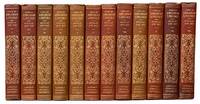
18942311448Harrogate Tennessee: Lincoln Memorial University 1894. Limited Edition. Full-Leather. Very Good/No Jacket. Limited edition #399 of an unspecified limitation this set 'especially prepared for Harry J. Williams.' Signed by John Wesley Hill opposite limitation page. Copyright page states 1894 but this is clearly reproduced from the plates of the original - this set is circa 1905. Volume 1 has very minor discoloration to edges of cloth on rear board minor wear to corners spine a bit faded. Complete in twelve hardcover volumes. Red full leather gilt titles & decorations top edges gilt decorative endpapers. A complete collection of Abraham Lincoln's works including speeches letters biographical writings etc. with an introduction by John Wesley Hill and special articles by various other contributors. The editors were Lincoln's private secretary and assistant secretary and also served in various other governmental roles Hay going on to become Secretary of State under McKinley and Roosevelt. Nicolay and Hay are perhaps best known for their ten-volume biographical history of Lincoln's administration originally published serially in The Century Magazine beginning in 1886 -- it remains one of the more exhaustive and personal accounts of the life of the 16th President of the United States and is notable for the inclusion of facsimiles of original drafts of important documents most importantly the Emancipation Proclamation. This set includes facsimiles of original correspondence and documents reproductions of contemporary photographs and engravings etc. Lincoln Memorial University hardcover books
18942283609Lincoln Memorial University 1894. Limited Edition. Full-Leather. Near Fine/No Jacket. Limited edition #212 of an unspecified limitation this set 'especially prepared for Ann Emerson Strong to whom it was presented by her father Pritchard H. Strong. Copyright page states 1894 but this is clearly reproduced from the plates of the original - this set is circa 1905. Small chip from spine head of volume 7 1/4 inch tear to spine head of first volume otherwise an excellent set small bookplate with initials A.E.S. on front endpaper of first volume. Complete in twelve hardcover volumes. Red full leather gilt titles & decorations top edges gilt decorative endpapers. A complete collection of Abraham Lincoln's works including speeches letters biographical writings etc. with an introduction by John Wesley Hill and special articles by various other contributors. The editors were Lincoln's private secretary and assistant secretary and also served in various other governmental roles Hay going on to become Secretary of State under McKinley and Roosevelt. Nicolay and Hay are perhaps best known for their ten-volume biographical history of Lincoln's administration originally published serially in The Century Magazine beginning in 1886 -- it remains one of the more exhaustive and personal accounts of the life of the 16th President of the United States and is notable for the inclusion of facsimiles of original drafts of important documents most importantly the Emancipation Proclamation. This set includes facsimiles of original correspondence and documents reproductions of contemporary photographs and engravings etc. Lincoln Memorial University hardcover books
18666114no place given: William E. Marshall 1866. Very good . Lithograph measuring about 17." x 22.5" full margins; likely untrimmed. The image measures about 15.75" x 20.5". Matted and framed and has not been examined out of frame. Offsetting/age-toning affects the right half of the print although this is only visible at the margin not within the image. Important 1866 engraving of the recently deceased 16th president; Marshall sent copies to many of Lincoln's closest friends and colleagues and the response was one of unanimous praise. Highly detailed and dignified it presents the statesman as a figure of great worth; even of immortailty. This example handsomely presented in a double matte and deep brown wooden frame. William E. Marshall unknown
1899WRCAM52883Cleburne Tx.: T.L. Sanders 1899. 129pp. Original printed wrappers. Small chip to top corner of front wrapper and spine tail small stain to top corner of first few leaves last few leaves and rear wrapper chipped at lower corner not affecting text. Contents tanned as usual. Good plus. The autobiographical story of a Confederate soldier from an area described as having "Carolina's tallest peaks" on its southeastern horizon. Most names in the story appear to be fictional. Includes his capture at Kennesaw Mountain in June 1864 as a prisoner of war at Camp Douglas Illinois journey home and how he came to join an infantry company. Yeager 1842-1940 served with the 29th Tennessee Infantry Confederate until his capture. After the war he was a lawyer in Tennessee then a newspaperman and farmer in Johnson County Texas. Rare. Not in any of the standard reference works on the Civil War or Tennessee. T.L. Sanders unknown books
189963536Cleburne TX: A. H. Yeager Publisher T. L. Sanders Printer 1899. First edition. 12mo. 129 pp. Autobiographical account of a Confederate soldier from Washington County Tennessee; Civil War experiences include his capture at Kennesaw Mountain in June 1864 his incarceration as a prisoner of war at Camp Douglas Illinois his journey home and after reflecting on his childhood in east Tennessee how he came to join an infantry company as the war began. Yeager 1842-1940 served with the 29th Tennessee Infantry until his capture; though not included here his post-Civil War years were spent first as a lawyer in Tennessee then as a newspaperman and farmer in Johnson County Texas. Not in Nevins Dornbusch Eicher Nicholson or Broadfoot. OCLC locates 23 copies but only one in Tennessee Knox County Public. Text pages a little toned but a very good copy. Original printed wrappers a little wear to the spine. 10020. <br/><br/> A. H. Yeager, Publisher, T. L. Sanders, Printer unknown books
186125613<p>An unusual and possibly unique Lincoln portrait above patriotic banners and a quotation from his first inaugural address.</p> <b>ABRAHAM LINCOLN. GABRIEL KAEHRLE.</b>Print. "Abraham Lincoln" with excerpt from First Inaugural Address ca. 1861-1864. 9¾ x 12 in.<p><b><br /></b></p><p><b>Complete Transcript</b></p><p> <i>ABRAHAM LINCOLN</i></p><p><i> SIXTEENTH PRESIDENT OF THE UNITED STATES</i></p><p><i>"In your hands my dissatisfied fellow-countrymen and not in mine is the momentous issue of Civil War. You have no oath registered in heaven to destroy the Government while I have the most solemn one to 'preserve protect and defend it.' The mystic chords of memory stretching from every battle-field and patriot-grave to every living heart in this broad land will swell the chorus of the Union when again touched as surely they will be by the better angels of our nature."</i></p><p><i>Extract from the closing paragraph of Lincoln's Inaugural Message March 4 1861.</i></p><p>A lithograph of this same Lincoln image retaining Kaehrle's signature was used in a jugate 1864 campaign illustration of Lincoln and Andrew Johnson published by H. H. Lloyd & Co. in New York.</p><p><b>Gabriel Kaehrle</b> is listed in an 1857 New York directory as an engraver and he illustrated books which were published in New York in 1860 and 1862.</p><p>Very rare and possibly unique. None in OCLC and no other examples traced.</p><p><b>Condition</b></p><p>Staining to edges shadow of former matting; professionally conserved.<br /></p> books
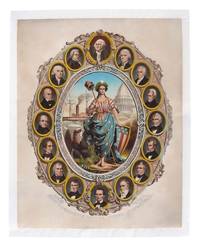
186131279Philadelphia: F. Bouclet 1861. Very Good. Philadelphia: F. Bouclet 1861. Original color lithograph 68x54cm. Mounted to matte backing; marginal tears and soiling; rubbing and a few scrapes around title; colors remain bright; a Very Good copy. <br /> <br /> This large vibrant lithograph was issued to commemorate Lincoln's first inauguration depicting the first sixteen Presidents with George Washington at top a beardless Abraham Lincoln at the bottom. The female personification of Columbia stands in the center before the Capitol holding a shield and staff with a liberty cap. The Capitol Dome sits in the background and is depicted as the artist anticipated it would look--the structure was not completed until late 1863. A handsome and uncommon print scarce in retail and auction records with only two holdings found in OCLC at the Library of Congress and the Mankato Area Public School District in Minnesota. . F. Bouclet unknown
186358199Camp near Brooks Station Saturday April 11 1863. Fine original condition. 15-1/2 x 9-3/4 inches. ".Yesterday I witnessed one of the grandest sights that I ever beheld. Our whole corps was reviewed by the President Generals Hooker McLain Howard Steinway Secretary Seward and an innumerable host of Brigadier Generals and it was a sight that has paid me for coming to war." The spectacle is described in great detail. Private Penfield was soon to be captured at Chancellorsville spending 12 days as a prisoner of war before being exchanged. He survived the war to carry on his father's carriage making business in Monroe Connecticut and later founded a small private academy. unknown
186085724Chicago: Charles Leib 1860. Very Good. Four-page newspaper. A couple of small holes various brown spots and other bits of minor wear A campaign newspaper for Abraham Lincoln in the Presidential Campaign of 1860. We note a half-column story on the front page of this issue that accuses Senator Douglas of being a Roman Catholic -- a charge based partly on the fact that Mrs. Douglas was a Catholic as were their children -- probably an effective charge in largely Protestant mid-19th century America. Our brief research suggests that Douglas was neither a Catholic nor a formal member of any other organized religious group. The purpose of another half-column story on the front page was to make it clear that Lincoln had publicly condemned the actions of John Brown and did not object to Brown's execution. Charles Leib the editor was a political operative with an unclear background who had previously edited a Democratic campaign newspaper on behalf of the Buchanan campaign in 1856. Leib served briefly as an Assistant Quartermaster in the Union Army before heading to New Mexico probably in 1863 and died there in 1865 at the age of 38. Charles Leib unknown