987 résultats
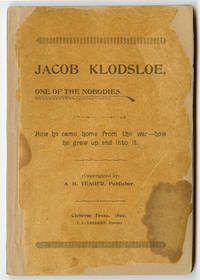
189944062Cleburne TX: A.H. Yeager publisher T. L. Saunders printer 1899. 12mo.; 129pp. Original printed gray wrappers some wear to spine; text paper somewhat browned but a very good copy. First edition. Autobiographical story of a Confederate soldier from Washington County Tennessee; Civil War experiences include his capture at Kennesaw Mountain in June 1864 his incarceration as a prisoner of war at Camp Douglas Illinois his journey home and after reflecting on his childhood in east Tennessee how he came to join an infantry company as the war began. Yeager 1842-1940 served with the 29th Tennessee Infantry Confederate until his capture; though not included in this autobiography his post-Civil War years were spent first as a lawyer in Tennessee then as a newspaperman and farmer in Johnson County Texas. Rare. OCLC locates ten copies but only one in Tennessee Knox County Public. Not in Nevins Eicher or Broadfoot. Not in Sam Smith's TENNESSEE HISTORY: A BIBLIOGRAPHY. <br/><br/> A.H. Yeager, publisher (T. L. Saunders, printer) unknown books
186423516Boston: Wright & Potter 1864. First Thus. Octavo 23.5cm.; publisher's drab printed wrappers; 88cxpp.; large folding map of Gettysburg bound in. Some shallow chipping and small losses to wrapper extremities none approaching text dampstaining most heavily so to rear cover title page and preliminary leaves else Near Very Good. Includes the third or fourth earliest appearance in book-form of Lincoln's Gettysburg Address printed here on p. lxxii simply as "Dedicatory Speech." See MONAGHAN p. 48. Wright & Potter unknown books
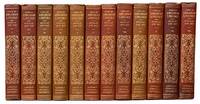
18942311448Harrogate Tennessee: Lincoln Memorial University 1894. Limited Edition. Full-Leather. Very Good/No Jacket. Limited edition #399 of an unspecified limitation this set 'especially prepared for Harry J. Williams.' Signed by John Wesley Hill opposite limitation page. Copyright page states 1894 but this is clearly reproduced from the plates of the original - this set is circa 1905. Volume 1 has very minor discoloration to edges of cloth on rear board minor wear to corners spine a bit faded. Complete in twelve hardcover volumes. Red full leather gilt titles & decorations top edges gilt decorative endpapers. A complete collection of Abraham Lincoln's works including speeches letters biographical writings etc. with an introduction by John Wesley Hill and special articles by various other contributors. The editors were Lincoln's private secretary and assistant secretary and also served in various other governmental roles Hay going on to become Secretary of State under McKinley and Roosevelt. Nicolay and Hay are perhaps best known for their ten-volume biographical history of Lincoln's administration originally published serially in The Century Magazine beginning in 1886 -- it remains one of the more exhaustive and personal accounts of the life of the 16th President of the United States and is notable for the inclusion of facsimiles of original drafts of important documents most importantly the Emancipation Proclamation. This set includes facsimiles of original correspondence and documents reproductions of contemporary photographs and engravings etc. Lincoln Memorial University hardcover books
18942283609Lincoln Memorial University 1894. Limited Edition. Full-Leather. Near Fine/No Jacket. Limited edition #212 of an unspecified limitation this set 'especially prepared for Ann Emerson Strong to whom it was presented by her father Pritchard H. Strong. Copyright page states 1894 but this is clearly reproduced from the plates of the original - this set is circa 1905. Small chip from spine head of volume 7 1/4 inch tear to spine head of first volume otherwise an excellent set small bookplate with initials A.E.S. on front endpaper of first volume. Complete in twelve hardcover volumes. Red full leather gilt titles & decorations top edges gilt decorative endpapers. A complete collection of Abraham Lincoln's works including speeches letters biographical writings etc. with an introduction by John Wesley Hill and special articles by various other contributors. The editors were Lincoln's private secretary and assistant secretary and also served in various other governmental roles Hay going on to become Secretary of State under McKinley and Roosevelt. Nicolay and Hay are perhaps best known for their ten-volume biographical history of Lincoln's administration originally published serially in The Century Magazine beginning in 1886 -- it remains one of the more exhaustive and personal accounts of the life of the 16th President of the United States and is notable for the inclusion of facsimiles of original drafts of important documents most importantly the Emancipation Proclamation. This set includes facsimiles of original correspondence and documents reproductions of contemporary photographs and engravings etc. Lincoln Memorial University hardcover books
1899WRCAM52883Cleburne Tx.: T.L. Sanders 1899. 129pp. Original printed wrappers. Small chip to top corner of front wrapper and spine tail small stain to top corner of first few leaves last few leaves and rear wrapper chipped at lower corner not affecting text. Contents tanned as usual. Good plus. The autobiographical story of a Confederate soldier from an area described as having "Carolina's tallest peaks" on its southeastern horizon. Most names in the story appear to be fictional. Includes his capture at Kennesaw Mountain in June 1864 as a prisoner of war at Camp Douglas Illinois journey home and how he came to join an infantry company. Yeager 1842-1940 served with the 29th Tennessee Infantry Confederate until his capture. After the war he was a lawyer in Tennessee then a newspaperman and farmer in Johnson County Texas. Rare. Not in any of the standard reference works on the Civil War or Tennessee. T.L. Sanders unknown books
189963536Cleburne TX: A. H. Yeager Publisher T. L. Sanders Printer 1899. First edition. 12mo. 129 pp. Autobiographical account of a Confederate soldier from Washington County Tennessee; Civil War experiences include his capture at Kennesaw Mountain in June 1864 his incarceration as a prisoner of war at Camp Douglas Illinois his journey home and after reflecting on his childhood in east Tennessee how he came to join an infantry company as the war began. Yeager 1842-1940 served with the 29th Tennessee Infantry until his capture; though not included here his post-Civil War years were spent first as a lawyer in Tennessee then as a newspaperman and farmer in Johnson County Texas. Not in Nevins Dornbusch Eicher Nicholson or Broadfoot. OCLC locates 23 copies but only one in Tennessee Knox County Public. Text pages a little toned but a very good copy. Original printed wrappers a little wear to the spine. 10020. <br/><br/> A. H. Yeager, Publisher, T. L. Sanders, Printer unknown books
19042550New York: King Memorial Committee of The Century Association by G.P. Putnam's Sons 1904. First Edition. Leather bound. Near fine. Letter from Secretary of State John Hay to General James Grant Wilson regarding a lock of President Lincoln's hair. Octavo. vii 429pp. Three quarter green morocco title in gilt on spine decorative compartments. Frontispiece portrait with issue cover. Marbled endpapers. Bookplate affixed to front endpaper. Top edge gilt. Letter affixed to front endpaper from Secretary of State John Hay to Gen. James Wilson Grant dated November 8 1902 in response to an inquiry over whether he still possessed a lock of Lincoln's deathbed hair. Includes envelope. Letter notes that he "greatly regrets that I am not the possessor of a lock of Lincoln's hair. I had a little of it for a year or two after his death but in some unaccountable way it was lost." John Hay's search for locks of Lincoln's hair would be a lifelong passion for the friend of the slain president. In 1893 Hay wrote to Doctor Charles Sabin Taft a bystander physician who attended to President Lincoln after being shot at Ford's Theater asking if the doctor had any strands of hair in his possession. Doctor Taft declined to barter for his memento but in 1905 his son found the original letter and contacted Hay. In a hurry the hair was purchased by Hay and promptly encased in a yellow ring. This yellow ring was sent to President Theodore Roosevelt on the occasion of his inauguration. He wore the ring to his inauguration and it remains in the Theodore Roosevelt collection at Sagamore Hill. Mearns 1959. King Memorial Committee of The Century Association by G.P. Putnam's Sons unknown books
15782206Antwerp: Plantin 1578. Hardcover. Very Good. 4to - over 9¾ - 12" tall. 4to. 23 x 16.5 cm 4 ff. 417 1 pp. 1 f. Bound in contemporary vellum over flexible boards head slightly chipped; early signature on t-p. Woodcut 'golden compass' device of the Plantin press on title. Generally good. First edition of this early modern geographical dictionary published alongside the first Plantin edition of Ortelius' successful Theatrum orbis terrarum Antwerp 1579 and listing thousands of names both ancient and modern for "peoples regions islands great and small towns mountains foothills forests seas bays lakes" etc. depicted in the atlas. Earlier versions of the Synonymia had previously appeared as indices to the atlas containing a little over 2000 entries; "in all this first version of Ortelius' geographical dictionary in the form of a separate book includes approximately 10000 entries" Meurer. Ortelius' methodology in the present volume differs from that of his earlier indices: a parallel glossary of non-Latin names has been turned into a bilingual appendix and Ortelius relies almost completely on classical authors quoting moderns only when he cannot go straight to the source. The significance of these alterations for the author's role not as mapmaker but as linguist and lexicographer is hard to overstate: his introduction declares that he undertook the new Synonymia largely out of frustration at the scholarly inadequacy of current Latin lexica including earlier editions of his own which frequently printed inexact or even nonexistent terms sometimes on dodgy authority. Voet 1835; Skelton Theatrum orbis terrarum facsimile 1964; Meurer in Abraham Ortelius and the First Atlas ed. Voet pp. 331-346. Plantin hardcover books
159517860Antwerp: Ortelius 1595. Copper-engraved map with full original colour Latin text on verso of one half of the sheet in excellent condition apart from a small expert repair to the left blank margin and a small section of the upper blank margin torn away. A superb map of Europe by one of the greatest names in the history of cartography.<br/> <br/>This important map of Europe derives in large part from Mercator's work; Russia from Jenkinson's map; Scandinavia from Olaus Magnus. The relatively modest cartouche shows a partially covered and apparently distraught Europa sitting on the back of Zeus in the form of a placid bull he the unwelcome lover of Europa both gazing toward Europe curious about its future. Published in a Latin edition of Ortelius' s ground-breaking atlas Theatrum Orbis Terrarum.<br/> <br/>van den Broecke Ortelius Atlas Maps 5. Ortelius unknown books
16808291Amsterdam: Adriaen Moetjens La Haye 1680 4 volumes. Second edition revised corrected and augmented. 24mo. Pp. 28 781 16 18 771 20 12 588 12 16 750 16. Illustrated with 2 folding copper-engraved plates. Contemporary full polished calf blind-stamped dentelle on covers spines extra gilt marbled ends. Circular library stamp on each title page. A superior complete set in handsome matched bindings clean and crisp throughout. A very fine set perhaps the finest extant. A rare collection of 17th century diplomatic texts treatises extracts dispatches negotiation and correspondence. This work provides important original sources and contemporary accounts of the Treaties of Peace of Nijmegen. These series of treaties signed in the Dutch city of Nijmegen between August 1678 and December 1679 ended various interconnected wars among France the Dutch Republic Spain Brandenburg Sweden Denmark the Prince-Bishopric of Munster and the Holy Roman Empire. Text in French. Excessively scarce. Only two sets located in France by OCLC; no copies at auction in fifty years. Adriaen Moetjens, La Haye unknown books
186125613<p>An unusual and possibly unique Lincoln portrait above patriotic banners and a quotation from his first inaugural address.</p> <b>ABRAHAM LINCOLN. GABRIEL KAEHRLE.</b>Print. "Abraham Lincoln" with excerpt from First Inaugural Address ca. 1861-1864. 9¾ x 12 in.<p><b><br /></b></p><p><b>Complete Transcript</b></p><p> <i>ABRAHAM LINCOLN</i></p><p><i> SIXTEENTH PRESIDENT OF THE UNITED STATES</i></p><p><i>"In your hands my dissatisfied fellow-countrymen and not in mine is the momentous issue of Civil War. You have no oath registered in heaven to destroy the Government while I have the most solemn one to 'preserve protect and defend it.' The mystic chords of memory stretching from every battle-field and patriot-grave to every living heart in this broad land will swell the chorus of the Union when again touched as surely they will be by the better angels of our nature."</i></p><p><i>Extract from the closing paragraph of Lincoln's Inaugural Message March 4 1861.</i></p><p>A lithograph of this same Lincoln image retaining Kaehrle's signature was used in a jugate 1864 campaign illustration of Lincoln and Andrew Johnson published by H. H. Lloyd & Co. in New York.</p><p><b>Gabriel Kaehrle</b> is listed in an 1857 New York directory as an engraver and he illustrated books which were published in New York in 1860 and 1862.</p><p>Very rare and possibly unique. None in OCLC and no other examples traced.</p><p><b>Condition</b></p><p>Staining to edges shadow of former matting; professionally conserved.<br /></p> books
1700D5997Nurnberg: J. Chr. Weigel c. 1700. First and only Edition. Hardcover. Very Good. Speckled calf gilt-stamped ornament on spine; 4to; with copper-engraved title-page and 67 copper-engraved plates 1 of them lightly colored. Very rare work illustrating various human follies and obsessions according to Bertsche not by Santa Clara although that's the general assumption. Title-page and 1 plate professionally restored; some plates neatly repaired with tape or reinforced with paper on the verso; occasional marginal chip or tear infringing upon the image itself in just 2 instances; 2 plates with marginal ink doodles. <br/><br/> J. Chr. Weigel hardcover books
183723104.01<p>Lincoln and John Todd Stuart cousin of Lincoln's future wife Mary Todd had served together in the Illinois House of Representatives from 1834-1836. They formed Stuart & Lincoln on April 12 1837.</p> <b>ABRAHAM LINCOLN.</b>Newspaper. <i>Sangamo Journal</i> Springfield Ill. December 23 1837. 4 pp. 18 x 24¾ in. Double matted and framed with glass on both sides to display pages one and four. Slightly chipped 26 x 33 in. frame.<p>In the upper portion of the first column of the first page appears this five line advertisement: <i>"STUART & LINCOLN / ATTORNEYS and Counsellors at Law will practice / conjointly in the Courts of this Judicial Circuit. – / Office No. 4 Hoffman's Row up stairs. / Springfield april 12 1837."</i> Two ads directly above: <i>"NINIAN W. EDWARDS / ATTORNEY & COUNSELLOR AT LAW / Springfield – Illinois."</i></p><p>Lincoln had moved from New Salem Illinois to Springfield in 1836. He had first met fellow attorney Ninian W. Edwards when both were members of the Illinois State House of Representatives. Edwards married Elizabeth Todd in 1832 and Lincoln met Elizabeth's sister Mary Todd at the Edwards home where Mary had moved in 1839. On November 4 1842 Lincoln and Mary Todd were married in the Edwards mansion.</p><p>The <i>Sangamo Journal </i>started publishing in 1831 shortly after a young Lincoln settled in New Salem. The newspaper faithfully supported Abraham Lincoln and the Whig Party throughout many name changes: the <i>Illinois Journal</i> 1847 shortly after Lincoln left for Congress then the <i>Illinois State Journal</i>1855. As the Whig party broke up the newspaper supported the newly-formed Republican Party and Abraham Lincoln's rising political star.</p><p><b> Condition</b></p><p>Very fine with no visible tears.</p> books
1907876081907. Photograph signed and dated "Gutzon Borglum 1907." The photograph taken by Borglum shows his marble bust of Abraham Lincoln. On February 6 1908 the President's son Robert Todd Lincoln wrote to Borglum regarding the bust as "the most extraordinarily good portrait of my father I have ever seen." The sculpture is on display in the Crypt of the U.S. Capitol Building. A<i> </i>typed Lincoln quotation pasted to mount at lower left. In very good condition. Double matted and framed. The entire piece measures 15 inches by 17.5 inches. Sculptor Gutzon Borglum designed and oversaw the execution of the Mount Rushmore National Memorial from 1927 to 1941 with the assistance of his son Lincoln Borglum. Conceived by South Dakota historian Doane Robinson the 60-foot sculpture was initially intended to promote tourism in the Black Hills Region of South Dakota. unknown books
6726Engraved frontis.; eight engraved vignettes and head- & tailpieces 19 finely engraved plates most folding & some engravings in the text. 18 p.l. 254 36 pp. of index & errata. Thick 8vo 160 x 105 mm. late 18th-cent. marbled boards extremities a little rubbed & worn. Dresden: C. G. Nitzsche 1765. An important German edition of Bosse's Traité des manières de graver en Taille douce 1st ed. in French: 1645 considerably augmented for the German audience. This work was translated and published by Carl Gottlieb Nitzsche from the 1745 Cochin edition. The Cochin edition was the first to promote etching with hard etching-ground vernis dur instead of the soft etching-ground vernis mol to imitate line engraving. It also featured long sections on Le Blon's color printing and the refining of mezzotint illustration. In the present book we find four illustrations of the rolling press which Cochin had updated to account for several design upgrades. There are also several diagrams and cross-sections of printing presses. This book is richly illustrated with plates and vignettes executed by Carl Gottfried Nestler 1730-80 that depict various techniques equipment and the interiors of print shops. Nestler reworked the engraved title-page from the 1645 first edition for this book's frontispiece. A very good copy internally fresh. Unidentified engraved bookplates with the initials "G. F." on front and rear paste-downs. ❧ Benezit Dictionary of Artists Vol. 10 p. 258 Nestler. hardcover books
1756S13188London:: A. Millar 1756. 1756. Quarto. 4 xi 1 errata 348 pp. Portrait medallion vignette on title; mild foxing but barely noticeable. Original full calf red gilt-stamped leather spine label; hinges repaired with calf inner joints strengthened corners worn all preserving original spine. Bookseller's ticket: "Sold by Carpenter & Co. 14 Old Bond Street" London. Early ownership ink signature of Th. Spencer; penciled initials of F.N.D. see below. Very good. A KEY WORK BY THE FATHER OF PROBABILITY THEORY. Third edition. This is a key work by the father of probability theory in which major steps in the measurement of uncertainty were achieved. De Moivre is "best known in statistical circles for his famous large-sample approximation to the binomial distribution whose generalization is now referred to as the Central Limit Theorem. De Moivre was one of the great pioneers of classical probability theory." Bellhouse-Genest p.1. It is the first systematic treatment of probability in English. Abraham De Moivre became with Edmund Halley a founder of English actuarial science. The author's dedicatory letter is address to Lord George Carpenter 1702-1749 the first edition had been dedicated to Newton where the author states emphatically "that this Doctrine is so far from encouraging Play that it is rather a Guard against it. . ." DNB vol. 38 p.116. / "The first edition of this work contains 175 pages the second edition 258 pages and the third 348 pages. The following list will indicate the parts which are new in the third edition: the Remark pages 30/33 and pages 48 & 49 the greater part of the second Corollary pages 64/66 the Examples page 88; the Scholium page 95 the Remark page 149 and pages 151/159 the fourth Corollary page 162 the second Corollary pages 176/179 the note at the foot of page 187 the Remark pages 251/254. The part on life annuities is very much changed. The Introduction is very much fuller than the corresponding part of the first edition. In his third edition De Moivre draws attention to the convenience of approximating to a fraction with a large numerator and denominator by continued fractions which he calls "the Method proposed by Dr. Wallis Huygens and others". He gives the rule for the formation of the successive convergents. This third edition contains 74 problems exclusive of those relating to life annuities in the first edition there were 53 problems. The pages 220/229 contains one of De Moivre's most valuable contributions to mathematics namely that of Recurring series. Pages 261/328 are devoted to Annuities on lives ; an Appendix finishes the book occupying pages 329/348 : this also relates principally to annuities but it contains a few notes on the subject of probability." :: Todhunter. A very full account of the above third edition will be found in Todhunter's History of the theory of probability. / "De Moivre's first book on probability was based upon a short memoir entitled De mensura sortis published in the 1711 volume of the Philosophical Transactions. The 1718 first edition is essentially a gambler's manual giving a systematic presentation of the arithmetic principles upon which are based the solution of problems concerning the advantage of players and size of wager which may be lain in a wide variety of games of chance. Walker. It does not contain De Moivre's work on the normal approximation of the binomial probability distribution which ranks as the most memorable of his discoveries; this discovery was first printed in its entirety in 1733 in a Latin pamphlet which was later translated into English and incorporated in successively expanded versions in the second 1738 and posthumous third 1756 edition of The doctrine of chances." Norman. / In terms of mathematics applied to the human actuarial lifespan "De Moivre French Huguenot mathematician and demographer formulated the hypothesis that among a body of persons over a certain age the successive annual decreases by death are nearly equal." Garrison & Morton. / "De Moivre's work on the theory of probability surpasses anything done by any other mathematician except Laplace. His principal contributions are his investigations respecting the duration of play his theory of recurring series and his extension of the value of Bernouilli's theorem by the aid of Sterling's theorem". Cajori. / De Moivre born at Vitry received a varied education and settled in London as a Huguenot refugee in 1688. In England he continued his study of mathematics while working as a tutor. He is said to have acquired and read a copy of Newton's Principia and even to have carried loose sheets around with him to study at every available moment. This method of study worked so well that not only did he become one of England's foremost mathematicians but Newton in old age was in the habit of referring questions about the Principia to De Moivre. De Moivre's Doctrines of Chance is in fact a revised and expanded translation of his essay De Mensura Sortis which had been published in Latin in the Philosophical Transactions in 1711. In its Latin form it thus preceded Jacob Bernoulli's Ars Conjectandi 1713 by a full two years. / De Moivre was a French mathematician famous for De Moivre's formula which links complex numbers and trigonometry and for his work on the normal distribution and probability theory. He was elected a Fellow of the Royal Society in 1697 and was a friend of Isaac Newton Edmund Halley and James Stirling. Among his fellow Huguenot exiles in England he was a colleague of the editor and translator Pierre des Maizeaux. / Shafer points out that De Moivre one of Jacob Bernoulli's successors was among those who were applying Huygens' theories to both games and economies p. 11. He points out that the 1718 first edition was influenced by Bermoulli in that he used the word "probability" which was a word he did not use in his De mensura sortis. He continues: "We should not exaggerate De Moivre's importance in the eighteenth century. In retrospect he represents the pat that mathematical probability followed but he was hardly a philosopher of Jacob's caliber and Jacob retained a strong influence throughout the century among those who wanted to understand probability philosophically. Jacob's and Hooper's rules survived the whole course of that century in the works of philosophically sophisticated writers such as Lambert and Diderot. They disappeared only after Bayesian alternatives were developed by Laplace." pp. 13-14. Steve Stigler and Lorraine Daston expand on the use of the word "probability" in the eighteenth century. / Theodore Porter UCLA writes that De Moivre introduced the astronomer's law error to probability theory p. 93. "Like most early probability mathematics it first arose in the context of games of chance; it appeared as the limit of the binomial distribution. Because of its usefulness in combination and permutation problems the binomial had become the heart of the doctrine of chances. . . De Moivre then showed in a paper of 1733 reprinted in 1738 in the second edition of his Doctrine of Chances that the exponential error function gave a very good approximation to the distribution of possible outcomes for problems like the result of 1000 coin tosses Now for the first time it was practicable to apply probability theory to indefinitely large numbers of independent events." / PROVENANCE: I Thomas Spencer undetermined. II F.N.D. :: Florence Nightingale David 1909-1993 also known as F. N. David was an English statistician born in Ivington Herefordshire England. She was named after Florence Nightingale who was a friend of her parents. David did not like her forenames and thus always referred to herself as "F. N. David". She attended the Bedford College for Women in London earning her degree in mathematics in 1931. She then joined University College London to work with Karl Pearson who obtained a scholarship for her working as his research assistant resulting in a doctorate received in 1938 Pearson died in 1934. In 1938 her first book was published Tables of the Correlation Coefficient. During that period she was working with Jerzy Neyman. "During World War II she served as Experimental Officer in the Ordnance Board for the Ministry of Supply Senior Statistician for the Research and Experiments Department for the Ministry of Home Security Member of the Land Mines Committee of the Scientific Advisory Council and as Scientific Advisor on Mines to the Military Experimental Establishment. Her work during this time ranged from the study of bombing patterns and damage to the problem of discovering the placement of enemy land mines and a methodology for randomly placing land mines so as to avoid the semblance of any pattern in their placement." Garber et.al. After WWII she came back to University College London and was appointed professor in 1962. Five or six years later she took a position at the University of California Riverside becoming head of the Department of Statistics in 1970. Retiring in 1977 she came to Berkeley and continued her research. this book bears her initials on the Francis Galton Laboratory bookplate; she gave her books to Margaret Stein of Stanford University. See: M. J. Garber D. V. Gokhale J. M. Utts R. J. Beaver Chair "Florence Nightingale David Statistics: Riverside." Obituary; "A conversation with F.N. David" Statistical Science Vol. 4 No. 3235-246 by Nan Laird; J. Utts "Florence Nightingale David 1909-1993: Obituary" Biometrics 1993 49 1289-1291; Norman L. Johnson & Samuel Kotz eds. Leading Personalities in Statistical Sciences from the Seventeenth Century to the Present Wiley 1997 pp. 91-92. / REFERENCES: Babson 181 1st ed.; Ball A short account of the history of mathematics pp. 383-4; BM Readex Vol. 17 p. 751; Cajori History of Mathematics pp. 229-30; DNB vol. 38 p.116; Kress S.2793; Institute of Actuaries 1935 p. 39; Mansutti 504; Norman 1529 1st ed.; Pearson The History of Statistics in the 17th & 18th Centuries. . . pp. 155-60 165-66; Smith Source book in mathematics pp. 440-54; Stigler The History of Statistics: The Measurement of Uncertainty before 1900 1986 p. 70; Todhunter History of the theory of probability; Walker pp. 12-13; Wellcome IV p. 149; Westergaard pp. 104-5. Not in Goldsmiths or Hanson. / See: Raymond Clare Archibald "Abraham de Moivre"; David F.N. Games Gods and Gambling; The origins and history of probability and statistical ideas . . . 1962 pp. 161-178. A. Millar, 1756. hardcover books
1854008887Philadelphia: George W. Taylor 1854. Half leather. Very good. Philadelphia: George W. Taylor 1853-1854. Half leather. 24 monthly issues bound together. Complete; each volume contains 104 text pages. Half-leather with marbled boards; 6.75" x 10.25". Sound binding. Clean pages with light intermittent foxing. Old pencil annotation at top of the first title page. Light dampstain to the first six leaves. Some edgewear to cover; two-inch loss of spine covering at head and tail. This ardent abolitionist journal includes coverage of the debate regarding the expansion of slavery news of anti-slavery events some early writings of Frederick Douglass discussion of Quaker events American slavery laws Uncle Tom's Cabin temperance issues including the "Maine Law" and much more. The journal was the organ of the Free Produce Society of Philadelphia and its publisher George Taylor managed the city's Free Produce Store. 'Free Produce' included all manners of goods traditionally made with slave labor that were produced without any taint of slavery. Such items were much more expensive than slave-produced items but the most principled Quakers and abolitionists paid the price to keep their consciences clear. Although the Society disbanded in 1856 Taylor kept the store open until after the Civil War when customers no longer saw a reason to patronize him. See The Atlantic Monthly October 1868 and Cison's "Quality Came Second" in Main Line Today March 2007. Scarce. While digital and microform reprints are available at the time of listing OCLC shows only a few institutions holding intermittent original issues. Two auction records are on file at the Rare Book Hub. George W. Taylor unknown books
13623LINCOLN Abraham. Stereograph photo published by Keystone View Company. The original 1865 image was long attributed Mathew Brady and a handwritten note in pencil on verso mentions that attribution but the image was actually taken by Lewis Emory Walker a government photographer about February 1865 and published for him by the E. & H. T. Anthony Co. This rare stereograph O-104 was Published by Keystone. It is said that the short haircut was suggested by Lincoln's barber to facilitate the taking of his life mask by Clark Mills. Lincoln's eyes are deep and sorrowful; The civil war had taken its toll on him. One pen notation: "No 92" below the image Keystone bio of Lincoln on verso with their copyright. unknown books
1865863261865. BROADSIDE - Lithograph LINCOLN Abraham. EMANCIPATIONS PROKLAMATION. Davenport Iowa: W.H. Pratt 1865. August Hageboeck lithographer. This is the second German-language version of the Emancipation Proclamation. It is printed in cursive within an oval border. The weight of the individual letters is varied so that when viewed from a distance a portrait of Lincoln emerges from the text. Originally printed on a rectangular sheet but here trimmed to an oval that surrounds the image the sheet is 37 x 29.5 cm. The image is 32 x 23 cm. The paper is browned and dampstained at the bottom center at the copyright information. It is matted and housed in a custom archival portfolio. A rare print. unknown books
18641403210Wright & Potter 1864. 5th or later Edition. Soft cover. Very Good. Boston. 1864. 88110pp. plus folding map. Original printed paper wrappers. Internally clean back cover not attached anymore water stain at top of spine and around it. Very good. Devoted almost entirely to the Massachusetts war effort published early in January 1864. The folding map shows the Soldier's National Cemetery at Gettysburg dedicated November 19 1863 with the long speech of Edward Everett of Massachusetts and the short "Dedicatory Speech by President Lincoln" better known as the Gettysburg Address. Also printed is the "Programme of Arrangements" of that day a list of Massachusetts soldiers killed at Gettysburg and buried there and details of the cemetery. Monaghan notes this as an early printing of the Gettysburg Address. MONAGHAN LINCOLN BIBLIOGRAPHY I:48. This historically significant and very early book publication of the Gettysburg Address which may be the most important and certainly best known speech in US history is extremely uncommon and almost only found rebound or with the covers missing. This version intact and in its original condition is a coveted artifact of Americana. Comes in a custom-made slipcase. Wright & Potter unknown books
186085724Chicago: Charles Leib 1860. Very Good. Four-page newspaper. A couple of small holes various brown spots and other bits of minor wear A campaign newspaper for Abraham Lincoln in the Presidential Campaign of 1860. We note a half-column story on the front page of this issue that accuses Senator Douglas of being a Roman Catholic -- a charge based partly on the fact that Mrs. Douglas was a Catholic as were their children -- probably an effective charge in largely Protestant mid-19th century America. Our brief research suggests that Douglas was not a Catholic or a formal member of any other organized religious group. The purpose of another half-column story on the front page was to make it clear that Lincoln had publicly condemned the actions of John Brown and did not object to Brown's execution. Charles Leib the editor was a political operative with a murky background who had previously edited a Democratic campaign newspaper on behalf of the Buchanan campaign in 1856. Leib served briefly as an Assistant Quartermaster in the Union Army before heading to new Mexico probably in 1863 and died there in 1865 at the age of 38. <br/><br/> Charles Leib unknown books
1950131050Los Angeles: Twentieth Century-Fox 1950. Revised First Draft Continuity script for the 1951 film. Included is an index to the script breakdown detailing various scenes and script page numbers with revisions. Copy belonging to Dane Anderson an uncredited member of the crew with his name on the front wrapper of the script breakdown and annotations throughout in holograph pencil. File copy rubber-stamped on the front wrapper. <br/><br/>Based on Weidman's 1937 novel and Vera Caspary's loose adaptation. Harriet Boyd Hayward is a fashion designer who partners with Teddy Dailey whom she loves and Sam Jaffe and starts a new business dedicated to selling affordable women's dresses. A rival fashion company lead by Noble Sanders momentarily distracts Harriet but at the last minute she realizes her true devotion to Teddy and Sam. <br/><br/>Screenwriter Polonsky was blacklisted shortly after the film's release refusing to answer questions before the House Un-American Activities Committee. <br/><br/>White titled wrappers rubber-stamped as REVISED FIRST DRAFT CONTINUITY on the front wrapper copy No. 3 and production No. 2446.8 dated August 4 1950. Distribution page present with receipt removed. Title page present dated August 4 1950 noted as Revised 1st Draft Continuity with a credit for screenwriter Polonsky. 170 leaves with last page of text numbered 168. Mimeograph on eye-rest green stock. Pages and wrapper Near Fine internally bound with three gold brads. <br/><br/>Script Breakdown: self wrappers as issued. 88 leaves dated 10/2/50 mimeograph on eye-rest green stock. Near Fine bound with three gold brads. Twentieth Century-Fox unknown books
633xxxx 256 pp. 8vo cont. paste-paper boards minor foxing uncut. Freiberg: Gerlach 1791. First edition. This work by Werner who is known as the father of historical geology describes his "theory of the origin of ore deposits which would be consistent with his general theory of the origin of the earth's crust.Many of its elements were of lasting value. Werner formulated basic questions about the origin and history of veins and their contents established criteria for determining the relative age of veins and vein materials and presented a comparative study of the structure of veins and rock masses.Perhaps the most important contribution of Von den Entstehung der Gänge however was that it made the study of vein formation an integral part of historical geology."D.S.B. XIV pp. 262-63. Fine copy. Hoover 878. hardcover books
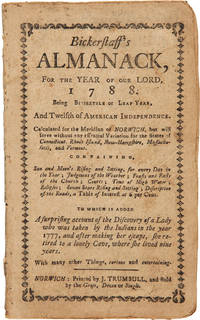
1787WRCAM51205Norwich 1787. 24pp. Dbd. Minor toning light foxing. Very good. In a blue cloth clamshell case gilt leather label. A rare and important Bickerstaff's almanac containing the first printing of the famous Abraham Panther Indian captivity. Titled "A Surprising account of the Discovery of a Lady who was taken by the Indians in the year 1787 and after making her escape she retired to a lonely Cave where she lived nine years" the captivity narrative covers pages 19-24 of the almanac. The captivity account was found to be fictional but was nonetheless popular and reprinted more than twenty times between this first appearance and 1814. Rare with only three copies reported in ESTC. EVANS 20875. DRAKE 416. TRUMBULL 1846. VAIL 767. SABIN 93891. AYER SUPPLEMENT 13. JONES CHECKLIST 608. ESTC W25617. hardcover books
186125965<p><b>ABRAHAM LINCOLN.</b>Chromolithograph. <i>Presidents of the United States</i> Philadelphia: Published by F. Bouclet lithographed by A. Feusier. Sheet size: 21 in. x 27 in. Image size: 24½ in. x 18¾ in. </p><br />A large patriotic chromolithograph issued around the time of Abraham Lincoln's first inauguration. The central image is the goddess Columbia wearing a draped American flag flanked by bald eagle and Union shield. Behind her is a steam ship and the artist's rendition of what the then-uncompleted Capitol building was expected to look like. Surrounding Columbia is an ornate frame made up of portraits of the presidents of the United States from 1789-1861—including a beardless Abraham Lincoln: George Washington John Adams Thomas Jefferson James Madison James Monroe John Quincy Adams Andrew Jackson Martin Van Buren William H. Harrison John Tyler James K. Polk Zachary Taylor Millard Fillmore Franklin Pierce James Buchanan and Abraham Lincoln.<p><b>Historical Background</b></p><p>Erin Mast curator of "My Abraham Lincoln" a 2009 exhibition at President Lincoln's Cottage Museum noted that the print "both commemorates Lincoln's election and recognizes the challenges and opportunities facing the 16th president. The 16 presidential portraits encircle symbols of the republic at a time when a divided nation faced secession and civil war. In the center Columbia holds a shield and liberty cap the latter being a symbol both of revolution and of freed slaves. A bald eagle grasps arrows and an olive branch and carries a ribbon with the motto 'E Pluribus Unum.' The Capitol dome shown completed at a time when it was still unfinished symbolizes the founding of the democratic republic while a steamship symbolizes development and progress. The allegorical images relate to concepts that Lincoln expressed in his first inaugural address; that seceding and breaking the Constitution would be a step backward not forward and violates the very principles of the Union a Union which is 'older than the Constitution.' By commemorating Lincoln's election and illustrating the troubled and complex scene he faced this chromolithograph encapsulates the spirit of Lincoln's presidency."</p><p><b>Provenance</b></p><p>From the Estate of Malcolm S. Forbes.</p><p><b>Condition</b></p><p>Damp stains at top two corners light mat burn but generally a very fine example.</p> books