987 résultats
1750167Etching and engraving. D.1385 Blum 203. Image: 10 x 12½. Margins: 10½ x 14. books
16421661642. Etching and engraving. Duplessis 1386; Blum 204 only state. Image: 10 x 12 with small margins. Foxing traces of old fold in the legend. books
180427999London 1804. Hand-coloured and colour-printed aquatint with stipple and line engraving by Elmes. Paper watermarked 1804. The most strikingly beautiful flower plates ever to be printed in England.<br/> <br/>"The Persian Cyclamen Cyclamen persicum Miller parent of the florist's cyclamen. is a native of the countries and islands at the eastern end of the Mediterranean but not of Persia itself. It is the largest flowered of an attractive genus of small plants much grown in modern times by connoisseurs. The Persian Cyclamen was not the first of its kind to become known in western Europe. Cyclamen europeaum the `Bleeding Nun' as it was called was thought to be dangerous to pregnant women: any unfortunate lady in this condition who stepped over it might immediately miscarry. John Gerrard the Elizabethan herbalist believed this implicitly and describes how he fenced his plants around with sticks with others laid across them `lest any woman should by lamentable experiment find my words to be true by stepping over the same.' When the baby was nearing full term and delivery was to be encouraged wearing of the disc-like tuber `hanged about' the expectant mothers had a salutary effect and Gerrard told his wife to use it when attending confinements. Its use by midwifes dates back to the days of the Greeks." Ronald King. The Temple of Flora by Robert Thornton. 1981 p. 52. Thornton's Temple of Flora is the greatest English colour-plate flower book. ".Thornton inherited a competent fortune and trained as a doctor. He appears to have had considerable success in practice and was appointed both physician to the Marylebone Dispensary and lecturer in medical botany at Guy's and St. Thomas's hospitals. But quite early in his career he embarked on his. great work. What Redouté produced under the patronage of L'Héritier Marie Antoinette the Empress Josephine Charles X and the Duchesse de Berry Thornton set out to do alone. Numerous important artists were engaged. twenty-eight paintings of flowers commissioned from Abraham Pether known as `Moonlight Pether' Philip Reinagle . Sydenham Edwards and Peter Henderson. The result. involved Thornton in desperate financial straits. In an attempt to extricate himself he organized the Royal Botanic Lottery under the patronage of the Prince Regent. it is easy to raise one's eyebrows at Thornton's unworldly and injudicious approach to publishing. But he produced. one of the loveliest books in the world" Alan Thomas Great Books and Book Collecting pp.142-144. Third state of three of this plate from the Temple of Flora. `In the first state the top the castle is indistinct and has no pinnacles on the towers and this is the first feature to inspect. The hillside is pure aquatint; the shading behind the cyclamen flowers is lightly cross-hatched while the tree trunk to the right has only a few lines on it. In the second state the castle is more prominent and five distinct sharp pinnacles have been added while many extra etched lines are to be seen - notably behind the cyclamen flowers; on the tree trunk; and under the cyclamen leaves on the left which themselves stand out more sharply. The principal change in the third state is the addition of the aquatint to the sky on the left so that only a streak of light remains above the mountains while in the earlier states the light reached the top corner. The leaves of the cyclamen now have. light and dark patches the coarse-grained aquatint has been added to the middle distance. Much additional aquatinting has been applied to other parts of the plate. The most easily-noticed difference however are the changes in the castle between states one and two and in the sky between states two three." Handasyde Buchanan. Thornton's Temple of Flora 1951 p.15. Third state of three of this plate from the Temple of Flora. unknown books
184822094.01 -.02<p>Lincoln's spot resolution and speech condemns the pretexts for starting the war with Mexico. He requests proof from President Polk that American blood was shed on American soil and that the enemy provoked the Americans and he asks if those Americans present were ordered there by the United States Army.</p> <b>ABRAHAM LINCOLN.</b>Newspaper. <i>National Intelligencer</i> Thursday December 23 1847. Washington: Gales & Seaton . 4 pp. Offered with another issue of the <i>National Intelligencer</i> January 20 1848. 4 pp.<p><b><br /></b></p><p><b>Excerpts:</b></p><p><b>December 23 1847 issue</b></p><p>Page 2 bottom of first column to second column</p><p><i>Mr. LINCOLN moved the following preamble and resolutions which were read and laid over under the rule:</i></p><p><i> Whereas the President of the United States in his message of May 11 1846 has declared that "the Mexican Government not only refused to receive him the envoy of the United States or listen to his propositions but after a long-continued series of menaces have at last invaded </i>our territory<i> and shed the blood of our fellow citizens on</i> our own soil<i>."</i></p><p><i> And again in his message of December 8 1846 that "we had ample cause of war against Mexico long before the breaking out of hostilities; but even we forbore to take redress into our own hands until Mexico herself became the aggressor by invading </i>our soil <i>in hostile array and shedding the blood of our citizens."</i></p><p><i> And yet again in his message of December 7 1847.</i></p><p> Resolved by the House of Representatives<i> that the President of the United States be respectfully requested to inform this House—</i></p><p><i> 1st. Whether the spot on which the blood of our citizens was shed as in his messages declared was or was not within the territory of Spain at least after the treaty of 1819 until the Mexican Revolution.</i></p><p><i> 2d. Whether that spot is or is not within the territory which was wrested from Spain by the revolutionary Government of Mexico. </i></p><p><i> 3d. Whether that spot is or is not within a settlement of people which settlement has existed ever since long before the Texas revolution and until its inhabitants fled before the approach of the United States army.</i></p><p> <i>4th. Whether that settlement is or is not isolated from any and all other settlements by the Gulf and the Rio Grande on the south and west and by wide uninhabited regions on the north and east.</i></p><p><i> 5th. Whether the people of that settlement or a majority of them have ever submitted themselves to the government or laws of Texas or of the United States by consent or by compulsion either by accepting office or voting at elections or paying tax or serving on juries or having process served upon them or in any other way.</i></p><p><i> 6th . Whether the people of that settlement did or did not flee from the approach of the United States army leaving unprotected their homes and their growing crops </i>before<i> the blood was shed as in the messages stated; and whether the first blood so shed was or was not shed within the enclosure of one of the people who had thus fled from it. </i></p><p><i> 7th. Whether our </i>citizens<i> whose blood was shed as in his messages declared were or were not at that time armed officers and soldiers sent into that settlement by the military order of the President through the Secretary of War.</i></p><p><i> 8th. Whether the military force of the United States was or was not so sent into that settlement after Gen. Taylor had more than once intimated to the War Department that in his opinion no such movement was necessary to the defense or protection of Texas. </i></p><p><i> Several resolutions of inquiry were here offered my Messrs. GEORGE S. HOUSTON W.P. HALL PHELPS GREEN McCLELLAND and KAUFMAN which are omitted for want of room.</i></p><p><b>January 20 1848 issue: </b></p><p>Page 2 bottom of 3rd column thru 6th column. In this lengthy address Lincoln questions President Polk's judgment regarding the aims and prosecution of the war in Mexico putting it in the context of the American Revolution: <i>"Texas revolutionized against Mexico and became the owner of something…if she got it in any way she got it by revolution; one of the most sacred of rights—the right which he believed was yet to emancipate the world; the right of a people if they have a government they do not like to rise and shake it off…He talked like an insane man. He did not propose to give Mexico any credit at all for the country we had already conquered; he proposed to take more than he asked for last fall…"</i></p><p>Additional news: page 2 middle of 4th column prints a lively senatorial debate involving Jefferson Davis. Page 3 bottom of 2nd column <i>"Mr. LINCOLN from the same committee reported a bill for the relief of William Fuller and Orlando Saltmarsh. Read and committed." </i>Page 4 middle of 3rd column <i>"By Mr. LINCOLN: A bill to amend an act entitled 'An Act to raise for a limited time an additional military force and for other purposes' approved February 11 1847."</i> This act gave the president permission to raise one regiment of dragoons and nine regiments of infantry to be used in the war with Mexico. In addition the act dealt with the logistics of each regiment such as raising the pay for field surgeons or adding a quartermaster to each regiment.</p> books
1648001623Paris: Pierre Des-Hayes 1648. Book. Very good- condition. Hardcover. First Edition. 16mo - over 5¾" - 6¾" tall. xviii 342 pages of text. Defective copy lacking five plates the frontis and a final engraved table. Attractive early-to-mid-18th century leather binding with moderate wear to the hinges spine extremities and corners. Raised bands gilt tooling and lettering on spine. Decorative marbled endpapers and blank endsheets supplied at time of binding. Present is the full-page engraved portrait of Michel Larcher engraved armorial dedication to Larcher and the engraved title page following page 58. A complete copy has the plate numbers 151 and 156 used twice totalling 158 plates showing plans and designs of perspective of which 153 only are present in this copy. Lacks plate numbers 110 151 both 154 and 155. However early hand-drawn facsimiles of plates 151 one of two and 155 are supplied and bound-in leaving three images unrepresented. The majority of the plates are double-sided. Plate 156 is in less than good condition with heavy staining and soiling. Engraved title page is repaired with early conservator's tape with no loss. Pages 168 through 193 are bound out of order. Several leaves are affected by damp staining and minor rippling; approximately 15 front and 30 rear. The title page and several adjacent leaves as well as a few at the rear of the text are heavily stained. Some of the staining appears to originate from washed-out markings -- notations to which an attempt at removal were made -- that are in blank areas mainly in the front and rear pages but also in the blank areas in the introduction. Includes Desargues New Theory at the end with demonstrations. Protected in a modern circa 1950 slipcase decorated with marbled endpaper the seams of which are detached at the top edge. Desargues 1593-1661 was a French mathemetician and a founder of modern Geometry. With Pascal he introduced the method of perspective; treated conic sections as projections of circles formulated the so-called Arguesian transformation; developed the theory of involution and of transversals; defined parallels as lines that intersect at infinity. Measures 6-5/8" tall by 4-1/2" wide; printed on thick paper with ample margins. 20th century bookplate of Paul and Verner Mac Alister on front pastedown and a neatly handwritten identification on the 2nd front endpaper. On the same leaf is a contemporary name or marking. French France Fortifications Conics Cartography Projective and Descriptive Geometry. Early editions of Desargues works are quite uncommon. Pierre Des-Hayes Hardcover books
5980157 leaves of text paginated 1-124 & 129-317 nothing seems lacking. Large 4to 318 x 215 mm cont. sheep-backed black cloth extremities slightly worn title in gilt on spine. S.l.: c. 1852. A finely written and illustrated manuscript with highly technical observations on French naval artillery training and testing in the mid-19th century which are complemented by numerous hand-drawn marginal diagrams and many tables. The present manuscript was composed by Floucaud de Fourcroy 1831-1929 a descendant of the famous chemist Antoine de Fourcroy as a cadet aboard the Uranie a former frigate converted into a training ship in 1851. By the end of his career Floucaud de Fourcroy was a highly decorated admiral and commander in the Legion of Honor. The present manuscript recapitulates the curriculum of naval artillery in the middle of the 19th century. It begins with a survey of weapons classifications artillery rifles swords pikes axes etc. and the situations in which to use them different types of ammunition and their purposes and the history of their development. There are then lengthy explanations of each weapon's size range reloading time effectiveness etc. Each of these is presented with precise measurements and dimensions. The author recounts the multitude of exercises which a cadet had to undergo and master in order to progress as a naval officer pp. 265-90. There are also extensive notes on his lessons in ballistics often accompanied by intricate diagrams and mathematical formulas. Pages 295-96 feature a section entitled in trans.: "Notes on the Practical Instruction which a Sailor-Gunner must Receive." The drawings in the margins many very complex illustrate the composition of ships weapons ammunition and instruments the trajectory of cannons and firearms the construction of equipment the optimal angles of attack the adjustments necessary to maintain accuracy while the ship is in motion etc. etc. On page 317 Floucaud de Fourcroy has drawn detailed cross-sections of five types of cannons. The tables concern the range of various cannons their effectiveness at specific ranges in terms of speed and their penetration the supply needs of cannons the number of cannons that can fit on a ship etc. A most interesting manuscript in fine condition that captures the state of French naval training and warfare in the middle of the 19th century. Pages 227-28 258-64 and 315-16 are blank. hardcover books
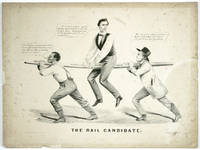
1860WRCAM37633New York: Currier & Ives 1860. Lithograph 13 1/2 x 18 inches. Moderate age-toning foxing and soiling. Moderate browning in margins. Small closed tears and chips in margins one moderate-size closed tear in left margin. A fair copy. A lithographic political cartoon published by Currier & Ives commenting upon the anti- slavery plank of the 1860 Republican platform. "The 'essential' anti-Lincoln cartoon of 1860" - Holzer et al. Abraham Lincoln is shown being carried uncomfortably in the middle of a split wooden rail an allusion to both the platform and to Lincoln's backwoods origins. Supporting the left end of the rail is a black man in simple working clothes who states "Dis N asterisks ours strong and willin' but its awful hard work to carry Old Massa Abe on nothing but dis ere rail!!" Holding the right end of the rail is well-dressed newspaper editor and strong Lincoln supporter Horace Greeley identified by a copy of his NEW YORK TRIBUNE in his coat pocket. Greeley tells Lincoln "We can prove that you have split rails & that will ensure your election to the Presidency." Lincoln replies "It is true I have split rails but I begin to feel as if this rail would split me it's the hardest stick I ever straddled." Lincoln is depicted - visually and thematically - as a straddler at best while the images of Greeley and the African American supporting the rail are derisive. <br> <br> A finely drawn and insightful political cartoon from the 1860 election. REILLY AMERICAN POLITICAL PRINTS 1860-31. WEITENKAMPF p.123. CURRIER & IVES: CATALOGUE RAISONNÉ 5478. Harold Holzer Gabor Borritt & Mark Neely THE LINCOLN IMAGE p.38 figure 18. Currier & Ives hardcover books
1669D6035Paris: Frederic Leonard 1669. First Edition. Hardcover. Very Good. 4to 242 x 185 mm. 120pp. Printers woodcut device on title depicting the winged lion of Evangelist Mark and motto Virtute invidiam vince Virtue overcometh envy and the legend Pax tibi marce Evangelista meus. 5 engraved folding plates 4 by Sebastien Le Clerc and one by Abraham Bosse depicting a chameleon on a branch and a plate with chameleons skeleton and organs in the upper part on a trompe-loeil sheet; and the same anatomical analysis for the beaver the camel the bear and the gazelle decorative woodcut head- and tail-pieces. Contemporary mottled calf spine gilt in compartments plates with some tears along folds repaired on verso some light darkening minor marginal worming at end; light edgewear. From the collection of Charles Philippe Robin 1821-1885 French doctor anatomist and politician bibliographical note at foot of title. Other early inscriptions to title referring to the engraver M. LeClerc and on rear pastedown to the state of the engravings. <br/><br/>First Edition and second publication dealing with the comparative anatomy of the animals the chameleon the beaver the camel the bear and the gazelle. Perrault scientist and naturalist was the leader of a team of comparative anatomists called the Parisians that included Guichard-Joseph Duverney Jean Pecquet Moyse Charas and Philippe de la Hire. Their investigations began in June 1667 with a thresher shark and lion from the royal academy and went on to encompass forty-nine vertebrate species. The detailed reports and exact descriptions on these dissections were the first of a long series of anatomical descriptions which ultimately included those of twenty-five species of mammals seventeen birds five reptiles one amphibian and one fish. Perrault and the team of Parisians prided themselves on several discoveries and in the process debunked many popular myths attached to certain species such as the legend that salamanders live in fire or that chameleons subsist on air. The scientists also recorded how they obtained their results providing a glimpse of how such anatomical research was conducted in the seventeenth century. The work is illustrated beautifully with five large folding plates by the expert painter engraver and writer Sebastian Leclerc 1637-1714 four of which were engraved by Leclerc and one by the watercolor painter writer and printmaker Abraham Bosse c. 1604-1676. Very fine work; the large folding plates remain fresh and intact. No such detailed and exact descriptions and illustrations had been published before. It is hard to measure another such important addition to the anatomical study of animals. Frederic Leonard hardcover books
186136386Philadelphia: Published by F. Bouclet 1861. Rare beautifully colored 20" x 25-3/4" lithograph printed on wove paper titled "Presidents of the United States". Displays all the Presidents through a beardless Lincoln surrounding a vignette of Lady Liberty the American eagle a steamboat and the Capitol the dome complete as anticipated though still under construction. Published by F. Bouclet and lithographed by A. Feusier. In superb condition with just a hint of toning from previous framing. Fine.<br/><br/> "A large patriotic print probably issued around the time of Abraham Lincoln's inauguration. Columbia stands before the U.S. Capitol holding a shield and a staff with a liberty cap. On her brow she wears a laurel wreath with a single star. Beside her is an eagle holding a streamer with the motto "E Pluribus Unum." A steamship is visible in the background left. The central scene is framed by oval portraits of the first sixteen presidents of the United States with George Washington at the top and a beardless Abraham Lincoln at the bottom" Reilly.<br/> The print "commemorates Lincoln's election and recognizes the challenges and opportunities facing the 16th president. In this image a portrait of Lincoln completes an unbroken ring of portraits depicting the 15 presidents who preceded him. The illustration calls to mind a quote from Lincoln's first inaugural 'Perpetuity is implied if not expressed in the fundamental law of all national governments'. By commemorating Lincoln's election and illustrating the troubled and complex scene he faced this chromolithograph encapsulates the spirit of Lincoln's presidency" Mast 'A Closer Look at Presidents of the United States 4 President Lincoln's Cottage page 2 2009. <br/>Reilly 1861-13. OCLC 41119329 2- Lib. Cong. MN Public School District as of November 2019. The print is also included in the Jay Last Collection at the Huntington. Published by F. Bouclet unknown books
186095830c. 1860. Rare original painting of the 16th President of the United States Abraham Lincoln. After a photograph by Civil War photographer Alexander Gardner. Scottish photographer Alexander Gardner immigrated to the United States in 1856 where he became best known for his photographs of the American Civil War President Abraham Lincoln and the execution of the conspirators to Lincoln's assassination. In near fine condition. In a period frame. The entire piece measures 20.75 by 16.75 inches. Rare and desirable. Abraham Lincoln served as the 16th President of the United States from March 1861 until his assassination in April 1865. He led the United States through its Civil War and in doing so preserved the Union of the United States of America abolished slavery and strengthened the federal government. Lincoln began constructing his cabinet on election night and sought to create a cabinet that would unite the Republican party. His eventual cabinet would include his primary rivals for the Republican nomination and although his appointees held differing views on economic issues all were opposed to the expansion of slavery into the territories of the United States. The most senior cabinet post of Secretary of State was appointed to William Seward who had recently failed to win the 1860 Republican presidential nomination and Lincoln's choice for Secretary of the Treasury was Ohio Senator Salmon P. Chase Seward's primary political rival and the leader of a radical faction of the Republican party that sought the immediate abolition of slavery. unknown books
18642547081864. very good-. This historic and rare black printed broadside presents the platforms of both parties the Republicans having convened in Baltimore in June and nominated Abraham Lincoln for President and Andrew Johnson for Vice President and the Democrats having convened in Chicago in August and nominated George B. McClellan for President and George H. Pendleton for Vice President. This copy measures 29 x 23 cm is double columned and with the imprint "For sale by all News Agents. Price $1 per 100." Very light foxing at the bottom margin more visible on the verso. Fraying at the margins as usual. Sabin 63348 Exceedingly scarce.<br/><br/> unknown books
30892 p.l. viii 236 pp. 8vo attractive antique calf double gilt fillet round sides flat spine gilt uncut. Paris: veuve Tilliard et Fils 1805. The rare sale catalogue of the library rich in oriental books and manuscripts of Anquetil-Duperron 1731-1805 French orientalist and brother of the historian Pierre Anquetil. Abraham Hyacinthe had a fascinating early life: while unsuccessfully studying for the priesthood in Paris and Utrecht he developed a passion for Hebrew Arabic Persian and other languages of the East. He travelled to India as a private soldier in 1754 in order to search for the works of Zoroaster. Granted free passage he learned modern Persian in Pondicherry and Sanskrit at Chandernagore. When war broke out between France and England Anquetil-Duperron travelled widely throughout India on foot learning further languages and studying the antiquities and sacred laws of the Hindus. He returned to Europe in an English vessel ultimately arriving in Paris in 1762 with 180 oriental manuscripts. He devoted many of the following years to scholarship editing and publishing many important oriental texts. The French Revolution seems to have greatly affected him: during that period he abandoned society and lived in voluntary poverty on a few pence a day. A fine copy. 1600 lots and priced throughout in a contemporary hand. From the library of Jean Viardot. ❧ Gustave Brunet Dictionnaire de Bibliologie Catholique col. 408-"Ce catalogue est curieux surtout pour les livres en langues étrangeres." Grolier Club Printed Catalogues of French Books Auctions.1643-1830 458. Peignot p. 77. unknown books
1862WRCAM54585Washington D.C.: War Department Adjutant General's Office 1862. Three volumes with over 300 individual imprints. 12mo. Uniformly bound in contemporary three- quarter roan and marbled boards gilt leather labels. Wear to leather and edges boards somewhat rubbed front hinges tender. Contemporary ownership inscriptions and binder's tickets on front endpapers of second and third volumes; later bookplate on front pastedown of first volume. Light toning in places otherwise internally clean. Very good. A uniformly-bound set of General Orders issued by the Adjutant General's Office of the War Department in Washington D.C. previously owned by Brig. Gen. John Pope Cook. The orders cover 1861 and 1862 and comprise a nearly complete run of orders for the Union Army during the first two years of the Civil War. Undoubtedly the most significant General Order in this collection is a preliminary printing of the Emancipation Proclamation. <br> <br> A handful of the orders are signed in ink by the various adjutant generals. The Emancipation Proclamation bound in the third volume is as follows: <br> <br> GENERAL ORDERS No. 139. THE FOLLOWING PROCLAMATION BY THE PRESIDENT IS PUBLISHED FOR THE INFORMATION AND GOVERNMENT OF THE ARMY AND ALL CONCERNED: BY THE PRESIDENT OF THE UNITED STATES OF AMERICA A PROCLAMATION caption title. Washington D.C.: War Department Adjutant General's Office ca. September 24 1862. 3pp. This work is one of the earliest printings of the Preliminary Emancipation Proclamation issued to regimental commanders in the field during the Civil War in the week after President Lincoln's official manuscript version was finished. Here the third paragraph rings out with Lincoln's timeless words: "That on the first day of January in the year of our Lord one thousand eight hundred and sixty- three all persons held as slaves within any State or designated area of a State the people whereof shall then be in rebellion against the United States shall be then thenceforward and forever free." <br> <br> Following the Seven Days Battle and Gen. McClellan's retreat from the Peninsula at the end of June 1862 President Lincoln realized that there would be no early end to the war and found himself "as inconsolable as it was possible for a human to be and yet live." Anxious for news from the army and needing to escape the constant interruptions at the White House he frequently visited the telegraph office in the War Department building to await dispatches. It was during one such visit early in July that he asked the chief of the telegraph staff Maj. Thomas Thompson Eckert for some paper to "write something special" and began the first draft of the Emancipation Proclamation completing it in a few weeks. <br> <br> Lincoln had long hoped to resolve the slavery issue through a congressional act of emancipation compensating slave owners for their loss of "property" but that approach was roundly rejected by representatives from the border states leaving the President who had decided upon the necessity of emancipation with a presidential proclamation as the only option. The extraordinary document he conceived would announce the liberation on January 1 1863 of all slaves in those states still in rebellion against the Union and promised compensation to slave owners in those states that returned to the fold before that time if they adopted "immediate or gradual abolishment of slavery." This proclamation would be followed by a final proclamation issued on the 1st of January identifying those states still in rebellion and confirming the liberation of all slaves therein. <br> <br> On Tuesday July 22 Lincoln presented his draft to the Cabinet telling them that he had resolved firmly upon the course of action it specified and asking them not for advice but suggestions. The only observation he had not anticipated came from Secretary of State Seward who proposed that it might be best to wait for a military victory before issuing the Proclamation as it could otherwise seem like "the last measure of an exhausted government." Immediately recognizing the wisdom of the suggestion Lincoln held back. On September 17 after an anxious wait of nearly two months he received the victory he needed at the bloody Battle of Antietam. Completing his final draft Lincoln presented it to his cabinet for refinement on September 22. Following the meeting Seward took the amended draft with him to the State Department where a formal manuscript copy was made then signed by Lincoln and Seward. <br> <br> The first edition of the Preliminary Emancipation Proclamation Eberstadt #1 a small three-page circular intended for distribution within the government and to the local press was likely printed on September 22. At the time that Charles Eberstadt published his study of the Proclamation 1950 he was able to locate only one copy which he himself owned and as nearly as we have been able to determine no other copies have come to light since then. <br> <br> Eberstadt #2 is a supposed second edition no copy of which Charles Eberstadt was able to locate whose existence he inferred from the standard State Department practice of printing a folio edition consisting solely of the text of the proclamation followed by another printing consisting of the text of a letter of transmittal from the Secretary of State as well as the text of the proclamation. While there may be a copy of Eberstadt #2 in the National Archives as he speculated it is not recorded in their online catalogue nor have we been able to find a copy in any other online catalogue including OCLC the Library of Congress and the Abraham Lincoln Library. <br> <br> Eberstadt's third printing of the Preliminary Emancipation Proclamation is without a doubt the earliest obtainable printing. It consists of Secretary of State Seward's one-page letter of transmittal addressed "To the Diplomatic and Consular Officers of the United States in foreign countries" and the text of the proclamation. Eberstadt located a total of only five copies in institutions at the Library of Congress the National Archives Yale the Clements Library and Brown. OCLC does not record any additional copies nor is it recorded in Monaghan. This firm sold a copy several years ago. <br> <br> The present copy of GENERAL ORDERS No. 139 is Eberstadt's fourth printing of the Preliminary Emancipation Proclamation dated in print on September 24. Charles Eberstadt surmises that this field order printing could have been accomplished as late as September 29 or 30 and produced in as many as 15000 copies. It is however rather uncommon in the market and this is the first copy of this printing of the Preliminary Emancipation Proclamation offered by this firm. <br> <br> "From the first days of the Civil War slaves had acted to secure their own liberty. The Emancipation Proclamation confirmed their insistence that the war for the Union must become a war for freedom. It added moral force to the Union cause and strengthened the Union both militarily and politically. As a milestone along the road to slavery's final destruction the Emancipation Proclamation has assumed a place among the great documents of human freedom" - National Archives. "The proclamation has been called by responsible persons one of the three great documents of world history ranking with Magna Carta and the Declaration of Independence" - Eberstadt. <br> <br> Besides including about 300 orders on all manner of Union military activity at the outset of the Civil War the present collection also contains the 1861 printing of REGULATIONS FOR THE UNIFORM AND DRESS FOR THE ARMY OF THE UNITED STATES. Set out in GENERAL ORDERS No. 6 this twenty-four-page printing of the Army dress regulations was the first to set out uniform requirements for the Union during the conflict. The first sentence of the first section requires officers to "wear a frock coat of dark blue cloth." Thus the Blue and the Gray begins. <br> <br> This set was collected and bound by John Pope Cook who began the Civil War as a colonel in command of the 7th Illinois Volunteer Regiment. He was promoted to brigadier general after his troops played a key role in the Union victory at Fort Donelson early in 1862. After his promotion he was transferred to a command in the Department of Iowa and Dakota Territory where he remained until early 1863 conducting campaigns against the Sioux from his base in Sioux City Iowa. These orders must have been bound near the end of this period since contemporary labels note the binder one William F. Kiter as being from relatively close by Council Bluffs. <br> <br> A very early printing of one of the most important political acts in the Civil War and indeed in American history contained in a set of General Orders contemporaneously assembled by a significant Union Army commander. EBERSTADT LINCOLN'S EMANCIPATION PROCLAMATION 4. War Department, Adjutant General's Office hardcover books
6915London 1783-1816: George Eyre and Andrew Strahan Printers. Hard Cover. Folio 12" X 18 ½". The first four volumes are as follows; Vol. #1-382 leaves Vol. #2-450pp.Vol. #3- 570pp. index vol. Vol. #4-635pp. supplement vol. All are handsomely bound in 19th century ¾ calf over marbled boards raised bands with contrasting red morocco labels gilt. Joints of two volumes expertly repaired; an exceptionally nice set and quite scarce as such. There are 26 blank leaves in volume one with a few leaves containing portions of text or text on the verso. It would appear that these leaves were left blank for illustrations which evidently never took place perhaps because of the cost and manpower it would take to make it possible. The projected cost and labor is noted in volume 3. It does contain the later inserted title pages and contents leaves and the four facsimile leaves are present in the last volume the supplement two displaying hand coloring. The first two volumes are printed on hand-made laid paper watermarked "J. Whatman" and coat-of-arms with the King's Initials "GR". The last two volumes printed on hand-made wove paper by Balston & C. all uncut and wide margined. The last page cvii of the general introduction of the third volume states: "It was not however till after 1770 that the work was actually commenced. It was completed early in 1783 having been ten years in passing through the press. The type with which it was executed was destroyed in the fire which consumed Mr. Nichols' printing-office in the month of February 1808." The book itself was proposed by Mr. John Nichols and executed by Mr. Joseph Jackson and printed by George Eyre and Andrew Strahan. While title pages were added later and dated 1816 printed on the last page of volume three is the printers' names and date1811 and volume four is dated 1816. The Domesday Book was commissioned in December 1085 by William the Conqueror who invaded England in 1066. The Domesday Book project was a major undertaking employing many transcribers of the manuscripts and type makers to design the special type used. It is one of the most ancient records of England and represents an amazing accomplishment. It is the Register from which judgment was to be given upon the value tenure and services of the land. Another point on which the Domesday Survey throws considerable light is the history of the ancient Castles which William erected everywhere. By the completion of this survey the King acquired an exact knowledge of the possessions of the crown. It afforded him names of the land holders and the means of ascertaining the military strength of the country. It also pointed out the possibility of increasing the revenue in some cases and of lessening the demands of the tax collectors in others. The Domesday Book also left exact records behind which give historians today much data about Norman English life and the first appearance of English names. At the end of the introduction to volume four pertaining to the "Bolden Book" is a section considered to be the most important work of the supplement; it is from the Laud MSS. 542. Contained herein is a manuscript note stating; "This account of the 'Bolden Book' was written by me; I also transcribed MS. Laud collated it with the others & prepared the whole for the press as it appeared in that volume. signed Adam Clarke. Adam Clarke was a noted commentator and theological writer who lived in London after 1805. He wrote English translations and new editions of other men's books a bibliographical dictionary in six volumes and many other very important works during his lifetime. He was also a member of the Society of Antiquaries of London. Our only reasoning for this note is the fact that while Clarke transcribed the Laud MS. his name was not acknowledged as the transcriber and does not appear within the text. Only those either of high office or directly involved in its publication had their names included. see DNB Vol iv p. 413 Provenance: Hudson Gurney of Keswick 1775-1864 his book with his signature on the front free endpaper of the first volume. <br/><br/> George Eyre and Andrew Strahan, Printers hardcover books
1864D16155Baltimore: Cushings & Bailey 1864. First Edition. First and only edition extra-illustrated with approximately 65 inserted portraits. Full red pebbled morocco gilt dated 1882 on the spine rebacked with the original spine laid down the covers panelled in gilt the spine tooled and lettered in gilt with the initials "W.H.W." at the foot. 10 x 8 inches 25.5 x 21 cm; with lithographed title and approximately 65 mostly engraved or lithographed portraits inserted three are original drawings including one of Julia Ward Howe xi lithographed contents 200 pp. lithographed fascsimiles of the handwriting of the authors. Intermittent foxing the inserted portraits have offset to the text leaves opposite rebacked as noted and lightly rubbed. <br/><br/>This volume produced at the time of the 1864 Baltimore Sanitary Fair contains what is considered the first reproduction of the Gettysburg Address in Lincoln's hand. The facsimile was made from what is now known as the "Bliss Copy" of the address the fifth and final manuscript copy of the address that Lincoln executed at the request of the editors of this volume. Other authors represented here include Emerson Poe Melville Hawthorne and many other notables of the period. Cushings & Bailey unknown books
1667D14109Venice: Scipion Banca 1667. Hardcover. Very Good. Early-20th century vellum lettering hand-painted in black and red on spine very pretty; 8vo 131x92mm. Include half-title title with vignette 108 engraved maps. Vellum a little dust-smudged else fine. D7 torn and repaired; gathering I and K transposed; trimmed a bit close at inner margin. Provenance: Francesco Baranelli di Sinigaglia early ownership signature on half-title; discreet gilt-lettered bookseller's label on front paste-down "C. E. Rappaport Libri Rara Roma." <br/><br/>Third Italian edition of a so-called Epitome Theatrum the desirable "pocket" version of Ortelius's Theatrum Orbis Terrarum. Enormously popular this version of Ortelius's atlas was primarily used by travelers students and others for whom the folio edition would be inconvenient. Copies were eagerly sought and usually received considerable wear. The atlas was published by varying printers and engravers through to the 18th-century. Koeman III Ort 71. Scipion Banca hardcover books
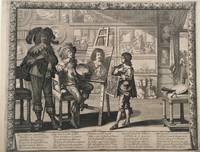
2226Le Blond 1636. Etching. A good impression on paper without a watermark. Trimmed just showing the platemark all around. 259mm x 324mm. G.D. 1080 Blum 154 only state Paris/Tours 2004 No. 128. unknown books
19035344Beautiful full brown leather with gilt detailing and rule to boards and spine; decorative red labels to boards and spine; 5 raised bands. Elaborately designed doublures with gilt dentelles. Silk fly sheets. "The Delphic Edition of The Breviary Treasures consists of 475 copies printed on French hand-made paper of which this copy is Number 94." xii 214 pp. 6 3/4 x 9 1/4 inches. Nathan Haskell Dole hardcover books
17091Vienna: Christoph Lercher 1709. First edition. Fair. Johann Christoph Weigel. The date of publication is revealed from the chronosticon given on the title page completed here with bracketed letters. Johann Ulrich Megerle July 2 1644 December 1 1709 is also known as Gautentius Hilarion Hilarius von Freudberg Theophilus Mariophilus. First edition emblem book 20.5 cm x 16cm quarto; engraved allegorical frontispiece; title-page in black and red letter; vi; 404; iv 101 leaves of full-page engravings. Johann Christoph Weigel / Kupfferstechern in Nürnberg caption legends engraved or hand-written under each image. Errors of pagination: p. 188 is missing the page number; p. 192 reads as 912; p. 307 reads as 407; p. 318 reads as 218; p. 320 reads as 230; p. 374 reads as 274; p. 376 reads as 176; p. 378 reads as 278; p. 403 reads as 401.This copy is bound in contemporary quarter vellum on light-gray marbled paper boards with a hand-lettered spine. The title-page has been repaired and reinforced with heavier paper as are some of the introductory pages and plates. Plate No. 48 is printed on very heavy paper with a handwritten legend. The other plates have engraved legends. The edges of the first nine pages have been expertly reinforced. Apart from a crack in the uppermost front hinge this binding is in fair condition. Inside the back cover is a triangular stamp reading in part ZUR AUSFUR FREIGEGEBEN. Pencil annotations inside the front cover are a title index of the emblem plates and the calculus of the chronosticon.Extremely rare complete. Old repairs noted this is a good bright tight copy. Not in Praz or Landwehr. See Gerhard Dünnhaupt F5.1.; Bertsch 52a 1; Goedeke III 240 26. See also William Sallochs Catalog 365 Sept. 1980: 100 fools with their occupations preoccupations and vanities described and illustrated by Weigel. An old booksellers catalog entry pasted down on the verso of the initial blank states: In 150 Exemplaren gedruckt als Festgabe für die Gesellschaft der Bibliophilen. The last plate is blank intentionally to provoke the reader. Christoph Lercher hardcover books
30651 p.l. 4 viii 108 2 slip of errata mounted on final blank leaf. 8vo attractive antique panelled calf some light foxing throughout spine lettered in gilt. London: Printed by W.P. and sold by F. Fayram et al. 1725. First edition. Employing the mortality statistics gathered by Edmund Halley in the 1690s de Moivre formulated the theory of annuities. "De Moivre's contribution to annuities lies not in his evaluation of the demographic facts then known but in his derivation of formulas for annuities based on a postulated law of mortality and constant rates of interest on money. Here one finds the treatment of joint annuities on several lives the inheritance of annuities problems about the fair division of the costs of a tontine and other contracts in which both age and interest on capital are relevant. Ths mathematics became a standard part of all subsequent commercial applications in England."-D.S.B. IX p. 454. Very good copy. ❧ Garrison-Morton 1690. Stigler The History of Statistics pp. 70-85. unknown books
184238683Hamilton Ontario: Ruthven's Book and Job Office 1842. 8vo. English and Mohawk text on facing pages. viii 456pp. Contemporary blue calf flat spine ruled and lettered in gilt.<br/> <br/>A fine copy of a scarce Book of Common Prayer in Mohawk.<br/> <br/>"Rev. Abraham Nelles archdeacon of Brant Ontario was born at Grimsby Ont. December 25 1805 and died December 20 1884. He was chief missionary of the New England Company to the Six Nation Indians for 53 years being first appointed as assistant missionary in 1829" Pilling. The Collects Services of Baptism etc. etc. translated by John Hill Junr. appear in Mohawk for the first time in this edition of the prayer book. Nelles proposed this edition for the use of the Grand River Mohawks. "This is the most complete of all editions of the Mohawk Prayer Book" Wright. Scarce.<br/> <br/>Pilling 2735; Sabin 6352; TPL 1st Supplement 5228; Wright Early Prayer Books of America p.40. Ruthven's Book and Job Office unknown books
186222179<p>"<i>We cannot escape history… In giving freedom to the slave we assure freedom to the free… We shall nobly save or meanly lose the last best hope of earth.</i>"</p><p>One month before signing the Emancipation Proclamation the president proposes colonization and his plan for compensated emancipation discusses foreign affairs reports on progress of the Pacific Railroad the war and finance. This rare "<i>Sentinel Extra</i>" broadsheet apparently unrecorded in OCLC has other news of the day on the verso including a fantastic article quoting General Meagher's reaction to the resignation of several officers after McClellan was removed.</p> <b>ABRAHAM LINCOLN.</b>Broadsheet <i>"Sentinel Extra"</i> place unknown ca. December 2 1862 9⅛ x 24 in. 2 pp.<p><b><br /></b></p><p><b>Excerpt:</b></p><p>"<i>The suspension of specie payments by the banks… made large issues of United States notes unavoidable. In no other way could the payment of the troops and the satisfaction of other just demands be so economically or so well provided for… A return to specie payments however at the earliest period … should ever be kept in view. Fluctuations in the value of currency are always injurious… Convertibility prompt and certain convertibility into coin is generally acknowledged to be the best and surest safeguard against them; and it is extremely doubtful whether a circulation of United States notes payable in coin and sufficiently large for the wants of the people can be permanently usefully and safely maintained…</i></p><p><i>There is no line straight or crooked suitable for a national boundary upon which to divide…Among the friends of the Union there is great diversity of sentiment and of policy in regard to slavery and the African race amongst us… emancipation will be unsatisfactory to the advocates of perpetual slavery but the length of time 37 years in Lincoln's compensated emancipation proposal should greatly mitigate their dissatisfaction. The time spares both races from the evils of sudden derangement… while most of those whose habitual course of thought will be disturbed by the measure will have passed away before its consummation. They will never see it. Another class will hail the prospect of emancipation but will deprecate the length of time. They will feel that it gives too little to the now living slaves. But it really gives them much. It saves them from the vagrant destitution which must largely attend immediate emancipation in localities where their numbers are very great and it gives the inspiring assurance that their posterity shall be free forever… Let us ascertain the sum we have expended in the war since compensated emancipation was proposed last March and consider whether if that measure had been promptly accepted by even some of the slave States the same sum would not have done more to close the war than has been otherwise done…</i></p><p><i><b>Fellow-citizens we cannot escape history.</b> We of this Congress and this administration will be remembered in spite of ourselves. No personal significance or insignificance can spare one or another of us. <b>The fiery trial through which we pass will light us down in honor or dishonor to the latest generation. We say we are for the Union. The world will not forget that we say this. We know how to save the Union. The world knows we do know how to save it. We—even we here—hold the power and bear the responsibility. In giving freedom to the slave we assure freedom to the free—honorable alike in what we give and what we preserve. We shall nobly save or meanly lose the last best hope of earth.</b></i>"</p><p><b>Additional Content Below Lincoln's State of the Union</b></p><p>Three news items cover the bottom half of the third column verso.</p><p>The first discusses the three top western cities as grain shippers Chicago Milwaukee and Toledo. The numerical measurements of the grain are counted in bushels. Chicago tallied a total export of <i>Wheat Corn Oats Rye and Barely</i> which amounted to <i>55526816</i> bushels. Milwaukee totaled <i>14869625</i> bushels. Toledo totaled <i>18667817</i> bushels.</p><p>The second re-prints news from <i>Liverpool Journal of Commerce</i> published on November 11th regarding the British government's adherence to neutrality policies.</p><p>The third reports on Gen. Thomas Meagher's reaction to the resignation of some of his officers after Gen. McClellan was removed from his command of the Army of the Potomac:</p><p>"<i>Commanding a brigade composed principally of Irish soldiers the Brigadier-General considers it not out of place to remind them that the great error of the Irish people in their struggle for an independent national existence has been their passionate and blind adherence to an individual instead of to a principle of cause. Thus for generations their heroic efforts in the right direction have been feverish and spasmodic when they should have been continuous equable and consistent.</i>"</p><p><b>Thomas Francis Meagher</b> 1823-1867 was an Irish nationalist and leader of the Young Irelanders in the Rebellion of 1848. After being convicted of sedition he was first sentenced to death but received transportation for life to Van Diemen's Land in Australia. In 1852 he escaped and made his way to the United States where he settled in New York City. At the beginning of the American Civil War Meagher joined the U.S. Army and rose to the rank of brigadier general. He was most notable for recruiting and leading the Irish Brigade U.S. 69th Infantry Regiment New York State Volunteers and encouraging support among Irish immigrants for the Union. He had one surviving son from his first wife.</p><p>Following the Civil War Meagher was appointed acting governor of the Montana Territory. In 1867 Meagher drowned in the swift-running Missouri River after falling accidentally from a steamboat at Fort Benton.</p> books
1619119435Honolulu: Bishop Museum Press 1916-1917. Rare complete first edition set of Fornander's foundational work on Hawaiian history and legend. Quarto 9 parts in 3 volumes bound in three quarters 20th century calf with red morocco spine labels lettered in gilt gilt ruling and stamping to the spine in six compartments within raised bands original wrappers bound in. In fine condition. A rare and desirable complete first edition set. In 1831 Swedish-born ethnologist Abraham Fornander emigrated to America where he soon joined the whaleship Ann Alexander which departed from New Bedford Massachusetts in 1841 a five-year campaign in the Pacific Ocean. In 1844 he deserted the ship in Honolulu and soon became a citizen of the Kingdom of Hawaii marrying a Hawaiian chiefess from Molokai named Pinao Alanakapu in 1847. After founding several publications in Hawaii Fornander was appointed to the circuit court a position that allowed him to do extensive travel within the islands and learn a great deal about Hawaiian mythology and language. Fornander paid special attention to legends and genealogies that he thought preserved the history of the Hawaiian islands after their settlement--their external and internal wars dynastic quarrels and eventually their contact by Captain James Cook and George Vancouver. On his death in 1887 his voluminous research passed to the Bishop Museum who eventually ensured their publication. Bishop Museum Press hardcover books
15859Lincoln Abraham. The Republican Party Vindicated--The Demands of the South Explained. Speech of Hon. Abraham Lincoln of Illinois at the Cooper Institute New York City February 27 1860. 16 pages caption title as issued. Lincoln's Historic Cooper Union discourse which catapulted him to serious presidential consideration and provided a cogent and widely-publicized argument that slavery was and always had been contrary to American values. <br/><br/>Lincoln's great Cooper Union speech argues that the Framers and early Congresses contemplated a narrow role for slavery. Examining the constitutional and early Congressional debates he demonstrates that contemporary statements viewed slavery "as an evil not to be extended but to be tolerated and protected only because of and so far as its actual presence among us makes that toleration and protection a necessity." Lincoln's argument received wide press coverage; it catapulted him into presidential contention for its great contribution placed the new Republican Party at the center of American constitutional and legal thought rather than an unacceptable extreme paving the way for his 1860 presidential win on the Republican ticket. An unusual 16-page issue of Lincoln's Cooper Union discourse followed at the middle of page 9 by John Hickman's July 24 1860 campaign speech. Page 16 prints Stephen Douglas' endoursement of the Dred Scott Decision and criticisms of his doctrine of Popular Sovereignty. Most copies print Lincoln's speech only in 8 pages. Scattered foxing dusting blank margin chipped not affecting text. Very good copy of this historic speech by Abraham Lincoln presaging his presidential nomination. unknown books
186325971<p>"<i>The brave men living and dead who struggled here have consecrated it far above our poor power to add or detract…</i>"</p><p>Lincoln's Gettysburg Address is on page 2 along with Edward Everett's entire speech and a report on the ceremonies. Printed in an important newspaper owned by John Forney this version is in some ways more accurate than the more widely spread Associated Press report.</p> <b>ABRAHAM LINCOLN. GETTYSBURG ADDRESS.</b>Newspaper <i>Philadelphia Press</i> Philadelphia November 20 1863. Complete 4 pp. approx. 20¼ x 28 in.<p><b><br /></b></p><p><b>John Wien Forney</b> 1817-1881 had been a Democrat whose support for President James Buchanan brought appointment as clerk of the House of Representatives and lucrative printing contracts. However after Forney lost his election bid for the U.S. Senate he started the anti-Buchanan Philadelphia <i>Press</i> and switched to the Republican Party in 1860 becoming a key Lincoln supporter. Forney again served as House clerk and then secretary of the Senate until 1868. In that position he was one of only four men to sign the official 13th Amendment Resolution: President Lincoln Vice President Hamlin Speaker of the House Schuyler Colfax and Forney writing "I certify that this Resolution originated in the Senate." At the same time he maintained his editorial "Letter from Occasional" column in the <i>Press</i> and established the Washington <i>Chronicle</i> aimed at the public and to soldiers in the Army of the Potomac. He interviewed the President on issues such as freedom of the press and the probable effects of the Emancipation Proclamation and was invited to consult about cabinet appointments. His White House access caused opponents to call him "Lincoln's dog."</p><p>The night before the Gettysburg Cemetery Forney got "roaring drunk and gave a violently pro-Lincoln speech" Boritt. Given that history he probably should not have been chosen to chaperone newly-elected vice president Andrew Johnson at the March 4 1865 inauguration; Johnson was widely criticized for his drunken performance there. After Lincoln's assassination and Johnson's veto of the Freedman's Bureau Act in 1868 Forney changed positions and campaigned for impeachment. Selling the <i>Chronicle</i> and returning to Philadelphia the chameleon-like editor switched back to the Democrats and started a weekly magazine <i>The Progress</i>. In addition he served as a director of the Texas & Pacific Railway.</p><p><b>Partial Transcript:</b></p><p>"<i>Four score and seven years ago our fathers brought forth upon this continent a new nation conceived in liberty and dedicated to the proposition that all men are created equal. Applause Now we are engaged in a great civil war testing whether that nation or any nation so conceived and so dedicated can long endure. We are met on a general battle-field of that war; we are met to dedicate a portion of it as the final resting place of those who here gave their lives that that nation might live. It is altogether fitting and proper that we should do this but in a larger sense we cannot dedicate we cannot consecrate we cannot hallow this ground. The brave men living and dead who struggled here have consecrated it far above our poor power to add or detract. Applause The world will note nor long remember what we say here but it can never forget what they did here. Applause. It is for us the living rather to be dedicated here to the unfinished work that they have thus far so nobly carried on. Applause. It is rather for us here to be here dedicated to the great task remaining before us that from these honored dead we take increased devotion to that cause for which they here gave the last full measure of devotion. That we here highly resolve that the dead shall not have died in vain. Applause That the nation shall under God have a new birth of freedom and that the Government of the people by the people and for the people shall not perish from the earth. Long applause. Three cheers given for the President of the United States and the Governors of the States…</i>"</p><p><b>Textual Differences</b></p><p>The speed with which printings were produced given 19th century communication issues and the lack of any official manuscript or text produced questions about Lincoln's exact words. This version includes the word "poor" in the line "<i>far above our <b>poor</b> power to add or detract.</i>" This was heard by some reporters and is present in both of Lincoln's drafts though is lost in most other contemporary printings. This version correctly quotes Lincoln's "<i>unfinished work</i>" which the AP incorrectly transcribed as "refinished work." The applause notations also differentiates the <i>Philadelphia Press</i> version from the AP report especially with the three cheers at the speech's conclusion.</p><p>Additional differences:</p><p>- The "<i>general battle-field of that war</i>" is the "great battle-field of that war" in the AP text.</p><p>- "<i>We are met to dedicate</i>" is "We have come to dedicate" in Lincoln's written copies.</p><p>- "<i>carried on</i>" is found here and in Lincoln's second draft but Lincoln used "advanced" in subsequent versions: "<i>have thus so far</i> so <i>nobly</i> carried on advanced"</p><p><b>Other Contents of the Paper</b></p><p>Page 1 starts with a column of advertising ie "<i>Cotton is not king yet.-I am selling linen sheetings at prices that are cheaper than cotton.</i>" The news begins with a report from Chattanooga: "<i>We lost 100 a fourth of whom were killed. The enemy had completely invested the place but Gen. Burnside will defend it to the last man … Our troops are in the best spirits. Every import point is fortified and confidence prevails that we shall whip the enemy out.</i>" Also reports from Charleston Atlanta Cumberland MD Harpers' Ferry VA Texas etc. A report via Baltimore on November 19th carries "most gloomy" news from Union prisoners at Richmond ending "these men must not be permitted to starve." A New York bank was rumored to have been robbed of $20000.</p><p>From Europe there's notice of a speech of Emperor Napolean III the differing interpretations as to whether it called for peace or war. There are reports of war like preparations in Russia.</p><p>An interesting notice: "<i>A slander on Mr. Lincoln refuted.-The remark said to have been ascribed to President Lincoln by Wendall Phillips to the affect that 'the greatest folly of his life was the issuing of the Emancipation Proclamation' out of which such Copperhead journals as The World and The National Intelligencer are attempting to make political capital is emphatically pronounced in high quarters to be all together untrue.</i>"</p><p>Column 4 starts the extensive reporting on the National Cemetery at Gettysburg dedication including a "documentary history on the battles of July" and General Meade's letter sending his official report on the battle.</p><p>Column 5 discusses the grounds of the cemetery and starts Edward Everett's two hour oration which on page 2. Transcriptions include the prayer the dirge after the dedication the consecration speech by Charles Henry Brock and more.</p><p>Page 2 column 5 has more foreign news re Japan Britain Napoleon III's war with Mexico etc. Column 8 includes lengthy reports on battles in Tennessee and Virginia "half of Lee's army reported to be falling back to Richmond." At the bottom a <i>Boston Journal</i> description of some of Confederate firebrand Robert Toombs' slaves is republished.</p><p>Page 3 includes advertisements list of arrivals at hotels the offering of about 200 million dollars in treasury notes and the "five-twenty" six percent loan with Jay Cooke as subscription agent.</p><p>Page 4 includes a report from New York on the raising of colored troops and a notice about Professor McCulloh "who recently left a professorship in Columbia College … suddenly turned up in the south as Confederate brigadier general. He's said to be a native of Baltimore and a graduate of Princeton College. The <i>Pittsburgh Commercial</i> says that several years ago he was a professor of mathematics and natural sciences in Jefferson College Pennsylvania and was subsequently connected with the Coast Survey and the Philadelphia Mint."</p><p>More political news includes from a Western newspaper a platform "said to have been adopted by Ohio and others elsewhere since the elections: "<b>Resolved That we air in favur uv subjoogashen emansipashen confiscashen taxashen conscripshen exterminashen nigger enlistments and f there is anything else the peeple desire let em write post-pade and weel pass the necessary resolushen.</b>"</p><p>Reports from Philadelphia including police account of an attempted murder by a deserter who was passing counterfeit money a case of concealed deadly weapons and an arraignment of a women for running a "disorderly house". Plus Philadelphia financial reports "gold was much excited today and rose to 153 ½" p 4 col 3.</p><p>This is a scarce large format paper.</p><p><b>Condition</b></p><p>Some archival tape repairs on front page which we will have removed by a conservator.</p> books