[ABRAHAM LINCOLN]Biblio.com

699 résultats
186525618<p>Frank Leslie published this print as a premium for his new family magazine <i>Frank Leslie's Chimney Corner</i> and copyrighted it on April 8 1865 just a week before Lincoln's death. The image created by engraver Henry B. Major and lithographer Joseph Knapp portrays Lincoln flanked by the First Lady and Vice President Andrew Johnson greeting Julia Dent Grant wife of Lieutenant General Ulysses S. Grant who stands nearby.</p><p>According to a notice printed at the bottom right corner "<i>Every Person who pays Ten Cents each for numbers 1 and 2 of Frank Leslie's Chimney Corner The New Family Paper is entitled to a copy of this PLATE without extra charge</i>" or individuals could purchase the print for $3.</p> <b>ABRAHAM LINCOLN.</b>Lithograph. "Grand Reception of the Notabilities of the Nation at the White House 1865" New York: Frank Leslie April 1865. 1 p. 19 x 23¾ in.<p><br /></p><p>In the first issue of <i>The Chimney Corner</i> Leslie described the "Grand Reception" image as "the most costly gift plate ever presented by any publisher in the United States having been produced at an expense of $10000."</p><p>"Every family should possess this truly national picture and carefully preserve it" Leslie continued "as it will transmit to future generations the men who have restored our great national unity. It is especially valuable as it contains an excellent likeness of our late lamented President introducing General Grant and his wife to Mrs. Lincoln." The picture contains "nearly 100 portraits of our most celebrated Generals Statesmen and Civilians also of many of our most distinguished American ladies. The likenesses are admirable having been taken from photographs by Brady."</p><p>The key giving the names of each individual portrait was published in issue number 4 of the <i>Chimney Corner</i> on June 24.</p><p>Included in the image are Generals Ulysses S. Grant John G. Foster William T. Sherman Hugh J. Kilpatrick Nathaniel P. Banks Philip H. Sheridan Winfield S. Hancock John A. Logan Joseph Hooker Benjamin F. Butler Oliver O. Howard John A. Dix and Henry W. Slocum. Admirals David Farragut and David Dixon Porter represent the Navy. Members of the cabinet include Secretary of War Edwin M. Stanton Secretary of State William H. Seward and Secretary of the Navy Gideon Welles. Members of Congress include Senator Henry B. Anthony of Rhode Island Senator William P. Fessenden of Maine Senator Charles Sumner of Massachusetts and Speaker of the House Schuyler Colfax of Indiana. Chief Justice Salmon P. Chase represents the U.S. Supreme Court. New York newspaper editors Horace Greeley Henry J. Raymond and James Gordon Bennett are also present. Prominent women include First Lady Mary Lincoln Ann S. Stephens dime novelist and magazine editor Miriam Folline Squier wife of Leslie's former editor-in-chief and Leslie's future wife Julia Dent Grant wife of Ulysses S. Grant Kate Chase Sprague daughter of Chief Justice and wife of Rhode Island Senator and Adele Cutts Douglas widow of Stephen A. Douglas. Others identified in the key include Ephraim G. Squier Leslie's former editor-in-chief archaeologist and U.S. commissioner to Peru Governor Andrew G. Curtin of Pennsylvania and Ambassador to Russia Cassius M. Clay of Kentucky.</p><p>Despite Leslie's copyright Anton Hohenstein created a very similar image entitled "Lincoln's Last Reception" which also featured Lincoln's meeting General Ulysses S. Grant's wife Julia. Published by John Smith in Philadelphia in 1865 and hand-colored "Lincoln's Last Reception" also included more than thirty military and political leaders and a few prominent women among the onlookers in the ballroom.</p><p><b><i>Frank Leslie's Chimney Corner</i></b> 1865-1884 was a weekly family newspaper published "every Tuesday" in New York by Frank Leslie. Each illustrated issue of sixteen pages contained serial fiction short stories poetry biographies history travel sketches natural history anecdotes and other subjects. According to the prospectus the newspaper would be "a welcome messenger of instruction and amusement to the young and old in the family and by the fireside—that altar around which cluster our holiest and most cherished recollections." Leslie had copyrighted the title in 1861 but "the great Rebellion now happily closing intervened to put a stop to the enterprise."</p><p><b>Frank Leslie</b> 1821-1880 was born in England as Henry Carter but he adopted the pseudonym of Frank Leslie to keep his artistic activities a secret from his relatives who disapproved. He came to the United States in 1848 and settled in New York in 1853 to engrave woodcuts for P. T. Barnum's <i>Illustrated News</i>. When that publication failed Leslie began work on his own series of illustrated publications including <i>Frank Leslie's Illustrated Newspaper</i> <i>The Budget of Fun</i> <i>Frank Leslie's Chimney Corner</i> and others. At his death he was deeply in debt but his second wife Miriam Folline Squier 1836-1914 continued his publications and again made them profitable even legally changing her name to Frank Leslie in 1881.</p><p><b>Condition</b></p><p>Spot-mounted to modern board mat toning moderate foxing minor edge wear. Would benefit from conservation.</p> Frank Leslie
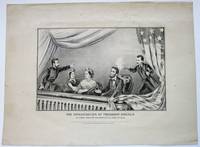
186537441New York: Currier & Ives. 152 Nassau Street 1865. Lithograph print oblong 13-1/2" x 18." Uncolored depicting Booth shooting Lincoln in the back of the head Mrs. Lincoln Miss Harris and Major Rathbone sharing the theater box with him. Minor dusting in the margins. Very Good plus.<br /> <br /> A related print by Currier & Ives lists the names of the occupants in the theater box. See 165 Eberstadt 460. This variant does not list the occupants' names.<br /> "This lithograph records the shocking moment when Abraham Lincoln was shot by John Wilkes Booth. As a famous actor Booth had free access to Ford's Theatre and had gone there to collect his mail on April 14 when he learned of the president's intention to attend a play that evening. Booth was the leader of a group of pro-Confederate conspirators determined to prevent the South's defeat and when Robert E. Lee surrendered to Ulysses S. Grant on April 9 they decided to kill Lincoln and other key Union leaders hoping to destabilize the war effort and allow Confederate armies still in the field to rally. Major Henry Rathbone who rises at left to restrain Booth was subsequently stabbed but survived. Lincoln died the next morning" The MET online.<br /> Currier & Ives Gallery C0291. Not in Reilly. Currier & Ives. 152 Nassau Street unknown
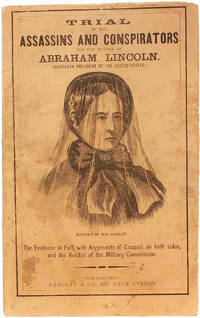
1865005102<p>Philadelphia: Barclay & Co. 1864 1865 1865. FIRST EDITION. 1 vol. 9-1/4" x 5-3/4" original pictorial wrappers illustrated pagination irregular but complete original stitching completely unsophisticated without repairs internally clean and bright mild general handling but surely one of the nicest copies you're going to encounter VERY GOOD. McDade 623 According to RBH only 2 copies have ever appeared at auction. The last one in 2008. Variant issue mentioned by Howes with the illustration of the execution moved to p 96; also with misprint of copyright date as "1864". Featuring engraved portrait of Mary Surratt on cover. The assassination of Lincoln by John Wilkes Booth on the night of April 14 1865 need no retelling. Time however which has its own way with our judgments has raised some doubts about some of these. The unfairness of the military tribunal is now manifest and the guilt of Mrs. Surratt is certainly doubtful. This was amply demonstrated by the fact that only two years after the crime the government could not obtain the conviction of her son John Surratt in the civil courts in Washington.</p> Philadelphia: Barclay & Co., 1864 [1865]
18666114no place given: William E. Marshall 1866. Very good . Lithograph measuring about 17." x 22.5" full margins; likely untrimmed. The image measures about 15.75" x 20.5". Matted and framed and has not been examined out of frame. Offsetting/age-toning affects the right half of the print although this is only visible at the margin not within the image. Important 1866 engraving of the recently deceased 16th president; Marshall sent copies to many of Lincoln's closest friends and colleagues and the response was one of unanimous praise. Highly detailed and dignified it presents the statesman as a figure of great worth; even of immortailty. This example handsomely presented in a double matte and deep brown wooden frame. William E. Marshall unknown
18874021887. 1st Edition. FIRST EDITION FIRST BRITISH PRINTING of a work haled both as the greatest failed experiment of all time AND as 'one of the greatest achievements in physics of all time' Lightman 130. 'What Michelson and Morley did. was undermine a longstanding belief in something called the luminiferous ether; a stable invisible weightless frictionless. medium that was thought to permeate the universe. Conceived by Descartes embraced by Newton and venerated by nearly everyone ever since the ether held a position of absolute centrality in nineteenth-century physics as a way of explaining how light traveled across the emptiness of space Bryson 117. Prevailing theories held that ether formed an absolute reference with respect to which the rest of the universe was stationary and that ether was a medium for the propagation of light as water waves must have a medium to move across: water. Given the speed of light designing an experiment to detect the presence of ether and its drift or hypothetical motion relative to earth was challenging. To do so Michelson designed an interferometer -- essentially a massive stone block with mirrors and crisscrossing light beams -- capable of measuring the velocity of light with great precision. The device enabled Michelson and Morley to measure the speed of light in different directions enabling them in theory to measure the speed or drift of the ether relative to Earth thus establishing its existence. Michelson and Morley expected to see their light beams shifted by the swift motion of the earth in space thus giving measure to different speeds of light in each direction but "none was observed showing that the earth's motion did not affect the light's speed" Dibner 161. "The failure of this experiment was a serious blow to classical scientific theories because it cast doubts on the existence of the universal ether which had been a basic principle of for example the Newtonian theories of the universe" PMM 401. The result discredited the ether theories "and opened the door to "new standards of reference of time and space from geometry and cosmometry" ultimately leading to Einstein's 1905 proposal that the speed of light is a universal constant" Dibner; Lightman 130. The history of science records the 1887 ether-drift experiment of Albert Michelson and Edward Morley as the turning point at which the energetic "ether of space" was discarded by mainstream physics thereafter replaced with the postulate of "empty space." Michelson and Morley's work sounded the death knell of classical physics' beautifully simple belief in the idea of ether. CONDITION & DETAILS: London: Taylor & Francis. 8.5 x 5.5 inches; 213 x 138mm. Complete. viii 524 9 plates. Michelson & Morley paper: pp. 449-463. Ex-libris bearing a discreet stamp on the title page. Solidly and tightly bound in three quarter brown calf over marbled paper boards. Some scuffing and rubbing at the edge tips and along the spine. Five gilt-ruled raised bands at the spine; gilt armorial devices in the compartments. Gilt-lettered red and black morocco spine labels. Very slight age toning within; largely clean and bright. Very good condition. hardcover
1865228501865. No binding. Fine. Broadside. The Nation's Loss. A Poem on the Life and Death of the Hon. Abraham Lincoln. 1865. 1 p. 9 3/4 x 15 1/4 in. 1/2 inch loss at top not affecting text. Headed by an engraving of Lincoln Reverend Peter W. Brister's mourning poem occupies the first two columns and Lincoln's Emancipation Proclamation is printed in full in the third column. Brister's poem addressed what Lincoln meant to the nation during the Civil War how he saved the Union and freed the slaves. Below the image of Lincoln it reads ""Late President of the United States Who departed this life in Washington D.C. April 15 1865."" unknown
186522935<p><b>ABRAHAM LINCOLN.</b>Print. <i>Abraham Lincoln. The Nations Martyr. Assassinated April 14th. 1865.</i> Currier & Ives New York N.Y. 1865. 1 p. 13½ x 18 in. Light toning. </p>By recycling stock images Currier & Ives could issue "rush" prints of important 19th century events thus providing Americans with graphic depictions of current events. Based on Anthony Berger's famed photograph taken in February 1864 this is a fine example of a "rush" print of Lincoln following his assassination to hang in the homes of Americans mourning the loss of their president.<br />
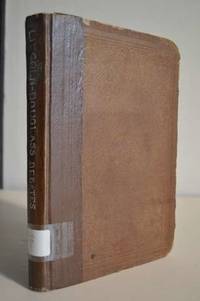
1860SKU1039674Follett Foster and Company 1860. First Edition. hardcover. Acceptable. 0x0x0. This Book is an Ex-Library Book with several library markings. Political debates between Hon. Abraham Lincoln and Hon. Stephen A. Douglas in the celebrated campaign of 1858 in Illinois; including the preceding speeches of each at Chicago Springfield etc.; also the two great speeches of Mr. Lincoln in Ohio in 1859 as carefully prepared by the reporter of each party and published at the times of their delivery. Follett Foster and Company; Columbus 1860. Hardcover. First Edition First Issue. First issue with no advertisements no rule above the publishers imprint on the copyright page and with numeral 2 at the bottom of page 17. An Acceptable brown cloth binding with blind stamped ornate design on boards re-enforced spine with handwritten white ink title and library locations sticker on spine binding shaky starting hinges with partially cracked rear hinge heavy wear to board corners with some loss some scuffing and discoloration to boards abrasions along board margins specifically to rear bit pulpy text block with age toning and scattered foxing throughout rubbing to board and spine edges previous owner handwritten ink info on front free endpaper few small dog-eared pages faint moisture stain on fore-edge and slightly on page margins several library markings include: library bookplate library due date card pocket embossed library stamp ink library stamps few ink and pencil notes barcode sticker without Dust wrapper. 8vooctavo or approx. 6 x 9 inches. 268pp. We pack securely and ship daily with delivery confirmation on every book. The picture on the listing page is of the actual book for sale. Additional Scans are available for any item please inquire. Follett, Foster and Company hardcover
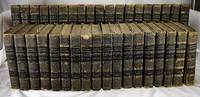
1894112666Lincoln Memorial University 1894. Leather. Very Good. 1894 Lincoln Memorial University Sponsors edition #500 of unstated limitation. 12 volume gilt decorated full leather bindings top edge gilt. Fine condition with no issues. oversized and overweight. B67 Please email for photos. Lincoln Memorial University hardcover
1834ABC_45429Noordwijk 1834. Folio 23 x 38.5 cm & 26 x 44 cm. 2 autograph letters each written on a single leaf and folded for posting with the address and remnants of a seal. 2 ll. Both letters were written by Abraham Hendrik Verster van Wulverhorst 1797-1882 living in Noordwijk Binnen near Leiden as a forester in the Dutch province of Zuid-Holland he was Inspecteur der Opperhoutvesterij. The present letters contain detailed observations on the Salamander punctata probably the European spotted salamandar now designated Salamandra salamandra. The letters further offer laudatory words regarding Heinrich Boie 1794-1827 who had also worked at the Rijksmuseum but had left for the Dutch East Indies to study the Southeast Asian fauna and sadly had died there in 1827. Also interesting remarks by Verster as a bird watcher on the bird migration: he had observed that the gallingo snipe and the rusticola woodcock were very early that year.The edges of the second letter are frayed. Otherwise in good condition. unknown
18192007240053London : Longman Hurst Rees Orme & Brown 1819. Hardcover. Good. Rees' Cyclopedia 37 volume set. Missing volumes 7 and 8. Bound in contemporary navy Russia Leather-backed marbled boards. Good bindings with minor shelf wear/rubbing. All edges marbled. Lacks the plate volumes. Armorial bookplate of John Proctor Anderdon. Anderdon 1760-1846 was a London merchant and noted collector. <br> Abraham Rees 1743-1825 was a British clergyman best known for this his outstanding encyclopedic work The Cyclopaedia. Initially published 1802-1820. Rees' work not only featured theological and humanistic issues but also extensive articles on mathematics and natural sciences. The Cyclopaedia "is the richest work for technology of the period with detailed text and handsome carefully prepared plates." Ferguson Eugene. "Contributions to Bibliography in the History of Technology part II". Technology and Culture 3.2 1962: 169 p. "Rees was convinced that the important progress made during the last decades of the eighteenth century especially in the fields of history geography geology natural history and the physical sciences senu lato required a new type of encyclopedia with the accent on these fields as well as the still relatively undeveloped domains of biography and the history of sciences. The Cyclopaedia thus became one of the first works of its kind to be compiled with the help of 'persons eminently distinguished in these branches of science to which they had devoted their talents.'" Taxon Vol. 35 No. 2 1986 This is an oversized or heavy book that requires additional postage for international delivery outside the US. Encyclopedia London : Longman, Hurst, Rees, Orme & Brown hardcover