987 résultats
173144795Dublin: re-printed by and for Samuel Fuller 1731. Second edition "corrected" 8vo A-R4; woodcut initials head- and tail-pieces text diagrams and tables throughout; 20th-century green cloth gilt-lettered spine; ex-Northwestern National Life Ins. Co. Minneapolis with their rubber stamps; some shallow losses to front endpaper edges textblock foxed else very good and sound. An early actuarial treatise by one of the founders of the science of life-contingencies which was first published in 1725 and dedicated to the Earl of Macclesfield see DNB XIII p. 536. See Morrison 1690 for the first edition. <br/><br/> re-printed, by and for Samuel Fuller hardcover books
5190ABRAHAM LINCOLN ASSASSINATION. Newspaper. 4pg. 10 ¼†x 13 ¾â€. Sunday April 16 1865. San Francisco. A The Flag’s Evening Dispatch from San Francisco detailing the death of President Lincoln. It is printed in four columns with mourning borders with front-page coverage of the assassination and its aftermath. The left column has headlines including Booth being the killer and that Johnson is the new President. There is an announcement by the San Francisco mayor that there will be a funeral for the President and news from the country’s interior. An editorial argues that the assassination argues “Let the fires of retribution sweep across the land accursed by treason. Let the sacrificial fires be lighted and the bodies of the hellish monsters who originated and took part in the conspiracy be offered up as a partial though tardy atonement for the destruction of the nation's peace.†There are the usual folds and a few minor edge tears and repaired fold separations. Extremely rare with only a few institutional holdings. unknown books
186536639New York 1865. Elephant Folio. 8pp. Each page printed in six columns. Uncut at top edge. Very Good. A contemporary hand has written in pencil at the top blank margin "His last Proclamation. Keep this Paper."<br/><br/> This was Lincoln's "Last Public Address" Abraham Lincoln Online. This issue of the Times appearing the following day is surely a candidate for its earliest printing. His Speech discloses Lincoln's most recent thoughts on Reconstruction the War having virtually ended by the surrender of Lee's Army at Appomattox Court House on April 9. Reconstruction he says is "fraught with great difficulty. We simply must begin with and mould from disorganized and discordant elements. Nor is it a small additional embarrassment that we the loyal people differ among ourselves as to the mode manner and means of reconstruction."<br/> Lincoln emphasizes his flexibility. He disclaims any intention to insist upon a single comprehensive plan. He makes clear that "the Executive claimed no right to say when or whether members should be admitted to seats in Congress" from the rebellious States. He remarks that he has never pronounced on the interesting legal question "whether the seceding States so called are in the Union or out of it." Such an issue has no practical significance. "We all agree that the seceded States so called are out of their proper relation with the Union; and that the sole object of the government civil and military in regard to those States is to again get them into that proper practical relation." Lincoln will act as circumstances require the only criterion being whether the proposed policy will expedite that "proper practical relation." It is obvious that Lincoln had he lived would have been much more successful than his dogmatic and inflexible successor at guiding Reconstruction.<br/> This issue treats many other issues arising from the War's end including the topic "What shall be done with Jeff. Davis unknown books
199911658N. Y.: Thornwillow Press 1999. First edition. With a never-before-seen collection of all the known letters & telegraph communications exchanged among members of the Lincoln family up to the time of his assassination. One of 185 copies printed on handmade paper & signed by David Herbert Donald a leading Lincoln scholar winner of two Pulitzer Prizes for biography & the Charles Warren Professor Emeritus of American History & American Civilization at Harvard University. A lovely book. As new. Small 4to illustrated with three tipped-in photogravure portraits & two fold-out facsimile letters 3/4 black moroccan goatskin & dark blue paste-paper boards t.e.g. velvet lined folding black cloth traycase. A lovely book. As new. Thornwillow Press unknown books
1928163209New York: Boni and Liveright 1928. Octavo pp. i-iv v vi-viii 9-310 311-312: blank note: last leaf is a blank original tan cloth front panel stamped in red and gold spine panel stamped in red top edge stained red. First edition. First printing with "B&L" monogram on copyright page and no statement of printing. A mystery thriller in the mode of Sax Rohmer concerning Satan an unusual criminal mastermind who rules a band of thieves bound to his service by an elaborate game. The Boni and Liveright edition was reprinted at least twice and the novel was frequently reissued by various publishers in several formats through 1955. "7 FOOTPRINTS TO SATAN one of Merritt's most financially successful works appeared in ARGOSY ALL-STORY in five issues in 1927. Based upon Robert Barr's "A Game of Chess" it is his only pure mystery. Although it contains neither the fantasy nor the occult elements that characterize his earlier novels it is an intriguing tale containing an interesting plot and one of the most sinister villains in mystery fiction." - Foust p. 48. Clareson Science Fiction in America 1870s-1930s 558. In 333. Bleiler 1948 p. 199. Reginald 10068. Hubin 1994 p. 569. Neat contemporary owner's signature dated March 1928 on the front free endpaper. A fine copy in good four-color pictorial dust jacket priced $2.00 on the front flap with wear and shallow loss at spine ends and corner tips. rubbing along folds and several closed tears with internal tape mends. #163209 Boni and Liveright unknown books
1933157781New York: Liveright Inc Publishers 1933. Octavo pp. i-vi vii-ix x xi-xii xiii-xiv 15-301 302-304: blank note: last leaf is a blank original black cloth front and spine panels stamped in gold top edge stained red other edges rough-trimmed. First edition. "Celebrated weird mystery novel of witchcraft and deadly little dolls." - Locke A Spectrum of Fantasy p. 155. "Reputations come and reputations go but in the fields of science fiction and fantasy there is probably no other great reputation of the past that has suffered as much as that of A. Merritt. During the 1930's and 1940's he was widely considered the greatest fantasy writer of modern times . Is any of Merritt's work worth reading today other than as historical documents . A sense of peril emerges from BURN WITCH BURN! ." - Bleiler Supernatural Fiction Writers p. 842. Filmed in 1936 as The Devil Doll directed by Tod Browning screenplay by Garrett Fort Guy Endore and Erich von Stroheim with Lionel Barrymore and Maureen O'Sullivan in lead roles. Barron ed Horror Literature 3-146. Bleiler The Guide to Supernatural Fiction 1160. Clareson Science Fiction in America 1870s-1930s 552. Survey of Modern Fantasy Literature I pp. 181-83. In 333. Bleiler 1978 p. 138. Reginald 10058. A fine copy in bright good pictorial dust jacket with wear at spine ends shallow loss at spine folds and corner tips short closed tear at lower edge of rear panel several internal tape mends at edges and some re-coloring of black background ink. The book is quite nice and the jacket presents well overall. #157781 Liveright Inc Publishers unknown books
186323743<p>In this creative pamphlet Lincoln stands trial before a jury of his "peers" former presidents and statesmen from American history including Stephen A. Douglas Daniel Webster Henry Clay John Hancock Patrick Henry Gouverneur Morris Alexander Hamilton John C. Calhoun James Madison George Mason Elbridge Gerry Andrew Jackson Thomas Jefferson George Washington and William Gaston. The author compiles passages from their speeches in mock dialogue with the defendant Lincoln as they contradict his defenses against their charges.</p> <b>ABRAHAM LINCOLN.</b>Pamphlet. <i>Trial of Abraham Lincoln by the Great Statesmen of the Republic. A Council of the Past on the Tyranny of the Present. The Spirit of the Constitution on the Bench—Abraham Lincoln Prisoner at the Bar his own Counsel.</i> New York: Office of the Metropolitan Record 1863. Original printed wrappers stitched. 29 3 pp. First Edition.<p><b><br /></b></p><p><b>Excerpts:</b></p><p>"<i>George Washington the father of the American Union who was surrounded by the great statesmen of the Revolution and by others of a still later date…had assembled for the trial of the present incumbent … on charges of the gravest and most serious character. the Spirit of the Constitution…occupied the bench of Justice.</i>" 4-5</p><p>"<i>Abraham Lincoln is herein charged with treasonable intent purposes and designs in having committed the following unconstitutional acts in the course of his administration:</i></p><p>"<i>1. In having declared war against independent and sovereign States under the pretence of repossessing himself of certain forts and other property seized and held by said States.</i></p><p>"<i>2. In having arrested citizens of the United States and incarcerated them in Government bastiles without process of law.</i></p><p>"<i>3. In having suppressed the liberty of speech thereby denying to the citizen the Constitutional right of criticizing the acts of his Administration.</i></p><p>"<i>4. In having prohibited and stopped the publication of certain newspapers for the exercise of the same right referred to in the preceding charge.</i></p><p>"<i>5. In having placed the military above the civil power as shown in the establishment of martial law over portions of the country which were not embraced within the theatre of war.</i></p><p>"<i>6. In overthrowing State sovereignty as in the case of Virginia the integrity of which was violated by the erection of the so-called State of Kanawha within its limits.</i></p><p>"<i>7. In having approved indorsed and partially carried into execution the unconstitutional act of Congress known as the Confiscation Bill.</i></p><p>"<i>8. In having approved of the infamous law known as the Conscription Act which was not only subversive of the Constitution but violative of State sovereignty.</i></p><p>"<i>9. <b>In having attempted to carry into execution the Emancipation Act thereby violating the most sacred guarantees of the Constitution.</b></i> 5-6</p><p>"<i>The criminal looked around the court and on the faces of the assembled patriots of the past but as they returned his gaze they shuddering averted their heads. Then the Spirit of the Constitution addressing him spoke as follows:</i></p><p>"<i>'You have been tried and found wanting. You have been given the opportunity of saving a nation but you have stabbed it to the heart. You were born in the freest country under the sun but you have converted it into a despotism. You have violated your oath; you have betrayed the trust reposed in you by the popular will and to the outraged justice of your countrymen I now leave you with the brand of "Tyrant" upon your brow. They will hereafter inflict upon you that penalty which justice demands while history will pronounce its judgment upon the infamous acts of your Administration.'</i>" 28-29</p><p><b>Historical Background</b></p><p>Contemporaries historians and others have criticized Lincoln for violating state sovereignty freedom of speech and freedom of the press for suspending habeas corpus and imposing martial law. All of these charges figure prominently in this ghostly trial of the President.</p><p>The publisher and possibly author of this pamphlet was John Mulally the Irish-born editor and proprietor of the <i>Metropolitan Record</i> a weekly Catholic family newspaper published from 1859 to 1868 in New York City. From 1859 to March 1863 it was the official organ of the Archbishop John Hughes of New York. Catholic critics accused it of taking an "open and avowedly treasonable course…since the war broke out; but more especially since the President issued his Emancipation Proclamation" and of forcing Archbishop Hughes to withdraw his support.</p><p><i>The Indiana State Sentinel</i> a Democratic newspaper published in Indianapolis printed much of the pamphlet on its front page declaring it "perhaps the most thorough and effective exposition of the terrible character and extent of the departure of the present Administration from the word and spirit of the fathers of the Constitution that has yet been put in print."</p><p>In 1863 authorities arrested Baltimore booksellers Michael J. Kelly and John B. Piet publishers of the <i>Catholic Mirror</i> for printing works of a "treasonable character." On May 23 1864 Provost Marshal detectives again arrested Kelly and Piet and searched their store. Among the "inflammable matter" found were 97 copies of <u>this</u>pamphlet envelopes with rebel flags 57 packs of playing cards with Confederate officers and some 212 Confederate photographs. The authorities imprisoned Kelly and Piet in Fort McHenry. On May 28 Kelly's son received permission to reopen the store and authorities allowed the press to resume publication of the <i>Catholic Mirror</i> on May 30 while Kelly and Piet awaited trial. On June 1 and 2 Major General Lew Wallace ordered Kelly and Piet released if they each posted a $5000 security bond not to violate any departmental regulations.</p><p>In March 1864 Major General William S. Rosecrans a Catholic commander of the Department of the Missouri ordered the Provost Marshal General in St. Louis to seize all issues of the <i>Metropolitan Record</i> to prohibit further distribution of the newspaper in that department and to punish all vendors who sold or distributed issues of the newspaper knowing their "traitorous contents." Rosecrans had read enough in the <i>Metropolitan Record</i> to satisfy himself that "no reasonable freedom nor even license of the press suffice for the traitorous utterances in those articles" and that they were "a libel on the Catholics who as a body are loyal and national." In November 1864 Major General Hugh Ewing commanding the District of Kentucky likewise banned the circulation of the <i>Metropolitan Record</i> and seven other newspapers in his district.</p><p>In the midst of the 1864 presidential election campaign the <i>Metropolitan Record</i>advertised for canvassers to sell this as "the great campaign pamphlet of the day." Mulally later reportedly repudiated McClellan as the Democratic nominee favoring a peace candidate instead.</p><p>111 Eberstadt 332. Monaghan 252. Sabin 41234. LCP 10399.</p><p><b>Condition</b></p><p>Margin dusting to the front wrapper Very Good.</p> Office of the Metropolitan Record paperback books
1592273298Antwerp: Abraham Ortelius 1592. unbound. Map. Uncolored engraving. Sheet measures 16" x 21".<br/><br/> This beautiful 1588 map by Abraham Ortelius depicts Holland or the Netherlands in exceptional detail. The map covers the regions near the Wadden Sea roughly covering modern day provinces of North Holland South Holland and Utrecht. The map centered on Amsterdam is oriented with north to the left. Topographical and geographical features such as mountains and cities are beautifully rendered in profile.<br><br>The waters surrounding the region are shown with waves and include several illustrations of ships throughout. This is the first state of the map with later states showing a stippled sea rather than waves. Includes a large strapwork title cartouche scale of miles with a divider in the lower left. The Royal coat of arms is presented in the top left. The map also includes a 16-point compass rose.<br><br>Ortelius based this map on the work of Jacob van Daventer. Published in the 1588 edition of Ortelius' famous "Theatrum Orbis Terrarum" which is historically considered the first modern atlas. Based on the text on verso only 300 copies of this particular edition were ever printed van der Broecke 79.<br><br>The map is in good condition with minor wear along the original centerfold. Minor foxing at places. Original plate mark is visible. Latin text on verso.<br><br> Abraham Ortelius 1527--1598 a Flemish cartographer and geographer is widely regarded as one of the important and influential cartographers in history. He is known for his "Theatrum Orbis Terrarum" which was the first modern atlas. Hard to find in black and white.<br/><br/> Abraham Ortelius unknown books
1603213571Antwerp: Ortelius Abraham 1603. unbound. very good. Map. Engraving with original hand coloring. Image measures 13" x 18.25".<br/><br/> Fine antique map of Perugia and Lake Trasimeno in central Italy in the Umbria region. Today the region is known it's foraged truffles and red wine. From 1603 edition "Theatrum Orbis Terrarum". Minor chipping to edges. Light stain near top centerfold. Full original margins. Abraham Ortelius 1527--1598 a Flemish cartographer and geographer is widely regarded as one of the important and influential cartographers in history. He is known for his "Theatrum Orbis Terrarum" which was the first modern atlas.<br/><br/> Ortelius, Abraham unknown books
186330001.20<p>Contains Lincoln's entire 1863 Message to Congress where he reaffirmed his commitment to emancipation as well as His Proclamation of Amnesty and Reconstruction which laid out a plan to return the rebellious states to the Union fold. Commonly called the "Ten Percent Plan" it allowed for a state to hold new elections when 10% of its 1860 voters took a loyalty oath to the Union.</p> <b>ABRAHAM LINCOLN.</b>Newspaper. <i>New York Times</i> New York N.Y. Dec. 10 1863 with <i>"Supplement to The New York Times"</i> complete with its own masthead. 12 pp. 14¾ x 21 in.<p><b><br /></b></p><p><b>Excerpt</b></p><p>"<i>To now abandon them would be not only to relinquish a lever of power but would also be a cruel and an astounding breach of faith. I may add at this point that while I remain in my present position I shall not attempt to retract or modify the emancipation proclamation nor shall I return to slavery any person who is free by the terms of that proclamation or by any of the acts of Congress.</i>"</p><p><b>Historical Background</b></p><p>Throughout the fall of 1863 eventual Union victory became increasingly clear and on December 8 1863 Lincoln issued his Proclamation of Amnesty and Reconstruction. This lenient plan that offered citizens of the rebellious states full pardons voting and property rights except possession of slaves encouraged the states to begin addressing the issue of the freedmen and women without compromising their rights and allowed a former Confederate state to hold elections and form a pro-Union government once 10% of the number of voters in the 1860 election swore loyalty oaths. Commonly called the "Ten Percent Plan" it reflected both Lincoln's charitable view of Reconstruction as well as the reality that heavy penalties denial of voting and property rights to rebels and impoverishing the South was no way to rebuild a nation after a war fought at least initially to preserve the Union.</p> books
1877239161877. No binding. Fine. Autograph Quote Signed from Lincoln's Cooper Institute speech given on February 27 1860. Sept 10 1877. Schuyler Colfax U.S. representative from Indiana and vice president under Ulysses S. Grant pens a famous quote from Lincoln's Cooper Institute speech. Transcript""Let us have faith that Right makes Might; and in that faith let us to the end dare to do our Duty."" Lincoln's Cooper Institute speech Feb. '60. Yrs truly Schuyler Colfax / Sept 10 1877Schuyler Colfax 1823-1885 born in New York City moved with his family to Indiana when he was an adolescent. Colfax pursued a career in journalism serving as legislative correspondent for the Indiana State Journal and becoming part-owner of the Whig organ of northern Indiana the South Bend Free Press renamed the St. Joseph Valley Register in 1845. Colfax was a member of the 1850 state constitutional convention and four years later was elected as a Republican to Congress where he served until 1869. An energetic opponent of slavery Colfax's speech attacking the Lecompton Legislature in Kansas became the most widely requested Republican campaign document in the 1858 mid-term election. In 1862 following the electoral defeat of Galusha Grow Colfax was elected Speaker of the House. In that capacity Colfax announced the passage of the Thirteenth Amendment on January 31 1865: ""The constitutional majority of two thirds having voted in the affirmative the Joint Resolution is passed."" Colfax considered February 1 1865 the day he signed the House resolution the happiest day of his life. ""Fourteen years before among a mere handful of kindred spirits in the Constitutional Convention of his State he had said: 'Wherever within my sphere be it narrow or wide oppression treads its iron heel on human rights I will raise my voice in earnest protest.' He had kept his word and well earned his share in the triumph."" Hollister 245. Colfax next served as Vice President under Ulysses S. Grant 1869-1873. He lost a re-nomination bid in 1872 as a result of his involvement in the Crédit Mobilier of America scandal. Hollister Ovando James. Life of Schuyler Colfax 1886. books
186124870<p>"<i>The Sanitary Commission is … of direct practical value to the nation in this time of its trial. It is entitled to the gratitude and confidence of the people… There is no agency through which voluntary offerings of patriotism can be more effectively made. A. Lincoln.</i>"</p> <b>ABRAHAM LINCOLN. HENRY W. BELLOWS.</b>Printed Circular Letter to "<i>the Loyal Women of America</i>." Washington D.C. October 1 1861. 3 pp. 8 x 10 in.<p><b><br /></b></p><p><b>Historical Background</b></p><p>The United States Sanitary Commission USSC was a private relief agency to support sick and wounded Union soldiers and sailors. The idea began at a meeting of the Women's Central Relief Association of New York in April 1861 and was modeled on the British Sanitary Commission which operated during the Crimean War. The USSC set up and staffed hospitals and operated thirty soldiers' homes lodges and rest houses for traveling and disabled Union soldiers.</p><p>This circular urges American women to send contributions to the USSC for distribution to suffering servicemen. "<i>Every woman in the country can at the least knit a pair of woolen stockings</i>" the letter declared "<i>or if not can purchase them.</i>" The USSC sought blankets quilts pillows slippers delicacies such as cocoa and dried fruit checker and backgammon boards and books and magazines for convalescing soldiers and sailors. Before it was printed Frederick Law Olmsted wrote to Lincoln requesting "a line from the President recommending the purpose of the Commission to the confidence of the public." Lincoln's response sent the same day is included at the end.</p><p>7000 affiliated local societies held bazaars concerts raffles and plays to raise money. Beginning in the fall of 1863 major cities—including Chicago Cincinnati Brooklyn New York Pittsburgh Philadelphia St. Louis and Boston—held large sanitary fairs that lasted for weeks. With donations from many famous figures and artifacts for sale such as signed copies of the Emancipation Proclamation over the course of the war the USSC raised an estimated $5 million in cash and $15 million in in-kind contributions.</p><p>At first the Army Medical Bureau resented civilian involvement and questioned the use of women as nurses. Similar groups such as the Christian Commission argued that their counterparts were more interested in providing something for the upper classes to do in the war aside from fighting than they were in sympathizing with the plight of soldiers. But its success silenced most critics over time.</p><p>The USSC did provide significant opportunities for women to participate in the war effort. Dorothea Dix Mary Livermore and Mary Ann Bickerdyke held leadership roles. Novelist Louisa May Alcott was a nurse in a USSC hospital. One of its nurses Clara Barton became a founder of the American Red Cross. Many of the Northern women who were its grass roots workers developed an involvement in philanthropic and public affairs including the Civil Rights and Women's Suffrage movements.</p><p><b>Henry W. Bellows</b> 1814-1882 born in Boston graduated from Harvard College in 1832 and Harvard Divinity School in 1837. In 1839 he became the pastor of the First Congregational church in New York City. Gaining a reputation as a pulpit and lyceum speaker he became a leader of the Unitarian Church in America. From 1847 to 1866 Bellows edited the <i>Christian Inquirer</i> a weekly Unitarian newspaper. Bellows planned the United States Sanitary Commission and served as its only president from 1861 to 1878. In 1877 he became the first president of the first Civil Service Reform Association.</p> books
186424202<p>Two tickets to the Great Central Fair in Philadelphia. One admitted a pupil of the public schools of Philadelphia and was used on Saturday June 11 according to the stamp on the verso. The other is an apparently unused "Season Ticket" that admitted the bearer "<i>To All Parts of the Fair</i>" except the Children's Exhibitions but was "<i>Forfeited if Transferred and Not Good unless Endorsed</i>." The verso includes the oath "<i>I hereby promise that this Ticket shall be used to obtain admission to the Fair by myself only</i>" and a blank line for a signature.</p> <b>CIVIL WAR. ABRAHAM LINCOLN.</b>Great Central Fair Tickets June 1864. Pair of passes for the Great Central Fair held in Philadelphia June 7-28 1864. One ticket is for one day's admission for a public school student. The other is a season ticket. 1 p. each 3½ x 2¼ and 3½ x 2 in.<p><b><br /></b></p><p><b>Historical Background</b></p><p>During the Civil War several northern cities hosted sanitary fairs between 1863 and 1865 to raise money for the care of wounded soldiers. The Great Central Fair held at Logan Square in Philadelphia in June 1864 was a fundraiser for the United States Sanitary Commission and was one of the largest fairs. The main exhibit building constructed in forty working days by local volunteer skilled labor enclosed 200000 square feet. It featured nearly one hundred departments offering a broad range of displays from Arms and Trophies to Fine Arts to Umbrellas and Canes. Curiosities included a $1000 doll house a recreated parlor of William Penn with Penn artifacts the boat used by Arctic explorer Elisha Kent Kane and George Washington's carriage.</p><p>Over three weeks the fair welcomed more than 400000 visitors. The season ticket offered here cost $5 a week's pay for a day laborer or a domestic and several days' wages for skilled workers. The fair served more than 9000 meals per day in its restaurant and had a daily newspaper with descriptions of the various departments. During its existence the fair raised approximately $1 million for the Sanitary Commission second only to New York City in money raised.</p><p>President Abraham Lincoln attended the fair with his family on June 16. He also donated forty-eight signed copies of the Emancipation Proclamation printed under the auspices of George Boker of the Union League which were sold for $10 each.</p><p><b>Condition</b></p><p>Both have glue discolored on the reverse sides. The smaller card has a 1" edge tear on the right side neatly repaired with archival tape.</p><br /> books
1701046917Jena: Birchner 1701. Early Edition. Hardcover Vellum. Good Condition. Contemporary vellum soiled frontis and title page stained and detached with some chipping and old tape marks wear to first few pages a few old marks and notes but very good otherwise. Three works bound in one the first two by Hoping typically found together the last with added engraved title published in 1692 in Frankfurt Illustrated throughout endpapers with notes and a few hand sketches. The Ingeber work is a first edition. 155 7; 183 61; 180 4pp<br/><br/>Three early chiromancy volumes bound up together Size: Octavo 8vo. Quantity Available: 1. Shipped Weight: Under 1 kilo. Category: Science & Technology; Magic Paranormal & Occult. Inventory No: 046917. Birchner hardcover books
1862100336Newspaper folio unbound 8pp. Dampstained browned at edges with some foxing early owner's ink stamp on top margin some small tears and chips along edges and a little creasing. Still in decent shape overall. This is one of the earliest printings of the Emancipation Proclamation which was issued on September 22 1862. The Emancipation Proclamation declared freedom for all slaves in any Confederate state that didn't return to the Union by January 1 1863. Although this executive order did not actually free a large number of slaves it set the stage for the freedom of all slaves. Coverage of the Emancipation in this newspaper begins in the middle of the first page. This newspaper article represents important coverage of a very significant event in American History. archives government exhibits emancipation website books
1864M13597New York: Derby & Miller 1864. 1864. Volume II. 8vo. xxxi 1 711 1 pp. Subtle waterstain at top margin viewable from pages 500-712. Original full dark blue-green pebbled cloth gilt spine titles; light wear to extremities. Bookplate of the Essex Institute; small rubber stamp on title C.W. Post College Documents Library. The Emancipation Proclamation declared freedom for all slaves by January 1 1863. This proclamation is dated January 2 1863. Lincoln in writing this one of the most important documents in all US history declared "And by virtue of the power and fpr the purpose aforesaid I do order and declare that all persons held as slaves within said designated States and parts of the States are and henceforward shall be free; and that the Executive government of the United States including the military and naval authorities thereof will recognize and maintain the freedom of said persons." / The War Orders of 1863 are among the most historical during the Civil War. The volume includes: General Orders No.1: Emancipation Proclamation Liberty for Slaves. / General Orders No.100: The Lieber Code How soldiers should conduct ethically themselves in wartime. / General Orders No. 143: Order for the creation of the United States Colored Troops. / General Orders No.1. President Abraham Lincoln issued the Emancipation Proclamation on January 1 1863. With this Executive Order. He took a decisive stand on the most contentious issue in American history redefined the Union's goals and strategy and sounded the death knell for slavery. / Lincoln had always believed slavery to be immoral and fought its expansion. The President took the action "sincerely believed to be an act of justice" knowing that it might cost him the election. / With the Emancipation Proclamation Lincoln dramatically tied the Union's war aims to ending slavery. Whether they approved or not after January 1 1863 Americans could no longer deny that emancipation was central to the Union war effort. / Though ready to lay the groundwork for emancipation Lincoln feared that delivering the Proclamation at the wrong time would doom its chances for public acceptance and harm the Union cause. / On September 22 1862 Lincoln issued his preliminary Emancipation Proclamation giving the South 100 days to end the rebellion or face losing their slaves. / His final Proclamation on January 1 1863 further demonstrated his own evolving views by eliminating earlier references to colonizing freed blacks and compensating slave-owners for voluntary emancipation. Lincoln also added provisions for black military enlistment. Pausing before he signed the final Proclamation Lincoln reportedly said: "I NEVER IN MY LIFE FELT MORE CERTAIN THAT I WAS DOING RIGHT THAN I DO IN SIGNING THIS PAPER." Despite the political risks by 1864 he insisted on both reunion and emancipation as preconditions to any peace negotiation. Though the battle for civil rights would have to follow Lincoln rightly regarded the Proclamation as: "THE CENTRAL ACT OF MY ADMINISTRATION AND THE GREAT EVENT OF THE 19TH CENTURY" Derby & Miller, 1864. hardcover books
1817619331817. Appeals of murder were abolished after this Case. Appeals of murder were abolished after this Case. "Diabolically Ravished Murdered And Thrown Into a Pit" Trial. Thornton Abraham c.1793-1860 Defendant. Horrible Rape and Murder!! The Affecting Case of Mary Ashford A Beautiful Young Virgin Who was Diabolically Ravished Murdered And Thrown Into a Pit As She Was Returning From a Dance; Including the Trial of Abraham Thornton For the Wilful Murder of the Said Mary Ashford; With the Whole of the Evidence Charge to the Jury &c. Tried at Warwick Assizes Before Mr. Justice Holroyd On the 8th of August 1817. Taken in Short Hand. To Which is Added Copious Elucidations of this Extraordinary Case; And a Correct Plan of the Spot Where the Rape and Murder were Committed &c. &c. London: Published by John Fairburn 1817. ii 60 columns 34 pp 64 1 pp. Several contemporary newspaper clippings concerning this case pasted to final leaf rear wrapper and verso of title page. Woodcut folding map of crime scene. Octavo 8-3/4" x 5-1/2". Stab-stitched pamphlet in printed wrappers untrimmed edges. Some soiling and edgewear spine and fold-lines of table reinforced fore-edge mended some toning to text. Early owner signatures and annotation to front wrapper and map not the image side interior otherwise clean. $950. "Third Edition." Abraham Thornton a bricklayer "was accused of rape and murder after attending a dance where he became intimate with a gardener's daughter named Mary Ashford. They left the dance together and her body was found the next morning in a deep pool of water near a local footpath. Thornton was tried at the Warwick assizes on 8 August 1817. Since the marks on Mary's body were not necessarily inconsistent with Thornton's claim that she had consented to sexual intercourse and since the times on the morning in question when Thornton was seen walking home to Bromwich suggested he could not have been with her when she met her death the jury found him not guilty. The case aroused much interest and reminded people of a similar murder of a local woman a year earlier. Many were convinced of Thornton's guilt and he was assailed in local and London newspapers. A group collected around the Birmingham solicitor William Bedford invoked the old legal process of 'appeal of murder' by which a person acquitted of murder could be tried again for the same offense. This process was generally regarded as obsolet. unknown books
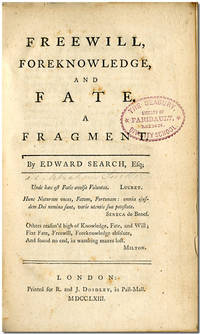
1763WRCLIT65699London: Printed for R. and J. Dodsley 1763. xxxi1 errata268pp. Octavo. Modern half calf and marbled boards raised bands gilt label. Old divinity school stamp on title minor foxing but a very good copy very neatly bound. First edition. The pseudonymously published prelude to Tucker's magnum opus THE LIGHT OF NATURE PURSUED. This "1763 fragment was strongly criticized in the MONTHLY REVIEW to which Tucker provided a humorous reply MAN IN QUEST OF HIMSELF under the new pseudonym Cuthbert Comment. In 1768 again using the pseudonym Edward Search he published the first four volumes of his book; the last three volumes were posthumously published under the editorship of his daughter Judith in 1778 . Although an occasionally eccentric and digressive text THE LIGHT OF NATURE PURSUED enjoyed a high reputation from its first appearance. In the introduction to his MORAL AND POLITICAL PHILOSOPHY 1785 William Paley emphasized his deep indebtedness to Tucker in expounding his ethical theory. Paley considered Tucker to be a very original thinker. His work was also highly praised by Sir James MacIntosh who had used his ideas in his lectures on ethics ." - DNB. Tucker's writings were also read and admired by among others Coleridge Godwin and Hazlett and the latter undertook an abridgement of the full work published in 1807. ESTC locates ten copies in North America and OCLC adds a few more but this work is uncommon in the trade. ESTC T117455. NCBEL II: 1893. Printed for R. and J. Dodsley hardcover books
16747716London: Henry Herringman pr. by J.M. 1674. Folio 30 cm 11.8". Frontis. 42 41 1 blank 80 4 70 59/60 skipped in pagination text uninterrupted 154 23 1 blank 148 pp. <br><br>Cowley's collected poems in their fourth edition beginning with a good impression of => the frontispiece portrait engraved by Faithorne "an account of the life and writings" of the poet signed by T. Spratt and two odes on Cowley's death by Thomas Higgons and Sir John Denham. Once considered the epitome of his era's wit the author of "The Mistress" verses in honor of love and various women included in this volume suffered a notable decline in popularity in subsequent years prompting Pope's musing "Who now reads Cowley . . . but still I love the language of his heart." And indeed despite the vagaries of reputation he has always had his worthy appreciators.<br>Â Â Â Â Cowley's Pindaric odes are present here as are the "Davideis" and "Davideidos"; also set forth are the "delightful little prose Essays with verse interwoven" for which The Concise Cambridge History of English Literature believes Cowley will most ultimately be remembered. Some sections have separate title-pages bearing the same publisher and date information as the main Provenance: Front pastedown with small armorial bookplate and with bookseller's ticket from Cambridge England. <br>Â Â Â Â <br>Â Â Â Â ESTC R29730; Wing rev. ed. C6652. On Cowley see: Concise Cambridge History of English Literature 35152. 17th-century mottled calf rebacked at some point in the 19th century and again more recently with hinges carefully reinforced inside; spine gilt extra with gilt-stamped leather title label covers showing the predictable acid-etching. Varying degrees of browning to pages; scattered incidents of worming in lower inner and outer margins almost never affecting text.<br>Â Â Â Â => A handsome book in a binding both sturdy and attractive. Henry Herringman (pr. by J.M.) hardcover books
186564322Davenport Iowa: Designed by W.H. Pratt and lithographed by A. Hageboeck 1865. Broadside. 38 x 31 cm. Several small tape repairs on verso several untaped tears on edges. A calligraphic portrait memorial of Lincoln using shading to form his likeness with the text of his Emancipation Proclamation. "Designed and written by W. H. Pratt and printed in Iowa the state that sent the most soldiers per capita to the front in the Civil War"- EBERSTADT 40. <br/><br/> Designed by W.H. Pratt and lithographed by A. Hageboeck unknown books
1865WRCAM56487Providence: Salisbury Bro. & Co. 1865. Illustrated broadside 12 1/2 x 8 inches. Old folds. Remnants of a label on verso a few small chips to edges uneven tanning light foxing. Very good. Rare broadside advertising gold jewelry and "Patent Embossed Carte de Visites.of all noted personages." from Salisbury Bro. & Co. of Providence Rhode Island. The text describes a large stock of photographs offered at wholesale prices to retailers across the country. The broadside has a vignette of the Salisbury factory in the top quarter of the sheet with a dense cascade of text in a variety of different fonts below. The lower third of the sheet is devoted to descriptions of images of Lincoln and the Civil War advertising three different Lincoln images and the promise "Our Picture of Lincoln is the best ever taken. All others as good as ever sold by any one." They also offer images of other prominent Civil War personages as well as "Booth the Assassin Robert E. Lee Jeff Davis and other prominent Rebels all at the same price. Also we have the ASSASSIN'S VISION and the ASSASSIN'S DOOM on full Cards." <br> <br> This broadside is primarily directed towards retailers as opposed to private customers and provides costs for bulk orders of up to 1000 cartes de visite. They claim their prices are "500 per cent. less than any dealers ever have." with prices starting at $7 for 100 and up to $100 for 1000 depending on the image. Although Salisbury Bros. & Co.'s cartes de visite and other photographic products are easily accessible in many libraries we could find no record of this broadside. An interesting record of the mass-marketing of photographic images in the post-Civil War era. Salisbury, Bro. & Co. unknown books
186122671<p><b>ABRAHAM LINCOLN.</b>Book. <i>Message of the President of the United States to the Two Houses of Congress. Volume 1</i> Washington: Government Printing Office 1861. 839 pp. 5¾ x 8¾ in. </p><b>Excerpt</b><p><i>"A disloyal portion of the American people have during the whole year been engaged in an attempt to divide and destroy the Union. A nation which endures factious domestic division is exposed to disrespect abroad and one party if not both is sure sooner or later to invoke foreign intervention. </i></p><p><i> Nations thus tempted to interfere are not always able to resist the counsels of seeming expediency and ungenerous ambition although measures adopted under such influences seldom fail to be unfortunate and injurious to those adopting them. </i></p><p><i> The disloyal citizens of the United States who have offered the ruin of our country in return for the aid and comfort which they have invoked abroad have received less patronage and encouragement than they probably expected.</i></p><p><i> It continues to develop that the insurrection is largely if not exclusively a war upon the first principle of popular government--the rights of the people. Conclusive evidence of this is found in the most grave and maturely considered public documents as well as in the general tone of the insurgents. In those documents we find the abridgment of the existing right of suffrage and the denial to the people of all right to participate in the selection of public officers except the legislative boldly advocated with labored arguments to prove that large control of the people in government is the source of all political evil. Monarchy itself is sometimes hinted at as a possible refuge from the power of the people. </i></p><p><i> In my present position I could scarcely be justified were I to omit raising a warning voice against this approach of returning despotism."</i></p><p><b>Historical Background</b></p><p>President Lincoln's first message to Congress in 1861 immediately follows the title page. In the first year of both his presidency and the Civil War Lincoln criticizes disloyal citizens who are trying to ruin the country. He acknowledges that the Confederates firing on Fort Sumter ended hope of a peaceful solution and expresses his confidence in General McClellan. Lincoln also expounds on the foreign affairs the relationship of labor to capital and reports on domestic commerce and other affairs. The remainder of the book is over 400 pages of papers relating to foreign affairs and correspondence with other nations and diplomats. The second half of the book is made up of the Reports of the Secretaries of the Interior War Navy and Postmaster General.</p><p><b>Condition </b></p><p>Good. Original cloth boards with U.S. seal and titled spine some slight chipping and wear to boards and spine binding a little loose and front endpaper almost detached hinges a bit weak but still firm some aging but generally clean internally.</p> hardcover books
186424898<p>"<i>As a MAN OF THE PEOPLE understanding them and trusted by them he has proved himself the man for the time.</i>"</p> <b>ABRAHAM LINCOLN. HENRY CHARLES LEA.</b>Printed Pamphlet. <i>No. 17: Abraham Lincoln</i> March 1864. 12 pp. 5¾ x 8¾ in.<p><b><br /></b></p><p><b>Excerpts:</b></p><p>"<i>What will be the place assigned by history to Abraham Lincoln</i>" p3</p><p>"<i>Few of us can forget the feelings of doubt and distrust with which we regarded his advent to the Presidential chair. That his native energy had elevated him from a youth of poverty and labor was reassuring and yet the narrow sphere in which his life had mostly been passed seemed to deprive him of the opportunities of familiarity with the great principles and details of statesmanship requisite for the perilous contingencies of the future.</i>" p3-4</p><p>"<i>Thus with doubt confusion and demoralization around him with no landmarks in the past to serve as a guide for the present or as a precedent for the future did Mr. Lincoln undertake the awful responsibilities of his high position. Thus relying on himself and on the people he boldly set to work to restore the Republic.</i>" p5</p><p>"<i>The country was saved so soon as the people recognized in their President a man who believed that he could save it and who honestly intended to do so. Had Abraham Lincoln done no more than this he would have merited a place between Washington and Jackson. It is a great thing to lift a nation to the highest level of its duties and responsibilities and few men to whom in the world's history the opportunity has been vouchsafed have accomplished the task so thoroughly.</i>" p6</p><p>"<i>And now the momentous question arises before the American people—to whose hands shall be confided the delicate trust of restoring the Union of our fathers</i>" p7</p><p>"<i>The great duty to which Mr. Lincoln has dedicated himself with rare singleness of purpose is the one thought which engrosses every true American heart—the re-establishment of the Union on a permanent basis.</i>" p7</p><p>"<i>The results of the war during the last twelve-month have not shown that the Proclamation was a mistake in military policy.</i>" p9</p><p>"<i>When Mr. Lincoln recommended the plan of compensated emancipation which was adopted by Congress he showed that he recognized fully how great an element of future strife lay in the institution of slavery and how beneficial to the whole country its abolition would be. Moderate in all his opinions he wanted a gradual not a violent change and long after his Emancipation Proclamation was issued he provoked the wrath of the radical emancipationists in Missouri by lending what aid he constitutionally could to the 'conservatives' in that State who desired that the extinction of slavery should be brought about gradually. Possibly in this Mr. Lincoln was mistaken yet if so the error arose from the desire which he has constantly manifested to harmonize the conflicting interests of the country even at the expense of temporary popularity.</i>" p9-10</p><p>"<i>The wisest statesman does not disdain to profit by experience nor can the head of a popular government adopt measures of fundamental change before the people are ripe for them. It is probable that Mr. Lincoln learned much as the war wore on; at all events the people did.</i>" p10</p><p>"<i>There are many who have richly earned the gratitude of the people for eminent services rendered to the Republic in the hour of her trials. There is no one who has so signally centered upon himself the confidence of all. There have been mistakes of detail in military naval and financial matters—mistakes inseparable from the sudden transition from profound and prolonged peace to civil war upon the largest scale. Yet in the general policy of the administration in its principles of statesmanship there have been few errors save those arising from a too generous disbelief in the sincerity of Southern madness.</i>" p11</p><p>"<i>Had Mr. Lincoln moved faster than he has done he would have left the people behind him and lost the support without which no popular government can conduct an exhausting war.</i>" p11</p><p>"<i>As a MAN OF THE PEOPLE understanding them and trusted by them he has proved himself the man for the time.</i>" p12</p><p>"<i>no one can be named who unites like Abraham Lincoln the kindliness and firmness the skill and experience the native sagacity and honesty to bring about an harmonious settlement and to extort from repentant rebels the implicit confidence which those high qualities have won from all loyal men.</i>" p12</p><p><b>Historical Background</b></p><p>The Union League Club of Philadelphia formed in 1862 as a patriotic society to support the Union and the policies of the Lincoln administration. The members of this private club represented the Philadelphia region's elite in business education and religion.</p><p>On April 15 1864 Lea met with Lincoln in Washington and three days later he wrote to Lincoln including two pamphlets he had recently written for the Union League Club including this one. He informed Lincoln "To prevent misconstruction perhaps I should add that I am a man of independent position with nothing to ask at your hands except the preservation of our institutions."<br /></p><p><b>Henry Charles Lea</b> 1825-1909 was born in Philadelphia and received a classical education from a private tutor. He showed particular promise in natural history. He joined his father in the publishing business in 1843 but had a nervous breakdown in 1847. While recuperating he read medieval French history and decided to become a historian rather than a scientist. Over the next fifty years Lea produced ten books and numerous articles on medieval institutional legal and ecclesiastical history. During the Civil War Lea was a member of the Union League of Philadelphia and led its Board of Publication. In that role he wrote many of the League's published pamphlets including this one. From 1863 to 1865 he served as a Bounty Commissioner and aided the provost marshal in recruiting soldiers including African Americans.</p> books
1828009569This ciphering book measures 8" x 12.5". It contains 92 pages of ciphering work. There is also an additional 36 pages of text in a different hand perhaps by a sister copied from Timothy Shay Arthur's <i>Advice to Young Ladies</i> and the American Tract Society's <i>Helps for Every Hour</i>. Quarter-bound with marbled boards. The owner's label reads "Abraham Rex / Philadelphia / 1828." An 8.5" x 4" pencil drawing copied from <i>The Tours of Dr. Syntax</i> is laid in. <br /><br />Ciphering books were prepared as part of the basic mathematical training of relatively well-off American students usually boys. Most like this one contain examples of the Numeration Addition Subtraction Compound Multiplication Reduction Compound Reduction Rule of Three Indirect Proportion Vulgar Fractions Compound Proportions The Double Rule of Three Avoirdupois Weight Troy Weight Long and Land Measure etc. <br /><br />In addition to providing mathematical basics boys venturing into trades or businesses needed advanced or specialized training in mathematics. In this case Abraham's book includes some work that would prepare him for mercantile positions including Tare and Tret calculating weight adjustments for packing and shipping materials Insurance Commissions and Brokerage Compound Interest Rebate or Discount Equation calculating combined payments Barter Loss and Gain Fellowship calculating complicated partnership percentages etc. <br /><br />Abraham was a member of a prominent and prosperous Pennsylvania Dutch family. Online genealogical records show that the Rüx anglicized to Rex family immigrated to the United States sometime prior to 1720 and settled in Germantown north of Philadelphia. The family soon moved westward to Schaefferston in Lancaster County where it proliferated and prospered with members becoming merchants innkeepers informal bankers brokers pharmacists and physicians. <br /><br />For more information about the Rexes of Schaefferstown see Wenger's <i>Delivering the Goods: The Country Storekeeper and Inland Commerce in the Md-Atlantic</i>. An archive of Rex family business papers is held by the Winterthur Library. <br /><br />For more information about ciphering books see Kilpatrick's <i>Rewriting the History of School Mathematics in North America . . . The Central Role of the Cyphering Books</i> Doer's master's thesis: <i>Cipher Books in the Southern Historical Collection of the University of North Carolina</i> and Andries's "Learning Mathematics in North America" at the University of Pennsylvania's Kaplan Collection of Early American Judaica. <br /><br />18th-century American ciphering books are scarce as the overwhelming majority of extant examples date from the early 1800s into the mid-1850s. hardcover books
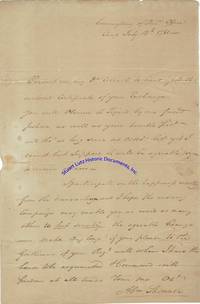
5036AMERICAN REVOLUTION PRISONERS OF WAR. ALS. 1pg. 8 ¼†x 12 ½â€. July 12 1781. Commissary of Prisnrs. Office Phillipsburg New York. An autograph letter signed “Abm Skinner†the American Commissary General of British prisoners of war. He wrote to an unidentified man: “Permit me my Dr. Colonel to hand you the inclosed Certificate of your Exchange. You will observe it Signed by our friend Joshua Loring British commissioner for prisoners as well as your humble Servt. and tho as long since as Octobr. Last I cannot but Suppose it will be agreeable to you to receive it now. I participate in the happiness resulting from the transaction and I hope the ensuing Campaign may enable you as well as many others to feel sensibly the agreeable Change - make my Compts. if you please to the Gentlemen of your Regt. with whom I have the honor to be acquainted…â€. The letter is docketed in an unknown hand on a stub remnant most likely by the gratified Colonel. The letter is tanned there are some spots and there is a minor repair to the verso. unknown books