26 503 résultats
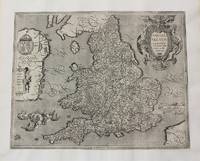
1603M10773Antwerp Belgium c.1603. Very Good margins extended. Notes: Important map of United Kingdom by Ortelius based on an earlier map by Christopher Saxton in 1579. Size : 384x483 mm 15.12x19.02 Inches Coloring: Hand Colored Category: Maps Europe United Kingdom England; Maps Europe Ireland; Maps Europe United Kingdom Wales; unknown
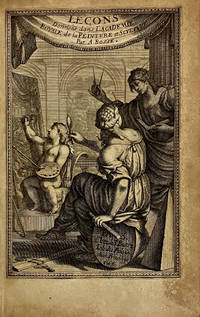
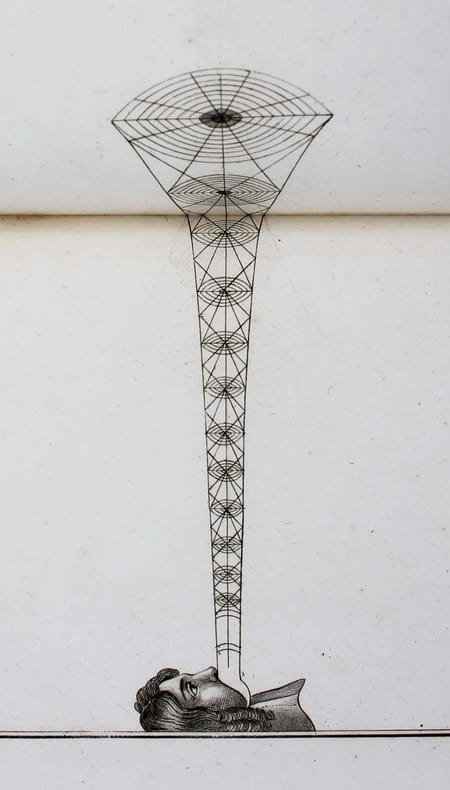
1665102684<p>Paris chez l'auteur 1665. 8vo. Engraved frontispiece titlepage xiv 140 pp engraved title plus 69 plates numbered 1 - 67 plates 6 & 7 present twice; plate 67 is double-page. Modern full calf pastiche binding spine with five raised bands and red titleshield.<em> Some copies have overlays on plate 50 some don't ours has no overlays.</em> paper slightly browned.</p><p>Abraham Bosse 1604-1676 famous for his etchings was also the first teacher of perspective at the Academy Royale de Peinture et de Sculpture that was founded in 1648. Bosse a mathematician and geometrician was extremely interested in the work of Girard Desargues and published several works on perspective. The present work was published in 1665. He wanted it to be the definite text on the subject that he taught but he was expelled from the Academy for lack of flexibility before its publication. Most of the 47 pages of the introduction deal with the principal errors that painters can make if they are not aware of the rules of perspective. The 67 plates and their explications deal with the necessary knowledge to apply perspective correctly. And these echo the lessons Bosse gave to his students at the Academy. He also deals with perspective in architecture.</p> chez l'auteur
67657New York NY: G.P. Putnam's Sons 1905. History Finely bound Constitutional Edition. Complete in eight volumes. Octavo 22 x 15 x 37cm. Frontispiece of the author with captioned tissue guard. Title page printed in red and black. Handsomely hand-bound in tan half calf with raised bands red morocco title labels marbled covered sides t.e.g. Contents clean exterior as new. A fine set in an attractive recent leather binding. The works include Addresses Letters Political Debates etc. New York, NY: G.P. Putnam's Sons, 1905 unknown
1776133671Milan: Giuseppe Galeazzi 1776. First edition in Italian of part of de Moivre's early and important contribution to the calculus of games of chance and probability theory one of the first instructional texts on the subject which together with the works of Montmort and Bernoulli was one of the most important books written on the subject in the early eighteenth century. His introduction contains an overview of main concepts such as probability conditional probability expectation dependent and independent events the multiplication rule and the binomial distribution. The translator Roberto Gaeto of the University of Pavia translates the parts of de Moivre's work dealing with the application of the doctrine of chance to annuities tontines life expectancies and mortallity tables. Gaeta has added an introduction notes and appendices comparing other European writers on lifetime annuities such as Deparcieux Kersseboom Süssmilch and Bernoulli with a useful bibliography of works of mortality tables and statistics pages lix-lxviii. Two works bound in a single vol. octavo 207 x 130 mm. Printer's woodcut device on title tables and vignettes in the text. Contemporary half mottled calf and sprinkled boards rebacked preserving the original spine red morocco label sprinkled edges. Spine neatly repaired and lined where split recased with new endpapers board edges worn. Second work has the half title cut away. Pale damp mark to lower margin extending into the text in places occasional light foxing marginal worming to last 4 leaves of the second work; good copies of two scarce works. hardcover
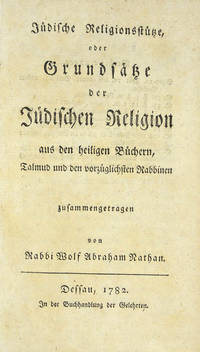
91842Dessau Buchhandlung der Gelehrten 1782. . First Edition. 8vo 17 x 10 cm. Text in German. Contemporary boards some worming marks to boards and leaves edges rubbed. 126 pp. <br /> One of the first instructive texts on Judaism to be published in Germany.<br /><br />In his Foundations of the Jewish Religion Rabbi Abraham Nathan Wolf lays out the basic principles and teachings of Judaism written in simple and accessible language but without reducing the moral and religious content of the Jewish law and faith.<br /><br />The settlement of Jews in Dessau dates from 1621. The Jewish community there led the struggle for the emancipation of the German Jews. Both Rabbi Abraham Nathan Wolf and Moses Mendelssohn were born there. Wolf's views on Judaism were considered extremely liberal at the time; though this made him popular with Mendelssohn his attempts to align traditional Jewish education with modern European culture also led to his persecution by conservative Jewish scholars who nicknamed him 'the backslider.'<br /><br />Other publications by Wolf include the Pesher Davar Berlin 1777 a comprehensive commentary on the Book of Job plus contributions to Ha-Meassef and the first three volumes of Bikkurey ha-'Ittim.<br /> Dessau, Buchhandlung der Gelehrten, 1782. hardcover
MC01A-00006Seeley Burnside and Seeley. Collectible - Acceptable. London: Seeley Burnside and Seeley 1847. 1st edition. 8vo hardcover. Green figured cloth with gilt spine lettering. xlviii589pp. Two folded maps. Fair book. Ex-Library copy from the Boston College Library with call number and label on spine and other usual markings. Tears to head and foot of spine. Hinges cracked. In polypropylene bag. 7 copies on OCLC. Sierra Leone Africa Travel Inquire if you need further information. Seeley, Burnside, and Seeley hardcover
1689ST13039gLondon: Printed for Charles Harper 1689. FIRST EDITION. 297 x 192 mm. 11 5/8 x 7 1/2". 20 166 148-9 misnumbered 140-1 2 pp. <br/> Very pleasing contemporary red morocco elaborately panelled in gilt covers with mitered frames composed of gilt rules decorative rolls pointillé tooling and floral sprays raised bands spine intricately gilt in compartments with central star-like design and scrolling cornerpieces marbled endpapers all edges gilt possible very expert repair to top spine compartment. Frontispiece engraving of Cowley's tomb. Front pastedown with the bookplate of Robert S. Pirie. Wing C-6665; ESTC R21164. ◆Spine and head of rear board sunned a bit of wear to joints and extremities boards tending to splay slightly faint scattered dark flecks to leather text with isolated spots and browning but an excellent copy the binding solid and only minimally worn and internally very fresh and clean.<br/> <br/> From a distinguished collection in extremely attractive condition and in a fine contemporaneous binding this is the first appearance of the botanical writings of one of the most precocious poets in the annals of English literature. Cowley 1616-67 was producing poetic works of inexplicable sophistication before he had settled into puberty; he published his first volume of verse at 15 and went on to become one of the most popular poets of his day. A staunch royalist who served in the exiled court of Charles I's queen Henrietta Maria he helped encode and decipher messages sent between the monarchy's supporters including the royal couple themselves. Despite having been arrested and imprisoned as a royalist agent at one point Cowley escaped the Cromwell years largely unscathed and retired to the countryside in 1663. Upon his death Cowley was not only given the extraordinary honor of burial in Westminster Abbey noted by the DNB as "the most lavish funeral which had ever been given to a mere man of letters in England" but was also afforded a privileged spot next to the graves of Spenser and Chaucer. Cowley's influence on contemporary poetry was demonstrably deep; his funerary monument pictured in our frontispiece refers to him as "the English Virgil" and Perkin asserts that his "fame as a poet exceeded even that of Milton" during the waning years of the Restoration. The present copy comes from the collection of Robert S. Pirie 1934-2015 an extremely successful lawyer and investment banker who amassed the finest library of 16th and 17th century English literature in private hands during his lifetime. In 1984 he was elected one of the 40 members of the Roxburghe Club the world's oldest society of bibliophiles. Printed for Charles Harper unknown
2010C93177Nabu Press. As New. 2010. Paperback. 1149148764 . FREE UPGRADE to Courier/Priority Shipping Upon Request - IN STOCK AND IMMEDIATELY AVAILABLE FOR SHIPMENT - Flawless copy brand new pristine never opened -- Text in French. 564 pages. Reprint of an earlier edition. Catalogue Raisonne Catalog Raisonné Complete Works La Vie Et L'uvre Oeuvre Raisonnee -- with a bonus offer-- - May be EITHER: out of print OOP and extremely rare in this pristine condition; signed by author or contributor; or a first or special edition; inquire for details . Nabu Press paperback
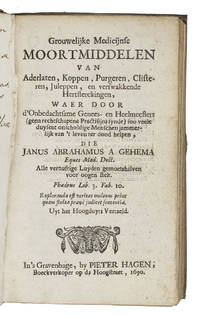
1690ABC_454621690. 20 140; 169-538 14 pp. Ad 1: First and only edition of three very rare medical and pharmacological treatises published together by the German physician Jansz Abraham Gehema 1647-1715. Gehema studied in Leiden where he settled as a physician before returning to Berlin in 1695. All three treatises translated into Dutch by G.D.C. from the original German were originally published in Bremen in 1688 as Grausame medicinische Mord-Mittel containing serious warnings against the evil practices of charlatans and quacks such as blood-letting purgation and suspicious prescriptions noting that they have killed many people Der Reformirte Apotheker a proposal to reform pharmacies to modern standards and Diaetetica rationalis instructions for a healthy lifestyle. Although the Dutch edition gives each work its own title-page and each begins on the first page of a quire so that they could have been sold separately they share a single series of page numbers and quire signatures.Ad 2: An incomplete copy of another very rare book with a curious combination of texts edited by Ulrik Huber professor of law at Franeker University. Texts present are René Descartes Passiones. sive affectus animae pp. 169-299 Huber's Institutionis reipublicae liber singularis pp. 301-494 and exerpts from Ovids Metamorphosis under the title Argumenta Metaµfse excerpta ex Ovidio pp. 495-538.Ad 2 lacking the title-page preliminaries and pp. 1-168 which contain excerpts from Aristotles Ethica. Spine somewhat wrinkled but still in good condition.l Ads 1-3: STCN 1 compl. & 1 incompl. Copy; Wellcome III p. 99; cf. Krivatsy 45999 1688 German ed. unknown
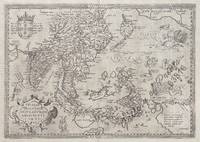
158163816<p>hand-coloured copper engraving. RARE. Stunning well-known map from 'Theatre de L'Univers contenant les cartes de tout le monde'.</p><p>This is the first French edition of his celebrated atlas - the FIRST in the World: 'Theatrum Orbis Terrarum" which was first published in Latin in 1570. The work was published by Christofle Plantin for Ortelius between 1581 and 1582 in Anvers Antwerp Belgium. Shows India and Indonesia Japan and the Philippines still without Luzon and parts of the American and Australian coastlines and the first Western map to show Formosa Taiwan.</p><p>Ortelius was a notable Dutch cartographer and 'the publication of this atlas in 1570 marked an epoch in the history of cartography. It was the first uniformly sized systematic collection of maps of the countries of the world based only on contemporary knowledge since the days of Ptolemy & in that sense may be called the first modern atlas; although that term itself was not used until 20 years later by Mercator. The Theatrum was re-issued in 42 editions with 5 supplements. with text in Latin Dutch German French Spanish Italian & English between the years 1570-1612. The protrusion of a Southern landmass initially called 'Beach' by Marco Polo is shown South of "Java Major" alluding to another "necessary" suspected landmass to keep the round earth balanced: Australia… Reference: Quirino p. 76; Cortazzi Isles of Gold p. 20 & 17; Walter Japan Nr. 11D; Broecke #166; Tooley Maps of Australia Nr. 937; Clancy Terra Australis Map 5.16; Clancy/R. S. 44/45/46; Suarez Southeast Asia; Farbabb. S. 166: Parry South Indian Islands S.; 78 mit Abb:Koeman III 8400:31:vdB 166.1; Ort 29 B Latin ed.; Lietz Insulae Indiae Orientalis 36th IMCoS Symposium Manila 2018 Gallery of Prints & Ayala Museum p.101.</p><p>Condition: centrefold as issued.</p> Anvers (Antwerp), Belgium.
2017Atlantic-9789386062017SAGE India 2017. Hardcover. New. SAGE India hardcover
2017Atlantic-9789386062017SAGE India 2017. Hardcover. New. SAGE India hardcover
15782206Antwerp: Plantin 1578. Hardcover. Very Good. 4to - over 9¾ - 12" tall. 4to. 23 x 16.5 cm 4 ff. 417 1 pp. 1 f. Bound in contemporary vellum over flexible boards head slightly chipped; early signature on t-p. Woodcut 'golden compass' device of the Plantin press on title. Generally good. First edition of this early modern geographical dictionary published alongside the first Plantin edition of Ortelius' successful Theatrum orbis terrarum Antwerp 1579 and listing thousands of names both ancient and modern for "peoples regions islands great and small towns mountains foothills forests seas bays lakes" etc. depicted in the atlas. Earlier versions of the Synonymia had previously appeared as indices to the atlas containing a little over 2000 entries; "in all this first version of Ortelius' geographical dictionary in the form of a separate book includes approximately 10000 entries" Meurer. Ortelius' methodology in the present volume differs from that of his earlier indices: a parallel glossary of non-Latin names has been turned into a bilingual appendix and Ortelius relies almost completely on classical authors quoting moderns only when he cannot go straight to the source. The significance of these alterations for the author's role not as mapmaker but as linguist and lexicographer is hard to overstate: his introduction declares that he undertook the new Synonymia largely out of frustration at the scholarly inadequacy of current Latin lexica including earlier editions of his own which frequently printed inexact or even nonexistent terms sometimes on dodgy authority. Voet 1835; Skelton Theatrum orbis terrarum facsimile 1964; Meurer in Abraham Ortelius and the First Atlas ed. Voet pp. 331-346. Plantin hardcover books
159517860Antwerp: Ortelius 1595. Copper-engraved map with full original colour Latin text on verso of one half of the sheet in excellent condition apart from a small expert repair to the left blank margin and a small section of the upper blank margin torn away. A superb map of Europe by one of the greatest names in the history of cartography.<br/> <br/>This important map of Europe derives in large part from Mercator's work; Russia from Jenkinson's map; Scandinavia from Olaus Magnus. The relatively modest cartouche shows a partially covered and apparently distraught Europa sitting on the back of Zeus in the form of a placid bull he the unwelcome lover of Europa both gazing toward Europe curious about its future. Published in a Latin edition of Ortelius' s ground-breaking atlas Theatrum Orbis Terrarum.<br/> <br/>van den Broecke Ortelius Atlas Maps 5. Ortelius unknown books
15782206Antwerp: Plantin 1578. Hardcover. Very Good. 4to - over 9¾ - 12" tall. 4to. 23 x 16.5 cm 4 ff. 417 1 pp. 1 f. Bound in contemporary vellum over flexible boards head slightly chipped; early signature on t-p. Woodcut 'golden compass' device of the Plantin press on title. Generally good. First edition of this early modern geographical dictionary published alongside the first Plantin edition of Ortelius' successful Theatrum orbis terrarum Antwerp 1579 and listing thousands of names both ancient and modern for "peoples regions islands great and small towns mountains foothills forests seas bays lakes" etc. depicted in the atlas. Earlier versions of the Synonymia had previously appeared as indices to the atlas containing a little over 2000 entries; "in all this first version of Ortelius' geographical dictionary in the form of a separate book includes approximately 10000 entries" Meurer. Ortelius' methodology in the present volume differs from that of his earlier indices: a parallel glossary of non-Latin names has been turned into a bilingual appendix and Ortelius relies almost completely on classical authors quoting moderns only when he cannot go straight to the source. The significance of these alterations for the author's role not as mapmaker but as linguist and lexicographer is hard to overstate: his introduction declares that he undertook the new Synonymia largely out of frustration at the scholarly inadequacy of current Latin lexica including earlier editions of his own which frequently printed inexact or even nonexistent terms sometimes on dodgy authority. Voet 1835; Skelton Theatrum orbis terrarum facsimile 1964; Meurer in Abraham Ortelius and the First Atlas ed. Voet pp. 331-346. Plantin hardcover
16808291Amsterdam: Adriaen Moetjens La Haye 1680 4 volumes. Second edition revised corrected and augmented. 24mo. Pp. 28 781 16 18 771 20 12 588 12 16 750 16. Illustrated with 2 folding copper-engraved plates. Contemporary full polished calf blind-stamped dentelle on covers spines extra gilt marbled ends. Circular library stamp on each title page. A superior complete set in handsome matched bindings clean and crisp throughout. A very fine set perhaps the finest extant. A rare collection of 17th century diplomatic texts treatises extracts dispatches negotiation and correspondence. This work provides important original sources and contemporary accounts of the Treaties of Peace of Nijmegen. These series of treaties signed in the Dutch city of Nijmegen between August 1678 and December 1679 ended various interconnected wars among France the Dutch Republic Spain Brandenburg Sweden Denmark the Prince-Bishopric of Munster and the Holy Roman Empire. Text in French. Excessively scarce. Only two sets located in France by OCLC; no copies at auction in fifty years. Adriaen Moetjens, La Haye unknown books
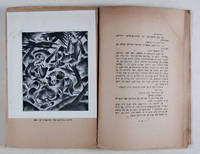
192339395Warsaw: Di Zayt 1923. Second edition. Softcover. fair to vg. Large Octavo. 225pp. Original decorative wrappers with b/w. illustration pasted down on front cover in hardcover cassette with half cloth over decorative paper-covered boards and black lettering on spine. 12 b/w illustrations by Jakob Adler. Abraham Zak 1891-1980 describes the fate of galician population during World War I the sudden change in life the preparations life of and with soldiers and living with war and the Jewish holidays. Zak gives words to the differences and the major change in the way of life of the Jews in Galicia. With his style of essays with dialogues he creates a unique approach to the understanding of the meaning of war which is strongly impacted by the dramatic drawings by Jakob Adler. Text in Yiddish. Cassette with light wear along edges. Wrappers rubbed small piece of cover illustration is missing wear along edges and fraying at head and tail of spine. Foxing at verso of front wrapper and title page. Block tanned 60% of pages are loose but present. Block with some fraying at foredge. Binding in overall very good wrappers and interior in fair to good condition. Di Zayt unknown
140Document du plus grand intrt. Cette pice fut signe et date par Duquesne, charg de dfendre la Sicile reprise par les Franais aux Espagnols, deux jours avant son dpart pour les les de Lipari o il devait rencontrer son adversaire Ruyter (bataille de Stromboli, grce laquelle Duquesne sempara de Messine). Cette pice indique les routes maritimes suivre selon linfluence des vents, ...partant de Toulon ou des isles dHires, ils feront routte droit au cap Corse (...). Ayant doubl le cap Corse on fera routte entre Laplanouze et la Corse... labri du cap Corse et du Golfe de Fayence, si le vent se montrait trop violent, ils relcheraient aux les de La Madeleine, ...ce qui ne se fera que dans la dernire extremit... Mais si le vent est favorable, il faudrait continuer la route jusqu lle de Lustrigo appele Ustica. Duquesne signale en outre une autre route, au cas o les vents ne permettraient pas de suivre la premire. Ce qui est important, dit-il, ...ne se pas sparer pour arriver tous ensemble Messine... afin de vaincre lennemi...Colbert disait de Duquesne : lhomme du royaume qui entend le mieux la navigation .
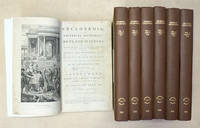
91775London Rivington 1786. 2° XXVII ca. 3000 unpag Bl. 144 blattgr. Kupfertafeln. einige Falttafel. Bibliotheksbände neu aufgebunden u. etwas beschnitten. Etwas stockfleckig u fingerflelckig eingie Blätter knittrig u. angeschmutzt einige Bl. hinterlegt - insgesamt ein schönes Exemplar. Titelblatt verso jeweils Bibliotheksstemp. Aus der Bibliothek von Wolverhampton. -"Eines der bedeutendsten frühen enzyklopädischen Wörterbücher In engl. Sprache. Hat das Erscheinen der Enzyklopädie von Diderot und d'Alembert maßgeblich veranlasst und beeinflußt" Lenz Werner: Kleine Geschichte Großer Lexika. Daten und Fakten über 500 Lexika und Enzyklopädien aus aller Welt. 1980.- Ephraim Chambers c.1680 – 15 May 1740 was an English writer and encyclopaedist who is primarily known for producing the Cyclopaedia or a Universal Dictionary of Arts and Sciences.Chambers was born in Milton near Kendal Westmorland England. Little is known of his early life but he attended Heversham Grammar School then was apprenticed to a globe maker John Senex in London from 1714 to 1721. It was here that he developed the plan of the Cyclopaedia or an Universal Dictionary of Arts and Sciences. After beginning the Cyclopaedia he left Senex's service and devoted himself entirely to the encyclopedia project. He also took lodging in Gray's Inn where he remained for the rest of his life. Chambers died in Islington and was buried in the cloisters of Westminster Abbey.The first edition of the Cyclopaedia appeared by subscription in 1728 and was dedicated to George II King of Great Britain. When he died in 1740 he left materials for a Supplement; edited by George Lewis Scott this was published in 1753.He also wrote for and possibly edited the Literary Magazine 1735–1736 which mainly published book reviews. Chambers worked on translating other works in French on perspective and chemistry from 1726 to 1727 including the Practice of Perspective from the French of Jean Dubreuil. He also worked with John Martyn to translate the History and Memoirs of the Royal Academy of Sciences at Paris 1742. 010 London, Rivington, 1786 unknown
2023BRG-21_5_563Grove Press 2023-05-02. hardcover. UsedVeryGood. 6x2x9. Very Good condition.Crisp pages. Clean cover and pages. Book shows minimal shelf wear. No highlighting/marking. Not Satisfied Contact us to get a refund. Grove Press hardcover
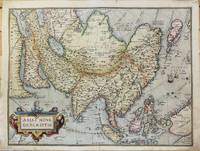
1575M10946Antwerp 1575. Very Good with some expert restoration on the two corners of the lower margin not affecting the map. Notes: Latin Text on verso.<br>From Theatrum Orbis Terrarum Atlas Ortelius's influential map of continental Asia after Gastaldi. "While the Mediterranean coastline and the southern coastline of Asia are fairly accurate the eastern and northern coastlines are erroneous. Especially the north-western parts with the Japanese island group is quite mis-presented. Also many errors in placenames e.g. Meppo for Aleppo. . There is no doubt about the Italian source for this map viz. Gastaldi." Brandmair. Size : 372x492 mm 14.65x19.37 Inches Coloring: Original Hand Coloring Reference: Van Den Broecke #7. Category: Maps Asia Continent; unknown
19042550New York: King Memorial Committee of The Century Association by G.P. Putnam's Sons 1904. First Edition. Leather bound. Near fine. Letter from Secretary of State John Hay to General James Grant Wilson regarding a lock of President Lincoln's hair. Octavo. vii 429pp. Three quarter green morocco title in gilt on spine decorative compartments. Frontispiece portrait with issue cover. Marbled endpapers. Bookplate affixed to front endpaper. Top edge gilt. Letter affixed to front endpaper from Secretary of State John Hay to Gen. James Wilson Grant dated November 8 1902 in response to an inquiry over whether he still possessed a lock of Lincoln's deathbed hair. Includes envelope. Letter notes that he "greatly regrets that I am not the possessor of a lock of Lincoln's hair. I had a little of it for a year or two after his death but in some unaccountable way it was lost." John Hay's search for locks of Lincoln's hair would be a lifelong passion for the friend of the slain president. In 1893 Hay wrote to Doctor Charles Sabin Taft a bystander physician who attended to President Lincoln after being shot at Ford's Theater asking if the doctor had any strands of hair in his possession. Doctor Taft declined to barter for his memento but in 1905 his son found the original letter and contacted Hay. In a hurry the hair was purchased by Hay and promptly encased in a yellow ring. This yellow ring was sent to President Theodore Roosevelt on the occasion of his inauguration. He wore the ring to his inauguration and it remains in the Theodore Roosevelt collection at Sagamore Hill. Mearns 1959. King Memorial Committee of The Century Association by G.P. Putnam's Sons unknown books
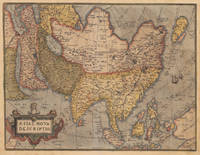
158017201Antwerp: Christopher Platin 1580. Other. A very good example in excellent condition and original colors. 376 by 489mm 14 by 19 inches. Original copper engraving oldcolored published 1582 in Antwerpen in the atlas Theatrum Orbis Terrarum. This is the 2nd plate of Ortelius's "Asia Nova Descriptio". It has the lower case "Farfana" and the town "Ara" has disapeared. The map is finely hand-colored in wash and outline when published. A colored title cartouche is in the lower left corner. Villages and towns are shown as miniature views moreover the map is ornated with sea monsters. A highly decorative 16th century map of Asia. Ortelius was born on 14 April 1527 in the city of Antwerp which was then in the Habsburg Netherlands modern-day Belgium. The Orthellius family were originally from Augsburg a Free imperial city of the Holy Roman Empire. In 1535 the family had fallen under suspicion of Protestantism. Following the death of Ortelius's father his uncle Jacobus van Meteren returned from religious exile in England to take care of Ortelius. Abraham remained close to his cousin Emanuel van Meteren who would later moved to London. In 1575 he was appointed geographer to the king of Spain Philip II on the recommendation of Arias Montanus who vouched for his orthodoxy. He travelled extensively in Europe and is specifically known to have traveled throughout the Seventeen Provinces; in southern western northern and eastern Germany e.g. 1560 15751576; France 15591560; England and Ireland 1576; and Italy 1578 and perhaps twice or thrice between 1550 and 1558. Beginning as a map-engraver in 1547 he entered the Antwerp Guild of Saint Luke as an illuminator of maps. He supplemented his income trading in books prints and maps and his journeys included yearly visits to the Frankfurt book and print fair where he met Gerardus Mercator in 1554. In 1560 however when travelling with Mercator to Trier Lorraine and Poitiers he seems to have been attracted largely by Mercator's influence towards the career of a scientific geographer. Wikipedia Broe. 7. Christopher Platin unknown
1649518331649. Luguni Joannis Antoni Huguetan 1649 Folio Portrait 2 2 68 984 311 pp.; 50 655 1 46 2 pp.; 14 148 6 1 pp. zwei Pergamenteinbände d.Zt.; von einigen kleineren Mängel abgesehen ein feines Expl. Editio postrema à mendis purgatissima - Second Edition of this Opera Omnia first published 1642. ABRAHAM ZACUTUS LUSITANUS 1575-1642 - or Abraham ben Samuel Zacutus "was born in Lisbon. He studied medicine at Coimbra and Salamanca and took his degree of doctor in 1596 when he was twenty-one years of age after having attended the Universities of Salamanca Coimbra and Siguenza . He then returned to Lisbon where according to L. Lemos "In the thirty years he practiced there . He stood out preeminent among his colleagues of many lands . . . whether in discussion or in consultation in medical practice or in literary matters he easily won the palm. . . . But when there seemed that nothing could be added to the happiness of Zacutus- behold a sudden whirlwind of fate . he was plunged headlong from the high peak of the good fortune to which his merit had raised him. A most cruel edict of the king of Lusitania banished all of the Hebrew stock from the kingdom." Zacutus departed from the city of his birth when he was 50 years of age and settled in Amsterdam. " . He journeyed to Amsterdam in the hope of obtaining a peaceful abode ." Zacutus joined the Amsterdam Jewish Community and was one of that remarkable body of physicians who as Portuguese emigres won fame for themselves and added luster to Portuguese medicine; many proudly added "Lusitanus" to their names. In his "Peroration" to the first volume of his Opera Omnia Zacutus writes: " For I am a Jew and a stranger who fled from Portugal and my beloved and most lovely birthplace Lisbon tossed about hither and thither by severe misfortune and the storms of a long life. . I have allowed no day to pass-as Seneca says-without writing a line in which I showed my love for the Republic of Medicine. . I was determined to spend my life in devotion to study." He regarded " physicians as the tutelaries of Divinity sons of the gods." M. Lemos has studied Zacutus' works and presents us with an interesting summary. From this we can see that as an anatomist and pathologist Zacutus deserves special praise for the frequency with which he made autopsies at a time when they were rare. He embraced every opportunity and as a result he published post-mortem findings in the plague in affections of the heart malignant tumors renal and vesical calculi etc. He was much interested in drugs . But it is chiefly as clinician that he showed his greatness; he examined carefully with all the means then known and he relied upon his observations. As a result M. Lemos claims that the name of Zacutus is inseparable from the history of such diseases as plague diphtheria the eruptive fevers and malignant growths. He was one of the first to describe black water fever. He is praised for his studies of and contributions to the knowledge of syphilis. In estimating Zacutus' place in medicine we must bear in mind with M. Lemos that he was one of the most illustrious representatives of moribund Galenism which he defended with great loyalty. In his devotion he combated with all his force those whom he regarded as perverting the text and showing disregard to the masters. But as Carvalho points out "it is true that we had at that time some doctors who without despising traditional science by their devotion to progressive tendencies made great advance in the field of pathology and therapeutics. Of this number Zacutus and Duarte Madeira Arrais take front rank." The universality of Zacutus' interest in human diseases is everywhere apparent. His writings are arranged very systematically and no part of the body fails of attention. An interesting account could be made of the diseases of the eye which he describes and discusses. The same may be said of other organs. It is to be regretted that Zacutus did not live to publish his promised work on surgical diseases for the purpose itself furnishes proof there was nothing in medicine that was foreign to his concern. The collected works the Opera Omnia published in Lyon 1st.Ed. 1642/44 in two large volumes shortly after Zacutus' death January 22 1642 "hauptsächlich betrauert von den Armen" Hirsch but bearing the note of the author's revision present vast scholarship. They were dedicated to King Louis XIII of France. Volume I is described in its title as: The History of the Great Physicians being all the medical histories of internal diseases which are found scattered in the works of the foremost physicians most carefully arranged in proper order and supplied with explanatory notes and commentaries; together with a review of questions and matters of doubt." This is a medical history written not in chronological order of the general development of medicine nor in the sequence of eminent medical personages and their discoveries and their writings but from the point of view of single diseases their course and their treatment as recorded in the works of medical writers throughout the centuries. At the end of the volume Zacutus writes that he has presented " the histories of medical cases gathered from the foremost physicians in bountiful measure-to the number of 433 " and that he has illustrated clarified arranged and confirmed them on the authority of the most learned scholars to the number of 1711 "whom he has cited. It represents work of astounding volume. Volume II is entitled " The Practice of Cases-in which the treatment of all internal diseases is explained according to the views of leading physicians; serious doubts are discussed and resolved; and finally many practical observations are interspersed in their proper places. With an introduction of the physician into practice together with a most elegant pharmacopoeia. To which are added extraordinary medical cases by the very same author fully and newly enriched in which rare wonderful monstrous cases are presented together with their hidden causes signs courses and treatments." Each disease is considered under the following heads: Definition sometimes followed by "differentia" species causes signs prognosis treatment together with illustrative cases. The volume ends with a deeply pious and moving prayer of gratitude for Divine help-just as the book of precepts mentioned above opens with Precept I: "The physician should be a faithful worshipper of Divine Majesty "; yet in discussing objectively a medical problem he adds: "for we are physicians and not theologians! " It is also worthy of mention that the editions of 1649 and 1657 both volumes were from the same printer and are identical in form and paging with the first. What estimate have medical historians placed upon Zacutus Lusitanus Sprengel summarizes his life and work with the words that he distinguished himself as a practitioner as well in Holland as in Portugal. He commends the well ordered and carefully explained collections of cases of older writers as well as his own observations and experiences in rare cases. Daremberg describes the books as "precious works . . . still very useful." Neuburger and Pagel cite Zacutus frequently and praise his works. Neuburger regards him as the first to deal with the history of medicine." Harry Friedenwald The Jews and Medicine I pp.307-321 Cat. p.154 unknown