987 résultats
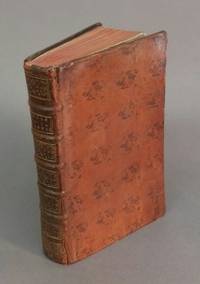
1667D14109Venice: Scipion Banca 1667. Hardcover. Very Good. Early-20th century vellum lettering hand-painted in black and red on spine very pretty; 8vo 131x92mm. Include half-title title with vignette 108 engraved maps. Vellum a little dust-smudged else fine. D7 torn and repaired; gathering I and K transposed; trimmed a bit close at inner margin. Provenance: Francesco Baranelli di Sinigaglia early ownership signature on half-title; discreet gilt-lettered bookseller's label on front paste-down "C. E. Rappaport Libri Rara Roma." <br/><br/>Third Italian edition of a so-called Epitome Theatrum the desirable "pocket" version of Ortelius's Theatrum Orbis Terrarum. Enormously popular this version of Ortelius's atlas was primarily used by travelers students and others for whom the folio edition would be inconvenient. Copies were eagerly sought and usually received considerable wear. The atlas was published by varying printers and engravers through to the 18th-century. Koeman III Ort 71. Scipion Banca hardcover books
186095830c. 1860. Rare original painting of the 16th President of the United States Abraham Lincoln. After a photograph by Civil War photographer Alexander Gardner. Scottish photographer Alexander Gardner immigrated to the United States in 1856 where he became best known for his photographs of the American Civil War President Abraham Lincoln and the execution of the conspirators to Lincoln's assassination. In near fine condition. In a period frame. The entire piece measures 20.75 by 16.75 inches. Rare and desirable. Abraham Lincoln served as the 16th President of the United States from March 1861 until his assassination in April 1865. He led the United States through its Civil War and in doing so preserved the Union of the United States of America abolished slavery and strengthened the federal government. Lincoln began constructing his cabinet on election night and sought to create a cabinet that would unite the Republican party. His eventual cabinet would include his primary rivals for the Republican nomination and although his appointees held differing views on economic issues all were opposed to the expansion of slavery into the territories of the United States. The most senior cabinet post of Secretary of State was appointed to William Seward who had recently failed to win the 1860 Republican presidential nomination and Lincoln's choice for Secretary of the Treasury was Ohio Senator Salmon P. Chase Seward's primary political rival and the leader of a radical faction of the Republican party that sought the immediate abolition of slavery. unknown books
18642547081864. very good-. This historic and rare black printed broadside presents the platforms of both parties the Republicans having convened in Baltimore in June and nominated Abraham Lincoln for President and Andrew Johnson for Vice President and the Democrats having convened in Chicago in August and nominated George B. McClellan for President and George H. Pendleton for Vice President. This copy measures 29 x 23 cm is double columned and with the imprint "For sale by all News Agents. Price $1 per 100." Very light foxing at the bottom margin more visible on the verso. Fraying at the margins as usual. Sabin 63348 Exceedingly scarce.<br/><br/> unknown books
186136386Philadelphia: Published by F. Bouclet 1861. Rare beautifully colored 20" x 25-3/4" lithograph printed on wove paper titled "Presidents of the United States". Displays all the Presidents through a beardless Lincoln surrounding a vignette of Lady Liberty the American eagle a steamboat and the Capitol the dome complete as anticipated though still under construction. Published by F. Bouclet and lithographed by A. Feusier. In superb condition with just a hint of toning from previous framing. Fine.<br/><br/> "A large patriotic print probably issued around the time of Abraham Lincoln's inauguration. Columbia stands before the U.S. Capitol holding a shield and a staff with a liberty cap. On her brow she wears a laurel wreath with a single star. Beside her is an eagle holding a streamer with the motto "E Pluribus Unum." A steamship is visible in the background left. The central scene is framed by oval portraits of the first sixteen presidents of the United States with George Washington at the top and a beardless Abraham Lincoln at the bottom" Reilly.<br/> The print "commemorates Lincoln's election and recognizes the challenges and opportunities facing the 16th president. In this image a portrait of Lincoln completes an unbroken ring of portraits depicting the 15 presidents who preceded him. The illustration calls to mind a quote from Lincoln's first inaugural 'Perpetuity is implied if not expressed in the fundamental law of all national governments'. By commemorating Lincoln's election and illustrating the troubled and complex scene he faced this chromolithograph encapsulates the spirit of Lincoln's presidency" Mast 'A Closer Look at Presidents of the United States 4 President Lincoln's Cottage page 2 2009. <br/>Reilly 1861-13. OCLC 41119329 2- Lib. Cong. MN Public School District as of November 2019. The print is also included in the Jay Last Collection at the Huntington. Published by F. Bouclet unknown books
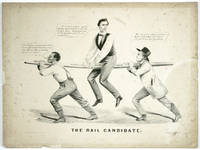
1860WRCAM37633New York: Currier & Ives 1860. Lithograph 13 1/2 x 18 inches. Moderate age-toning foxing and soiling. Moderate browning in margins. Small closed tears and chips in margins one moderate-size closed tear in left margin. A fair copy. A lithographic political cartoon published by Currier & Ives commenting upon the anti- slavery plank of the 1860 Republican platform. "The 'essential' anti-Lincoln cartoon of 1860" - Holzer et al. Abraham Lincoln is shown being carried uncomfortably in the middle of a split wooden rail an allusion to both the platform and to Lincoln's backwoods origins. Supporting the left end of the rail is a black man in simple working clothes who states "Dis N asterisks ours strong and willin' but its awful hard work to carry Old Massa Abe on nothing but dis ere rail!!" Holding the right end of the rail is well-dressed newspaper editor and strong Lincoln supporter Horace Greeley identified by a copy of his NEW YORK TRIBUNE in his coat pocket. Greeley tells Lincoln "We can prove that you have split rails & that will ensure your election to the Presidency." Lincoln replies "It is true I have split rails but I begin to feel as if this rail would split me it's the hardest stick I ever straddled." Lincoln is depicted - visually and thematically - as a straddler at best while the images of Greeley and the African American supporting the rail are derisive. <br> <br> A finely drawn and insightful political cartoon from the 1860 election. REILLY AMERICAN POLITICAL PRINTS 1860-31. WEITENKAMPF p.123. CURRIER & IVES: CATALOGUE RAISONNÉ 5478. Harold Holzer Gabor Borritt & Mark Neely THE LINCOLN IMAGE p.38 figure 18. Currier & Ives hardcover books
1669D6035Paris: Frederic Leonard 1669. First Edition. Hardcover. Very Good. 4to 242 x 185 mm. 120pp. Printers woodcut device on title depicting the winged lion of Evangelist Mark and motto Virtute invidiam vince Virtue overcometh envy and the legend Pax tibi marce Evangelista meus. 5 engraved folding plates 4 by Sebastien Le Clerc and one by Abraham Bosse depicting a chameleon on a branch and a plate with chameleons skeleton and organs in the upper part on a trompe-loeil sheet; and the same anatomical analysis for the beaver the camel the bear and the gazelle decorative woodcut head- and tail-pieces. Contemporary mottled calf spine gilt in compartments plates with some tears along folds repaired on verso some light darkening minor marginal worming at end; light edgewear. From the collection of Charles Philippe Robin 1821-1885 French doctor anatomist and politician bibliographical note at foot of title. Other early inscriptions to title referring to the engraver M. LeClerc and on rear pastedown to the state of the engravings. <br/><br/>First Edition and second publication dealing with the comparative anatomy of the animals the chameleon the beaver the camel the bear and the gazelle. Perrault scientist and naturalist was the leader of a team of comparative anatomists called the Parisians that included Guichard-Joseph Duverney Jean Pecquet Moyse Charas and Philippe de la Hire. Their investigations began in June 1667 with a thresher shark and lion from the royal academy and went on to encompass forty-nine vertebrate species. The detailed reports and exact descriptions on these dissections were the first of a long series of anatomical descriptions which ultimately included those of twenty-five species of mammals seventeen birds five reptiles one amphibian and one fish. Perrault and the team of Parisians prided themselves on several discoveries and in the process debunked many popular myths attached to certain species such as the legend that salamanders live in fire or that chameleons subsist on air. The scientists also recorded how they obtained their results providing a glimpse of how such anatomical research was conducted in the seventeenth century. The work is illustrated beautifully with five large folding plates by the expert painter engraver and writer Sebastian Leclerc 1637-1714 four of which were engraved by Leclerc and one by the watercolor painter writer and printmaker Abraham Bosse c. 1604-1676. Very fine work; the large folding plates remain fresh and intact. No such detailed and exact descriptions and illustrations had been published before. It is hard to measure another such important addition to the anatomical study of animals. Frederic Leonard hardcover books
5980157 leaves of text paginated 1-124 & 129-317 nothing seems lacking. Large 4to 318 x 215 mm cont. sheep-backed black cloth extremities slightly worn title in gilt on spine. S.l.: c. 1852. A finely written and illustrated manuscript with highly technical observations on French naval artillery training and testing in the mid-19th century which are complemented by numerous hand-drawn marginal diagrams and many tables. The present manuscript was composed by Floucaud de Fourcroy 1831-1929 a descendant of the famous chemist Antoine de Fourcroy as a cadet aboard the Uranie a former frigate converted into a training ship in 1851. By the end of his career Floucaud de Fourcroy was a highly decorated admiral and commander in the Legion of Honor. The present manuscript recapitulates the curriculum of naval artillery in the middle of the 19th century. It begins with a survey of weapons classifications artillery rifles swords pikes axes etc. and the situations in which to use them different types of ammunition and their purposes and the history of their development. There are then lengthy explanations of each weapon's size range reloading time effectiveness etc. Each of these is presented with precise measurements and dimensions. The author recounts the multitude of exercises which a cadet had to undergo and master in order to progress as a naval officer pp. 265-90. There are also extensive notes on his lessons in ballistics often accompanied by intricate diagrams and mathematical formulas. Pages 295-96 feature a section entitled in trans.: "Notes on the Practical Instruction which a Sailor-Gunner must Receive." The drawings in the margins many very complex illustrate the composition of ships weapons ammunition and instruments the trajectory of cannons and firearms the construction of equipment the optimal angles of attack the adjustments necessary to maintain accuracy while the ship is in motion etc. etc. On page 317 Floucaud de Fourcroy has drawn detailed cross-sections of five types of cannons. The tables concern the range of various cannons their effectiveness at specific ranges in terms of speed and their penetration the supply needs of cannons the number of cannons that can fit on a ship etc. A most interesting manuscript in fine condition that captures the state of French naval training and warfare in the middle of the 19th century. Pages 227-28 258-64 and 315-16 are blank. hardcover books
184822094.01 -.02<p>Lincoln's spot resolution and speech condemns the pretexts for starting the war with Mexico. He requests proof from President Polk that American blood was shed on American soil and that the enemy provoked the Americans and he asks if those Americans present were ordered there by the United States Army.</p> <b>ABRAHAM LINCOLN.</b>Newspaper. <i>National Intelligencer</i> Thursday December 23 1847. Washington: Gales & Seaton . 4 pp. Offered with another issue of the <i>National Intelligencer</i> January 20 1848. 4 pp.<p><b><br /></b></p><p><b>Excerpts:</b></p><p><b>December 23 1847 issue</b></p><p>Page 2 bottom of first column to second column</p><p><i>Mr. LINCOLN moved the following preamble and resolutions which were read and laid over under the rule:</i></p><p><i> Whereas the President of the United States in his message of May 11 1846 has declared that "the Mexican Government not only refused to receive him the envoy of the United States or listen to his propositions but after a long-continued series of menaces have at last invaded </i>our territory<i> and shed the blood of our fellow citizens on</i> our own soil<i>."</i></p><p><i> And again in his message of December 8 1846 that "we had ample cause of war against Mexico long before the breaking out of hostilities; but even we forbore to take redress into our own hands until Mexico herself became the aggressor by invading </i>our soil <i>in hostile array and shedding the blood of our citizens."</i></p><p><i> And yet again in his message of December 7 1847.</i></p><p> Resolved by the House of Representatives<i> that the President of the United States be respectfully requested to inform this House—</i></p><p><i> 1st. Whether the spot on which the blood of our citizens was shed as in his messages declared was or was not within the territory of Spain at least after the treaty of 1819 until the Mexican Revolution.</i></p><p><i> 2d. Whether that spot is or is not within the territory which was wrested from Spain by the revolutionary Government of Mexico. </i></p><p><i> 3d. Whether that spot is or is not within a settlement of people which settlement has existed ever since long before the Texas revolution and until its inhabitants fled before the approach of the United States army.</i></p><p> <i>4th. Whether that settlement is or is not isolated from any and all other settlements by the Gulf and the Rio Grande on the south and west and by wide uninhabited regions on the north and east.</i></p><p><i> 5th. Whether the people of that settlement or a majority of them have ever submitted themselves to the government or laws of Texas or of the United States by consent or by compulsion either by accepting office or voting at elections or paying tax or serving on juries or having process served upon them or in any other way.</i></p><p><i> 6th . Whether the people of that settlement did or did not flee from the approach of the United States army leaving unprotected their homes and their growing crops </i>before<i> the blood was shed as in the messages stated; and whether the first blood so shed was or was not shed within the enclosure of one of the people who had thus fled from it. </i></p><p><i> 7th. Whether our </i>citizens<i> whose blood was shed as in his messages declared were or were not at that time armed officers and soldiers sent into that settlement by the military order of the President through the Secretary of War.</i></p><p><i> 8th. Whether the military force of the United States was or was not so sent into that settlement after Gen. Taylor had more than once intimated to the War Department that in his opinion no such movement was necessary to the defense or protection of Texas. </i></p><p><i> Several resolutions of inquiry were here offered my Messrs. GEORGE S. HOUSTON W.P. HALL PHELPS GREEN McCLELLAND and KAUFMAN which are omitted for want of room.</i></p><p><b>January 20 1848 issue: </b></p><p>Page 2 bottom of 3rd column thru 6th column. In this lengthy address Lincoln questions President Polk's judgment regarding the aims and prosecution of the war in Mexico putting it in the context of the American Revolution: <i>"Texas revolutionized against Mexico and became the owner of something…if she got it in any way she got it by revolution; one of the most sacred of rights—the right which he believed was yet to emancipate the world; the right of a people if they have a government they do not like to rise and shake it off…He talked like an insane man. He did not propose to give Mexico any credit at all for the country we had already conquered; he proposed to take more than he asked for last fall…"</i></p><p>Additional news: page 2 middle of 4th column prints a lively senatorial debate involving Jefferson Davis. Page 3 bottom of 2nd column <i>"Mr. LINCOLN from the same committee reported a bill for the relief of William Fuller and Orlando Saltmarsh. Read and committed." </i>Page 4 middle of 3rd column <i>"By Mr. LINCOLN: A bill to amend an act entitled 'An Act to raise for a limited time an additional military force and for other purposes' approved February 11 1847."</i> This act gave the president permission to raise one regiment of dragoons and nine regiments of infantry to be used in the war with Mexico. In addition the act dealt with the logistics of each regiment such as raising the pay for field surgeons or adding a quartermaster to each regiment.</p> books
1648001623Paris: Pierre Des-Hayes 1648. Book. Very good- condition. Hardcover. First Edition. 16mo - over 5¾" - 6¾" tall. xviii 342 pages of text. Defective copy lacking five plates the frontis and a final engraved table. Attractive early-to-mid-18th century leather binding with moderate wear to the hinges spine extremities and corners. Raised bands gilt tooling and lettering on spine. Decorative marbled endpapers and blank endsheets supplied at time of binding. Present is the full-page engraved portrait of Michel Larcher engraved armorial dedication to Larcher and the engraved title page following page 58. A complete copy has the plate numbers 151 and 156 used twice totalling 158 plates showing plans and designs of perspective of which 153 only are present in this copy. Lacks plate numbers 110 151 both 154 and 155. However early hand-drawn facsimiles of plates 151 one of two and 155 are supplied and bound-in leaving three images unrepresented. The majority of the plates are double-sided. Plate 156 is in less than good condition with heavy staining and soiling. Engraved title page is repaired with early conservator's tape with no loss. Pages 168 through 193 are bound out of order. Several leaves are affected by damp staining and minor rippling; approximately 15 front and 30 rear. The title page and several adjacent leaves as well as a few at the rear of the text are heavily stained. Some of the staining appears to originate from washed-out markings -- notations to which an attempt at removal were made -- that are in blank areas mainly in the front and rear pages but also in the blank areas in the introduction. Includes Desargues New Theory at the end with demonstrations. Protected in a modern circa 1950 slipcase decorated with marbled endpaper the seams of which are detached at the top edge. Desargues 1593-1661 was a French mathemetician and a founder of modern Geometry. With Pascal he introduced the method of perspective; treated conic sections as projections of circles formulated the so-called Arguesian transformation; developed the theory of involution and of transversals; defined parallels as lines that intersect at infinity. Measures 6-5/8" tall by 4-1/2" wide; printed on thick paper with ample margins. 20th century bookplate of Paul and Verner Mac Alister on front pastedown and a neatly handwritten identification on the 2nd front endpaper. On the same leaf is a contemporary name or marking. French France Fortifications Conics Cartography Projective and Descriptive Geometry. Early editions of Desargues works are quite uncommon. Pierre Des-Hayes Hardcover books
180427999London 1804. Hand-coloured and colour-printed aquatint with stipple and line engraving by Elmes. Paper watermarked 1804. The most strikingly beautiful flower plates ever to be printed in England.<br/> <br/>"The Persian Cyclamen Cyclamen persicum Miller parent of the florist's cyclamen. is a native of the countries and islands at the eastern end of the Mediterranean but not of Persia itself. It is the largest flowered of an attractive genus of small plants much grown in modern times by connoisseurs. The Persian Cyclamen was not the first of its kind to become known in western Europe. Cyclamen europeaum the `Bleeding Nun' as it was called was thought to be dangerous to pregnant women: any unfortunate lady in this condition who stepped over it might immediately miscarry. John Gerrard the Elizabethan herbalist believed this implicitly and describes how he fenced his plants around with sticks with others laid across them `lest any woman should by lamentable experiment find my words to be true by stepping over the same.' When the baby was nearing full term and delivery was to be encouraged wearing of the disc-like tuber `hanged about' the expectant mothers had a salutary effect and Gerrard told his wife to use it when attending confinements. Its use by midwifes dates back to the days of the Greeks." Ronald King. The Temple of Flora by Robert Thornton. 1981 p. 52. Thornton's Temple of Flora is the greatest English colour-plate flower book. ".Thornton inherited a competent fortune and trained as a doctor. He appears to have had considerable success in practice and was appointed both physician to the Marylebone Dispensary and lecturer in medical botany at Guy's and St. Thomas's hospitals. But quite early in his career he embarked on his. great work. What Redouté produced under the patronage of L'Héritier Marie Antoinette the Empress Josephine Charles X and the Duchesse de Berry Thornton set out to do alone. Numerous important artists were engaged. twenty-eight paintings of flowers commissioned from Abraham Pether known as `Moonlight Pether' Philip Reinagle . Sydenham Edwards and Peter Henderson. The result. involved Thornton in desperate financial straits. In an attempt to extricate himself he organized the Royal Botanic Lottery under the patronage of the Prince Regent. it is easy to raise one's eyebrows at Thornton's unworldly and injudicious approach to publishing. But he produced. one of the loveliest books in the world" Alan Thomas Great Books and Book Collecting pp.142-144. Third state of three of this plate from the Temple of Flora. `In the first state the top the castle is indistinct and has no pinnacles on the towers and this is the first feature to inspect. The hillside is pure aquatint; the shading behind the cyclamen flowers is lightly cross-hatched while the tree trunk to the right has only a few lines on it. In the second state the castle is more prominent and five distinct sharp pinnacles have been added while many extra etched lines are to be seen - notably behind the cyclamen flowers; on the tree trunk; and under the cyclamen leaves on the left which themselves stand out more sharply. The principal change in the third state is the addition of the aquatint to the sky on the left so that only a streak of light remains above the mountains while in the earlier states the light reached the top corner. The leaves of the cyclamen now have. light and dark patches the coarse-grained aquatint has been added to the middle distance. Much additional aquatinting has been applied to other parts of the plate. The most easily-noticed difference however are the changes in the castle between states one and two and in the sky between states two three." Handasyde Buchanan. Thornton's Temple of Flora 1951 p.15. Third state of three of this plate from the Temple of Flora. unknown books
186125965<p><b>ABRAHAM LINCOLN.</b>Chromolithograph. <i>Presidents of the United States</i> Philadelphia: Published by F. Bouclet lithographed by A. Feusier. Sheet size: 21 in. x 27 in. Image size: 24½ in. x 18¾ in. </p><br />A large patriotic chromolithograph issued around the time of Abraham Lincoln's first inauguration. The central image is the goddess Columbia wearing a draped American flag flanked by bald eagle and Union shield. Behind her is a steam ship and the artist's rendition of what the then-uncompleted Capitol building was expected to look like. Surrounding Columbia is an ornate frame made up of portraits of the presidents of the United States from 1789-1861—including a beardless Abraham Lincoln: George Washington John Adams Thomas Jefferson James Madison James Monroe John Quincy Adams Andrew Jackson Martin Van Buren William H. Harrison John Tyler James K. Polk Zachary Taylor Millard Fillmore Franklin Pierce James Buchanan and Abraham Lincoln.<p><b>Historical Background</b></p><p>Erin Mast curator of "My Abraham Lincoln" a 2009 exhibition at President Lincoln's Cottage Museum noted that the print "both commemorates Lincoln's election and recognizes the challenges and opportunities facing the 16th president. The 16 presidential portraits encircle symbols of the republic at a time when a divided nation faced secession and civil war. In the center Columbia holds a shield and liberty cap the latter being a symbol both of revolution and of freed slaves. A bald eagle grasps arrows and an olive branch and carries a ribbon with the motto 'E Pluribus Unum.' The Capitol dome shown completed at a time when it was still unfinished symbolizes the founding of the democratic republic while a steamship symbolizes development and progress. The allegorical images relate to concepts that Lincoln expressed in his first inaugural address; that seceding and breaking the Constitution would be a step backward not forward and violates the very principles of the Union a Union which is 'older than the Constitution.' By commemorating Lincoln's election and illustrating the troubled and complex scene he faced this chromolithograph encapsulates the spirit of Lincoln's presidency."</p><p><b>Provenance</b></p><p>From the Estate of Malcolm S. Forbes.</p><p><b>Condition</b></p><p>Damp stains at top two corners light mat burn but generally a very fine example.</p> books
1750167Etching and engraving. D.1385 Blum 203. Image: 10 x 12½. Margins: 10½ x 14. books
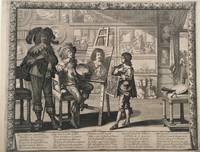
16421661642. Etching and engraving. Duplessis 1386; Blum 204 only state. Image: 10 x 12 with small margins. Foxing traces of old fold in the legend. books
1700D5997Nurnberg: J. Chr. Weigel c. 1700. First and only Edition. Hardcover. Very Good. Speckled calf gilt-stamped ornament on spine; 4to; with copper-engraved title-page and 67 copper-engraved plates 1 of them lightly colored. Very rare work illustrating various human follies and obsessions according to Bertsche not by Santa Clara although that's the general assumption. Title-page and 1 plate professionally restored; some plates neatly repaired with tape or reinforced with paper on the verso; occasional marginal chip or tear infringing upon the image itself in just 2 instances; 2 plates with marginal ink doodles. <br/><br/> J. Chr. Weigel hardcover books
183723104.01<p>Lincoln and John Todd Stuart cousin of Lincoln's future wife Mary Todd had served together in the Illinois House of Representatives from 1834-1836. They formed Stuart & Lincoln on April 12 1837.</p> <b>ABRAHAM LINCOLN.</b>Newspaper. <i>Sangamo Journal</i> Springfield Ill. December 23 1837. 4 pp. 18 x 24¾ in. Double matted and framed with glass on both sides to display pages one and four. Slightly chipped 26 x 33 in. frame.<p>In the upper portion of the first column of the first page appears this five line advertisement: <i>"STUART & LINCOLN / ATTORNEYS and Counsellors at Law will practice / conjointly in the Courts of this Judicial Circuit. – / Office No. 4 Hoffman's Row up stairs. / Springfield april 12 1837."</i> Two ads directly above: <i>"NINIAN W. EDWARDS / ATTORNEY & COUNSELLOR AT LAW / Springfield – Illinois."</i></p><p>Lincoln had moved from New Salem Illinois to Springfield in 1836. He had first met fellow attorney Ninian W. Edwards when both were members of the Illinois State House of Representatives. Edwards married Elizabeth Todd in 1832 and Lincoln met Elizabeth's sister Mary Todd at the Edwards home where Mary had moved in 1839. On November 4 1842 Lincoln and Mary Todd were married in the Edwards mansion.</p><p>The <i>Sangamo Journal </i>started publishing in 1831 shortly after a young Lincoln settled in New Salem. The newspaper faithfully supported Abraham Lincoln and the Whig Party throughout many name changes: the <i>Illinois Journal</i> 1847 shortly after Lincoln left for Congress then the <i>Illinois State Journal</i>1855. As the Whig party broke up the newspaper supported the newly-formed Republican Party and Abraham Lincoln's rising political star.</p><p><b> Condition</b></p><p>Very fine with no visible tears.</p> books
1907876081907. Photograph signed and dated "Gutzon Borglum 1907." The photograph taken by Borglum shows his marble bust of Abraham Lincoln. On February 6 1908 the President's son Robert Todd Lincoln wrote to Borglum regarding the bust as "the most extraordinarily good portrait of my father I have ever seen." The sculpture is on display in the Crypt of the U.S. Capitol Building. A<i> </i>typed Lincoln quotation pasted to mount at lower left. In very good condition. Double matted and framed. The entire piece measures 15 inches by 17.5 inches. Sculptor Gutzon Borglum designed and oversaw the execution of the Mount Rushmore National Memorial from 1927 to 1941 with the assistance of his son Lincoln Borglum. Conceived by South Dakota historian Doane Robinson the 60-foot sculpture was initially intended to promote tourism in the Black Hills Region of South Dakota. unknown books
6726Engraved frontis.; eight engraved vignettes and head- & tailpieces 19 finely engraved plates most folding & some engravings in the text. 18 p.l. 254 36 pp. of index & errata. Thick 8vo 160 x 105 mm. late 18th-cent. marbled boards extremities a little rubbed & worn. Dresden: C. G. Nitzsche 1765. An important German edition of Bosse's Traité des manières de graver en Taille douce 1st ed. in French: 1645 considerably augmented for the German audience. This work was translated and published by Carl Gottlieb Nitzsche from the 1745 Cochin edition. The Cochin edition was the first to promote etching with hard etching-ground vernis dur instead of the soft etching-ground vernis mol to imitate line engraving. It also featured long sections on Le Blon's color printing and the refining of mezzotint illustration. In the present book we find four illustrations of the rolling press which Cochin had updated to account for several design upgrades. There are also several diagrams and cross-sections of printing presses. This book is richly illustrated with plates and vignettes executed by Carl Gottfried Nestler 1730-80 that depict various techniques equipment and the interiors of print shops. Nestler reworked the engraved title-page from the 1645 first edition for this book's frontispiece. A very good copy internally fresh. Unidentified engraved bookplates with the initials "G. F." on front and rear paste-downs. ❧ Benezit Dictionary of Artists Vol. 10 p. 258 Nestler. hardcover books
1756S13188London:: A. Millar 1756. 1756. Quarto. 4 xi 1 errata 348 pp. Portrait medallion vignette on title; mild foxing but barely noticeable. Original full calf red gilt-stamped leather spine label; hinges repaired with calf inner joints strengthened corners worn all preserving original spine. Bookseller's ticket: "Sold by Carpenter & Co. 14 Old Bond Street" London. Early ownership ink signature of Th. Spencer; penciled initials of F.N.D. see below. Very good. A KEY WORK BY THE FATHER OF PROBABILITY THEORY. Third edition. This is a key work by the father of probability theory in which major steps in the measurement of uncertainty were achieved. De Moivre is "best known in statistical circles for his famous large-sample approximation to the binomial distribution whose generalization is now referred to as the Central Limit Theorem. De Moivre was one of the great pioneers of classical probability theory." Bellhouse-Genest p.1. It is the first systematic treatment of probability in English. Abraham De Moivre became with Edmund Halley a founder of English actuarial science. The author's dedicatory letter is address to Lord George Carpenter 1702-1749 the first edition had been dedicated to Newton where the author states emphatically "that this Doctrine is so far from encouraging Play that it is rather a Guard against it. . ." DNB vol. 38 p.116. / "The first edition of this work contains 175 pages the second edition 258 pages and the third 348 pages. The following list will indicate the parts which are new in the third edition: the Remark pages 30/33 and pages 48 & 49 the greater part of the second Corollary pages 64/66 the Examples page 88; the Scholium page 95 the Remark page 149 and pages 151/159 the fourth Corollary page 162 the second Corollary pages 176/179 the note at the foot of page 187 the Remark pages 251/254. The part on life annuities is very much changed. The Introduction is very much fuller than the corresponding part of the first edition. In his third edition De Moivre draws attention to the convenience of approximating to a fraction with a large numerator and denominator by continued fractions which he calls "the Method proposed by Dr. Wallis Huygens and others". He gives the rule for the formation of the successive convergents. This third edition contains 74 problems exclusive of those relating to life annuities in the first edition there were 53 problems. The pages 220/229 contains one of De Moivre's most valuable contributions to mathematics namely that of Recurring series. Pages 261/328 are devoted to Annuities on lives ; an Appendix finishes the book occupying pages 329/348 : this also relates principally to annuities but it contains a few notes on the subject of probability." :: Todhunter. A very full account of the above third edition will be found in Todhunter's History of the theory of probability. / "De Moivre's first book on probability was based upon a short memoir entitled De mensura sortis published in the 1711 volume of the Philosophical Transactions. The 1718 first edition is essentially a gambler's manual giving a systematic presentation of the arithmetic principles upon which are based the solution of problems concerning the advantage of players and size of wager which may be lain in a wide variety of games of chance. Walker. It does not contain De Moivre's work on the normal approximation of the binomial probability distribution which ranks as the most memorable of his discoveries; this discovery was first printed in its entirety in 1733 in a Latin pamphlet which was later translated into English and incorporated in successively expanded versions in the second 1738 and posthumous third 1756 edition of The doctrine of chances." Norman. / In terms of mathematics applied to the human actuarial lifespan "De Moivre French Huguenot mathematician and demographer formulated the hypothesis that among a body of persons over a certain age the successive annual decreases by death are nearly equal." Garrison & Morton. / "De Moivre's work on the theory of probability surpasses anything done by any other mathematician except Laplace. His principal contributions are his investigations respecting the duration of play his theory of recurring series and his extension of the value of Bernouilli's theorem by the aid of Sterling's theorem". Cajori. / De Moivre born at Vitry received a varied education and settled in London as a Huguenot refugee in 1688. In England he continued his study of mathematics while working as a tutor. He is said to have acquired and read a copy of Newton's Principia and even to have carried loose sheets around with him to study at every available moment. This method of study worked so well that not only did he become one of England's foremost mathematicians but Newton in old age was in the habit of referring questions about the Principia to De Moivre. De Moivre's Doctrines of Chance is in fact a revised and expanded translation of his essay De Mensura Sortis which had been published in Latin in the Philosophical Transactions in 1711. In its Latin form it thus preceded Jacob Bernoulli's Ars Conjectandi 1713 by a full two years. / De Moivre was a French mathematician famous for De Moivre's formula which links complex numbers and trigonometry and for his work on the normal distribution and probability theory. He was elected a Fellow of the Royal Society in 1697 and was a friend of Isaac Newton Edmund Halley and James Stirling. Among his fellow Huguenot exiles in England he was a colleague of the editor and translator Pierre des Maizeaux. / Shafer points out that De Moivre one of Jacob Bernoulli's successors was among those who were applying Huygens' theories to both games and economies p. 11. He points out that the 1718 first edition was influenced by Bermoulli in that he used the word "probability" which was a word he did not use in his De mensura sortis. He continues: "We should not exaggerate De Moivre's importance in the eighteenth century. In retrospect he represents the pat that mathematical probability followed but he was hardly a philosopher of Jacob's caliber and Jacob retained a strong influence throughout the century among those who wanted to understand probability philosophically. Jacob's and Hooper's rules survived the whole course of that century in the works of philosophically sophisticated writers such as Lambert and Diderot. They disappeared only after Bayesian alternatives were developed by Laplace." pp. 13-14. Steve Stigler and Lorraine Daston expand on the use of the word "probability" in the eighteenth century. / Theodore Porter UCLA writes that De Moivre introduced the astronomer's law error to probability theory p. 93. "Like most early probability mathematics it first arose in the context of games of chance; it appeared as the limit of the binomial distribution. Because of its usefulness in combination and permutation problems the binomial had become the heart of the doctrine of chances. . . De Moivre then showed in a paper of 1733 reprinted in 1738 in the second edition of his Doctrine of Chances that the exponential error function gave a very good approximation to the distribution of possible outcomes for problems like the result of 1000 coin tosses Now for the first time it was practicable to apply probability theory to indefinitely large numbers of independent events." / PROVENANCE: I Thomas Spencer undetermined. II F.N.D. :: Florence Nightingale David 1909-1993 also known as F. N. David was an English statistician born in Ivington Herefordshire England. She was named after Florence Nightingale who was a friend of her parents. David did not like her forenames and thus always referred to herself as "F. N. David". She attended the Bedford College for Women in London earning her degree in mathematics in 1931. She then joined University College London to work with Karl Pearson who obtained a scholarship for her working as his research assistant resulting in a doctorate received in 1938 Pearson died in 1934. In 1938 her first book was published Tables of the Correlation Coefficient. During that period she was working with Jerzy Neyman. "During World War II she served as Experimental Officer in the Ordnance Board for the Ministry of Supply Senior Statistician for the Research and Experiments Department for the Ministry of Home Security Member of the Land Mines Committee of the Scientific Advisory Council and as Scientific Advisor on Mines to the Military Experimental Establishment. Her work during this time ranged from the study of bombing patterns and damage to the problem of discovering the placement of enemy land mines and a methodology for randomly placing land mines so as to avoid the semblance of any pattern in their placement." Garber et.al. After WWII she came back to University College London and was appointed professor in 1962. Five or six years later she took a position at the University of California Riverside becoming head of the Department of Statistics in 1970. Retiring in 1977 she came to Berkeley and continued her research. this book bears her initials on the Francis Galton Laboratory bookplate; she gave her books to Margaret Stein of Stanford University. See: M. J. Garber D. V. Gokhale J. M. Utts R. J. Beaver Chair "Florence Nightingale David Statistics: Riverside." Obituary; "A conversation with F.N. David" Statistical Science Vol. 4 No. 3235-246 by Nan Laird; J. Utts "Florence Nightingale David 1909-1993: Obituary" Biometrics 1993 49 1289-1291; Norman L. Johnson & Samuel Kotz eds. Leading Personalities in Statistical Sciences from the Seventeenth Century to the Present Wiley 1997 pp. 91-92. / REFERENCES: Babson 181 1st ed.; Ball A short account of the history of mathematics pp. 383-4; BM Readex Vol. 17 p. 751; Cajori History of Mathematics pp. 229-30; DNB vol. 38 p.116; Kress S.2793; Institute of Actuaries 1935 p. 39; Mansutti 504; Norman 1529 1st ed.; Pearson The History of Statistics in the 17th & 18th Centuries. . . pp. 155-60 165-66; Smith Source book in mathematics pp. 440-54; Stigler The History of Statistics: The Measurement of Uncertainty before 1900 1986 p. 70; Todhunter History of the theory of probability; Walker pp. 12-13; Wellcome IV p. 149; Westergaard pp. 104-5. Not in Goldsmiths or Hanson. / See: Raymond Clare Archibald "Abraham de Moivre"; David F.N. Games Gods and Gambling; The origins and history of probability and statistical ideas . . . 1962 pp. 161-178. A. Millar, 1756. hardcover books
1854008887Philadelphia: George W. Taylor 1854. Half leather. Very good. Philadelphia: George W. Taylor 1853-1854. Half leather. 24 monthly issues bound together. Complete; each volume contains 104 text pages. Half-leather with marbled boards; 6.75" x 10.25". Sound binding. Clean pages with light intermittent foxing. Old pencil annotation at top of the first title page. Light dampstain to the first six leaves. Some edgewear to cover; two-inch loss of spine covering at head and tail. This ardent abolitionist journal includes coverage of the debate regarding the expansion of slavery news of anti-slavery events some early writings of Frederick Douglass discussion of Quaker events American slavery laws Uncle Tom's Cabin temperance issues including the "Maine Law" and much more. The journal was the organ of the Free Produce Society of Philadelphia and its publisher George Taylor managed the city's Free Produce Store. 'Free Produce' included all manners of goods traditionally made with slave labor that were produced without any taint of slavery. Such items were much more expensive than slave-produced items but the most principled Quakers and abolitionists paid the price to keep their consciences clear. Although the Society disbanded in 1856 Taylor kept the store open until after the Civil War when customers no longer saw a reason to patronize him. See The Atlantic Monthly October 1868 and Cison's "Quality Came Second" in Main Line Today March 2007. Scarce. While digital and microform reprints are available at the time of listing OCLC shows only a few institutions holding intermittent original issues. Two auction records are on file at the Rare Book Hub. George W. Taylor unknown books
13623LINCOLN Abraham. Stereograph photo published by Keystone View Company. The original 1865 image was long attributed Mathew Brady and a handwritten note in pencil on verso mentions that attribution but the image was actually taken by Lewis Emory Walker a government photographer about February 1865 and published for him by the E. & H. T. Anthony Co. This rare stereograph O-104 was Published by Keystone. It is said that the short haircut was suggested by Lincoln's barber to facilitate the taking of his life mask by Clark Mills. Lincoln's eyes are deep and sorrowful; The civil war had taken its toll on him. One pen notation: "No 92" below the image Keystone bio of Lincoln on verso with their copyright. unknown books
1865863261865. BROADSIDE - Lithograph LINCOLN Abraham. EMANCIPATIONS PROKLAMATION. Davenport Iowa: W.H. Pratt 1865. August Hageboeck lithographer. This is the second German-language version of the Emancipation Proclamation. It is printed in cursive within an oval border. The weight of the individual letters is varied so that when viewed from a distance a portrait of Lincoln emerges from the text. Originally printed on a rectangular sheet but here trimmed to an oval that surrounds the image the sheet is 37 x 29.5 cm. The image is 32 x 23 cm. The paper is browned and dampstained at the bottom center at the copyright information. It is matted and housed in a custom archival portfolio. A rare print. unknown books
18641403210Wright & Potter 1864. 5th or later Edition. Soft cover. Very Good. Boston. 1864. 88110pp. plus folding map. Original printed paper wrappers. Internally clean back cover not attached anymore water stain at top of spine and around it. Very good. Devoted almost entirely to the Massachusetts war effort published early in January 1864. The folding map shows the Soldier's National Cemetery at Gettysburg dedicated November 19 1863 with the long speech of Edward Everett of Massachusetts and the short "Dedicatory Speech by President Lincoln" better known as the Gettysburg Address. Also printed is the "Programme of Arrangements" of that day a list of Massachusetts soldiers killed at Gettysburg and buried there and details of the cemetery. Monaghan notes this as an early printing of the Gettysburg Address. MONAGHAN LINCOLN BIBLIOGRAPHY I:48. This historically significant and very early book publication of the Gettysburg Address which may be the most important and certainly best known speech in US history is extremely uncommon and almost only found rebound or with the covers missing. This version intact and in its original condition is a coveted artifact of Americana. Comes in a custom-made slipcase. Wright & Potter unknown books
186085724Chicago: Charles Leib 1860. Very Good. Four-page newspaper. A couple of small holes various brown spots and other bits of minor wear A campaign newspaper for Abraham Lincoln in the Presidential Campaign of 1860. We note a half-column story on the front page of this issue that accuses Senator Douglas of being a Roman Catholic -- a charge based partly on the fact that Mrs. Douglas was a Catholic as were their children -- probably an effective charge in largely Protestant mid-19th century America. Our brief research suggests that Douglas was not a Catholic or a formal member of any other organized religious group. The purpose of another half-column story on the front page was to make it clear that Lincoln had publicly condemned the actions of John Brown and did not object to Brown's execution. Charles Leib the editor was a political operative with a murky background who had previously edited a Democratic campaign newspaper on behalf of the Buchanan campaign in 1856. Leib served briefly as an Assistant Quartermaster in the Union Army before heading to new Mexico probably in 1863 and died there in 1865 at the age of 38. <br/><br/> Charles Leib unknown books
1950131050Los Angeles: Twentieth Century-Fox 1950. Revised First Draft Continuity script for the 1951 film. Included is an index to the script breakdown detailing various scenes and script page numbers with revisions. Copy belonging to Dane Anderson an uncredited member of the crew with his name on the front wrapper of the script breakdown and annotations throughout in holograph pencil. File copy rubber-stamped on the front wrapper. <br/><br/>Based on Weidman's 1937 novel and Vera Caspary's loose adaptation. Harriet Boyd Hayward is a fashion designer who partners with Teddy Dailey whom she loves and Sam Jaffe and starts a new business dedicated to selling affordable women's dresses. A rival fashion company lead by Noble Sanders momentarily distracts Harriet but at the last minute she realizes her true devotion to Teddy and Sam. <br/><br/>Screenwriter Polonsky was blacklisted shortly after the film's release refusing to answer questions before the House Un-American Activities Committee. <br/><br/>White titled wrappers rubber-stamped as REVISED FIRST DRAFT CONTINUITY on the front wrapper copy No. 3 and production No. 2446.8 dated August 4 1950. Distribution page present with receipt removed. Title page present dated August 4 1950 noted as Revised 1st Draft Continuity with a credit for screenwriter Polonsky. 170 leaves with last page of text numbered 168. Mimeograph on eye-rest green stock. Pages and wrapper Near Fine internally bound with three gold brads. <br/><br/>Script Breakdown: self wrappers as issued. 88 leaves dated 10/2/50 mimeograph on eye-rest green stock. Near Fine bound with three gold brads. Twentieth Century-Fox unknown books
633xxxx 256 pp. 8vo cont. paste-paper boards minor foxing uncut. Freiberg: Gerlach 1791. First edition. This work by Werner who is known as the father of historical geology describes his "theory of the origin of ore deposits which would be consistent with his general theory of the origin of the earth's crust.Many of its elements were of lasting value. Werner formulated basic questions about the origin and history of veins and their contents established criteria for determining the relative age of veins and vein materials and presented a comparative study of the structure of veins and rock masses.Perhaps the most important contribution of Von den Entstehung der Gänge however was that it made the study of vein formation an integral part of historical geology."D.S.B. XIV pp. 262-63. Fine copy. Hoover 878. hardcover books