Abraham PaisABAA

987 résultats
2006UYIGI-3Oxford etc.:: Oxford University Press 2006. First Edition. Hardcover. Very Good/Very Good. First Printing. With Supplemental Material by Robert P. Crease. 8vo. xxii 353 pp. Black-and-white plates index; text clean unmarked. Quarter cloth gilt-titled spine dust-jacket; binding square and tight the jacket has very minor shelf wear and creasing otherwise appears to be a beautiful unread copy. Very Good plus. This book is the most comprehensive biography of J. Robert Oppenheimer available told with compassion and insight by Oppenheimer's colleague and friend Abraham Pais. Oxford University Press, hardcover books
1828009569This ciphering book measures 8" x 12.5". It contains 92 pages of ciphering work. There is also an additional 36 pages of text in a different hand perhaps by a sister copied from Timothy Shay Arthur's <i>Advice to Young Ladies</i> and the American Tract Society's <i>Helps for Every Hour</i>. Quarter-bound with marbled boards. The owner's label reads "Abraham Rex / Philadelphia / 1828." An 8.5" x 4" pencil drawing copied from <i>The Tours of Dr. Syntax</i> is laid in. <br /><br />Ciphering books were prepared as part of the basic mathematical training of relatively well-off American students usually boys. Most like this one contain examples of the Numeration Addition Subtraction Compound Multiplication Reduction Compound Reduction Rule of Three Indirect Proportion Vulgar Fractions Compound Proportions The Double Rule of Three Avoirdupois Weight Troy Weight Long and Land Measure etc. <br /><br />In addition to providing mathematical basics boys venturing into trades or businesses needed advanced or specialized training in mathematics. In this case Abraham's book includes some work that would prepare him for mercantile positions including Tare and Tret calculating weight adjustments for packing and shipping materials Insurance Commissions and Brokerage Compound Interest Rebate or Discount Equation calculating combined payments Barter Loss and Gain Fellowship calculating complicated partnership percentages etc. <br /><br />Abraham was a member of a prominent and prosperous Pennsylvania Dutch family. Online genealogical records show that the Rüx anglicized to Rex family immigrated to the United States sometime prior to 1720 and settled in Germantown north of Philadelphia. The family soon moved westward to Schaefferston in Lancaster County where it proliferated and prospered with members becoming merchants innkeepers informal bankers brokers pharmacists and physicians. <br /><br />For more information about the Rexes of Schaefferstown see Wenger's <i>Delivering the Goods: The Country Storekeeper and Inland Commerce in the Md-Atlantic</i>. An archive of Rex family business papers is held by the Winterthur Library. <br /><br />For more information about ciphering books see Kilpatrick's <i>Rewriting the History of School Mathematics in North America . . . The Central Role of the Cyphering Books</i> Doer's master's thesis: <i>Cipher Books in the Southern Historical Collection of the University of North Carolina</i> and Andries's "Learning Mathematics in North America" at the University of Pennsylvania's Kaplan Collection of Early American Judaica. <br /><br />18th-century American ciphering books are scarce as the overwhelming majority of extant examples date from the early 1800s into the mid-1850s. hardcover books
196743623Baltimore MD: Har Sinai 1967. First Edition. First Edition. Fine with no dust jacket. Har Sinai unknown books
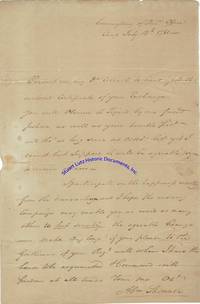
5036AMERICAN REVOLUTION PRISONERS OF WAR. ALS. 1pg. 8 ¼†x 12 ½â€. July 12 1781. Commissary of Prisnrs. Office Phillipsburg New York. An autograph letter signed “Abm Skinner†the American Commissary General of British prisoners of war. He wrote to an unidentified man: “Permit me my Dr. Colonel to hand you the inclosed Certificate of your Exchange. You will observe it Signed by our friend Joshua Loring British commissioner for prisoners as well as your humble Servt. and tho as long since as Octobr. Last I cannot but Suppose it will be agreeable to you to receive it now. I participate in the happiness resulting from the transaction and I hope the ensuing Campaign may enable you as well as many others to feel sensibly the agreeable Change - make my Compts. if you please to the Gentlemen of your Regt. with whom I have the honor to be acquainted…â€. The letter is docketed in an unknown hand on a stub remnant most likely by the gratified Colonel. The letter is tanned there are some spots and there is a minor repair to the verso. unknown books
1928134096London: John Tiranti & Co 1928. Revised edition. Hardcover. Good only ex-library with expected marks. additionally all plates are marked with a library ink stamp. wear and soiling to cloth including fraying at corners and spine ends. feps slightly chipped at edges. slight dampstain to very outer edge of pages. hinges loosening . Grey cloth. Foreword and table of contents followed by 64 bw plates. Oversize. Selection of reprint plates drawing from Swan's works 1 The British Architect of the Builders Treasury of Staircases 2 A Collection of Designs in Architecture 3 Designs in Carpentry or the Carpenters Complete Instructor and 4 Designs for Chimnies. John Tiranti & Co hardcover books
1964163490Baltimore: Murphy Fine Arts Center Gallery 1964. Paperback. VG-. Some shelf wear; some pencil writing on cover and first page. Otherwise contents are clean and tight. Small gray stapled wraps with white lettering. 12 pp. 4 BW illustrations. Catalogue of an exhibition held from November 1-25 1964. Murphy Fine Arts Center Gallery paperback books
1947018797Philadelphia: Dropsie College for Hebrew and Cognate Learning 1947. Rabbi Agus received his Ph. D. from Dropsie based on this massive work. He later served as dean of the Harry Fischel Research in Talmudic Studies in Jerusalem. Vol. I xxxiii 392p Digest of Responsa Text Ora Hayym Yoreh Deah Eben Haezer with details reflecting how the strict observance of the Talmud allowed Jews to maintain their traditions. Volume II 1 395-749 continues with Hoshen Mishpa and has a detailed series of appendices glossary and bibliography. There is also an index to the Responsa. Bound in dark blue cloth spine lettering giltA scarce set in very good condition. Dropsie College for Hebrew and Cognate Learning unknown books
1795M3955Jena:: Fiedlerianis 1795. 1795. 232 x 197 mm. Small 4to. iv iv 46 ix pp. Foxed. Self wraps; last few gatherings loose. Ex library rubber stamp on title. Very good. Albers' dissertation on dropsy of the belly. Johann Abraham Albers studied under J. C. von Loder and Chistoph Wilhelm Hufeland 1762-1836. Hirsch I pp. 80. Not in RLIN. Fiedlerianis, 1795. paperback books
1949SFK519-1011New York NY: The Typophiles 1949. Hardcover. Very Good. Series: Typophile Chapbook No. XXII. LIMITED EDITION of 1250 copies designed by W. A. Dwiggins printed and bound at the Plimpton Press Norwood MA. 12mo. 7 1/4 x 4 11/16 inches. vi 41 13 pp. Half-title frontispiece caricature headpiece 4 ff. of printer's marks from the Borzoi Kennel printer's device on colophon; text clean unmarked. Blind- and gilt-stamped red cloth clear plastic dust jacket; binding square and tight jacket lightly toned chipped. Muir Dawson's copy without distinguishing mark. SFK519-1011. Very Good. The text is in Linotype Arcadia a type designed by W. A. Dwiggins and used here for the first time. Alfred Knopf reminisces about some publishing experiences before the AIGA Type Design Exhibit for members of the Grolier Club. REFERENCE: Rathe Bibliography of the Typophile Chapbooks No. 22. The Typophiles hardcover books
167719726Paris: Frederic Leonard 1677. 16mo. Engr. t.-p. 6 1 pp. 7 6 ff. 211 3 pp. 1 f. 550 pp. 19 ff. 237 3 pp. <br><br>The main title-page is engraved with the title printed above the illustration.<br>Â Â Â Â There are special title-pages and paginations for "Examen de la liberté originaire de Venise. Traduit de l'Italien. Avec une Harangue de Louïs Hïlian . Traduite du Latin. Et des Remarques Historiques. Sur la copie a Ratisbonne Chez J. Aubri . 1677"; "Histoire du gouvernement de Venise avec le supplement; par le sieur Amelot de la Houssaie. Et l'examen de la Liberté originaire de Venise. Sur la copie a Paris; Chez Frederic Leonard . 1677"; and "Suplement a l'Histoire du gouvernement de Venise. Par le sieur Amelot de La Houssaie. Sur la copie a Paris chez Frederic Leonard . 1677."<br>Â Â Â Â "Examen de la liberté originaire de Venise" is a translation by Amelot de La "Houssaye of Squitinio della liberta veneta" which is attributed to Marcus Welser Alfonso de la Cueva and others. Contemporary calf modest gilt tooling on covers spine tooled in blind and with raised bands. Leather cracking and with thumbnail-sized chip on spine; some loss of leather on front cover and at head and foot of spine; and front joint starting. Bookplate on front pastedown and a couple of ink notations by an early owner at bottom of engraved title-page. Endpapers with heavy brown stains along edges but pages overall clean. Frederic Leonard hardcover books
191819741Boston: The Stratford Company Publishers 1918. First American Edition. First Printing. Slim octavo 20cm; beige paper-covered boards with titling and rule printed in dark brown on front panel; dustjacket; 58pp 6 ads. Light wear to crown with faint sunning to board edges; Near Fine. Dustjacket shows light edgewear with tiny chips at spine ends and old partial sticker removed from 25c price at base of spine; flaps trimmed presumably as-issued; Very Good. Apparent first appearance of each story in English a joint publication by The Stratford Universal Library. Both Lazarus and The Gentleman from San Francisco are early works in translation for Andreyev and Bunin. Bunin whose style was deeply rooted in the Russian folkloric tradition had the distinction of being the first Russian to win the Nobel Prize in Literature. An especially scarce title in dustjacket. The Stratford Company, Publishers unknown books
18841562Various places in South Africa Botswana 1884. Overall very good. 295pp. plus five additional letters totaling 60pp. altogether more than 38000 words. Composed mostly on small octavo sheets. Some wear to edges of initial and final few leaves slightly affecting text. Light even tanning. Written in a consistent legible script. An extensive and outstanding manuscript account of travel and exploration in southern Africa during late 1883 and early 1884 by Abraham Anscher a Polish Jewish immigrant to Chicago. The manuscript is composed in the form of a letter addressed to Edith Delia Rogalski but really comprises a travelogue or diary with entries written from September 1883 to mid-January 1884. Five additional letters accompany this account addressed to Edith's later husband Israel Jackson Roe; her parents Samuel and Sarah Rogalski; and her brother Benny. <br/><br/>Anscher's descriptions of his experiences in Africa cover a wide variety of topics including big game hunting; interactions with local indigenous peoples and their rulers; encounters with white missionaries traders and other hunters; ethnographic botanical geological and zoological observations and much more. His account is by turns dramatic and amusing interspersed with personal recollections of family and home cultural and religious notes his addressee was also a Polish-speaking Jewish immigrant to Chicago and reminiscences of earlier adventures in Colorado Utah the California gold fields and elsewhere.<br/><br/>Little can be readily discerned of the details of Anscher's biography beyond the pages of this manuscript. He was born in Mariampol then a part of Poland and today in Lithuania but clearly came to the United States at an early age and was well-educated. He was an adventurer at heart and spent several years in the West perhaps in the U.S. Army for part of this time and partly as a solo fortune seeker. At some point during the mid- to late-1870s he decided to take his adventuring talents to South Africa in order to satisfy his own wanderlust and to create a business of organizing guided African exploration and hunting. The stakes of his chosen profession are mentioned several times throughout his narrative such as when a party member dies of an unspecified illness "My lot is a very hard one just now and my position as promoter and chief adventurer is anything but enviable". From the additional letters present it is apparent that the young Ms. Rogalski was a former love interest of Anscher who spurned his affections and became engaged to a mutual friend. Indeed a letter here addressed to the fiancé offers an apology for presumption of writing to Edith in such a lengthy and cordial manner; at one time all of the individuals addressed by Anscher were a part of the same immigrant community in Chicago.<br/><br/>This absorbing account follows a lengthy excursion organized and led by Anscher across the Transvaal through Bechuanaland Matabeleland and beyond to a settlement he calls Tatti probably Francistown on the Tati River traveling through parts of modern-day South Africa and Botswana. They contain many details of great interest and his vignettes are well-written and dramatically delivered. An immense boa constrictor drops out of the treetops strangling a springbok before his eyes. He finds a five-year-old girl with a broken leg the only survivor of a village massacre; he sets her leg nurses her for a month and eventually conveys her to a missionary station. A young zebra joins the traveling party incurring the jealousy of the team's dogs. A large lizard is trained to sleep in a tent but only after his teeth are removed for safety. <br/><br/>His missive begins in medias res with his party already underway in South Africa near the Orange River in what he calls the "Tarka bush" during mid-September 1883. Anscher decides having missed his last opportunity to send mail "Now to put myself on guard against mischance and not be like the traditional foolish virgins who did not keep their lamps properly trimmed.to have a so-called running letter always open and ready" for his recipient. The group first traveled northeast near and along the Orange allowing Anscher to wax discursive concerning the river's wildlife:<br/><br/>"The wanderings of the river sometimes flowed through immense chasms over hung with stupendous precipices and then like a translucent lake with beautiful towering mimosas and willows reflected from its bosom and a rich variety of fine plumage though without a song; wild geese ducks snipes flamingoes in perfect security feeding on the banks beneath the green shade or basking in the sun's rays on the verdant islands far from the fowler's snare. The swallows also mounting aloft or skimming the surface of the mirror of the stream; while the ravens with their hoarse note might be seen seeking their daily food among the watery tribe or cawing on the bending tops of the weeping willows."<br/><br/>The party leaves the river and skirts the southern edge of the Kalahari to reach Lattakoo modern-day Dithakong a traditional departure point for excursions deeper into the interior of Africa during the 19th century. Thence they headed north again stopping often to hunt for food and sport:<br/><br/>"When on the Kama plains I went one night accompanied by Tytler and Winsloe and one native to a pool of water about two miles from camp. We did not wait more than about half an hour when we heard loud lapping at the water. The natives told me 'Ronimala ' be silent 'There is a lion.' Our next visitors were two buffaloes but we did not fire lest we attract the attention of the lions. Next came three giraffes and one we knocked over on the spot and wounded another but who got away. I have seen plenty of game in my time. I saw and hunted antelope and elk on the Laramie plains and in the Meek Mountains in America before the Union Pacific RR was built. I saw quite enough of buffalo in the Smokey Hills and Montana as well as south of the Green Horn Mountains between California and Arizona but such a variety of game big game and in such number as I saw some years ago in the Transvaal & Swaziland and hereabouts now I never saw anywhere."<br/><br/>As the excursion proceeds further into the interior their encounters with native tribes increases and Anscher observes them keenly and reports with a detailed if somewhat jaded 19th-century eye:<br/><br/>"The town of Kalabeg is already in the Matabele country. Of course they have no religion of any kind for there is no such thing as natural religion. Men acquire knowledge good or bad from instruction of men with more fertile brains. This holds good all the world over. The rainmakers here hold the position of prophets and divines of the so-called civilized countries. These rainmakers who are also the doctors and sextons have great influence over the minds of the people and are held in great estimation by them superior to that of their king who is likewise compelled to yield to the dictates of this personage the rainmaker. Nothing can exceed the freaks of fancy and the adroitness with which the rainmaker can awe the public mind and lead thousands captive at his will. Each tribe has one or more of them and they generally come from other countries for a prophet is seldom honored in his own country."<br/><br/>Arriving in Shoshong in what is now central Botswana Anscher meets some missionaries and witnesses a tribal gathering which leads him to remember the religious theories of a familial acquaintance back home:<br/><br/>"Was present at a Pitsoh or native congress this forenoon held by the natives about some tribe affairs. About 12000 natives present and wound up the proceedings with a war dance. As these tribes are considered by some religious enthusiasts to be of the lost tribes of Israel not your own but ours and as your uncle once spoke to me about them while at Chicago I would therefore request you to kindly tell him to disabuse his mind on this point and that the only peg whereon the so-called lost tribe maniacs hang their argument in favor of their hobby is that the natives practice a certain custom which history attributes to our father Abraham. But this ceremony takes place instead of at the age of 7 days old when they are about fourteen years old and even when older. But they have no tradition as to why it is done. If this simple custom entitles them to be call Jews why for my part they are quite welcome to the honor. But this is about all there is to build the theory on." <br/><br/>Despite his occasionally sarcastic and somewhat disparaging demeanor toward the natives he encounters Anchser seems overall to have a decent connection with them at a personal level and to understand a basic sense of shared humanity. In one particularly poignant episode Anscher meets a mother and father who have walked 300 miles to ransom their two teenaged sons enslaved by a local chief: <br/><br/>"Neither the man's looks nor ornaments excited the smallest emotion in the bosom of the chief and when he was solicited by one who felt something of a father's love to pity the old man who had walked so far and brought his all to purchase his own children he at last replied with a sneer that one of the boys died last year and for the other he wants an ox at least. 'But I have not even a goat' pleaded the old man 'the Matabele have taken all I had and destroyed my hut.' A sigh it was a heavy sigh burst from his bosom one dead and the other not permitted to see anymore. The chief walked off while the man sat leaning his head on the palm of his hand and his eye fixed on the ground apparently lost to everything but his grief. On taking up his trinkets to retire I told him to keep up a good heart that I would try to get him his boy. He started at the sound of my voice kneeled before me and laid down his trinket saying 'take all this but get me back my boy.' I got him his boy for a colored blanket and 1 lb. of tobacco."<br/><br/>When sad and homesick Anscher recalls his time in Chicago and in the West but it is often insufficient comfort. After departing Shoshong for Tatti Anscher must leave his group to "pioneer" a trail to the settlement:<br/><br/>"On the evening of my first day's journey I had to off-saddle a term used here on a waterless plain picketed my horse and went to bed minus my supper or dinner. I awoke suddenly by something touching me on my forehead like the cold nose of a dog but I could see nothing in the dark except my horse who was laying down poor fellow. After this occurrence I could sleep no longer. My head was hot my lips parched and had no taste even for a cigarette. I daresay some of you have experienced waiting for a train early in the morning in some out of the way small RR station where moments appear like days. Well waiting there is not a patch to lying in the dark in Africa's solitude waiting for daylight to come. I tried to divert my mind and think of anything but water but I could not do it! I tried to cool myself by thinking of Chicago in the month of Feb. but that only led me to snow and from snow to water. One may as well try Ovid's 'Remedia Amoris' to cure him from hankering after the girl he loves as to try Chicago in my case as a remedy when thirsty." <br/><br/>The difficulties of obtaining food and water establishing safe camp and finding routes through minimally charted territory evident in this final passage are an ever-present theme of the expedition but Anscher eventually guided his group to their destination where they intended to stay for a month or two before heading further north to Victoria Falls on the Zambezi River. The final entries describe life at the settlement and how a Portuguese colonial explorer and administrator Alexandre de Serpo Pinto whom they met in camp would be entrusted with the present manuscript as he traveled to Namaqualand on the west coast of Africa in the hopes that it would eventually find its way aboard a ship bound for America. Pinto was a fascinating figure in his own right -- he explored the interior of Africa for Portugal in the 1860s and 1870s and after this meeting with our author became the Portuguese Consul in Zanzibar.<br/><br/>Anscher's trail goes somewhat cold after January 1884 when he relinquished control of this massive "running letter." An additional fragment of a later letter to Edith Rogalski included here forwarded via a mining acquaintance in Kimberly contains a few tantalizing details of his onward expedition including an attack on their party near Victoria Falls by a group of slavers led by "an American Negro." He was also working on a journal and taking photographs which are mentioned several times throughout this account but the survival of this other material as well as the ultimate conclusion of this expedition are not known. A wonderful unpublished account of African exploration by a seemingly unlikely and apparently otherwise unknown American character. A complete transcription of the manuscript is available upon request. unknown books
18843195451884. 295pp. plus five additional letters totaling 60pp. altogether more than 38000 words. Composed mostly on small octavo sheets. Some wear to edges of initial and final few leaves slightly affecting text. Light even tanning. Written in a consistent legible script. Overall very good. 295pp. plus five additional letters totaling 60pp. altogether more than 38000 words. Composed mostly on small octavo sheets. An extensive and outstanding manuscript account of travel and exploration in southern Africa during late 1883 and early 1884 by Abraham Anscher a Polish Jewish immigrant to Chicago. The manuscript is composed in the form of a letter addressed to Edith Delia Rogalski but really comprises a travelogue or diary with entries written from September 1883 to mid-January 1884. Five additional letters accompany this account addressed to Edith's later husband Israel Jackson Roe; her parents Samuel and Sarah Rogalski; and her brother Benny. <br/> <br/>Anscher's descriptions of his experiences in Africa cover a wide variety of topics including big game hunting; interactions with local indigenous peoples and their rulers; encounters with white missionaries traders and other hunters; ethnographic botanical geological and zoological observations and much more. His account is by turns dramatic and amusing interspersed with personal recollections of family and home cultural and religious notes his addressee was also a Polish-speaking Jewish immigrant to Chicago and reminiscences of earlier adventures in Colorado Utah the California gold fields and elsewhere.<br/> <br/>Little can be readily discerned of the details of Anscher's biography beyond the pages of this manuscript. He was born in Mariampol then a part of Poland and today in Lithuania but clearly came to the United States at an early age and was well-educated. He was an adventurer at heart and spent several years in the West perhaps in the U.S. Army for part of this time and partly as a solo fortune seeker. At some point during the mid- to late-1870s he decided to take his adventuring talents to South Africa in order to satisfy his own wanderlust and to create a business of organizing guided African exploration and hunting. The stakes of his chosen profession are mentioned several times throughout his narrative such as when a party member dies of an unspecified illness "My lot is a very hard one just now and my position as promoter and chief adventurer is anything but enviable". From the additional letters present it is apparent that the young Ms. Rogalski was a former love interest of Anscher who spurned his affections and became engaged to a mutual friend. Indeed a letter here addressed to the fiancé offers an apology for the presumption of writing to Edith in such a lengthy and cordial manner; at one time all of the individuals addressed by Anscher were a part of the same immigrant community in Chicago.<br/> <br/>This absorbing account follows a lengthy excursion organized and led by Anscher across the Transvaal through Bechuanaland Matabeleland and beyond to a settlement he calls Tatti probably Francistown on the Tati River traveling through parts of modern-day South Africa and Botswana. They contain many details of great interest and his vignettes are well-written and dramatically delivered. An immense boa constrictor drops out of the treetops strangling a springbok before his eyes. He finds a five-year-old girl with a broken leg the only survivor of a village massacre; he sets her leg nurses her for a month and eventually conveys her to a missionary station. A young zebra joins the traveling party incurring the jealousy of the team's dogs. A large lizard is trained to sleep in a tent but only after his teeth are removed for safety. <br/> <br/>His missive begins in medias res with his party already underway in South Africa near the Orange River in what he calls the "Tarka bush" during mid-September 1883. Anscher decides having missed his last opportunity to send mail "Now to put myself on guard against mischance and not be like the traditional foolish virgins who did not keep their lamps properly trimmed.to have a so-called running letter always open and ready" for his recipient. The group first traveled northeast near and along the Orange allowing Anscher to wax discursive concerning the river's wildlife:<br/> <br/>"The wanderings of the river sometimes flowed through immense chasms over hung with stupendous precipices and then like a translucent lake with beautiful towering mimosas and willows reflected from its bosom and a rich variety of fine plumage though without a song; wild geese ducks snipes flamingoes in perfect security feeding on the banks beneath the green shade or basking in the sun's rays on the verdant islands far from the fowler's snare. The swallows also mounting aloft or skimming the surface of the mirror of the stream; while the ravens with their hoarse note might be seen seeking their daily food among the watery tribe or cawing on the bending tops of the weeping willows."<br/> <br/>The party leaves the river and skirts the southern edge of the Kalahari to reach Lattakoo modern-day Dithakong a traditional departure point for excursions deeper into the interior of Africa during the 19th century. Thence they headed north again stopping often to hunt for food and sport:<br/> <br/>"When on the Kama plains I went one night accompanied by Tytler and Winsloe and one native to a pool of water about two miles from camp. We did not wait more than about half an hour when we heard loud lapping at the water. The natives told me 'Ronimala ' be silent 'There is a lion." Our next visitors were two buffaloes but we did not fire lest we attract the attention of the lions. Next came three giraffes and one we knocked over on the spot and wounded another but who got away. I have seen plenty of game in my time. I saw and hunted antelope and elk on the Laramie plains and in the Meek Mountains in America before the Union Pacific RR was built. I saw quite enough of buffalo in the Smokey Hills and Montana as well as south of the Green Horn Mountains between California and Arizona but such a variety of game big game and in such number as I saw some years ago in the Transvaal & Swaziland and hereabouts now I never saw anywhere."<br/> <br/>As the excursion proceeds further into the interior their encounters with native tribes increases and Anscher observes them keenly and reports with a detailed if somewhat jaded 19th-century eye:<br/> <br/>"The town of Kalabeg is already in the Matabele country. Of course they have no religion of any kind for there is no such thing as natural religion. Men acquire knowledge good or bad from instruction of men with more fertile brains. This holds good all the world over. The rainmakers here hold the position of prophets and divines of the so-called civilized countries. These rainmakers who are also the doctors and sextons have great influence over the minds of the people and are held in great estimation by them superior to that of their king who is likewise compelled to yield to the dictates of this personage the rainmaker. Nothing can exceed the freaks of fancy and the adroitness with which the rainmaker can awe the public mind and lead thousands captive at his will. Each tribe has one or more of them and they generally come from other countries for a prophet is seldom honored in his own country."<br/> <br/>Arriving in Shoshong in what is now central Botswana Anscher meets some missionaries and witnesses a tribal gathering which leads him to remember the religious theories of a familial acquaintance back home:<br/> <br/>"Was present at a Pitsoh or native congress this forenoon held by the natives about some tribe affairs. About 12000 natives present and wound up the proceedings with a war dance. As these tribes are considered by some religious enthusiasts to be of the lost tribes of Israel not your own but ours and as your uncle once spoke to me about them while at Chicago I would therefore request you to kindly tell him to disabuse his mind on this point and that the only peg whereon the so-called lost tribe maniacs hang their argument in favor of their hobby is that the natives practice a certain custom which history attributes to our father Abraham. But this ceremony takes place instead of at the age of 7 days old when they are about fourteen years old and even when older. But they have no tradition as to why it is done. If this simple custom entitles them to be call Jews why for my part they are quite welcome to the honor. But this is about all there is to build the theory on." <br/> <br/>Despite his occasionally sarcastic and somewhat disparaging demeanor toward the natives he encounters Anchser seems overall to have a decent connection with them at a personal level and to understand a basic sense of shared humanity. In one particularly poignant episode Anscher meets a mother and father who have walked 300 miles to ransom their two teenaged sons enslaved by a local chief: <br/> <br/>"Neither the man's looks nor ornaments excited the smallest emotion in the bosom of the chief and when he was solicited by one who felt something of a father's love to pity the old man who had walked so far and brought his all to purchase his own children he at last replied with a sneer that one of the boys died last year and for the other he wants an ox at least. 'But I have not even a goat' pleaded the old man 'the Matabele have taken all I had and destroyed my hut.' A sigh it was a heavy sigh burst from his bosom one dead and the other not permitted to see anymore. The chief walked off while the man sat leaning his head on the palm of his hand and his eye fixed on the ground apparently lost to everything but his grief. On taking up his trinkets to retire I told him to keep up a good heart that I would try to get him his boy. He started at the sound of my voice kneeled before me and laid down his trinket saying 'take all this but get me back my boy.' I got him his boy for a colored blanket and 1 lb. of tobacco."<br/> <br/>When sad and homesick Anscher recalls his time in Chicago and in the West but it is often insufficient comfort. After departing Shoshong for Tatti Anscher must leave his group to "pioneer" a trail to the settlement:<br/> <br/>"On the evening of my first day's journey I had to off-saddle a term used here on a waterless plain picketed my horse and went to bed minus my supper or dinner. I awoke suddenly by something touching me on my forehead like the cold nose of a dog but I could see nothing in the dark except my horse who was laying down poor fellow. After this occurrence I could sleep no longer. My head was hot my lips parched and had no taste even for a cigarette. I daresay some of you have experienced waiting for a train early in the morning in some out of the way small RR station where moments appear like days. Well waiting there is not a patch to lying in the dark in Africa's solitude waiting for daylight to come. I tried to divert my mind and think of anything but water but I could not do it! I tried to cool myself by thinking of Chicago in the month of Feb. but that only led me to snow and from snow to water. One may as well try Ovid's 'Remedia Amoris' to cure him from hankering after the girl he loves as to try Chicago in my case as a remedy when thirsty." <br/> <br/>The difficulties of obtaining food and water establishing safe camp and finding routes through minimally charted territory evident in this final passage are an ever-present theme of the expedition but Anscher eventually guided his group to their destination where they intended to stay for a month or two before heading further north to Victoria Falls on the Zambezi River. The final entries describe life at the settlement and how a Portuguese colonial explorer and administrator Alexandre de Serpo Pinto whom they met in camp would be entrusted with the present manuscript as he traveled to Namaqualand on the west coast of Africa in the hopes that it would eventually find its way aboard a ship bound for America. Pinto was a fascinating figure in his own right -- he explored the interior of Africa for Portugal in the 1860s and 1870s and after this meeting with our author became the Portuguese Consul in Zanzibar.<br/> <br/>Anscher's trail goes somewhat cold after January 1884 when he relinquished control of this massive "running letter." An additional fragment of a later letter to Edith Rogalski included here forwarded via a mining acquaintance in Kimberly contains a few tantalizing details of his onward expedition including an attack on their party near Victoria Falls by a group of slavers led by "an American Negro." He was also working on a journal and taking photographs which are mentioned several times throughout this account but the survival of this other material as well as the ultimate conclusion of this expedition are not known. A wonderful unpublished account of African exploration by a seemingly unlikely and apparently otherwise unknown American character. unknown books
1970181917Banfield Provinica de Buenos Aires: Editorial IndoAmerica 1970. Paperback. v 400p. text in Spanish scattered b&w images in text first edition trade paperback in frenchfold orange pictorial wraps. Slightly edgeworn "Complimentary copy" in pen on half-title else a very good copy. Historia de la Literatura. Editorial IndoAmerica paperback books
196863431Buenos Aires: Editorial Indoamerica 1968. Novena edicion. Paperback. Very Good. errata slip laid in 304p. Wrapper. 23cm. Backstrip browned. INSCRIBED by Arias-Larreta. Spanish text. <br/><br/> Editorial Indoamerica paperback books
196262962Los Angeles 1962. Octava edicion. Paperback. Very Good/Very Good. 124p. Wrapper with a dj. 23cm. INSCRIBED by Arias Larreta Typed Letter signed from the author also laid in. Spanish text. <br/><br/> paperback books
195139793Los Angeles 1951. 1st ed. Hardcover. Very Good. 125p. Hardcover. 23cm. No Jacket. INSCRIBED by Arias-Larreta. Spanish text. <br/><br/> hardcover books
1972260405Cambridge: Harvard University Press 1972. Hardcover. viii 420p. plus a menu of Hoover publications hardbound in 9.5x6 inch orange cloth boards and dust jacket. The dj is sunned toned and edgeworn but still serviceable while book itself is sound and unmarked. Very good copy. Incidentally the text is not illustrated but there is a vignette photoportrait of Axelrod on dj. Hoover Institution pub no.115. Harvard University Press hardcover books
69318hardcover. 147pp. 8vo cloth d.w. Ithaca: Cornell University Press 1976.<br/><br/> unknown books
19002197274Dunlap Printing Company 1900. Hard Cover. Very Good/No Jacket. Lightly rubbed. 1900 Hard Cover. xxvi 227 pp. First Annual Message of Samuel H. Ashbridge Mayor of the City of Philadelphia with Annual Reports of Abraham L. English Director of the Department of Public Safety and of the Bureau of Health for the Year Ending December 31 1899. Issued by the City of Philadelphia 1900. Annual reports for the year 1899 include the following: The First Annual Message. Office of the Mayor Philadelphia April 2 1900.; Department of Public Safety.; Thirteenth Annual Report of the Department of Public Safety. Abraham L. English Director.; Bureau of Health of the City and Port of Philadelphia.; Appendix to the Report of the Bureau of Health of the City and Port of Philadelphia for the Year 1899.; Medical Inspector Division of Contagious Diseases.; Medical Inspector of the Sanitary Inspection of Public Schools.; Division of Disinfection.; Division of Bacteriology Pathology and Disinfection.; Physician-in-Charge for the Dunlap Printing Company hardcover books
19761312380New York: Schenkman Publishing Company John Wiley & Sons 1976. Hardcover. Octavo; VG/VG-Hardcover; Black spine with white text; Heavy shelf wear and age to dust jacket white spotting age spots rubbing fading and fraying along sides and edges 3 inch tear at spine head age tone spotting along jacket flaps; Light shelf wear to boards which are strong and clean binding slightly cocked age toning spots to free end pages; Minor spots along text block exterior text block clean; 222 pp. 1312380. FP New Rockville Stock. Schenkman Publishing Company, John Wiley & Sons hardcover books
196847890Baltimore: Willliams & Wilkins 1968. First Edition. Octavo. Maroon cloth; 520pp. Ex-Institute for Psychoanalysis Chicago with bookplate and card pocket. Very Good. 43rd volume in the series. Contributions include "Addiction to Barbiturate andNonbarbiturate Sedative Drugs" Carl F. Essig; "Patterns of Intravenous Self-Injection by Morphine-addicted Rats" James R. Weeks and R. James Collins; "Opioid Addiction Problems in Canada" S.J. Holmes; "Small Group Drinking Behavior: an Experimental Study of Chronic Alcoholics" Jack H. Mendelson Nancy K. Mello and Philip Solomon; etc. Willliams & Wilkins unknown books
1971008089London: George Allen & Unwin 1971. 221p. b/w front. original grey cloth ex libris. George Allen & Unwin unknown books
30892 p.l. viii 236 pp. 8vo attractive antique calf double gilt fillet round sides flat spine gilt uncut. Paris: veuve Tilliard et Fils 1805. The rare sale catalogue of the library rich in oriental books and manuscripts of Anquetil-Duperron 1731-1805 French orientalist and brother of the historian Pierre Anquetil. Abraham Hyacinthe had a fascinating early life: while unsuccessfully studying for the priesthood in Paris and Utrecht he developed a passion for Hebrew Arabic Persian and other languages of the East. He travelled to India as a private soldier in 1754 in order to search for the works of Zoroaster. Granted free passage he learned modern Persian in Pondicherry and Sanskrit at Chandernagore. When war broke out between France and England Anquetil-Duperron travelled widely throughout India on foot learning further languages and studying the antiquities and sacred laws of the Hindus. He returned to Europe in an English vessel ultimately arriving in Paris in 1762 with 180 oriental manuscripts. He devoted many of the following years to scholarship editing and publishing many important oriental texts. The French Revolution seems to have greatly affected him: during that period he abandoned society and lived in voluntary poverty on a few pence a day. A fine copy. 1600 lots and priced throughout in a contemporary hand. From the library of Jean Viardot. ❧ Gustave Brunet Dictionnaire de Bibliologie Catholique col. 408-"Ce catalogue est curieux surtout pour les livres en langues étrangeres." Grolier Club Printed Catalogues of French Books Auctions.1643-1830 458. Peignot p. 77. unknown books
183719688Ooroomiah Urmia West Azerbaijan Iran March 3rd 1837. 3.5 pages in autograph ink in English on an unlined foolscap folio 13.75 x 8.75 inches approx. 850 words no cover. Docketed in autograph ink "Letter from Priest Abraham to Prof. Tyler March 2 1837. <br /><br />"Permit me to inform you that the year Mr. Perkins came to the county of Persia to the city of Tabreez; Mr. Perkins and Mr. Haas a German Preacher came to the country of Ooroomiah- first to Gavalan the village of Mar Yanna i.e Mar Yohanna who accompanied them to the city of Ooroomiah. They remained in the city a few days and then came to my village- viz. Geog Tapa which is four miles distant from the city and we accompanied them to Tabreez. There we read your language the English and Mr. Perkins read our language the Syriac about eight months. Then the Plague entered Tabreez and Mar Yohana and myself took leave of Mr. Perkins and returned to Ooroomiah. After about five months Mr. Perkins came again to Ooroomiah also Mrs. Perkins and Dr. Grant and Mrs. Grant." <br /><br />A lengthy letter in English from one of the earliest Nestorian Christians to assist the American mission to Persia launched in November 1835 by the arrival in Urmia of "the Apostle to the Persians" Justin Perkins 1805-1869 with his wife Charlotte Bass Perkins missionary physician Asahel Grant 1807-1844 and Grant's wife Judith Campbell Grant. <br /><br />Qasha Auraham this the Syriac rendering of Priest Abraham was a native of the village of Georgtapa just to the southeast of Urmia the nephew to village elder Muqdasi Mormezd who had suggested Auraham as the suitable local assistant for the missionary team; along with Mar Yohannon Auraham was instrumental in teaching the missionaries modern Syriac and in creating written vernacular Syriac. <br /><br />The goal of the American Board of Missions with the Perkins mission had been the revival of the Assyrian Church of the East rather than planting an independent Protestant church and Perkins worked with Auraham and other local scholars to create a written modern Syriac in order to translate Nestorian religious texts out of ancient Syriac into the vernacular. Linguistics in that period was something of a rugged pursuit in Azerbaijan and Auraham was instrumental in recruiting a noted scholar to the translation mission as later reported by Perkins in <i>Nestorian Biography</i>: <br /><br />"A few months after the missionaries arrived at Oroomiah Mr. Perkins sent priest Abraham of Geog Tapa and a Nestorian deacon to the mountains to obtain from thence an ecclesiastic to assist him in reducing the modern Syriac to writing and in the translation of the Scriptures. . . . There was real advantage in uniting the labors of a translator from the mountains with one on the Plain to harmonize so far as practicable the different dialects in the first reduction of the language to a written form. The messengers were charged to obtain 'the most learned' priest they could find. They boldly set off on foot—entered the formidable mountains and penetrated as far as Marbeshoo a large village in a secluded glen forty miles west of the Plain of Oroomiah. It was a fearful journey at that period. . . . At Marbeshoo they found priest Dunkha who had come down to that place from his more distant home on business. His fame as a very learned man was already known to the messengers and they at once engaged him to return with them to Oroomiah. A week after they left the missionary they introduced to his study priest Dunkha who though grotesquely clad in wild Koordish costume struck him as a very pleasant man." <br /><br />The collaboration with Dunkha is alluded to here by Auraham: <br /><br />"I would also inform you that we four viz. Mar Yohanna -- myself -- Joseph a brother of Mar Yohannan -- and little John the son of my uncle study your language. And Mr. Perkins and Mrs. Perkins and Mr. Grant and Mrs. Grant study our language the Syriac. We learn your language by little and little but Mr. Perkins learns our language very well. And I would further inform you that Mr. Perkins and Priest M'dunka i.e. Qasha Dunkha and myself are translating the Old and New Testament from the Syriac language into our dialect. Of the Old Testament we have translated the first book which as you know gives an account of the creation and three chapters of the second book. And of the New Testament we have translated the first fifteen chapters. If God smile upon us we shall be and by finish complete this good work." <br /><br />Since the first mission press would not be operational in Urmia until the arrival of printer Edward Breath in 1840 this earliest translation of the New Testament from the Peshitta rather than the Greek would not be published until 1846. Professor William S. Tyler of Amherst seems the likeliest recipient of this missive given that he had both been a friend and fellow-student of Perkins at Andover Theological Seminary and had taught with Perkins at the Amherst Academy; presumably this firsthand account from Auraham was meant both as English practice and—with its mixture of exotic romance and good works to drum up for support for the mission among kindred scholars in America. <br /><br />Some short closed tears along old folds but no loss; some light toning a little old creasing; in very good condition quite legible. With a preliminary typescript.<br /><br /><br /><br /><i>References: </i><br /><br />American Sunday-School Union.<i> The Nestorians of Persia: a history of the origin and progress of that people and of missionary labours among them.</i> Philadelphia: American Sunday-School Union 1848. <br /><br />Campbell William S. editor. <i>A Memoir of Mrs. Judith S. Grant Late Missionary to Persia.</i> New York: J. Winchester 1844. <br /><br />Murre-van den Berg H. L. "The Missionaries' Assistants: The Role of Assyrians in the Development of Written Urmia Aramaic." <i>Journal of the Assyrian Academic Society.</i> Volume X issue 2. October 1996. <br /><br />Perkins Justin and Fidelia Fiske. <i>Nestorian biography: being sketches of pious Nestorians who have died at Oroomiah Persia.</i> Boston: Massachusetts Sabbath School Society 1857. <br /><br />Tyler Cornelius ed. <i>Autobiography of William Seymour Tyler D. D. LL. D.</i> n. p.: Privately Printed 1912. <br /><br />See also the <i>Missionary Herald</i> December 1840 <i>inter alia</i> for extracts from Perkins' journal in Urmia and his accounts of both Priest Abraham and of Priest Dunka. books