987 résultats
1933016857NY: Dutton. 1933. First Edition. Hardcover. Very good owner's bookplate later printing Games knots tricks and more. . Dutton hardcover books
1944012023Philadelphia: David McKay 1944. Color pictorial dust jacket showing American planes attacking a ship presumably Japanese. Crisp and clean throughout. Contents include a map of Japan basic principles of spoken Japanese basic conversation a large appendix Japanese-English and English-Japanese dictionaries. 159pp. First Edition. Green Cloth. Light Edge Wear./Chipped Dust Jacket. Small Octavo. David McKay Hardcover books
200138923Amsterdam: John Benjamins Publishing Company 2001. 8vo pp. xii 2 148; original red printed wrappers some soiling else a good copy. <br/><br/> John Benjamins Publishing Company unknown books
1978022189Amsterdam: John Benjamins 1978. Papers prepared for the Working Group "Valence and Semantic Case" 12th International Congress of Linguists University of Vienna Austria August 29 to September 3 1977. xiv 729 original cloth Studies in language companion series 1. John Benjamins unknown books
1995S4435Offprint: STROKE H. Henry editor. The Physical Review. The first hundred years. A selection of seminal papers and commentaries. New York and Maryland:: AIP Press American Institute of Physics The American Physical Society 1995. 1995. 280 x 211 mm. 4to. 10 pp. 14 figs. Self-wraps. Very good. AIP Press, American Institute of Physics, The American Physical Society, 1995. paperback books
1687289634Zug. : Muosischen Druckerey. 1687. Contemporary vellum. . Good covers soiled front hinge split old repair to preliminaries at gutter moderate foxing throughout old library marking to preliminaries a little light mostly marginal dampstaining. . 4to. 20.5x15.5 cm. . German text. Uncommon Zug edition of a popular work. Woodcut frontis with arcane illustration of demons dancing around a hanging Judas. Muosischen Druckerey. hardcover books
17237654Vienna and Nuremberg: Georg Lehmann 1723. First printing. Vellum. Very Good. 4to. 1841953pp. Index. Title printed in red & black. Copper engraved frontispiece. Cont. vellum a bit soiled hand lettered paper spine label. Paper repairs to small wormholes on recto of frontispiece and verso of title. Cont. ownership signature at top of title. Volume 3 of 3 only. Georg Lehmann hardcover books
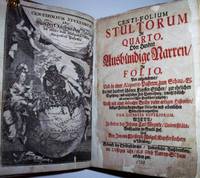
17091Vienna: Christoph Lercher 1709. First edition. Fair. Johann Christoph Weigel. The date of publication is revealed from the chronosticon given on the title page completed here with bracketed letters. Johann Ulrich Megerle July 2 1644 December 1 1709 is also known as Gautentius Hilarion Hilarius von Freudberg Theophilus Mariophilus. First edition emblem book 20.5 cm x 16cm quarto; engraved allegorical frontispiece; title-page in black and red letter; vi; 404; iv 101 leaves of full-page engravings. Johann Christoph Weigel / Kupfferstechern in Nürnberg caption legends engraved or hand-written under each image. Errors of pagination: p. 188 is missing the page number; p. 192 reads as 912; p. 307 reads as 407; p. 318 reads as 218; p. 320 reads as 230; p. 374 reads as 274; p. 376 reads as 176; p. 378 reads as 278; p. 403 reads as 401.This copy is bound in contemporary quarter vellum on light-gray marbled paper boards with a hand-lettered spine. The title-page has been repaired and reinforced with heavier paper as are some of the introductory pages and plates. Plate No. 48 is printed on very heavy paper with a handwritten legend. The other plates have engraved legends. The edges of the first nine pages have been expertly reinforced. Apart from a crack in the uppermost front hinge this binding is in fair condition. Inside the back cover is a triangular stamp reading in part ZUR AUSFUR FREIGEGEBEN. Pencil annotations inside the front cover are a title index of the emblem plates and the calculus of the chronosticon.Extremely rare complete. Old repairs noted this is a good bright tight copy. Not in Praz or Landwehr. See Gerhard Dünnhaupt F5.1.; Bertsch 52a 1; Goedeke III 240 26. See also William Sallochs Catalog 365 Sept. 1980: 100 fools with their occupations preoccupations and vanities described and illustrated by Weigel. An old booksellers catalog entry pasted down on the verso of the initial blank states: In 150 Exemplaren gedruckt als Festgabe für die Gesellschaft der Bibliophilen. The last plate is blank intentionally to provoke the reader. Christoph Lercher hardcover books
1700D5997Nurnberg: J. Chr. Weigel c. 1700. First and only Edition. Hardcover. Very Good. Speckled calf gilt-stamped ornament on spine; 4to; with copper-engraved title-page and 67 copper-engraved plates 1 of them lightly colored. Very rare work illustrating various human follies and obsessions according to Bertsche not by Santa Clara although that's the general assumption. Title-page and 1 plate professionally restored; some plates neatly repaired with tape or reinforced with paper on the verso; occasional marginal chip or tear infringing upon the image itself in just 2 instances; 2 plates with marginal ink doodles. <br/><br/> J. Chr. Weigel hardcover books
181046955Cambridge: E.W. Metcalf and Company 1810. Paperback. Good. viii 103pp. String bound signatures with some loss to the edges especially the last page else good. <br/><br/>Sabin 10125. E.W. Metcalf and Company paperback books
19592480New York: Hebrew Publishing Company 1959. Good. 29cm; 160 pages illustrated in color with lively border decorations vignettes and Hebrew calligraphy. Bound in blue velvet-nap cloth with original dust jacket. Dust jacket discolored along spine chipped at edges and once torn and repaired on rear panel. Velvet uneven. From the search for Chometz to Chad Gadya a very pleasing richly illustrated and well-designed Haggadah. Hebrew Publishing Company hardcover books
1993261920The Classics of Medicine Library 1993. Full Leather. Near Fine binding. Nice copy bound in black leather with marbled endpapers. Top edge of gilt textblock has some spotting. Classics of Medicine material laid in. Near Fine binding. The Classics of Medicine Library unknown books
186424901.02<p>"<i>with the same determination to divide the country unless they can secure universal abolition we are exposed to the same dangers every day and God only knows in what unlucky hour our ruin may be consummated. Compare his policy with McClellan's expression of readiness to receive any State when its people offer to submit to the Union.</i>"</p><p>This Democratic Party campaign pamphlet quotes an April 1864 letter to argue that Lincoln gave Lieutenant General Ulysses S. Grant free rein to conduct the war after having interfered with and micromanaged McClellan's Peninsula Campaign in 1862. The publication also declared that Republicans were stained with "<i>The Taint of Disunion</i>" and quoted from Republican speeches and editorials to insist that the Democrats were the party of "<i>UNION AND PEACE</i>."</p> <b>ABRAHAM LINCOLN.</b>Printed Document. Democrat Campaign "<i>Document No. 12</i>" with headings "<i>Lincoln's Treatment of Gen. Grant</i>" "<i>Mr. Lincoln's Treatment of Gen. McClellan</i>" and "<i>The Taint of Disunion</i>." New York 1864. 8 pp. 5¾ x 8â… in.<p><b><br /></b></p><p><b>Excerpts:</b></p><p>Lincoln to Grant April 30 1864</p><p>"<i>I wish to express in this way my entire satisfaction with what you have done up to this time so far as I understand it. The particulars of your plans I neither know nor seek to know. You are vigilant and self-reliant; and pleased with this I wish not to obtrude any restrains or constraints upon you while I am very anxious that any real disaster or capture of our men in great numbers be avoided.</i>" p1/c1</p><p>"<i>Such in brief are some of the most notable instances in which Mr. Lincoln interfered with General McClellan when he occupied a position similar to that held by General Grant. They reflect so severely upon the President that no attempt to gloss them over by his apparent subsequent repentance can disabuse the patriotic portion of the nation of the matured conviction that he is to be held responsible for the lack of decisive victories in Eastern Virginia. The blame must and will rest upon him to whom it belongs.</i>" p5/c2</p><p>"<i>Having shown by copious extracts from the speeches of Abraham Lincoln W. H. Seward Wendell Phillips Wm. Lloyd Garrison and from the editorial writings of the Chicago Tribune and the N. Y. Tribune… that they were all <b>original secessionists and disunion men</b> we propose now to give the evidence that Mr. Lincoln himself has within the last three months been concerned in a movement to make peace with Jeff. Davis on terms involving the direct proposal to divide the Union and let the South go.</i>" p7/c2-p8/c1</p><p>"<i>with the same determination to divide the country unless they can secure universal abolition we are exposed to the same dangers every day and God only knows in what unlucky hour our ruin may be consummated. Mark how Mr. Lincoln constantly keeps up the idea of negotiating only with Jefferson Davis. Why does he never address himself to the people or the States of the South. Compare his policy with McClellan's expression of readiness to receive any State when its people offer to submit to the Union.</i>" p8/c2</p><p><b>Historical Background</b></p><p>The 1864 presidential election pitted President Lincoln against his Democratic challenger General George B. McClellan. Although McClellan had been the commander of the Army of the Potomac and general-in-chief of the Union Army the Peace platform adopted by the Democratic National Convention in Chicago declared the war a failure. The party was bitterly divided between War Democrats who favored continuing the war to restore the Union while leaving slavery alone; moderate Peace Democrats who favored an armistice and a negotiated peace that would likely protect slavery in a reconstructed union and radical Peace Democrats who favored an immediate end to the war without securing Union victory. McClellan was a War Democrat but the platform was written by radical Peace Democrat Clement Vallandigham and Peace Democrat George H. Pendleton was nominated for vice president.</p><p>In 1864 Republicans created the National Union Party to attract War Democrats Unconditional Unionists and Unionist Party members who would not vote for the Republican Party though most state Republican parties did not change their name. President Abraham Lincoln won the nomination of the "National Union Party" at its Baltimore convention and won re-election with new running mate War Democrat Andrew Johnson.</p><p>Although Lincoln was convinced by August 1864 that he would not be reelected General William T. Sherman's capture of Atlanta in early September and General Philip Sheridan's successes in the Shenandoah Valley of Virginia from August to October ensured his victory. Without the participation of the seceded states Lincoln and Johnson won 55 percent of the popular vote and an overwhelming 212-to-21 victory in the Electoral College. McClellan and Pendleton carried only Kentucky Delaware and McClellan's home state of New Jersey.</p> books
186230007.01<p>On the front page under <i>"News from the North" </i>is the text of Abraham Lincoln's reply to <i>New York Tribune</i>editor Horace Greeley. Greeley's letter urging Lincoln to emancipate all slaves in Union-held territory was known as "The Prayer of Twenty Millions." It was first published on August 20 1862. Lincoln responded on August 22 declaring that his paramount goal is to save the Union regardless of its effect on slavery as well as his personal views that all men should be free.</p> <b>ABRAHAM LINCOLN.</b>Newspaper. <i>Richmond Whig</i> Richmond Va. August 30 1862. 2 pp. 17 x 24 in.<p><b><br /></b></p><p><b>Excerpt:</b></p><p><i>"…As to the policy I 'seem to be pursuing' as you say I have not meant to leave any one in doubt. </i></p><p><i> I would save the Union. I would save it the shortest way under the Constitution. The sooner the national authority can be restored the nearer the Union will be 'the Union as it was.' If there be those who would not save the Union unless they could at the same time </i>save<i> slavery I do not agree with them. If there be those who would not save the Union unless they could at the same time </i>destroy<i> slavery I do not agree with them—My paramount object in this struggle </i>is <i>to save the Union and is </i>not<i> either to save or to destroy slavery. If I could save the Union without freeing </i>any<i> slave I would do it and if I could save it by freeing </i>all<i>the slaves I would do it; and if I could save it by freeing some and leaving others alone I would also do that.—What I do about slavery and the colored race I do because I believe it helps to save this Union and what I forbear I forbear because I do not believe it would help to save the Union. I shall do </i>less<i> whenever I shall believe what I am doing hurts the cause and I shall do </i>more<i>whenever I shall believe doing more will help the cause. I shall try to correct errors when shown to be errors; and I shall adopt new views so fast as they shall appear to be true views. </i></p><p><i> I have here stated my purpose according to my view of </i>official<i> duty; and I intend no modification of my oft-expressed </i>personal<i> wish that all men every where could be free." </i></p><p><b>Historical Background</b></p><p>Though this letter is often as proof that Lincoln did not intend to abolish slavery unknown to Greeley and most Americans Lincoln had already drafted the preliminary Emancipation Proclamation and was only waiting for a Union military victory to deliver it. Moreover Lincoln makes a "divide and conquer" rhetorical move: he splits the issue by stating that his constitutional duty as president is to keep the Union together while simultaneously expressing his personal view of universal freedom at the end.</p><p>Additional content in this issue includes a front page editorial <i>"European Recognition" "The Indian Atrocities in Minnesota" "Yankee Finances" "An Order From Gen. Burnside" "The Peninsular Campaign—Gen. </i><b><i>J. Bankhead </i></b><i>Magruder's Official Report"</i> which takes over two columns with considerable detail.<br /><br />The back page has additional content with: <i>"A Brilliant Cavalry Exploit" "The Impressment of Slaves In Georgia" "Outrages in Arkansas" "From Kentucky"</i> and more. Additionally there are various reports from the <i>"Confederate Congress"</i> and numerous advertisements including a <i>"$100 Reward"</i> for a runaway slave.</p><p>The <i>Richmond Whig</i> is one of the less common—but still important—newspapers from the capital of the Confederacy.</p><p>In <i>Four Years in Rebel Capitals: An Inside View of Life in the Southern Confederacy from Birth to Death</i> journalist T. C. DeLeon wrote that the <i>Richmond</i> <i>Whig</i>was among the South's best wartime newspapers. Their pages "recorded the real and true history of public opinion during the war. In their columns is to be found the only really correct and indicative 'map of busy life its fluctuations and its vast concerns' in the South during her days of darkness and of trial."</p><p>One of the more interesting episodes in the history of the <i>Whig</i> is its alleged involvement in a terror plot against New York City during the Civil War. The <i>Whig</i>was reputed to have worked with the Confederate government to use advertisements and editorials to convey secret messages to Southern sympathizers in the North. In October 1864 the <i>Whig</i> was alleged to have run an editorial that signaled Southern supporters to embark on a terror campaign that called for widespread fires to be set in New York city and federal offices to be taken over and the capture of the city's military commander Maj. Gen. John Adams Dix.</p><p><b>Condition</b></p><p>Good. Never bound several folds with minor wear at the folds.</p> books
186522051Boston MA 1865. No binding. Fine. Photograph. Lincoln funerary stereoview. c. April 1865 E.F. Smith photographer Boston Mass. This double card from a stereopticon shows a large room with tables a globe and two men sitting. Mourning bunting reads ""A Nation Mourns Him Who Has Honored It."" unknown books
186125965<p><b>ABRAHAM LINCOLN.</b>Chromolithograph. <i>Presidents of the United States</i> Philadelphia: Published by F. Bouclet lithographed by A. Feusier. Sheet size: 21 in. x 27 in. Image size: 24½ in. x 18¾ in. </p><br />A large patriotic chromolithograph issued around the time of Abraham Lincoln's first inauguration. The central image is the goddess Columbia wearing a draped American flag flanked by bald eagle and Union shield. Behind her is a steam ship and the artist's rendition of what the then-uncompleted Capitol building was expected to look like. Surrounding Columbia is an ornate frame made up of portraits of the presidents of the United States from 1789-1861—including a beardless Abraham Lincoln: George Washington John Adams Thomas Jefferson James Madison James Monroe John Quincy Adams Andrew Jackson Martin Van Buren William H. Harrison John Tyler James K. Polk Zachary Taylor Millard Fillmore Franklin Pierce James Buchanan and Abraham Lincoln.<p><b>Historical Background</b></p><p>Erin Mast curator of "My Abraham Lincoln" a 2009 exhibition at President Lincoln's Cottage Museum noted that the print "both commemorates Lincoln's election and recognizes the challenges and opportunities facing the 16th president. The 16 presidential portraits encircle symbols of the republic at a time when a divided nation faced secession and civil war. In the center Columbia holds a shield and liberty cap the latter being a symbol both of revolution and of freed slaves. A bald eagle grasps arrows and an olive branch and carries a ribbon with the motto 'E Pluribus Unum.' The Capitol dome shown completed at a time when it was still unfinished symbolizes the founding of the democratic republic while a steamship symbolizes development and progress. The allegorical images relate to concepts that Lincoln expressed in his first inaugural address; that seceding and breaking the Constitution would be a step backward not forward and violates the very principles of the Union a Union which is 'older than the Constitution.' By commemorating Lincoln's election and illustrating the troubled and complex scene he faced this chromolithograph encapsulates the spirit of Lincoln's presidency."</p><p><b>Provenance</b></p><p>From the Estate of Malcolm S. Forbes.</p><p><b>Condition</b></p><p>Damp stains at top two corners light mat burn but generally a very fine example.</p> books
184721117.99<p>A list of stockholders entirely in Lincoln's hand filed as evidence in his first significant railroad case. Lincoln's own appearance in the shareholder list represents only the second known instance of a stock purchase by the future president. The Illinois Supreme Court's ultimate ruling in favor of Lincoln and the railroad set an important legal precedent upholding the binding nature of a stockholder's contractual and financial obligations. "The decision subsequently cited in twenty-five other cases throughout the United States helped establish the principle that corporation charters could be altered in the public interest and it established Lincoln as one of the most prominent and successful Illinois practitioners of railroad law" Donald p.155.</p> <b>ABRAHAM LINCOLN.</b>Autograph Manuscript Signed by Lincoln in text constituting his official transcript of the "<i>Subscription Book of the Capital Stock of the Alton and Sangamon Rail Road Company</i>" incorporated February 27 1847 transcribed in early 1851. Comprising a cover sheet titled in Lincoln's hand the joint stock subscription statement and list of 91 shareholders with the number of shares subscribed and leaf with Lincoln's legal docket: "<i>Alton and Sangamon Railroad Company vs. James A. Barret. Copy of contents of subscription book</i>." 8 pp. 6â… x 8¼ x ¼ in.<p><b><br /></b></p><p><b>Historical Background</b></p><p>The Alton and Sangamon Rail Road Company was chartered in 1847 to construct a line from Alton via New Berlin to Springfield. In 1850 however the Illinois General Assembly approved a more direct route bypassing the landholdings of some investors. Claiming breach of contract James A. Barret refused to make further installment payments for his 30 shares of stock as did several others who no longer stood to benefit from the new line. In 1851 Lincoln was hired to compel the defaulting shareholders to pay the balance of their promised investment.</p><p>The tactical details are spelled out in a February 19 1851 letter from Lincoln to William Martin a commissioner for the sale of the company's stock. Four suits were to be brought against stockholders who had subscribed to the initial offering but had then failed to make the additional installment payments. In preparation Lincoln listed the essential documents he would need in order to win a judgment. "We must prove" he advised Martin "that the defendant is a Stockholder" "that the calls have been made" and "that due notice of the calls has been given." To show that the defendants were in fact stockholders Lincoln explained he needed to produce "the subscription book with the defendant's name and proof of the genuineness of the signature together with any competent parole or evidence that he made the advance payment" Basler 2:99.</p><p>Lincoln's meticulous transcript of the subscription book was a key piece of the evidence filed in Sangamon Circuit Court on February 22 1851. The book includes Barret's name and the subscription statement transcribed by Lincoln on page two is explicit about the shareholders' obligations.</p><p><i>We the subscribers to the Capital Stock of the Alton and Sangamon Rail Road Company.do hereby agree.to pay the balance of the installments due on said stock by us subscribed when the same may be called for by the board of Directors of said Company when duly organized in conformity with the Charter approved February 27th 1847.</i></p><p>"<i>A. Lincoln</i>" with six shares for $600 is prominent among the 91 subscriber names. The only other known record of a Lincoln stock purchase dates from 1836 when he bought one share in the Beardstown and Sangamon Canal.</p><p>In June of 1847 as head of a committee to promote subscriptions for the projected railroad Lincoln wrote an open letter to the "People of Sangamon County" appealing for their support. Railroad construction was booming and Lincoln anticipated that a line between Springfield and Alton would prove a lucrative investment for himself and his state. "The whole is a matter of pecuniary interest" he argued. "The proper question for us is whether with reference to the present and the future and to direct and indirect results it is our interest to subscribe. If it can be shown that it is we hope few will refuse" Basler 1:396-398.</p><p>The list of subscribers is itself of considerable interest. It includes John Hay 1775-1865 the grandfather of Lincoln's later secretary John Hay 2 shares Ninian W. Edwards 1809-1889 husband of Mary Todd Lincoln's sister 20 shares John T. Stuart 1807-1885 Lincoln's law partner 5 shares Henry Yates 1786-1865 father of Illinois governor Richard Yates 10 shares Noah W. Matheny 1815-1877 clerk of Sangamon County and others. In the subscription book Henry Yates hedging his bets has added a condition beneath his name: "<i>if the Road intersects the M. & S R R at New Berlin.</i>"</p><p>Lincoln was mindful of the critical issues raised by the Alton and Sangamon lawsuits and "took extraordinary pains to construct an airtight case for his client" Donald p.155. To Martin he pointed out the legal issues adding "I have labored hard to find the law" in preparation for the trials. In the end two of the defaulting stockholders paid their delinquent calls. The suits against James A. Barret and Joseph Klein came to trial in the Sangamon Circuit Court in August of 1851 with Lincoln handling both the trials and the appeals for the railroad.</p><p>Lincoln's preparation proved its worth – the rulings were in favor of the railroad. "Illinois Supreme Court Justice Samuel H. Treat ruled that public utility superseded private profit. If Barret had won the case other stockholders would balk at fulfilling their obligations. The rule of caveat emptor protected corporate management from stockholder's personal interests and encouraged subsequent investment" <i>Lincoln Legal Briefs</i> Oct-Dec 1990 no. 16 online.</p><p>At the time he transcribed this document Lincoln was an attorney on the 8th Judicial Circuit and also managed a thriving appellate and federal court practice. He handled a number of railroad-related cases representing both private individuals as well as the railroads themselves. He was not as some have argued a hired gun for corporate interests. Rather as his law partner William Herndon described him Lincoln was "purely and entirely a case lawyer."</p><p>The fact that Lincoln despite his commitment to railroading often handled suits against the carriers casts light on his understanding of the lawyer's role in society…He simply could not afford to take only one side in legal disputes. Nor did Lincoln pursue some political or philosophical agenda through litigation. He was not concerned with developing a consistent legal ideology. His business as Donald reminds us "was law not morality." James W. Ely "Lincoln as Railroad Attorney" Indiana Historical Society Symposium April 15-16 2005</p><p>Though a prominent lawyer Lincoln was still smarting over recent political defeats. Elected to the U.S. Congress in 1846 he had served out his term but his outspoken opposition to the Mexican-American War had cost him any chance at a second term. He subsequently failed in his attempt to become commissioner of the General Land Office. Lincoln declined an appointment as governor of the Oregon Territory instead returning to his law practice with William H. Herndon in Springfield Illinois. He would not attempt a political comeback until 1854.</p><p>The rail line was ultimately highly profitable. Lincoln's overriding belief in the broader benefits of internal improvements is best expressed in a speech he delivered before Congress in 1848.</p><p>Let the nation take hold of the larger works and the states the smaller ones; and thus working in a meeting direction discreetly but steadily and firmly what is made unequal in one place may be equalized in another extravagance avoided and the whole country put on that career of prosperity which shall correspond with it's extent of territory it's natural resources and the intelligence and enterprize of it's people.</p> books
183723104.01<p>Lincoln and John Todd Stuart cousin of Lincoln's future wife Mary Todd had served together in the Illinois House of Representatives from 1834-1836. They formed Stuart & Lincoln on April 12 1837.</p> <b>ABRAHAM LINCOLN.</b>Newspaper. <i>Sangamo Journal</i> Springfield Ill. December 23 1837. 4 pp. 18 x 24¾ in. Double matted and framed with glass on both sides to display pages one and four. Slightly chipped 26 x 33 in. frame.<p>In the upper portion of the first column of the first page appears this five line advertisement: <i>"STUART & LINCOLN / ATTORNEYS and Counsellors at Law will practice / conjointly in the Courts of this Judicial Circuit. – / Office No. 4 Hoffman's Row up stairs. / Springfield april 12 1837."</i> Two ads directly above: <i>"NINIAN W. EDWARDS / ATTORNEY & COUNSELLOR AT LAW / Springfield – Illinois."</i></p><p>Lincoln had moved from New Salem Illinois to Springfield in 1836. He had first met fellow attorney Ninian W. Edwards when both were members of the Illinois State House of Representatives. Edwards married Elizabeth Todd in 1832 and Lincoln met Elizabeth's sister Mary Todd at the Edwards home where Mary had moved in 1839. On November 4 1842 Lincoln and Mary Todd were married in the Edwards mansion.</p><p>The <i>Sangamo Journal </i>started publishing in 1831 shortly after a young Lincoln settled in New Salem. The newspaper faithfully supported Abraham Lincoln and the Whig Party throughout many name changes: the <i>Illinois Journal</i> 1847 shortly after Lincoln left for Congress then the <i>Illinois State Journal</i>1855. As the Whig party broke up the newspaper supported the newly-formed Republican Party and Abraham Lincoln's rising political star.</p><p><b> Condition</b></p><p>Very fine with no visible tears.</p> books
186222179<p>"<i>We cannot escape history… In giving freedom to the slave we assure freedom to the free… We shall nobly save or meanly lose the last best hope of earth.</i>"</p><p>One month before signing the Emancipation Proclamation the president proposes colonization and his plan for compensated emancipation discusses foreign affairs reports on progress of the Pacific Railroad the war and finance. This rare "<i>Sentinel Extra</i>" broadsheet apparently unrecorded in OCLC has other news of the day on the verso including a fantastic article quoting General Meagher's reaction to the resignation of several officers after McClellan was removed.</p> <b>ABRAHAM LINCOLN.</b>Broadsheet <i>"Sentinel Extra"</i> place unknown ca. December 2 1862 9⅛ x 24 in. 2 pp.<p><b><br /></b></p><p><b>Excerpt:</b></p><p>"<i>The suspension of specie payments by the banks… made large issues of United States notes unavoidable. In no other way could the payment of the troops and the satisfaction of other just demands be so economically or so well provided for… A return to specie payments however at the earliest period … should ever be kept in view. Fluctuations in the value of currency are always injurious… Convertibility prompt and certain convertibility into coin is generally acknowledged to be the best and surest safeguard against them; and it is extremely doubtful whether a circulation of United States notes payable in coin and sufficiently large for the wants of the people can be permanently usefully and safely maintained…</i></p><p><i>There is no line straight or crooked suitable for a national boundary upon which to divide…Among the friends of the Union there is great diversity of sentiment and of policy in regard to slavery and the African race amongst us… emancipation will be unsatisfactory to the advocates of perpetual slavery but the length of time 37 years in Lincoln's compensated emancipation proposal should greatly mitigate their dissatisfaction. The time spares both races from the evils of sudden derangement… while most of those whose habitual course of thought will be disturbed by the measure will have passed away before its consummation. They will never see it. Another class will hail the prospect of emancipation but will deprecate the length of time. They will feel that it gives too little to the now living slaves. But it really gives them much. It saves them from the vagrant destitution which must largely attend immediate emancipation in localities where their numbers are very great and it gives the inspiring assurance that their posterity shall be free forever… Let us ascertain the sum we have expended in the war since compensated emancipation was proposed last March and consider whether if that measure had been promptly accepted by even some of the slave States the same sum would not have done more to close the war than has been otherwise done…</i></p><p><i><b>Fellow-citizens we cannot escape history.</b> We of this Congress and this administration will be remembered in spite of ourselves. No personal significance or insignificance can spare one or another of us. <b>The fiery trial through which we pass will light us down in honor or dishonor to the latest generation. We say we are for the Union. The world will not forget that we say this. We know how to save the Union. The world knows we do know how to save it. We—even we here—hold the power and bear the responsibility. In giving freedom to the slave we assure freedom to the free—honorable alike in what we give and what we preserve. We shall nobly save or meanly lose the last best hope of earth.</b></i>"</p><p><b>Additional Content Below Lincoln's State of the Union</b></p><p>Three news items cover the bottom half of the third column verso.</p><p>The first discusses the three top western cities as grain shippers Chicago Milwaukee and Toledo. The numerical measurements of the grain are counted in bushels. Chicago tallied a total export of <i>Wheat Corn Oats Rye and Barely</i> which amounted to <i>55526816</i> bushels. Milwaukee totaled <i>14869625</i> bushels. Toledo totaled <i>18667817</i> bushels.</p><p>The second re-prints news from <i>Liverpool Journal of Commerce</i> published on November 11th regarding the British government's adherence to neutrality policies.</p><p>The third reports on Gen. Thomas Meagher's reaction to the resignation of some of his officers after Gen. McClellan was removed from his command of the Army of the Potomac:</p><p>"<i>Commanding a brigade composed principally of Irish soldiers the Brigadier-General considers it not out of place to remind them that the great error of the Irish people in their struggle for an independent national existence has been their passionate and blind adherence to an individual instead of to a principle of cause. Thus for generations their heroic efforts in the right direction have been feverish and spasmodic when they should have been continuous equable and consistent.</i>"</p><p><b>Thomas Francis Meagher</b> 1823-1867 was an Irish nationalist and leader of the Young Irelanders in the Rebellion of 1848. After being convicted of sedition he was first sentenced to death but received transportation for life to Van Diemen's Land in Australia. In 1852 he escaped and made his way to the United States where he settled in New York City. At the beginning of the American Civil War Meagher joined the U.S. Army and rose to the rank of brigadier general. He was most notable for recruiting and leading the Irish Brigade U.S. 69th Infantry Regiment New York State Volunteers and encouraging support among Irish immigrants for the Union. He had one surviving son from his first wife.</p><p>Following the Civil War Meagher was appointed acting governor of the Montana Territory. In 1867 Meagher drowned in the swift-running Missouri River after falling accidentally from a steamboat at Fort Benton.</p> books
1904833New York: Andersen Auction Company 1904. <p>Together two pamphlets. 8vo. 230 x 155 mm. 9 x 6 inches. 33 pp.; 37 pp. Original toned printed wrappers; some light soiling to wrappers corners chipped otherwise good copies. </p><br /> <p>These copy with a presentation bookplate inside the back wrapper pasted-in by the New England Historic Genealogical Society citing the catalogue as a gift from Anderson Auction Galleries; with numerous ownership stamps in blind of the NEHGS. With a printed Bid Sheets and envelope. </p><br /> <p>Together 750 lots devoted to President Lincoln early life political campaigns presidency and administration and the Confederacy. A special section is devoted to Lincoln and the suspension of the Habeas Corpus Act. Many lots of printed ephemera and pamphlets.  833</p>. Andersen Auction Company unknown books
186522935<p><b>ABRAHAM LINCOLN.</b>Print. <i>Abraham Lincoln. The Nations Martyr. Assassinated April 14th. 1865.</i> Currier & Ives New York N.Y. 1865. 1 p. 13½ x 18 in. Light toning. </p>By recycling stock images Currier & Ives could issue "rush" prints of important 19th century events thus providing Americans with graphic depictions of current events. Based on Anthony Berger's famed photograph taken in February 1864 this is a fine example of a "rush" print of Lincoln following his assassination to hang in the homes of Americans mourning the loss of their president.<br /> books
19272237n.p. 1927. First Edition. Wraps. Very good. String tied handmade paper handwritten in handprinted paper wraps the text of Lincoln's Gettysburg address printed calligraphically by Jack Bryan 'Scribe'. A lovely example of the most-quoted most-memorized piece of oratory in American history. <br/><br/> paperback books
186525618<p>Frank Leslie published this print as a premium for his new family magazine <i>Frank Leslie's Chimney Corner</i> and copyrighted it on April 8 1865 just a week before Lincoln's death. The image created by engraver Henry B. Major and lithographer Joseph Knapp portrays Lincoln flanked by the First Lady and Vice President Andrew Johnson greeting Julia Dent Grant wife of Lieutenant General Ulysses S. Grant who stands nearby.</p><p>According to a notice printed at the bottom right corner "<i>Every Person who pays Ten Cents each for numbers 1 and 2 of Frank Leslie's Chimney Corner The New Family Paper is entitled to a copy of this PLATE without extra charge</i>" or individuals could purchase the print for $3.</p> <b>ABRAHAM LINCOLN.</b>Lithograph. "Grand Reception of the Notabilities of the Nation at the White House 1865" New York: Frank Leslie April 1865. 1 p. 19 x 23¾ in.<p><br /></p><p>In the first issue of <i>The Chimney Corner</i> Leslie described the "Grand Reception" image as "the most costly gift plate ever presented by any publisher in the United States having been produced at an expense of $10000."</p><p>"Every family should possess this truly national picture and carefully preserve it" Leslie continued "as it will transmit to future generations the men who have restored our great national unity. It is especially valuable as it contains an excellent likeness of our late lamented President introducing General Grant and his wife to Mrs. Lincoln." The picture contains "nearly 100 portraits of our most celebrated Generals Statesmen and Civilians also of many of our most distinguished American ladies. The likenesses are admirable having been taken from photographs by Brady."</p><p>The key giving the names of each individual portrait was published in issue number 4 of the <i>Chimney Corner</i> on June 24.</p><p>Included in the image are Generals Ulysses S. Grant John G. Foster William T. Sherman Hugh J. Kilpatrick Nathaniel P. Banks Philip H. Sheridan Winfield S. Hancock John A. Logan Joseph Hooker Benjamin F. Butler Oliver O. Howard John A. Dix and Henry W. Slocum. Admirals David Farragut and David Dixon Porter represent the Navy. Members of the cabinet include Secretary of War Edwin M. Stanton Secretary of State William H. Seward and Secretary of the Navy Gideon Welles. Members of Congress include Senator Henry B. Anthony of Rhode Island Senator William P. Fessenden of Maine Senator Charles Sumner of Massachusetts and Speaker of the House Schuyler Colfax of Indiana. Chief Justice Salmon P. Chase represents the U.S. Supreme Court. New York newspaper editors Horace Greeley Henry J. Raymond and James Gordon Bennett are also present. Prominent women include First Lady Mary Lincoln Ann S. Stephens dime novelist and magazine editor Miriam Folline Squier wife of Leslie's former editor-in-chief and Leslie's future wife Julia Dent Grant wife of Ulysses S. Grant Kate Chase Sprague daughter of Chief Justice and wife of Rhode Island Senator and Adele Cutts Douglas widow of Stephen A. Douglas. Others identified in the key include Ephraim G. Squier Leslie's former editor-in-chief archaeologist and U.S. commissioner to Peru Governor Andrew G. Curtin of Pennsylvania and Ambassador to Russia Cassius M. Clay of Kentucky.</p><p>Despite Leslie's copyright Anton Hohenstein created a very similar image entitled "Lincoln's Last Reception" which also featured Lincoln's meeting General Ulysses S. Grant's wife Julia. Published by John Smith in Philadelphia in 1865 and hand-colored "Lincoln's Last Reception" also included more than thirty military and political leaders and a few prominent women among the onlookers in the ballroom.</p><p><b><i>Frank Leslie's Chimney Corner</i></b> 1865-1884 was a weekly family newspaper published "every Tuesday" in New York by Frank Leslie. Each illustrated issue of sixteen pages contained serial fiction short stories poetry biographies history travel sketches natural history anecdotes and other subjects. According to the prospectus the newspaper would be "a welcome messenger of instruction and amusement to the young and old in the family and by the fireside—that altar around which cluster our holiest and most cherished recollections." Leslie had copyrighted the title in 1861 but "the great Rebellion now happily closing intervened to put a stop to the enterprise."</p><p><b>Frank Leslie</b> 1821-1880 was born in England as Henry Carter but he adopted the pseudonym of Frank Leslie to keep his artistic activities a secret from his relatives who disapproved. He came to the United States in 1848 and settled in New York in 1853 to engrave woodcuts for P. T. Barnum's <i>Illustrated News</i>. When that publication failed Leslie began work on his own series of illustrated publications including <i>Frank Leslie's Illustrated Newspaper</i> <i>The Budget of Fun</i> <i>Frank Leslie's Chimney Corner</i> and others. At his death he was deeply in debt but his second wife Miriam Folline Squier 1836-1914 continued his publications and again made them profitable even legally changing her name to Frank Leslie in 1881.</p><p><b>Condition</b></p><p>Spot-mounted to modern board mat toning moderate foxing minor edge wear. Would benefit from conservation.</p> Frank Leslie books
1864286487Philadelphia: T. B. Peterson & Brothers 1864. Hard Cover. Good binding. The Life and Public Services of Abraham Lincoln published by Peterson and Brothers. With portrait frontispiece and publisher's adverts at the rear. 4 17-187 19 pp. Lacking endpapers. Hinges cracked but holding. Loss to the bottom corner of the final advertising leaf. Writing on the pastedown and recto of the frontispiece. Some foxing. Shelfwear and loss to the corners of the boards and extremities of the spine. Patterned brown cloth with gilt and blindstamped lettering and decoration. Good. Good binding. T. B. Peterson & Brothers unknown books
186421191.99<p>President Lincoln endorses a manuscript petition from border-state Unionists seeking the establishment of a permanent military post at Hickman Kentucky. "<i>Submitted to the Sec. of War who is requested to see the bearer. A Lincoln.</i>"</p> <b>ABRAHAM LINCOLN.</b>Autograph Endorsement Signed as President ca. December 1864 on a manuscript petition with two endorsements from Brigadier General Solomon Meredith. 2 pp. 7 x 9â…› in.<p><b><br /></b></p><p><b>Complete Transcript</b></p><p> <i>Hickman Ky Decr. 6th 1864</i></p><p><i>To the Honr. Abraham Lincoln.</i></p><p><i>President of the United States</i></p><p> <i>Sir</i></p><p> <i>We after an interview with our mutual Friend Brig Genl Meredith commanding the Western district of Kentucky have concluded to commission and empower our friend and fellow citizen Parson N.N. Cowgill to represent our interest before your august presence!</i></p><p> <i>We are suffering from the invatian of the Enemy upon us every day and have no power to repell them we ask of you to instruct our commander Brig Genl Meredith to make a permanant military post at this place</i></p><p> <i>We don't ask it for our protection exclusively but for the great benefit it will be to the Federal Army; We have a district of Country composing some 6 or 8 counties in area about two hundred miles! It being varied in its products offers every inducement to the Federal government to have it protected and let all of its resources be brought forward to</i> 2 <i>sustain our army. Our worthey and truly Union friend Parson N.N. Cowgill can give you a correct topography of our place and country. We would ask of you to extend our most appreciable Commander's district to the Hatchie River as this point is the natural outlet for all the cotton and tobacco raised in that section of the Country!</i></p><p> <i>We trust in Divine Providence you may be awakened to our great necessities and grant us the humble request we have made of you!</i></p><p> <i>Very Respectfully yours.</i></p><p> <i>Many Citizens of Loyalty</i></p><p>on verso in hand of Solomon Meredith: <i>I strongly recomend that a military post may be established at Hickman Ky. by the Secy of War. S Meredith Brig. Genl.</i></p><p><i>Head Qrs Dist of Westn Ky Paducah Ky. Dec 9th 1864</i></p><p><i>I am personally acquainted with Parson NN Cowgill and know him to be an honest patriotic and loyal man. The petition of which he is the bearer asking that Hickman be made a permanent military post I would most earnestly recommend to be granted knowing as I do that it will be of great benefit to the Union cause in this state. The Citizens of Hickman and Fulton Co gave a decided majority for the Union ticker at the late election which gives them a very powerful argument if not a claim for the protection of the government they serve. The government will be benefitted equally with the citizens by adopting the course proposed and the benefit both receive will be so much taken from the enemy who now occupy in little squads of guerrillas the whole country in that vicinity and run off every thing of value to their army which the can lay hands on. S Meridith Brig Genl.</i></p><p>on verso in hand of President Lincoln: <i>Submitted to the / Sec. of War who is / requested to see the / bearer. / A Lincoln</i></p><p><b>Historical Background</b></p><p>Border-state loyalists implore President Lincoln to establish a permanent military post at Hickman. Because of daily raids by rebel forces which the Unionists have no power to repel the citizens of Hickman file their request with the endorsement of General Solomon Meredith commander of the District of Western Kentucky based in Paducah. Meredith who had led the "Iron Brigade" was transferred to a desk command because of a bad shrapnel wound suffered at Gettysburg.</p><p>The town of Hickman is located in extreme southwestern Kentucky near the Mississippi River. Though Unionist in orientation it was a center of cotton cultivation. Even after the Confederate Army of Tennessee commanded by Braxton Bragg retreated from Kentucky in October 1862 the state was beset by guerrilla warfare for the remainder of the conflict. There were famous raids conducted by Confederate cavalrymen John Hunt Morgan and Nathan Bedford Forrest. President Lincoln declared martial law in August 1864 suspending the writ of habeas corpus to empower Union commanders such as Meredith unilaterally to arrest Confederate spies sympathizers and bandits.</p> books