Lincoln, Abraham; Gideon WellesBiblio.com
699 résultats
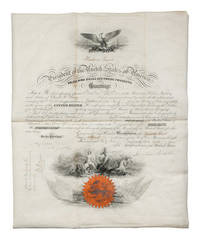
1864132067April 21 1864. American naval commission signed by Abraham Lincoln as President of the United States and Gideon Welles as Secretary of the Navy. Folio partially engraved on vellum the document is dated April 21 1864 and promotes Charles W. Tracy to the rank of Lieutenant. In near fine condition. Matted and framed with a portrait of Lincoln and engraved plate. The Commission measures 19 inches by 16 inches. The entire piece measures 34 inches by 29.5 inches. Abraham Lincoln served as the 16th President of the United States from March 1861 until his assassination in April 1865. He led the United States through the American Civil War the country's greatest moral cultural constitutional and political crisis and in doing so preserved the Union of the United States of America abolished slavery and strengthened the federal government. Lincoln ran for President in 1860 sweeping the North in victory. The South was outraged by Lincoln's election and in response secessionists implemented plans to leave the Union before he took office in March 1861. War began in April 1861 when secessionist forces attacked Fort Sumter in South Carolina just over a month after Lincoln's inauguration and after years of deadly military conflict officially ended on April 9 1865 when Confederate General Robert E. Lee surrendered to Union General Ulysses S. Grant at the Battle of Appomattox Court House. On April 14 1865 just days after the war's end at Appomattox Lincoln was attending a play at Ford's Theatre with his wife Mary when he was assassinated by Confederate sympathizer John Wilkes Booth. Lincoln is remembered as the martyr hero of the United States and is consistently ranked as one of the greatest presidents in American history. hardcover
187212463Springfield IL: Privately Printed 1872. FIRST EDITION. Frontispiece portrait of Lincoln and 11 text illustrations. Complete with the fold-out map. Blue cloth with blind-ruled boards very lightly rubbed. Generally a fresh and bright copy inscribed in the year of publication to Newton Bateman a well known Illinois educator. First edition. This work describes the life and then the public mourning of the assassinated President. The author details the funeral funeral train and the monument built for Lincoln in Springfield. [Privately Printed] unknown
1889108246O.H. Oldroyd 1889. Pamphlet. Very Good. 9x6x0. 1889 O.H. Oldroyd Springfield staple bound pamphlet library stamp to front cover and emboss to title otherwise unmarked. Very light chip to wrappers. 14 pages Please email for photos. O.H. Oldroyd unknown
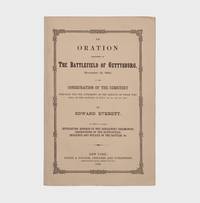
1863376857New York: Baker & Godwin 1863. First edition in book form. 48 pp. 1 vols. 8vo. Original printed wrappers expert restoration to the spine. Housed in a morocco backed box. First edition in book form. 48 pp. 1 vols. 8vo. A lovely copy of the rare first edition of Lincoln's Gettysburg Address delivered at the dedication of a cemetery on the Gettysburg battlefield four months after the bloody and pivotal battle that turned the tide of the Civil War in favor of the Union. Lincoln's speech delivered in only a few minutes stands as a supreme distillation of American values and of the sacrifices necessary for the survival of liberty and freedom.<br /> <br /> Much controversy surrounds the circumstances and content of the address as it was actually delivered at Gettysburg. The words spoken in the speech differ in the versions appearing in newspapers and the text which appeared in Washington several days later published as The Gettysburg Solemnities and known in only four copies which is now taken as the closest version to Lincoln's final intent because of its correspondence to the known manuscript versions. Interestingly and according to Carbonell the text of the first appearance of the speech in book form published a few days later as An Oration Delivered on the Battlefield of Gettysburg i.e. the present printing is taken largely from the New York Tribune printing. Lincoln's address appears on page 40 and parenthetical notes are added indicating "applause" and "long-continued applause." A diagram on page 32 gives the details of the Soldiers' National Cemetery at Gettysburg.<br /> <br /> "Lincoln's speech composed on the train on the way to Gettysburg and written down according to tradition on scratch-paper and the backs of envelopes comprised ten sentences and took only a few minutes to deliver. From the first words - 'Four score and seven years ago' - to the last - 'that government of the people by the people and for the people shall not perish from the earth' - it is immortal one of the supreme utterances of the principles of democratic freedom" PMM. PMM 351; Wills 191-204 261-263; Howes E233; Sabin 23263; Streeter sale 1747; Monaghan 193 Baker & Godwin unknown
1863423266New York: Baker & Godwin Printers and Publishers Printing-House Square opposite City Hall 1863. Softcover. Very Good. The earliest publication of Lincoln’s Gettysburg Address in book form preceded only by the exceptionally scarce 16-page pamphlet The Gettysburg Solemnities. Octavo. Stitched in the original printed wrapper with a publisher’s advertisement on the rear wrap. pp. 1-3 4-48. Modest overall toning and rubbing to the wrapper some fraying at the corners part of the paper along the spine back is perished one vertical stain at the front wrap and title page a very good copy with a few scattered contemporary brown ink markings. Very light contemporary ownership name in pencil at the top of the front wrap. Housed in a fine quarter blue morocco slipcase with gilt spine lettering and two raised bands and with an internal cloth chemise. “Collection of Foreman M. Lebold†stamped in gold on the front cover of the slipcase. Foreman M. Lebold was a noted collector of Lincoln material and the eldest brother of Nathan Leopold one of the infamous Leopold and Loeb teenage thrill killers convicted of the murder of Bobby Franks which captured the attention of the nation. Foreman like much of his family eventually changed his last name to Lebold because of the notoriety of the trial.<br /> <br /> Lincoln delivered his speech at the dedication ceremony of the Gettysburg National Cemetery on November 19 1863 about four months after the pivotal battle that turned the tide of the Civil War in favor of the Union. His speech was preceded by an Oration by Edward Everett the most famous orator of the day. Everett’s oration printed here in full took about two hours to deliver and is now largely forgotten. Lincoln’s address was delivered in only a few minutes and is now celebrated as the supreme distillation of American values and testament to the sacrifices necessary to achieve freedom for all Americans. It is printed on page 40 of this booklet under the title: “The dedicatory remarks were then delivered by the President as follows: / President Lincoln’s Speech. / Four score and seven years ago our fathers brought forth upon this continent a new nation …â€<br /> <br /> A well-preserved copy in the original wrappers.<br /> <br /> Sabin 23263; Printing and the Mind of Man 351. Baker & Godwin, Printers and Publishers, Printing-House Square, opposite City Hall unknown
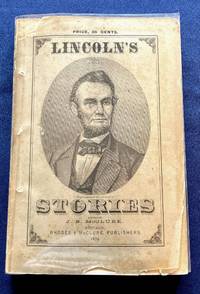
18792355Chicago: Rhodes & McClure Publishers 1879. First Paperback Edition reprinting 1878 hardback. Pictorial wrappers. Good . Lithographic engravings. 8vo tan pictorial wrappers perfect bound with publisher's cord tie and lithographic engraved oval image of bearded Abraham Lincoln illustrated throughout with B&W frontispiece vignette title page & 8 plates; 188 pages 2 Ads. RARE POST-1871 CHICAGO FIRE WRAPPERED & ILLUSTRATED WRAPPERED REPRINT! Covers Lincoln's entire life with illustrations and illustrative anecdotes and many stories. <br /> <br /> Solid copy light to moderate periodic foxing plates generally clean chipping to cover. Mylar added for protection. No previous owner's marks or annotations Rhodes & McClure, Publishers hardcover
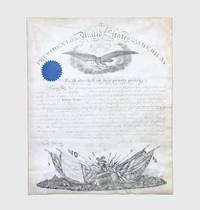
1863172650Washington DC: 10 March 1863. Signed four months before the Battle of Gettysburg A military appointment signed by Abraham Lincoln at the height of the American Civil War. Such documents were instruments of authority and means of identification as soldiers crossed through military lines and took command. The document appoints James Gillette to the position of "Commissary of Subsistence of Volunteers with the rank of Captain". James Gillette 1838-81 enlisted as a private and rose quickly through the ranks. He served as Commissary of Subsistence for the 2nd Division XII Corps under General John W. Geary. For his meritorious service he was breveted lieutenant colonel U.S. Volunteers and for gallantry at the battle of Chancellorsville he was breveted major in the regular Army. A week earlier on 3 March Lincoln signed the Conscription Act mandating the impressment of able-bodied young men into the service of the Union Army. A clause allowing for exemption by paying a fee provoked national fury leading to riots in New York. Engraved military appointment 415 x 340 mm on vellum with the sections accomplished in manuscript attractive cartouche of the American eagle at the head and large trophy of arms at the foot engraved by J. V. N. and O. H. Throop blue wafer seal at left War Department docketing notations at upper left. Mounted and framed with UV conservation glazing framed size 64 x 53 cm. Originally folded into sixths leaving light creases as usual. Slightly discoloured at extremities ink a little faded but still clear. In very good condition. hardcover
1862190938Washington DC: 28 July 1862. Taxing the new state of Oregon to fund the Civil War Lincoln appoints Lawrence White Coe collector of federal taxes for the State of Oregon. In August 1861 Congress passed a new direct tax to fund the Civil War. Oregon's share was $35000 seven eighths of the state's annual revenue Bancroft p. 640. The measure marked both a substantial expansion of federal taxation and a wartime extension of presidential patronage through the appointment of tax officers. Oregon had become a state in 1859. Coe 1831-1897 resident in Wasco County had opened steam navigation on the upper Columbia River with the stern-wheeler Colonel Wright which was contracted to carry army supplies to Fort Walla Walla. His father Nathaniel Coe had been appointed by President Fillmore as the first postal agent in the Northwest. Printed document with manuscript additions 281 x 434 mm embossed seal of the US Treasury. Presented in a wooden frame with conservation acrylic glazing 555 x 425 cm. Minor chipping at extremities tape residue on verso from former framing minor soiling and light spotting. In very good condition. Hubert Howe Bancroft History of Oregon Vol. II 1888. unknown
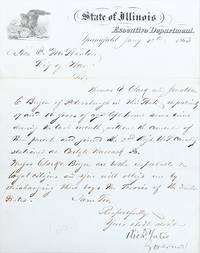
1863192290Springfield Illinois: 22 January 1863. Lincoln intercedes for two runaway boys On the verso of a letter to Stanton from Illinois Governor Richard Yates 1815-1873 the president writes "The families to which these boys belong are among my old acquaintances. A. Lincoln. Jan. 22 1863". Yates 1815-1873 was a longtime friend of Lincoln's. His letter dated 12 January 1863 states that "Thomas E. Clark and Jonathan C. Bergen of Petersburg in this state respectively 17 and 16 years of age left home some time during the last month without the consent of their parents and joined the 2nd Reg't U.S Cavalry stationed at Carlyle Barrack Pa". Yates requests to Stanton that "Messrs Clark & Bergen are both respectable & loyal citizens and you will oblige me by discharging these boys from the service of the United States". Petersburg Illinois is near New Salem where Lincoln lived from 1831 to 1837. Lincoln also received letters from the fathers George S. Bergen and David Clark which he referred to the Adjutant General of the Army Lorenzo Thomas on 21 January Collected Works of Abraham Lincoln Vol. 8 1953 p. 509. Although no one under 18 could legally enlist without the written consent of a parent or guardian many did so. By one recent estimate underage enlistees accounted for roughly a tenth of the Union forces Clarke & Plant. Parents filed thousands of petitions with Union authorities and state courts to secure their children's discharge. Here the families were sufficiently well-connected to appeal at the highest level; Lincoln's endorsement implies that the request was granted. Provenance: Elsie O. and Philip D. Sang their sale at Sotheby Parke Bernet 1978 lot 484; Louise Taper Beverly Hills California; acquired by the Abraham Lincoln Presidential Foundation as part of the Taper Collection 2007; sold by the Foundation at Freeman's Hindman in their Lincoln's Legacy sale 2025 lot 78. Single sheet on State of Illinois Executive Department letterhead 253 x 197 mm handwritten by Yates on recto endorsed by Lincoln on verso alongside a note it was forwarded to Stanton. Central folds repaired still in very good condition. The endorsement is published in Roy P. Basler The Collected Works of Abraham Lincoln First Supplement 1974 page 175. Frances M. Clarke & Rebecca Jo Plant Of Age: Boy Soldiers and Military Power in the Civil War Era 2022. unknown
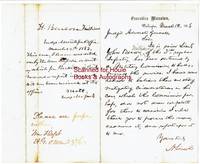
1863604602"A. Lincoln" in black ink on Executive Mansion Washington letterhead March 18 1863. 5" x 8" 1 page with integral leaf. Very good. Integral blank with an autograph endorsement signed by Holt and clerical endorsement from the Adjutant General's office. To Judge Advocate General Joseph Holt: Lincoln requests his Judge Advocate General to investigate the "Strong Mitigating Circumstances" surrounding the court-martial of a member of the West Point Class of 1861. "It is said Lieut. John Benson Williams of the 3rd regular infantry as been sentenced by a Military Commission to be dismissed the service. I have some reason to believe there are strong mitigating circumstances in his case which the Commission perhaps did not deem competent for them to consider I will thank you to procure the record examine it and report it to me. . ." Holt forwarded Lincoln's letter to the Adjutant General noting that "No record or report in regard to the Williams case has been received at this office." The letter was returned to Holt accompanied by the record of William's court-martial and docketed "Please see papers within." After studying the record Holt made a lengthy report to Secretary of War Stanton March 30 1863 which survives in the Abraham Lincoln Presidential Library. Holt dismissed the "mitigating circumstances" referenced by Lincoln - Williams's supposedly "severe sickness" - and concluded that "It is evident that Lieut. Williams left his command on the battlefield and returned to Washington without leave and in known violation of orders and of his duty. . . .He has shown himself disqualified for the profession of arms." On April 8th Stanton in turn forwarded Holt's deposition to the President "as requested by his note on the 18th Ulto" that is the present letter. Lincoln ended the matter with his own terse endorsement on April 11th: "I decline to interfere in Behalf of Lieut. Williams" Basler 4:169. Although referred to in Basler's note regarding Lincoln's endorsement the present letter does not appear in "The Collected Works of Abraham Lincoln".<br /><br />Extra shipping required.<br /><br />
1863027103Washington D.C.: Executive Mansion 1863. Small Octavo. 4 page folded pamphlet issued to military. The large number of desertions in the Civil War was becoming epidemic. Previously they might go home to bring in a harvest to visit a wife or girl friend or simply be tired of either war or what often seemed like endless waiting for something to happen. This offered soldiers amnesty if they returned before April 1 1863. Their only penalty would be the forfeiture of pay and allowances during their absence. After that date they will be arrested as "deserters and punished as the law provides." Pages 2-3 lists 36 places where they can report. Besides those near the places of conflict it includes locations as far away as Fort Vancouver Washington Territory Fort Randall Dakota Territory Salt Lake City and San Francisco. Executive Mansion unknown
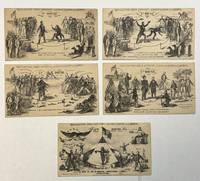
186141884New York: J.H. Tingley 1861. Five postal covers each oblong 3-1/4" x 5-7/8." The recto of each is an engraving of a Round of the boxing match. Near Fine.<br /> <br /> From the U VA description: "Five envelopes in the Champion Prize Envelope set depict a boxing match between Lincoln and Davis in which the latter is easily defeated and Winfield Scott commands the Union armies. Smaller vignettes in the corners depict dogs guarding southern cotton and then fleeing; liberated slaves Union artillery advancing firing and marching home; Union and Confederate politicians commenting on the fight including John Minor Botts who is seen as keeping Virginia in the Union; European countries commenting on the fight; and the Union eagle and Liberty victorious with Lincoln the champion of all sections."<br /> 1st Round: Standing around a boxing ring Lincoln and Davis in the middle are a group of civilians Soldiers cannon. two dogs guarding a bale of cotton and a Confederate flag a group of slaves three men on a globe Capitol and American flag in the background. In the ring Davis cowers before Lincoln who says "I use no more force than necessary." Davis: "Let me alone!"<br /> 2nd Round: The same group encircles the ring. Lincoln: "Go back you dog to the junction I'll call on you there soon." Davis: "Beauregard Lets fall back on Richmond." From the crowd of civilians: "Secession is looking smaller" and "We shall soon strip it." Other comments are also uttered.<br /> 3d Round: Lincoln: "I will soon smother those pirates." From the same encirclement anti-Confederate comments such as "General That's secession's last kick" rebel soldiers saying "Let's go home boys." The cotton bale and Confederate flag are missing.<br /> 4th Round: Seward and Scott are in the ring. Seward: "General where is secession now" Scott : "Don't you see that greasespot" Comment: "Virginia and Kentucky may now be heard in behalf of the whole Union."<br /> 5th Round: Lincoln with "The Champion Belt": "You shall all have my impartial constitutional and humble protection." He is surrounded by the iconic Screaming Eagle; a triumphant West North East and South; and Lady Liberty who says "I still live." <br /> Not in Reilly or Weitenkampf. AAS and the University of Indiana own all five envelopes. OCLC 277634667 1- U VA 14953428 2- CT Mus. Hist. Culture U IL as of June 2026. J.H. Tingley unknown
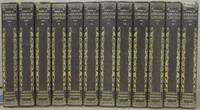
189480033Lincoln Memorial University 1894. Sponsors Edition. Hardcover. Very Good. 23.5 x 16 cm. Complete twelve volume set. This is the Sponsors Edition printed from plates of the original new and enlarged edition of 1894 signed by the chancellor of the university and with the seal of of the university. There is supposed to be a limitation page opposite this in volume 1 but this is NOT present. Several versions of this edition were done. This set bound into brown boards with a gilt emblem of the Lincoln Memorial and TEG. Many unopened pages. Frontispiece in each volume and additional plates and facsimile letters throughout the work. Wear and sometimes chipping at the heads of spines. Nice internally. Heavy set. Substantial additional charges will be required for priority or orders outside the US. Lincoln Memorial University hardcover
189501037869Lincoln Memorial University 1895. 356pp. Gilt titles on embossed deep blue cloth. Vol. 5 of 12. Hard Cover. VG-/No Jacket. Large Octavo. Lincoln Memorial University Hardcover
189501037868Lincoln Memorial University 1895. 356pp. Gilt titles on embossed deep blue cloth. Vol. 3 of 12. Hard Cover. VG-/No Jacket. Large Octavo. Lincoln Memorial University Hardcover
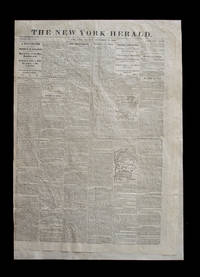
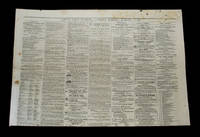
186268870New York: The New York Herald 1862. Full Description:<br> <br> LINCOLN Abraham. Emancipation Proclamation."A Proclamation by the President of the United States. Operations of the Confiscation Act. All Slaves in States in Rebellion January 1 1863 to Be Free." New York. Published in: The New York Herald Tuesday September 23 1862. Whole No. 9506.<br> <br> The publication of Lincoln's Emancipation Proclamation in James Gordon Bennett's pro-Democratic New York Herald and one of if not the first official public announcements of the preliminary Emancipation Proclamation.<br> <br> Broadsheet folio one large leaf folded along top to make four pages two leaves printed on recto and verso. Six-column format. 22 x 15 1/2 inches; 560 x 395 mm. Light creases down the middle in both directions. Some nearly invisible repaird along top margin and edges. Some of the repairs just touching a few letters in the headline. Still a very good copy of this important declaration. We could only find 3 copies of this at auction and it is not mentioned in Eberstadt. Eberstadt mentions that his Third edition of the Emancipation has a publication date somewhere between September 24th and 26th therefore putting the current copy before this. Eberstadt's first and second edition are the official state department editions printed the day of the declaration September 22nd just the day before this New York Herald was printed.<br> <br> Abraham Lincoln issued the preliminary Emancipation Proclamation on September 22 1862 stating that if the rebelling states did not cease fighting and rejoin the Union by January 1 1863 the slaves in those states would be set free. The New York Herald issued this front-page top left corner early printing of Lincoln's Proclamation the very next day appearing under the headline: "All Slaves in States of Rebellion January 1 1863 to Be Free."<br> <br> "Lincoln read the first draft of what came to be known as the Preliminary Emancipation Proclamation to his cabinet on 22 July 1862. Given the criticism directed at Lincoln for moving too slowly on the issue of emancipation it is worth noting that this first reading took place just sixteen months after he had pledged not to 'interfere with the institution of slavery in the States where it exists.' He continued to revise the document throughout the summer and following the Union victory at Antietam he issued the preliminary proclamation-which managed to balance daring with prudence-on 22 September. This first proclamation essentially gave the Rebel States one hundred days to return to the Union after which period any slaves within their borders would be "then thenceforward and forever free." Any rebellious states that returned to the Union in the interim would be able to adopt immediate or gradual-and compensated-abolition of slavery within their borders." Sotheby's.<br> <br> The front page of this newspaper also contains two maps and reports of the campaigns in Kentucky.<br> <br> HBS 68870.<br> <br> $3500. The New York Herald unknown
186369186Boston: Boston Daily Courier 1863. Full Description:<br> <br> LINCOLN Abraham. Emancipation Proclamation."President's Proclamation. Emancipation of Slaves in Rebellious States." Boston. Published in: Boston Daily Courier Volume LXXVIII no. 2. Friday Morning January 2 1863.<br> <br> The publication of Lincoln's Emancipation Proclamation in the Boston Daily Courier and one of if not the first official public announcements of the Final Emancipation Proclamation once it was signed and in effect as of January 1 1863. The Proclamation is featured at the top of the center column of page 3.<br> <br> We could find no other copies of this or any other January 2nd edition at auction and it is not mentioned in Eberstadt. Eberstadt's entry for the second edition of the "Final Proclamation" Eberstadt 9 states "Second edition. Apparently the only separate newspaper edition of the final proclamation and the earliest non-official edition. Printed on Friday evening January 2 1863 this Extra in point of chronological sequence was preceded only by the first official edition." Our present copy although not a separate newspaper edition was rushed to press and published in the Friday Morning edition of the Courier placing it's publication prior to Eberstadt 9.<br> <br> According to Eberstadt "A number of newspapers did not issue on January 2nd because of the previous day's holiday but most of those that did carried the final proclamation. Many of the others printed it on January 3rd." pg. 17.<br> <br> Broadsheet folio one large leaf folded along side to make four pages two leaves printed on recto and verso. Seven-column format. 26 x 19 inches; 655 x 490 mm. Light creases down the middle in both directions. A few minor closed tears. A large old ink signature along top margin of front page causing some bleed-through and foxing but not affecting text. Still a very good copy of this important declaration.<br> <br> Abraham Lincoln issued the preliminary Emancipation Proclamation on September 22 1862 stating that if the rebelling states did not cease fighting and rejoin the Union by January 1 1863 the slaves in those states would be set free. Once January 1st 1863 arrived President Lincoln signs and issues the final Emancipation Proclamation freeing the slaves in the Confederate states. The Boston Courier issued this early printing of Lincoln's Proclamation the very next morning January 2 1863. "<br> <br> HBS 69186.<br> <br> $8500. Boston Daily Courier unknown
186210466Washington: Government Printing Office 1862. Hard Cover. Very Good binding. Octavo. 910 pp. First edition. As issued in publisher's embossed cloth; spine titled "Messages / and / Diplomatic / Correspondence. / 1862 / Ho. Reps." Binding is a trifle sunned at the spine but generally it presents quite nicely; early and occasional tidelines; occasional scattered foxing. <br /> <br /> This contains Lincoln's second "State of the Union" though at that time it was a printed message rather than an address. In this message Lincoln tangles with the year and a half old civil war and his struggle to preserve the Union while wrestling with the central impasse of the rebellion slavery. A remarkable address that contains at the conclusion one of his memorable lines "The dogmas of the quiet past are inadequate to the stormy present. The occasion is piled high with difficulty and we must rise with the occasion. As our case is new so we must think anew and act anew. We must disenthrall ourselves and then we shall save our country" p. 23. Of profound importance and one of Lincoln's boldest moves to "rise with the occasion" this volume contains the 22 September 1862 preliminary Emancipation Proclamation the final version would be issued and enforced a month after Lincoln's message. The idea of an executive action that would free the slaves in states that were in open rebellion with the Union came in the summer of 1862. An early version of the proclamation was read by Lincoln to his cabinet in July 1862. On the advice of Secretary of State William Seward this penultimate version of the proclamation was thought to be more effective if issued after a significant Union victory—that victory turned out to be at Antietam. The Emancipation Proclamation is among the most important documents in United States history and this preliminary version offers a glimpse into Lincoln's steps towards the abolition of slavery in service of the preservation of the Union. Government Printing Office unknown
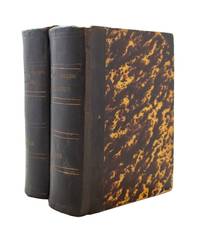
186369520Washington D.C.: War Department 1863. CIVIL WAR. War Department General Orders 1863. Washington D.C.: War Department 1863.<br> <br> Full Description:<br> <br> LINCOLN Abraham. CIVIL WAR. Emancipation Proclamation War Department General Orders 1863. Washington D.C.: War Department 1863.<br> <br> The first War Department printing General Orders #1 Jan 2 1863 and fifth overall printing of the final Emancipation Proclamation. The 4 page pamphlet bound together with a nearly complete run of War Department general orders for the year 1863. Two octavo volumes 6 7/8 x 4 5/8 inches; 174 x 119 mm. Volume I comprising General Orders of the War Department Adjutant General's Office Numbers 1-221 2 January 1863 to 16 July 1863 and Volume II comprising Numbers 222-400 16 July 1863 to 28 December 1863. Nearly complete only lacking numbers 55 63 116-119 148 in volume I and 274 352 and 381 in volume II. With 5 copies of number 149 and and 3 copies of number 240.<br> <br> Contemporary half calf over marbled boards. Spine lettered in gilt. All edges speckled brown. Hinges repaired. Some rubbing to board edges. Previous owner's contemporary ink signature Bvt. Col. E.J. Wells on front paste down of each volume. Numerous annotations in the same old ink throughout generally noting when the order was received and dated 1863. Some glue marks to the General Order #1 not affecting text. A small tear to last leaf of text in volume I with no loss. Overall a very good copy.<br> <br> In addition to the very important first War department printing of the Emancipation Proclamation these volumes contain several other very important and interesting General Orders from the War Department as well as President Abraham Lincoln in relation to the military during this year in the Civil War.<br> <br> Notably:<br> <br> No. 100 April 24 "Instructions for the Government of Armies of the United States in the Field." "commonly known as the 'Lieber Code' after its main author Francis Franz Lieber. The Lieber Code set out rules of conduct during hostilities for Union soldiers throughout the U.S. Civil War. Even today it remains the basis of most regulations of the laws of war for the United States. The Lieber Code consists of 157 provisions that deal with a wide range of legal issues that must be considered in armed conflict. It contains general principles but also very detailed rules. Among the issues addressed are whether armed force is justified by military necessity the principle of humanity the distinction between combatants and civilians POW status retaliation and permissible methods and means of warfare." LOC"<br> <br> No. 143 May 22 the establishment of the United States Colored Troops. This authorized the establishment of a bureau regulating the recruitment training and organization of the U.S. Army's first regiments composed entirely of African-American soldiers.<br> <br> Numerous court cases are documented including #17- The sentenced hanging death of a "colored man" for "attempted rape". #346- The trial of George Woolfolk for "Being secretly within lines of the US forces as the same time belonging to the so-called Confederate Army." He was sentenced to be shot to death. And #396- The trial brought by Colonel John Gault against Dr. Aaron James for "Being the captain of a band of guerillas or marauders and shooting at US soldiers." He was sentenced to death but the President disapproved the sentence and directed him to be released.<br> <br> A number of orders of Military discharges both honorable and dishonorable as well as military promotions. #337 announces "Major General U.S. Grant U.S. Army is placed in command of the Military Division of the Mississippi Headquarters in the field." #349 announces "Major General William T. Sherman is appointed to the command of the Department and Army of the Tennessee Headquarters in the field." #194 is the appointment of Major General George Meade as commander of the Army of the Potomac who would defeat General Robert E. Lee at Gettysburg only days later. And #398 honors Ulysses S. Grant for his Mississippi River campaign and presents him a gold medal.<br> <br> Numerous obituaries including #71 which announces the death of Major General E.V. Sumner who fell ill and died on his way to take command of the Department of the Missouri and directs the ways that Department should give him military honors.<br> <br> Important presidential proclamations including #58- Calling to all soldiers who were "absent without leave" urging them to return to their regiments and would not face punishment beside loss of wages for time missed. #252- Orders regarding the treatment of prisoners of war stating that 'if the enemy shall sell or enslave anyone because of his color the offence shall be punished by retaliation upon the enemy's prisoners in our possession'. "President Abraham Lincoln issued an 'eye-for-eye' order warning the Confederacy that Union soldiers would shoot a rebel prisoner for every Black prisoner shot. It also would condemn a rebel prisoner to a life of hard labor for every Black prisoner sold into slavery. AA Registry. #315- Lincoln's suspension of the "writ of habeas corpus." "The doctrine of habeas corpus is the right of any person under arrest to appear in person before the court to ensure that they have not been falsely accused. Lincoln's suspension of the "writ of habeas corpus" was one of the most controversial acts of his administrations. Lincoln defended himself against charges that his administration had subverted the Constitution however arguing that acts that might be illegal in peacetime might be necessary "in cases of rebellion" when the nation's survival was at stake." The Gilder Lehrman Institute of American History. #340- Proclamation by the President calling for three hundred thousand volunteers. "Whereas the term of service of a part of the volunteer forces of the United States will expire during the coming year; and Whereas in addition to the men raised by the present draft it is deemed expedient to call out 300000 volunteers to serve for three years or the war not however. exceeding three years."<br> <br> And numerous other General Orders pertaining to soldiers and the war effort including #35- A list of items that could be sold to soliders by sutlers. #40- The establishment of a Volunteer force for Kentucky. #163- "A resolution to encourage the enlistments in the Regular Army and Volunteer forces." #323- which authorized each enlisted cook "two under-cooks of African descent who shall receive for their full compensation ten dollars per month and one ration per day." #351- This discusses the governance of "The Employment of women nurses in the U.S. General Hospitals." and #364 which discusses the cos of clothing and camp for the U.S. Army and includes a folding chart.<br> <br> Eberstadt 12. Grolier 100 American 71. Streeter 1751.<br> <br> HBS 69520.<br> <br> $7500. War Department unknown
1865863261865. BROADSIDE - Lithograph LINCOLN Abraham. EMANCIPATIONS PROKLAMATION. Davenport Iowa: W.H. Pratt 1865. August Hageboeck lithographer. This is the second German-language version of the Emancipation Proclamation. It is printed in cursive within an oval border. The weight of the individual letters is varied so that when viewed from a distance a portrait of Lincoln emerges from the text. Originally printed on a rectangular sheet but here trimmed to an oval that surrounds the image the sheet is 37 x 29.5 cm. The image is 32 x 23 cm. The paper is browned and dampstained at the bottom center at the copyright information. It is matted and housed in a custom archival portfolio. A rare print. unknown
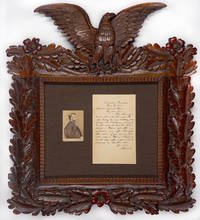
186132820663<br />One page. Beautifully presented in a spectacular 19th-century carved wood frame with surmounted eagle. <br />Abraham Lincoln writing at the outset of the Civil War recommends that the Army admit three volunteers from the highly divided city of Baltimore. He advises Adjutant General Lorenzo Thomas "I hate to reject any volunteers offered from what is called a Southern State."<br />Maryland's Southern sympathies were of paramount concern to Lincoln. On February 23 1861 learning of a rumored assassination plot president-elect Lincoln passed through Baltimore in secrecy to reach Washington. On April 19 1861 just a week after the surrender of Fort Sumter a mob killed four soldiers and wounded thirty-six more when the 6th Massachusetts Infantry passed through Baltimore en route to Washington. A week later Lincoln suspended the writ of habeas corpus to maintain control in the state. Maryland's governor had ordered the militia to burn railroad bridges north of the city to prevent more federal troops from coming through the city. Finally on May 13 federal troops occupied the city quelling pro-Confederate unrest.<br /> In this fine letter written just days later Lincoln asks Adjutant General Lorenzo Thomas "The three gentlemen who will hand you this note belong to an Artillery Company at Baltimore who wish to get into the United States service. Please give them an interview; and after they explain their case if you advise it I will receive them. I hate to reject any offered from what is called a Southern State."<br />This outstanding letter from the earliest days of the Civil War reflects Lincoln's intense desire to keep the people of Baltimore Maryland and the neighboring border states in the Union and to bring in new recruits wherever he could find them.<br />Important Lincoln letters relating to his concern about Baltimore and Maryland in the early days of his presidency are of great rarity.<br />OFFERED WITH:<br />Silk U.S. Flag Bunting from the Presidential Box at Ford's Theatre the Night of the Assassination. Ford's Theatre April 14 1865.<br />Section of an American flag in two pieces upper half 6 1â„2 x 8 1â„4 in. lower half 6 1â„4 x 7 1â„2 in. Horizontal separations light loss and fraying some stains. Oriented vertically. Handsomely framed.<br />This is a section of the bunting from the presidential box at Ford's Theatre where Abraham Lincoln was shot by John Wilkes Booth on April 14 1865. Harry C. Ford manager of stage shows at Ford's Theatre preserved the bunting and a few weeks later gave this section to John A. Ellinger see Provenance.<br />The bunting has an impeccable provenance. It came into the possession of Oliver R. Barrett perhaps the greatest of all Lincoln collectors and it was sold at his Parke Bernet auction in 1952. Elsie O. and Philip D. Sang the leading Lincoln and Civil War collectors of the second half of the century then acquired it. The bunting was sold in 1981 at the fifth Sang sale and has since been owned by two other leading Lincoln collectors Dr. John K. Lattimer and Dr. Blaine Houmes.<br />"The term 'draped" used by Ellinger who received the bunting from Ford would seem to indicate that this piece was from one of the two flags draped on the presidential-box balustrades and not mounted on a pole. … Known Provenance: Oliver R. Barrett Lincoln Collection … It is not known where the item is today" "The Oliver R. Barrett artifact" in Smyth & Garrett The Lincoln Assassination: The Flags of Ford's Theatre p. 70.
This is an evocative relic from a sacred place in American memory and one of the most momentous events in American history.<br />Please inquire for more details.
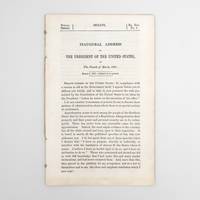
1861377680Washington D.C.: Government Printing Office 1861. Special Session Senate Ex. Doc. No. 1. 10pp. 8vo. Disbound. Housed in a cloth box. Special Session Senate Ex. Doc. No. 1. 10pp. 8vo. Lincoln began drafting his first inaugural in Springfield soon after his election hoping the speech would impart a spirit of reconciliation toward the seceded states. His speech balances his pledge to protect Federal property in the south while insisting that he would not use military force unless attacked first. In all he eloquently argues against secession presenting the United States as undissolvable. Lincoln ends his speech with the memorable lines: "We are not enemies but friends. We must not be enemies. Though passion may have strained it must not break our bonds of affection. The mystic chords of memory stretching from every battle-field and patriot grave to every living heart and hearth-stone all over this broad land will yet swell the chorus of the Union when again touched as surely they will be by the better angels of our nature."<br /> <br /> "Lincoln became President on March 4 1861. Before being sworn in he gave his First Inaugural Address devoting it entirely to the secession crisis. It was the linguistic equivalent of an optical illusion: one could view it two ways. As historians have noted he seemed to placate the South; he would not 'interfere with the institution of slavery in the States where it exists.' This language was the old Lincoln . The new Lincoln was a resolute executive who had no choice but to enforce the Constitution a contract that does not allow states to withdraw from it unilaterally. In his enforcement there would be no bloodshed 'unless it be forced upon the national authority" Mazy Boroujerdi editor Abraham Lincoln: His Life in Print p. 108.<br /> <br /> Lincoln had begun writing his inaugural the month prior before leaving Springfield and once in Washington asked William Seward to review the draft. It was Seward who suggested softening the tone so as not to appear too inflammatory suggesting "a nostalgic call for unity emphasizing the country's shared history. Lincoln embraced the idea but massaged it into near poetry. Seward's prosaic text ended up as Lincoln's oft quoted appeals to the 'mystic chords of memory' and 'the better angels of our nature.' The words did nothing to reverse disunion" Ibid. p. 97.<br /> <br /> This is the official government printing of Lincoln's first inaugural address issued as a document of a special session of the Senate printed by their order four days after its delivery being only the second printing overall of the memorable speech. Monaghan 102; Abraham Lincoln: His Life in Print p. 108 [Government Printing Office] unknown
1863RLINLET00efH. H. Lloyd 1863. Fair. Lincoln Abraham. Letters of President Lincoln on Questions of National Policy. Pamphlet. New York: H. H. Lloyd 1863. 22pp. 12mo. Pink wraps. Book condition: Fair with detached rear cover faded and stained front one-inch loss from head and two-inch closed tear in front. Pages have a few faint stains not affecting text. Contains letters to General McClellan Horace Greeley Fernando Wood the Albany Committee Governor Seymour and the Springfield Meeting. Scarce. H. H. Lloyd paperback
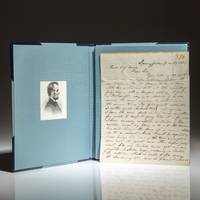
185316994Springfield Ill: Handwritten Letter 1853. ALS. Cloth. Very good. A two-page handwritten letter from Abraham Lincoln to fellow attorney Thomas J. Turner of Freeport Illinois addressing their future legal strategy since ".the Judge has already decided." The letter is dated June 27 1853 and is self-addressed. Octavo 4pp. Previously folded glue remnant along top edge. Several folds of the letter are weakened some partially separated. Small paper loss at intersecting fold with archival tissue repair. The letter is addressed in Lincoln's hand with "Springfield" and "Paid 3" stamped on cover. Housed in custom folding folio quarter blue morocco blue cloth title in gilt on the spine illustration of Lincoln on the front pastedown. This letter concerns the case of Kemper v. Adams & Bovey a land dispute in Freeport Illinois. Lincoln was retained by Adams and Bovey who after a series of losses and appeals prevailed in March 1858 by appealing to U.S. Circuit Court of Northern Illinois. Full letter reads: "Springfield June 27. 1853. / Hon. T. J. Turner: / Dear Sir: Your letter of the 20th. reached me day-before yesterday. I had the day before written to Adams to be on hand with his witnesses- but at the request of Judge Logan who is Kemper's attorney I put in a Post-script saying to Adams if he was agreed the cause should be continued over the summer term. On subsequent reflection I rather wish Adams may not agree. I have the case fresh in my mind and therefore wish to keep it going till it is finished. I have already drafted a Bill of Exceptions and my plan is to put the common lawsuit through the forms of a second trial up to a verdict which must be against us under Judge D's view of the law except & save all the points and then before judgment file our Bill and get an injunction. I shall begin preparing a Bill this afternoon which I which I wish to file during the evening term; and I believe I will do this Mr Adams must come down to swear to the Bill. In no event can we be ready for proof in the chancery suit at this time so that we will need no other witness than the one that was here last summer. I wrote Mr Adams about a Register's certificate & if he can find one or two missing tax receipts let him bring them. I should be glad to see you & shake you by the hand; but as there is no contested jury question I scarcely think you need be at the trouble & expense of coming. All the law questions which can arise at this term the Judge has already decided. Very truly yours A. Lincoln." Provenance: Originally the property of Claribel Mitchell of Freeport Illinois a principal at the Lincoln School until 1916. The letter was sold at auction by the American Art Association on January 30 1923 to Mr. George A. Ball of Muncie Indiana the namesake of the Ball Mason Jar Company. This letter was published in The Collected Works of Abraham Lincoln by Roy Basler New Brunswick NJ: Rutgers University Press 1953 2:199-200. Handwritten Letter unknown
18661007628vo original dark brown pebbled and blindstamped cloth front cover decoratively lettered in gilt steel engraved frontispiece portrait of Lincoln 69 pp. Binding with some edge wear and chipping to spine missing about two inches of lower spine hinges a little weak but still firm ends and corners bumped a little soiling pencil signature of previous owner; else very good. George Bancroft who at one time was Secretary of the Navy deliverd this memorial address to both houses of Congress on February 12 1866. This pamphlet was also published in New York but that issue lacked the portrait. Sabin 3132 Government Printing Office hardcover