312 résultats
17497098Wien und Nürnberg, (Bd. 1:) Lehmann bzw. (Bde. 2 und 3:) Krauß, 1723 - 1749. Mischauflage. 3 Bde. 7 Bll., 473 S., 18 Bll., (Register); 6 Bll., 458 S., 18 Bll. (Register), 1 Bl. (Anzeigen); 6 Bll., 419 S., 26 Bll. (Register). 3 Kupfer-Frontisp. Gr.-8°. (Bde. 1 und 3:) HLdr. des 18. Jahrhunderts mit Rückebschildern (stark beschabt und bestoßen) bzw. (Bd. 2:) Pgmt. der Zeit (stark fleckig und gebräunt, kl. hinterlegte Einrisse, etw. bestoßen).
1721E75858Vienna & Nurnberg Germany: Georg Lehmann 1721. Hardcover. Good. Frontispiece with a party of six sitting under a tree near their hut with a cook preparing a meal in a tent beyond 29 Floral & other initial letters 30 x 30mm a few large handsome tail-pieces. 4to brown leather on 4 raised bands with gilt rules and light tan spine label gilt titled edges worn /lacking approx. 1cm at the head and foot of spine/ hinges cracking but both covers held by all cords and head-bands/ covers are thus well attached Frontispiece titlepage in red and black 8pp = approbation Privilege and Preface 4pp =contents 473pp 37pp =index The front free endpaper has a tearout to remove and inscription and the foot of the page there is a marginal worm tack which decreases until it ends with the last page of the contents. It just touches three letters of one word of the privilege however it just encroaches on the fore-ground of the frontis.where it makes a 1cm V shaped track not touching any of the figures just the floor The verso of the title page 92 have a 2cm round purple library stamp of "S.Maria D.Lacum" The titlepage has an old ink name crossed out to the upper outer margin and "Specto ad biblio" written to the opposide margin and there are also a few ink slurps in pale brown. The text is decorated with floral initial letters 28 of themand a few handsome large head- and tail-pieces.The text has quite some foxing throughout and some gatherings have the text block with a uniform tanning to the text area showing that the ink used had an acidic content. The paper is still entirely sound and not brittle. There are side notes throughout the book and they are nowhere cropped having a good 2cm clear margin to the sides.No tears no loose pages and no writing except to the titlepage. Georg Lehmann hardcover
17106155C1710. Zweiter von drei Bänden. Nürnberg: Weigel. 1710. 4° ca. 21 x 165 cm. 4 Bl. 714 Seiten 7 Bl. Register Fraktur mit 2 Kupfern 1 als Frontispiz 1 zwischen S. 670/671. Mit zahlreichen Vignetten im Text. Ganzpergament der Zeit. Pergament mit Gebrauchsspuren und Verfärbungen. Seiten mit Randläsuren vereinzelt stockfleckig. Frontispiz und Titelseite mit Fehlstellen restauriert und auf neue Seiten montiert. Insgesamt guter bis befriedigender Zustand. Brümmer 7; Wilpert/G. II.56. unknown
17046154Würzburg Hiob Hertzen1704. 4to. Nice later hcalf with raised bands and blindtoolings. 12 538 8 pp. and 50 fine half-page engravings in the text by C. Luyken. A frontisp. seems to be missing. First edition. hardcover
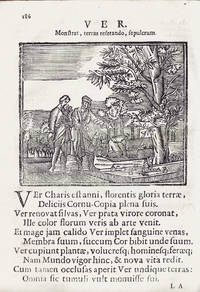
173435709Nu¨rnberg: Riegel. Very Good with no dust jacket. 1734. Hardcover. Woodcuts; 4 491 37 pages; 22 woodcuts emblems. Engraved frontis. Title: Mercurialis oder Winter-grun Das ist: Anmuthige und Kurzweil-volle Geschichte und Gedichte. Worinnen unterschiedliche sittliche Lehr-Puncten und sehr reicher Vorrath biblischer Concepten zu finden: Allen betrubten und freudenreichen Gemuthern Pfarrherren Predigern wie auch Geistlichen Ordens-Personen ingleichen allen Privat-Lesern zur erspriesslichen Zeit-Vertreibung namentlich freudig zu leben und freudig zu sterben zusammen getragen durch P. Abraham a S. Clara Weyland Augustiner Baarfusser und Kayserl. Prediger: Und mit saubern Kupfern geziert/Mit Erlaubnis der ObernAuthor: Abraham a Sancta Clara - Abraham a Sancta Clara Austrian divine was born at Kreenheinstetten near Messkirch. His lay name was Johann Ulrich Megerle Not to be confused with his uncle Abraham Megerle de composer 1607-1680 . He has been described as "a very eccentric but popular Augustinian monk." In 1662 he joined the Catholic religious order of Discalced Augustinians and assumed the religious name by which he is known. In this order he rose step by step until he became prior provincialis and definitor of his province. Having early gained a great reputation for pulpit eloquence he was appointed imperial court preacher at Vienna in 1669. The people flocked to hear him attracted by the force and homeliness of his language the grotesqueness of his humour and the impartial severity with which he lashed the follies of all classes of society and of the court in particular. In general he spoke as a man of the people the predominating quality of his style being an overflowing and often coarse wit. There are however many passages in his sermons in which he rises to loftier thought and uses more dignified language. He died at Vienna on 1 December 1709. In his published writings he displayed many of the same qualities as in the pulpit. Perhaps the most favorable specimen of his style is his didactic novel entitled "Judas der Erzschelm" 4 vols. Salzburg 1686-1695. His works have been several times reproduced in whole or in part though with many spurious interpolations. The best edition is that published in 21 vols. At Passau and Lindau 1835-1854. See Th. G von Karajan "Abraham a Sancta Clara" Vienna 1867 ; Blanckenburg "Studien uber die Sprache Abrahams a S. C." Halle 1897 ; "Sexto Abraham a S. C." Sigmaringen 1896 ; Schnell Pater A. A S. C. Munich 1895 ; "H Mareta Uber Judas d. Erzschelm"Width: 7" Height: 8.5"Book Details: Condition / Notes: This antique volume is bound in full leather with raised bands and stamped lettering and ornamentation to the spine. The book shows external wear with rubbing to covers and loss at the top/bottom of the spine and at the outside corners of the boards. The binding is sound. The antique bookplate of book dealers "Benziger Bros." of New York and Cincinnati appears in the upper left corner of the front pastedown. The title page is printed in red and black. Rector and verso of the title page have library markings. The age-toned pages display light foxing. This work is illustrated with a frontispiece engraving textual woodcuts head- and tailpieces. Scarce- Worldcat locates but 5 copies worldwide. . Riegel hardcover
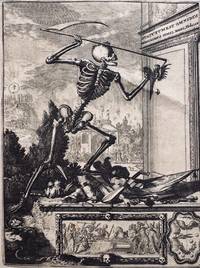
1702251118002Amsterdam: George Gallet 1702. 1st Edition. Hardcover. Good. De Chertablon. SCARCE EMBLEMATA 1ST EDITION IN GERMAN ON PREPARING FOR DEATH TO REACH HEAVENLY SALVATION THROUGH JESUS <br /> <br /> TRANSLATED TITLE : Dying and inheriting that is the most beautiful preparation for death. Or the surest way to die and inherit salvation by contemplating the bitter suffering and death of our only and dearest Savior Jesus Christ <br /> <br /> Condition: GOOD COMPLETE ORIGINAL <br /> <br /> I see no other copy currently for sale and this title scarcely comes up for auction. Worldcat shows only a handful of copies held by institutions. <br /> <br /> ABOUT THE BOOK <br /> <br /> Published in 1702 by George Gallet in Amsterdam. First edition in German. Text primarily in Gothic. In contemporary full dark brown calf. Covers with blind stamped bordering and five raised spine bands. All edges speckled red. Quarto 10.5" x 8.5". Collated and complete: 22 108 pp. and all 42 copper engraved plates. A few embellished initials and chapter headers. Title page in red and black. Wide-margined thick pages.<br /> <br /> IMPORTANCE<br /> <br /> The book is an emblemata of the German Baroque literature movement of the seventeenth century through early eighteenth century. It is comprised mostly of plates of a man on his deathbed awaiting his fate on the recto of leaves and scripture from the Bible and description of the plate scene on the verso. The engravings by De Chertablon are striking in composition highly detailed and rich with religious and moral symbolism. Only two plates are actual 'Dance of Death' images the others show dynamic scenes surrounding the dying person. The remarkable thing about the depictions is that personified Death does not appear as usual as a skeleton or a mummy but as an angel. He often points to a painting in the background held by putti which depicts scenes from the Life and Passion of Christ. In a few striking scenes the path to salvation appears closed. In one instance the devil presents a list of all the sins the dying man has committed. Unlike the majority of scenes there are no angels pointing the way to salvation. The foreboding description for this scene says that faith and belief are not enough for heavenly salvation: you will be judged by your acts and deeds while on Earth. <br /> <br /> ABOUT THE AUTHOR <br /> <br /> Abraham a Sancta Clara born Johann Ulrich Megerle; 1644 - 1709 was an Augustinian friar. He gained a great reputation for pulpit eloquence early on. He was appointed imperial court preacher of Vienna in 1669. The people flocked to hear him attracted by the force and simplicity of his language the grotesqueness of his humor and the impartial severity with which he lashed the follies of all social classes. <br /> <br /> CONDITION REPORT <br /> <br /> GOOD for a 320-year-old book <br /> <br /> Exterior and binding: Some spine lean and front hinge cracked. Rear hinge starting to crack at its head. Binding and boards holding firm but strained in places. Heavily rubbed and worn leather that is dry and cracking and pitting. Has a beautiful texture of authentic aging. Spine label mostly perished. Multiple pen-tip sized wormholes on covers. <br /> <br /> Interior: Grubby endpapers. Toned pages. Mostly light to scattered foxing on the text block itself; heavier foxing along the gutters at times. Browning and dust along page margins. A single pen-tip sized wormhole throughout the entire text block gradually expanding to more same sized holes toward the last quartile of the book. The final leaf has about 12 pin-tipped sized holes. These holes slightly affect text and images. The plate impressions are strong and are visible on the verso and form an unintended but quite nice bordering of the descriptive text. No writing beyond a few scribbles in red on front pastedown. No marginalia or underlining. A few margin tears. <br /> <br /> All in all a beautifully illustrated scarce work of religious emblemata depicting deathbed scenes and the path to heavenly salvation. George Gallet hardcover
17428506Amsteldam: H. W. van Welbergen boekverkooper 1742. In-8° titel in rood en zwart 8 356 pp. Goed exemplaar. Gebonden in vol leder verlies van leer aan bovenste kapitaal. Rug versierd met goud H. W. van Welbergen, boekverkooper unknown
170208242Peter Retteler 1702. Hardcover. Acceptable. Full leather boards are very worn they originally had metal corners not present any longer the boards are edge worn and cracking with age backstrip was suede and it's mostly gone binding is exposed. Pen name on front endpaper interior is tanned bug damage and stains to first few pages page 139 is almost loose stains on and off throughout book. German language. Woodcut of rooster on title page All orders packed with care most dust jackets protected by Brodart sleeve independent bookseller since 2011 Peter Retteler hardcover
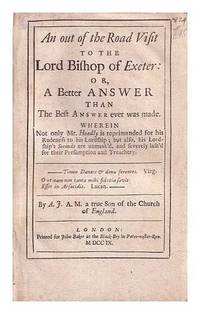
1709342667London : Printed for John Baker 1709. First edition. Softcover. Good pamphlet copy; wrappers slightly edge-dulled. Pages tanned as with age. Remains particularly well-preserved overall. Physical description: 15 1 p.; 19 cm. Subjects: Leslie Charles 1650-1722. Best answer ever was made.Blackall Offspring 1654-1716. Divine institution of magistracy. Hoadly Benjamin 1676-1761. Great Britain History Anne 1702-1714; Sources. Great Britain Politics and government 1702-1714.Church Of England. Controversial Literature. London : Printed for John Baker paperback
1787713561787. WEST Benjamin. PANTHER Abraham. Bickerstaff's Almanack for the Year of Our Lord 1788. Being Bissextile of Leap Year and Twelfth of American Independence. Norwich. 1787. 24pp. Original plain wrappers stitched as issued. Faint contemporary ink notations on covers. Minor toning light foxing. Very good. A rare and important Bickerstaff's almanac containing the first printing of the famous Abraham Panther Indian Captivity. Titled "A Surprising account of the Discovery of a Lady who was taken by the Indians in the year 1787 and after making her escape she retired to a lonely Cave where she lived nine years" the captivity narrative covers pp.19-24 of the almanac. The captivity account was found to be fictional but was nonetheless popular and reprinted more than twenty times between this first appearance and 1814. Rare with only three copies reported in ESTC. EVANS 20875. DRAKE 416. TRUMBULL 1846. VAIL 767. SABIN 93891. AYER SUPPLEMENT 13. JONES CHECKLIST 608. ESTC W25617. unknown
1788799861788. WEATHERWISE Abraham pseud. An Almanack for the Year of Christian ra 1788. Portsmouth NH: John Melcher 1787. 12 leaves. Sewn. Complete. Early owner's name on final leaf some short closed tears else very good. Drake 4645 locates four copies. Evans 20859. ESTC W25187. Includes Franklin's "The Way to wealth. unknown
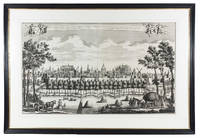
172891I90T01U79OAmsterdam 1728. Leonardus Schenk Framed 82.5 x 121 cm. Large engraved wall print on 2 sheets together 57.5 x 97 cm showing the Leiden city wall between the Koepoort and Zijlpoort with various windmills and prominent buildings in the background identified by name. The title appears in a banderole at the head with putti on either side holding the arms of Leiden and Holland. Leonardus Schenk's name appears as engraver and publisher at the right end of the banderole. Large view of the city of Leiden by the Amsterdam engraver and publisher Leonardus Schenk. The viewer observes the city from the south from between the city's Koe and Zijl gates. In the background several windmills and a few characteristic buildings are identified by name in the engraving including the university the library the Pieterskerk the Town Hall the Mare kerk the "Burcht" the fort and the Hooglandse kerk. On the quay outside the wall groups of people walk sporadically passed by small boats on the nearby city moat. In the foreground we see a typical Dutch landscape with grazing cattle farm workers a loaded hay cart and haystacks in the field. We know of several other wall prints by Schenk depicting local situations with almost photographic detail. Thanks to this detail important socio-historical aspects have been passed on to later generations giving these prints an important cultural meaning today. A few spots formerly folded otherwise in very good condition.l Overvoorde Catalogus van de prentverzameling der Gemeente Leiden 1906 no. 640; Waller Biogr. woordenb. Noord Ned. graveurs p. 287. unknown
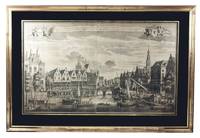
1728A2RGD4WT38YEAmsterdam: Leonardus Schenk 1728. In black passepartout and gilt frame 82 x 121 cm. Large engraved wall print on 2 sheets together 58 x 97 cm the sheets overlapping each other slightly showing the traditional business centre of the city of Leiden. The title both in Dutch and French is printed in a banderole at the head with putti on each side supporting the arms of Leiden and Holland. Leonardus Schenk's name appears as engraver and publisher at the right tip of the banderole. A large engraved wall print in two sheets showing the trading and commercial centre of the city of Leiden at the convergence of the Oude Rijn and Nieuwe Rijn canals. Unlike most other Dutch towns Leiden had no central market square so that the waterways formed the major access routes for merchandise. On the banks of the canals there is a lively market that converges on the bridge central in the print. Market traders and customers come and go. Women from the coastal fishing villages of Katwijk and Noortwijk display fresh fish for sale. Right in the print we see the monumental "Waag" the weigh-house built in 1658 following a plan by the Dutch architect and engraver Pieter Post. The splendid relief designed by Rombout Verhulst that crowns the entrance is reproduced with a sharp eye for detail. In front of the building commercial goods are hoisted up from carts and a number of ships for transport to the weigh-house. Several other ships had moored and now continue to their destination. A boat flying the Dutch flag brings in a prominent party while a herald standing precariously at the bow trumpets for right of way. We know of several other wall prints by Schenk depicting local situations with almost photographic detail. Thanks to this detail important socio-historical aspects have been passed on to later generations giving these prints an important cultural meaning today. With some faint foxing otherwise in very good condition.l Overvoorde Catalogus van de prentverzameling der Gemeente Leiden 1906 no. 964; Waller Biogr. woordenb. Noord Ned. graveurs p. 287. Leonardus Schenk, unknown
1797800171797. SHOEMAKER Abraham. Poulson's Town and Country Almanac for the Year of Our Lord 1797. Phila.: Zachariah Poulson 1796. 24 leaves. Disbound. Complete. Light uniform toning early owner's signature on titlepage else very good. Drake 10043. Evans 31189. ESTC W22814. A list of births and deaths in the several religious societies including the "Jewish or Hebrew Church" and the "African Episcopal Church" in the city of Philadelphia from August 1 1795 to August 1 1796."--p. 42. The calendar pages include a daily record of weather and temperature for 1795. unknown
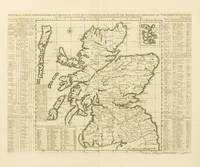
1719143633Amsterdam: L'Honoré et Chatelain 1719. Very Good. Amsterdam L'Honoré et Chatelain 1719. An engraved map printed surface 353 × 463 mm sheet size approximately 455 × 520 mm. Vertical centrefold crease as issued; a few faint spots; light creases and a few tiny closed tears about the edges well clear of the printed surface; a very good copy. From Chatelain's 'Atlas historique ou Nouvelle introduction à l'histoire à la chronologie & à la Geographie ancienne & moderne .'. With an inset map of the Orkney Islands. L'Honoré et Chatelain unknown
1717116<p>4° mm 230x168; ll. 6 pp. 400. Woodcut frontispiece and <strong>100 emblematic woodcuts</strong> each approx. 105×120 mm. Contemporary vellum binding. Small restorations to the title page and pp. 353–54. Overall a fine copy.</p><p>First edition in Italian the original title: <em>Huy und Pfuy der Welt</em> 1707.</p><p>A very interesting richly illustrated book by the Augustinian preacher Abraham a Sancta Clara https://en.wikipedia.org/wiki/Abraham_a_Sancta_Clara. The treatise is a kind of iconographic and textual compendium intended for use by the popular preacher. Its format of emblem commentary 'favola' enables a constellation of homiletic <em>exempla</em> to be committed to memory in keeping with a very ancient rhetorical and visual tradition cfr. L. Bolzoni <em>La rete delle immagini. Predicazione in volgare dalle origini a San Bernardino da Siena</em> Torino 2002.</p><p>"One of the greatest orators Germany has ever produced. People flocked to hear him drawn by the power and vivid clarity of his speech by the inexhaustible wealth of his wit and by the impartial severity with which he denounced the vices of all social classes. He poured his whole being into everything he said. Endowed with extraordinary creativity and inventive originality Abraham blended into his imaginative style fables short stories anecdotes erudite quotations witty sayings colourful and sometimes trivial wordplay sudden asperations personal recollections and vivid genre sketches with flashes of true eloquence—passionate fiery and vibrant. Even when he wrote he stood so to speak at the pulpit and saw his audience before him face to face" L. Bianchi.</p> Per Gio. Parone
1718102323<p> Newspaper 16" x 22" six columns of text 4 pp. Folded at center several tears and chips at folds and extremities some loss of text Lincoln text less affected some aging and browning and some uneven darkening ; in about fair condition overall for a newspaper from this period. Dated April 17 1865 this is a relatively early account of the Lincoln assassination. Most of the coverage is on the second and third pages of the newspaper. The articles include stories on the "death bed scene" the attacks on Secretary Seward and his son the national reaction and reports on those involved in the plot. Some interesting coverage of a national event in a local newspaper.</p>
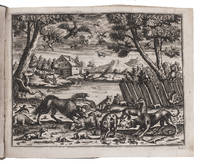
1709KAHFNW706ETUNürnberg 1709. 8vo. Johann Leonhard Buggel Contemporary but not uniform vellum sewn on 3 cords with a hollow back vol. I with dark blue edges with a manuscript title in Latin at the head of the spine: Tractatus de insectis aliisque animalibus nocivis extirpandis; vol. II with a manuscript title in German at the head of the spine: Von schadliechen Ungedierter Außrottung II. Each volume with a folding illustrated engraved title-page and a folding letterpress title-page a larger folding engraved plate in volume II woodcut tailpieces and decorated initials headpieces built up from typographic ornaments. Set in fraktur types with incidental Schwabacher and roman types. 2 volumes. 22 699 = 697 23; 38 944 48 pp. plus 2 folding letterpress title-pages and the 3 engravings. First edition rarely found complete of a detailed account of animals that are harmful to people and to their livestock the treatment of bites illnesses and poisonings they cause and instructions for their extermination. It covers animals on land in water in the air and underground. The large folding plate in vol. II shows 38 insects including 14 caterpillars and the two engraved title-pages for volumes I and II show well over 50 vol. I about 25 vol. II animals not counting a large group of ants and many birds in the distance in the former. The book also provides information about uses of the dead harmful animals for making clothes and medicines and includes many medicinal recipes. The animals discussed include wolves foxes mad dogs birds including birds of prey snakes frogs toads rats mice moles beetles caterpillars bed bugs lice fleas and other insects spiders snails and other molluscs various kinds of worms and even a dragon and basilisk the latter illustrated in the engraved title-page to volume I: it looks more cock-like than snake-like so most people would now call it a cockatrice but the two have long been used almost interchangeably. Krafft notes that dragons are rarely or never found in Germany but says one was found in Bohemia a few years ago and that they are more common in Nubia Libya and the largest ones in "Indien" probably meaning the East Indies and perhaps based on reports of the Komodo dragon.With an owner's inscription of Stefan von Clodt 1674-1737 Vicar General and Provost of Michaelsberg in Fulda on the title-page of vol. I. Somewhat browned vol. I only slightly and with an occasional small stain but still in good condition. The binding of vol. I is in very good condition with only a few small worm holes in the hinges; vol. II is rubbed and damaged lacking the lowest 3 cm of the backstrip. A very detailed source of information on animals regarded as pests from both a medical and a farming and gardening perspective.l Lindner Jagdliteratur 11.1171.01 & 11.1173.01; VD18 11041935 = 90643208 & 90643224; cf. Horn & Schenkling 12340 with 1713 ed. of vol. I. ABE CAT Agriculture hardcover
171963084[Basel], Gedruckt bey Johann Jacob Genath, (1719). 4°. Mit einigen Holzschn.-Vignetten. 48 S., Geheftet (ausgebunden).
1730378329Samuel Fuller; J. Peele 1730 1731. Full leather. Ex-library foxing. Full leather with raised bands. Boards are significantly bowed. The first title lacks title page and publisher and publication date unknown. 135 72 32 pages. Samuel Fuller; J. Peele hardcover
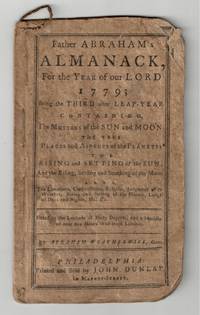
177927545Philadelphia: Printed and sold by John Dunlap 1779. A very early issue of a Weatherwise American Almanac. Illustrated with the well-known anatomical woodcut of a man “governed by the twelve constellations†and woodcut page frames. 12mo original printed self wrappers stitched. 15 leaves unnumbered including printed wrappers. A very well preserved little almanac the wrappers somewhat worn at the corners the rear with a little loss at the bottom outside corner some expected toning and mellowing to the paper and some spotting but complete and very usable and with the original stitching still strong and tight. AN EARLY WEATHERWISE ALMANAC and a competitor of Franklin's "Poor Richard". Abraham Weatherwise was of course a pseudonym and one which was likely used by multiple almanac printers. They “ushered in the healthiest and most interesting period of almanac making†Sagendorph 116.<br> Along with the typical astronomical data and weather forecasts this almanac also contains a table valuing the dollar humorous stories and historical tracts a collection of hints and home remedies for the care of horses court dates for Pennsylvania and New Jersey and a schedule for Quaker meetings. Printed and sold by John Dunlap unknown
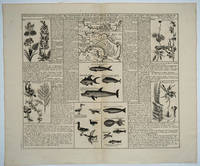
172125850Paris 1721. From the Australian point of view most interesting for the illustrations drawn from Dampier's explorations on the West Australian coast particularly the images of fish birds squid & plants the first images of Australian fauna & flora to be seen by the Western world.<br /> It includes extensive text describing the natural history found there in French. His account of the expedition was published as "A Voyage to New Holland" in 1703. Dampier is regarded by many as Australia's first natural historian. <br /> <br /> The three maps at the top of the plate are of the Isthmus of Darien and the Gulf of Panama. Size : 370x433 mm 14.57x17.05 Inches. Many of the maps are based on the work of Guillaume de l'Lisle.<br /> <br /> Published in Chatelain's "Atlas Historique ou nouvelle introduction a l'histoire a la chronologie & a la geographie ancienne & moderne" in Amsterdam 1721. Many of the maps are based on the work of Guillaume de l'Lisle.<br /> <br /> Copperplate engraving 14.5 x17". Full impression mark with wide margins. Some slight bends in margin fine overall. unknown
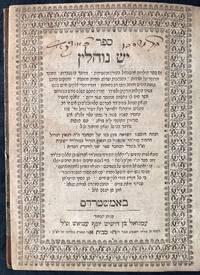
170143446Amsterdam: 'Imanu'el ben Yosef 'Atias 1701. 1st edition. Period Half Leather over Marbled Boards 8vo 2 46 leaves i.e. 4 92 pages 20 cm. In Hebrew.<br> By the father of the Holy Shela'h haKadosh.<br> <br> Ethical teachings and customs by the father of the holy Shelah with the will of his son Rabbi Shabtai Sheftel printed here for the first time<br> Sefer Yesh Nochalin a collection of ethical teachings conduct and laws by the Gaon and Kabbalist Rabbi Avraham HaLevi Horowitz father of the Ba'al Shelah HaKadosh with glosses and additions by his son Rabbi Yaakov Horowitz.<br> At the end of the book the will of Rabbi Shabtai Sheftel Horowitz son of the holy Shelah and grandson of the author was printed for the first time.<br> Rabbi Shabtai Sheftel HaLevi Segal Horowitz 1592-1660 son of Rabbi Yeshayahu HaLevi Horowitz is known for his book "Snei Luchot HaBrit." He was a rabbi and Rosh Yeshiva one of the greatest Ashkenazi Jewish scholars of his generation. He was a preacher in the Prague community and the rabbi of Fürth Frankfurt Poznan and Vienna. He edited his father's book "Snei Luchot HaBrit" and is known by the name of his own book "Vavei HaAmudim."<br> <br> SUBJECTS: Jewish ethics -- Early works to 1800. Morale juive -- Ouvrages avant 1800. Testaments moraux <br> OCLC: 9055147.Light rubbing to boards toning as expected a very attractive copy in original binding Very Good Condition. B Rab-67-15-KKXLB. Amsterdam: 'Imanu'el ben Yosef 'Atias unknown
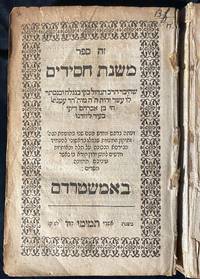
174042573Amsterdam: No Publisher Listed 1740. Hardback. 2nd edition. Period Vellum binding 12mo 132 leaves; 17 cm. In Hebrew. Mayer Sulzberger's copy with his bookplate. Like the Mishnah Mishnat Hasidim is arranged in "Sedarim" which are divided into "massechtot" and subdivided into "perakim." With an introduction entitled: Olam Katan. Includes index. Title-page has ornamental border. <br> Raphael Immanuel ben Abraham Hai Ricchi 1688-1743 was an "Italian rabbi cabalist and poet.After having studied Talmud under Nathan Pinkerle rabbi of Alessandria della Paglia Ricchi became tutor in the houses of several wealthy Jews. He was thus successively employed at Göritz Fiorenzuola Finale in Modena and Venice; in the last-named place he opened a school. He then went to Triest where he was ordained rabbi in 1717 by Hillel Ashkenazi rabbi of Canea after which he was invited to the rabbinate of Görz.<br> Owing to his great love for cabalistic studies and to his ascetic tendencies Ricchi resolved to settle in Palestine. He arrived at Safed in 1718 and during his stay there of two years he occupied himself with the study of the works of Isaac Luria and Hayyim Vital. He was also reordained rabbi by Hayim Abulafia. In 1720 an epidemic broke out in Palestine and Ricchi was compelled to return to Europe. <br> On the voyage he and all his fellow passengers were captured by pirates and brought to Tripolitza whence through the efforts of Abraham Halfon Ricchi and his family were allowed to return to Italy. He then occupied the rabbinate of Florence till 1723 in which year he removed to Leghorn where for twelve years he engaged in business as a merchant. He spent twenty months in travel visiting Smyrna Salonica Constantinople Amsterdam and London and in 1735 set out for Palestine spending two years at Aleppo and three at Jerusalem. In 1741 he returned to Leghorn and in 1743 while traveling in Italy for the purpose of selling his works he was killed by robbers who buried his body by the shore of the Reno. Six days later some Modena Jews discovered the remains and brought them to Cento for burial.<br> Ricchi's most important work is the above-cited 'Mishnat Hasidim' a cabalistic work begun in 1726 at Leghorn. <br> Like the Mishnah it is arranged in orders 'sedarim' which are divided into treatises 'massektot' and subdivided into chapters 'peraim' the names of the six Mishnah orders being taken in a cabalistic sense. But the chief divisions of the work are three termed 'mafteot' besides the introduction entitled ''Olam Kaon' = 'microcosmos' in which Ricchi endeavors to popularize the Cabala. <br> The first main division is the 'Maftea ha-'Olamot' in which the worlds are treated. It contains: 1 the order of Zera'im treating of the cabalistic cosmology and of metaphysics and divided into seven massektot and eighteen chapters; 2 the order Kodashim treating of the realm of emanation 'olam ha-azilut' which is styled 'the holy of holies' and containing twenty massektot and seventy-eight chapters; 3 the order ohorot treating of the three other realms namely those of creative ideas 'beri'ah' creative formations 'yezirah' and creative matter 'asiyah' and divided into nine massektot and twenty-seven chapters; and 4 the order Nezikin treating of the demons and 'kelifot' and divided into six massektot and seventeen chapters. <br> The second main division entitled 'Maftea ha-Neshamot' contains the order Nashim treating of souls in twelve massektot and forty-eight chapters. The third main division entitled 'Mafteah ha-Kawwanot' contains the order Mo'ed divided into fifty-eight massektot and 371 chapters and treating of the Kawwanah. It will be seen that the number of massektot in this work is 112 corresponding to the numerical value of the sacred name ; and the number of chapters 547 equal to the numerical value of Ricchi's name plus twelve the number of its letters. <br> The sources for this work besides the Zohar are mostly Isaac Luria's and Hayyim Vital's writings of which the 'Sefer ha-Gilgulim' 'Kanfe Yonah' and 'Shulhan 'Aruk' may be particularly mentioned. Ricchi drew also from other cabalists" M. Seligsohn in JE 1905.<br> NYU houses their copy in the Mitchell M. Kaplan Collection of Rare Judaica and Hebraica. Aviva Ben-Ur's Ladino catalog list #14. Judge Mayer Sulzberger "was closely associated with Isaac Leeser and assisted that scholar in editing The Occident contributing to it a partial translation of Maimonides' "Moreh Nebukim." After Leeser's death Sulzberger edited vol. xxvi. of The Occident. He was one of the founders of the Young Men's Hebrew Association which he served as president; and he has taken great interest in the Jewish Hospital of Philadelphia of which he has been vice-president since 1880. He was from the beginning in 1888 chairman of the publication committee of the Jewish Publication Society of America; was one of the original trustees of the Baron de Hirsch fund; and interested himself in the establishment of agricultural colonies at Woodbine N. J. and in Connecticut.Sulzberger had one of the best private libraries in America; it contained a very large number of Hebraica and Judaica" WIkipedia. SUBJECTS: Cabala -- Early works to 1800. Siddurim -- Texts. Judaism -- Ari rite -- Liturgy -- Kabbale -- Ouvrages avant 1800. Siddour -- Textes. Cabala. OCLC: 904949349. OCLC lists only 2 copies of this 1740 2nd edition worldwide NYU & Cambridge and only 3 copies of the first edition of 1727.<br> Boards slightly bowed with front hinge starting. Remains of 19th Century paper label on spine. Lacks front blank pastedown. Jewish institutional bookplate in addition to that of Sulzberger. Paper toning but strong. About Very Good- Condition. Attractive copy of early edition of an important cabalistic text. RAB-67-7. Amsterdam: [No Publisher Listed] unknown
176686149Fribourg - Paris : Imprim Fribourg et se trouve Paris chez Lottin le Jeune 1766. 190x110mm. XII- cartonnage moderne tranches non rognes. Indications bibliographiques sur le plat intrieur. 400 Imprim Fribourg et se trouve Paris chez Lottin le Jeune unknown