Feldman, Abraham JehielBiblio.com
"Words in Season""
1347180915.Ghardcover. Good. Access codes and supplements are not guaranteed with used items. May be an ex-library book. hardcover

Bonita · États-Unis50,96 $US≈ 43,12 €
26 503 résultats
1962S4443Offprint from:: Physical Review Letters Vol. 9 No. 3 August 1 1962. 1962. 267 x 200 mm. 4to. 117-120 pp. Self-wraps. Very good. Physical Review Letters, Vol. 9, No. 3, August 1, 1962. paperback books
1999S4437Offprint from:: Reviews of Modern Physics Vol. 71 No. 2 1999. 1999. 280 x 210 mm. 4to. S16-S24 pp. Self-wraps. Fine. Reviews of Modern Physics, Vol. 71, No. 2, 1999. paperback books
1957S4362Offprint from:: The Physical Review Vol. 106 No. 5 June 1 1957. 1957. 268 x 200 mm. 4to. 1106-1107 pp. Self-wraps. Fine. "Treiman and I were the first to note that the switch from C to CP importantly affects the 3p-decay modes of neutral K's however. Before long experiment confirmed our findings." Pais A tale of two continents p. 360. Mimeograph version at $ 4. The Physical Review, Vol. 106, No. 5, June 1, 1957. paperback books
1981S4420Offprint from:: Physical Review D Vol. 23 No. 2 15 January 1981. 1981. 279 x 216 mm. 4to. 469-472 pp. 1 fig. Self-wraps. Very good. Physical Review D, Vol. 23, No. 2, 15 January 1981. paperback books
1975S4405Offprint from:: Physical Review D Vol. 12 No. 2 15 July 1975. 1975. 278 x 216 mm. 4to. 508-512 pp. 1 fig. Self-wraps. Fine. Physical Review D, Vol. 12, No. 2, 15 July 1975. paperback books
1970S4453Offprint from:: The Physical Review D Vol. 1 No. 5 1 March 1970. 1970. 267 x 200 mm. 4to. 1349-1356 pp. Self-wraps. Fine. The Physical Review D, Vol. 1, No. 5, 1 March 1970. paperback books
1965S4456no place:: Submitted June 3 1965. 1965. 280 x 217 mm. 4to. i 15 ff. Mimeographed sheets. Self-wraps. Fine. Submitted June 3, 1965. paperback books
1963S4444Offprint from: Theoretical Physics. Vienna:: International Atomic Energy Agency 1963. 1963. 241 x 160 mm. 8vo. 593-618 pp. 8 figs. Printed wrappers. Very good. International Atomic Energy Agency, 1963. unknown books
1974S4399Offprint from:: Physical Review D Vol. 9 No. 5 1 March 1974. 1974. 279 x 216 mm. 4to. 1459-1467 pp. 1 table. Self-wraps. Very good. Physical Review D, Vol. 9, No. 5, 1 March 1974. paperback books
1347180915.Ghardcover. Good. Access codes and supplements are not guaranteed with used items. May be an ex-library book. hardcover
1980S4419Offprint from:: Physik und Didaktik 4 1980. 1980. 236 x 165 mm. 8vo. 300-324 pp. References. Printed wrappers. Fine. German-language edition of Pais' "Radioactivity's two early puzzles" originally published in Reviews of Modern Physics Vol. 49 No. 4 1977. Physik und Didaktik, 4, 1980. unknown books
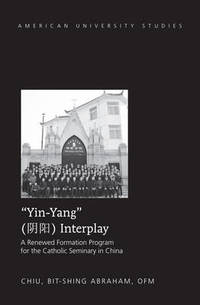
B9781433123207Hardback. New. "Yin-Yang" Interplay: A Renewed Formation Program for the Catholic Seminary in China puts the spotlight on the design of a renewed formation program for the Catholic seminary in China. hardcover
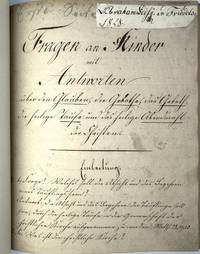
1828512100Self-Published 1828. Hardcover. VERY GOOD. 89 32pp. Two autograph manuscripts in fine longhand by Abraham Leisy. The first is a transcription of the Gerrit Roosen's Mennonite Catechism; the second text is a 32-page collection of pious tales. The books were bound together with a signature inlaid from a letter by Abraham Leisy and pasted to the title page of the first volume. Bound in black finished cloth with 'Biblische Fragen' stamped to the front cover. The FFEP bears a note by Leisy's sister Babette reading 'Babette Leisy. / Cleveland. / Dieses Buch brachte meinen topfchen Diana im Jahr 1895. von Deutschland Friedelsheim das hat alles Bruders Abraham Leisy geschrieben.' 'The Abraham and Katarina Leisy family emi grated to America in 1855 from Friedelsheim Germany. They settled on a farm outside of Donnellson Iowa. The Leisys were members of the West Zion Mennonite Church of Donnellson.' Mennonite Life April 1976. Abraham's sons notably founded the Leisy Brothers' 'Union Brewery' in 1862 in Keokuk Iowa. When the state of Iowa banned manufacture of alcoholic beverages in 1884 the brewery was moved to Peoria Illinois and renamed 'Leisy Brewing Company' a major regional beer producer and known as the last Mennonite-operated brewery in the U.S. Self-Published hardcover
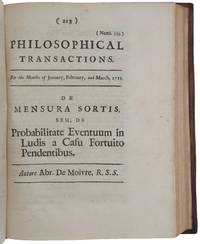
17126431London: Printed for H. Clements . and W. Innys . and D. Brown 1712. First edition. <p>First edition published in the Philosophical Transactions and de Moivre's first published work on probability-the earliest original contribution to the subject to appear in Britain. This pioneering paper laid the groundwork for his later masterpiece The Doctrine of Chances 1718 the definitive English-language textbook on probability theory for over a century. As Hald notes "Nearly all of De Mensura Sortis was later incorporated into The Doctrine of Chances . the most important textbook on probability theory until the publication of Laplace's Théorie Analytique des Probabilités 1812."</p>. <p>THE FOUNDATION OF THE DOCTRINE OF CHANCES</p> . <p>First edition contained in a complete volume of the Phil. Trans. of de Moivre's first published work on probability and the first original work on the subject published in Britain a precursor to his Doctrine of Chances which appeared seven years later. "De Moivre's work on the theory of probability surpasses anything done by any other mathematician except Laplace. His principal contributions are his investigations respecting the Duration of Play his Theory of Recurring Series and his extension of the value of Daniel Bernoulli's theorem by the aid of Stirling's theorem" Cajori p. 245. "The only systematic treatises on probability printed before 1711 were Huygens' De ratiociniis in ludo aleae 1657 and Pierre Rémond de Montmort's Essay d'analyse sur les jeux de hazard 1708. Problems which had been posed in these two books prompted de Moivre's earliest work and incidentally caused a feud between Montmort and de Moivre on the subject of originality and priority" DSB. "Nearly all of De Mensura Sortis was later incorporated into de Moivre's book The Doctrine of Chances 1718 1738 1756 which was the most important textbook on probability theory until the publication of Laplace's Théorie Analytique des Probabilités 1812. In the preface de Moivre states that he began his work on probability theory at the exhortation of Francis Robartes who asked him to solve the division problem for two gamesters playing bowls and also to find the probability of getting certain given faces as the outcome of a given number of throws with a die. He also states that he had previously read the books by Huygens and Montmort 'but these distinguished gentlemen do not seem to have employed that simplicity and generality which the nature of the matter demands.' Furthermore he writes that 'while they suppose that the skill of the gamesters is always equal they confine this doctrine of games within limits too narrow.' Finally his remarks about Montmort may be read as if Montmort had used only the method of Huygens on some new examples. These rash remarks naturally provoked a dispute with Montmort" Hald 1984 pp. 230-1. "The most remarkable of de Moivre's contributions in De mensura sortis are his derivation of the ruin probability in Huygens' fifth problem; his use of the Poisson approximation to solve the binomial equation Bc n p = ½ with respect to n; his solution of the occupancy problem by means of the method of inclusion and exclusion and the algorithm for the continuation probability in the duration of play for the ruin problem. Furthermore he gives without proof the probability of getting a given number of points by throwing any given number of dice and the probability of ruin when one of the players has infinitely many counters. The only contemporary evaluation of these impressive results is the critical review given by Montmort in a letter of 5 September 1712 to Nicholas Bernoulli about a month after Montmort had received a copy of the paper from de Moivre . Montmort recognizes de Moivre's priority to the Poisson approximation to Robartes' problem and to the algorithm for finding the continuation probability in the problem of the duration of play" Hald 2003 pp. 403-4. No copies in auction records.</p> <br /> <p>Provenance: Toft Hall in Cheshire England seat of the Leycester family since the 14th century bookplate on front paste-down.</p> <br /> <p>De Moivre's interest in probability was awakened by Francis Robartes 1649-1718 Member of Parliament and scion of an aristocratic family. In 1692 Robartes wrote a manuscript on two probability problems that he presented to the Royal Society but never published and in the following year he succeeded in publishing another paper on probability. In 1710 Robartes helped John Harris with his article entitled "Play" in Harris's scientific dictionary Lexicon Technicum. Robartes devised an algorithm that Harris used to extract the appropriate terms in a binomial expansion in order to solve the problem of the division of stakes. At some point over the years 1708 to 1710 Robartes received a copy of Montmort's Essay which he showed to de Moivre. He also gave de Moivre three challenge problems of his own devising to work on. "Once de Moivre had solved the first problem within a day of Robartes posing it Robartes gave de Moivre the other two problems to work on while at the same time encouraging him to write on probability. The encouragement proved fruitful. De Moivre finished his manuscript on probability during a holiday that he spent at a country house possibly Robartes's. On June 11 1711 de Moivre submitted his manuscript to the Royal Society. The Society's Journal Book quietly marked the beginning of a new era for probability in England with the note 'Mr. De Moivre presented a Treatise Intituled de Probabilitate Eventum in Ludo Alea This Treatise was Ordered to be printed in the Transactions.' The treatise with the title De Mensura Sortis or 'Of the measurement of lots' comprises an entire issue Number 329 of Philosophical Transactions. At 52 journal pages it is more than three times longer than anything else de Moivre had written to that date" Bellhouse p. 70.</p> <br /> <p>De Moivre begins De Mensura Sortis with two basic definitions from which many of his results are derived. The first comes directly from Huygens's De ratiociniis. For two players A and B contending for a stake of value a A has p chances to win and B has q. The expected value for each player follows what Huygens obtained: ap/ p q for A and aq/ p q for B. The second definition may have come from Edmond Halley or Francis Robartes. If an event can happen in p ways and fail to happen in q and a second event can happen in r ways and fail to happen in s then all the chances for events happening or failing are in the product p qr s or pr qr ps qs. For example pr is the number of ways both events can happen and ps is the number of ways that the first event happens and the second fails. This is the approach that Halley used in evaluating joint life annuities in his 1693 paper on mortality data from the city of Breslau .</p> <br /> <p>"De Moivre finishes the introduction by saying that if the first event is repeated n times then the total number of chances in the game is given in the binomial expression p qn. When this expression is expanded it may be written as a sum containing terms of the form piqn-imultiplied by an appropriate coefficient where i represents the number of times the event happens and n - i represents the number of times it fails the sum of the first c terms of this expansion is denoted Bc n p . The binomial expansion becomes the motif for the paper . At the beginning nine of the first ten problems there are some simple variations on the use of the expansion of p qn and then at the end the last seven problems the expansion is used to solve a very complex problem the problem of the duration of play. In the middle there are several solutions to a number of challenge problems taken from various sources including the three from Robartes" Bellhouse p. 73.</p> <br /> <p>Problems 1 3 and 4 are relatively straightforward applications of the binomial distribution. Problem 1 is to find the chance of throwing an ace two or more times in 8 throws with a single die. Problem 3 is to determine the chances of A and B winning a single game supposing that A can give B two games out of three. Problem 4 is similar.</p> <br /> <p>In problems 5 to 7 de Moivre considers the problem of finding the number of trials that gives an even chance for getting at least one success but fewer than some given number of successes c say. This means he has to solve the equation Bc - 1 n p = ½ for n when c and p are given. De Moivre considers the two extreme cases p = ½ and p tends to 0 of which the first is easy by symmetry. De Moivre shows that as p tends to 0 Bc - 1 n p tends to e-mmultiplied by the sum of the first c terms in the series expansion of em in powers of m where m = np/1 - p de Moivre was not able to express the result this way because our notation for the exponential function had not yet been invented. This result the 'Poisson approximation' to the binomial distribution played a very important role in later developments. "There has been some discussion of whether it is reasonable to contend that de Moivre found the Poisson distribution" Hald 1984 p. 231 more than a century before Simeon-Denis Poisson. </p> <br /> <p>Problems 2 3 4 and 10 are on the division of stakes or 'problem of points'. "Consider a series of games with two players A and B where in each game A has probability p and B probability q = 1 - p of winning a point. If play stops when A lacks a points and B lacks b points in winning how should the stake be divided between them De Moivre proves that A's probability of winning equals the sum of the last b terms of the expansion of p qab-1 and B's probability of winning equals the remaining a terms. This result had already been derived by Johann Bernoulli in 1710 in a letter to Montmort but it was not published until 1713 . In Problem 8 de Moivre generalizes to k players say and gives the solution as the sum of the appropriate terms of the multinomial pl p2 . pknl-k n being the total number of points lacking. He points out that certain terms have to be divided among the players depending on the permutation of the p's.</p> <br /> <p>"In Problems 16 and 17 he gives the solution of Robartes's problem: the division problem for two gamesters playing bowls. In each game B say gets a number of points equal to the number of his bowls which is nearer to the jack than any of A's bowls. By combinatorial methods de Moivre finds the probability of getting i points in a single game assuming that the players have the same number of bowls and are of the same skill. The division problem is then solved by recursion" Hald 1984 pp. 231-2.</p> <br /> <p>Problems 11 12 and 13 are related to the first two of the five problems Huygens posed at the end of his De ratiociniis. "In these problems the players take turns in a specified order until one of them wins. De Moivre gives the solution as the sum of an infinite series" ibid. p. 232.</p> <br /> <p>Problem 15 is 'Waldegrave's problem' James Waldegrave 1684-1741 later the first Earl Waldegrave was a British diplomat living in Paris who himself published nothing in mathematics. "Let there be n 1 players A1 . An1 of equal skill. Players A1 and A2 play a game and the loser pays a crown to a common stock and does not enter the play again until all the other players have played; the winner plays against A3 and the loser pays a crown to the stock and so on. If the winner of the first game beats all the rest the play is finished; if not the play goes on each player coming in again in turn until one player has beaten in succession all the other players and he then receives all the money in the stock.<br /> The problem is to determine</p> <br /> <br /> the probability of each player winning the stock;<br /> the expectation of each player; and<br /> <br /> the probability of a given duration of the play.<br /> <br /> <p>"In a letter to Bernoulli of I0 April 1711 Montmort writes that the problem has been proposed to him and also solved by Waldegrave for three players. Independently de Moivre formulated and solved the problem for three p1ayers in De Mensura Sortis 1712" Hald 2003 p. 378. "De Moivre solves this problem by means of conditional expectations. First he supposes that A beats B in the first game. On this assumption the play may end with A as winner in the second fifth eighth . game. The probabilities of A for reaching these games and winning are ½ ½4 ½7 . Hence the expected stake plus fines may be found and subtracting A's expected fine his conditional expectation results. Under the same assumption B's expectation is obtained. The unconditional expectation is then found as the average of the two conditional expectations" Hald 1984 p. 232.</p> <br /> <p>Problems 18 and 19 are 'occupancy problems' the third type of problem posed to de Moivre by Robartes: Find the probability pn that f specified faces occur at least once in n throws with a die having k faces. De Moivre calculates pn by means of the method of 'inclusion and exclusion'. In Problem 19 he solves the equation pn = ½ under the assumption that f is small compared to k.</p> <br /> <p>Problem 9 is a generalization of the 'gambler's ruin problem' the fifth of Huygens's problems in De ratiociniis. "Consider two players A and B having a and b counters respectively. In each game A has probability p and B has probability q = 1 - p of winning and the winner gets a counter from the loser. The play continues until one of the players is ruined. What is the probability of A being ruined Huygens's fifth problem is obtained for a = b = 12" ibid. Problems 20-26 are a continuation of the discussion of the ruin problem: what is the probability that the play ends at the nth game or before Problem 25 is the case when A has infinitely many counters; de Moivre states the result without proof.</p> <br /> <p>"Although the publication date is given as 1711 De Mensura Sortis was not in print until 1712. Shortly after its publication de Moivre sent copies of the issue to several people in England including Edmond Halley Isaac Newton and de Moivre's fellow chess player at Slaughter's Coffeehouse the Earl of Sunderland. De Moivre's friend Pierre des Maizeaux handled several copies that were bound for the Continent. Using his connections in the Republic of Letters des Maizeaux sent copies of De Mensura Sortis to Abbé Jean-Paul Bignon at that time the French minister of state with responsibility for the Académie Royale des Sciences. Bignon wrote to des Maizeaux on September 24 1712 saying that the copies he received had been distributed. He also enclosed a letter from Montmort to de Moivre thanking him for his treatise; the letter has not survived. Whatever he thought personally about de Moivre's treatise Montmort was adhering to the code of civility in the Republic of Letters by sending the letter of thanks. Other people on the Continent receiving copies were Nicolaus Bernoulli Johann Bernoulli and Pierre Varignon. Johann Bernoulli received his copy via William Burnet a younger son of Gilbert Burnet Bishop of Salisbury; Bernoulli had asked Burnet to obtain a copy for him" Bellhouse p. 71.</p> <br /> <p>Abraham Moivre stemmed from a Protestant family. His father was a surgeon from Vitry-le-François in the Champagne. From the age of five to eleven he was educated by the Catholic Péres de la doctrine Chrètienne. Then he moved to the Protestant Academy at Sedan were he mainly studied Greek. After the latter was forced to close in 1681 for its profession of faith Moivre continued his studies at Saumur between 1682 and 1684 before joining his parents who had meanwhile moved to Paris. At that time he had studied some books on elementary mathematics and the first six books of Euclid's elements. He had even tried his hand at Huygens' 1657 tract without mastering it completely. In Paris he was taught mathematics by Jacques Ozanam who had made a reputation from a series of books on practical mathematics and mathematical recreations. Ozanam made his living as a private teacher of mathematics. He had extended the usual teachings of the European reckoning masters and mathematical practitioners by what was considered fashionable mathematics in Paris. Ozanam enjoyed a moderate financial success due to the many students he attracted. It seems plausible that young Moivre took him as a model he wanted to follow when he had to support himself. After the revocation of the Edict of Nantes in 1685 the Protestant faith was no longer tolerated in France and hundreds of thousands of Huguenots who had refused to convert to Catholicism emigrated to Protestant countries. Amongst them was Moivre who arrived in England in 1687. There he began his occupation as a tutor in mathematics. He also added a 'De' to his name probably because he wanted to take advantage of the prestige of a pretended noble birth in France in dealing with his clients many of whom were noblemen. An anecdote from this time which goes back to de Moivre himself tells that he cut out the pages of Newton's Principia of 1687 and read them while waiting for his students or walking from one to the other - the main function of this anecdote was to demonstrate that de Moivre was amongst the first true and loyal Newtonians and that as such he deserved help and protection in order to gain a better position than that of a humble tutor of mathematics. In 1692 de Moivre met with Edmond Halley and shortly afterwards with Newton. Halley ensured the publication of de Moivre's first paper on Newton's doctrine of fluxions in the Philosophical Transactions for 1695 and saw to his election to the Royal Society in 1697. Newton's influence concerning university positions in mathematics and natural philosophy persuaded de Moivre to engage in the solution of problems posed by the new infinitesimal calculus. In 1697 and 1698 he published the polynomial theorem a generalization of Newton's binomial theorem together with application in the theory of series. In 1704 de Moivre began a correspondence with Johann Bernoulli but Bernoulli's letters showed de Moivre that he lacked the time and perhaps the mathematical power to compete with a mathematician of this calibre in the new field of analysis. De Moivre ceased his correspondence with Bernoulli after he was made a member of the Royal Society commission to adjudicate in the priority dispute between Newton and Leibniz over the invention of calculus - continuing the correspondence may have made him appear disloyal to the Newtonian cause. When the Lucasian chair in mathematics at Cambridge was given in 1711 on Newton's recommendation to Nicholas Saunderson de Moivre realized that this only option was to continue his occupation as a tutor and consultant in mathematical affairs in the world of the coffee houses where he met his clients; additional income he could draw from the publication of books and from translations. He therefore turned to the calculus of games of chance and probability theory which was of great interest for many of his students and where he had few competitors in England.</p> <br /> <p>Hald 'A. de Moivre: De Mensura Sortis or On the Measurement of Chance' International Statistical Review 52 1984 pp. 229-262. Hald History of Probability and Statistics and their Applications before 1750 2003. Bellhouse Abraham de Moivre 2011. Cajori A History of Mathematics 1894.</p> <br/> <br/> 4to 218 x 168 mm pp. vi 555 with 13 plates a little browning and foxing. Contemporary calf sides decorated in blind with corner fleurons a little rubbed joints starting spine label mostly missing. A handsome copy with no restoration. Printed for H. Clements ... and W. Innys ... and D. Brown unknown
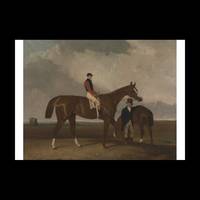
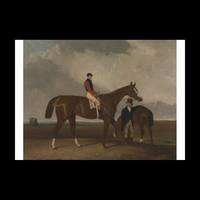
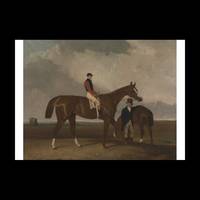
382795Contentum Ltd. Loose sheet. New. High-quality art print based on an original work from the Ycba. Created in the 19th century between 1836 and 1837. Professionally printed on premium fine-art paper Photo Rag 308 in size A2. The artwork is printed with a white border museum-style presentation. Contentum Ltd. unknown
382797Contentum Ltd. Loose sheet. New. High-quality art print based on an original work from the Ycba. Created in the 19th century between 1836 and 1837. Professionally printed on premium fine-art paper Museum Etching museum quality in size A2. The artwork is printed with a white border museum-style presentation. Contentum Ltd. unknown
382796Contentum Ltd. Loose sheet. New. High-quality art print based on an original work from the Ycba. Created in the 19th century between 1836 and 1837. Professionally printed on premium fine-art paper Photo Rag Bright White premium quality in size A2. The artwork is printed with a white border museum-style presentation. Contentum Ltd. unknown
382794Contentum Ltd. Loose sheet. New. High-quality art print based on an original work from the Ycba. Created in the 19th century between 1836 and 1837. Professionally printed on premium fine-art paper Museum Etching museum quality in size A3. The artwork is printed with a white border museum-style presentation. Contentum Ltd. unknown
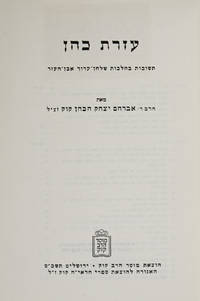
196917948Jerusalem: Mossad Ha-Rav Kook 1969. Hardcover. vg. Small 4to. 485pp Hebrew pagination. 1/4 leather over brown cloth in original dust jacket. Ex-libris Rabbi Isaac David Essrig author of "The fountain of wisdom". Work by Rav Cook one of the most influential Rabbis of what now is considered "religious Zionism" see below. The topic of this book is the "Even Ha-'Ezer" - section of the "Shulkhan ha-Arukh" that deals with personal law marriage divorce sexual conduct etc. The "Shulkhan ha-Arukh" a.k.a. Shulchan Aruch meaning "set table" is the most authoritative compilation of Halakha Jewish Law.<br /> Staining and minor tears to dj. Age wear to binding. Inside clean and tight. In Hebrew. Very good condition. On the author from a public domain online encyclopedia: <br /> Abraham Isaac Kook 1864 - 1935 was the first Ashkenazi chief rabbi of the British Mandate for Palestine the founder of the now Religious Zionist "Yeshiva Merkaz HaRav" and a renowned Torah scholar. He was a master of Halakha in the strictest sense while at the same time possessing an unusual openness to new ideas especially in regards to the settling of Eretz Yisrael. This drew many religious and non-religious people to him but also led to widespread misunderstanding of his ideas. He wrote prolifically on both Halakha and Jewish thought and his books and personality continued to influence many even after his death in Jerusalem in 1935. Mossad Ha-Rav Kook hardcover
25629‘Temple May 26’ no year. The interesting context of the present item is explained in a quotation from Antony Chessell’s 2009 biography of Hayward subtitled ‘one of the Two Best Read Men in England’ - the other was Macaulay subjoined to this entry. See also the entries for Hayward and Lewis in the Oxford DNB. 4pp 12mo. Bifolium. Sixty lines of text. In good condition lightly aged. Folded for postage. Addressed to ‘My dear Lewis’ and signed ‘A. Hayward’. He begins by expressing regret that ‘any misapprehension has arisen from the introduction of Sir J Graham’s name in the Memorandum. It certainly was not our intention to reiterate or revive directly or indirectly any charge against anyone. Sir R. Peel Sir J. Walsham & Mr Nott were involved in the charges as well as Sir J. Graham and yourself but as you are the sole prosecutor we to confine the arrangement exclusively to you.’ He continues on the same theme with reference to ‘Sir F. Thesiger’ ‘Charles Greville’ ‘the Adjutant General Macdonald’ ‘Lord John Manners’. Postscript: ‘I told you that Ferrand expressed himself perfectly satisfied and that there is not the remotest chance of his reviving the matter.’ The subject of the letter is Tory MP William Busfeild Ferrand 1809-1889. Chessell explains: ‘Two letters by Ferrand in The Times in August 1844 accused Sir James Graham Home Secretary under Sir Robert Peel from 1841 until 1846 and George Lewis of conspiring to produce a false report designed to discredit him as chairman of the Keighley Board of Guardians. This prompted Lewis to consider legal action but many other matters intervened and the final incentive to do so was only triggered in 1847. / ‘The Queen v. Ferrand Esq. M.P.’ was due to be heard in the Hilary Term between January and March 1847 but the trial was delayed to await Ferrand’s plea. In response Lewis denied any conspiracy between himself and Graham. Abraham Hayward who was not part of Lewis’s legal team then acted as an intermediary in persuading Ferrand to retract his letters. With Hayward acting for Lewis and Lord John Manners acting for Ferrand a statement was inserted in The Times on November 18th 1847 to include a formal memorandum in which Mr. Ferrand recognised that he had acted in haste and expressed regret that he had done so.’ ‘Temple May 26’ [no year]. unknown
25628‘Temple May 26’ no year. See Antony Chessell’s 2009 biography of Hayward subtitled ‘one of the Two Best Read Men in England’ - the other was Macaulay along with his entry and Lady Theresa Lewis's in the Oxford DNB. 2pp 12mo. In good condition lightly aged and folded for postage. Addressed to ‘Dear Lady Theresa’ and signed ‘A Hayward’. He begins by confirming a visit. ‘I sent you a little book to-day which has at least the merit of rarity as only fifty copies have been printed.’ ‘Temple May 26’ [no year]. unknown
66150-A-59619Janssoons van Waesberge Amsterdam 1734. Halfperkamenten bandjes met handgeschreven rugtitel gemarmerde platten. 155x105 cm. Eerste deel met frontispice titelpagina in rood en zwart. 309 1; 424 p. -Platten licht sleets en wat verkleurd maar al met al in prima conditie. Janssoons van Waesberge, Amsterdam, 1734 unknown
1983213523New York: Oxford University Press 1983. First Paperback Edition; First Printing. Softcover. Near Fine in wraps. Oxford University Press unknown
1982652583Oxford: Clarendon Press 1982. 1st Edition 1st Printing. Hardcover. Near Fine/Very Good. 552 pages in near fine condition. Pages are clean and unmarked. Previous owner's stamp and seal on the ffep. Bound in dark blue cloth with gilt titles on the spine. White dustjacket in very good condition with black and red titles. Lightly worn around the edges. Lightly scuffed. 1ST PRINTING. NPC. NF/VG <br/> <br/> Clarendon Press hardcover
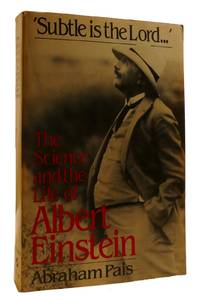
198276386New York: Oxford University Press 1982. Presumed First U. S. Edition First printing. Hardcover. Very good/Good. xvi 552 8 pages. Frontis illustration. Footnotes. Appendices. Einstein Chronology. Name Index. Subject Index. DJ has wear tears soiling and chips. Abraham Pais May 19 1918 - July 28 2000 was a Dutch-born American physicist and science historian. Pais earned his Ph.D. from University of Utrecht just prior to a Nazi ban on Jewish participation in Dutch universities during World War II. When the Nazis began the forced relocation of Dutch Jews he went into hiding but was later arrested and saved only by the end of the war. He then served as an assistant to Niels Bohr in Denmark and was later a colleague of Albert Einstein at the Institute for Advanced Study in Princeton New Jersey. Pais wrote books documenting the lives of these two great physicists and the contributions they and others made to modern physics. He was a physics professor at Rockefeller University until his retirement. During World War II Pais's doctoral dissertation had attracted the attention of Niels Bohr who invited him to come to Denmark as his assistant. Pais was forced into hiding before he could leave the Netherlands. In 1946 following the war Pais was able to accept that invitation and served as a personal assistant to Bohr at his country home in Tisvilde for a year. In 1947 he accepted a position at the Institute for Advanced Study in the United States and thus became a colleague of Albert Einstein. "Subtle is the Lord—" won the 1983 U.S. National Book Award in Science. Since the death of Albert Einstein in 1955 there have been many books and articles written about the man and a number of attempts to "explain" relativity. Throughout the preparation of this book Pais has had complete access to the Einstein Archives and the invaluable guidance of the late Helen Dukas--formerly Einstein's private secretary. Written with Pais' intimate and incomparable knowledge of Einstein Subtle is the Lord will delight and inspire anyone fascinated by the man whose revolutionary ideas have defined modern physics. Subtle is the Lord is widely recognized as the definitive scientific biography of Albert Einstein. Pais was a distinguished physicist turned historian who knew Einstein both professionally and personally in the last years of his life. His biography combines a profound understanding of Einstein's work with personal recollections from their years of acquaintance illuminating the man through the development of his scientific thought. Pais examines the formulation of Einstein's theories of relativity his work on Brownian motion and his response to quantum theory with authority and precision. The profound transformation Einstein's ideas effected on the physics of the turn of the century is here laid out for the serious reader. Pais also fills many gaps in what we know of Einstein's life - his interest in philosophy his concern with Jewish destiny and his opinions of great figures from Newton to Freud. This remarkable volume written by a physicist who mingled in Einstein's scientific circle forms a timeless and classic biography of the towering figure of twentieth-century science. Albert Einstein 14 March 1879 - 18 April 1955 was a German-born theoretical physicist widely acknowledged to be one of the greatest physicists of all time. Einstein is best known for developing the theory of relativity but he also made important contributions to the development of the theory of quantum mechanics. Relativity and quantum mechanics are together the two pillars of modern physics. His mass-energy equivalence formula E = mc2 which arises from relativity theory has been dubbed "the world's most famous equation". His work is also known for its influence on the philosophy of science. He received the 1921 Nobel Prize in Physics "for his services to theoretical physics and especially for his discovery of the law of the photoelectric effect" a pivotal step in the development of quantum theory. His intellectual achievements and originality resulted in "Einstein" becoming synonymous with "genius" Oxford University Press hardcover