773 résultats
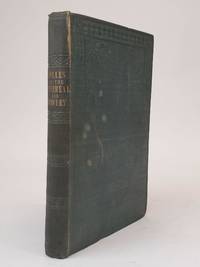
18602741Columbus: Follett Foster and Company 1860. First edition. Original publisher's cloth binding with some rubbing to spine and extremities. First issue with all points as called for by Monaghan no line over the publisher's slug on title verso and the number 2 at the foot of page 17. Collates viii 268 pages: lacking front endpaper else complete. Some light scattered foxing as is common in American imprints of this era but in all a tight pleasing copy of this book documenting an important moment in American politics.<br/><br/>Documenting Lincoln and Douglas' rivalry for the 1858 U.S. Senate race this title captures an important moment of flux for American politics. Just beginning his political career the young Lincoln earned the Republican nomination right as the party was forming; and he already had proven himself "a leading figure because of his adroit and earnest dealing with the problem of slavery" Oxford Companion. One of his great strenghts was his eloquence -- something Lincoln put on full display in these debates against Douglas including the utterance of one of his most memorable lines that "A house divided against itself cannot stand." Though Lincoln lost the Senate in 1858 he had managed to develop a national reputation and in 1860 the year of this book's release would win the Presidency.<br/><br/>Monaghan 69. Follett, Foster and Company unknown books
1860RLINPOL00LRFollett Foster and Company 1860. Good. Lincoln Abraham and Stephen Douglas. Political Debates between Hon. Abraham Lincoln and Hon. Stephen A. Douglas in the Celebrated Campaign of 1858 in Illinois. Columbus Ohio: Follett Foster and Company 1860. Early printing: 2nd 3rd or 4th. 268pp. 8vo. Book condition: Good with moisture damage to covers and endsheets and light soiling to covers. Edges are rubbed slightly exposing boards at corners. Uniform foxing to text block with old library stamps on edges of text block and rear pastedown. Follett, Foster, and Company hardcover books
1860116741Columbus: Follett Foster and Company 1860. First edition second issue with the Table of Contents on page ii of "the most important series of American political debates" Howes L338. Octavo original publisher's brown cloth with gilt titles to the spine and elaborate blind stamping to the front and rear panels. In very good condition. Ownership name. Although the debates were originally performed during the Illinois Senatorial race in 1858 they were published when both men became presidential candidates in 1860. Douglas won the race for senator but the debates were his undoing in the presidential race as Lincoln reminded voters repeatedly of the inconsistency between Douglas' principle of "popular sovereignty" in which the new territories would individually determine the status of slavery and the Dred Scott decision in which the Supreme Court declared that slavery would not be excluded from the territories by Congress. As a result Douglas was too tolerant of slavery for many northerners and not vigorous enough for Southern Democrats. Somewhat surprisingly for an attorney Lincoln did not seek Douglas' permission to publish a book of their combined speeches although Douglas was later given the last-minute opportunity--he declined--to make corrections to his own remarks" Morris 121. Follett, Foster and Company hardcover books
186125613<p>An unusual and possibly unique Lincoln portrait above patriotic banners and a quotation from his first inaugural address.</p> <b>ABRAHAM LINCOLN. GABRIEL KAEHRLE.</b>Print. "Abraham Lincoln" with excerpt from First Inaugural Address ca. 1861-1864. 9¾ x 12 in.<p><b><br /></b></p><p><b>Complete Transcript</b></p><p> <i>ABRAHAM LINCOLN</i></p><p><i> SIXTEENTH PRESIDENT OF THE UNITED STATES</i></p><p><i>"In your hands my dissatisfied fellow-countrymen and not in mine is the momentous issue of Civil War. You have no oath registered in heaven to destroy the Government while I have the most solemn one to 'preserve protect and defend it.' The mystic chords of memory stretching from every battle-field and patriot-grave to every living heart in this broad land will swell the chorus of the Union when again touched as surely they will be by the better angels of our nature."</i></p><p><i>Extract from the closing paragraph of Lincoln's Inaugural Message March 4 1861.</i></p><p>A lithograph of this same Lincoln image retaining Kaehrle's signature was used in a jugate 1864 campaign illustration of Lincoln and Andrew Johnson published by H. H. Lloyd & Co. in New York.</p><p><b>Gabriel Kaehrle</b> is listed in an 1857 New York directory as an engraver and he illustrated books which were published in New York in 1860 and 1862.</p><p>Very rare and possibly unique. None in OCLC and no other examples traced.</p><p><b>Condition</b></p><p>Staining to edges shadow of former matting; professionally conserved.<br /></p> books
1896262839Chicago: Scott Foresman 1896. hardcover. good. Plates. viii 555pp. 2pp. of publisher's ads. 8vo maroon cloth lacks front flyleaf inner hinges strengthened spine sunned top margins lightly creased on pages 51-56 page 101 lightly soiled. Chicago: Scott Foresman 1896.<br/><br/> "Historically the most important series of American political debates." Howes L-338. Later edition of Monaghan I 69.<br/><br/> Scott, Foresman unknown books
1895RLINPOL00DGScott Foresman & Company 1895. Very Good. Lincoln Abraham. Political Speeches and Debates of Abraham Lincoln and Stephen A. Douglas 1854-1861. Douglas Stephen A. 1895: Scott Foresman & Company 1895. 555pp. Indexed. 8vo. Burgundy cloth with gilt titles on spine. Book condition: Very good; gentle bumping to edges; former owner's name written faintly on the front pastedown; endsheets split at hinges but hinges are sturdy and tightly bound with clean pages. Scott, Foresman & Company hardcover books
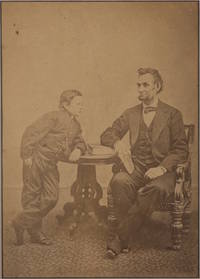
186632820664<br />Perhaps the most delightful of the Lincoln family photographs this portrait shows an impish Tad leaning on a table as his seemingly bemused father sits on Gardner's studio chair. Thomas "Tad" Lincoln was the youngest of the Lincoln boys.<p>Abraham Lincoln an indulgent father let his children run wild at his law offices and at the White House. His law partner William H. Herndon recounted "I have felt many and many a time that I wanted to wring their little necks and yet out of respect for Lincoln I kept my mouth shut. Lincoln did not note what his children were doing or had done."Lincoln sat for this portrait at Alexander Gardner's studio on February 5 1865. Just a month later he delivered the Second Inaugural Address and within weeks he was assassinated. It would be his final sitting for Gardner who made five poses that day. This fine portrait does not show the heavy retouching evident in later prints</p><p>By this date the end of the Civil War seemed to be drawing near. The war years had taken a heavy toll on Lincoln and on the nation. Horace Greeley observed "his face was haggard with care and seamed with thought and trouble. It looked care-ploughed tempest-tossed and weatherbeaten."</p><p>Albumen print 14 x 10 in. card mount. Minimal wear and fading two spots at the upper left. Good tones. An excellent photograph. Framed.</p><p>Ostendorf <i>Lincoln's Photographs</i> O-114.</p><p><b>This fine portrait is the largest example we have seen and a scarce survival showing Lincoln as a loving father.</b></p><br /> Gardner
18370003681837. 1st American Edition . Hardcover. Good/None. This volume comprises 2 books in one. It is a first edition bound in good leather with gilt stamping and lettering. It would be excellent except the title label is loose. The boards are worn a little at the edges and corners as are the spine ends and there is a crack in the leather front hige at the top about 1" long. The hinges are however tight. Bright mable end papers with matching page edges. There is a book plate of Henry Tweedy m MD inside the cover.The pages are clean and bright. There is a two page color print at the end of book one. That text is 351 pages. The second text by Richard Carmichael Clinical Lectures on Venereal Disease is 219 pages. published in 1942.no markings. The book seems to have been bound as a presntation copy. a rare find. <br/> <br/> hardcover
18371357511London: Sherwood Gilbert & Piper 1837. Hardcover. Octavo xvii 351 pp. Good; bound in contemporary embossed green cloth with gilt titling some discoloration to covers crack to top of front hinge and wear and rubbing to spine edges and corners; binding tight; text block age-toned with some top edges of pages uncut; very minor foxing to pages; ex-library copy with usual markings including institutional stamps to several pages and call number written in pencil; MF consignment. 1357511. Special Collections. Sherwood, Gilbert, & Piper hardcover
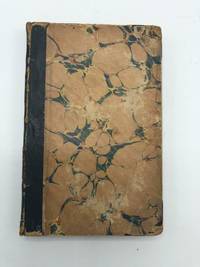
18373807Philadelphia: A. Waldie 1837. First American edition part of the "American Medical Library" series. 8vo 211pp orange marbled boards with black morocco and gilt spine. The author was was Professor of Anatomy Surgery and Physiology at the Royal College of Surgeons in Ireland. An important treatise on venereal disease in which the author first published "Colles' Law" regarding veneral disease in infants. Foxing to text block edges rubbing and wear to covers. An attractive copy. A. Waldie hardcover
1863013462Washington D. C.: Government Printing Office. Good. 1863. Hardcover. Recased in orange boards with title gilt on spine. Ex-library copy with rubber stamp on all edges and title page. All edges have moderate soiling and light wear. Light toning throughout text block. This book relates the status of Mexico during the second French Intervention and includes dispatches from various foreign emissaries to Secretary of State William Seward. At this time Mexican democracy was trying stay afloat as European powers tried establish a monarchy. Although President Lincoln sympathized with Mexico's plight the United States was in a Civil War of its own. ; Large 8vo 9" - 10" tall; 802 pp . Government Printing Office hardcover books
1864101729Np New York: For sale by all News Agents. Price $1 per 100. 1864. 4to. Broadside text in two columns; creased from prior folding and split at creases some toning and paper clip rust staining. Republic campaign broadside reprinting an interview with Lincoln by former Wisconsin State Assemblyman Joseph T. Mills and former state Governor Alexander Williams Randall. Lincoln vigorously defends the use of Black soldiers in the Union Army against Democratic candidate McClellan's strategy of leniency towards Southern States rejoining the Union: "The slightest knowledge of Arithmetic will prove to any man that the rebel armies cannot be destroyed with Democratic strategy. It would sacrifice all the white men of the North to do it. There are now in the service of the United States near 200000 able-bodied colored men most of them under arms defending and acquiring Union territory. The Democratic strategy demands that these forces be disbanded and that the masters be conciliated by restoring them to slavery. Will you give our enemies such military advantages. to get them back into the Union Abandon all the posts now garrisoned by black men take 200000 men from our side and put them in the battle-field or corn-field against us and we would be compelled to abandon the war in three weeks. . There have been men base enough to propose to me to return to slavery the black warriors of Port Hudson and Olustee and thus win the respect of the masters they fought. Should I do so I should deserve to be damned in time and eternity. My enemies pretend I am now carrying on this war for the sole purpose of abolition. So long as I am president it shall be carried on for the sole purpose of restoring the Union. But no human power can subdue this Rebellion without the use of the emancipation policy and every other policy calculated to weaken the moral and physical forces of the Rebellion." This is the first separate printing of the interview which was first published as "The Loyal Road to Peace and the Disloyal Road to Ruin President Lincoln on Democratic Strategy" in the Wisconsin Grant County Herald August 1864. The broadside also prints Grant's letter to E.B. Washbourne "The Rebels have now in their ranks their last man. The little boys and old men are guarding prisoners guarding railroad bridges and forming a good part of their garrisons for entrenched positions " and a poem by Bayard Taylor on the Democrats' presidential nominating convention. REFERENCE: Sabin 41157; Weinstein Against the Tide 141 For sale by all News Agents. Price, $1 per 100. unknown
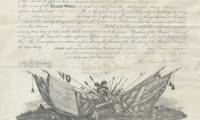
18623341204/03/1862. <p>As 1862 opened the war was not going well for the Union. In the east Bull Run had been a disaster and led to the shake-up of command with no results yet to show for it. In the west the loss at Wilson’s Creek gave the Confederates the upper hand. The Federal armies in the west then turned their attention to implementation of the Anaconda Plan – to cut the Confederacy in half by securing the Mississippi River from St. Louis all the way to the Gulf of Mexico and clearing a maritime invasion route into the heart of the Confederacy by taking the Tennessee and Cumberland Rivers which lay just to the east of the Mississippi. If successful these maneuvers would cut Texas Arkansas and Louisiana off from the main body of the South hold Kentucky and Missouri firmly in the Union and make it difficult for Tennessee to cooperate with her sister Confederate states. The first moves would be to take and hold commanding locations north on the Tennessee and Cumberland rivers and command of the operation was given to Brig. Gen. Ulysses S. Grant an obscure and largely unproven officer.</p><p>On February 6 1862 Fort Henry commanding the Tennessee River was captured by Grant’s forces. It had a poor defensive position and was reduced mainly by the bombardment of gunboats on the river. Nonetheless its fall opened the Tennessee River to Union gunboats and shipping past the Alabama border and provided a real victory for Union arms. Grant next focused his attention on Fort Donelson eleven miles away on the more strategically important Cumberland River. This fort had a much stronger physical position and the Confederates had placed some 20000 men and a number of senior commanders on site to engage in its defense. They were not about to concede the fort and they were ready and waiting for Grant. Grant arrived at Fort Donelson late on February 12 and on the 13th established his headquarters near the left side of the front of the line. That day was spent in battle preparation with a few small probing attacks being carried out against the Confederate defenses.</p><p>Grant's headquarters was at Cairo Ill where the head of Ordnance was Stephen Lyford. Grant arrived at Fort Donelson late on February 12 and on the 13th established his headquarters near the left side of the front of the line. That day was spent in battle preparation with a few small probing attacks being carried out against the Confederate defenses.</p><p>The battle was severe with nearly 1000 soldiers on both sides killed and about 3000 wounded. When Simon Buckner the Confederate commander asked for surrender terms Grant famously replied “No terms except unconditional and immediate surrender can be accepted“ adding “I propose to move immediately upon your works.†Buckner surrendered his command of about 15000 men; this was the first of three Confederate armies that Grant captured during the war.</p><p>The capture of Fort Donelson gave the North control of the Cumberland River which provided the road that opened the Deep South to Union invasion. It boosted morale in the North which now saw that the war could result in great victories and not just defeats. It gave President Lincoln the fighting general he was looking for and it made Grant’s career in the process; he was soon promoted to major general of volunteers.</p><p>Stephen C. Lyford had a long and distinguished career. He served from May to August 1861 in the defenses of Washington D. C. and in the Manassas Campaign participating in the Battle of Bull Run July 21 1861. He was Aide-de_Camp to Brig. General McDowell in the defenses of Washington D. C. August to October 1861 and Asst. Ordnance Officer at St. Louis Arsenal Mo. November 2 1861 to February 1 1862; in command of the Cairo Ordnance Depot Ill. February to May 1862 being detached to the Cumberland River and was present at the Surrender of Ft. Donelson. He was part of Gen. Halleck's Mississippi Campaign May to July 1862 being engaged in the Siege of Corinth May 1862 and was Chief of Ordnance for Department of the Tennessee July 11 1862 to September 6 1863 and fought in the Battle of Corinth. He would go on to teach at West Point and also serve as aide-de-camp for Gen. Halleck and as representative of the US to Japan to bring back information and technology relevant for American ordnance.</p><p><strong>Document signed</strong> with engravings of flags and weapons Washington March 4 1862 Naming Lyford a <em>“Second Lieutenant in the Ordnance Department.""</em></p><p><img class=""alignnone wp-image-25018 size-post-window"" src=""https://cdn.raabcollection.com/wp-content/uploads/20231204144051/Folder-site-11-1600x1327.jpg"" alt="""" width=""1600"" height=""1327"" /></p> unknown
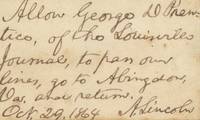
18643503129/10/1864. <blockquote><p>Journalist George D. Prentice's son was a Confederate officer captured by Union forces who would later be charged with murder</p></blockquote><p>George D. Prentice was born in Connecticut on December 18 1802 and graduated from Brown University in 1823. He came to Kentucky in 1830 to write a campaign biography entitled The Biography of Henry Clay and remained in this state until his death on January 22 1870 in Louisville. Prentice became the editor of the Louisville Journal the newspaper of the Whig Party. The main focus of this paper was the promotion of Henry Clay’s agenda and his multiple presidential campaigns. Prentice brought the Journal from upstart newspaper to the most widely read newspaper in the western United States because of his wit and command of the English language. Upon the failure of the Whig Party Prentice supported the Know-Nothing Party. Prentice then supported John Bell and his Unionist platform in the 1860 election calling for the Southern states to stay in the Union. Following the repeal of neutrality in Kentucky the pro-Union Prentice wrote in the Louisville Journal on September 19 1861: “Well thank God we at last have weighed anchor and set out for the haven of safety and of honor. Now let all possible sail be spread and the noble ship of state be driven into the lines of her insolent foe with the whole might of the valor and devotion of her true men.†Prentice became part of Lincoln’s core group of advisors for Kentucky affairs during the war. But despite Prentice’s Unionist satisfaction that Kentucky was no longer neutral his two sons fought in the Confederate army one dying in 1862 and the other being captured in 1863.</p><p>The son of Prentice Clarence J. Prentice was one of the most colorful Kentuckians in the Confederate Army. From 1863 to 1865 he commanded the 7th Confederate Cavalry Battalion. Based in southwestern Virginia the 7th was composed of mountaineers who resided along the Kentucky-Virginia border. The unit was difficult to discipline and was regarded as a ""black sheep"" battalion by other units in the department. While some members of the battalion accompanied Gen. John Hunt Morgan on his last Kentucky raid they were part of the dismounted brigade. Prentice and the balance of the 7th was left behind to guard Pound Gap. In his ""Kentucky Cavaliers in Dixie"" George Dallas Mosgrove left a lively pen portrait of the young officer. He described the 7th as wild and difficult to discipline but added that the men were afraid of Prentice who was a crack shot. Major Prentice was captured on March 31 1863.</p><p>George Prentice wrote to Lincoln to enlist his help in securing a parole for his son. In his letter to Lincoln dated Journal Office Louisville Ky. May 6 1863 Prentice stated: “I wrote to you last week in regard to my son Major Clarence Prentice now a rebel prisoner at Camp Chase. He would ere this have been forwarded for exchange but Gen. Burnside at my solicitation consented to have him detained until I could have time to hear from you. I think there has been time but I have received nothing from you either by mail or telegraph. I know that the pressure of the affairs of state upon you is very great. Perhaps you did not read my letter at all. Major Prentice is the only child left to me. My household is very desolate. My son is tired of the war but unfortunately he thinks the south right. I ask you to direct his release upon his taking the non combatants oath and giving bond and security for its scrupulous observance. If you cannot do this as I painfully fear you cannot I earnestly appeal to you to parole him to stay outside of both the United States and the Southern Confederacy until after the rebellion. I should scarcely venture Mr. President to make this appeal to you but that I think I have served the Union cause faithfully devotedly and successfully. I have suffered very much and sacrificed very much in its behalf—more I am sure than any other man in Kentucky; and I am likely even at the best to suffer and sacrifice much hereafter. I think there is not a candid and intelligent Union man in this state who would hesitate to say to you that I have saved it to the Union politically.</p><p>“And now dear sir pray grant me what I ask in behalf of my only son. His mother is half delirious and so am I. I am scarcely capable of performing my daily duties to the country but if my request were granted I feel I should be buoyant with new life. Please let me know your decision soon for if my son cannot be paroled upon either of the conditions I have mentioned I want him sent forward as soon as possible to City Point as he is extremely uncomfortable in his present situation.â€</p><p>Ten days later Lincoln issued an order written on the back of Prentice's letter instructing General Burnside to parole young Prentice ""to remain outside the limits of both the loyal and disloyal States or so-called 'Confederate States’…during the present rebellion and to abstain from in any wise aiding or abetting said rebellion."" He was released in May 1863. However Clarence Prentice immediately upon his release from Camp Chase violated his oath and re-entered the Confederate Army. He was promoted to lieutenant colonel. Only a few months after his parole he was back to robbing banks burning courthouses and spreading terror and destruction generally along the Kentucky-Virginia border.</p><p>In the fall of 1863 after being released from Union custody Prentice shot and killed a hotel proprietor named White in Abingdon Va. during a ""personal difficulty."" His trial was set for November 8 1864 in Abingdon and his father wanted to attend and assist him at his trial. George Prentice again wrote Lincoln asking for his assistance.</p><p>Lincoln complied with Prentice’s request. <strong>Autograph note signed</strong> Washington October 29 1864.<em> “Allow George D. Prentice of the Louisville Journal to pass our lines go to Abingdon Va. and return.â€</em></p><p>Prentice also wrote to Secretary of State William Seward on October 25 1864. A letter of Captain R. H. Baptist exists October 22 1864 to Prentice offering to give evidence in the forthcoming trial of his son saying “a conversation occurred between White & myself that ought to be made known in the trial of your son by all means.†Prentice sought Seward’s help in lining up Baptist up as a witness for his son: “Capt Baptist who formerly served under my son…and is now a prisoner…at Johnson's Island writes to me some facts which would be of vast importance to my erring child in his approaching trial…and which Capt. B. says he would state on oath…if he could be paroled to the Southern Confederacy or exchanged…I think that the exchange of Capt Baptist would subserve the cause of truth humanity and justice.’’ After being shown Baptist's letter Lincoln arranged for his parole so that he could testify on behalf of Clarence Prentice.</p><p>Thus did Lincoln intervene twice to aid his Kentucky advisor.</p><p>Clarence Prentice was acquitted of the murder charge. He continued to serve in the Confederate Army until the war ended.</p><p><img class=""alignnone wp-image-25018 size-post-window"" src=""https://cdn.raabcollection.com/wp-content/uploads/20231204144051/Folder-site-11-1600x1327.jpg"" alt="""" width=""1600"" height=""1327"" /></p> unknown
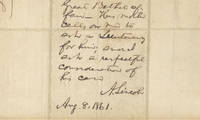
18613521508/08/1861. <blockquote><p>""It is said that the young man named within was in the Great Bethel affair. His mother calls on me to ask a Lieutenancy for him""</p><p> </p><p>We have never before a document on the market referencing Bethel by name or referring to the battle as great</p><p> </p><p>Part of a private collection assembled at Sesslers more than a half century ago</p></blockquote><p>The Civil War formally began with the bombardment of Fort Sumter on April 12–13 1861 but the first sustained clash between organized armies on land was the Battle of Big Bethel also called the Battle of Bethel Church fought on June 10 1861 near Hampton Virginia.</p><p>Virginia's decision to secede from the Union had been ratified by popular vote on May 23 and Confederate colonel later major general John B. Magruder was sent down to the peninsula to deter any advance on the state capital Richmond by Union troops based at the well-defended post of Fort Monroe.</p><p>Confederate forces under Magruder defeated a probing Union attack led by John Adams Dix and field commander Theodore Winthrop who was killed in the assault. The Union objective was to push back Confederate outposts guarding the Yorktown Road but poor coordination and a nighttime friendly-fire incident ruined surprise. When Union troops advanced at dawn they were repulsed by well-positioned Southern artillery and infantry around Big Bethel Church. The battle ended in a Confederate victory providing an early morale boost to the South while exposing the inexperience and disorganization of Union forces in the war’s opening weeks. It confirmed that the conflict would not be short or bloodless.</p><p>Abraham Lincoln was distressed by the Union defeat at Big Bethel. The battle underscored for him the Union's lack of military preparedness and the challenges in finding capable commanders reinforcing his determination to avoid future losses.</p><p>During his presidency Lincoln would regularly meet with members of the public who would wait to see him in the foyer of his office in the White House. This included soldiers and their family members.</p><p>Autograph letter signed Frank J. White as Captain of Company A 10th Regiment Fortress Monroe July 27 1861 seemingly given to the soldier himself or his sent to his family. ""Mr. Charles. J. Seymour has been a member of my company for three months and has gained my highest esteem for the excellent manner in which he has discharged his duties. He is well qualified to hold a much higher position than his present one.""</p><p><strong>Autograph document signed</strong> August 8 1861 on a detached leaf no recipient but likely Secretary of War Simon Cameron. <em>""It is said that the young man named within was in the Great Bethel affair. His mother calls on me to ask a Lieutenancy for him; and I ask a respectful consideration of his case.""</em></p><p>Seymour received the promotion Lincoln requested becoming a lieutenant just weeks later on August 27 1861. He served as Aide-de-Camp on the staff of Gen. Daniel E. Sickles and was later promoted to major. He also assisted in recruiting efforts in New York City.</p><p>This was acquired from Mabel Zahn at Sesslers in the 1970s.</p><p><img class=""alignnone wp-image-25018 size-post-window"" src=""https://cdn.raabcollection.com/wp-content/uploads/20231204144051/Folder-site-11-1600x1327.jpg"" alt="""" width=""1600"" height=""1327"" /></p> unknown
18623568928/02/1862. <blockquote><p>He was later promoted to Lt. Colonel for gallantry in action at the Battle of Groveton</p></blockquote><p><strong>Document signed</strong> with fine engravings of an eagle flags and cannons Washington February 28 1862 naming Percy B. Spear a Commissary of Subsistence of Volunteers with the rank of Captain effective November 30 1861. The document is countersigned by Secretary of War Edwin M. Stanton. The appointment is listed in the U.S. Army Register.</p><p>The Civil War Commissary Department was responsible for procuring storing and distributing food to soldiers. The rations managed by the department included such things as pork beef bread coffee and soap.</p><p>But Spear did not serve solely as a Commissary for the entire war. He would soon serve an aide-de-camp in the Fifth Corps in the Gettysburg campaign with Gen. James Barnes mentioning him with distinction in dispatches. Spear ended the war as a Brevet Major. In July 1865 he was appointed Lt. Colonel of Volunteers for meritorious service and for gallantry in action at the Battle of Groveton in 1862. After the war he was again named Commissary of Subsistence this time at the recommendation of Gen. George G. Meade.</p><p><img class=""alignnone wp-image-25018 size-post-window"" src=""https://cdn.raabcollection.com/wp-content/uploads/20231204144051/Folder-site-11-1600x1327.jpg"" alt="""" width=""1600"" height=""1327"" /></p> unknown
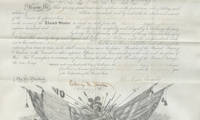
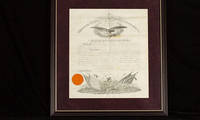
18643560801/08/1864. <blockquote><p>This appointment is listed in War Department General Orders no. 256</p></blockquote><p>According to the National Museum of Civil War Medicine and other sources Lt. Adam Miller of the 2nd Mass. Vols. aged twenty-three years was badly wounded August 9 1862 at the Battle of Cedar Mountain by an elongated musket ball which entered below the right eye socket and traversing the nasal cavity emerged through the left eye socket destroying the globe of the left eye and lacerating the left lower eyelid. He was made a prisoner and taken to a hospital at Charlottesville Va. where his wound ultimately formed a scar with great deformity. After being exchanged he entered the New York Eye Infirmary and on April 10 1863 a plastic surgical operation was performed by Dr. Henry B. Sands for the restoration of the eyelid. The operation was eminently successful and on April 22 1863 the parts were sufficiently healed to permit the insertion of an artificial eye. He thus survived a catastrophic facial wound and underwent pioneering plastic surgery.</p><p>Due to his injuries which made him unfit for active field duty but still capable of light service he was transferred to the Veteran Reserve Corps in August 1863 with his commission dating back to June 27 1863. The Veteran Reserve Corps was a military organization of the Union Army created for partially disabled or otherwise infirm soldiers who could still perform simple duties such as guarding prisoners or patrolling cities. This appointment is listed in War Department General Orders no. 256.</p><p><strong>Document signed</strong> with engravings of an eagle flags and weapons Washington August 1 1864 naming Adam Miller a lieutenant in the Veteran Reserve Corps effective June 27 1863.</p><p>An extraordinary Lincoln appointment of a soldier who made medical history in the Civil War.</p><p><img class=""alignnone wp-image-25018 size-post-window"" src=""https://cdn.raabcollection.com/wp-content/uploads/20231204144051/Folder-site-11-1600x1327.jpg"" alt="""" width=""1600"" height=""1327"" /></p> unknown
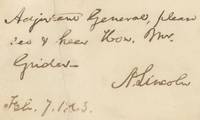
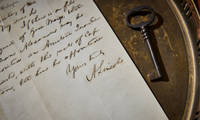
18633619207/02/1863. <blockquote><p>This document has been in a private collection for a generation</p><p> </p><p>Kentucky Unionists were important to Lincoln a Kentucky native as he famously said ""I hope to have God on my side but I must have Kentucky.â€</p><p> </p><p>The Congressman Henry Grider apparently needed to see Thomas to discuss the Act its impact on Kentucky and the details of how the recruitment would be handled</p></blockquote><p>Kentuckian Henry Grider was a Whig who served in Congress from 1843-1847 and then as a Unionist from March 4 1861 until 1865. For the Thirty-ninth Congress 1865–1867 Grider shifted to the Democratic Party but retained his commitment to the Union serving from March 4 1865 until his death in office on September 7 1866. Grider represented a Kentucky pro-slavery but Union-loyal constituency and he retained that point of view throughout the Civil War. Kentucky Unionists like Grider were particularly important to Abraham Lincoln a Kentucky native who had famously said ""I hope to have God on my side but I must have Kentucky.†Lincoln is known to have consulted with Grider about Kentucky affairs and relied on his support and that of the Kentucky delegation to Congress.</p><p>On February 7 1863 Congress passed an Act providing that “the Governor of the State of Kentucky by the consent and under the direction of the President of the United States shall have power to raise and organize into regiments a volunteer force not exceeding twenty thousand rank and file to be raised within the State of Kentucky to serve for the term of twelve months to be employed within the limits of Kentucky in repelling invasion suppressing insurrection and guarding and protecting the public property: Provided That at any time it may be necessary in the discretion of the President of the United States these troops may be employed out of the limits of Kentucky against the enemies of the United States.â€</p><p>Thus the Governor of Kentucky would raise a force of 20000 volunteers to serve in Kentucky but President Lincoln had the authority to order them used outside the state. This Act was received with mixed reviews in Kentucky and on the very day it was enacted Grider’s son Benjamin C. Grider a slave-holding Unionist resigned from the Union Army. From the timing of his resignation one can surmise that he disapproved of the Act. He had commanded the 9th Kentucky Volunteers.</p><p>Lorenzo Thomas was the Adjutant General of the U.S. Army at that time and his job was to maximize operational effectiveness of the army by manning recruiting for and sustaining military operations.</p><p><strong>Autograph note signed</strong> Washington February 7 1863 the day of the Act to Lorenzo Thomas expediting Grider’s ability to see Thomas. <em>“Adjutant General Please see and hear Hon. Mr. Grider. A. Lincoln.â€</em> It seems clear that Grider needed to see Thomas to discuss the Act its impact on Kentucky and the details of how the recruitment would be handled and managed. Not in Basler. A separation running vertically archivally mended.</p><p>This is a very scarce communication involving Lincoln aiding a Kentucky Unionist.</p><p><img class=""alignnone wp-image-25018 size-post-window"" src=""https://cdn.raabcollection.com/wp-content/uploads/20231204144051/Folder-site-11-1600x1327.jpg"" alt=""historical memorabilia dealer"" width=""1600"" height=""1327"" /></p> unknown
18642292021/03/1864. <blockquote><p>“If there is on file a request of Gen. Meigs that William Alexander may be appointed an Assistant Quarter-Master with the rank of Captain let him be appointed.â€</p><p> </p><p>There is no record of the appointment having been made with speculation being that Lincoln possibly sent the appointment to Stanton to die there</p><p> </p><p><img class=""alignnone wp-image-22921 size-post-window"" src=""https://cdn.raabcollection.com/wp-content/uploads/20231204160847/branding-Lincoln-March-21-1864-C-e1640668975889-1600x692.jpg"" alt="""" width=""1600"" height=""692"" /></p></blockquote><p>Lincoln had the rare quality of not taking opposition personally. During the Civil War he was vilified more than any other public figure in American history yet saw the issues as so great that they transcended any personal aspect. He bore no resentments because as he said he “never thought it paid.†He appointed men to high office because he perceived that they would be useful to the war effort. When Gen. George B. McClellan was insufferably rude to him he was willing to suffer the personal indignity if only McClellan would win. His most important civilian appointment shows this management principal in operation. Edwin Stanton had met Lincoln before the war when they had served as co-counsel in a famous lawsuit involving the McCormick reaper. Stanton who had a reputation for being stern imperious hot-tempered and controlling had snubbed him and then ridiculed him publicly as a gorilla and an imbecile. Lincoln also saw him as honest dedicated and extremely competent. Carrying no grudges he appointed Stanton to be Secretary of War and it was a brilliant choice. The two men came to respect and even like each other as they worked together daily to achieve victory.</p><p>Lincoln even used Stanton to deflect criticism from himself. Lincoln was inundated with requests for military positions requests in which he had little if any interest. But these requests often came from members of his administration from Union generals or other notables and the President could not decline them without angering his friends colleagues or other supporters of the Union cause. He shoveled these requests to Stanton with his endorsement. But Stanton would only approve those requests he deemed meritorious.</p><p><img class=""alignnone wp-image-22923 size-post-window"" src=""https://cdn.raabcollection.com/wp-content/uploads/20231204160837/Lincoln-March-21-1864-B-e1640669110694-1600x636.jpg"" alt="""" width=""1600"" height=""636"" /></p><p>Montgomery C. Meigs was a career United States Army officer civil engineer and construction engineer. At the start of the Civil War Lincoln appointed Meigs quartermaster general a crucial post that was perfectly suited to his organizational and management talents. Before the war Meigs played a key role in the extension and dome of the U.S. Capitol. After the war he oversaw much of the design and monument construction at Arlington National Cemetery.</p><p>Meigs had requested that Lincoln make an appointment in his department and the President wrote this letter to accommodate him. <strong>Autograph letter signed</strong> on Executive Mansion letterhead Washington March 21 1864 to <em>“Hon. Secretary of War.â€</em> Lincoln writes <em>“My dear Sir If there is on file a request of Gen. Meigs that William Alexander may be appointed an Assistant Quarter-Master with the rank of Captain let him be appointed. Yours truly A. Lincoln.â€</em></p><p>There is no record of the appointment having been made with speculation being that Lincoln sent the appointment to Stanton to die there. An interesting letter associating the President Secretary of War and Quartermaster General and taking place just eleven days after Grant assumed the role that led to Union victory.</p><p><img class=""alignnone wp-image-22732 size-post-window"" src=""https://cdn.raabcollection.com/wp-content/uploads/20231204162353/Folder-site-1600x1327.jpg"" alt="""" width=""1600"" height=""1327"" /></p> unknown
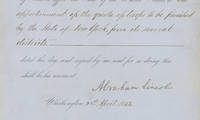
18642373223/04/1864. <blockquote><p>A search of public sale records going back 40 years fails to turn up even one other example of this document</p></blockquote><p>After the firing on Fort Sumter on April 12 1861 enthusiasm for enlisting in military service swept through both the North and South. In remarkable speed two large volunteer armies were created. Except for a tiny number of professional soldiers all expected to be in service for a brief term. Not just soldiers but the public and political leaders had fooled themselves about the war's likely duration. However the patriotic hope on each side that the war would be over in a matter of weeks or months was dashed in the first battle of Bull Run on July 21 1861. By late 1862 no sensible person believed that an early end to the bloody strife was possible and the knowledgeable expected peace to be far off in the future. Facing a protracted war maintaining a sufficiently sizable army became the greatest problem facing both Union leader Abraham Lincoln and Confederate leader Jefferson Davis.</p><p>In 1862 rather than institute a draft President Lincoln requested 300000 more men and assigned each state a quota. The states could meet their quota in any manner they saw fit. Most states offered cash incentives known as bounties to gain recruits. Depending on where one enlisted the combination of local state and federal bounties could exceed $1000. But the 1862 policy also did not recruit enough troops.</p><p><img class=""alignnone wp-image-24611 size-post-window"" src=""https://cdn.raabcollection.com/wp-content/uploads/20231204150003/Lincoln-April-23-1864-2-1600x602.jpg"" alt="""" width=""1600"" height=""602"" /></p><p>As the war dragged on with no end in sight the inflow of volunteers was drying up and the Union needed to keep the ranks filled. The U.S. Congress resorted to the first draft in the country’s history in March 1863. All able-bodied men between ages 20 and 45 were required to be enrolled and available for military service. Draftees were chosen by lottery. Once conscripted a man could avoid service for that particular round of the draft either by paying a $300 commutation fee or by hiring a substitute to take his place. As in the South this raised accusations that the war had become “a rich man’s war but a poor man’s fight.†Nevertheless in both North and South statistics indicate that wealthy men were represented in the service in at least the same proportion as they were in the general population.</p><p>A lot of blood was spilled in 1863 with the battles of Chancellorsville Gettysburg Vicksburg Chickamauga and Chattanooga among others. By year’s end President Lincoln and the Union leadership realized that more men were needed for the army and urgently. On February 1 1864 Lincoln called for 500000 men to serve for three years or for the duration of the war. Then on March 15 he supplemented this with a call for 250000 more. There would be another draft call in December 1864 but it was never completed due to the impending end of the war.</p><p>The March 1864 draft call stated: “Washington March 15 1864. In order to supply the force required to be drafted for the Navy and to provide an adequate reserve force for all contingencies in addition to the 500000 men called for Feb. 1 1864 the call is hereby made and a draft ordered for Two Hundred Thousand men for the military service – Army Navy and Marine corps of the United States. The proportional quotas for the different wards towns townships precincts or election districts or counties will be made known through the Provost Marshall General’s bureau and account will be taken of the credits and deficiencies of former quotas.</p><p>The 15th day of April 1864 is designated as the time up to which the numbers required from each ward of a city town etc. may be raised by voluntary enlistment; and drafts will be made in each ward of a city town etc. which shall not have filled the quota assigned to it within the time designated for the number required to fill said quota. The draft will be commenced as soon after the 15th of April as practicable…†It took little more than a week for everything to be in place.</p><p><img class=""alignnone wp-image-24623 size-full"" src=""https://cdn.raabcollection.com/wp-content/uploads/20231204145931/My-Movie-177ygbhbj.gif"" alt="""" width=""1920"" height=""1080"" /></p><p>The mechanics of the draft were that each state and district within a state were assigned quotas and the President would order that each state’s draft numbers and districts be implemented. This was the actual order for the draft. Then each individual district would receive from the President details of its requirements in a circular letter. One sees these individual district circular letters on the market every now and then. But what one never sees is the order to implement the draft for a state assigning the districts and number of troops being called forth. In fact a search of public sale records going back 40 years fails to turn up another example nor have we seen one before.</p><p><strong>Document signed</strong> as President Washington April 23 1864 being Lincoln’s implementation order for New York. <em>“I hereby authorize and direct the Secretary of State to affix the Seal of the United States to the apportionment of the quota of troops to be furnished by the State of New York from its several districts dated and this day signed by me and for so doing this shall be his warrant.â€</em></p><p>An extremely rare if not unique document showing Lincoln raising troops on the macro level of a state.</p><p><img class=""alignnone wp-image-23729 size-post-window"" src=""https://cdn.raabcollection.com/wp-content/uploads/20231204152429/Folder-site-7-1600x1327.jpg"" alt="""" width=""1600"" height=""1327"" /></p> unknown
18611571129/03/1861. <p>James E. Harrison though born in Virginia served the Union cause during the Civil War. He received his first appointment as a Second Lieutenant to the 2d U. S. Cavalry in June 1856 and was stationed in Texas and various forts in the West until December 1858 when he was assigned to scouting Indians. He returned East and with the Civil War imminent he was promoted to First Lieutenant 2d U.S. Cavalry in March 1861 and then to Captain 5th U.S. Cavalry in May of that year. Harrison was engaged in the Peninsular campaign and commanded a regiment in the Army of the Potomac from September 1862 to June 1863. During that time he served at the battles of Antietem Chancellorsville and Brandy Station among many others. He was Breveted Major U.S. Army for gallant and meritorious services at the battle of Hanover Court House and Brevet Lieutenant Colonel U.S. Army for gallant and meritorious services at the battle of Antietam. In July of 1864 Harrison was assigned to be Inspector-General of Cavalry in the Department of Arkansas and was later appointed as Special Inspector of Cavalry in West Mississippi.</p><p><strong>Document signed</strong> as President Washington March 29 1861 effective retroactively to February 27 1861 an ornate vignetted commission with an eagle cannons and flags appointing Harrison to the rank of “First Lieutenant in the Second Regiment of Cavalry.†The document is countersigned by Secretary of War Simon Cameron.</p> unknown
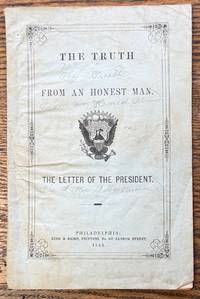
1863BOOKS350084Philadelphia PA: King & Baird. Good /NO DUSTJACKET. 1863. First Edition. Pamphlet. Vallandigham became a martyr for civil liberties symbolizing the struggle for dissent even as he returned to Ohio and was nominated for governor while in exile. He was exiled by Lincoln using War Powers Act. . 8vo. 16 pp. Not sure if it ever had a rear cover. Minor foxing. . King & Baird unknown
186325464<p>"<i>I esteem Gov. Francis Thomas as an able and very true man. I do not know that he agrees with me in everything—perhaps he does not; but he has given me evidence of sincere friendship & as I think of patriotism.</i>"</p> <b>ABRAHAM LINCOLN.</b>Autograph Letter Signed to Robert C. Schenck May 31 1863 Washington D.C. 1 p.<p><b><br /></b></p><p><b>Complete Transcript</b></p><p><i>Private</i></p><p><i>Executive Mansion</i></p><p> <i>Washington May 31 1863.</i></p><p><i>Major Gen. Schenck</i></p><p><i>Baltimore Md.</i></p><p> <i>I have been requested to say what I very truly can that I esteem Gov. Francis Thomas as an able and very true man. I do not know that he agrees with me in everything—perhaps he does not; but he has given me evidence of sincere friendship & as I think of patriotism.</i></p><p><i>Yours truly</i></p><p><i>A. Lincoln.</i></p><p><b>Historical Background</b></p><p>Lincoln had served in Congress together with fellow Whig Robert C. Schenck in the 1840s and made Schenck a Major General at the beginning of the war. Severely wounded at the Second Battle of Bull Run in August 1862 Schenck was given command of the Middle Department. He firmly supported the Unconditional Unionists from his headquarters in Baltimore and despite the necessity of tact in the politically sensitive border state of Maryland had little tolerance for middle ground.</p><p>In July 1861 Secretary of War Simon Cameron with the president's encouragement had authorized Thomas to raise four regiments of loyal citizens from western Maryland for the protection of the Chesapeake and Ohio Canal. A month later Thomas recommended and Lincoln endorsed three officers for the 1st Maryland Regiment Potomac Home Guard.</p><p>In early September 1862 Thomas sent Lincoln a lengthy private letter: "Our acquaintance is very limited…and it may be presumptuous in me to write this letter." Nevertheless he continued "In my humble judgment <u>all</u> the evils now threatening seriously the utter ruin of the country are to be traced to the error consumatted in the organization of your Cabinet. There is not so far as my knowledge extends at the head of any one of the Departments a single individual who has come into your Administration under the right influences…" "Now I have watched with the deepest anxiety" Thomas informed Lincoln "all or nearly all of your difficulties have their origin in the fact that you have Presidential aspirants in your cabinet and Presidential aspirants in your own party outside of your cabinet all of whom have their partisans in the Senate and House of Representatives." The "vast interests at stake" demanded that Lincoln reorganize his cabinet and announce his own candidacy for reelection.</p><p>Two months later Lincoln's cabinet crisis reached a boiling point when Radical Republican senators demanded Secretary of State William H. Seward's resignation. Lincoln called the senators to a meeting with every member of the cabinet except Seward who had offered his resignation. Lincoln asked if the cabinet had freely debated issues and offered input before important decisions were made. The cabinet agreed that they had. Chase who had painted a picture to the senators of Seward and Lincoln running roughshod over the cabinet was cleverly chastened and offered his resignation. Lincoln refused the resignations of Seward and Chase thus maintaining intact his now famous "team of rivals" and keeping the senate at bay.</p><p>Despite his criticism Thomas was also supportive. On April 23 1863 he was one of the speakers at a mass meeting of Unconditional Union men of Allegany County Maryland. Thomas "accorded to President Lincoln the purest motives and a patriotic determination to crush the rebellion and restore peace and prosperity to the country. He said that power and responsibility must rest somewhere and that he was willing to confide in the President and sustain him to the fullest extent in carrying out the measures adopted by Congress for prosecuting the war. He spoke of the emancipation proclamation of the President as a retaliatory measure for the confiscation acts of the southern conspirators and said it was a war measure calculated to subdue the rebels who had raised the standard of rebellion without any justifiable cause."</p><p>Despite the unsolicited advice and criticism Lincoln offered this honest testimonial. It isn't clear if this answered a request of Thomas or a mutual contact or if Lincoln wrote it to send Thomas with his own purpose in mind. In mid-April Schenck who had a reputation for ham-handed harshness ordered at least eight persons charged with "using treasonable language" or "disloyal practices" in Baltimore to be exiled to the South. Less than a week later he had two newspaper editors from smaller towns in Maryland sent South for "having published treasonable articles." On May 28 three days before Lincoln penned this letter Schenck and Maryland Governor Augustus W. Bradford visited Pennsylvania Governor Andrew G. Curtin in Harrisburg to discuss "the more effectual protection of the southern borders of Pennsylvania and Maryland against any further incursions of rebel cavalry." Schenck and the two governors then left for Washington. Within a month the entire Confederate Army of Northern Virginia was in Pennsylvania heading for a conflict at Gettysburg.</p><p>In mid-July 1863 a few weeks after writing this private letter Lincoln told his secretary John Hay that General Henry W. Halleck "thinks Schenck never had a military idea & never will learn one. however you may doubt or disagree with Halleck he is very apt to be right in the end."</p><p>Schenck resigned from the army in December 1863 after again winning election to Congress. On the other hand Lincoln maintained his trust of Thomas.</p><p>On July 5 1864 Confederate General Jubal Early crossed the Potomac River at Harper's Ferry with a corps of the Army of Northern Virginia aiming at Washington. General Lew Wallace's determined resistance near Frederick Maryland delayed the advance by a day providing defenders in Washington critical time to prepare. After the Confederate army withdrew into Virginia on July 14 Major General David Hunter ordered the provost marshal in Frederick to arrest "all male secessionists with their families" and force those who had given "undue sympathy" to the Confederates to sell their furniture for the benefit of Union families who had lost possessions during the incursion and to seize the sympathizers' houses for government use. By August 1 Major John I. Yellott had placed twenty-three southern sympathizers and their families under house arrest.</p><p>On August 3 Lincoln ordered the Secretary of War to suspend Hunter's order and have Hunter send a report of the charges against each individual. Hunter requested to be relieved of command a wish that was soon granted.On August 13 Thomas protested to fellow Marylander and Postmaster General Montgomery Blair writing that the arrests of "quiet inoffensive citizens who have not publicly given by words or acts encouragement to the enemy cannot but be mischievous." The President asked Thomas to investigate.</p><p>In September Thomas reported back. With the exception of two already discharged and two others charged with "a grave offence" who "ought to have an opportunity to establish their innocence" Thomas recommended that the President order the release of all the others on the list. Thomas followed up later that year reporting that specific charges had been made against only John W. Baughman an editor of the <i>Republican Citizen</i>newspaper in Frederick who had been sent South and against John Ruck and Isaack Ruck who were like the others on the list still under arrest at their homes in Frederick. On January 21 1865 Lincoln ordered all but Baughman discharged.</p><p>Lincoln's unmatched ability to take advice from all sides and to work with capable men whose own ambitions sometimes conflicted with Lincoln's views is reflected in our letter.</p><p><b>Robert C. Schenck</b> 1809-1890 was born in Ohio and graduated from Miami University in 1827. He received a master's degree in 1830 studied law under Thomas Corwin and gained admission to the bar in 1831. He moved to Dayton Ohio and opened a successful law practice. After serving in the state legislature he represented his district in Congress from 1841 to 1851 when President Millard Fillmore appointed him as U.S. Minister to Brazil. Schenck served there until 1853. In 1859 he gave perhaps the first public endorsement of Lincoln for the Presidency in a speech in Dayton. At the beginning of the Civil War Lincoln commissioned Schenck as a brigadier general and he served in both Battles of Bull Run and in the 1862 Valley Campaign. He was wounded at the Second Battle of Bull Run and held an administrative post in Maryland while recovering. He resigned his commission in December 1863 after election to Congress where he served again until 1871. President Ulysses S. Grant appointed him as U.S. Minister to Great Britain a position he held until 1876 though his involvement in an American mining scandal left him thoroughly discredited.</p><p><b>Francis Thomas</b> 1799-1876 was born in Frederick County Maryland attended college in Annapolis and was admitted to the bar in 1820. He began a practice in Frankville in western Maryland and served in the state legislature in 1822 1827 and 1829. From 1831 to 1833 he served in the U.S. House of Representatives. Thomas served as governor of Maryland from 1842 to 1845 but his term and political future was marred by his public and contentious divorce from his much younger wife Sally Campbell Preston McDowell the daughter of the governor of Virginia.Thomas was a strong opponent of slavery which was unusual in a border state like Maryland. Defeated for reelection in 1844 he served in the state constitutional convention of 1850. He was again elected to Congress in 1860 serving until 1869 as a Unionist an Unconditional Unionist and then a Republican. From 1870 to 1872 he was collector of internal revenue for Maryland and then U.S. Minister to Peru from 1872 to 1875. He was killed when struck by a locomotive near his estate in Frankville.</p> books
186536639New York 1865. Elephant Folio. 8pp. Each page printed in six columns. Uncut at top edge. Very Good. A contemporary hand has written in pencil at the top blank margin "His last Proclamation. Keep this Paper."<br/><br/> This was Lincoln's "Last Public Address" Abraham Lincoln Online. This issue of the Times appearing the following day is surely a candidate for its earliest printing. His Speech discloses Lincoln's most recent thoughts on Reconstruction the War having virtually ended by the surrender of Lee's Army at Appomattox Court House on April 9. Reconstruction he says is "fraught with great difficulty. We simply must begin with and mould from disorganized and discordant elements. Nor is it a small additional embarrassment that we the loyal people differ among ourselves as to the mode manner and means of reconstruction."<br/> Lincoln emphasizes his flexibility. He disclaims any intention to insist upon a single comprehensive plan. He makes clear that "the Executive claimed no right to say when or whether members should be admitted to seats in Congress" from the rebellious States. He remarks that he has never pronounced on the interesting legal question "whether the seceding States so called are in the Union or out of it." Such an issue has no practical significance. "We all agree that the seceded States so called are out of their proper relation with the Union; and that the sole object of the government civil and military in regard to those States is to again get them into that proper practical relation." Lincoln will act as circumstances require the only criterion being whether the proposed policy will expedite that "proper practical relation." It is obvious that Lincoln had he lived would have been much more successful than his dogmatic and inflexible successor at guiding Reconstruction.<br/> This issue treats many other issues arising from the War's end including the topic "What shall be done with Jeff. Davis unknown books
18642547081864. very good-. This historic and rare black printed broadside presents the platforms of both parties the Republicans having convened in Baltimore in June and nominated Abraham Lincoln for President and Andrew Johnson for Vice President and the Democrats having convened in Chicago in August and nominated George B. McClellan for President and George H. Pendleton for Vice President. This copy measures 29 x 23 cm is double columned and with the imprint "For sale by all News Agents. Price $1 per 100." Very light foxing at the bottom margin more visible on the verso. Fraying at the margins as usual. Sabin 63348 Exceedingly scarce.<br/> <br/> unknown