987 résultats
196037046London: Constable and Co. 1960. First edition. Cloth. A very good copy clean copy. No just jacket. xiii 818 pp. Illus. with 11 b/w maps photos. 8vo. Constable and Co. hardcover books
191819741Boston: The Stratford Company Publishers 1918. First American Edition. First Printing. Slim octavo 20cm; beige paper-covered boards with titling and rule printed in dark brown on front panel; dustjacket; 58pp 6 ads. Light wear to crown with faint sunning to board edges; Near Fine. Dustjacket shows light edgewear with tiny chips at spine ends and old partial sticker removed from 25c price at base of spine; flaps trimmed presumably as-issued; Very Good. Apparent first appearance of each story in English a joint publication by The Stratford Universal Library. Both Lazarus and The Gentleman from San Francisco are early works in translation for Andreyev and Bunin. Bunin whose style was deeply rooted in the Russian folkloric tradition had the distinction of being the first Russian to win the Nobel Prize in Literature. An especially scarce title in dustjacket. The Stratford Company, Publishers unknown books
1933WRCLIT61772Paris: Éditions Coutan-Lambert 1933. Octavo. Gilt flexible black cloth. Portraits and illustrations. First edition ordinary issue. Issued in the series MASQUES CAHIERS D'ART DRAMATIQUE edited by Gaston Baty. A very good bright copy. Éditions Coutan-Lambert hardcover books
1838WN61677XNew York: Robinson and Franklin 1838. Full calf with gilt rules and lettering in red morocco label on spine. All edges sprinkled. Owner name in pencil on ffep. Text block is extensively foxed. Fascinating lectures on a range of subjects pertaining to rhetoric literature etc. Third Edition. Full Leather. Poor/No Dust Jacket. 12mo - over 6¾" - 7¾" tall. Learned. Robinson and Franklin Paperback books
1838WN61677New York: Robinson and Franklin 1838. Full tan calf with gilt spine lettering on red morocco label and gilt rules. Edges sprinkled. Spine edges and corners with moderate wear. Text block has fair amount of browning and foxing. Owner pencil signature on ffep. Unusual combination of technique and criticism regarding writing and literature. Third Edition. Full Leather. Good/No Jacket. 12mo - over 6¾" - 7¾" tall. Trade. Robinson and Franklin Paperback books
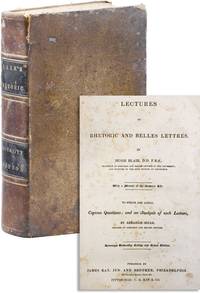
183331283Philadelphia: James Kay Jun. and Brother 1833. First Thus. Large octavo 22.5cm.; full contemporary speckled calf two black gilt spine labels; 557pp. Boards a bit shelf-worn with old soil spots corners lightly bumped textblock a bit foxed and soiled numerous contemporary and later 1930s ownership inscriptions to front endpapers else a Very Good example. "University Edition" - bottom spine label. Collected lectures delivered by Blair during his tenure as the Chair of Rhetoric and Belles Lettres at the University of Edinburgh first published in London in 1784 shortly after the author's retirement. James Kay, Jun. and Brother unknown books
176ABRAHAM James Johnston. LETTSOM HIS LIFE TIMES FRIENDS AND DESCENDENTS. London: Heinemann 1933. 4to. Cloth top edge gilt. Frontispiece xx 498 pages with illustrations throughout. First edition. A comprehensive biography of John Coakley Lettsom 1744-1815 18th Century physician freer of slaves and man of letters. He was born in the British Virgin Islands into a Quaker family. He is best know as the founder of the Medical Society of London in 1773 -- the oldest medical society in Great Britain and he was on the cutting edge of the latest advances in medical technology and preventative medicinal care for his day. He counted among his friends Benjamin Franklin. In addition to his renown work in the medical fie he is also a major abolitionist who freed his father's slaves in 1767 once he inherited them and continued to advocate for slave abolition all his life. unknown books
1889Z1620London & Bradford:: Sampson Low Marston Searle & Rivington & Thos. Brear 1889. 1889. Tall 8vo. xvi 342 ad 1 pp. Engraved frontis. with tissue guard 9 unnumbered plates 19 figs. indexes. Half vellum with marbled paper sides gilt-stamped black morocco spine labels t.e.g.; soiled extremities worn. AUTHOR'S PRESENTATION INSCRIPTION: "The Rev. Addison Croft M.A. With the Compliments of The Author" with pasted autograph "Yours Truly W. Cudworth." Good . Sharp was a Yorkshire mathematician and astronomer and Assistant to Flamsteed. Pages 1-215 are devoted exclusively to the life and correspondence of Abraham Sharp; the balance of the book pp.216-317 to other members of his family with a final general chapter on Greenwich Observatory in the 1880's pp.318-328 2 figs. The illustrations are mostly facsimiles of documents and genealogies. Nice association copy. Sampson Low, Marston, Searle & Rivington & Thos. Brear, 1889. hardcover books
1864286487Philadelphia: T. B. Peterson & Brothers 1864. Hard Cover. Good binding. The Life and Public Services of Abraham Lincoln published by Peterson and Brothers. With portrait frontispiece and publisher's adverts at the rear. 4 17-187 19 pp. Lacking endpapers. Hinges cracked but holding. Loss to the bottom corner of the final advertising leaf. Writing on the pastedown and recto of the frontispiece. Some foxing. Shelfwear and loss to the corners of the boards and extremities of the spine. Patterned brown cloth with gilt and blindstamped lettering and decoration. Good. Good binding. T. B. Peterson & Brothers unknown books
192372826Springfield: Illinois State Historical. Very Good. 1923. Softcover. lot of 3 pamphlets on Abraham Lincoln. Ohio Archaeological and Historical Quarterly January 1923 featuring an article on Lincoln and Ohio by Daniel J. Ryan; Abraham Lincoln Chronology 1809-1865 by Harry E. Pratt and Reminiscences of Abraham Lincoln Souvenir Edition soiled pictorial cover. All three pamphlets with some usual use wear but Good condition. The lot of 3 to sell at one price. . Illinois State Historical paperback books
116390hardcover. With the words of Abraham Lincoln. Arranged by David Plowden. profusely illustrated square 4to cloth d.w. N.Y.: Viking 1970. vg<br/><br/> unknown books
1952159088NY ALFRED A. KNOPF 1952 1952. DUST JACKET UNCLIPPED; DIRECTOR FRANK CAPRA'S COPY BOOK CLUB EDITION VERY GOOD. Hardcover. NY, ALFRED A. KNOPF, 1952 hardcover books
305687New York McGraw-Hill Book Company 1951. First edition. 8vo. 1 page preface by the author. Illustrated. Dust jacket unclipped; short tear; small chip to back panel; few nicks. Very good. 418 pages. No signatures or bookplates. 1st Edition. Hardcover. Very Good/Very Good. New York, McGraw-Hill Book Company [1951]. hardcover books
199911658N. Y.: Thornwillow Press 1999. First edition. With a never-before-seen collection of all the known letters & telegraph communications exchanged among members of the Lincoln family up to the time of his assassination. One of 185 copies printed on handmade paper & signed by David Herbert Donald a leading Lincoln scholar winner of two Pulitzer Prizes for biography & the Charles Warren Professor Emeritus of American History & American Civilization at Harvard University. A lovely book. As new. Small 4to illustrated with three tipped-in photogravure portraits & two fold-out facsimile letters 3/4 black moroccan goatskin & dark blue paste-paper boards t.e.g. velvet lined folding black cloth traycase. A lovely book. As new. Thornwillow Press unknown books
5899Historical newspaper. Splendid account of Lincoln's very close nomination to the Presidency of the United States. How Lincoln was seriously behind Seward in the first ballot. Moore's Rural New Yorker For The Week Ending Saturday May 26 1860 Rochester N.Y. In part: ".The resolutions were adopted and on motion the Convention proceeded to ballot for a candidate for President of the United States. Various individuals were put in nomination and the vote resulted as follows:. FIRST BALLOT Seward - 173 1/2 Lincoln - 102. . .Not having effected a choice another and the final ballot was taken when Abraham Lincoln of Illinois received 2311/2 votes or within 11/2 of the nomination. Mr. Andrews of Mass. rose and corrected Massachusetts by changing four votes and giving them to Lincoln thus nominating Lincoln by 21/2 majority." Very light foxing otherwise in very good condition. unknown books
186124870<p>"<i>The Sanitary Commission is … of direct practical value to the nation in this time of its trial. It is entitled to the gratitude and confidence of the people… There is no agency through which voluntary offerings of patriotism can be more effectively made. A. Lincoln.</i>"</p> <b>ABRAHAM LINCOLN. HENRY W. BELLOWS.</b>Printed Circular Letter to "<i>the Loyal Women of America</i>." Washington D.C. October 1 1861. 3 pp. 8 x 10 in.<p><b><br /></b></p><p><b>Historical Background</b></p><p>The United States Sanitary Commission USSC was a private relief agency to support sick and wounded Union soldiers and sailors. The idea began at a meeting of the Women's Central Relief Association of New York in April 1861 and was modeled on the British Sanitary Commission which operated during the Crimean War. The USSC set up and staffed hospitals and operated thirty soldiers' homes lodges and rest houses for traveling and disabled Union soldiers.</p><p>This circular urges American women to send contributions to the USSC for distribution to suffering servicemen. "<i>Every woman in the country can at the least knit a pair of woolen stockings</i>" the letter declared "<i>or if not can purchase them.</i>" The USSC sought blankets quilts pillows slippers delicacies such as cocoa and dried fruit checker and backgammon boards and books and magazines for convalescing soldiers and sailors. Before it was printed Frederick Law Olmsted wrote to Lincoln requesting "a line from the President recommending the purpose of the Commission to the confidence of the public." Lincoln's response sent the same day is included at the end.</p><p>7000 affiliated local societies held bazaars concerts raffles and plays to raise money. Beginning in the fall of 1863 major cities—including Chicago Cincinnati Brooklyn New York Pittsburgh Philadelphia St. Louis and Boston—held large sanitary fairs that lasted for weeks. With donations from many famous figures and artifacts for sale such as signed copies of the Emancipation Proclamation over the course of the war the USSC raised an estimated $5 million in cash and $15 million in in-kind contributions.</p><p>At first the Army Medical Bureau resented civilian involvement and questioned the use of women as nurses. Similar groups such as the Christian Commission argued that their counterparts were more interested in providing something for the upper classes to do in the war aside from fighting than they were in sympathizing with the plight of soldiers. But its success silenced most critics over time.</p><p>The USSC did provide significant opportunities for women to participate in the war effort. Dorothea Dix Mary Livermore and Mary Ann Bickerdyke held leadership roles. Novelist Louisa May Alcott was a nurse in a USSC hospital. One of its nurses Clara Barton became a founder of the American Red Cross. Many of the Northern women who were its grass roots workers developed an involvement in philanthropic and public affairs including the Civil Rights and Women's Suffrage movements.</p><p><b>Henry W. Bellows</b> 1814-1882 born in Boston graduated from Harvard College in 1832 and Harvard Divinity School in 1837. In 1839 he became the pastor of the First Congregational church in New York City. Gaining a reputation as a pulpit and lyceum speaker he became a leader of the Unitarian Church in America. From 1847 to 1866 Bellows edited the <i>Christian Inquirer</i> a weekly Unitarian newspaper. Bellows planned the United States Sanitary Commission and served as its only president from 1861 to 1878. In 1877 he became the first president of the first Civil Service Reform Association.</p> books
186421191.99<p>President Lincoln endorses a manuscript petition from border-state Unionists seeking the establishment of a permanent military post at Hickman Kentucky. "<i>Submitted to the Sec. of War who is requested to see the bearer. A Lincoln.</i>"</p> <b>ABRAHAM LINCOLN.</b>Autograph Endorsement Signed as President ca. December 1864 on a manuscript petition with two endorsements from Brigadier General Solomon Meredith. 2 pp. 7 x 9â…› in.<p><b><br /></b></p><p><b>Complete Transcript</b></p><p> <i>Hickman Ky Decr. 6th 1864</i></p><p><i>To the Honr. Abraham Lincoln.</i></p><p><i>President of the United States</i></p><p> <i>Sir</i></p><p> <i>We after an interview with our mutual Friend Brig Genl Meredith commanding the Western district of Kentucky have concluded to commission and empower our friend and fellow citizen Parson N.N. Cowgill to represent our interest before your august presence!</i></p><p> <i>We are suffering from the invatian of the Enemy upon us every day and have no power to repell them we ask of you to instruct our commander Brig Genl Meredith to make a permanant military post at this place</i></p><p> <i>We don't ask it for our protection exclusively but for the great benefit it will be to the Federal Army; We have a district of Country composing some 6 or 8 counties in area about two hundred miles! It being varied in its products offers every inducement to the Federal government to have it protected and let all of its resources be brought forward to</i> 2 <i>sustain our army. Our worthey and truly Union friend Parson N.N. Cowgill can give you a correct topography of our place and country. We would ask of you to extend our most appreciable Commander's district to the Hatchie River as this point is the natural outlet for all the cotton and tobacco raised in that section of the Country!</i></p><p> <i>We trust in Divine Providence you may be awakened to our great necessities and grant us the humble request we have made of you!</i></p><p> <i>Very Respectfully yours.</i></p><p> <i>Many Citizens of Loyalty</i></p><p>on verso in hand of Solomon Meredith: <i>I strongly recomend that a military post may be established at Hickman Ky. by the Secy of War. S Meredith Brig. Genl.</i></p><p><i>Head Qrs Dist of Westn Ky Paducah Ky. Dec 9th 1864</i></p><p><i>I am personally acquainted with Parson NN Cowgill and know him to be an honest patriotic and loyal man. The petition of which he is the bearer asking that Hickman be made a permanent military post I would most earnestly recommend to be granted knowing as I do that it will be of great benefit to the Union cause in this state. The Citizens of Hickman and Fulton Co gave a decided majority for the Union ticker at the late election which gives them a very powerful argument if not a claim for the protection of the government they serve. The government will be benefitted equally with the citizens by adopting the course proposed and the benefit both receive will be so much taken from the enemy who now occupy in little squads of guerrillas the whole country in that vicinity and run off every thing of value to their army which the can lay hands on. S Meridith Brig Genl.</i></p><p>on verso in hand of President Lincoln: <i>Submitted to the / Sec. of War who is / requested to see the / bearer. / A Lincoln</i></p><p><b>Historical Background</b></p><p>Border-state loyalists implore President Lincoln to establish a permanent military post at Hickman. Because of daily raids by rebel forces which the Unionists have no power to repel the citizens of Hickman file their request with the endorsement of General Solomon Meredith commander of the District of Western Kentucky based in Paducah. Meredith who had led the "Iron Brigade" was transferred to a desk command because of a bad shrapnel wound suffered at Gettysburg.</p><p>The town of Hickman is located in extreme southwestern Kentucky near the Mississippi River. Though Unionist in orientation it was a center of cotton cultivation. Even after the Confederate Army of Tennessee commanded by Braxton Bragg retreated from Kentucky in October 1862 the state was beset by guerrilla warfare for the remainder of the conflict. There were famous raids conducted by Confederate cavalrymen John Hunt Morgan and Nathan Bedford Forrest. President Lincoln declared martial law in August 1864 suspending the writ of habeas corpus to empower Union commanders such as Meredith unilaterally to arrest Confederate spies sympathizers and bandits.</p> books
186542656Philadelphia: Published by John Dainty 1865. Age-toning to engraving with some discoloration sections to margins especially to left. Minor wear to frame. Very Good. Oval image sepia toned 8" x 6-1/8". Period black oval wood frame 13-7/8" x 11-5/8" <br/><br/>Full-length group portrait of Abraham Lincoln and his family. Mary Todd Lincoln and the president are seated left to right with Robert Todd standing behind them and Thomas to Lincoln's right. A portrait of William Wallace Lincoln hangs on the wall. Published by John Dainty unknown books
1941244867New York: Duell Sloan and Pearce 1941. First edition Number 5 of a special edition signed by the author on the half-title. Illustrated throughout. 160 pp. 1 vols. 4to. Quarter brown pebbled morocco and cloth. Fine copy in open-faced slipcase some wear to slipcase. First edition Number 5 of a special edition signed by the author on the half-title. Illustrated throughout. 160 pp. 1 vols. 4to. SPECIAL EDITION. Duell, Sloan and Pearce unknown books
11502Photograph cabinet size albumen print 4" x 6 3 /4 " laid down to larger board of Lincoln's Springfield IL home dated 1889 with imprint of O.H. Oldroyd state custodian on verso. This is a photograph of the only house the Lincoln's ever owned. The house was built in 1839 it was only a story and a half when they purchased it in May of 1844. Between 1844 and 1861 the years the Lincolns lived there the home underwent several additions the last in 1856 when the second story was added. A note on the verso indicates that the original owner of this photograph visited the Lincoln homestead in May of 1889. Some spotting to image mount toned notations in various hands on recto and verso of mount. Provenance from Ostendorf's collection. unknown books
193633264Chicago: The Black Cat Press 1936. 1st edition Monaghan 3515. Limited to 1000 cc. Grey cloth binding. Yellow dust jacket. VG/VG spine a bit darkened/slight chipping at spine ends/pc. 258 2 pp including Index. Frontis of Lincoln after a portrait by John Doctoroff. 8vo. <br/><br/> The Black Cat Press hardcover books
1865228501865. No binding. Fine. Broadside. The Nation's Loss. A Poem on the Life and Death of the Hon. Abraham Lincoln. 1865. 1 p. 9 3/4 x 15 1/4 in. 1/2 inch loss at top not affecting text. Headed by an engraving of Lincoln Reverend Peter W. Brister's mourning poem occupies the first two columns and Lincoln's Emancipation Proclamation is printed in full in the third column. Brister's poem addressed what Lincoln meant to the nation during the Civil War how he saved the Union and freed the slaves. Below the image of Lincoln it reads ""Late President of the United States Who departed this life in Washington D.C. April 15 1865."" unknown books
186520323<p><b>ABRAHAM LINCOLN.</b>Currier & Ives. Lithograph New York 1865. In 24 x 29 in. hand-gilt frame. </p><p>From the hairs on Lincoln's head to the fabric of his suit this lithograph is a beautifully detailed rendering and remains even with a few areas of foxing a commanding showpiece.</p><p><b>Historical Background</b></p><p>The copyright date of <i>"1865"</i> along the bottom edge suggests that this oversized portrait was created to honor either Lincoln's second presidential term or his untimely death.</p><p>Lithographer <b>Nathaniel Currier</b> 1813-1888 and artist <b>James Merritt Ives</b>1824-1895 formed Currier & Ives in New York City in 1857 to publish art prints. The company closed in 1907 after the deaths of its founders when business had declined due to new printing technologies and changing artistic tastes.</p><p><b>Condition</b></p><p>There are a few areas of light age toning. It is displayed in a vintage frame not contemporary to 1865 as we bought it so it is not guaranteed to be archival.</p> books
186625617.02<p>An engraving by Alexander Hay Ritchie commemorates the moment Lincoln first presented the Emancipation Proclamation to his Cabinet.</p> <b>ABRAHAM LINCOLN.</b>Print. <i>The First Reading of the Emancipation Proclamation Before the Cabinet</i>. Engraved by Alexander Hay Ritchie after 1864 painting of Francis Bicknell Carpenter. New York: Alexander H. Ritchie 1866. 36 x 24 in.<p><b><br /></b></p><p><b>Francis Bicknell Carpenter</b> 1830-1900 a New York artist was so impressed with Lincoln's bold act that he recruited Illinois Congressman and abolitionist Owen Lovejoy to arrange a White House sitting. Carpenter met Lincoln on February 6 1864 and was allowed to set up a studio in the State Dining Room. Carpenter set his painting in Lincoln's office which also served as the Cabinet Room. Lincoln reportedly told Carpenter where each person was seated on the day he read them the preliminary Emancipation Proclamation. The artist was delighted that their placement was "entirely consistent with my purpose." To the left of Lincoln were Secretary of War Edwin M. Stanton and Secretary of the Treasury Salmon P. Chase the most radical members of his cabinet. A portrait of former Secretary of War Simon Cameron is also on the left of the painting. To the right of Lincoln around the table are Secretary of the Navy Gideon Welles Secretary of the Interior Caleb Smith Secretary of State William H. Seward Postmaster General Montgomery Blair and Attorney General Edward Bates the more conservative members of Lincoln's advisers. Lincoln sat at the head of the table between the two groups "but the uniting point of both" according to Carpenter.</p><p>After a temporary exhibit in the White House and Capitol in 1864 the fifteen-foot wide painting toured the country. Carpenter offered the painting to Congress which refused to make an appropriation for it. In 1877 Elizabeth Thompson of New York purchased the painting for $25000 and offered it to the nation. Congress formally accepted the gift on the sixty-ninth anniversary of Lincoln's birth. It hangs in the U.S. Senate. In 1866 book Carpenter also published a book <i>Six Months at the White House with Abraham Lincoln</i>.</p><p>This lithographic print by Scottish-born <b>Alexander H. Ritchie</b>1822-1895 captured and popularized Carpenter's painting before Carpenter made a series of alterations to the original most significantly in revising Lincoln's head and moving the quill pen from near Seward to in Lincoln's hand.</p><p>The National Portrait Gallery has a ledger page signed by Lincoln Stanton Chase Seward Wells and other members of Lincoln's administration ordering proof copies of Ritchie's print.</p><p><b>Historical Background</b></p><p>On July 22 Lincoln read a draft of his preliminary Emancipation Proclamation to his entire cabinet. In contrast to the Confiscation Acts of 1861 and 1862 the Emancipation Proclamation addressed only property in slaves and liberated all slaves in areas in rebellion not only those of rebellious masters. At Seward's urging Lincoln agreed to withhold announcing it until the Union forces had achieved a victory so that it did not appear especially to European observers to be the desperate act of a losing war effort.</p><p>Two months later when Union troops stopped Confederate General Robert E. Lee's invasion of Maryland at Antietam Creek Lincoln finally had his opportunity. On September 22 1862 Lincoln issued his Preliminary Emancipation Proclamation giving the South 100 days to end the rebellion or face losing their slaves. On both sides of the Mason-Dixon Line Lincoln's order was condemned as a usurpation of property rights and an effort to start racial warfare.</p><p>When the South failed to acquiesce Lincoln as promised issued the final Emancipation Proclamation on January 1 1863. With this Executive Order he took a decisive stand on the most contentious issue in American history redefined the Union's goals and strategy and sounded the death knell for slavery. The full text of his proclamation reveals the major issues of the Civil War: slave labor as a Confederate resource; slavery as a central war issue; the status of African Americans who escaped to Union lines; courting border states; Constitutional and popular constraints on emancipation; hopes of reunion; questions of Northern acceptance of black soldiers; and America's place in a world moving toward abolition. The President took the action "sincerely believed to be an act of justice" knowing that it might cost Republicans in the fall 1862 elections.</p><p>The final Proclamation showed Lincoln's own progression on the issue of slavery and eliminated earlier references to colonizing freed blacks and compensating slave owners for voluntary emancipation. It also added provisions for black military enlistment. Pausing before he signed the final Proclamation Lincoln reportedly said: "I never in my life felt more certain that I was doing right than I do in signing this paper."</p><p><b>Condition</b></p><p>Toned and slightly cropped.</p> books
186122671<p><b>ABRAHAM LINCOLN.</b>Book. <i>Message of the President of the United States to the Two Houses of Congress. Volume 1</i> Washington: Government Printing Office 1861. 839 pp. 5¾ x 8¾ in. </p><b>Excerpt</b><p><i>"A disloyal portion of the American people have during the whole year been engaged in an attempt to divide and destroy the Union. A nation which endures factious domestic division is exposed to disrespect abroad and one party if not both is sure sooner or later to invoke foreign intervention. </i></p><p><i> Nations thus tempted to interfere are not always able to resist the counsels of seeming expediency and ungenerous ambition although measures adopted under such influences seldom fail to be unfortunate and injurious to those adopting them. </i></p><p><i> The disloyal citizens of the United States who have offered the ruin of our country in return for the aid and comfort which they have invoked abroad have received less patronage and encouragement than they probably expected.</i></p><p><i> It continues to develop that the insurrection is largely if not exclusively a war upon the first principle of popular government--the rights of the people. Conclusive evidence of this is found in the most grave and maturely considered public documents as well as in the general tone of the insurgents. In those documents we find the abridgment of the existing right of suffrage and the denial to the people of all right to participate in the selection of public officers except the legislative boldly advocated with labored arguments to prove that large control of the people in government is the source of all political evil. Monarchy itself is sometimes hinted at as a possible refuge from the power of the people. </i></p><p><i> In my present position I could scarcely be justified were I to omit raising a warning voice against this approach of returning despotism."</i></p><p><b>Historical Background</b></p><p>President Lincoln's first message to Congress in 1861 immediately follows the title page. In the first year of both his presidency and the Civil War Lincoln criticizes disloyal citizens who are trying to ruin the country. He acknowledges that the Confederates firing on Fort Sumter ended hope of a peaceful solution and expresses his confidence in General McClellan. Lincoln also expounds on the foreign affairs the relationship of labor to capital and reports on domestic commerce and other affairs. The remainder of the book is over 400 pages of papers relating to foreign affairs and correspondence with other nations and diplomats. The second half of the book is made up of the Reports of the Secretaries of the Interior War Navy and Postmaster General.</p><p><b>Condition </b></p><p>Good. Original cloth boards with U.S. seal and titled spine some slight chipping and wear to boards and spine binding a little loose and front endpaper almost detached hinges a bit weak but still firm some aging but generally clean internally.</p> hardcover books