400 résultats
17071840London: Printed for Jacob Tonson 1707. Hardcover. Very Good. 2 volumes 8vo 193 x 116mm. 2LXXVIII88942p. Engraved portraits of Abraham Cowley Martin Clifford Thomas Sprat William DíAvenant Pindar Thomas Hobbes and Dr. Scarborough vol. I and Dr. Harvey King Charles II Mrs. Catherine Philips John Evelyn Esq. and George Villiers vol. II Engraved folding plate of mythical creatures Orpheus playing lyre and full-page engraving of David playing harp pastoral scenes and heraldic vignettes opening books of David plus two others vol. II. Text including ëThe mistress: or several copies of love-versesí ëPindarique odes written in imitation of the stile and manner of the Odes of Pindarí ëDavideis a sacred poemí and ëCutter of Coleman-Streetí with separate title-pages pagination and register are continuous; with the final advertisement leaf. Late 19th-century full calf by Jeremiah Larkins marbled endpapers edges stained yellow; edges trimmed close affecting some printed marginalia lightly toned some dustsoiling; spines crudely repaired calf chipped at edges corners rounded. Booklabel the Chaucerhead Bookshop to rear pastedown. Tenth Edition. Abraham Cowley was one of the leading English poets of the 17th century with 14 printings of his Works published between 1668 and 1721. The Works were collected in 1668 when Thomas Sprat afterwards bishop of Rochester brought out a splendid edition in folio to which he prefixed a graceful and elegant life of the poet. There were many reprints of this collection which formed the standard edition until 1881 when it was superseded by AB Grosartís privately printed edition in two volumes for the Chertsey Worthies library. Internally a nice copy complete with plates. <br/><br/> Printed for Jacob Tonson hardcover
1707000712LONDON: Jacob Tonson 1707. Bound in 19th century calf. Two Volumes The Tenth Edition Adorned with cuts. Handsome two volume set of the works by this 17th Century British writer. Best known for his work "The Mistress" and early romances written in his teens! Later works included Essays Discourses etc. Five raised bands on spine. Tenth Edition. Hard Cover. VG. Jacob Tonson Hardcover
1710SET25-C-5London : Tonson et al. 1710-1711. Leather. Good. 8" by 5". None. Three volumes of Abraham Cowley's works. With separate title pages for 'The Mistress' 'Pindarique Odes' 'Davideis' 1707 and 'Cutter of Coleman-Street' but with continuous pagination as called for. From the antiquarian library of Christopher Rowe. Christopher Rowe was a schoolmaster in Norwich and then in Bristol. Throughout his career he inspired many to love literature history and music. He was a specialist on 17th century printer and bookseller Humphrey Moseley and began his unfortunately unfinished PhD dissertation on him. Nineteen plates to volume I ten plates to volume II and none to volume III. Volumes I and III have been tripped more closely than volume II resulting in it being a slightly larger volume. It would appear that volumes I and III were originally part of a set and the previous owner purchased volume II separately. Volume I is lacking one plate volume II is lacking one plate and Volume III is lacking two plates compared to the same editions found on Eighteenth Century Collections Online. Collated this set comprises of I and II of an original two volume set with the third volume which was added later. The eleventh edition of volume I and II and the ninth edition of volume III. Abraham Cowley was an English poet of the seventeenth century. He was one of the leading poets of his time. In calf bindings with gilt stamping to spines. Volume II has been rebacked in a similar style to the original spines with original boards preserved. Externally sound with slight rubbing to spine to volumes I and III. Loss to the head and tail of spines to volumes I and III.Front joint to volume I is starting but firm. Small crack to front joint to volume III. Boards to volume II are heavily rubbed. Crack down the entire spine of volume I affecting internal binding it is tender and may cause a split if handled too much. Bookplate of one Christopher Rowe to front pastedown of volumes I and III. Prior owner's signature to title page of both volumes I and III Hammond. Both hinges are slightly strained but firm to all volumes. Internally both volumes are generally firmly bound though strained in places. Pages are generally bright slightly age toned to edges as expected. A few spots to first and last few pages. The odd spot throughout. Good Tonson et al. hardcover
178626305Boston: Printed and Sold by John W. Folsom 1786. 12 leaves as issued. Stitched light to moderate wear. Two closed tears no loss. Good<br/><br/> Folsom's edition is one of three printings of this almanac all from Boston. The almanac includes a "Brief Account of General Washington" and a listing of Connecticut courts.<br/>Not in Evans. Bristol B6383. Shipton & Mooney 45017. Drake 3385. Printed and Sold by John W. Folsom unknown books
178626305Boston: Printed and Sold by John W. Folsom 1786. 12 leaves as issued. Stitched light to moderate wear. Two closed tears no loss. Good<br /> <br /> Folsom's edition is one of three printings of this almanac all from Boston. The almanac includes a "Brief Account of General Washington" and a listing of Connecticut courts.<br /> Not in Evans. Bristol B6383. Shipton & Mooney 45017. Drake 3385. Printed and Sold by John W. Folsom unknown
1800mon0000136159Gale ECCO Print Editions 25/04/2018 00:00:01. hardcover. Acceptable. 2.8680 cent in x 23.3756 cent in x 15.5838 cent in. 1708 edition rare leather bound folio but quite damaged with a loose binding missing spine cover and worn leather outer boards but otherwise intact antiquity section Gale ECCO, Print Editions hardcover
171152173London: Charles Harper. Very Good. 1711. Hardcover. Volume three only of three. Contemporary half leather gilt 5 spine bands marbled boards endpapers and edges. Old PO name to title page. Engraved frontis plus four engraved plates additional title pages. Pages toned. Front and rear blanks. Ample margins. ; 8vo 8" - 9" tall . Charles Harper hardcover
179955365Providence: printed by Brother Bennett Wheeler 1799. First edition 8vo pp. 15 1; 20th-century brown cloth-backed marbled boards gilt-lettered direct on spine; title page guarded small stain in the top gutter margin throughout; all else very good. On the verso of the last leaf: "Benjamin J. Sheffield his book bought December 23 AD 1799 price P. 4½." This discourse by a clergyman indicates the comfort of the clergy with Masonry at the turn of the century. Alden 1614; Bartlett p. 77-8; Evans 35310. <br/><br/> printed by Brother Bennett Wheeler hardcover books
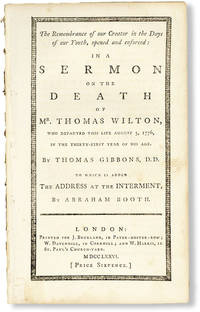
177649282London: J. Buckland 1776. First Edition. Octavo 20.5cm.; removed; 467pp.; title page serving as upper cover printed within single heavy funereal rule. Very Good and sound overall. Funeral oration by the nonconformist hymn writer including a detailed account of the agonizing death of the young Calvinist Thomas Wilton who appears to have suffered from an infected abscess. ESTC T94248. J. Buckland unknown
176820<p>Hardback.</p><p>Second Edition</p><p>excellent condition</p> E and C Dilly hardcover
179969603Edinburgh: J. Fairbai and others 1799. Early English edition. Octavo. viii 284 pp. Original calf with red morocco label. Calf dry and rubbed. A good copy.Abraham Booth 1734-1806 was a leading Baptist theologian of his day one of the most widely read Baptist authors of his era the prime mover in beginning the theological college that would become Regent’s Park College Oxford and the first London Baptist pastor to offer active support of the fledgling Baptist Missionary Society. This is his chief work first published in 1768 and it has been reprinted numerous times and remains in print today. J. Fairbai and others unknown
176566438vi xvi 190 pages illustrated with musical scores and notes throughout Published by C. and S. Thompson hardcover
1784005449Edinburg sic: John Bell 1784. This is a Very Good copy of the Second Edition stated of Bell's "Poets of Great Britain" Volume III only of original four. Polished calf binding with ruled gilt compartments and decorations on the spine; Titled in gilt; ends of the covers are decorated with gilt. Clean text; xxii continues with page 23 to page 271; with five pages of addenda and Contents at the rear. Engraved half-title page. There is a bookseller label and the remains of a partially-removed armorial bookplate on the front paste-down. Rubbed at the margins; the front gutter is cracked but is holding. An attractive little book. Second Edition. Full-Leather. Very Good/No Jacket. 16mo - over 5¾" - 6¾" tall. John Bell Hardcover
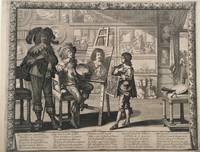
1750167Etching and engraving. D.1385 Blum 203. Image: 10 x 12½. Margins: 10½ x 14. books
1750167<p>Etching and engraving. D.1385 Blum 203. Image: 10 x 12½. Margins: 10½ x 14.</p>
180037722London 1800. Hand-coloured and colour-printed mezzotint engraving by Dunkerton. The most strikingly beautiful flower plates ever to be printed in England.<br/> <br/>"The plant shown in this picture Selenicereus grandiflorus L. Britton & Rose. is also known as the Moon Cactus from the moon-like appearance of the fully open flower. Thornton also says that. it was sometimes called the `Torch Thistle' as it `exhibits to the observer a figure equally grotesque as terrific with flowers possessing actually the blazing appearance of a torch.' The plant is a native of Jamaica and Cuba. This picture is one of the most arresting in the collection. The plant itself is of interest not only for its large and beautiful flowers but as a representative of those which growing in a hot and dry environment open their flowers at night for pollination by night-flying insects pollinators being scarce in such climates during the heat of the day. This has a curious effect where public botanic gardens are concerned since these are shut at night to visitors who thus never see the plant in full bloom." Ronald King. The Temple of Flora by Robert Thornton. 1981 p.74. Thornton's Temple of Flora is the greatest English colour-plate flower book. ".Thornton inherited a competent fortune and trained as a doctor. He appears to have had considerable success in practice and was appointed both physician to the Marylebone Dispensary and lecturer in medical botany at Guy's and St. Thomas's hospitals. But quite early in his career he embarked on his. great work. What Redouté produced under the patronage of L'Héritier Marie Antoinette the Empress Josephine Charles X and the Duchesse de Berry Thornton set out to do alone. Numerous important artists were engaged. twenty-eight paintings of flowers commissioned from Abraham Pether known as `Moonlight Pether' Philip Reinagle . Sydenham Edwards and Peter Henderson. The result. involved Thornton in desperate financial straits. In an attempt to extricate himself he organized the Royal Botanic Lottery under the patronage of the Prince Regent. it is easy to raise one's eyebrows at Thornton's unworldly and injudicious approach to publishing. But he produced. one of the loveliest books in the world" Alan Thomas Great Books and Book Collecting pp.142-144 First state of plate A. unknown books
1743185338Boston: S. Kneeland and T. Green 1743. Hardcover. Good pages are clean and clear. Missing title page and last two sermons. Rebound in white thick cardboard covers with cloth ties along spine; vi 110 pp. Full title: The necessity of holding fast the truth : Represented in three sermons on Rev. III. 3 : preached at New-York April 1742 : with an appendix relating to errors lately vented by some Moravians in those parts : to which are added a sermon on the priestly-office of Christ and another on the virtue of charity : together with a sermon of a Dutch divine on taking the little foxes faithfully translated. <br/>Includes: To the Reader on pages i-vi and signed by Benjamin Colman Thomas Prince John Webb William Cooper Thomas Foxcroft and Joshua Gee. The necessity of Holding Fast the Truth; Sermon II Sermon III Appendix. S. Kneeland and T. Green hardcover books
1743185338Boston: S. Kneeland and T. Green 1743. Hardcover. Good pages are clean and clear. Missing title page and last two sermons. Rebound in white thick cardboard covers with cloth ties along spine; vi 110 pp. Full title: The necessity of holding fast the truth : Represented in three sermons on Rev. III. 3 : preached at New-York April 1742 : with an appendix relating to errors lately vented by some Moravians in those parts : to which are added a sermon on the priestly-office of Christ and another on the virtue of charity : together with a sermon of a Dutch divine on taking the little foxes faithfully translated. <br /> Includes: To the Reader on pages i-vi and signed by Benjamin Colman Thomas Prince John Webb William Cooper Thomas Foxcroft and Joshua Gee. The necessity of Holding Fast the Truth; Sermon II Sermon III Appendix. S. Kneeland and T. Green hardcover
1767JC14337London: Printed by T. Jones. and Sold by T. Payne. / Printed by W. Oliver. and Sold by T. Payne and Son. et al 1767-8. First Edition. Hardcover. Very Good. Contemporary specked calf ornate gilt-stamped border on boards gilt-stamped lettering and ornament in spine compartments 5 raised bands; complete set of 9 volumes published and bound as Volume I Parts i-ii Volume II Parts i-iii Volume III Parts i-iv 8vo; pp. xlvi 384; 384; 315; 335; 540 3 blank errata; 403; 432; 462; 505 1 errata. Volumes I-II bound as the first 5 volumes of this set printed by T. Jones 1768 and with the armorial bookplate of Reverend John St. John of Farley; Volume III the last 4 volumes of this set printed by W. Oliver 1767. Bindings just a bit worn with some bumping and very light chipping along spines and edges of boards. Contents somewhat tanned with some faint foxing here and there but overall tight bright clean and unmarked. A nice set of the rare first edition difficult to find in a straight run. <br/><br/> Printed by T. Jones... and Sold by T. Payne... / Printed by W. Oliver... and Sold by T. Payne and Son... [et al] hardcover books
1768EXP4-B-3London: T. Jones 1768-1778. Leather. Fair. 8.5" by 5". None. A set of five very scarce volumes by Abraham Tucker under the pen name of Edward Search in leather binding. Very important texts and all contemporary editions are extremely rare. As these were published separately they are usually seen individually and a five volume collection is highly unusal. The original work was seven volumes broken in to parts. Not special externally and would really benefit from the attentions of a good binder but we keep them here are entirely original. Bound and marked as an eight volume set this collection comprises Volumes III Volume II Part I- 1768 Volume V Volume II part III-1768 Volume VI Volume III Part I- 1778 Volume VI IV Part II- 1777 and Volume VIII Volume V Part III- 1777 The volumes are major works of eighteenth century philosophy and theology anticipating utilitarianism and holding that "every man's satisfaction" is the ultimate end of any action. Contains the bookplate of one George Phillips to the pastedown of volume III. In calf binding with gilt detailing. Externally there is wear to the boards joints extremities and backstrips with tenderness to hinges. The front board is detached but present to the sixth volume and missing to the eighth. Internally the pages are firmly bound but are somewhat spotted and age-toned with some creasing. Overall: FAIR due to binding though internally presentable. Fair T. Jones hardcover
1767JC14337London: Printed by T. Jones. and Sold by T. Payne. / Printed by W. Oliver. and Sold by T. Payne and Son. et al 1767-8. First Edition. Hardcover. Very Good. Contemporary specked calf ornate gilt-stamped border on boards gilt-stamped lettering and ornament in spine compartments 5 raised bands; complete set of 9 volumes published and bound as Volume I Parts i-ii Volume II Parts i-iii Volume III Parts i-iv 8vo; pp. xlvi 384; 384; 315; 335; 540 3 blank errata; 403; 432; 462; 505 1 errata. Volumes I-II bound as the first 5 volumes of this set printed by T. Jones 1768 and with the armorial bookplate of Reverend John St. John of Farley; Volume III the last 4 volumes of this set printed by W. Oliver 1767. Several boards detached. Nevertheless a nice set of the rare first edition difficult to find in a straight run. Images available upon request. <br/><br/> Printed by T. Jones... and Sold by T. Payne... / Printed by W. Oliver... and Sold by T. Payne and Son... [et al] hardcover
1768150964London: Printed by T. Jones & W. Oliver 1768 & 1777. The complete set of an influential philosophical work First edition a complete set of Tucker's magnum opus which outlined a vast and idiosyncratic philosophical system and which had a noted influence on his philosophical contemporaries. The set pairs the five volumes he published in 1768 with the four-volume continuation posthumously published in 1777 uniformly bound in contemporary calf and very scarce thus. "Although an occasionally eccentric and digressive text The Light of Nature Pursued enjoyed a high reputation from its first appearance. In the introduction to his Moral and Political Philosophy 1785 William Paley emphasized his deep indebtedness to Tucker in expounding his ethical theory. Paley considered Tucker to be a very original thinker. His work was also highly praised by Sir James MacIntosh who had used his ideas in his lectures on ethics. Mildmay had looked to MacIntosh to provide an introduction to his edition of the work but MacIntosh had been too busy to oblige. Hazlitt produced an abridged edition in 1807. Tucker's speculations also had some influence on Malthus whose family were resident in Surrey. Tucker's style is direct conversational and full of deliberately familiar metaphors and analogies. He was very much an amateur metaphysician and The Light of Nature Pursued is noticeably unsystematic and occasionally rambling in tone. His theory of consciousness and knowledge owes a great deal to John Locke though his speculations about the nervous system and the brain are closer to those of David Hartley whom he nevertheless disliked and whose theories he criticized" ODNB. The first five volumes were published under Tucker's pseudonym of "Edward Search" but his daughter Judith discarded this pseudonym when arranging the posthumous publication of the latter four volumes. Together 9 vols octavo 212 x 130 mm. Contemporary calf red morocco labels red speckled edges. Book label of bookseller and bibliographer John Stephens 1948-2006. Some slight wear around extremities occasional light foxing or worming but contents otherwise fresh; a nice set. ESTC T109651 & T153498. unknown
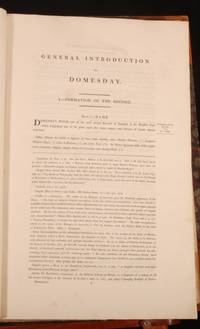
1783SET21-A-1London: Not Stated 1783; 1811-1816. Leather. Good Only. 18" by 11". None. The 1783 Domesday Book with 1816 Additional Volumes. The text of this work is in Latin with 'Introductions' in English. Whilst title pages for Volumes I and II were issued in 1816 these volumes are bound without as usual. Publication Information for Volumes I and II from the ESTC. Citation number: T97297. System Number: 006367139 Volume III includes the informative 1816 'Introduction' by Henry Ellis an English librarian. He was educated at the Mercers' School and St John's College Oxford where he acted as an assistant at the Bodleian Library. He was first appointed to a position at the British Museum in 1800 and was chief librarian from 1827 to 1856. Ellis was knighted in 1833. An important work normally commanding £3000- £4000. We have discounted these to allow for the rebinding they deserve. With two interesting ink inscriptions concerning the text including one from 'the eminent antiquarian' David Turner in Volume III. The Domesday Book is the record of the great survey of England completed in 1086 executed for William I of England otherwise known as 'William the Conqueror'. It was written in Latin although there were some vernacular words inserted for native terms with no previous Latin equivalent and the text was highly abbreviated. Abraham Farley d.1791 was a lifelong civil servant who was appointed deputy chamberlain of the Exchequer in 1736 and soon became involved with the public records at the Chapter House of Westminster Abbey. First amongst these was the Domesday Book of which Farley became custodian granting visiting antiquaries access to the Book and making transcripts for a fee. In later life Farley was to produce the first printed edition of Domesday Book. Following a Parliamentary order in 1767 Farley was appointed co-editor of the Domesday printing project in 1770 alongside Charles Morton of the British Museum. Sir Henry Ellis 1777 1869 was an English librarian. He was educated at the Mercers' School and St John's College Oxford where he acted as an assistant at the Bodleian Library. He was first appointed to a position at the British Museum in 1800 and was chief librarian from 1827 to 1856. Ellis was knighted in 1833. He edited various works on antiques and wrote an Introduction to Domesday Book. In a half calf binding with marbled paper-covered boards. Externally a trifle rubbed resulting in small loss to leather on spine volumes I and IV. Backstrip partially detached to volume II missing to volume III. Boards detached. Internally generally firmly bound. Pages bright and clean with scattered spotting. Pages occasionally age toned to edges. Nameplates and institutional labels to front pastedowns. Good Only Not Stated hardcover
17183173London: W. Pearson 1718. First edition. Very Good. Small folio 240 x 200 mm. Collates 4 xiv 175 1 blank: complete with an engraved vignette on title-page numerous engraved head and tail pieces and initials and an engraved vignette headpiece on page 1. With a dedication to Sir Isaac Newton. Contemporary speckled calf rebacked to style. Boards double-ruled in gilt. Spine with a red morocco label lettered and ruled in gilt. All edges speckled brown. Some minor soiling to final two pages. Some light toning from glue on endpaper edges. Previous owner's armorial bookplate on front pastedown. Overall a very good copy. <br/><br/>Abraham De Moivre was a mathematician and a close friend of Sir Isaac Newton to whom he dedicated the first edition of this work. "His work on the theory of probability surpasses anything done by any other mathematician except Laplace" Cajori. "De Moivre's representation of the solutions of the then current problems of games of chance tended to be more general than those of Montmort. In addition he developed a series of algebraic and analytic tools for the theory of probability like a 'new algebra' for the solution of the problem of coincidences which foreshadowed Boolean algebra the method of generating functions or the theory of recurrent series for the solution of differential equations. In the Doctrine de Moivre offered an introduction which contains the main concepts such as probability condition probability expectation dependent and independent events the multiplication rule and the binomial distribution" DNB. Very Good. W. Pearson unknown books
1756S13188London:: A. Millar 1756. 1756. Quarto. 4 xi 1 errata 348 pp. Portrait medallion vignette on title; mild foxing but barely noticeable. Original full calf red gilt-stamped leather spine label; hinges repaired with calf inner joints strengthened corners worn all preserving original spine. Bookseller's ticket: "Sold by Carpenter & Co. 14 Old Bond Street" London. Early ownership ink signature of Th. Spencer; penciled initials of F.N.D. see below. Very good. A KEY WORK BY THE FATHER OF PROBABILITY THEORY. Third edition. This is a key work by the father of probability theory in which major steps in the measurement of uncertainty were achieved. De Moivre is "best known in statistical circles for his famous large-sample approximation to the binomial distribution whose generalization is now referred to as the Central Limit Theorem. De Moivre was one of the great pioneers of classical probability theory." Bellhouse-Genest p.1. It is the first systematic treatment of probability in English. Abraham De Moivre became with Edmund Halley a founder of English actuarial science. The author's dedicatory letter is address to Lord George Carpenter 1702-1749 the first edition had been dedicated to Newton where the author states emphatically "that this Doctrine is so far from encouraging Play that it is rather a Guard against it. . ." DNB vol. 38 p.116. / "The first edition of this work contains 175 pages the second edition 258 pages and the third 348 pages. The following list will indicate the parts which are new in the third edition: the Remark pages 30/33 and pages 48 & 49 the greater part of the second Corollary pages 64/66 the Examples page 88; the Scholium page 95 the Remark page 149 and pages 151/159 the fourth Corollary page 162 the second Corollary pages 176/179 the note at the foot of page 187 the Remark pages 251/254. The part on life annuities is very much changed. The Introduction is very much fuller than the corresponding part of the first edition. In his third edition De Moivre draws attention to the convenience of approximating to a fraction with a large numerator and denominator by continued fractions which he calls "the Method proposed by Dr. Wallis Huygens and others". He gives the rule for the formation of the successive convergents. This third edition contains 74 problems exclusive of those relating to life annuities in the first edition there were 53 problems. The pages 220/229 contains one of De Moivre's most valuable contributions to mathematics namely that of Recurring series. Pages 261/328 are devoted to Annuities on lives ; an Appendix finishes the book occupying pages 329/348 : this also relates principally to annuities but it contains a few notes on the subject of probability." :: Todhunter. A very full account of the above third edition will be found in Todhunter's History of the theory of probability. / "De Moivre's first book on probability was based upon a short memoir entitled De mensura sortis published in the 1711 volume of the Philosophical Transactions. The 1718 first edition is essentially a gambler's manual giving a systematic presentation of the arithmetic principles upon which are based the solution of problems concerning the advantage of players and size of wager which may be lain in a wide variety of games of chance. Walker. It does not contain De Moivre's work on the normal approximation of the binomial probability distribution which ranks as the most memorable of his discoveries; this discovery was first printed in its entirety in 1733 in a Latin pamphlet which was later translated into English and incorporated in successively expanded versions in the second 1738 and posthumous third 1756 edition of The doctrine of chances." Norman. / In terms of mathematics applied to the human actuarial lifespan "De Moivre French Huguenot mathematician and demographer formulated the hypothesis that among a body of persons over a certain age the successive annual decreases by death are nearly equal." Garrison & Morton. / "De Moivre's work on the theory of probability surpasses anything done by any other mathematician except Laplace. His principal contributions are his investigations respecting the duration of play his theory of recurring series and his extension of the value of Bernouilli's theorem by the aid of Sterling's theorem". Cajori. / De Moivre born at Vitry received a varied education and settled in London as a Huguenot refugee in 1688. In England he continued his study of mathematics while working as a tutor. He is said to have acquired and read a copy of Newton's Principia and even to have carried loose sheets around with him to study at every available moment. This method of study worked so well that not only did he become one of England's foremost mathematicians but Newton in old age was in the habit of referring questions about the Principia to De Moivre. De Moivre's Doctrines of Chance is in fact a revised and expanded translation of his essay De Mensura Sortis which had been published in Latin in the Philosophical Transactions in 1711. In its Latin form it thus preceded Jacob Bernoulli's Ars Conjectandi 1713 by a full two years. / De Moivre was a French mathematician famous for De Moivre's formula which links complex numbers and trigonometry and for his work on the normal distribution and probability theory. He was elected a Fellow of the Royal Society in 1697 and was a friend of Isaac Newton Edmund Halley and James Stirling. Among his fellow Huguenot exiles in England he was a colleague of the editor and translator Pierre des Maizeaux. / Shafer points out that De Moivre one of Jacob Bernoulli's successors was among those who were applying Huygens' theories to both games and economies p. 11. He points out that the 1718 first edition was influenced by Bermoulli in that he used the word "probability" which was a word he did not use in his De mensura sortis. He continues: "We should not exaggerate De Moivre's importance in the eighteenth century. In retrospect he represents the pat that mathematical probability followed but he was hardly a philosopher of Jacob's caliber and Jacob retained a strong influence throughout the century among those who wanted to understand probability philosophically. Jacob's and Hooper's rules survived the whole course of that century in the works of philosophically sophisticated writers such as Lambert and Diderot. They disappeared only after Bayesian alternatives were developed by Laplace." pp. 13-14. Steve Stigler and Lorraine Daston expand on the use of the word "probability" in the eighteenth century. / Theodore Porter UCLA writes that De Moivre introduced the astronomer's law error to probability theory p. 93. "Like most early probability mathematics it first arose in the context of games of chance; it appeared as the limit of the binomial distribution. Because of its usefulness in combination and permutation problems the binomial had become the heart of the doctrine of chances. . . De Moivre then showed in a paper of 1733 reprinted in 1738 in the second edition of his Doctrine of Chances that the exponential error function gave a very good approximation to the distribution of possible outcomes for problems like the result of 1000 coin tosses Now for the first time it was practicable to apply probability theory to indefinitely large numbers of independent events." / PROVENANCE: I Thomas Spencer undetermined. II F.N.D. :: Florence Nightingale David 1909-1993 also known as F. N. David was an English statistician born in Ivington Herefordshire England. She was named after Florence Nightingale who was a friend of her parents. David did not like her forenames and thus always referred to herself as "F. N. David". She attended the Bedford College for Women in London earning her degree in mathematics in 1931. She then joined University College London to work with Karl Pearson who obtained a scholarship for her working as his research assistant resulting in a doctorate received in 1938 Pearson died in 1934. In 1938 her first book was published Tables of the Correlation Coefficient. During that period she was working with Jerzy Neyman. "During World War II she served as Experimental Officer in the Ordnance Board for the Ministry of Supply Senior Statistician for the Research and Experiments Department for the Ministry of Home Security Member of the Land Mines Committee of the Scientific Advisory Council and as Scientific Advisor on Mines to the Military Experimental Establishment. Her work during this time ranged from the study of bombing patterns and damage to the problem of discovering the placement of enemy land mines and a methodology for randomly placing land mines so as to avoid the semblance of any pattern in their placement." Garber et.al. After WWII she came back to University College London and was appointed professor in 1962. Five or six years later she took a position at the University of California Riverside becoming head of the Department of Statistics in 1970. Retiring in 1977 she came to Berkeley and continued her research. this book bears her initials on the Francis Galton Laboratory bookplate; she gave her books to Margaret Stein of Stanford University. See: M. J. Garber D. V. Gokhale J. M. Utts R. J. Beaver Chair "Florence Nightingale David Statistics: Riverside." Obituary; "A conversation with F.N. David" Statistical Science Vol. 4 No. 3235-246 by Nan Laird; J. Utts "Florence Nightingale David 1909-1993: Obituary" Biometrics 1993 49 1289-1291; Norman L. Johnson & Samuel Kotz eds. Leading Personalities in Statistical Sciences from the Seventeenth Century to the Present Wiley 1997 pp. 91-92. / REFERENCES: Babson 181 1st ed.; Ball A short account of the history of mathematics pp. 383-4; BM Readex Vol. 17 p. 751; Cajori History of Mathematics pp. 229-30; DNB vol. 38 p.116; Kress S.2793; Institute of Actuaries 1935 p. 39; Mansutti 504; Norman 1529 1st ed.; Pearson The History of Statistics in the 17th & 18th Centuries. . . pp. 155-60 165-66; Smith Source book in mathematics pp. 440-54; Stigler The History of Statistics: The Measurement of Uncertainty before 1900 1986 p. 70; Todhunter History of the theory of probability; Walker pp. 12-13; Wellcome IV p. 149; Westergaard pp. 104-5. Not in Goldsmiths or Hanson. / See: Raymond Clare Archibald "Abraham de Moivre"; David F.N. Games Gods and Gambling; The origins and history of probability and statistical ideas . . . 1962 pp. 161-178. A. Millar, 1756. hardcover books