Lincoln AbrahamABAA
775 résultats
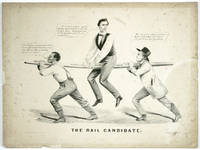
1860WRCAM37633New York: Currier & Ives 1860. Lithograph 13 1/2 x 18 inches. Moderate age-toning foxing and soiling. Moderate browning in margins. Small closed tears and chips in margins one moderate-size closed tear in left margin. A fair copy. A lithographic political cartoon published by Currier & Ives commenting upon the anti- slavery plank of the 1860 Republican platform. "The 'essential' anti-Lincoln cartoon of 1860" - Holzer et al. Abraham Lincoln is shown being carried uncomfortably in the middle of a split wooden rail an allusion to both the platform and to Lincoln's backwoods origins. Supporting the left end of the rail is a black man in simple working clothes who states "Dis N asterisks ours strong and willin' but its awful hard work to carry Old Massa Abe on nothing but dis ere rail!!" Holding the right end of the rail is well-dressed newspaper editor and strong Lincoln supporter Horace Greeley identified by a copy of his NEW YORK TRIBUNE in his coat pocket. Greeley tells Lincoln "We can prove that you have split rails & that will ensure your election to the Presidency." Lincoln replies "It is true I have split rails but I begin to feel as if this rail would split me it's the hardest stick I ever straddled." Lincoln is depicted - visually and thematically - as a straddler at best while the images of Greeley and the African American supporting the rail are derisive. <br> <br> A finely drawn and insightful political cartoon from the 1860 election. REILLY AMERICAN POLITICAL PRINTS 1860-31. WEITENKAMPF p.123. CURRIER & IVES: CATALOGUE RAISONNÉ 5478. Harold Holzer Gabor Borritt & Mark Neely THE LINCOLN IMAGE p.38 figure 18. Currier & Ives hardcover books
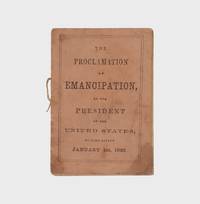
1862WRCAM55729Boston: J.M. Forbes 1862. 7pp. Miniature 3 1/4 x 2 1/8 inches. Original printed salmon wrappers. Slight soiling to wrappers light tanning. Very good. In a cloth chemise and half morocco and cloth slipcase spine gilt. The first and only contemporary printing of Lincoln's historic act in separate pamphlet form the seventh edition overall. The preliminary proclamation of the Emancipation Proclamation was issued on September 22 1862 shortly following the Battle of Antietam and declared the freedom of all slaves in any Confederate state that did not return to Union control by January 1 1863. A quotation by Alexander Stephens "Vice President of the so-called Confederate States" entitled "Slavery the Chief Corner- Stone" is printed on the rear wrapper. This small pamphlet was printed by John Murray Forbes in Boston for distribution by Union soldiers to blacks at the front lines and legend has it that he printed a million copies. Its scarcity in institutions and in the market however would seem to belie that notion; it is among the rarest of editions of the Proclamation no doubt because of its small size. EBERSTADT LINCOLN'S EMANCIPATION PROCLAMATION 7. MONAGHAN 147. J.M. Forbes hardcover books
1862376858Boston: J.M. Forbes 1862. 7 1 blankpp. Miniature 3-1/4x2-1/8 inches. Original wrappers unstitched. Small repair to tears at gutter. Housed in a blue morocco backed box. 7 1 blankpp. Miniature 3-1/4x2-1/8 inches. The first and only contemporary printing of Lincoln's historic preliminary Emancipation Proclamation in separate pamphlet form. <br /> <br /> This small pamphlet was printed by John Murray Forbes a Boston industrialist and abolitionist for distribution by Union soldiers to African Americans in the south. In 1899 the publisher's daughter recalled the genesis of this pocket-sized edition: "With the view of placing the Proclamation of Emancipation in the hands of the negroes themselves my father had printed 1000000 copies on small slips one and half inches square put into packages of fifty each and distributed among the Northern soldiers at the front who scattered them about among the blacks while on the march. Massachusetts Senator Charles Sumner approved the idea ." Sara Forbes Hughes Letters and Recollections of John Murray Forbes pp. 348-49. Indeed in a letter to Forbes on Christmas Day 1862 Sumner asked "Why not send to all the hospitals camps posts The more the better" However the diminutive printing's scarcity in institutions and in the market would seem to belie that notion as it is among the rarest of editions of the Proclamation no doubt in part because of its small size. <br /> <br /> The preliminary proclamation of the Emancipation Proclamation was issued on September 22 1862 shortly following the Battle of Antietam and declared the freedom of all slaves in any Confederate state that did not return to Union control by January 1 1863. The text of the final official proclamation was the result of Lincoln's consultation with his cabinet on the morning of Dec. 31 1862 in which many changes were suggested. Lincoln then retired to consider all the cabinet members' recommendations and compose the final proclamation which he completed late in the day just before it would take effect. <br /> <br /> A signal moment in American history and the ideological raison d'etre of America's bloodiest war. Eberstadt 7; Monaghan 147 J.M. Forbes unknown
186530432Boston: Walker Fuller and Company 1865. Hardcover. Early Printing "Third Thousand." 4.25 x 6.5in. viii. 186pp. iv. Publisher's pebbled cloth boards with gilt titling. NEAR FINE. Shows marginal shelf rubbing of the extremities else Fine. An exceptionally maintained copy. As pictured. Walker, Fuller, and Company hardcover
18653116807Very Good with no dust jacket. 1865. First Edition; First Printing. Hardcover. First edition. Very good copy in maroon cloth with gilt titles and top edge without dust jacket as issued. Edges of cloth faintly foxed. Top edge lightly dulled. Previous owner's name inked on first blank with discreet blind-stamp. Short splits at top & bottom edge of front & rear hinges. 4pps of advertisements at rear of text. Published a month after Lincoln's assassination. ; 8vo 8" - 9" tall; 186 pages . hardcover
1862289963Washington. : Government Printing Office. 1862 . Publisher’s brown blindstamped cloth gilt spine title. . Good plus damp spotting to front cover spine title faded ink name to pastedown light toning to some pages. 23x15 cm. . A collection of correspondence regarding Mexican foreign relations. Mexico was of concern to the United States due to the French intervention and installation Maximilian and the prospect of a Confederate alliance with Mexico. weight: 1.5 lb. (Government Printing Office). hardcover books
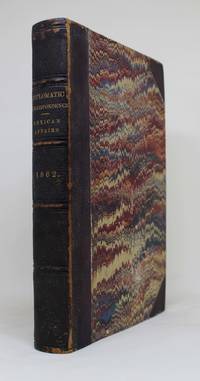
186234963Washington D.C.: U.S. Government Printing Office 1862. First edition. Three quarter morocco over marbled boards four raised bands gilt titles all edges marbled. A very good or better copy with minor scuffing and edgewearindex penciled on rear blank. 434 pp. 8vo. 37th Congress 2 Session Ex. Doc. No. 100. In October 1861 England France and Spain signed a treaty to force Mexican reparations; the English and Spanish withdrew but the French remained unseating Benito Juarez and installing Maximilian as Emperor . This was of grave concern to Lincoln and the North and a violation of the Monroe Doctrine. Also of concern was the relations between the Confederacy and Mexico. Provenance: Library of James Torr Harmer with his bookplate on front pastedown. [U.S. Government Printing Office] hardcover books
1863244615Washington D.C.: GPO 1863. First edition. 802 pp. 1 vols. Thick 8vo. Quarter morocco pine perished fine internally. Bookplate of James Torr Harmer. First edition. 802 pp. 1 vols. Thick 8vo. <br/><br/> GPO unknown
1862289963Washington.: Government Printing Office. 1862. Publisher’s brown blindstamped cloth gilt spine title. Good plus damp spotting to front cover spine title faded ink name to pastedown light toning to some pages. 23x15 cm. A collection of correspondence regarding Mexican foreign relations. Mexico was of concern to the United States due to the French intervention and installation Maximilian and the prospect of a Confederate alliance with Mexico. weight: 1.5 lb. (Government Printing Office). hardcover
1862RMP442<p>Washington DC U.S. Government Printing Office House of Representatives 1862<br /><br />8º. 434pp. Three quarter morocco over marbled boards four raised bands gilt titles all edges marbled. First edition. A very good or better copy with minor scuffing and edgewearindex penciled on rear blank.</p><p>37th Congress 2 Session Ex. Doc. No. 100. In October 1861 England France and Spain signed a treaty to force Mexican reparations; the English and Spanish withdrew but the French remained unseating Benito Juarez and installing Maximilian as Emperor . This was of grave concern to Lincoln and the North and a violation of the Monroe Doctrine. Also of concern was the relations between the Confederacy and Mexico. <br />Provenance: Library of James Torr Harmer with his bookplate on front pastedown.</p><p>With a list of Documents relating to Mexican Affairs accompanying the President´s message in reply to the resolution of the <em><strong>House of Representatives of March 3 1862.</strong></em></p><p>A very good copy with minor scuffing and edgewearindex penciled on rear blank.</p> U.S. Government Printing Office hardcover
186037152New York: Currier & Ives 1860. Lithograph broadside 13-1/2" x 18." Several closed tears two of them repaired with old tape on verso tear line affecting Seward's midsection. Good.<br/><br/> This scarce lithograph is a detailed humorous "parody on the field of presidential candidates and their supporters in the 1860 campaign." Bell and Everett for the Constitutional Union Party are there: Bell a muscle man holds Everett aloft on a barbell. Horace Greeley's "political ambitions are mocked by the artist who shows him vainly attempting to climb up a horizontal bar." Lincoln is at the center: he has "successfully mounted a balance beam constructed of wooden rails." The New York Courier's James Watson Webb's does a backward somersault in the foreground. <br/> The broadside evidently issued after the parties' nominating Conventions because Seward is depicted as a cripple "on crutches and with bandaged feet." Breckinridge and Douglas "the two sectional Democratic candidates compete in a boxing match."<br/>Reilly 1860-34 quotations are from Reilly. Weitenkampf 123. OCLC records copies at AAS Clements and Lincoln Pres. Lib. under three accession numbers as of October 2020. Currier & Ives unknown books
1864WB163441864. Hardcover. Very Good. Rare broadside tipped into a copy of The Early Life of Abraham Lincoln: Containing many unpublished documents and unpublished reminiscences of Lincoln's early friends. TARBELL Ida M. Assisted by James McCann Davis. Published by McClure New York 1896. The broadside printed in two columns presents the platforms of the Republicans who in June in Baltimore nominated Lincoln and the Democrats who in August in Chicago nominated McClellan. <br /> <br/><br/> hardcover
1851biblio2482<p>The Pilgrim for the Purchaser; 3d Edition 1851. NearFine Hardcover Original Gray cloth Gilt title and stamping on the spine no dj. Just a hint of wear to the top of the spine. The Book is Free of marks inscriptions etc. throughout. Strong tight binding perfect hinges. 6.3"x4.1"x0.8". be10106.</p> The Pilgrim for the Purchaser hardcover
1865212130Philadelphia: The Philadelphia Inquirer 1865. 8 pp. 1 vols. Folio. Fine. 8 pp. 1 vols. Folio. The Philadelphia Inquirer unknown books
18936391893. Wood-engraving. 280mm by 395mm sheet. From 'The Illustrated London News' 1893. Text on reverse as issued.<br /> Robert J Abraham fl.1877-1909 was an English artist who lived in Stokeon-Trent and London. He exhibited at the Royal Academy on several occasions. unknown
180427999London 1804. Hand-coloured and colour-printed aquatint with stipple and line engraving by Elmes. Paper watermarked 1804. The most strikingly beautiful flower plates ever to be printed in England.<br/> <br/>"The Persian Cyclamen Cyclamen persicum Miller parent of the florist's cyclamen. is a native of the countries and islands at the eastern end of the Mediterranean but not of Persia itself. It is the largest flowered of an attractive genus of small plants much grown in modern times by connoisseurs. The Persian Cyclamen was not the first of its kind to become known in western Europe. Cyclamen europeaum the `Bleeding Nun' as it was called was thought to be dangerous to pregnant women: any unfortunate lady in this condition who stepped over it might immediately miscarry. John Gerrard the Elizabethan herbalist believed this implicitly and describes how he fenced his plants around with sticks with others laid across them `lest any woman should by lamentable experiment find my words to be true by stepping over the same.' When the baby was nearing full term and delivery was to be encouraged wearing of the disc-like tuber `hanged about' the expectant mothers had a salutary effect and Gerrard told his wife to use it when attending confinements. Its use by midwifes dates back to the days of the Greeks." Ronald King. The Temple of Flora by Robert Thornton. 1981 p. 52. Thornton's Temple of Flora is the greatest English colour-plate flower book. ".Thornton inherited a competent fortune and trained as a doctor. He appears to have had considerable success in practice and was appointed both physician to the Marylebone Dispensary and lecturer in medical botany at Guy's and St. Thomas's hospitals. But quite early in his career he embarked on his. great work. What Redouté produced under the patronage of L'Héritier Marie Antoinette the Empress Josephine Charles X and the Duchesse de Berry Thornton set out to do alone. Numerous important artists were engaged. twenty-eight paintings of flowers commissioned from Abraham Pether known as `Moonlight Pether' Philip Reinagle . Sydenham Edwards and Peter Henderson. The result. involved Thornton in desperate financial straits. In an attempt to extricate himself he organized the Royal Botanic Lottery under the patronage of the Prince Regent. it is easy to raise one's eyebrows at Thornton's unworldly and injudicious approach to publishing. But he produced. one of the loveliest books in the world" Alan Thomas Great Books and Book Collecting pp.142-144. Third state of three of this plate from the Temple of Flora. `In the first state the top the castle is indistinct and has no pinnacles on the towers and this is the first feature to inspect. The hillside is pure aquatint; the shading behind the cyclamen flowers is lightly cross-hatched while the tree trunk to the right has only a few lines on it. In the second state the castle is more prominent and five distinct sharp pinnacles have been added while many extra etched lines are to be seen - notably behind the cyclamen flowers; on the tree trunk; and under the cyclamen leaves on the left which themselves stand out more sharply. The principal change in the third state is the addition of the aquatint to the sky on the left so that only a streak of light remains above the mountains while in the earlier states the light reached the top corner. The leaves of the cyclamen now have. light and dark patches the coarse-grained aquatint has been added to the middle distance. Much additional aquatinting has been applied to other parts of the plate. The most easily-noticed difference however are the changes in the castle between states one and two and in the sky between states two three." Handasyde Buchanan. Thornton's Temple of Flora 1951 p.15. Third state of three of this plate from the Temple of Flora. unknown books
1849128285New York J. Wiley 1849. Second Edition. Hardback. Fine copy in the original gilt-blocked cloth. Slightest suggestion only of dust-dulling to the panel edges. Remains particularly well-preserved overall; tight bright clean and strong. ; 77 pages; Description: viii 77 p. 22 cm. Subjects: Cholera. New York, J. Wiley hardcover
183624346.991836. No binding. Fine. Autograph Letter Signed to Mary S. Owens December 13 1836 2 pp. 9 3/4 x 7 3/4 in. ""Write back as soon as you get this and if possible say something that will please me for really I have not been pleased since I left you.""Here Lincoln perfectly demonstrates what Owens later described as deficiencies ""in those little links which make up the chain of a woman's happiness."" Rather than expressing his feelings for Owens Lincoln complains about his health and discusses political issues swirling in the Illinois General Assembly. Although inept at love the letter offers rare insight into the young representative's thoughts on a variety of political issues. In this highly important letter to Mary Owens a self-absorbed Lincoln complains to his potential spouse of his health both physical and mental and discusses political issues to the point that he describes his own letter as ""dry and stupid."" Perhaps more revealing than he realized it illustrates the tension in Lincoln's early life between matters of the head with which he was comfortable and matters of the heart with which he clearly was not. Complete Transcript Vandalia Decr 13. 1836Mary I have been sick ever since my arrival here or I should have written sooner. It is but little difference however as I have verry little even yet to write. And more the longer I can avoid the mortification of looking in the Post Office for your letter and not finding it the better. You see I am mad about that old letter yet. I dont like verry well to risk you again. I'll try you once more anyhow. The new State House is not yet finished and consequently the legislature is doing little or nothing. The Governor delivered an inflamitory political message and it is expected there will be some sparring between the parties about it as soon as the two Houses get to business. Taylor delivered up his petitions for the New County to one of our members this morning. I am told that he despairs of its success on account of all the members from Morgan County opposing it. There are names enough on the petitions I think to justify the members from our county in going for it; but if the members from Morgan oppose it which they say they will the chance will be bad. Our chance to take the seat of Government to Springfield is better than I expected. An Internal Improvement Convention was held here since we met which recommended a loan of several millions of dollars on the faith of the state to construct Rail Roads. Some of the legislature are for it and some against it; which has the majority I can <2> not tell. There is great strife and struggling for the office of U.S. Senator here at this time. It is probable we shall ease their pains in a few days. The opposition men have no candidate of their own and consequently they smile as complacently at the angry snarls of the contending Van Buren candidates and their respective friends as the Christian does at Satan's rage. You recollect I mentioned in the outset of this letter that I had been unwell. That is the fact though I belive I am about well now; but that with other things I can not account for have conspired and have gotten my spirits so low that I feel that I would rather be any place in the world than here. I really can not endure the thought of staying here ten weeks. Write back as soon as you get this and if possible say something that will please me for really I have not been pleased since I left you. This letter is so dry and stupid that I am ashamed to send it but with my present feelings I can not do any better. Give my respects to Mr & Mrs Abell and family. Your friend LincolnMiss Mary S. OwensHistoric BackgroundThis is one of the ten oldest Lincoln letters known to have survived. Although 11 leaves 9 of which are in institutions from Lincoln's educational sum book a few documents written or signed by Abraham Lincoln in 1832 relating to his service in the Black Hawk War again mos. See website for full description books
183624346.99<p>1836. No binding. Fine. Autograph Letter Signed to Mary S. Owens December 13 1836 2 pp. 9 3/4 x 7 3/4 in. ""Write back as soon as you get this and if possible say something that will please me for really I have not been pleased since I left you.""Here Lincoln perfectly demonstrates what Owens later described as deficiencies ""in those little links which make up the chain of a woman's happiness."" Rather than expressing his feelings for Owens Lincoln complains about his health and discusses political issues swirling in the Illinois General Assembly. Although inept at love the letter offers rare insight into the young representative's thoughts on a variety of political issues. In this highly important letter to Mary Owens a self-absorbed Lincoln complains to his potential spouse of his health both physical and mental and discusses political issues to the point that he describes his own letter as ""dry and stupid."" Perhaps more revealing than he realized it illustrates the tension in Lincoln's early life between matters of the head with which he was comfortable and matters of the heart with which he clearly was not. Complete Transcript Vandalia Decr 13. 1836Mary I have been sick ever since my arrival here or I should have written sooner. It is but little difference however as I have verry little even yet to write. And more the longer I can avoid the mortification of looking in the Post Office for your letter and not finding it the better. You see I am mad about that old letter yet. I dont like verry well to risk you again. I'll try you once more anyhow. The new State House is not yet finished and consequently the legislature is doing little or nothing. The Governor delivered an inflamitory political message and it is expected there will be some sparring between the parties about it as soon as the two Houses get to business. Taylor delivered up his petitions for the New County to one of our members this morning. I am told that he despairs of its success on account of all the members from Morgan County opposing it. There are names enough on the petitions I think to justify the members from our county in going for it; but if the members from Morgan oppose it which they say they will the chance will be bad. Our chance to take the seat of Government to Springfield is better than I expected. An Internal Improvement Convention was held here since we met which recommended a loan of several millions of dollars on the faith of the state to construct Rail Roads. Some of the legislature are for it and some against it; which has the majority I can <2> not tell. There is great strife and struggling for the office of U.S. Senator here at this time. It is probable we shall ease their pains in a few days. The opposition men have no candidate of their own and consequently they smile as complacently at the angry snarls of the contending Van Buren candidates and their respective friends as the Christian does at Satan's rage. You recollect I mentioned in the outset of this letter that I had been unwell. That is the fact though I belive I am about well now; but that with other things I can not account for have conspired and have gotten my spirits so low that I feel that I would rather be any place in the world than here. I really can not endure the thought of staying here ten weeks. Write back as soon as you get this and if possible say something that will please me for really I have not been pleased since I left you. This letter is so dry and stupid that I am ashamed to send it but with my present feelings I can not do any better. Give my respects to Mr & Mrs Abell and family. Your friend LincolnMiss Mary S. OwensHistoric BackgroundThis is one of the ten oldest Lincoln letters known to have survived. Although 11 leaves 9 of which are in institutions from Lincoln's educational sum book a few documents written or signed by Abraham Lincoln in 1832 relating to his service in the Black Hawk War again mos. See website for full description</p>
1822ZB1325179London: John Murray 1822. Price HAS BEEN REDUCED by 10% until Monday June 29 SALE item 257 iv 205 pp. late 19th century quarter leather & cloth covered boards covers worn and now lacking the leather spine cover masonic book plate to the front paste down else internally clean & tight. - If you are reading this this item is actually physically in our stock and ready for shipment once ordered. We are not bookjackers. Buyer is responsible for any additional duties taxes or fees required by recipient's country. London: John Murray hardcover
1854008887Philadelphia: George W. Taylor 1854. Half leather. Very good. Philadelphia: George W. Taylor 1853-1854. Half leather. 24 monthly issues bound together. Complete; each volume contains 104 text pages. Half-leather with marbled boards; 6.75" x 10.25". Sound binding. Clean pages with light intermittent foxing. Old pencil annotation at top of the first title page. Light dampstain to the first six leaves. Some edgewear to cover; two-inch loss of spine covering at head and tail. This ardent abolitionist journal includes coverage of the debate regarding the expansion of slavery news of anti-slavery events some early writings of Frederick Douglass discussion of Quaker events American slavery laws Uncle Tom's Cabin temperance issues including the "Maine Law" and much more. The journal was the organ of the Free Produce Society of Philadelphia and its publisher George Taylor managed the city's Free Produce Store. 'Free Produce' included all manners of goods traditionally made with slave labor that were produced without any taint of slavery. Such items were much more expensive than slave-produced items but the most principled Quakers and abolitionists paid the price to keep their consciences clear. Although the Society disbanded in 1856 Taylor kept the store open until after the Civil War when customers no longer saw a reason to patronize him. See The Atlantic Monthly October 1868 and Cison's "Quality Came Second" in Main Line Today March 2007. Scarce. While digital and microform reprints are available at the time of listing OCLC shows only a few institutions holding intermittent original issues. Two auction records are on file at the Rare Book Hub. George W. Taylor unknown books
1865102321<p> Newspaper 16" x 23" uncut six columns of text 8 pp. Folded at center some tears and a little loss of text at center fold but not significant other chips tears and folds mostly at extremities some aging and browning a little uneven darkening uncut and center pages probably never read; good or better for a newspaper and still very presentable. Dated April 26 1865 this paper covers events relating to the Lincoln funeral. The Herald reports that 750000 stood in silence during the funeral procession and that there were many disappointed mourners who didn't get a chance to join the 150000 that had a chance to make it to view the body. The paper gives details about the funeral procession and the final church services for the slain president. An important piece of American History.</p> books
1865102320<p> Newspaper 16" x 23" uncut six columns of text 8 pp. Folded at center some tears and a little loss of text at center fold but not significant other chips tears and folds mostly at extremities normal aging and darkening uncut and center pages probably never read; good or better for a newspaper and still very presentable.</p><p>Dated April 21 1865 this paper covers events of the Lincoln assassination Most of the front page and part of the last page are dedicated to Lincoln's death. The Herald discusses the eminent capture of John Wilkes Booth and gives an updat on Secretary Seward"s condition. The paper also carries a story on the conspiracy to kill Lincoln and an arrest made in Baltimore. The Herald gives a clear picture of a nation in mourning and the large crowds that turned out for a final viewing of the late president. An important piece of American History. </p> books
1865WRCAM31127New York 1865. 8pp. Large folio newspaper. Moderate foxing. Very good. The assassination of President Lincoln on April 14 1865 came on the same day Gen. Joseph Johnston of the Confederacy contacted Sherman to discuss the suspension of operations under similar terms granted to Lee. The present issue of THE NEW YORK HERALD treats both events with an account of Johnston's actual surrender under desired terms along with a relation of the progress of Lincoln's funeral train across America. The previous day the President's body was in Cleveland on the 29th the body was in Columbus. A poignant slice of America at the close of the Civil War. Long E.B. THE CIVIL WAR DAY BY DAY pp.675- 76684. unknown books
1865WRCAM31218New York 1865. 8pp. Large folio newspaper. Split along fold with loss to a few words. Good. Published three days after Lincoln's death and bordered in black this edition of THE NEW YORK HERALD begins to sift details of the assassination from the fog of recent events and also contains important news regarding the conclusion of the Civil War. One story contains statements of eyewitnesses including Dr. Charles A. Leale who attended to Lincoln in his box at Ford's Theatre immediately after the President was shot. Another story gives details of the route for Lincoln's funeral train. There are also reports on the condition of Secretary of State Seward and the arrest of his attacker. This issue also carries news of the important meeting between Gen. Sherman and Gen. Johnston regarding the latter's surrender. unknown books