Adam Lonicer (Adami Loniceri)Biblio.com

42 895 résultats
1716250718001Ulm Germany: Daniel Bartholomew 1716. 2nd Edition. Hardcover Vellum & Calf. Good. <p>TRANSLATED TITLE<br /> <br /> A complete herbal book and artificial representations of trees shrubs hedges herbs crops spices etc. with an accurate description of their names in German Greek Latin French Italian and Spanish as well as their form natural strength and effect; including a detailed account of the art of distilling as well as the construction of gardens and planting of trees; as well as of the most important animals of the earth birds fish and worms; . metals ore precious stones rubber . formerly reviewed by Mr. Petro Uffenbachio . enlarged . and provided with . indexes . With an encore accompanied by Balthasar Ehrhart.<br /> <br /> IMPORTANCE & COLLECTIBILITY</p> <br /> <p>SCARCE 2nd Ulm Edition - earliest of the desirable ULM edition currently available for sale. World-famous herbalist book containing 800 fantastic and beautiful woodcuts of hundreds of plants species but also hundreds of illustrations of land animals aquatic life and birds mythical beasts like unicorns and dragons alcohol distillation a cadaver study genre and Biblical scenes like of Adam and Eve in the Garden of Eden and more. Quite exceptional! 800 woodcuts with thousands of distinct images. By Adam Lonicer<br /> <br /> Overall condition: GOOD <br /> <br /> BOOK INFO<br /> <br /> Published in 1716 in Ulm Germany by Daniel Bartholomew. 2nd Ulm edition. In full contemporary vellum likely original with a slightly later added gilded spine covering of calf over the vellum. Folio 13.25" x 8" x 2.25" thick. Collated and complete: 4 750 24. 800 woodcuts comprising thousands of images. Plentiful decorated initials. Several head- and tail-pieces. Title page with printer device. A richly illustrated work throughout! All edges stained black. <br /> <br /> ABOUT THE AUTHOR & BOOK <br /> <br /> Adam Lonicer Adam Lonitzer or Adamus Lonicerus October 10 1528 -- May 29 1586 was a German mathematics professor and botanist who studied at Marburg and the University of Mainz obtaining his Magister degree at sixteen years of age. After becoming a Doctor of Medicine in 1554 he became the town physician in Frankfurt am Main. His true interest though was herbs and the study of botany. He married into the prominent German printing family Egenolph in 1554 which was famous for printing herbals like the Kr uterbuch. Lonicer first published his important and highly influential work on herbs the Kr uterbuch in 1557. The Kr uterbuch is an early example of a bestsellerthe book remained in print in various forms from 1557 through 1783 which is a testament to its lasting appeal and use. Although the name Kr uterbuch literally translates to herb book and most of it is indeed about plants a great deal of the book is devoted to describing the natures and uses of animals metals gemstones and distillation. In this work Lonicer provides us with one of the early descriptions of local flora as well as being one of the first to differentiate deciduous trees from conifers. It is also noted for its woodcuts and descriptions of mythical beats including unicorns dragons gryphons and phoenixes.<br /> <br /> CONDITION REPORT<br /> <br /> GOOD for a 300-year-old folio. Collated and complete with all textual pages. Without a few blank flyleaves. <br /> <br /> Exterior and binding - a later spine covering of richly gilded calf covers contemporary possibly original full vellum. Leather spine covering is heavily worn and fraying with much of the spine gilding rubbed away. The vellum is aged shrunken with time discolored in areas and soiled and worn along the edges. Fading to the black stain and an ink spill on top edge. Front hinge cracked binding holding firm. <br /> <br /> Interior: Grubby heavily soiled endpapers. A few words of antique writing on the endpapers and title page. Oxidation of much of the text block. Light foxing overall heavier in a few areas. Signs of handling over the centuries: ink spills marginal thumbing and smudging creases. Raggedy page edges in areas and some paper loss to endpapers. Some larger creases on title page.</p> . Daniel Bartholomew hardcover
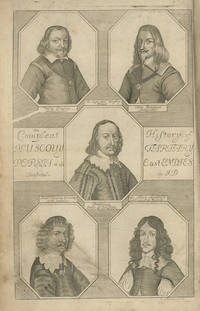
166928698London: Printed for John Starkey and Thomas Basset 1669 1669. Second edition in English preceded by the edition of 1662. ESTC R30756; Wing O270; Cox Literature of Travel I page 249. Several of the maps have paper repairs at the folds and in the margins; the third map of the River Volga is a little darkened at the edges and dust-soiled; the two leaves Q4 & R1 adjacent to that map are also a little darkened and dust-soiled; one clean tear to a leaf without loss; very good copy. Folio in fours contemporary mottled calf rebacked red morocco spine label blind rules and gilt lettering. Frontispiece six folding maps two portraits and one engraved Cyrillic alphabet in the text. In 1634 Frederick III of Holstein-Gottorp present day Denmark and Germany sent an expedition with Adam Olearus 1603-1671 as its secretary from Hamburg to Moscow in an attempt to establish commercial relations with Russia which failed. Undeterred Frederick sent a similar expedition to Persia in 1636 also with Adam Olearius as secretary The first part of this work is the first English translation by John Davies of Olearius' detailed account of those expeditions in its second edition. The second part contains the account by German adventurer Johan Albrecht de Mandelslo 1616-1644 of his departure from Frederick's mission to Persia and continuation on to India China Japan and Formosa also translated by Davies from Olearius' posthumous editing and publication of that travelogue. Though trade missions generally make for dull reading Olearius' narrative is quite engaging with details and anecdotes about the people and places they encountered. Typical of his observations is one about the Russians: "There is no place in the World where drunkenness is more common than in Muscovy . . . Ecclesiastics and laicks Men and Women Old and Young will drink strong water at any time before at and after their meals . . . will drink of it till they lye down and many times die in the place." From the library of John Evelyn with the Evelyn book label "JE" on the front paste-down. Early marginal notes in Mandelslo's adventures though not in Evelyn's hand alas. London: Printed for John Starkey and Thomas Basset, 1669 unknown
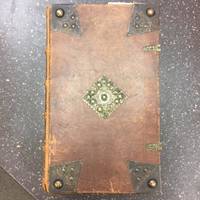
17831277019Augsburg Bavaria Germany: Joseph Wolffischen 1783. Hardcover. folio 750pp. 24pp. index 136pp.; VG; bound in brown leather paneled spine with no lettering; front board decorated with metal in the four corners diamond in the center; remnants of two clasps present two metal hooks on fore edge of front board two torn leather strips bound into rear board; moderate rubbing to boards; newer endpapers; title page has had a strip of paper approximately 1.25 inches 3.5cm. high torn off of the bottom primarily including the entirety of the publication information. It has been repaired with the backing of another sheet on that portion. There is a small tear in the middle of the page that is backed by a piece of paper on the verso and so barely impacts the legibility of the words; complete collation: endpaper title page 2pp. table of contents 4pp. 750pp. 24pp. index title page 6pp. 136pp.; separate title page with separate pagination; page 110 misprinted as 100 160 as 142 217 as 21 271 as 217 523 as 532 524 as 534 554 as 454 732 as 571 only the page number impacted; small repairs on pages 165/166 571/572 633/634 649/650 687/688 701/702 705/706 719/720 1/2; illustrated pages beginning parts two and three on pages 165 and 567. The pagination between pages 566-571 appear to be missing a page as is usual with this edition; ffep partially detached; profusely illustrated with over 800 black and white woodcut illustrations including genre scenes individual plants and animals and distilling apparatus; <br /> <br><br /> <br><br /> Adam Lonicer was a German botanist who studied at Marburg and the University of Mainz obtaining his Magister degree at sixteen years of age. After becoming a Doctor of Medicine in 1554 he became the town physician in Frankfurt am Main. His true interest though was herbs and the study of botany. His first important work on herbs the Kräuterbuch was published in 1557 with a large part dealing with distillation. He married Magdalena Egenolff the daughter of Christian Egenolff his Frankfurt publisher and a printer who specialized in herbals. The work that made his name famous is this popular herbal the Kräuterbuch. Lonicer provides us with one of the early descriptions of local flora as well as being one of the first to differentiate deciduous trees from conifers.<br /> <br /> shelved case 4. 1277019. Shelved Dupont Bookstore. Joseph Wolffischen hardcover books
17831277019Augsburg Bavaria Germany: Joseph Wolffischen 1783. Hardcover. Folio 750 pages 24 pages 136 pages. In Very Good condition. Bound in brown leather with blank paneled spine. Front board with metal corner pieces and metal diamond-shaped ornament to center of board. Remnants of clasps present: two metal hooks on fore edge of front board and two torn leather strips affixed to rear board. Boards moderately rubbed. Front free end paper partially detached. Title page shows 1.25 in-long area of damage to lower edge repaired but resulting in loss of publication information. Title page also shows small tear repaired to center of page minimally impacting legibility. Minor repairs to pages 165/166 571/572 633/634 649/650 687/688 701/702 705/706 719/720.<br> <br> Plates preface Parts Two and Three pp. 165 and 567 respectively. Profusely illustrated with over 800 black and white woodcut illustrations including genre scenes individual plants and animals and distilling apparatus. Shelved in Case 4. Adam Lonicer was a German botanist who studied at Marburg and the University of Mainz obtaining his Magister degree at sixteen years of age. After becoming a Doctor of Medicine in 1554 he became the town physician in Frankfurt am Main. His true interest though was herbs and the study of botany. His first important work on herbs the Kräuterbuch was published in 1557 with a large part dealing with distillation. He married Magdalena Egenolff the daughter of Christian Egenolff his Frankfurt publisher and a printer who specialized in herbals. The work that made his name famous is this popular herbal the Kräuterbuch. Lonicer provides us with one of the early descriptions of local flora as well as being one of the first to differentiate deciduous trees from conifers. <br> <br> Complete collation: page 110 misprinted as 100 160 as 142 217 as 21 271 as 217 523 as 532 524 as 534 554 as 454 732 as 571. Pagination consistent with this edition. 1277019. Shelved Dupont Bookstore. Joseph Wolffischen hardcover
17751240791775. AMERICAN REVOLUTION BURKE Edmund TUCKER Josiah D.D. An Humble Address and Earnest Appeal to Those Respectable Personages in Great-Britain and Ireland Whether a Connection with or a Separation from the Continental Colonies of America Be Most for the National Advantage and the Lasting Benefit of these Kingdoms. Gloucester: R. Raikes Sold by T. Cadell 1775. Slim octavo period-style half brown morocco and marbled boards raised bands; pp. 1-3 4-93 3. $3200.First corrected edition second overall issued within days of the same year's first edition of the ""important and influential"" British economist's seminal rebuke of Edmund Burke charging him with a crucial misunderstanding how the political economics of self-interest would best prevent further ""Disturbances and Disputes"" with America urging Britain in 1775 to ""separate totally from the Colonies to enter into Alliances of Friendship and Treaties of Commerce as with any other sovereign independent States"" handsomely bound.""A controversial figure during his lifetime"" particularly in his views on the economics of Britain's stance toward the American colonies Tucker was well known to Adam Smith and Founding Fathers Madison and Jefferson who each owned copies of his writings. ""Increasingly recognized as an important and original 18th-century theorist"" ODNB Tucker was ""espousing the cause of American separation as early as 1766 before the Americans themselves had considered this eventuality with any seriousness"" To key scholars ""Tucker analyzed the American conflict more accurately than his contemporaries yet so different were his views from all those around him that he has been noted as a 'visionary' Trevelyan or a 'fanatic' Clark"" Rashid ""Tucker's Proposal"" in Journal of the History of Ideas V43 No.3 439. His assessment of American independence was not motivated ""by any sympathy for the Americans."" Instead ""their rapid economic growth and dislike of regulation would he believed eventually lead them to separate from Britain through self-interest and the developing American crisis over taxation touched upon all Tucker's major interests: the need to maintain a mutually self-interested and beneficial trade between Britain and her colonies his dislike of war and mock patriotism and his distrust of political radicalism"" ODNB. ""Central to Tucker's philosophy of economy is the concept of 'self-love' which became part of Adam Smith's concept of the 'invisible hand' Tucker regarded trade as Britain's glory and went so far as to suggest that the colonies should be detached from Britain to allow greater freedom of trade a view which brought him into conflict with Edmund Burke"" Dictionary of 18th-Century British Philosophers V2:898.When Burke attacked Tucker in the famed March 22 1775 Speech on Conciliation with America Tucker quickly responded with Humble Address. Here he marshals arguments and evidence to counter claims that Britain would lose its profitable commerce if America broke free. Tucker contended the ""greater part of the colonial trade was motivated by self-interest and it was a simple corollary that neither shipping nor navigation could be hurt by the independence of the colonies."" To further support his position he details ""customs-house figures from 1765-72 to show that it was not Americans but Germany and Holland who purchased more British exports than the Americans"" Rashid 454. To F.P. Lock ""Tucker anticipated one of Adam Smith's shrewdest insights that regulations and restrictions impeded commerce rather than protecting it. For Tucker imperialism was uneconomic Let the Americans be independent and they will continue to trade with Britain as long as British goods are competitive Thus Tucker like Smith denied the economic value conventionally attributed to the possession of colonies. Burke disagreed in the 1770s Burke still held to the mercantilist belief that exclusive or preferential trade with its colonies benefits the home country"" Edmund Burke I:388. Copies of Tucker's works ""including those on the colonies are found to be in Adam Smith's library"" Rashid 456 and works by Tucker in Jefferson's library included Humble Address ""initialed by Jefferson"" Sowerby 3061. ""Second Edition Corrected"" on title page. With folding chart of exports; rear advertisement leaf. Engraved ornamental initials heading and tailpiece. Preceded by the November 1775 first edition. ESTC T36739. Adams American Controversy 75-144b. Sabin 97350. Goldsmith's 11300. Kress 7174. A fine copy. hardcover
198591169Schirmer/Mosel. New. 1985. Hardcover. FREE UPGRADE to Courier/Priority Shipping Upon Request - IN STOCK AND IMMEDIATELY AVAILABLE FOR SHIPMENT - Flawless copy brand new pristine never opened -- Text in German. 208 pages well-illustrated. Catalogue Raisonne Catalog Raisonné Complete Works Leben Und Werk Oeuvre-Katalog Kritischem Oeuvrekatalog Raisonnee -- with a bonus offer . Schirmer/Mosel hardcover
198791079Harry N Abrams. New. 1987. Hardcover. 0810909960 . FREE UPGRADE to Courier/Priority Shipping Upon Request - IN STOCK AND IMMEDIATELY AVAILABLE FOR SHIPMENT - FLAWLESS COPY BRAND NEW PRISTINE NEVER OPENED -- 400 pages. Catalogue Raisonne Catalog Raisonné Complete Works Life and Work Raisonnee -- with a bonus offer . Harry N Abrams hardcover
200693672Thalia. New. 2006. Paperback. 2352780020 . FREE UPGRADE to Courier/Priority Shipping Upon Request - IN STOCK AND IMMEDIATELY AVAILABLE FOR SHIPMENT - Flawless copy brand new pristine never opened -- Text in French. 196 pages; illustrated mostly in color. Three III Catalogue Raisonne Catalog Raisonné Complete Works La Vie et L'uvre Oeuvre Raisonnee -- with a bonus offer . Thalia paperback
600162005. Original artwork. Signed monogram in marker pen lower right by Neate. One of the best known street artists Neate specializes in painting urban art on recycled cardboard. He has left thousands of works in the street for anyone to collect and held sold out shows. Acrylic and marker pen on medium density fibreboard. Board size: 132 x 56 cm. Presented in a black wooden box frame. unknown
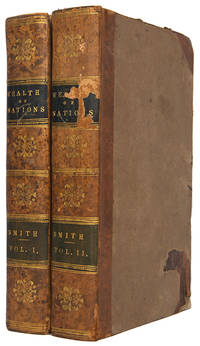
116934Dublin Printed by William Porter for G. Burnet et al. 1793. . Fifth Dublin edition; 2 vols; 8vo 20.5 x 13.5 cm; both titles with ownership inscriptions excised not affecting text lacking half-title vol. I; contemporary half mottled calf buff paper covers gilt spine in 6 compartments contrasting black and green morocco lettering-pieces sprinkled edges loss to upper lettering-piece of vol. II both with some loss to buff paper corners bumped with loss internally clean; iii-xiii 1 498; viii 489 61pp.<br /> A handsome two-volume edition of Smith's masterpiece the 'first and greatest classic of modern economic thought' PMM. <br /><br />Wealth of Nations is fundamentally an investigation into what makes certain nations prosperous. Smith's originality lies in locating the roots of this comparative wealth in the specialisation of labour which had occurred in developed economies for the 'annual labour of every nation is the fund which originally supplies it with all the necessaries and conveniences of life which it annually consumes and which consist always either in the immediate produce of that labour or in what is purchased with that produce from other nations' Introduction.<br /> ESTC T95114; Tribe 50. Dublin, Printed by William Porter, for G. Burnet et al., 1793. unknown
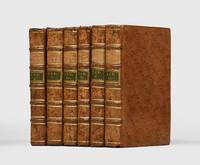
1781159019Yverdon: De Felice 1781. An attractive set Second edition in book form of Blavet's translation of The Wealth of Nations the earliest obtainable. Jean-Louis Blavet 1719-c.1809 was librarian for the prince du Conti; he had already published a translation of The Theory of Moral Sentiments in 1774-75. Blavet later claimed that Smith personally requested he translate The Wealth of Nations and sent him a copy. Blavet's translation was first published periodically in the Journal de l'agriculture from February 1779 to December 1780 and in book form in Paris earlier in 1781 in an edition of only 20 copies offprinted from the Journal de l'agriculture appearance. Only two copies of that edition are now known Carpenter p. 33. This edition was printed in Switzerland and apparently distributed largely outside France. Blavet claimed to not have been involved but "evidence suggests otherwise" ibid. p. 36. The Wealth of Nations was first published in French in 1778-79 by an unknown translator; Carpenter notes it as full of errors. Blavet's translation marks the second appearance in the language. 6 vols duodecimo 161 x 95 mm. Contemporary mottled calf twin orange and green spine labels marbled endpapers red edges. Contemporary annotation to vol. V p. 240. Slight wear at extremities slight worming to spines still a very attractive set contents clean. Tribe 24. Kenneth E. Carpenter The Dissemination of the Wealth of Nations in French and in France 1776-1843 2002. unknown
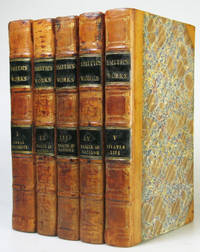
181223882London: T. Cadell and W. Davies et al 1812-11. First edition. Five volumes. 8vo. Slightly later tan half calf over marbled boards spines with raised bands new twin gilt lettered black labels the armorial bookplates of Frederick Henry Norman to the front pastedown of each volume which are affixed over earlier partially obscured gift inscriptions. Expert repairs to several joints and spine ends with darkening to the leather slight loss of gilt a very good set overall. The final three volumes bear the date 1811 the first two volumes the following year. Volume I comprises "The Theory of Moral Sentiments" volumes II-IV "The Wealth of Nations" and volume V Smith's Essays and Dugald Scott's biography. Frederick Henry Norman 1839-1916 the son of a director of the Bank of England was a notable financier and worked for the merchant bank Brown Shipley & Co. for many years. London: T. Cadell and W. Davies, [et al] unknown
1864389821864-1870. Würzburg Staehl 1864-1870; Leipzig Vogel 1871-1931 8° 115 Bde. einheitlich gebundenen Halbleinenbände. Aus den unzähligen wichtigen Beiträge seien hier nur folgende genannt: Lucae August: Ueber eine neue Methode zur Untersuchung des Gehörorgans zu physiologischen und diagnostischen Zwecken mit Hülfe des Interferenz Otoscopes 1867: pp.186-229. August Lucae "described an interference otoscope precursur of auditory impedance devices". Wreden R.B.: Sechs Fälle von Myringomykosis Aspergillus glaucus Lk. 1867: pp.1-21. Robert Robertovich Wreden 1837-1893 "otologist to the Czar was the first to call special attention to otomycosis". Schwarzte H.H.R. & Eysell A.: Ueber die künstliche Eröffnung des Warzenfortsatzes 1873: pp.158-187. Hermann Hugo Rudolf Schwartze 1837-1910 & Adolph Eysell 1846- "helped to revive the mastoid operation which had fallen in disuse placing it on a modern basis. They described the method of opening the ear by chiselling "Schwartze's operation"." Bezold Friedrich: Erkrankungen des Warzentheils 1877: pp.26-68. "First clear description of mastoiditis" by Friedrich Bezold 1842-1908. Politzer Adam: Ueber einen einheitlichen Hörmesser 1877: pp.104-109. Adam Politzer 1835-1920 "described an acumeter". Bárány Robert: Ueber die vom Ohrlabyrinth ausgelöste Gegenrollung der Augen bei Normalhörenden 1906: pp.1-30. Robert Bárány's "caloric test for labyrinthine function". Garrison & Morton No.3378.2;3380; 3382; 3386; 3387.1;3398 1.Deutsche Veröffentlichung des "Gradenigo's syndrome"; 3400. unknown
3 vols., 8vo., Sixth Edition, early nineteenth-century signature on titles, some light and inoffensive spotting to a few leaves, some very ight marginalia in pencil only; strongly and attractively bound in nineteenth century half calf, boards in dark green diced cloth, backs with five raised bands tooled in gilt, second and fourth compartments with red leather labels ruled, lettered and numbered in gilt, red sprinkled edges, a remarkably well-preserved, crisp, clean copy in later period binding. One of 2000 copies printed. 'The Wealth of Nations', coming at a point when 'natural liberty' was being being widely debated, had a decisive influence both on the study of national economy and on the freeing of economic policy from the artificial restraint of the mercantilist system. Smith's statement that labour is the source of a nation's commodities and that the variation in 'stock' values are due to the interaction of wages, profits and rent, formulated the doctrine of the classic school of economic thought, and round it all modern economic discussion has revolved' (PMM). Goldsmiths 14612; Kress B.2209; Tribe 41. See also PMM 221, 363.
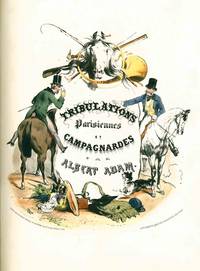
50400Collection of mostly equestrian-themed caricatures 32 pp. lithographed by the Parisian firm Godard and depicting a variety of incidents such as a dog cart running in front of a horse-drawn buggy a racehorse stopping short and nearly launching its rider into a marsh a horse leaping over a group having a picnic and a bull headbutting an artist into a ravine. A few leaves trimmed slightly affecting page numbers extremely minor soiling. Slim 4to. Modern navy blue 3/4 morocco with marbled boards red gilt spine label. Very slight rubbing or scuffing some uneven fading or sunning to leather. Paris Hautecoeur Frères n.d. circa 1850. Albert Adam published a number of collections of humorous caricatures during his career but is perhaps best known for his views of Paris burning during the Paris Commune of 1871 and his Napoleonic scenes. He got his start working with his father caricaturist and lithographer Jean Victor Adam who he often assisted with his commissions. Quite scarce; as of November 2019 WorldCat locates just five holdings of this title in North American institutions. hardcover books
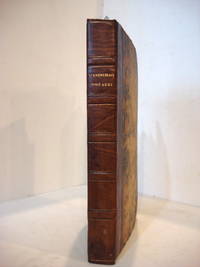
16699791London: John Starkey and Thomas Basset 1669. 2nd revised English. Half morocco. Very good. Folio. 2 parts in 1 each separately paginated with separate title-pages. Note: in this copy the title page for Mandelslo appears first in error. 6316;2223210pp. Complete with an added engraved title with 5 portraits 2 separate engraved portraits and a total of 6 folding or double-page maps. In this copy the very large folding map of the Volga River found at p. 112 has been divided in two the second half bound at p. 126 with a slight loss at the fold where they were divided. Engraved table of the Ruthenian alphabet in text. 19th century brown morocco spine over old marbled boards rubbed. Small chip at the top of spine otherwise an attractive copy. This is an odd copy quite complete but with certain preliminaries for the first part bound at front of the second part. The second edition revised of the English translation first published in 1662 made from a 1659 version in French. It contains material not found in the original German edition of 1656 and 1658. An important account of Central Asia including Persia and Russia and the East Indies. The Duke of Holstein's embassies were to negotiate trade. See Cox's THE LITERATURE OF TRAVEL Vol. 1 pp. 249 and 271 for more details. Wing O270. John Starkey and Thomas Basset unknown books
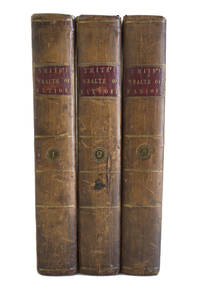
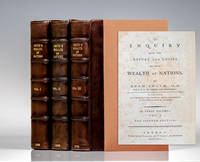
179367815ìThe First and Greatest Classic of Modern Economic Thoughtî SMITH Adam. An Inquiry into the Nature and Causes of the Wealth of Nations. In Three volumes. The Seventh Edition. London: Printed for A. Strahan; and T. Cadell 1793. Seventh edition. Three octavo volumes 8 1/4 x 5 1/8 inches; 210 x 130 mm. x 499 1 blank; vi 518 5 appendix 1 blank; v 1 blank 465 1 blank 49 index 1 colophon pp. Full contemporary speckled calf. All board edge stamped in blind. Each volume with a red morocco spine label lettered in gilt and a small green morocco volume number label printed in gilt. Top edges dyed brown others speckled red. Outer hinges of each volume with a few tiny wormholes. Boards a bit rubbed. Inner hinges of volume III a bit cracked but firm. Paper flaw to lower outer margin of leaf T4 of volume III but not affecting text. Overall a very good and internally very clean set. Adam Smith 1723-1790 spent ten years in the writing and perfecting of The Wealth of Nations. ìThe book succeeded at once and the first edition was exhausted in six months.Whether it be true or not as Buckle said that the ëWealth of Nationsà was ëin its ultimate results probably the most important that had ever been writtenÃ.it is probable that no book can be mentioned which so rapidly became an authority both with statesmen and philosophersî D.N.B. ìThe history of economic theory up to the end of the nineteenth century consists of two parts: the mercantilist phase which was based not so much on a doctrine as on a system of practice which grew out of social conditions; and the second phase which saw the development of the theory that the individual had the right to be unimpeded in the exercise of economic activity. While it cannot be said that Smith invented the latter theory . . . his work is the first major expression of it. He begins with the thought that labour is the source from which a nation derives what is necessary to it. The improvement of the division of labour is the measure of productivity and in it lies the human propensity to barter and exchange . . . From the working of the economy Smith passes to its matter -- ëstockà -- which compasses all that man owns either for his own consumption or for the return which it brings him. The Wealth of Nations ends with a history of economic development a definitive onslaught on the mercantile system and some prophetic speculations on the limits of economic control . . . The certainty of its criticism and its grasp of human nature have made it the first and greatest classic of modern economic thoughtî Printing and the Mind of Man. Einaudi. Goldsmiths' 15565. Kress 2618. Printing and the Mind of Man 221. Sabin 82303. HBS 67815. $3000 Printed for A. Strahan; and T. Cadell hardcover books
1789149720London: Printed for A. Strahan and T. Cadell in the Strand 1789-1793. Mixed early edition set of Adam Smith's magnum opus and cornerstone of economic thought. Octavo 3 volumes bound in one quarter modern calf over cloth-covered boards with gilt titles and five raised bands to the spine. Volumes I and III are seventh editions 1793 Vol. II is a fifth edition 1789. In near fine condition. An attractive set. Adam Smith's masterpiece first published in 1776 is the foundation of modern economic thought and remains the single most important account of the rise of and the principles behind modern capitalism. "The history of economic theory up to the end of the nineteenth century consists of two parts: the mercantilist phase which was based not so much on a doctrine as on a system of practice which grew out of social conditions; and the second phase which saw the development of the theory that the individual had the right to be unimpeded in the exercise of economic activity. While it cannot be said that Smith invented the latter theory.his work is the first major expression of it. He begins with the thought that labour is the source from which a nation derives what is necessary to it. The improvement of the division of labour is the measure of productivity and in it lies the human propensity to barter and exchange.Labour represents the three essential elements-wages profit and rent-and these three also constitute income. From the working of the economy Smith passes to its matter -'stock'- which encompasses all that man owns either for his own consumption or for the return which it brings him. The Wealth of Nations ends with a history of economic development a definitive onslaught on the mercantile system and some prophetic speculations on the limits of economic control.The Wealth of Nations is not a system but as a provisional analysis it is complete convincing. The certainty of its criticism and its grasp of human nature have made it the first and greatest classic of modern economic thought" PMM. Printed for A. Strahan and T. Cadell, in the Strand hardcover
17931356061Dublin: printed by William Porter for G. Burnet L. White W. Wilson P. Byrne W. McKenzie J. Moore and W. Jones 1793. Fifth Edition. Hardcover. Octavos Two Volumes. In Very Good condition. Bound in modern brown patterned cloth with green labels gilt titling and gilt tooling to spines. Complete with both half-titles. Some tide-marks Volume 1 with bottom half of text block for the first half of the volume then expanding to cover the entirety of the leaves. Volume 2 the top half of the text block for the first few gatherings then reducing to just the top edge and upper gutter. Removed bookplate to rear pastedowns. Front free end page and rear free end page of Volume 1 bound in upside down. Shelved case 5. Smith's masterpiece being "the first and greatest classic of modern economic thought" PMM - was first published in 1776 in London with the first Dublin edition published that same year. ESTC: T95114. 1356061. Shelved Dupont Bookstore. printed by William Porter, for G. Burnet, L. White, W. Wilson, P. Byrne, W. McKenzie, J. Moore, and W. Jones hardcover
elala5306<p>3 Volumes. 8vo. pp. x 499; vi 518 5; v 465 49index 1ads. contemporary tree calf bit rubbed small leather patch missing from lower front joint & spine of Vol. II occasional light foxing. Seventh Edition. '<b>'</b>Although Adam Smith did not create the study of political economy <i>The Wealth Of Nations </i>coming at a point when 'natural liberty' was being debated had a decisive influence both on the study of national economy and on the freeing of economic policy from the artificial restraint of the mercantilist system. Smith's statement that labour is the source of a nation's commodities and that the variations in 'stock'' values are due to the interaction of wages profits and rent formulated the doctrine of the classic school of economic thought and round it all modern economic discussion has revolved."' PMM Goldsmiths' 15565. Kress B.2618. Vanderblue p. 4. cfPMM 221. </p> London: Printed for A.Strahan & T.Cadell, 1793.
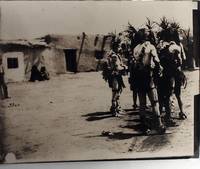
02146321.4 cm x 16.4 cm. Photograph by Adam Clark Vroman Koshari-Pueblo of Santo Domingo ca. 1900. Between 1895 and 1904 Adam Clark Vroman photographed the landscape and native peoples of the American Southwest. He photographed the Hopis Zunis and Pueblos among other tribes. His portraits of Native Americans humanize rather than romanticize his subjects. The process he used most frequently was the platinotype or platinum print known for its non-reflective surface rich detail broad tonal range and permanence. The platinum process was widely used in the United States and Europe from 1880 through the 1930s when the cost of platinum became prohibitive and the silver-based processes gained prominence. Vroman moved to Pasadena California in 1892. He soon opened a book stationery and photo-supply shop there in November of 1894. He traveled through southern California Arizona and New Mexico on seven separate trips from 1895 to 1904 to document the area's landscape Indians and Indian communities. Vroman was employed as a photographer by the Bureau of American Ethnology a research unit of the Smithsonian Institution for two separate trips to the Southwest the former involving a climb to the Enchanted Mesa in central New Mexico to prove the existence of Indian habitation and the latter a documentation of Southwestern pueblos and cliff dwellings. books
200587030D.A.P./Schirmer/Mosel. New. 2005. Hardcover. 1933045175 . FREE UPGRADE to Courier/Priority Shipping Upon Request - IN STOCK AND IMMEDIATELY AVAILABLE FOR SHIPMENT - Flawless copy brand new pristine never opened -- 160 pages; 85 illustrations. Catalogue Raisonne Catalog Raisonné Complete Works Life and Work Raisonnee D.A.P./Schirmer/Mosel hardcover
H852L¸beck Bˆckmann 1734. 8vo. 168 x 95 cm. 24 Bll. 336 SS. 4 Bll. Moderner Pappband mit R¸ckenschild leicht gebr‰unt. Eckausrifl bei den letzten 4 Bl. In gutem Zustand. Henze I S.338. Vgl. Eutin I 164. VD18 11444355 Ausgabe 1723. Lˆwendahl 222 EA 1698. - "Der aus L¸beck stammende lange Zeit in Ruflland t‰tige Kaufmann Brand begleitete 1692-94 Evert Ysbrants Ides auf seiner Gesandschaftsreise nach China. Seine Reisebeschreibung ist wie die von Ides selbst eine der ersten relativ zuverl‰ssigen Quellen zur Landeskunde Ethnographie und Geschichte von Sibirien. Brands Buch erschien noch vor der Amsterdamer Erstausgabe von Ides 1704 mit der sie oft verwechselt wird" Eutin. unknown
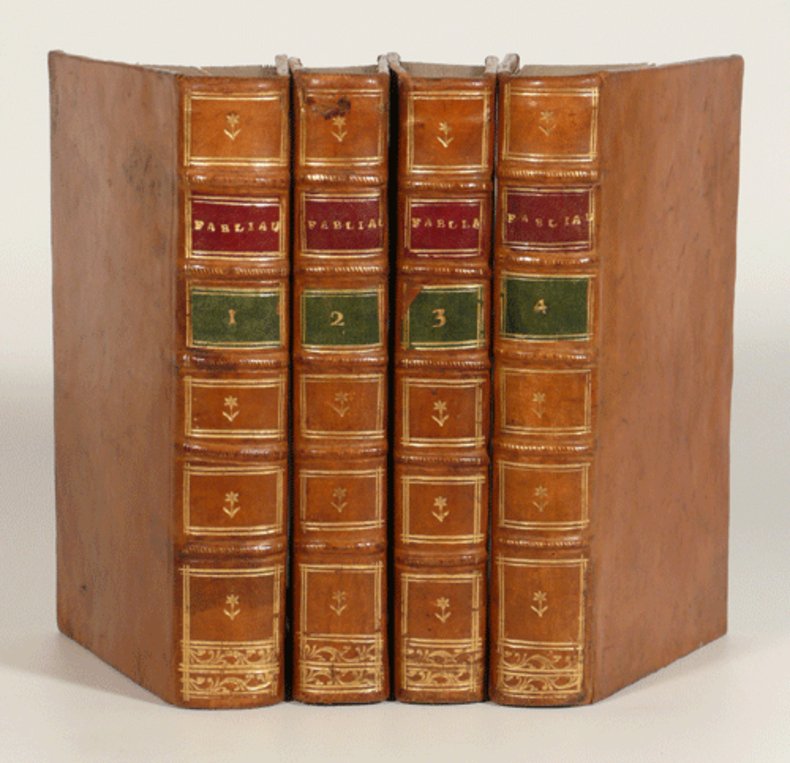
17790030421779 Paris, Eugène Onfroy, 1779-1781 & Paris, Chez l'Auteur et Dufour, 1781. Quatre volumes in-8 (130 X 197 mm) basane fauve, dos cinq nerfs ornés, caissons dorés avec fleuron central, pièces de titre et de tomaison maroquin grenat et vert, coupes filetées (reliure de l'époque). Tome I : (2) ff. de faux-titre et titre, CIX pages, (1) page et (1) f. d'errata, approbation et privilège, (1) f. avec une figure, 414 pages, (1) f. de table - Tome II : (2) ff. de faux-titre et titre, 430 pages, (1) f. d'errata - Tome III : (2) ff. de faux-titre et titre, 468 pages - Tome IV : (2) ff. de faux-titre et titre, XLVI pages, (1) page d'errata, 400 pages - "Observations sur les troubadours par l'éditeur des Fabliaux": (2) ff. de faux-titre et titre, 68 pages. Petit accroc restauré dans le caisson supérieur du tome II.
1956174400Cercle Grolier Cercle Grolier, 1956. In-4 en feuillets sous chemise et double emboitage. Illustré de 25 Eaux-fortes de Mario AVATI tirées sur les presses à bras de J.J.J. RIGAL. Tirage à 220 exemplaires numérotés sur Grand Vélin de Rives. Exemplaire enrichi d'une Suite sur Japon nacré, signé de l'artiste sur la chemise, d'un superbe tirage original d'une eau-forte signée, de la plaque de cuivre de cette même eau-forte, du menu illustré, signé et dédicacé par Mario AVATI, du Cercle Grolier (15 décembre 1956 au Pavillon Dauphine) organisé pour la présentation de l'ouvrage. Egalement joint, dans le menu, les étiquettes d'une bouteille de vin "MARQUIS DE TERME 1951" + un 2ème menu. Légères rousseurs n'affectant que la chemie et l'intérieur de l'étui, sinon Très bel exemplaire, rare dans cette condition.