Ferguson AdamBiblio.com
336 résultats
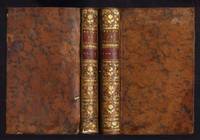
1783039834Paris: la Veuve Desaint Libraire 1783. First Edition. Hardcover Full Leather. Very Good Condition. The first French edition of Ferguson's influential work on civil society. A friend of Hume Adam Smith and Voltaire and a major figure of the Scottish Enlightenment Ferguson published Essay on the History of Civil Society in 1767. It was widely published and his views on political participation and community were influential on the thinking of the founding fathers of the American Revolution and later on the French. Size: Octavo 8vo. 2-volume set complete. Text is clean and unmarked. Quantity Available: 1. Shipped Weight: Under 1 kilo. Category: Philosophy; Antiquarian & Rare. Inventory No: 039834. la Veuve Desaint, Libraire hardcover
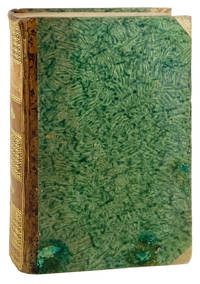
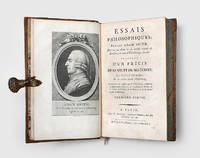
179727583Paris: H. Agasse 1797. Very Good . Paris: H. Agasse 1797. First French Edition. Two volumes bound in one; octavo; 19th-century calf over papier-peint boards gilt-tooled spine; 4316; 42831pp. collated complete with half titles. Small abrasions to boards somewhat clumsily repaired else a Very Good or better internally clean and exceptionally fresh copy.<br /> <br /> First appearance in French of Adam Smith's posthumously collected work "Essays on Philosophical Subjects" which includes most notably his "Principles which lead and direct philosophical enquiries illustrated by the history of astronomy." This edition as with the first in English preceded by a lengthy account of Smith's Life by the Scottish philosopher and mathematician Dugald Stewart. H. Agasse unknown
1797009266Paris: Agasse 1797. Due volumi in 8vo 12x20 cm di 4-283 pp e 4-316 pp. Ritratto inciso di Smith all'antiporta del primo volume. Graziosa legatura ottocentesca in mezza pelle avana dorso dorato e ornato piatti con carta marmorizzata. First edition in French of Smith's "Essays on philosophical subjects 1795. Traduits de l'anglais par P. Prevost. Ottime condizioni. Agasse unknown
1797166730Paris: H. Agasse 1797. A handsome copy of Smith's essays in French First edition in French this a superior copy preserving the half-titles and the fine portrait frontispiece often missing. "The writings that Joseph Black and James Hutton brought together in 1795 under the title Essays on Philosophical Subjects together with Dugald Stewart's 'Account' and Smith's 1755 letter to the Edinburgh Review were translated and published by Pierre Prévost as Essais philosophiques in 1797. Prévost added ten notes in the form of commentary directed to specific points as well as a more general essay 'Reflexions sur les oeuvres posthumes d'Adam Smith'" Tribe. Octavo 196 x 117 mm in 2 parts. Engraved portrait frontispiece of Smith by Benoît-Louis Prévost. Contemporary French speckled calf spine decorated in gilt black morocco label triple gilt fillet border to covers marbled endpapers and edges. Head of spine and front joint skilfully restored contents faintly browned else an attractive copy. Einaudi 5325; Goldsmiths' 16932; Jessop p. 172; Kress B.3505; Tribe 65; Vanderblue p. 44. unknown
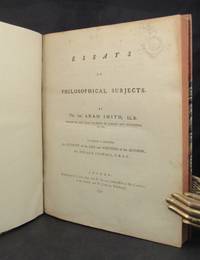
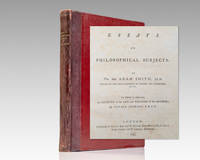
17951169901795. First Edition. SMITH Adam. Essays on Philosophical Subjects To Which Is Prefixed an Account of the Life and Writings of the Author by Dugald Stewart. London: for T. Cadell Jun. and W. Davies et al. 1795. Large quarto 9 by 11-1/4 inches period-style full speckled brown calf raised bands red morocco spine label; pp. i-iii iv v-vi vii-ix x-xcv blank 1-3 4-93 94-97 98-111 112-115 116-129 130-133 134-184 185-187 188-194 195-197 198-244; slipcase. $13800.First edition of this core volume of Smith's essays issued posthumously featuring the important first publication of History of Astronomy that seeks ""to explain what drives 'philosophers' to ask the questions they do"" an impressive wide-margined volume handsomely bound.Though Essays on Philosophical Subjects appeared five years after Smith's death most were likely written before the publication of his Theory of Moral Sentiments in 1759. Essays was compiled by his literary executors physicist Joseph Black and geologist James Hutton. Prior to his death Smith ""instructed them to destroy his manuscripts but allowed them at their discretion to publish a set of essays"" Berry Cambridge Companion 116. As noted herein Smith had begun work early in his career on ""a connected history of the liberal sciences and elegant arts"" but ""found it necessary to abandon that plan as far too extensive."" These writings thus represent Smith's longstanding attempts at such a ""connected history"" and range over philosophy aesthetics and the history of science. A biographical Account of Smith and his work is followed by the extensive History of Astronomy which was the only writing Smith did not want destroyed; indeed he specifically arranged for its posthumous publication. Black and Hutton used their authority to incorporate its momentous first publication into this collection. Astronomy ""was probably begun decades before Smith's death perhaps as early as 1746 and was at one time intended to form a chapter of a much larger work Astronomy purports to explain what drives 'philosophers' to ask the questions they do and to seek explanations for the things they observe"" Otteson Adam Smith 22-3. Astronomy ""has occasioned much scholarship Just as The Wealth of Nations was titled an enquiry into its 'natures and causes' so Smith says at the end of the preliminary section of Astronomy that the design of the essay is to consider the 'nature and causes of the three sentiments""identified by him as ""Wonder Surprise and Admiration."" Citing Galileo Copernicus Kepler Newton Descartes and others Astronomy aims ""to illustrate how philosophy is an activity that addresses itself to the imagination"" Berry 116-117 123. Also included in this volume are his essays on ""Ancient Physics"" ""Ancient Logics and Metaphysics"" and the ""Imitative Arts"" along with a concluding essay on perception in the five ""External Senses."" One of 1000 copies. Containing the first publication in book form of Dugald Stewart's Account of the Life and Writings of Adam Smith which had appeared in the Transactions of the Royal Society of Edinburgh in 1794. Stewart's Account ""formed the basis upon which everyone drew for biographies of Smith that began to appear in the early 19th century"" Tribe 55. Without initial blank. Goldsmith 16218. Kress B3038. Rothschild 1902. Trace of early owner signature above title page.Interior very fresh period-style calf fine. An elemental Adam Smith work. hardcover
179523048London: For T. Cadell Jun. and W. Davies and W. Creech in Edinburgh 1795. First Edition. 4to in a handsome and correct period style binding of three-quarter calf over marbled boards. The spine with raised bands gilt ruled and with chain device in gilt red morocco label ruled stippled and lettered in gilt additional gilt lettering in two other compartments edges dyed. xcv 244 pp. xcv 1 blank 244 pp. A4 a4-l4 B4-Z4 AA4-II2 A fine fresh copy quite clean and crisp the binding in excellent condition small and unobtrusive blank embossed exlibris on the top corners of several signatures. SCARCE FIRST EDITION of the posthumously published essays of Adam Smith. Though thought of today primarily as an economist due to the fame of his WEALTH OF NATIONS these essays demonstrate the diverse range of philosophical sciences to which Smith applied himself. They were arranged and edited by his close friends James Black and William Hutton. Black and Hutton had attended to Smith in his old age and had made his literary executors. Shortly before his death Smith had forced them to burn the vast majority of his unpublished papers over sixteen volumes worth of manuscripts. These few which remained were intended according to the editors as “parts of a connected history of the liberal sciences and elegant arts" but that Smith had "long since . found it necessary to abandon that plan as far too extensive". The range over fields as diverse as philosophy aesthetics the history of science astronomy physics metaphysics music and sensory perception. Most of them were originally written prior to 1759 long before his remarkable success with WEALTH OF NATIONS.<br> Stewart’s account of Smith’s life was the first biography written of him and remains an important source. It was originally delivered as a series of lectures at the Royal Society of Edinburgh. For T. Cadell Jun. and W. Davies, and W. Creech in Edinburgh hardcover
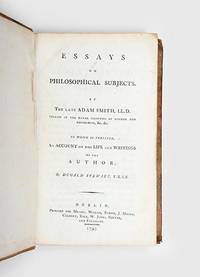
1795187211Dublin: Printed for Messrs. Wogan Byrne J. Moore and 5 others in Dublin 1795. Cementing the Smithian legacy First Dublin edition published the same year as the first. The Essays combines seven mainly pre-Moral Sentiments works by Smith with one of the earliest and most influential Smithian biographies by the prominent philosopher Dugald Stewart. Before his death in 1790 Smith arranged for some 16 volumes of his papers to be destroyed but he specifically selected the works in this collection to be spared for posthumous publication. The Essays range across philosophy aesthetics and the history of science remnants of an abandoned project to compile a comprehensive history of human philosophy. Many of them were conceived during Smith's brief period as a freelance teacher at Edinburgh in the 1750s but held back in the hope of publishing them as part of a much wider work. Among these pieces Roy Campbell highlights the History of Astronomy as "a truly remarkable piece of work. confirming the quite astonishing range and level of intellectual activity which Smith sustained in this period" p. 81. Stewart 1753-1828 a committed follower of Smith spoke extensively with those who had known him well: his Account of the Life and Writings pp. ix-cxxiii "continues to shape our understanding of Smith's character" Phillipson p. 275. Octavo 208 x 121 mm pp. ccxxiv 332. Contemporary tree sheep spine ruled and decorated in gilt and with later red calf label. Bumping and wear loss to spine ends foot of front joint and head of rear joint split but holding firm boards bowed paper flaws to e6-7 touching several words but sense recoverable contents otherwise crisp: a good copy. ESTC T33501; Jessop p. 172; Kress B.3037; Tribe 56; Vanderblue p. 43. Roy Campbell Adam Smith 1982; Nicholas Phillipson Adam Smith: An Enlightened Life 2010. hardcover
1795151270London: Printed for T. Cadell Jun. and W. Davies 1795. First edition of this important collection of Smith's essays featuring the important first publication of his History of Astronomy. Quarto bound in quarter calf with gilt titles to the spine. One of 1000 copies. Containing the first publication in book form of Dugald Stewart's Account of the Life and Writings of Adam Smith which had appeared in the Transactions of the Royal Society of Edinburgh in 1794. Stewart's Account "formed the basis upon which everyone drew for biographies of Smith that began to appear in the early 19th century" Tribe 55. Goldsmith 16218. Kress B3038. Rothschild 1902. In very good condition. Though Essays on Philosophical Subjects appeared five years after Smith's death most were likely written before the publication of his Theory of Moral Sentiments in 1759. Essays was compiled by his literary executors physicist Joseph Black and geologist James Hutton. Prior to his death Smith "instructed them to destroy his manuscripts but allowed them at their discretion to publish a set of essays" Berry Cambridge Companion 116. As noted herein Smith had begun work early in his career on "a connected history of the liberal sciences and elegant arts" but "found it necessary to abandon that plan as far too extensive." These writings thus represent Smith's longstanding attempts at such a "connected history" and range over philosophy aesthetics and the history of science. A biographical Account of Smith and his work is followed by the extensive History of Astronomy which was the only writing Smith did not want destroyed; indeed he specifically arranged for its posthumous publication. Black and Hutton used their authority to incorporate its momentous first publication into this collection. Astronomy "was probably begun decades before Smith's death perhaps as early as 1746 and was at one time intended to form a chapter of a much larger work… Astronomy purports to explain what drives 'philosophers' to ask the questions they do and to seek explanations for the things they observe" Otteson Adam Smith 22-3. Astronomy "has occasioned much scholarship… Just as The Wealth of Nations was titled an enquiry into its 'natures and causes' so Smith says at the end of the preliminary section of Astronomy that the design of the essay is to consider the 'nature and causes of the three sentiments"—identified by him as "Wonder Surprise and Admiration." Citing Galileo Copernicus Kepler Newton Descartes and others Astronomy aims "to illustrate how philosophy is an activity that addresses itself to the imagination" Berry 116-117 123. Also included in this volume are his essays on "Ancient Physics" "Ancient Logics and Metaphysics" and the "Imitative Arts" along with a concluding essay on perception in the five "External Senses." Printed for T. Cadell Jun. and W. Davies unknown
1795126439Dublin: Printed for Messrs. Wogan Byrne J. Moore and 5 others in Dublin 1795. First Dublin edition same year as the first London edition. The Essays were published five years after Smith's death and edited by the Scottish philosopher Dugald Stewart 1753-1828. Stewart's "Account of the Life and Writings of Adam Smith" is one of the earliest biographical notices of Smith and "until Stewart's Biographical Memoir of 1811. formed the basis upon which everyone drew for the biographies of Smith that began to appear in the early 19th century" Tribe. The editors Joseph Black and James Hutton state that Smith's essays were intended as parts of "a connected history of the liberal sciences and elegant arts" but that Smith "long since. found it necessary to abandon that plan as far too extensive". The essays range over philosophy aesthetics and the history of science. Most were probably written before the appearance of the Theory of Moral Sentiments in 1759 but were withheld from publication as part of Smith's "extensive plan". Kress lists the Dublin printing first and calls the London "another issue" while Tribe calls the Dublin edition a piracy. Neither is correct. Dublin booksellers at the time had a well-established exemption from the copyright laws and could legally reprint any new publication first published in London without having to pay for copy. The London edition precedes this legal Dublin reprint. Scarce: neither Einaudi nor Goldsmiths' list this Dublin edition. Octavo 205 x 125 mm. Early 19th-century tan calf and marbled boards neatly rebacked using a piece of diced Russia gilt roll decoration to head and tail of spine gilt device stamped around the spine. Ownership stamp of William Brough to rear free endpaper. Somewhat inelegantly rebacked with diced russia salvaged from another binding inner hinges cracked but firm corners worn some toning to leaf edges and a few small spots; overall a good copy. Jessop p. 172; Kress B.3037; Tribe 56; Vanderblue p. 43. hardcover
179568261London: Printed for T. Cadell Jun. and W. Davies etc. 1795. London: Printed for T. Cadell Jun. and W. Davies. 1795.<br> <br> First edition. Quarto 10 3/4 x 8 1/2 inches; 273 x 215 mm. xcv 1 blank 244 pp.<br> <br> Contemporary speckled calf. Board edges ruled in gilt. Spine ruled in gilt. Red morocco spine label lettered in gilt. Edges speckled brown. Green silk page-marker. Board edges a bit rubbed and corners bumped. Previous owner's old ink signature on title-page not affecting text. Occasional minor foxing or staining. Otherwise a fine copy.<br> <br> A posthumously published collection of essays mainly of a scientific and philosophical nature. Smith had instructed lis literary editors Joseph Black and James Hutton to destroy almost all of his manuscript material amounting to some sixteen volumes. These essays were exempted because the editors perceived them to "be part of a plan he had once formed for giving a connected history of the liberal sciences and elegant arts" even though Smith had to abandon the plan because it was too extensive.<br> <br> The essays illustrate the diversity of Adam Smith's interests and comprise: "The Principles which lead and direct Philosophical Enquiries; illustrated by the History of Astronomy;" "The Principles which lead and direct Philosophical Enquiries; History of the Ancient Physics;" "The Principles which lead and direct Philosophical Enquiries; History of the Ancient Logics and Metaphysics; "Of the Nature of that Imitation which takes place in what are called the Imitative Arts;" "Of the Affinity between Music Dancing and Poetry;" "Of the Affinity between certain English and Italian Verses;" "Of the External Senses."<br> <br> ESTC T33499 . Goldsmiths' 16218. Kress B. 3038. Rothschild 1902.<br> <br> HBS 68261.<br> <br> $9500. Printed for T. Cadell Jun. and W. Davies, etc. unknown
179566518London: Printed for T. Cadell Jun. and W. Davies etc. 1795. First edition. Quarto. xcv 244 pp.<br> <br> Contemporary boards rebacked. Small library stamp on title and verso and on last page a small ink smudge on title previous owner's bookplate. Overall a very good large paper copy totally uncut.<br> <br> A posthumously published collection of essays mainly of scientific and philosophical nature. Smith had instructed his literary editors Joseph Black and James Hutton to destroy almost all of his manuscript material amounting to some sixteen volumes. These essays were exempted because the editors perceived them to "be part of a plan he had once formed for giving a connected history of the liberal sciences and elegant arts" even though Smith had to abandon the plan because it was too extensive.<br> <br> HBS 66518.<br> <br> $10000. Printed for T. Cadell Jun. and W. Davies, etc. unknown
1795882052Dublin: Wogan Byrne J. Moore Etc. 1795. Original boards rebacked in leather with black labels and gold lettering. Contemporary owner's inscription above title page. Essays on astronomy and physics.In beautiful condition. First Irish Edition. Full Leather. Excellent. 8vo - over 7¾" - 9¾" tall. Wogan, Byrne, J. Moore Etc. Hardcover
1753000698<p>London: London: Printed for Robert. Dodsley in Pall-Mall where letters to the author are taken in and sold by Mary. Cooper at the Globe in Pater-Noster-Row 1753. 1st Printing. Full leather. Very Good. First edition four volumes in two folio; 1-628; 629-1258 16pp In contemporary tree calf lightly worn hinges cracked but firm spines gilt red and green gilt-lettered leather spine labels contemporary marbled endpapers woodcut headpieces opening each number a very clean copy. Very attractive example of this full bound-up run of Edward Moore's weekly periodical in handsome period binding with original collective title-pages added to each volume. Contributors include Horace Walpole Soame Jenyns and John Boyle Earl of Orrery and with Chesterfield's articles of late 1754 extolling Johnson's imminent Dictionary on the eve of its publication ESTC P1858 citing 14 examples in the UK 5 of which at British Library and 4 at Cambridge and 8 examples in US 3 of which at University of Virginia.</p> London: Printed for R[obert]. Dodsley in Pall-Mall, (where letters to the author are taken in) and sold by M[ary]. Cooper at the hardcover
1767mon0000954706CreateSpace Independent Publishi 1/1/1767 12:00:00 AM. paperback. Like New. in x in x in. First edition. 2014 copyright. CreateSpace Independent Publishi paperback
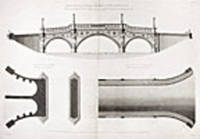
177517103London 1775. Engraving by T. Miller. In excellent condition with the exception of some very faint off-setting. A fine engraving of a proposed bridge over the river at Sion House in London.<br/> <br/> Robert and his brother James Adam forever changed the face of British architecture by introducing innovative Classical design ideas. From 1754-57 Robert lived in Italy where he had a long productive friendship with Piranesi which was inspirational for both men. Adam's first book on Diocletian's palace in Dalmatia is clearly very like the archaeological investigations Piranesi was making at the same time of similar ruins. Piranesi's friendship and passion for Roman Classicism were seminal influences on Adam and the greatest single factor other than his own talent in the work Adam produced on his return to England. Upon his return the brothers launched their career by building the Adelphi from the Thames to the Strand in London which although not a commercial success at the time included one of London's most cherished buildings the Adlephi Theatre. Together the Adam brothers designed and built some of the most famous buildings in England including such bastions of English architecture as Kenwood House Keddlestone Manor and Syon House. To the interiors of their English country houses the Adams brought wonderful ornamental elements in niches lunettes festoons and reliefs. Their classically designed buildings were so numerous in London that they changed the prevailing feel of the city and established their brand of neo-Classicism as the model of elegance and importance. It is asserted that the brothers originated the concept of the uniform facade attached to the typical English row house an architectural device that distinguishes London buildings. This monumental contribution is evidenced in the Adams' designs for Portland Place and Fitzroy Square and these were used as architectural models for the whole city. The brothers brought their talents into other areas by designing furniture to complement their beautiful interiors and by creating and publishing a treatise of design entitled 'Works in Architecture'. The work was published in three volumes over an extended span of time beginning in 1773 with the final volume being published posthumously in 1822.<br/> <br/> Cf. Brunet I.47; cf. Lowndes I p.8; DNB; Wilton-Ely The Mind and Art of Giovanni Battista Piranesi. unknown
177863071Ohne Ort, ohne Verlag bzw. Drucker, 1778. 4°. Mit Holzschn.-Titelvignette. 4 nn. Bll., Geheftet (ausgebunden).
1784005185Leipzig: M. G. Weidmanns 1784. Hardcover. Very Good. Nur Band I: Three-quarter speckled boards with leather corners and spine; gilt decorated spine and red title label are bright - very good; 5" x 8" internally inside covers have book plate cut out all text edges have the original red color. XXVIII 452 pp with 7 fold map at rear; text is very good - very good map is near fine with very light spotting/age toning; text is almost free of spotting and light age-toning conforms to the printing plate <br/> <br/> M. G. Weidmanns hardcover