387 résultats
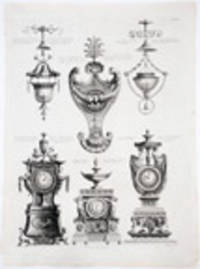
177517574London 1775. Engraving by P. Begbie. In excellent condition with the exception of being trimmed just outside the platemark on the left margin. An elegant engraving depicting various furnishings designed by Robert and James Adam including decorative clocks an ornamental knocker and two elaborate hanging lights.<br/> <br/>Robert and his brother James Adam forever changed the face of British architecture by introducing innovative Classical design ideas. From 1754-57 Robert lived in Italy where he had a long productive friendship with Piranesi which was inspirational for both men. Adam's first book on Diocletian's palace in Dalmatia is clearly very like the archaeological investigations Piranesi was making at the same time of similar ruins. Piranesi's friendship and passion for Roman Classicism were seminal influences on Adam and the greatest single factor other than his own talent in the work Adam produced on his return to England. Upon his return the brothers launched their career by building the Adelphi from the Thames to the Strand in London which although not a commercial success at the time included one of London's most cherished buildings the Adlephi Theatre. Together the Adam brothers designed and built some of the most famous buildings in England including such bastions of English architecture as Kenwood House Keddlestone Manor and Syon House. To the interiors of their English country houses the Adams brought wonderful ornamental elements in niches lunettes festoons and reliefs. Their classically designed buildings were so numerous in London that they changed the prevailing feel of the city and established their brand of neo-Classicism as the model of elegance and importance. It is asserted that the brothers originated the concept of the uniform facade attached to the typical English row house an architectural device that distinguishes London buildings. This monumental contribution is evidenced in the Adams' designs for Portland Place and Fitzroy Square and these were used as architectural models for the whole city. The brothers brought their talents into other areas by designing furniture to complement their beautiful interiors and by creating and publishing a treatise of design entitled 'Works in Architecture'. The work was published in three volumes over an extended span of time beginning in 1773 with the final volume being published posthumously in 1822.<br/> <br/>Cf. Brunet I.47; cf. Lowndes I p.8; DNB; Wilton-Ely The Mind and Art of Giovanni Battista Piranesi. unknown books
173045983Edinburgh / London.: Printed for Adam Black and J. & J. Robertson . T. Underwood and J. Taylor &c. 1730. c.1730 - 1740 / 1762 / 1811. Contemporary calf-backed marbled paper boards later protective box. Large folio. 550 x 384 mm. Printed title two leaves with 'List of the Plans &c.' in double columns listing 160 plates and 180 engraved plates numbered 1 - 160 including the unnumbered plates 71 and 148 and 20 'bis' plates with duplicate numbers 20 double-page and one large folding plate on two sheets; plates mounted on paper tabs from sheets of the same work throughout the title and text leaves on wove paper with the watermark '1809' the plates on laid paper with the watermark 'LLAR' and a fleur-de-lys countermark and others as per RIBA the sheets retaining deckle edges throughout. Sheet size: c. 534 x 356 mm; double-page plates: c. 534 x 712 mm; title and text: 518 x 358 mm. An excellent unsophisticated copy of the notoriously rare Vitruvius Scoticus.What was to become William Adam's 1689 - 1748 magisterially-intentioned yet still mysterious Vitruvius Scoticus was first mentioned in a letter in 1726 and by late 1727 Adam was issuing subscription receipts for a book of 'My Designs for Buildings &c. in 150 Plates'. Initially proposed as a book in the manner of James Gibbs' 'Book of Architecture' 'the first book in England to be devoted entirely to the designs of a living architect' Adam intended clearly to rival Gibbs to publicise his own work and to seek promotion and patronage from the new King George II. By 1733 Adam had found an Edinburgh-based engraver suitable for the task and one who may have shouldered some of the cost in Richard Cooper a student of John 'Friar' Pine and 'an acknowledged teacher and connoisseur of the fine arts'. Indeed it may have been Cooper who was the first to suggest a generalisation of the work and the assumption of a distinct Scottish character with the new title Vitruvius Scoticus. Cooper worked solely from the limited resource of Adam's own designs and under the stricture that there would be no theoretical work in the publication and was therefore limited and slow in what he was able to achieve. It is clear that Cooper's engravings were finished by the early 1740s but the reasons the work was then abandoned - not for the last time - are rather less so.It has been suggested that William Adam hesitated to publish for a number of reasons: financial pressure and the inherent costs of paper printing and publication; the curtailment of opportunities for promotion and patronage; a conflict of copyright; the 1745 Jacobite rising; Adam's advancing age; and finally the possibility of unflattering comparisons to Colen Campbell's Vitruvius Britannicus. At William's death in 1748 his son John revised the project adding additional plates including several taken from designs by his brothers Robert and James and it seemed at least briefly that the book would finally appear. At the time of the crash of the Fairholme brothers' bank in 1764 all was in readiness but the added financial burden on all of the brothers led John to sell the publishing rights to the London-based Andrew Millar and his partner Thomas Cadell; they issued subscription proposals in 1766. The agreement between John and the Londoners stipulated that of the existing sheets adequate for 950 copies they would require material for 750 and would allow the remainder to be retained by John for the existing subscribers. No copies were issued - it has been suggested that the reason was related to copyright although Robert and James Adam's opposition to a family association with 'outmoded taste' has been offered as more compelling - and on Millar's retirement in 1767 the sheets were in storage where they remained for 40 years.In 1804 Thomas Cadell's son wrote to John Adam's son another William that he was no longer able to store the sheets but that a scrap-paper merchant had offered £100 for them. Cadell's advice was to accept and it has been assumed subsequently that William did not: a story likely to be apocryphal states that the unused sheets were returned to Edinburgh and stored in a garret at the Royal Infirmary. It seems rather likelier that William did accept the £100 for the paper and his ongoing negotiations to have Vitruvius Scoticus published in 1808 - 1810 involved only those sheets that remained in Scotland. That the eventual publisher Adam Black issued only 120 copies - a very small run for a book of more than limited appeal - supports very strongly the idea that the remaining sheets were pulped an idea that the present copy with the plates mounted on paper guards composed of sections of those same plates corroborates. The final word on the mystery and indeed on the publication belongs to Eileen Harris: 'It is ironical that to be commercially viable Vitruvius Scoticus clearly the grandest of any architectural book published in Scotland had to be sold in the end as a remainder … '.'A resounding silence greeted Adam Black's announcement in the 'Edinburgh Weekly Chronicle' on 29 May 1811 that 'Vitruvius Scoticus' was 'this day . completed in fifteen numbers'. Not only was William Adam's book Vitruvius Scoticus a century too late to have the bearing on Scottish architecture that its title promised; but with no preface explanatory text or date of publication it was silent also about itself about the intentions of its author and above all about its complicatred past.' Eileen Harris.'The best and most jinxed of all the great 18th century British architectural books William Adam's Vitruvius Scoticus was three times abandoned by successive generations of the Adam family before finally in 1811 a young Edinburgh bookseller named Adam Black . published an edition of 'only 120 complete sets' hastily assembled from sheets printed nearly 50 years before . Ill-planned and muddled as the book was from its inception it was a sad irony that Vitruvius Scoticus should end up as an obscure bookseller's remainder totally unremarked upon at the time and only quite recently recognised as the paramount source document for the history of classical architecture in Scotland.' Weinreb. 'We are left therefore with the virtually inescapable conclusion that a decision to publish 'Vitruvius Scoticus' was definitely made almost certainly in the early 1760s; that this decision was modified after the Fairholme crash to the extent that a London publisher agreed to buy the unsubscribed portion of the edition; and finally that the entire edition was deliberately withheld under the pretence that the work was undergoing revision by the engraver. Such an extraordinary fiasco might seem more far-fetched were it not possible to detect behind the scenes as it were the influence of Robert and James Adam's rising star south of the border where any publication connected with the family name might do more harm than good if it failed to evince the most advanced and novel taste of the day.' BAL RIBA.Of the utmost scarcity on the market we can trace very few copies at auction or in institutions and of those copies that can be traced many appear to be incomplete; it is worth noting that Weinreb priced the example in his catalogue 2 'Books and Drawings Before 1800' at £285 in contrast the 1485 first edition of Alberti's De Re Aedificatoria was £845 and in catalogue 58 'Fine Architectural Books Part 2' in 1988 at £28000.BAL RIBA 30 incomplete; Millard 3 disbound and mounted; Harris 8; Weinreb 2:4 & 58:1; see 'British Architectural Books and Writers 1556 - 1785' by Eileen Harris Cambridge 1990 pp. 94 - 104. Printed for Adam Black, and J. & J. Robertson ... T. Underwood, and J. Taylor &c. hardcover
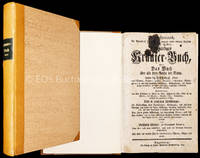
17834143DB2 Teile in 1 Band (von 2). Augsburg, Wolf, 1783. (4) Bl., 566 S. Mit zahlr. Textholzschnitten Moderner Halblederband.
170233723BBWien, In Verlegung dess Authoris, gedruckt bey Anna Rosina Sischowitz 1702. 8°. 6 n,n. Bl., 295 (recte 277) S., mit gestochenem Porträt als Frontispiz. Pergamentband der Zeit mit handschriftlichem Rückentitel.
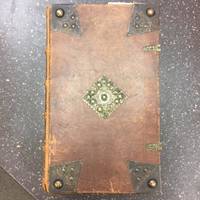
17831277019Augsburg Bavaria Germany: Joseph Wolffischen 1783. Hardcover. folio 750pp. 24pp. index 136pp.; VG; bound in brown leather paneled spine with no lettering; front board decorated with metal in the four corners diamond in the center; remnants of two clasps present two metal hooks on fore edge of front board two torn leather strips bound into rear board; moderate rubbing to boards; newer endpapers; title page has had a strip of paper approximately 1.25 inches 3.5cm. high torn off of the bottom primarily including the entirety of the publication information. It has been repaired with the backing of another sheet on that portion. There is a small tear in the middle of the page that is backed by a piece of paper on the verso and so barely impacts the legibility of the words; complete collation: endpaper title page 2pp. table of contents 4pp. 750pp. 24pp. index title page 6pp. 136pp.; separate title page with separate pagination; page 110 misprinted as 100 160 as 142 217 as 21 271 as 217 523 as 532 524 as 534 554 as 454 732 as 571 only the page number impacted; small repairs on pages 165/166 571/572 633/634 649/650 687/688 701/702 705/706 719/720 1/2; illustrated pages beginning parts two and three on pages 165 and 567. The pagination between pages 566-571 appear to be missing a page as is usual with this edition; ffep partially detached; profusely illustrated with over 800 black and white woodcut illustrations including genre scenes individual plants and animals and distilling apparatus; <br /> <br><br /> <br><br /> Adam Lonicer was a German botanist who studied at Marburg and the University of Mainz obtaining his Magister degree at sixteen years of age. After becoming a Doctor of Medicine in 1554 he became the town physician in Frankfurt am Main. His true interest though was herbs and the study of botany. His first important work on herbs the Kräuterbuch was published in 1557 with a large part dealing with distillation. He married Magdalena Egenolff the daughter of Christian Egenolff his Frankfurt publisher and a printer who specialized in herbals. The work that made his name famous is this popular herbal the Kräuterbuch. Lonicer provides us with one of the early descriptions of local flora as well as being one of the first to differentiate deciduous trees from conifers.<br /> <br /> shelved case 4. 1277019. Shelved Dupont Bookstore. Joseph Wolffischen hardcover books
17834143DB1783. 2 Teile in 1 Band von 2. Augsburg Wolf 1783. 4 Bl. 566 S. Mit zahlr. Textholzschnitten Moderner Halblederband. Nissen 1218. Äusserst erfolgreiches Destillier- und Kräuterbuch erschien erstmals 1557 in Frankfurt. Es fehlt der zoologische und der mineralogische Teil. Das Papier durchgehend stockfleckig. Das Titelblatt mit grösserem Titenfleck. unknown
17831277019Augsburg Bavaria Germany: Joseph Wolffischen 1783. Hardcover. Folio 750 pages 24 pages 136 pages. In Very Good condition. Bound in brown leather with blank paneled spine. Front board with metal corner pieces and metal diamond-shaped ornament to center of board. Remnants of clasps present: two metal hooks on fore edge of front board and two torn leather strips affixed to rear board. Boards moderately rubbed. Front free end paper partially detached. Title page shows 1.25 in-long area of damage to lower edge repaired but resulting in loss of publication information. Title page also shows small tear repaired to center of page minimally impacting legibility. Minor repairs to pages 165/166 571/572 633/634 649/650 687/688 701/702 705/706 719/720.<br> <br> Plates preface Parts Two and Three pp. 165 and 567 respectively. Profusely illustrated with over 800 black and white woodcut illustrations including genre scenes individual plants and animals and distilling apparatus. Shelved in Case 4. Adam Lonicer was a German botanist who studied at Marburg and the University of Mainz obtaining his Magister degree at sixteen years of age. After becoming a Doctor of Medicine in 1554 he became the town physician in Frankfurt am Main. His true interest though was herbs and the study of botany. His first important work on herbs the Kräuterbuch was published in 1557 with a large part dealing with distillation. He married Magdalena Egenolff the daughter of Christian Egenolff his Frankfurt publisher and a printer who specialized in herbals. The work that made his name famous is this popular herbal the Kräuterbuch. Lonicer provides us with one of the early descriptions of local flora as well as being one of the first to differentiate deciduous trees from conifers. <br> <br> Complete collation: page 110 misprinted as 100 160 as 142 217 as 21 271 as 217 523 as 532 524 as 534 554 as 454 732 as 571. Pagination consistent with this edition. 1277019. Shelved Dupont Bookstore. Joseph Wolffischen hardcover
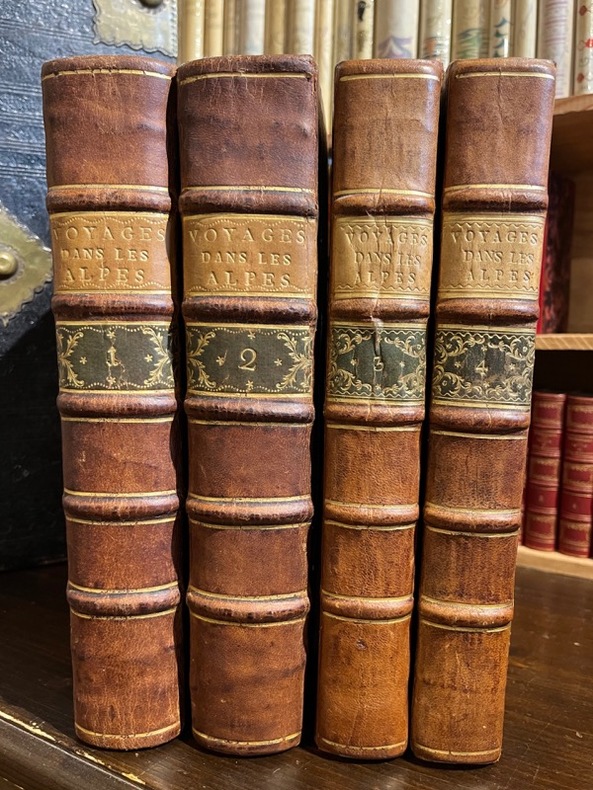
179619158Neuchâtel, Samuel Fauche, 1779, [et] Genève, Barde, Manget et Compagnie, 1786 [et] Neuchâtel, Louis Fauche-Borel, 1796. 4 volumes in-4 de [4]-XXXVI-540-[2]; [4]-XVI-641-[3]; [4]-XX-532-[2]; [4]-594-[4] pages. Demi-veau brun à coins, dos à nerfs ornés de filets dorés, pièces de titre et tomaison beiges et vertes, tranches mouchetées.
17271510220001Amsterdam: Michel Charles Le Cene 1727-01-01. Hardcover. Very Good. Folio. 2 12 439 pp.; 2 pp. 445-808p pagination continuous 43 of 44 plates. 2 Volumes in One Bound in contemporary vellum. 7 raised bands. Leather spine label. Good binding and cover. Spine and hinges restored. Faint soiling to vellum. Pages tanned with a several pages with some offsetting and foxing. Lacks frontis and added title. All 27 plates & 16 maps are present. Brunet IV 178; Cordier Japonica 367-68; Cordier Sinaca 2077; Lust 342 <br><Br> Jean Albert Mandeslo set out in 1636 with the Embassy that the Duke of Holstein sent to Russia and Persia. He visited India Ceylon Madagascar West Africa Congo and returned four years later. His story gives a very vivid picture of luxury vices curiosity and absolute disregard for life under the despotic tyranny of the Moghul Empire under Shah Jahan. In the port of Surat he arrived in April 1638 after he went to Ahmedabad and Agra. Although his observations of life in the capital are useful he apparently did not hear anything about the Taj Mahal which at that time was in the sixth year of building. Amsterdam: Michel Charles Le Cene hardcover
172730277Amsterdam: Michel Charles le Céne 1727. 2 volumes in 1 small folio. 12 1/8 x 7 5/8 inches. Titles printed in red and black. Engraved portrait frontispiece 44 engraved maps plans and views 31 folding 19 in-text engraved illustrations. Contemporary calf spine with raised bands in seven compartments red and green morocco lettering pieces in the second and third the others with a repeat decoration in gilt marbled endpapers and edges.<br/> <br/>A lovely copy of a noted illustrated work on Asia including maps and views of India China and Japan.<br/> <br/>"Johann von Mandelslo was a friend of Adam Olearius and a former page of the Duke of Holstein-Gottorp. Together Mandelslo and Olearius were sent by the Duke on an embassy to the Russian Czar and to the Shah of Persia for the purpose of initiating trade relations with Russia Tartary and Persia. Mandelslo was authorized to leave the embassy in Persia and to continue his travels to the Far East. He went to Surat Agra and Goa in India where he received great kindness from the English merchants and he also visited Ceylon. He gives long accounts of the other parts of the Far East which he did not visit personally. His return was made to England by sea via the Cape of Good Hope which he visited in 1639" Hill. Mandelslo's narrative contains substantial information on the Far East. "Before his death Mandelslo had entrusted his rough notes to Olearius who subsequently published them bound with his numerous official accounts of the embassy" Howgego. Following the first publication Olearius added additional information to subsequent editions. A new edition in French translated by Wicquefort included still more additional material including an account of the travels of Henri de Feynes to China Formosa and Japan. The present edition published in Amsterdam in 1727 is a re-issue of the Van der Aa edition of 1719 published in Leiden; both are celebrated as the best editions being the most complete and with the largest number of illustrations. The plates include views and plans of London Amsterdam Brussels Antwerp Capetown Goa Surat Jedo Tokyo St. Helena Mauritius Madagascar the Canary Islands Java Congo and elsewhere.<br/> <br/>Brunet IV 178; Cordier Japonica 367-368; Cordier Indosinica 883; Cordier Sinica 2076-77; cf. Hill 1073; Howgego M-38; Lust 342. Michel Charles le Céne unknown books
1787BOOKS236137London UK: Printed for Harrison and Co. printer unknown. FR/No Dustjacket. 1787. . Leather. Illustrated with numerous plates. . 8vo. 490pp. 96pp. As Is: front cover removed but present binding worn; wormholes at bottom front corners; bookplates on front cover & back of titlepage; occas. stains/foxing; owners signatures and notes in ink on back endpaper; some corners turned . Printed for Harrison and Co. (printer unknown) hardcover
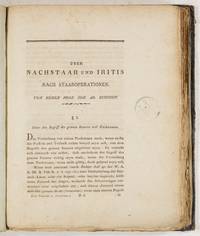
180048396ca. 1800. Abh. k.k. med.-chir. Josephs-Acad. 2. - Wien Bey Albert Camesina 1801 4° 16 435 1 Frontispice Pappband d.Zt.; St.a.Tit. u. Seitenränder; feies Expl. Frist Edition! "Inflammation of the iris was named iritis by Johann Adam Schmidt 1759-1809. In 1801 with Himly he founded the first journal devoted to ophthalmology the ophthalmolische Bibliothek." Further by Johann Adam Schmidt: Reflexionen über die Phänomene einer geschwächten Lebensthätigkeit bey lymphatischen Geschwülsten und über den grund der Tödlichkeit derselben pp.327-324. Ueber eine neue durch Verusche zuverlässig bestättigte Heilungsart der Augenliedlähmung und des Augenliedkrampfes pp.365-386. Garison & Morton No.5836 unknown