1 033 résultats
180114004London: Pr. by A. Strahan for T. Cadell & W. Davies 1801. 8vo. vi 626 pp. <br><br>Fifth edition with corrections. Adam 1741-1809 saw this work achieve great popularity and sales during his lifetime. Contemporary leather: Spine cracked front cover missing. Printed on pale blue paper Pr. by A. Strahan for T. Cadell & W. Davies hardcover books
19695839NY: Putnam. Near Fine in Near Fine dust jacket. 1969. Hardcover. The author's first novel. First American edition. Gift inscription on front free endpaper else near fine in a near fine trace edge wear lettering along the spine is sun faded dust jacket. . Putnam hardcover books
2005000369New York: William Morrow 2005. Hardcover. Fine. First edition; 8vo; pp. 4 v-vi 1-314; original boards with pictorial DJ; the slightest wear to head and tail of DJ; fine condition. Signed by Romo with the number '53' his player number after the signature. An autobiography of the prolific football star who played for the 49ers the Eagles the Broncos and the Raiders. New York: William Morrow hardcover books
2007145155Brooklyn: powerHouse Books 2007. Hardcover. 239p. 8.5x12.5 inches profusely illustrated with full-page double-page color homo-erotic photos of nude and near-nude young men lounging in hotels fine first edition in pictorial boards and edgeworn very good unclipped dj. powerHouse Books hardcover books
2000204694New York: Basic Books 2000. First. hardcover. very good/very good. Illus. 498pp. 8vo black boards d.w. with small tear. New York: Basic Books 2000.<br/><br/> Basic Books unknown books
191665624Stuttgart: Unstalt 1916. hardcover. very good. 22 plates some in color; 600 text illustrations. 524pp. Small folio pictorial cloth. Stuttgart: Unstalt 1916. Very good .<br/><br/> Unstalt unknown books
19819007455New York: Basic Books 1981. Hardcover. Book fine Dust jacket fine. The dust jacket is price clipped. <br/><br/> Basic Books hardcover books
1981221419London: Weidenfeld & Nicolson 1981. hardcover. fine/very good. 453pp. 8vo blue cloth d.w. London: Weidenfeld and Nicolson 1981. Very good<br/><br/> Weidenfeld & Nicolson unknown books
19951338717Seattle: Fantagraphics Books 1995. First Edition First Printing. Softcover. NM; minor edge-wear and small partial tear to back cover upper right edge near spine. 1338717. Special Collections. Fantagraphics Books unknown books
2000140633London: Victor Gollancz 2000. Octavo boards. First edition. Signed on the title page by Roberts. The author's first novel in which "two groups of human migrants settle on the eponymous planet whose radical and demanding simplicity -- it is salt-covered -- make it into a sounding board against which the dire incompatibilities of the two societies become drastically clear: one of them being a patriarchic hierarchy and the other anarchical." - The Encyclopedia of Science Fiction online. Broderick and Di Filippo Science Fiction: The 101 Best Novels 1985-2010 #65. A fine copy in fine dust jacket. #140633 Victor Gollancz unknown books
2000140358London: Victor Gollancz 2000. Octavo boards. First edition. The author's first novel in which "two groups of human migrants settle on the eponymous planet whose radical and demanding simplicity -- it is salt-covered -- make it into a sounding board against which the dire incompatibilities of the two societies become drastically clear: one of them being a patriarchic hierarchy and the other anarchical." - The Encyclopedia of Science Fiction online. Broderick and Di Filippo Science Fiction: The 101 Best Novels 1985-2010 #65. A fine copy in fine dust jacket. #140358 Victor Gollancz unknown books
2000139991London: Victor Gollancz 2000. Octavo boards. First edition. The author's first novel in which "two groups of human migrants settle on the eponymous planet whose radical and demanding simplicity -- it is salt-covered -- make it into a sounding board against which the dire incompatibilities of the two societies become drastically clear: one of them being a patriarchic hierarchy and the other anarchical." - The Encyclopedia of Science Fiction online. Broderick and Di Filippo Science Fiction: The 101 Best Novels 1985-2010 #65. A fine copy in fine dust jacket. #139991 Victor Gollancz unknown books
200069781London: Victor Gollancz 2000. First edition. 248 pp. Fine in fine dust jacket. Dated 25.07.00 and SIGNED by Roberts. London: Victor Gollancz unknown books
200069764London: Victor Gollancz 2000. First edition. 248 pp. Fine in fine dust jacket. London: Victor Gollancz unknown books
198544316Brooklyn: Hanging Loose Press 1985. First edition. 163 275 pp. Light foxing to page edges and endpapers else near fine in near fine dust jacket. A collaboration between Helen and Pat Adam with music by Al Carmines and drawings by Jess. Brooklyn: Hanging Loose Press unknown books
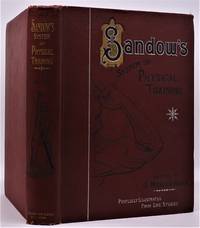
1894008930New York: J. Selwin Tait & Sons 1894. "the Marvel of Anatomists Sculptors and Artists in the Nude; embracing the great Athlete's simple method of Physical Education for the Home the Gymnasium and the Army Training School; preceded by a Biography dealing with the chief incidents in Mr. Sandow's Professional Career his Phenomenal Prowess and Gladiatorial Skill in Competitive Matches Contests and Exhibitions; with Mr. Sandow's Scheme of Dumb-bell and Bar-bell Exercises and his Views on the Physiology of Gymnastics the Function of the Muscles etc. Richly illustrated from photographs expressly taken for the work by Sarony of New York Morrison of Chicago and White of Birmingham and of Drawings by A. Casarin." Very Good Plus bound in red cloth decorated and lettered in gilt black and white front hinge cracked yet holding well light rubbing to cloth at the tips the stamp of "The Tarr System Library" front paste down which would seem to be a prior owner's obvious reference to Edgar Allen Poe's 1850 story THE SYSTEM OF DR. TARR AND PROF. FETHER. Eugen Sandow was a German bodybuilder and showman who in 1901 organized the world's first major bodybuilding competition. Considered the "Father of modern bodybuilding" he was one of the first to model his physique to predetermined dimensions so as to resemble classic Greek and Roman sculptures. . First Edition. Decorative Cloth. Very Good Plus. 8vo - over 7¾" - 9¾" tall. J. Selwin Tait & Sons Hardcover books
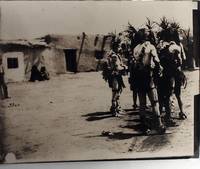
02146321.4 cm x 16.4 cm. Photograph by Adam Clark Vroman Koshari-Pueblo of Santo Domingo ca. 1900. Between 1895 and 1904 Adam Clark Vroman photographed the landscape and native peoples of the American Southwest. He photographed the Hopis Zunis and Pueblos among other tribes. His portraits of Native Americans humanize rather than romanticize his subjects. The process he used most frequently was the platinotype or platinum print known for its non-reflective surface rich detail broad tonal range and permanence. The platinum process was widely used in the United States and Europe from 1880 through the 1930s when the cost of platinum became prohibitive and the silver-based processes gained prominence. Vroman moved to Pasadena California in 1892. He soon opened a book stationery and photo-supply shop there in November of 1894. He traveled through southern California Arizona and New Mexico on seven separate trips from 1895 to 1904 to document the area's landscape Indians and Indian communities. Vroman was employed as a photographer by the Bureau of American Ethnology a research unit of the Smithsonian Institution for two separate trips to the Southwest the former involving a climb to the Enchanted Mesa in central New Mexico to prove the existence of Indian habitation and the latter a documentation of Southwestern pueblos and cliff dwellings. books
WELLER9781635570113New. New book. unknown books
177517124London 1775. Engraving by Joshua Record. In excellent condition with the exception of some minor foxing across the sheet and some waterstaining along the upper margin. A decorative engraving by the celebrated architect Robert Adam depicting an elegant room in Lord Derby's house in Grosvenor Square London.<br/> <br/>Robert and his brother James Adam forever changed the face of British architecture by introducing innovative Classical design ideas. From 1754-57 Robert lived in Italy where he had a long productive friendship with Piranesi which was inspirational for both men. Adam's first book on Diocletian's palace in Dalmatia is clearly very like the archaeological investigations Piranesi was making at the same time of similar ruins. Piranesi's friendship and passion for Roman Classicism were seminal influences on Adam and the greatest single factor other than his own talent in the work Adam produced on his return to England. Upon his return the brothers launched their career by building the Adelphi from the Thames to the Strand in London which although not a commercial success at the time included one of London's most cherished buildings the Adlephi Theatre. Together the Adam brothers designed and built some of the most famous buildings in England including such bastions of English architecture as Kenwood House Keddlestone Manor and Syon House. To the interiors of their English country houses the Adams brought wonderful ornamental elements in niches lunettes festoons and reliefs. Their classically designed buildings were so numerous in London that they changed the prevailing feel of the city and established their brand of neo-Classicism as the model of elegance and importance. It is asserted that the brothers originated the concept of the uniform facade attached to the typical English row house an architectural device that distinguishes London buildings. This monumental contribution is evidenced in the Adams' designs for Portland Place and Fitzroy Square and these were used as architectural models for the whole city. The brothers brought their talents into other areas by designing furniture to complement their beautiful interiors and by creating and publishing a treatise of design entitled 'Works in Architecture'. The work was published in three volumes over an extended span of time beginning in 1773 with the final volume being published posthumously in 1822.<br/> <br/>Cf. Brunet I.47; cf. Lowndes I p.8; DNB; Wilton-Ely The Mind and Art of Giovanni Battista Piranesi. unknown books
17745594London 1774. Engraving by J. Roberts. Expert repairs to lower left corner. A fine architectural engraving of the interior of Kenwood House in Hampstead London re-modelled in 1761-1773 and now home to the Iveagh Bequest picture collection.<br/> <br/>Robert and his brother James Adam forever changed the face of British architecture by introducing innovative Classical design ideas. From 1754-57 Robert lived in Italy where he had a long productive friendship with Piranesi which was inspirational for both men. Adam's first book on Diocletian's palace in Dalmatia is clearly very like the archaeological investigations Piranesi was making at the same time of similar ruins. Piranesi's friendship and passion for Roman Classicism were seminal influences on Adam and the greatest single factor other than his own talent in the work Adam produced on his return to England. Upon his return the brothers launched their career by building the Adelphi from the Thames to the Strand in London which although not a commercial success at the time included one of London's most cherished buildings the Adlephi Theatre. Together the Adam brothers designed and built some of the most famous buildings in England including such bastions of English architecture as Kenwood House Keddlestone Manor and Syon House. To the interiors of their English country houses the Adams brought wonderful ornamental elements in niches lunettes festoons and reliefs. Their classically designed buildings were so numerous in London that they changed the prevailing feel of the city and established their brand of neo-Classicism as the model of elegance and importance. It is asserted that the brothers originated the concept of the uniform facade attached to the typical English row house an architectural device that distinguishes London buildings. This monumental contribution is evidenced in the Adams' designs for Portland Place and Fitzroy Square and these were used as architectural models for the whole city. The brothers brought their talents into other areas by designing furniture to complement their beautiful interiors and by creating and publishing a treatise of design entitled 'Works in Architecture'. The work was published in three volumes over an extended span of time beginning in 1773 with the final volume being published posthumously in 1822.<br/> <br/>Cf. Brunet I.47; cf. Lowndes I p.8; DNB; Wilton-Ely The Mind and Art of Giovanni Battista Piranesi. unknown books
17745385London 1774. Engraving by J. Zucchi. A fine architectural engraving of the interior of Kenwood House in Hampstead London re-modelled in 1761-1773 and now home to the Iveagh Bequest picture collection.<br/> <br/>Robert and his brother James Adam forever changed the face of British architecture by introducing innovative Classical design ideas. From 1754-57 Robert lived in Italy where he had a long productive friendship with Piranesi which was inspirational for both men. Adam's first book on Diocletian's palace in Dalmatia is clearly very like the archaeological investigations Piranesi was making at the same time of similar ruins. Piranesi's friendship and passion for Roman Classicism were seminal influences on Adam and the greatest single factor other than his own talent in the work Adam produced on his return to England. Upon his return the brothers launched their career by building the Adelphi from the Thames to the Strand in London which although not a commercial success at the time included one of London's most cherished buildings the Adelphi Theatre. Together the Adam brothers designed and built some of the most famous buildings in England including such bastions of English architecture as Kenwood House Keddlestone Manor and Syon House. To the interiors of their English country houses the Adams brought wonderful ornamental elements in niches lunettes festoons and reliefs. Their classically designed buildings were so numerous in London that they changed the prevailing feel of the city and established their brand of neo-Classicism as the model of elegance and importance. It is asserted that the brothers originated the concept of the uniform facade attached to the typical English row house an architectural device that distinguishes London buildings. This monumental contribution is evidenced in the Adams' designs for Portland Place and Fitzroy Square and these were used as architectural models for the whole city. The brothers brought their talents into other areas by designing furniture to complement their beautiful interiors and by creating and publishing a treatise of design entitled 'Works in Architecture'. The work was published in three volumes over an extended span of time beginning in 1773 with the final volume being published posthumously in 1822.<br/> <br/>Cf. Brunet I.47; cf. Lowndes I p.8; DNB; Wilton-Ely The Mind and Art of Giovanni Battista Piranesi. unknown books
177517122London 1775. Engraving by Joshua Record. In excellent condition. An elegant engraving showing the chimney in the anteroom of Lord Derby's house in Grosvenor Square London.<br/> <br/>Robert and his brother James Adam forever changed the face of British architecture by introducing innovative Classical design ideas. From 1754-57 Robert lived in Italy where he had a long productive friendship with Piranesi which was inspirational for both men. Adam's first book on Diocletian's palace in Dalmatia is clearly very like the archaeological investigations Piranesi was making at the same time of similar ruins. Piranesi's friendship and passion for Roman Classicism were seminal influences on Adam and the greatest single factor other than his own talent in the work Adam produced on his return to England. Upon his return the brothers launched their career by building the Adelphi from the Thames to the Strand in London which although not a commercial success at the time included one of London's most cherished buildings the Adlephi Theatre. Together the Adam brothers designed and built some of the most famous buildings in England including such bastions of English architecture as Kenwood House Keddlestone Manor and Syon House. To the interiors of their English country houses the Adams brought wonderful ornamental elements in niches lunettes festoons and reliefs. Their classically designed buildings were so numerous in London that they changed the prevailing feel of the city and established their brand of neo-Classicism as the model of elegance and importance. It is asserted that the brothers originated the concept of the uniform facade attached to the typical English row house an architectural device that distinguishes London buildings. This monumental contribution is evidenced in the Adams' designs for Portland Place and Fitzroy Square and these were used as architectural models for the whole city. The brothers brought their talents into other areas by designing furniture to complement their beautiful interiors and by creating and publishing a treatise of design entitled 'Works in Architecture'. The work was published in three volumes over an extended span of time beginning in 1773 with the final volume being published posthumously in 1822.<br/> <br/>Cf. Brunet I.47; cf. Lowndes I p.8; DNB; Wilton-Ely The Mind and Art of Giovanni Battista Piranesi. unknown books
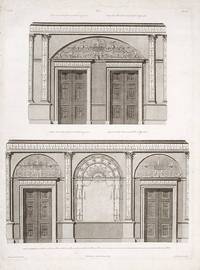
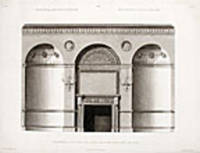
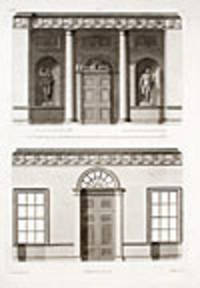
177817136London 1778. Copper engraving. Engraved by P. Mazell. In excellent condition. An elegant engraving the Porter's Lodge at Shelburne House in Berkeley Square in London.<br/> <br/>Robert and his brother James Adam forever changed the face of British architecture by introducing innovative Classical design ideas. From 1754-57 Robert lived in Italy where he had a long productive friendship with Piranesi which was inspirational for both men. Adam's first book on Diocletian's palace in Dalmatia is clearly very like the archaeological investigations Piranesi was making at the same time of similar ruins. Piranesi's friendship and passion for Roman Classicism were seminal influences on Adam and the greatest single factor other than his own talent in the work Adam produced on his return to England. Upon his return the brothers launched their career by building the Adelphi from the Thames to the Strand in London which although not a commercial success at the time included one of London's most cherished buildings the Adlephi Theatre. Together the Adam brothers designed and built some of the most famous buildings in England including such bastions of English architecture as Kenwood House Keddlestone Manor and Syon House. To the interiors of their English country houses the Adams brought wonderful ornamental elements in niches lunettes festoons and reliefs. Their classically designed buildings were so numerous in London that they changed the prevailing feel of the city and established their brand of neo-Classicism as the model of elegance and importance. It is asserted that the brothers originated the concept of the uniform facade attached to the typical English row house an architectural device that distinguishes London buildings. This monumental contribution is evidenced in the Adams' designs for Portland Place and Fitzroy Square and these were used as architectural models for the whole city. The brothers brought their talents into other areas by designing furniture to complement their beautiful interiors and by creating and publishing a treatise of design entitled 'Works in Architecture'. The work was published in three volumes over an extended span of time beginning in 1773 with the final volume being published posthumously in 1822.<br/> <br/>Cf. Brunet I.47; cf. Lowndes I p.8; DNB; Wilton-Ely The Mind and Art of Giovanni Battista Piranesi. unknown books
2005Embry 102830HarperCollins 2005. First edition first printing. Fine in fine dust jacket. B&W and color illustrations. HarperCollins, 2005. First edition, first printing. unknown books
2005272013New York: HarperCollins 2005. First Edition. Near Fine binding/Near Fine dust jacket. Signed. A First Edition copy which has been Signed on the title page with a personal inscription by Adam Nicolson. Near Fine binding / Near Fine dust jacket. HarperCollins unknown books