Smith, AdamBiblio.com
336 résultats
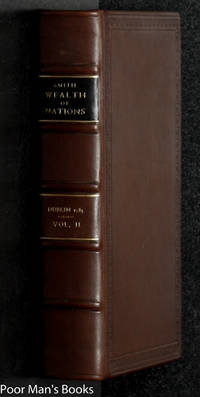
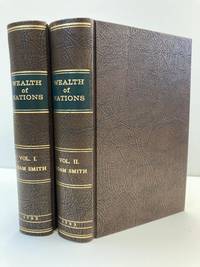
17931356061Dublin: printed by William Porter for G. Burnet L. White W. Wilson P. Byrne W. McKenzie J. Moore and W. Jones 1793. Fifth Edition. Hardcover. Octavos Two Volumes. In Very Good condition. Bound in modern brown patterned cloth with green labels gilt titling and gilt tooling to spines. Complete with both half-titles. Some tide-marks Volume 1 with bottom half of text block for the first half of the volume then expanding to cover the entirety of the leaves. Volume 2 the top half of the text block for the first few gatherings then reducing to just the top edge and upper gutter. Removed bookplate to rear pastedowns. Front free end page and rear free end page of Volume 1 bound in upside down. Shelved case 5. Smith's masterpiece being "the first and greatest classic of modern economic thought" PMM - was first published in 1776 in London with the first Dublin edition published that same year. ESTC: T95114. 1356061. Shelved Dupont Bookstore. printed by William Porter, for G. Burnet, L. White, W. Wilson, P. Byrne, W. McKenzie, J. Moore, and W. Jones hardcover
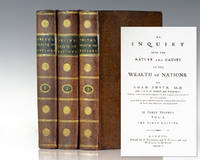
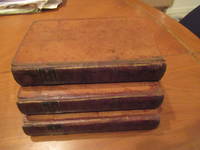
1799137589London: A. Strahan and T. Cadell 1799. Early edition of Adam Smith's magnum opus and cornerstone of economic thought. Octavo 3 volumes bound in full calf gilt titles to the spine morocco spine labels. In near fine condition rebacked. An exceptional set of this classic work. Adam Smith's masterpiece first published in 1776 is the foundation of modern economic thought and remains the single most important account of the rise of and the principles behind modern capitalism. "The history of economic theory up to the end of the nineteenth century consists of two parts: the mercantilist phase which was based not so much on a doctrine as on a system of practice which grew out of social conditions; and the second phase which saw the development of the theory that the individual had the right to be unimpeded in the exercise of economic activity. While it cannot be said that Smith invented the latter theory.his work is the first major expression of it. He begins with the thought that labour is the source from which a nation derives what is necessary to it. The improvement of the division of labour is the measure of productivity and in it lies the human propensity to barter and exchange.Labour represents the three essential elements-wages profit and rent-and these three also constitute income. From the working of the economy Smith passes to its matter -'stock'- which encompasses all that man owns either for his own consumption or for the return which it brings him. The Wealth of Nations ends with a history of economic development a definitive onslaught on the mercantile system and some prophetic speculations on the limits of economic control.The Wealth of Nations is not a system but as a provisional analysis it is complete convincing. The certainty of its criticism and its grasp of human nature have made it the first and greatest classic of modern economic thought" PMM. A. Strahan and T. Cadell unknown
179651283London A. Strahan and T. Cadell and W. Davies 1796. Hardcover. In a 20th century binding quarter morocco over marbled boards with gold-on-black spine labels. Bound without half titles. Three different circular embossed stamps blind stamps are noted each about 1.5 inches in diameter. The first reading "LIBRARY OF ARTHUR BEISS" on the circumference and "ABJ" in the center appears on an early blank in each volume. The second is essentially the same but reads "LIBRARY OF JUDITH BEISS" on the circumference and "JBA" in the center and is found on a rear blank in each volume. A third circular embossed stamp of the same size is not entirely legible. It reads "THE illegible LIBRARY ASSOCIATION" on the circumference with two smaller illegible lines and a year probably 1885 in the center. It is found on page 5 of each volume and also on page 345 of volume 2 and page 327 of volume 3. The volumes contain no other ownership markings or annotations or markings of any kind. The pages are mildly foxed but without tears or other damage. . Three volumes separately paged. London, A. Strahan and T. Cadell and W. Davies hardcover
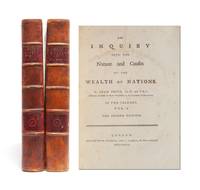
17785444London: for W. Strahan and T. Cadell 1778. Second edition. Very Good. 2 volumes quarto 282 × 225 mm half title in volume 2 as called for bound without the final blanks in each volume: 8 510; 8 589 1 blank. Contemporary tree calf rebacked preserving original red morocco spine labels plain endpapers. Engraved armorial bookplate of the Leigh family of Stoneleigh Abbey "Tout Vient de Dieu" and two Japanese bookseller's tickets to the front paste-down. Some insect damage to the leather boards corners worn light to moderate foxing throughout mostly in volume 1 a few tears or blemishes one or two signs of a contemporary reader's engagement with the text; a very good copy overall.<br /> <br /> Second edition first published in 1776 of this classic of economic thought the only other edition to be published in quarto format one of 500 copies. Long considered a straight reprint this edition in fact contains "a number of alterations large and small some providing new information some correcting matters of fact some perfecting the idiom and a large number now documenting references in footnotes" Todd. <br /> <br /> Published in the same year as the American Declaration of Independence Adam Smith's The Wealth of Nations was a magnum opus that shaped not only the future of a new republic but that also urged longstanding sovereign governments to reconsider how and when they regulated markets. Arguing that economic growth comes not from government planning "but as the natural outcome of many people pursuing their own self-interest in the confines of an ordered polity" Smith encouraged economists and political policy-makers to leave free markets to their own operations and focus instead on fulfilling the duties of peace keeping education and public infrastructure that they owed their citizenry The Wall Street Journal. <br /> <br /> ESTC T95117. Einaudi 5329; Goldsmiths' 11663; Kress B.154; Tribe 15; Vanderblue 3; see also PMM 221. Very Good. for W. Strahan and T. Cadell unknown
179327911London: A. Strahan and T. Cadell. Very Good with no dust jacket. 1793. Seventh Edition. Hardcover. All three volumes professionally rebacked keeping the original speckled leather boards. Not xlib. Owner's sticker inside the front c overs Bloomfield Jervis Beach 1820-1894. A very nice clean attractive set. ; 8vo 8" - 9" tall . A. Strahan and T. Cadell hardcover
179362455London: A. Strahan and T. Cadell. Very Good. 1793. Seventh Edition. Hardcover. Three volumes published in 1793 three years after his death; still stiff to open with bright crisp pages with very occasional age spot; in full contemporary tree calf still in very good condition; front board of volume one detached and nearly so to volume 3; unmarked but for name and bookplate to each volume. Spines are numbered with gilt decoration and red and black labels. Photos on request. . A. Strahan and T. Cadell hardcover
179630670Philadelphia: Thomas Dobson 1796. 412; 430; 387 1 blank 55 pp. Contemporary tree calf some chipping rebacked with remnants of original spines laid down. Toned scattered foxing lightly worn. Good. <br /> <br /> The second American edition the first having issued in 1789 also published by Dobson. 'Printing and the Mind of Man' describes this work as "the first and greatest classic of modern economic thought." <br /> Evans 31196. PMM 221 London 1776. Kress 3288. Thomas Dobson unknown
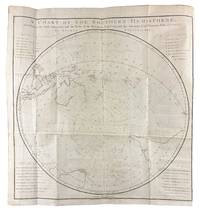
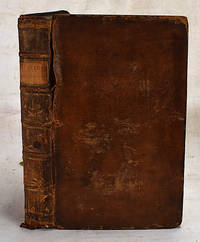
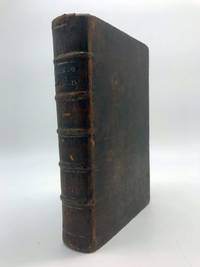
176455358E-08: A. Millar Et Al. Very Good. 1764. Hardcover. Leather. Folio 10-1/2 by 17 inches. A. Millar et al London. 1764. Two volumes. Xxxiv 500 pages; 434 pgs. With large folding hemispheric map of the world and two other maps. Bound in contemporary full brown calf leather with burgundy morocco spine labels raised bands. Boards have wear present to the extremities of the boards. No ownership marks present. Text is clean and free of marks. Binding tight and solid. First edition of this important authoritative history of commerce with a focus on Britain's acquisition of "new American markets" as well as the greater consequences of "the very extraordinary actions of the year 1720" when the South Sea Bubble burst. Within this impressive two-volume work are extensive references to treaties parliamentary acts the substantive contributions of economic texts and thorough statistical accounts of currency population and wealth. "In the year preceding Anderson's death appeared his great and only work An Historical and Chronological Deduction. Coming down from the earliest times to the year 1762 Anderson's work is a monument of stupendous industry. Composed in the form of annals it is not merely a record of commercial progress and colonial enterprise but a history of the political industrial and social development of all civilised countries and especially of Great Britain and Ireland. Abstracts of all treaties acts of parliament and pamphlets in any way bearing on commerce or kindred matters are added together with statistical accounts of the national finances of prices currency and population. In the introduction to his work Anderson showed himself in advance of his time and exposed several of the fallacies of the mercantile system. He condemned industrial monopolies and advocated the naturalisation of foreign protestants and a uniformity of weights measures and coinage for all the nations of Christendom." E-08; Folio 13" - 23" tall . A. Millar, Et Al, hardcover
1793JD1018T. Cadell 1793. Sixth Edition. Hardcover. Good. 1793; London; professionally rebound; sixth edition; red and blue cloth covered boards with gold titles; covers contain rubbing and wear; interior pages are original and contain rubbing and wear with mild foxing and musty smell; 8vo - over 7 3/4" to 9 3/4" tall; 468 pages T. Cadell hardcover
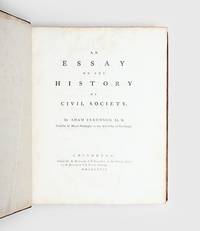
176761031Edinburgh 1767. Large 4to. Recased preserving the contemporary marbled leather boards with a gilt line-frame over a more recent light brown full calf binding with five raised bands and gilt ornamentations to spine. The contemporary gilt title-label also preserved in second compartment of the spine. A later leather-onlay to the lower compartment presumably covering an earlier library-marking. All edges of boards gilt. Inner hinges re-enforced. A good solid and sturdy copy. Library stamp Freie Universität Berlin to verso of title-page along with a deaccession-stamp as well as to blank lower margin of p. 48. Apart from the stamps internally extremely well preserved clean and fresh with only light occasional brownspotting. A very wide-margined copy on good paper. Leaves measuring 27x21 cm. VII 1 430 pp. <br/><br/><em>The uncommon first edition of this pioneering classic of the Enlightenment a magnum opus in the history of political thought. The Essay became extremely influential and established Ferguson’s reputation in Britain and the rest of Europe. The work was also taught at the University of Moscow causing Voltaire to praise Ferguson for “civilizing the Russiansâ€. Marx was also directly influenced by the work as were numerous of the great political and sociological theoreticians. “Adam Ferguson's Essay on the History of Civil Society first published in 1767 is a classic of the Scottish - and European - Enlightenment. Drawing on such diverse sources as classical authors and contemporary travel literature Ferguson offers a complex model of historical advance which challenges both Hume's and Smith's embrace of modernity and the primitivism of Rousseau. Ferguson combines a subtle analysis of the emergence of modern commercial society with a critique of its abandonment of civic and communal virtues. Central to Ferguson's theory of citizenship are the themes of conflict play political participation and military valour. The Essay is a bold and novel attempt to reclaim the tradition of active virtuous citizenship and apply it to the modern state.†Cambridge University Press. â€A pioneering work of the Scottish Enlightenment in the field of “philosophical history†or what we would today call sociology. It deals with the social political economic intellectual and legal changes which accompanied societies as they made the transition to modern commercial and manufacturing society.†OLL – Online Library of Liberty </em> hardcover
1767187228Edinburgh: for A. Millar & T. Cadell London; and A. Kincaid & J. Bell Edinburgh 1767. Synthetizing the Enlightenment First edition of this key text of the Scottish Enlightenment a pioneering precursor of modern sociology. The Essay explores how nations had developed towards the state of commerce refinement and liberty associated with 18th-century Britain. It consequently examines the development of human society from barbarism to civilized refinement and the consequences of that development - both beneficial and detrimental. Widely seen as synthesizing the thought of his times Ferguson followed Montesquieu in emphasizing the great variety of factors informing the historical rise and fall of polities in Europe and beyond. He had much to say on the issues of contemporary society including the thorny question of balancing wealth and virtue. His answer was to challenge the tendency of wealthy commercial men to withdraw from politics and thus from virtuous activities by inculcating a greater civic consciousness among such individuals. Among his contemporaries Ferguson's Essay made a particularly significant impact on the efforts to develop a discipline of social sciences at the University of Göttigen: "They were impressed by his comparative attitude to societies ancient and modern and by his attack on Rousseau's concept of the state of nature. Ferguson's approach inspired a comparative ethnography that went beyond the traditional dichotomy between 'primitive' and 'civilized' and tried to map the varieties of social mores without grading them on a strict ladder of historical progress" ODNB. Quarto 263 x 201 mm pp. viii 430. Contemporary sprinkled calf spine ruled in gilt and with red morocco label edges sprinkled red. Light bumping and wear minor infrequent foxing to otherwise crisp contents: a very good copy indeed. ESTC T76205; Goldsmiths' 10264; Higgs 3973; Kress 6432. unknown
1791053487London: Strahan And Cadell 1791. 5th or later Edition . Full-calf. Very Good. Three Volumes As Issued. Complete With All Preliminary Blanks In All Volumes Cancels X5 And X8 In Volume 3. Contemporary Calf New But Old Style Black Morocco Labels Gilt In All Compartments. 8Vo. The Preeminent Classic Of Economic Thought Now Scarce In All Early Editions. This Is The Sixth Edition One Of 2000 Copies Identical To The Last Revision By Smith And The First Published After His Death. Worn Extremities Rubbed Spines Chipped Away At Top And Bottom Edges Apparently Repaired At Some Time; Leather Recently Conditioned Furbished Minor Repairs To Corners. Corporate Bookplates In All Volumes. A "Printing And The Mind Of Man" Title. Human Greeds Tend To Cancel Each Other Out And Are Dangerous Only When Government Interferes On One Side Or Another. Thus Government Has No Role To Play In Using Military Force Or Diplomatic Resources To Protect Foreign Trade Although Of Course No Self-Proclaimed Adam Smith Acolyte Politician Would Agree Despite Their Justifications Of Liberalism Free Trade Democracy Etc. : The Greed Of Politicians The Primary Fact Of Modern Life Was Not Fully Anticipated By Smith. The Main Point That Is Usually Cited From Smith'S Long Work 4 Volumes Neglecting 99% Of His Analysis Focuses Only On The Idea That Unrestricted Free Trade Is Better. Modern Interpretations Further Claim That Free Trade Is Always Better And Should Be The Primary Goal- Period That It Is An Absolute Necessity. A Thought Experiment Can Show How That Is Ridiculous. Imagine A World Where A Country Spends Far More On Sex Tourism Overseas Than On Purchasing Anything Else. The Sex Workers Overseas Will Spend Some Money On That Country'S Services And Goods But If There Is An Unbalanced Outflow Most Of The Money In The "Purchasing" Country Will End Up In The "Selling Country". The Purchasing Country Has Nothing To Show In The Long Term For All Those Transitory Pleasures It Purchased And The Country Will Dissolve As It Can No Longer Pay The Normal Everyday Debts Of Government And Private Activity. One Can Listen To Professional Economists That Say That Is Not True But If It Is Not True Why Do The Unfunded Debts Of Federal State And Local Governments Worldwide Keep Going Up And Why Can'T Governments Worldwide Come Up With Working Budgets The Problem Is Not Just In Regulation It Is Also A Problem Of Too Much Consumption. If That Analysis Is Wrong Where Is A Country That Can Provide A Current Budget That Is Based On Receipts Rather Than Expectations And When Have Those Expectations Ever Been Correct Over Say A Century In World History Economists Are Not Historians They Are Bureaucratic Advisors Who Sell Their Advice That Is Not Based On Long-Term Evidence Have Themselves Never Built Anything That Endures Can Point To No Physical Evidence That They Understand How The World Works And Have No Responsibilities When Things Fail. Every Empire And Every Government Fails When It Can No Longer Pay Enough To Sustain And Defend Itself. The Best Interpretation Of The Free Trade Argument Is That Free Trade Is Better For Most Businesses That Make Money From Selling And That In Itself Is Better For Society. If That In Itself Is Better Than Not Having Free Trade If Free Trade Is The Highest Principle In And Of Itself Then Slavery Imperialist Warfare Dictatorship Poisonous And Unhealthy Food Pollution And The Destruction Of Every Natural Thing Become Acceptable So Long As Free Trade Exists. We May Look Forward To Seeing Articles From Economists That Defend That Position And Also To Detailed Budgets For National State And City Governments That Is Within The Boundaries Of Their Receipts. Absent That We Must At Least Consider That Whatever Professional Advisors Say There Is An Issue In The Real World Of "Government Budgets" And We Are Left To Consider What Is The System Of Trade Laws That Make It More Likely That We Will In The Foreseeable Future Have Balanced Them. <br/> <br/> London: Strahan And Cadell unknown
178534376Dublin: W. W. Colles R. Montcrieffe G. Burnet Et Al. Near Fine with no dust jacket. 1785. Fourth Edition. Hardcover. 8vo 8" - 9" tall; 4894 59 pages; Rebound in rich full calf leather. Contents clean and bright with minor water stains at inner upper spine. Vol II of 2 4th edition but 2nd Dublin edition. Light owner name at top of title. Exceptional. . W. W. Colles, R. Montcrieffe, G. Burnet, Et Al. hardcover
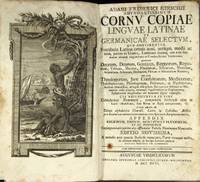
179648977Avgvstae Vindelicorvm i.e. Augsburg: officinae librariae Joseph Wolffianae 1796. Thick 8vo pp. xxviii 3028 columns; engraved frontispiece; contemporary full calf gilt-paneled spine in 6 compartments old brown morocco label in 1 edges stained red; several old ownership inscription on the front flyleaf some cracking at the tops of both joints; good and sound. A comprehensive German-Latin dictionary. Vancil p. 139 cites the 1750 and 1754 editions; Zaunmuller col. 254. officinae librariae Joseph Wolffianae unknown
177520371Wien 1775. Zwei Teile in einem Band Rücken lädiert Wasserrand auf den ersten Seiten ansonsten gute Erhaltung Editio novissima Emerici Felicis Bader 8°. Ldr. Philologie unknown
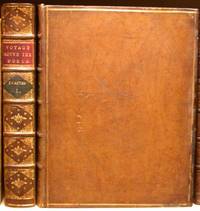
1777elala682London: Printed for B.White J.Robson P.Elmsly and G.Robinson 1777. 1777. 2 Volumes. 4to. pp. xviii 2 602; 2 p.l. 607. without the errata leaf at the end of Vol. I. folding engraved map frontis. An attractive set in contemporary sprinkled calf neatly rebacked corners renewed spines tooled in gilt Vol. I title-leaf professionally remargined at lower edge & upper outer corner with small repair marginal repair to GG2-3 affecting part of headline occasional spotting. First Edition of this important account of Cooks second voyage which preceded the publication of the official record by some six weeks. The author and his father Johann Reinhold served as naturalists on the expedition. While the elder Forster was originally to have written the account he was forbidden to do so because of a dispute with the Admiralty concerning his emoluments. It is based on his journal and also draws from Cooks own although no acknowledgement is given. Humboldt said that he was indebted to this work more so than to any other for his early love of nature and tropical beauty. On his second and historically most important voyage Cook determined that the Terra Australis Incognita which supposedly lay between New Zealand and South America did not exist and accomplished the first crossing of the Antarctic Circle. Cook revisited New Zealand and discovered or re-explored and charted many of the islands in the Pacific including Easter Island the Marquesas Tahita and the Society Islands the Tonga Islands the New Hebrides and New Caledonia. A vast amount of scientific and ethnographical information was gathered and as a result of new techniques developed by Cook not one crew member on the voyage died from scurvy a remarkable achievement for the time and for which Cook was awarded the Copley gold medal. Beddie 1247. Cox I p. 60. Hill p. 108. Hocken pp. 16-17. Holmes 23. Kroepelien 450. OReilly-Reitman 382. Sabin 25140. Spence 464. 1st Edition. Hardcover. Very Good. London: Printed for B.White, J.Robson, P.Elmsly, and G.Robinson, 1777. hardcover
177741959London: Printed for B. White Fleet-Street; J. Robson Bond Street; P. Elmsly Strand; and G. Robinson Pater-noster Row 1777. Two volumes. 4to. 11 3/16 x 8 1/2 inches. First edition. Volume I: A4 a4 b2 B-4G4 4H2. i-xviii 2 1-602 2. 624 pp. Title Preface Contents Engraved Folding Chart Chapters I-IV Errata. Volume II: A2 B-4H4. 4 1-607 1. 612 pp. Title Contents Errata Chapters V-VIII. Contemporary tan calf maroon morocco lettering pieces marbled endpapers<br/> <br/> First edition with Forster's large folding chart of the Southern Hemisphere.<br/> <br/> This the first published account of Cook's second voyage 1772-1775 was published six weeks before Cook's official version. Forster's work is substantial even though it was speedily produced to rival Cook's work. The German naturalist Forster and his father Johann Reinhold Forster 1729-1798 had served as the official botanists aboard the HMS Resolution during the second voyage. When the Royal Admiralty decided to withdraw their offer to have the elder Forster contribute to the official report due to a controversy over his emoluments George produced his own publication. The Admiralty had commissioned Cook to undertake his second voyage in the wake of the success of his first. It was perhaps the most important of Cook's three voyages. The purpose of the second voyage was to circumnavigate the globe as far south as possible searching for any unknown southern landmasses which the Royal Society still believed could exist. But Cook proved beyond a doubt that a fabled Terra Australis Incognita which was supposed to lie between South America and New Zealand did not exist. His two ships became the first to traverse the Antarctic Circle doing so three times discovering and re-discovering islands in the Pacific including New Zealand New Caledonia Palmerston the Norfolk Islands Easter Island the Marquesas New Hebrides Tonga and the Sandwich Islands. An enormous amount of scientific and ethnographic information was garnered from the expedition and as a result of the new techniques Cook employed not one crew member died of scurvy a remarkable achievement for which Cook was awarded the Royal Society's Copley Medal. Forster though young proved a knowledgeable and adept observer; his book is the essential supplement to the literature of the second voyage. The lively elegant prose and critical detail of his account based loosely on both his father's journal and though unacknowledged Cook's own work make it one of the finest examples of eighteenth-century travel literature. It is of prime importance too in the history of European contact with Pacific peoples. The Forsters' publications reveal the sophistication and enthusiasm they brought to their interactions with Polynesian peoples as well as a sensitivity to the moral ambiguities of contact. "For all the controversy A Voyage Round the World is an interesting and important account that complements the official one with facts and astute observations on the human side of the voyage." Rosove Its confident visionary style incorporates a good deal of polemic particularly in its criticism of the treatment of islanders by Cook's crew. It is a thrilling account of life aboard one of Cook's vessels.<br/> <br/> BCJC 1247. Beddie 1247. Cox I p. 60. Davidson pp. 61-62. ESTC T155479. Hill 625. Hocken pp.16-17. Holmes 23. Kroepelien 450. O'Reilly-Reitman 382. Rosove Antarctic 132. Sabin 25130. Spence 464. Printed for B. White, Fleet-Street; J. Robson, Bond Street; P. Elmsly, Strand; and G. Robinson, Pater-noster Row unknown
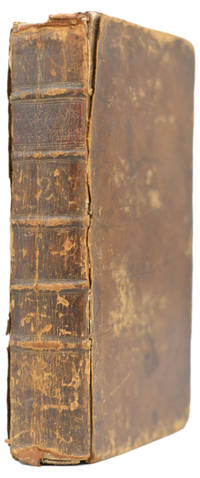
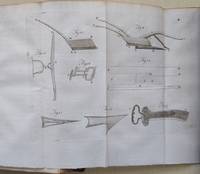
17652501060002Printed for A. Kincaid and J. Bell Edinburgh MDCCLXV 1765. The 2d ed. with large additions. Hardcover. Good. Early British Agriculture Bound in contemporary Scottish calf. Some cover splitting at the front hinge. Hardcover. xvi 487 pages 2 folded plates 21 cm. Contents:Of vegetation; Of tillage; Of manures and their operation; Of soils. <br> Goldsmiths'-Kress no. 10071. ESTC T129677 Printed for A. Kincaid and J. Bell, Edinburgh, MDCCLXV hardcover
1765mon0000065207Edinburgh: A. Kincaid and J. Bel 1765. Hardcover. Very Good. in x in x in. 2nd edition 1765. Contemporary full calf gilt 2 folding engraved plates as called for Edinburgh: A. Kincaid and J. Bel hardcover
1762jc017.130GB: printed by A Donaldson and J Reid for the Author and A Donaldson Edinburgh 1762. 16 and 428 pages. Two folding plates the second has a browned patch. Fairly clean tight text but edges spotted. Some early and late leaves browned and spotted. Armorial bookplate of Melville. In old full leather which is worn. Some loss to title label. Front cover just holding by strings. Hardback. Good/No DW. printed by A Donaldson and J Reid for the Author and A Donaldson, Edinburgh Hardcover
176550268Edinburgh: A. Kincaid and J. Bell 1765. Second edition 8vo xvi 487 1 pp. Two folding plates. Modern speckled half calf marbled sides red morocco label slight wear to the outer edge of the upper cover otherwise an attractive copy. Edinburgh: A. Kincaid and J. Bell unknown
176214Edinburgh: Printed by A. Donaldson and J. Reid. For the Author and A. Donaldson. Sold by A. Millar opposite to Catherine Street in the Strand; R. and J. Dodsley in Pall-mall; and J. Richardson in Pater-noster-row London 1762. 1st Edition. Full calf. Good . 8º 18cm. ; 428pp. Printed by A. Donaldson and J. Reid. For the Author, and A. Donaldson. Sold by A. Millar, opposite to Catherine Street in the St unknown
1769105Edinburgh: Printed for A. Kincaid and John Bell 1769. Full calf. Good. 8º 21cm.; lxiii 564pp.; cover rubbed corners bumped and rubbed through hinges cracked but holding previous owner stamp at head of title. Printed for A. Kincaid and John Bell unknown
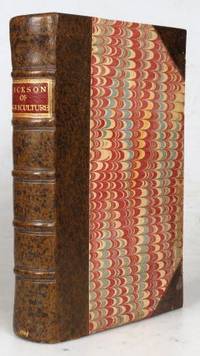
1770018436Edinburgh and London: A. Kincaid & J. Bell; T. Longman & T. Caddel 1770. Two volumes; with two engraved plates slightly marked at the margins small thick octavo pp lxvi 487; 8 564 edpapers age-toned at the margins the first volume suffers from some marginal worm holes early on but between pages 365 & 386 the little beast has eaten the upper margin so much that several pieces are nearly detached see illustration otherwise the volumes are both clean and tight internally with just a few turned corners; contemporary roan marked and scuffed joints a little worn the upper joint cracked slightly in each volume leather labels in black and red on the spines. Dickson was born in 1721 at Aberlady and studied at Edinburgh University where he took the degree of M.A. He passed his life between his cherished country employments on a large farm of his father's where he lost no opportunity of gathering experience from the conversation of the neighbouring farmers and the duties of his holy office. Having early shown a great taste for agriculture he watched its processes carefully and made rapid progress in it as he always connected practice with theory. On moving to Dunse he found more real improvements in the art and also more difficulties to be surmounted than had been the case in East Lothian. Observing that English works on agriculture were ill adapted to the soil and climate of Scotland and consisted of theories rather than facts supported by experience he determined to compose a "Treatise on Agriculture" on a new plan. The first edition of this appeared in 1762 and was followed by a second in 1770. This treatise is practical and excellently adapted to the farming of Scotland its first four books treating of soils tillage and manures in general the other four of schemes of managing farms usual in Scotland at that time and suggestions for their improvement. "Probably the most important of the authors of the period". And fifty years later J.C. Loudon wrote "decidedly the best work on tillage which has appeared in the English language and was and still is held in universal esteem among the practical farmers of Scotland". New Edition. Full Leather. Good. A. Kincaid & J. Bell; T. Longman & T. Caddel Hardcover