Roberts, DavidAntiquariat.de

18 859 résultats
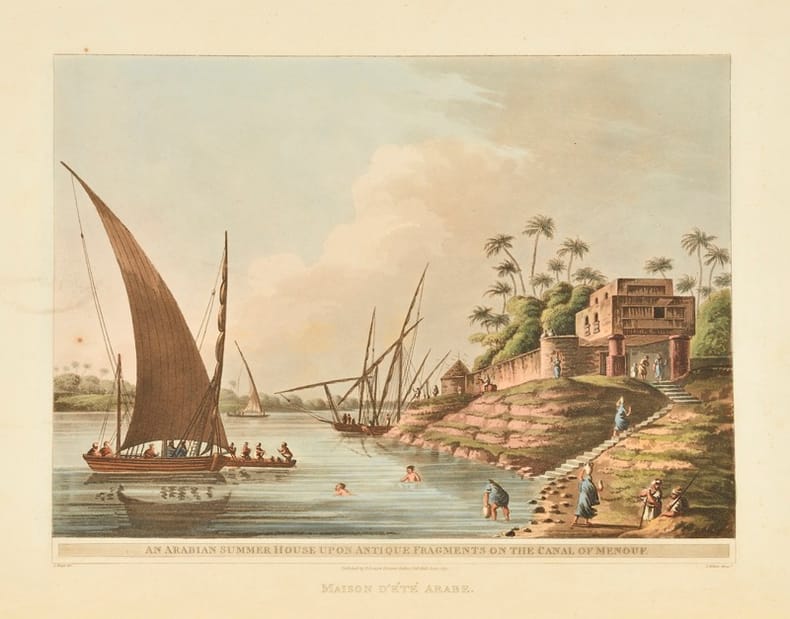
18499341London, Moon, 1842 - 1849. 6 Bde. 3 Bll., 30 S., 21 Bll.; 23 Bll.; 2 S., 18 Bll.; 2 Bll., 8 S., 21 Bll.; 22 Bll.; 24 Bll. mit 120 Textabb. 3 Frontisp., 6 Titel, 1 Porträt, 118 Tafeln (alles in getönter bzw. farbig getönter Lithographie von Louis Hague), 2 Kupferkarten. Gr.-Fol. OHLdr. (restauriert, fleckig, Rücken mit ergänzten Fehlstellen).
185964885London, James S. Virtue, (1858-1859). Gr.-Fol. (45 x 33 cm). Mit zus. 76 auf Untersatzkartons mont. Orig.-Fotografien (Albumin) von Francis Frith u. 82 nn. Bll. Text. HLdr.-Bde. d. Zt. m. goldgepr. Rückentiteln u. marmor. Schnitt.
Raccolta di 118 tavole litografiche (piu' frontespizio e 3 tavv. doppie, alcune colorate d'epoca), In-folio imperiale (cm. 60 x 47,5). Legatura mz. pelle. Tavole della rarissima opera del Rifaud (300 tavv. + 5 voll. testo, mai edito). Prima tiratura 1830-1836 con dedica al Re di Francia (e relativo blasone al front.), prima della trasformazione della dedica in onore all'Imperatore di Tutte le Russie (1837). Qualche fioritura, qualche gora, restauri a qualche tavola e segni di tarlo (senza perdite); frontespizio e seconda carta bianca rimontati, spellature alla legatura. Numeri editoriali delle tavole contenute : 1-2-3-4-8-12-13-15-18(coloritura a mano) -20-22-26-28(c.)-31-33-35-37-38-39-45- 46-49-50(c.) -51(c.)-52(c.)-53(c.)-5658(c.)-60(c.)-63(c.)-64(c.)-65(c.)-66(c.)-67(c.)-69(c.)-7071(c.)-72(c.)-73-75-76-78-83-84-88-89-91-93(c.)-95-97-99-100-101-102-103(c.)-104-105-106-107- 119-123 127 (c.) -128(c.)-130(c.)-132-136(c.)-137-138-140-141(c.) -142-143-144-148-149-150- 151-152-154-155-157-158(c.)-160(c.)-161-169-170- 171-173-175-176-178-179-182(c.)-183-186-187-188- 189(c.) -190 (c.) -192(c.)-195(c.)-198(c.)-199(c.)-200(c.)-236(c.)-237(c.)-240(c.)-243(c.)-242(c.)-242(grav. Normand) -255(c.)-264(c.-incisore, grav. Cazanave) - 262(c.)-263(c.)-264(c.-incisore,grav. Normand) -265(c.) (5891/ AFRICA - EGITTO - AFRIQUE - RIFAUD - EGYPT)
18000008<p><strong>printed leaf</strong> <strong>10 lines in Ottoman Turkish</strong>. Undated and without place of printing but apparently printed at the <strong>Imprimerie Nationale Cairo</strong> during the <strong>French Expedition to Egypt</strong>.</p><p>The document is a <strong>proclamation</strong> concerning <strong>Napoleon Bonaparte's reply</strong> to a letter from the Ottoman Sultan <strong>Selim III</strong> stating that <strong>Napoleon and Selim are allies</strong> that <strong>no force can disturb their alliance</strong> and that <strong>all victories on both sides are the result of this alliance</strong>.</p> Divan du Caire (the Napoleonic committee in Cairo)
185112090London, James Madden, 1851. 2. Auflage Folio (40-45 cm). 3 Bll., 60 S. Halbleder der Zeit über fünf Bünden mit montiertem Rückenschild, goldgeprägter Rückenverzierung und Ganzkopfgoldschnitt
Two volumes. I. Text: Octavo. PP. xix, 438. Plus frontispiece portrait of the author, one engraved plates and a large folding map; II. Plates: Folio. Comprising of 34 heavy leaves with a total of 44 plates, some in colour, mostly one to a page, often compound. Hardcover, nicely bound in matching contemporary half calf and marbled boards, spines gilt. Save for some minor imperfections in fine condition. ~ First edition. Text volume second edition. "As I made my discoveries alone, I have been anxious to write my book by myself, though in so doing, the reader will consider me, and with great propriety, guilty of temerity; but the public will perhaps gain in the fidelity of my narrative, what it loses in elegance." - Preface.
1821PHO-2038Paris, Imprimerie Royale et Imprimerie de L. Toinon et C ,1821-1862, 2 volumes in-folio. 1ère Partie, brochage papier bleu avec étiquette de titre sous coffret moderne, vieille mouillure, papier gondolé, quelques rousseurs. 2nde Partie, sous coffret moderne, rousseurs sur les planches en noir et blanc, mouillure angulaire au début et marginale en fin, petites déchirures en marge sur quelques feuillets, coin manquant faux-titre. XVII-120pp., 24 planches sous serpentes dont 2 cartes et une planche en couleur d’époque et 2ff. (faux-titre, titre)-V (avant-propos) -27pp. (explication , appendice) -20 planches (21) dont 4 en double pages et 9 en couleurs d’époque .
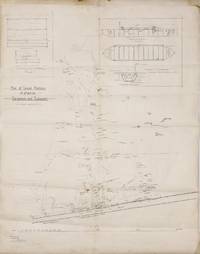
114959A detailed map of the battleground of the failed attempt by Turkish troops to invade Egypt on 3 February 1915. At the head of the map are large sketches of 'Frame of Kerosene Tin Raft in Turkish Attack' and 'Sketch of Turkish Pontoons captured at Toussoum-Serapeum 4.2.1915'. The Australian War Memorial has one of the 24 pontoons used by the 4th Turkish Army in their attempt to cross the Suez Canal in its collection. In fact the AWM records that 'The action in which it was captured was the first in which a unit of the AIF 3 Field Company Australian Engineers was engaged and as such this trophy was the first captured by the army in the First World War. by May 1918 the Australian War Records Section was lobbying for an example to be brought back to Australia noting that while Australian involvement by 3 Field Company Engineers was small it was important'. <p>Both Charles Bean 'The Official History of Australia in the War of 1914-18' Volume 1 Chapter VIII: 'The Turkish Expedition against Egypt' pages 140-165 and the AWM have much to say on this attack. After Turkey entered the war on 31 October 1914 one of the first objectives of both the Germans and Turks was to strike a blow against Britain in Egypt. By January 1915 a 'Turkish force of an estimated 10000 had travelled from Jerusalem to Kantara on the Suez Canal a distance of 200 miles. The force was composed of 5 percent Germans 10 percent Turks and 85 percent Bedouins and was aimed at raising anti-British feeling within the protectorate of Egypt inciting a Jihad and denying use of the canal to Allied forces. This potential threat forced the British to base up to 70000 troops in Egypt 30000 of them defending the Canal. Initially the Turks had three options: to attack from the Jordan-Mediterranean coast to Kantara through the Sinai from Beersheeba to Ismalia or from the south to Suez. Thus the British were obliged to keep options open defending all three zones along the 159 km of canal until it became obvious the Turks were marching south-west from Beersheeba heading for the central zone at Ismalia straight across the Sinai Desert. Despite being initially unconvinced that the Turks could actually organise such a crossing the British were aware of the intent; they decided to base their forces on the West Bank of the Suez using the canal as part of the defence bolstered by Royal Navy ships. This essentially meant giving up the Sinai. The force opposing the Turks mainly comprised of the 10th and 11th Divisions Indian Army. The New Zealand Wellington and Otago Battalions however assisted in the defence. The 3rd Field Company Engineers AIF were detached to operate searchlights and the Ismalia powerhouse but no other Australians were involved directly in the defence. The majority of defenders were hidden by high spoil banks thrown up on the west bank during construction of the Suez Canal. Small parties of Turks were spotted by a French seaplane on 15 January - but they missed most of the force heading out of Beersheeba and across the Sinai. This move was unexpected as most armies had moved along the coast. The Turks sent smaller parties to the southern & northern routes as a diversion and to keep the British guessing. The central party physically dragged their pontoons on wagons and artillery across the desert. Early on the morning of 3 February about 3:30 am movements and sounds were noticed by the defenders on the eastern bank and the Indian sentries started shooting. After dying down more sounds were noted a kilometre south. A Turkish pontoon landed on the west bank loaded with 25 Turks. This was charged by Punjabis and all the occupants were killed; a second crossed under fire but landed with only 10 survivors - four were captured in the morning. Pontoons were raked with shrapnel and machine gun fire killing all aboard. Many more were targeted on the east bank as their crews attempted to launch them with heavy casualties. Witnesses noted ten or eleven damaged pontoons drifting full of dead. Survivors tried to hide behind pontoons and make a dash for safety - many of these killed as well. Orders were given for Torpedo Boat 43 to blow up remaining intact pontoons. At the same time unaware of the disaster and hearing that some pontoons had already crossed the Turkish commander sent up thousands of reinforcements. The British Territorial artillery spotted them and started shooting as did the guns of the French battleship "Requin". An Indian counter-attack across the Canal took 250 prisoners and the attack ceased. The British had lost just on 160 men - the Turkish toll was ten times higher. The Turks retreated back across the desert. The Turkish performance at the Canal may have coloured Australian British and Indian attitudes to Turkish fighting ability which they brought to Gallipoli to their cost' AWM. <p>Bean provides more and pertinent details: 'Early in January the 3rd Field Company of Australian Engineers . had been sent down to construct trenches and floating bridges at the Canal. The British authorities at once began to discover in this company men experienced in almost any work which was needed. Within a week some were detached to manipulate searchlights others had taken over the power-house at Ismailia sic others were surveying for artillery ranges or for maps while the main body was making bridgeheads at Serapeum Ismailia and Kantara and also a floating bridge for Ismailia ferry-post'. <p>Bean's last words are also telling: 'There was a heavy fall in the current estimate of the fighting value of the Turkish Army. This was not without its influence on future events'. Those events which commenced on 25 April 1915 and reverberate to this day may go a long way to explaining why this extraordinary map appears to have been unrecorded. Bean was certainly unaware of it when he wrote his history; the AWM makes no reference to it; and Trove locates no examples. In the overall history of the First World War it may be a sideshow completely overshadowed by the Allied invasion of Turkey at Gallipoli: everything went according to the script of this dress rehearsal except the roles were reversed. unknown
Folio. With a total of 78 plates. Pp. viii, 20, 13 leaves of explanation of the pates, plus 64 plates including 5 in colors; 29, plus 14 plates. Hardcover, bound in handsome contemporary quarter calf and pebbled boards, spine with raised bands, gilt lettering. Some blemishes to one plate else in a very good condition. ~ First edition. Franz Christian Gau (1790-1853). French architect of German origin, born in Cologne but was naturalized French in 1826, changing his given names to François Chrétien. His monumental work was published in installments throughout a period of seven years. It was intended as a supplement to the "Description de l'Égypte" but Champolion criticized the accuracy of the drawings. Beinlich-Seeber 8482. Very rare.
Folio. 16 volumes bound in 11, comprising of 8 Text Volumes and 8 Plate Volumes. Hardcover, uniformly bound in half-calf and red cloth, worn. In good condition. ~ First edition. Extremely rare complete set. [Provenance:] From the library of Egyptologist Jacobus Visser. A superb production comprising of over 800 exquisitely produced plates. Collotype is one of the most accurate and attractive methods of photomechanical tonal printing processes. Highly skilled and expensive process, it cannot produce more than a limited number of impressions. It has been used for single-sheet prints and luxury portfolios, and since the 1950s has been abandoned by all except a few small specialist firms. Émile Gaston Chassinat (1868-1948). François Daumas (1915-1984).
1954000369Cairo: The government press 1954 Book. Very Good. Hardcover. Signed by Authors. 8vo - over 7¾ - 9¾" tall. PRIVATELY BOUND AS PRESENTATION COPY IN 29-5-1954 TO "OUR SON MR. ABDUL HAMID IBRAHIM ABD UR RAHMAN" FROM GENERAL MUHAMMAD NAGUIB. FRONTIS OF M. NAGUIB SIGNING THE TREATY OF SUDAN 12 FEB. 1953. TITLE PAGE WITH MANUSCRIPT DEDICATION SIGNED BY M. NAGUIB THE FIRST PRESEDENT OF EGYPT AFTER THE REVOLUTION OF 1952. FRONTIS OF M. NAGUIB WHEN HE WAS IN KHARTUM IN 1921 IN HIS MILITARY UNIFORM. ERRATA PREFACE BY AHMAD ATIYYATULLAH 96PP OF ARABIC TEXT WITH 7 FINE PHOTOGRAPHIC PLATES AND 1 PLAN. 1 PHOTOGRAPHIC PLATE OF GENERAL M. NAGUIB PRESEDENT IN 20-2-1954. THE BRITISH POLICY AND OCCUPATION IN SUDAN AND THE QUESTION OF SEPARATING DARFUR. ONE OF FOUR BOOKS BY PRESEDENT MUHAMMAD NAGUIB. SCARCE SIGNED COPY. The government press hardcover
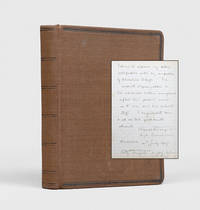
1653136102Alexandria: 1916-53. Politics power and position under empire A rich document of empire pageantry and elite education in British Egypt bearing some 150 dated signatures of leading political military and cultural figures from the first half of the 20th century. Among them are successive British High Commissioners - McMahon Wingate and Allenby - alongside royalty senior officials diplomats and figures from commerce and the press reflecting Victoria College's status as a focal point of imperial authority and social power. Founded in 1902 with the backing of Sir Evelyn Baring Lord Cromer Victoria College educated the sons of the Anglo-Egyptian elite and staged annual speech days that became ritualized displays of British rule. Before the Second World War when British influence was at its height the college was regularly visited by high commissioners and their entourages even during wartime. Early entries include Sultan Hussein Kamal's visit of June 1916 followed by Sir Henry McMahon and senior military and diplomatic figures connected to Kitchener and the Cairo administration. McMahon's successor Reginald Wingate contributed a full-page endorsement of the school in 1917 and Prince Arthur Duke of Connaught visited in 1918 during Allenby's Egyptian campaign. In the interwar years Victoria remained a symbol of British cultural power despite Egypt's formal independence. Edmund Allenby signed repeatedly between 1919 and 1922 later joined by his successors George Lloyd and Percy Loraine often alongside Egyptian ministers. The book also records visits connected to major political developments including members of the Milner Mission in 1920 Gilbert Clayton Sultan Fuad I and George Antonius a former pupil and later a key Arab nationalist intellectual. Other signatories range from the Sultan of Zanzibar to senior churchmen naval officers journalists artists publishers and statesmen underscoring the college's place at the intersection of British and Middle Eastern elites. The final entries chart the end of the imperial era. A 1949 inscription by Said Taha Bey marked "Visit of the Hero of Faluja" poignantly closes this compendium - a compact first-hand chronicle of shifting power personalities and allegiances in modern Middle Eastern history. Quarto. Original brown buckram ledger spine and covers ruled in black grey-green endpapers joints lined with green linen tape as issued marbled and rounded edges pages with printed blue rules approximately 65 pages with one or more signatures nearly all in ink remaining pages blank. Binding sturdy boards and contents soiled in places leaves with light foxing and browning signatures well preserved: an excellent example. Samir Raafat "Victoria College - Educating the Elite 1902-1956" Egyptian Mail 30 March 1996 available online hardcover
11 works bound in 17 volumes. Royal quarto. Various paginations, Illustrated. Hardcover, uniformly bound in three-quarters calf and matching boards, spines gilt. In fine condition. ~ First edition. Les Temples immergés de la Nubie. A massive body of work, comprising of 11 works in 17 volumes, published 1911-1941: I. The Temple of Dendûr; II. The Temple of Derr; III. Le temple d'Amada; IV. The Temple of Bîgeh; V. Le temple de Ouadi es-Sebouâ (2 volumes); VI. Le temple de Kalabchah (2 volumes); VII. Der Tempel von Dakke (3 volumes); VIII. Von Debod bis bab Kalabsche (3 volumes); IX. Der Felsentempel von Bet el-Wali; X. The Rock-pictures of Lower Nubia; XI. Documents sur l'état ancien des monuments.
180210569Londres, Bowyer, 1802 In-folio (480 x 339 mm), 2 ff. n. ch., 109 pp., 48 pl., 1 f. n. ch. Demi-maroquin rouge à petits coins, dos lisse orné de roulettes et fleurons dorés, quelques rares frottements (reliure de l'époque).
Three volumes. Crown quarto. Pp. xxiii, 231; xxxiv, 276; xvi, 248. Frontispiece to each volume. With numerous plates. Hardcover, uniformly bound in the original publisher's mid-brown full cloth, large gilt decoration to each cover, gilt lettering to covers and spines, decorative endpapers, spine-ends slightly bumped, some foxing. In a very good condition. ~ First edition. Volume I fourth impression. With a total of 413 photographic illustrations. This set was the treasured property of J. C. [Johannes Cornelis?] Mets, a Dutch resident of Surabaya, who acquired it in 1933, upon embarking on a trip to Egypt which lasted over a month. An avid traveller, he visited practically all of the places which were described in Carter's book, and took pains in specifying next to the appropriate place name or picture in the book the exact date of each and every visit. The set, particularly volume I, bears his annotations, signatures, remarks, and dates of visits which evokes the spirit of early explorations. Beinlich-Seeber 4804
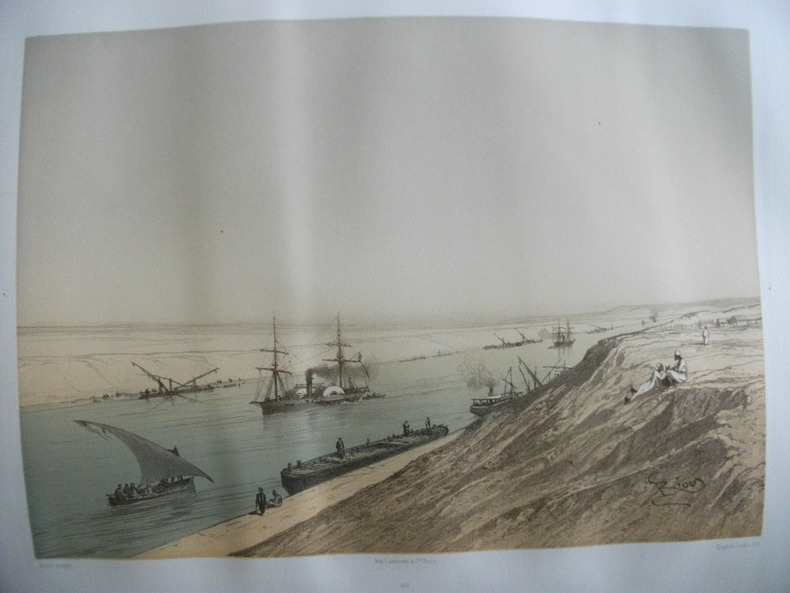
4803Grand in-folio (578 x 415 mm),reliure d’éditeur pleine toile rouge,titre doré et caissons à froid,au dos.Titre et armes dorés sur le premier plat, plaque dorée au deuxième plat ave nom de l'éditeur.Faux-titre,titre,une carte lithographiée,100 pages,25 aquarelles d’après nature par RIOU,sur papier fort,lithographiées par CICERI,sous serpentes imprimées,non rogné,pratiquement sans rousseurs,superbes lithographies à très grandes marges, coloris frais,rare en cartonnage. ÉDITION ORIGINALE,limitée à 500 exemplaires.Paris:Dupont & E.Lachaud,sans date [vers 1870].Coiffes et une charnière restaurées,une pâle mouillure angle supérieur droit à la planche 25 (photo) et de la page 97 jusqu’à la page 100 Ouvrage monumental,admirablement illustré d'après les aquarelles réalisées par Edouard RIOU d’après nature pendant les fêtes organisées lors de l'inauguration du canal de Suez en octobre 1869.Fontane fut le secrétaire de Ferdinand de Lesseps et l'accompagna également pendant les travaux de l'isthme de Panama. RIOU,élève de Gustave Doré, illustra entre autres les ouvrages de Jules Verne et fournit des planches pour Le Tour du Monde. Brunet VII, 510;Blackmer 611 L'auteur (1838-1914) est à la fois historien orientaliste, journaliste et secrétaire de Ferdinand de Lesseps.En 1854, il devient cadre de la Compagnie du Canal de Suez.Eugène Cicéri a réalisé quelques paysages en Afrique du Nord qui lui valent d'être aussi classé parmi les orientalistes. Seuls 500 exemplaires ont été publiés. parmi ceux ci 200 ont été réservés pour Ismaïl Pacha Vice Roi d'Efype. Il s'est senti insulté par la préface de Fontane qui a accordé tout le crédit de ce projet à de de Lesseps, et il a fait retiré de ses 200 exemplaires, à la fois, le portrait de de Lesseps en frontispice et la préface de Fontane.
In-4° rilegato in piena pergamena. 1) Bartolomeo Maranta, Methodi cognoscendorum simplicium, Venezia, Valgrisi, 1559 . (36), 296, marca tipografica incisa su legno al frontespizio, Durling 2950. Opera sulle proprietà medicinali delle piante, divisa in tre libri, che si inserisce nel filone dei testi di botanica farmaceutica, in cui le piante, come i fiori e i frutti, vengono esaminati dal punto di vista della nomenclatura, della nascita della specie e delle proprietà medico-farmacologiche. Maranta individua qui nel cytisus la "medicago arborea" nota agli antichi per le sue proprietà di erba medica. Bartolomeo Maranta, medico e botanico nato a Venosa verso il 1500 e morto a Molfetta nel 1571. Allievo di Luca Ghini, fu un naturalista stimato formatosi presso il Giardino dei Semplici a Pisa, lavorò presso il Giardino botanico di Napoli dal 1554 al 1556, esperienza che mise a frutto dal 1568 a Roma progettando un nuovo giardino. Fu medico del Duca di Mantova e del cardinale Branda Castiglione. 2) Prospero Alpini, De plantis aegypti, accessit etiam Liber de Balsamo, Venezia, de Franceschi, 1592. Prima edizione del De plantis e seconda del De balsamo; cc. (4), 80, (8), con 50 belle incisioni su legno nel testo, molte a piena pagina, e marca tipografica sui due frontespizi: il Dialogus de balsamo ha un suo frontespizio, la paginazione è continua. Durling 179. Edizione originale della prima opera sulle piante dell’Egitto e sull’opera considerata la più importante di Prospero Alpini; l’autore fu tra i primi botanici e medici del XVI secolo a studiare le piante per il loro specifico interesse botanico e non soltanto per gli utilizzi che se ne potevano fare in medicina; inoltre, il metodo autoptico adottato, sia sulle piante selvatiche che su quelle da lui coltivate, permise di fare in campo botanico grandi passi avanti. Sono qui rappresentate per la prima volta in un trattato di botanica europeo la pianta del caffè (?), del baobab (pianta e frutto) e della banana, i cui frutti vengono descritti come assai nutrienti, profumati ma un po’ pesanti per lo stomaco. Delle foglie e dei frutti si descrive la morfologia, l’utilizzo in cucina nel caso delle piante edibili, le proprietà benefiche e loro utilizzi nella preparazione di decotti. L’opera, di certo un trattato pioneristico, fu utilizzata come base sistemica per I successivi studi sulla flora egiziana. Le 49 xilografie, quasi tutte a piena pagina che illustrano piante, alberi e frutti, sono molto chiare e precise scientificamente. Il De balsamo è un approfondito trattato, anche questo in forma di dialogo, sulla materia con note storiche e scientifiche, con una illustrazione sulla pianta del balsamo, e la descrizione dei luoghi dove questa nasce, principalmente l’Egitto e l’Arabia, e i modi in cui viene utilizzata. Prospero Alpini (1553-1617), medico e botanico, ebbe l’occasione di viaggiare in Egitto quando divenne medico personale del console veneziano al Cairo, Giorgio Emo. DSB pp. 124-125 In-4 ° bound in full vellum. 1) pp. (36), 296, printer’s mark engraved on wood on the title page, Durling 2950. Work on the medicinal properties of plants, divided into three books, which is part of the of pharmaceutical botany texts, in which plants, such as flowers and fruits, are examined from the point of view of nomenclature, the birth of the species and medical-pharmacological properties. Here in the cytisus Maranta identifies the “medicago arborea“ known to the ancients for its properties of medical herb. Bartolomeo Maranta, physician and botanist born in Venosa around 1500 and died in Molfetta in 1571. A pupil of Luca Ghini, he was an esteemed naturalist trained at the Giardino de Semplici in Pisa and worked at the Botanical Garden of Naples from 1554 to 1556, an experience that he put to good use in Rome from 1568 by designing. He was doctor of the Duke of Mantua and of the cadinal Branda Castiglione 2) First edition of De plantis and second of De balsamo; cc. (4), 80, (8), with 50 beautiful wood engravings in the text, many in full page, and printer’s mark on the two title pages: the Dialogus de balsamo has its own title page, the pagination is continuous. Durling 179. Original edition of the first work on plants of Egypt and on the work considered the most important by Prospero Alpini; the author was among the first botanists and doctors of the sixteenth century to study plants for their specific botanical interest and not only for the uses that could be made of them in medicine; moreover, the autopsy methods adopted, both on wild plants and on those cultivated by him, made it possible to make great strides in the botanical field. The coffee plant (?), The baobab (plant and fruit) and the banana plant are represented here for the first time in a European botanical treatise, whose fruits are described as very nutritious, fragrant but a little heavy for the stomach. . The morphology of the leaves and fruits are described, their use in the kitchen in the case of edible plants, their beneficial properties and their uses in the preparation of decoctions. The work, certainly a pioneering treatise, was used as a systemic basis for subsequent studies on Egyptian flora. The 49 woodcuts, almost all full page illustrating plants, trees and fruits, are very clear and scientifically accurate. De balsamo is an in-depth treatise, also in the form of a dialogue, on the subject with historical and scientific notes, with an illustration on the balsam plant, and the description of the places where it was born, mainly Egypt and Arabia, and ways in which it is used. Prospero Alpini (1553-1617), physician and botanist, had the opportunity to travel to Egypt when he became the personal physician of the Venetian consul in Cairo, Giorgio Emo. DSB pp. 124-125.
189042492, , Ca 1870-1890. Album grand in-folio oblong, demi-chagrin à coins (reliure de l'époque).
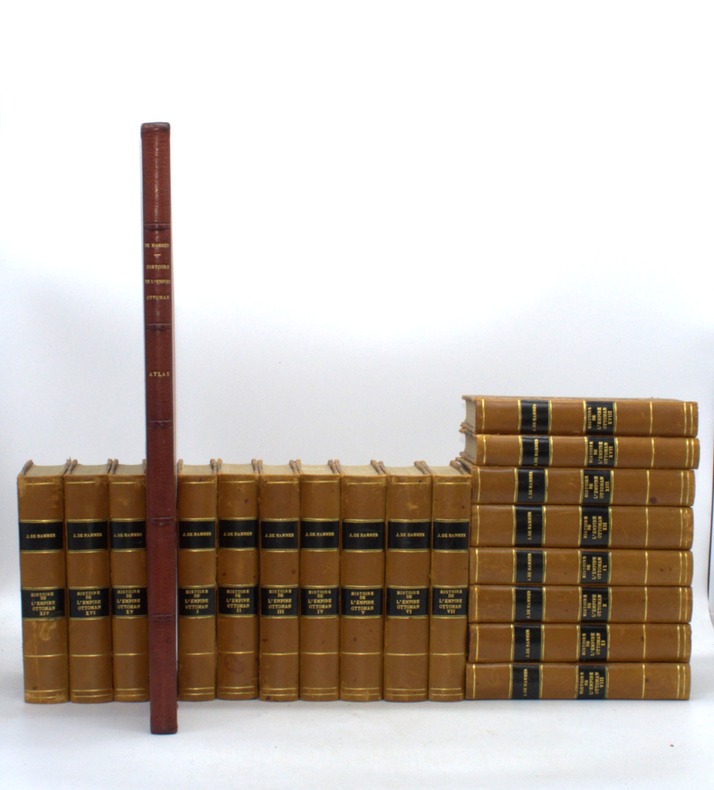
1835PHO-1982Paris, Bellizard, Barthes, Dufour et Lowell ; Londres, Bossange, Barthes et Lowell ; Saint-Petersbourg, Fd. Bellizard et Cie, 1835-1844. 18 volumes de texte in-8 et un atlas in-folio. TEXTE : 18 volumes in-8, relié demi basane et coins moderne, dos lisse orné avec pièces d’auteur, titre et tomaison noires, frottements et épidermures, défauts d’usage, rousseurs dans le texte, tampon et étiquette du relieur. ATLAS : Paris. Bellizard, Dufour etc. 1844. Imprimé chez Thierry Frères. Demi basane et coins à long grain grenat, dos à nerfs avec titre et auteur, In-folio (520x345mm), IV-82pp.-40 planches, il est composé du Commentaire sur l’Atlas de l’Empire Ottoman, d'une liste des cartes, d'une carte générale de l'Empire Ottoman (690x550mm), de 22 cartes particulières (dont une sur 2 feuilles) (815x850), de 13 plans de batailles ou de siège, et de 4 plans de villes dont un grand plan dépliant de Constantinople (690x670mm), le plan de Vienne est en 2 états, par G. Heck et Plée et gravé par U. Muschani, roussurs éparses, 2 cartes uniformément brunies avec réparations, mouillure claire en marge, tache sur les 16 premiers feuillets en tête et en fin d’ouvrage en pied. Provenance : collection de S.A.R. le Prince Osman Ibrahim d'Égypte (1951-2025), fils de S.A.R. le Prince Amr Ibrahim d'Égypte et de S.A.I. la Princesse Nejla Hibetullah Sultan (Necla Osmanoğlu) de Turquie, petite-fille du dernier calife Abdulmejid II et du sultan Mehmed VI, avec sa marque au tampon.
18126383Paris, Nepveu, 1812. 1812 6 vol. in 16° (142 x 93 mm) de : I. 1 frontispice ; 20 pp. (faux-titre, titre, avant-propos) ; XXXI (précis historique) ; 119 pp. ; [1] p. table ; II. 1 frontispice ; [2] ff. (Faux-titre, titre) ; 225 pp. ; [1] f. (table) ; III. 1 frontispice ; [2] ff. (Faux-titre, titre) ; 251 pp. ; [1] (table) ; 15 planches ; IV. 1 frontispice ; [2] ff. (Faux-titre, titre) ; 282 pp. ; [1] table ; 16 planches ; V. 1 frontispice ; 9 planches ; [2] ff. (Faux-titre, titre) ; 231 pp. ; [1] p. (table) ; VI. 1 frontispice ; [2] ff. (Faux-titre, titre) ; 235 pp. (dont table) ; 26 planches ; un total de 72 planches gravées en couleurs (dont les 6 frontispices). (Quelques brunissures et traces de transfert face aux planches, ensemble frais). Plein veau glacé mosaiqué à froid dépoque, dos lisse orné et titré, frise dencadrement dorée sur les plats, roulette dorée sur les coupes et intérieure, tranches dorées, signets de soie verte, gardes de papier marbré.
Six volumes. Folio. I. 80 plates; II. 87 plates; III. 83 plates; IV. 90 plates; V. 9 plates; VI. PP. vi, 351. Hardcover, uniformly bound in original cloth and printed boards. In good condition. ~ First edition. Very rare complete set. Comprising of Volumes I-II: Intérieur du temple; Volumes III-V: Cryptes. Terrasses. Supplément aux planches; Volume VI: Texte. Auguste Ferdinand François Mariette (1821-1881). Beinlich-Seeber 12887.
Eight volumes. Crown quarto. Pp. xxxii, 416; xxxii, 928; xxxii, 848; xxxii, 448; xxxii, 672; xxxii, 880; xxxii, 464; viii, 264. Hardcover, uniformly bound in the original publisher's blue cloth. In fine condition. ~ First edition. Very rare complete set of this mammoth work, autographed in its entirety. Kenneth Anderson Kitchen (1932-).
1895ABC_475631895. Oblong folio 28 x 39 cm. Contemporary gold-tooled black morocco gilt edges. With 58 photograph prints ca. 21 x 25.5 to 13.5 x 20 cm. Mounted on both sides of the leaves in the album. 60 pp. The album contains 15 silver albumen photographs of Melbourne taken mainly from the series C. Rudd's new views of Melbourne 1886-1887 by Charles Rudd 1849-1901. They show Collins Street Melbourne town hall the public library Parliament House the Court of Law Government House and various other buildings and infrastructure as well as botanical gardens such as Fitzroy Gardens. The photographs of Sydney were the work of the renowned Australian photographer Henry King 1855-1923 born in England in 1855 who emigrated to Australia with his family in 1856. He worked as a photographer at J. Hubert Newman's studio in Sydney before opening his own studio in 1880. King gained recognition for his photographic studies of Australian Aboriginal people and his scenic views of Sydney. He died in 1923 leaving behind his wife son and three daughters. His glass negatives were acquired by J.R. Tyrrell after his death and are now held by the Powerhouse Museum. King is one of Australia's most significant early photographers. The album contains seventeen of Kings photographs of the harbour including Farm Cove and the Circular Quay Government House and interior and exterior photographs of the town hall King and George Street the Mutual Life Association Building the General Post Office and the Ferner Botanical Garden. Rural New South Was appears in nine photographs including images of Illawarra National Park the Hawkesbury River and a series of outdoor photographs taken along the coast at Blackwall and dated July 1895.This curious album of 58 photographs from France Egypt and most importantly Australia opens with a section with six photos from Marseille showing street views the city harbour the Avenue du Prado and the castles.The ten photographs from Egypt depict both the cultural highlights of the country such as the Pyramids the Sphinx the Citadel of Cairo and the Palace of Gizeh as well as ordinary Arabian villages and street scenes. They stemmed from the ateliers of the Abdullah brothers of Constantinople. The Abdullah Frères namely Viçen 1820-1902 Hovsep 1830-1908 and Kevork 1839-1918 Abdullahyan were three Ottoman brothers of Armenian heritage who gained international fame as photographers during the late Ottoman Empire. Some evidence suggests that he may have collaborated with the Zangaki Brothers and he may have been the official photographer for the Universal Company of the Suez Canal. Later he worked in partnership with the British-Italian photographer Antonio Beato.With an owners inscription in pencil "a appartenu Alfred Schmid" some photographs are captioned in black ink or pencil detailing the places. With a small label from the bookshop that sold the album: "Papeterie Sauwen-Jehotte" in Antwerp. The edges are somewhat bumped and some browning and foxing throughout. Otherwise in good condition. unknown
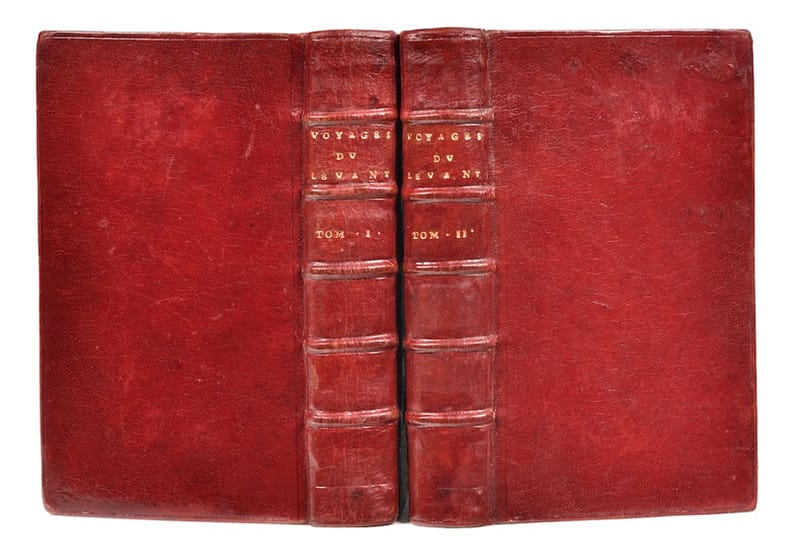
170410603Paris, Guillaume Vandive, 1704 Deux volumes in-12 (170 x 100 mm), 15 ff. n. ch., 372 pp. ; 1 f. n. ch., 416 pp., 4 ff. n. ch. Maroquin janséniste rouge, dos à nerfs, titre et tomaison dorés, filet à froid en encadrement sur les plats, roulette dorée sur les coupes et sur les chasses, tranches dorées sur marbrures, fines restaurations, déchirure sans manque p. 231 du tome 1, petite brûlure dans la marge p. 101 du tome 2 et petite déchirure sans manque dans la marge supérieure des pages 171 et 173 (reliure de l’époque).
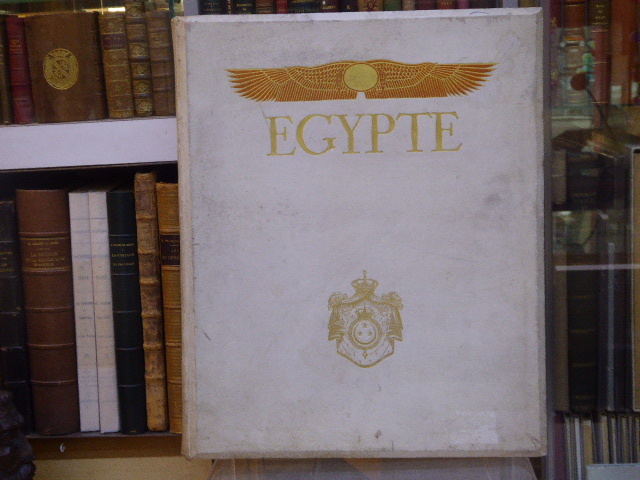
469748Editions Paul Trembley Genève 1932 Grand et fort in-folio ( 502 X 420 mm ) de 195 pages, cartonnage de vélin crème de l'éditeur décoré en couleurs et chiffré en lettres d'or ( Jacques WENDLING ). Très nombreuses photographies dans le texte et 40 magnifiques planches en héliogravure sous serpentes légendées hors-texte de Frédéric BOISSONNAS ( Les photographies ne seront jamais réimprimées ). EDITION ORIGINALE, un des 300 exemplaires numéroté à la presse en chiffres arabes. Reliure un peu frottée, très beau et imposant livre, un des plus beau sur l'Egypte, entièrement monté sur onglets, somptueuse publication signée par l'artiste et l'éditeur, rédigée par d'éminents spécialistes de l'époque, en 6 chapitres : 1. L'Egypte pittoresque, par Fred Boissonnas 2. L'Egypte des pharaons, par Gustave Jequier l'Egypte gréco-romaine, par P. Jouguet l'Egypte copte-byzantine, par H. Munier l'Egypte musulmane par Gaston Wiet l'Egypte moderne par P. Trembley.*****ATTENTION, vu le poids élevé de l'exemplaire ( Plus de 11,00 kg ), des frais de port supplémentaires seront demandés. Nous demandons aux amateurs étrangers de nous contacter avant de passer commande.*****