[PHOTOGRAPHY - YEMEN - EGYPT].Biblio.com
19 171 résultats
1889ABC_49512Yemen Egypt and other places 1889. Contemporary burgundy/auburn gold- and blindstamped calf lozenge-patterned blindstamping. Re-backed with the original back strip laid down. Gold-stamped turn-ins white watered silk endpapers gilt edges. Oblong folio 37.8 x 28 cm. An album containing 25 albumen prints ca. 20 x 27 cm including 1 double page mounted on thick card leaves many captioned in English. Photographic record of a journey begun in Australia and taken via Aden through the Suez canal and to the Mediterranean and then on to England. While the first image shows the steamship R.M.S. Ormuz in the port of Sydney three images including a double-page spread show the port of Aden in Yemen the famous water tanks and a native of the Southern Arabian region in a studio portrait. The majority of the album is dedicated to Egypt showing Arabs on their camels the Khedive's Ismailia Palace the Suez Canal Port Said and members the local population as well as the famous pyramids. The last few photographs show the final leg of the journey Naples and ultimately Gibraltar. Among the studios identified in the photographs are those of Hippolyte Arnoux and the Zangaki brothers based at Port Said.With a near-contemporary manuscript inscription in blue ink on the verso of the first flyleaf: "Edith Elkington or Elrington Aunt Ediths voyage home - to England about 1889". Foxed throughout slightly water stained but the prints are largely clean and clear some paper repairs in the margins the last flyleaf is lacking the final leaf is nearly detached. unknown
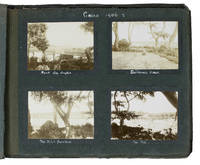
1906ABC_456561906. With: 2 LEHNERT & LANDROCK. Souvenir of Cairo. 12 real artistic photos. Serie A.Egypt late 1920s. Envelope containing 12 silver gelatin prints 12 x 9 cm.3 PHOTOGRAPHY - SINGAPORE. Photograph of a woman and a baby sitting in a rickshaw with a child in front and the rickshaw puller.Singapore late 1920s. Silver gelatin print 7.5 x 12.5 cm. A four-volume photo album compiled by an unknown British woman who also seems to have taken most of the photographs illustrating travels through Egypt Italy Wales and the Isle of Wight. Although the specific background to the album is unknown a photograph of a woman holding a camera is captioned " snapshotted" suggesting that she was the compiler of the album and probably took most of the photographs herself.The first volume starts in 1906 with several photographs showing the interior and exterior of a "summer house" near the "Pont des Anglais" now called the Evacuation bridge a Cairo neighbourhood containing many riverside villas. The final part of the second volume is devoted to the Tanta fair: Egypt's largest fair which normally attracted half a million visitors. Afterwards the party visited the village of Toukh north of Cairo.The third volume opens in May 1907 with a railway visit to the village of "El-Rico" near Hosh Essa also in the Nile delta but nearer to Alexandria. Photographs depict the travelling party as well as local agriculture another wedding and a visit to the weekly market at Abou El Matamer. The final part of the album shows a visit to the Isle of Wight in August 1908.With two photographs in volume IV Cairo on the Nile torn out. Bindings slightly worn spines damaged and volume III without a spine. A few photographs somewhat worn at the edges and with a few spots but otherwise in very good condition. An extensive and remarkable photo album especially for Egypt 1906-1908.l For the excavation at Deir-el-Bahari: Naville The XIth dynasty temple at Deir el-Bahari. Part II. unknown
17956386Paris, de l'imprimerie de Pierre Didot l'aîné, l'an IIIe de la République, 1795 - l'an VIe de la République, 1798. 1795 3 vol. in-4° (300 x 225 mm) de : I. 1 frontispice ; 1 portrait ; LV (dont faux titre, titre, préface) ; 176 pp. (dont table) ; 59 planches et cartes (n°1 à 59) ; II. 256 pp. (dont faux titre, titre) ; 54 planches et cartes (n°60 à 113) ; 149 pp. ; [3] ff. ; pp. 392 pp (reprise à 153) ; 53 planches et cartes (n°114 à 159, 140 et 141 ainsi que 142 et 143 réunies en deux planches + 9 non numérotées) ; petit dessin collé en regard de la planche n°8 avec notes manuscrites. Un total de 166 planches et cartes dont 2 composées de 2 numéros, certaines dépliantes et 9 planches d'éléments décoratifs non numérotées. (Petites manques aux premiers feuillets du second volume). Pleine basane marbrée, dos à nerfs orné, pièce de titre de maroquin et tomaison, filets dorés sur les plats, dos à nerfs très ornés, tranches rouges, gardes de couleurs. (reliure frottée).
Three volumes. I. Text: Quarto. Pp. xlviii, 209; II-III. Plates: Two Imperial folios with a total of colour 104 plates, 52 in each volume. Hardcover, uniformly bound in the original publisher's cloth, bit rubbed in places. In a very good condition. ~ First edition. An outstanding production. Collotype is one of the most accurate and attractive methods of photomechanical tonal printing processes. Highly skilled and expensive process, it cannot produce more than a limited number of impressions. It has been used for single-sheet prints and luxury portfolios, and since the 1950s has been abandoned by all except a few small specialist firms. Coloured collotypes the size of the plates in this set are very rare in book production, so much so in such superb quality. Reproduced extensively ever since the publication of the book, the grandeur of the original collotypes is breathtaking. Beinlich-Seeber 6273.
Royal quarto. Pp. 71, plus 24 chromolithograph plates, mounted on card and protected with tissue-guards. Plus frontispiece map. With 2 text figures. Hardcover, bound in original publisher's full cloth extra, richly decorated. A fine copy with just few minor blemishes. ~ First English edition. Karl Friedrich Heinrich Werner (1808-1894). Born and trained in Germany, Werner traveled extensively in Egypt and Palestine and produced there many splendid watercolours. The plates in this book are pantographic copies from the original watercolours, traced by mechanical means from the original. This method, however, could not reproduce the fine colouring which was done separately. The plates are accompanied by descriptive texts written mostly by Alfred Brehm (1829-1884) and Johannes Dümichen (1833-1894); both also wrote the preface.
1992100744Chicago: The Oriental Institute of The University of Chicago 1992. No. 4 one of 200 copies. 3 vols. Folio. 30 photographic prints from original glass plate negatives each print mounted 16 x 20 inches. viii pp. booklet with explanatory text and list of plates for each volume text by Peter F. Dorman John Coleman Darnell and Susan Lezon. Housed in three cloth clamshell boxes by Claudia Cohen. Small dampstain to volumes II & III box with some staining in vol. III to mounts and booklet confined to margin some fading to clamshell boxes prints fine with extraordinary detail and tonal gradation. A portfolio of limited edition photographic prints from the Epigraphic Survey's archive of over eight hundred large-format glass plate negatives taken in Egypt between 1880 and 1930 for the tourist trade by photographers such as Antonio Beato and the Zangaki brothers. Printed at Chicago House the field headquarters of the Survey in Luxor. "Unlike other methods of reproduction in which an artificial light source is used on a mass-production basis the glass negatives have been exposed individually to direct sunlight on printing-out-paper resulting in minuscule differences among the prints. Each print was then toned in a gold chloride solution. Great care has been taken to produce prints that would have resembled closely those that one might have purchased while journeying through Egypt in the nineteenth century" p. vi. Images include ruins of ancient monuments details of carved and painted temple walls fleets of feluccas palm groves and formal salon poses and ethnographic portraits of Egyptians and Nubians. The three volumes retailed at $2000 each when published in 1992. The Oriental Institute of The University of Chicago hardcover
Imperial (Elephant) folio(Volumes I-II 61x49 cm; Volume III 49x39 cm). Pp. xviii, 10, plus plates 1-54; x, plus plates 55-130; xvi, plus plates 131-192. The fine plates are printed in various techniques, partly lithography, partly collotype, many are double-page or compound, some printed in fine coloured collotype, including a different frontispiece to each volume. Hardcover, uniformly bound in the original publisher's duo-colour cloth, colour plate mounted on each cover, spines gilt; a corner or two bit bumped, minor rubbing to extremities here and there, some foxing in the beginning and end. In a very good condition. Overall a very good set, well preserved. ~ First edition. Rare first three volumes of this renowned series. An outstanding production. Collotype is one of the most accurate and attractive methods of photomechanical tonal printing processes. Highly skilled and expensive process, it cannot produce more than a limited number of impressions. It has been used for single-sheet prints and luxury portfolios, and since the 1950s has been abandoned by all except a few small specialist firms. Coloured collotypes the size of the plates here are very rare in book production, so much so in the such superb quality. [Provenance:] From the library of renowned Egyptologist Prof. Dr. Joris Frans Borghouts (1939-2018).
239499S.l., 1914 - 1917 7 carnets in-16, in-12 ou in-8, [759] ff. n. ch. [Cahiers II-VII] ; 287 pp., avec 2 ff. différents chiffrés 167-68 [Cahier VIII], percaline ou toile noire, le tout dans une grande boîte (33 x 23 cm) de demi-toile verte (reliures de l'époque).
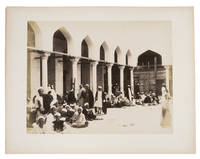
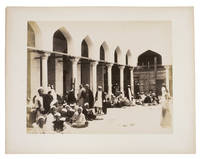
1888ABC_47975Cairo 1888. 34 albumen prints ca. 22 x 27 cm mounted on cream cardstock ca. 28 x 35.5 cm. Remarkable collection of 34 stunning photographic prints of Egypt all numbered titled and signed in the negative by photographer Jean Pascal Sébah 1872-1947 who owned the leading studio for Orientalist photography. He was even named the official photographer of the Sultan of Turkey together with his business partner Polycarpe Joailllier 1848-1904. The majority of the images in the present collection show streets and buildings from lesser known Egyptian cities and scenes of daily life. Larger collections of Sébah's work are relatively rare on the market.Sébah continued the business of his father Pascal Sébah 1823-1886 one of the first photographers working in Egypt. Pascal rose to prominence because of his well-organized compositions careful lighting and quality of his prints. The majority of his photographs are of tourist destinations and locals. Jean Pascal inherited his father's good eye but was more interested in depicting lesser known locations. His photos of people also appear more spontaneous. The present collection includes photographs of El-Souroughieh street and the Khalig canal in Cairo the Virgin Mary's tree in Matariya a local with a buffalo a group of seated men in a mosque a sugarcane market locals working on a sugarcane field a group of boys fishing and the hustle and bustle along the Nile.With a small purple ownership stamp of an anchor in mirror image and the letters "S A" near the top edge of one of the photographs of the Nile. The cardstock is very slightly foxed and yellowed and has somewhat warped from past temperature fluctuations. The prints have somewhat yellowed around the edges but are otherwise in good condition.l Cf. Saretzky The history of photography online. unknown
1888ABC_47975Cairo 1888. 34 albumen prints ca. 22 x 27 cm mounted on cream cardstock ca. 28 x 35.5 cm. Remarkable collection of 34 stunning photographic prints of Egypt all numbered titled and signed in the negative by photographer Jean Pascal Sébah 1872-1947 who owned the leading studio for Orientalist photography. He was even named the official photographer of the Sultan of Turkey together with his business partner Polycarpe Joailllier 1848-1904. The majority of the images in the present collection show streets and buildings from lesser known Egyptian cities and scenes of daily life. Larger collections of Sébah's work are relatively rare on the market.Sébah continued the business of his father Pascal Sébah 1823-1886 one of the first photographers working in Egypt. Pascal rose to prominence because of his well-organized compositions careful lighting and quality of his prints. The majority of his photographs are of tourist destinations and locals. Jean Pascal inherited his father's good eye but was more interested in depicting lesser known locations. His photos of people also appear more spontaneous. The present collection includes photographs of El-Souroughieh street and the Khalig canal in Cairo the Virgin Mary's tree in Matariya a local with a buffalo a group of seated men in a mosque a sugarcane market locals working on a sugarcane field a group of boys fishing and the hustle and bustle along the Nile.With a small purple ownership stamp of an anchor in mirror image and the letters "S A" near the top edge of one of the photographs of the Nile. The cardstock is very slightly foxed and yellowed and has somewhat warped from past temperature fluctuations. The prints have somewhat yellowed around the edges but are otherwise in good condition.l Cf. Saretzky The history of photography online. unknown
3122P., Demonville, 1803, un volume in 8 relié en demi-basane mouchetée, dos orné filets dorés (reliure moderne à l'imitation), 10pp., (1), 480pp., 2 planches hors texte
Three volumes. Royal quarto. I. Text: xiii, (344), xxxiv, vi, figures; II. Plates 1-57; III: Plates 58-125. Hardcover, bound in contemporary half cloth and marbled boards, gilt spines. In a very good condition. ~ First edition. Beinlich-Seeber 2889.
Fourteen volumes. Comprising of 284 collotype plates the size of ca. 70x48 cm each, all placed in 14 portfolios, uniformly bound in the original publisher's cloth and printed boards, with cloth ties. ~ First edition. Mammoth work, complete with all text and plates. With a total of 703 collotype images on 284 leaves of plates and 325 images to the text. Fully collated for completeness and condition.
966845A.-J. Dénain Et Delamare, Editeurs-Propriétaires Paris 1830 - 1834 10 volumes in-8 ( 210 X 130 mm ) demi veau fauve, dos à nerfs ornés de caissons dorés, pièces de titre de maroquin framboise et de tomaison de maroquin anthracite et 2 atlas in-4 oblong "à l'italienne" ( 280 X 350 mm ), demi basane chocolat, dos lisse orné de filets dorés. 309 planches ( sur 310, il manque la planche 310 ), certaines dépliantes, gravées en premier tirage et 3 cartes. Imposante publication elle en vint à compléter la Description de l'Egypte parue entre 1809 et 1826, tout en se voulant supérieure par son exactitude et son exhaustivité. Elle tient à la fois de l'encyclopédie et du livre de voyage. « une source partiellement originale et de premier ordre » ( De Meulenaere ). L'iconographie est due pour une large part à VIVANT DENON, qui a gravé lui-même ses compositions. Brunet, III 209 - De Meulenaere, 110-111 - Quérard, VII 562-563. Pour les volumes de texte: mors frottés, coiffes usées, rousseurs sans gravité. Pour les atlas: reliures épidermées, très minimes défauts à quelques feuillets, les planches sont fraîches. De la bibliothèque de l'égyptologue Adolphe CATTAUI ( Ex-libris gravé au premier contreplat de chaque volume ).
172777(1800) , 28 pp. in-4 en cahier.
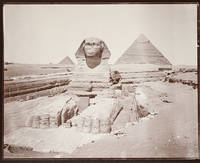
1891ABC_47521Egypt: Zangaki brothers 1891. Original gold-stamped bubble-grained maroon cloth over boards modern maroon cloth spine and leather corners. Gold stamped title and year on the front white watered silk endpapers. Oblong album 31.5 x 41 cm. With 34 large albumen prints mounted on heavy cardstock leaves. Most of the photographs are numbered and captioned in French in the negative and signed 'Zangaki'. The last one is signed Sebah & Joallier. The Zangaki prints measure 22.5 x 28.5 cm; the Sebah & Joallier one is 20.5 x 26.5 cm. A large German album with 34 albumen prints of Egypt. The Greek brothers G. and C. Zangaki were photographers who worked in Egypt in the second half of the 19th century. Due to increased tourism to this region after the opening of the Suez Canal there was a large demand for souvenir photographs. Photographers like the Zangaki brothers as well as Sebah & Joallier catered to this. The Zangakis were among the first commercial photographers to produce large-scale images of Egypt. They travelled through the country with a portable darkroom to capture high-quality images of famous monuments and daily life though the latter were usually posed. These images were then printed and sold to tourists either separately or compiled into albums. According to John Hannavy the brothers "produced some of the finest images of late Victorian Egypt". The 34 photographs include: the great pyramid Cairo and the Nile dervishes and other exotic looking locals Egyptians standing on top of the sphinx obeliscs the Ramesseum Karnak temple the temple of Dendera the Great Pyramid Egyptians climbing the pyramid the mosque and tomb of Muhammad Ali Saqqara and many others.With two small library stamps on the first page not affecting the photograph. The book has been rebacked. The left side of the front board has faded and the corners are worn. Minor browning around the edges of the leaves. Back flyleaf loose. The photos are crisp and clear and the book is otherwise in good condition.l Erdem Views of Egypt by Georgios and Constantinos Zangaki: Examining a late nineteenth-century photographic album at the Art Gallery of Ontario thesis 2006; Hannavy Encyclopedia of Nineteenth Century Photography pp. 1036 1093 & 1521. Zangaki brothers, hardcover
Ten volumes. Die altägyptischen Pyramidentexte: Four volumes. Quarto. Pp. xiii, 508; iv, 543, (4); iv, 179, plus 2 plates; 130, plus a leaf of illustrations at end. The main two volumes are hardcover, very nicely bound in duo-colour full cloth, spine and corners are crimson, boards are light grey, gilt lettering to spine. In fine condition. Volumes III+IV are in the original printed stiff wrappers, moderately worn along spine panels, else in fine condition. An excellent set. [AND:] Übersetzung und Kommentar. Six volumes. Royal quarto. Pp. viii, 409; 420; 443; 376; 517; 234. Hardcover, the first four volume uniformly bound in nice three-quarters buckram and matching boards, spine strips from original wrappers laid-down. The last two volumes are in the original publisher's blue full cloth, gilt lettering on red morocco labels to spine, gilt lettering to cover. In a very good condition. ~ Complete first edition of Sethe's greatest work, combined from the libraries of two Egyptology luminaries. First four volumes are from the library of renowned Egyptologist Prof. Dr. Heerma van Voss with his charming bookplate inside cover of each. Earlier small oval private ownership stamp to corner of title of two last volumes. With some of his very neat pencil annotations in margins; very few earlier minute marginal entries in ink. Beinlich-Seeber 18409. [AND:] The Übersetzung und Kommentar was published posthumously. The first four volumes, Spruch 213-506, were published a year after Sethe's death. Sethe's original manuscript was transferred to print by an old, now defunct method called "Manuldruck", also known as "Reflex Copying Process". The four volumes were printed by the inventor of this method, the printers' firm Max Ullman of Zwicaku. In 1962 appeared by Augustin Volume V, Spruch 507-582, to be followed the same year by Volume VI, Index. Also these two volumes are presented here in the first edition, to be distinguished from the second edition of the entire work which also appeared that year. Some of the volumes here occasionally with light marginal annotations in pencil or light pen, few cases within the text, some underlining, few cases in light colour crayon, all in the characteristic neat hand of Prof. Dr. Herman te Velde from whose library this wonderful set comes. Kurt Heinrich Sethe (1869-1934). Beinlich-Seeber 18525 (vols. I-IV).
51 volumes. Crown quarto. Hardcover, uniformly bound in black quarter cloth and matching patterned boards with lettering-piece to cover and spine cut from original wrappers; few volumes are in the original printed wrappers, one in the original IFAO hardcover. In fine condition. Excellent set, exceptionally well preserved, crisp interiors. ~ First edition. Fine set of 52 volumes spanning an uninterrupted period of 73 years (1915-1987). [Without volumes:] XXXI (1931); XLIII (1943); XLVIII (1948). Many of the volumes are exceptionally thick, the entire run is profusely illustrated and contains numerous contributions by most of the world's renowned Egyptologists throughout this period. Includes 2 Index volumes: XI-XX and XXI-XXX.
M7019dRare complete set of 2 volumes. Edition limited to 1200 sets. Ordnance Survey Giza 1949-54. First edition. Large folio original cloth containing 243 plates showing mosques and architectural and decorative details 27 in colour: 216 in photogravure with sepia ink 2 in photogravure with chromolithographed colour 3 chromolithographed and 22 in halftone offset lithography after paintings by Al-Husain Fawzy. Further with about 100 offset lithographic line illustrations on the integral leaves many full-page. Vol. I: 68 pages 93 plates 2 maps and index. Vol. II: pages 69-133 plates 94-243. In the introduction Creswell writes: "Cairo possesses a most remarkable series of Muslim monuments running unbroken from the ninth to the nineteenth centuries. In the latter respect it is unique. . we need have no hesitation in saying that these two volumes constitute the finest piece of book production achieved in Egypt". Language: English. This set ships from Europe shipping costs will be updated accordingly BPF. Relevant subjects: Egypt: Medieval & Modern Egypt. unknown
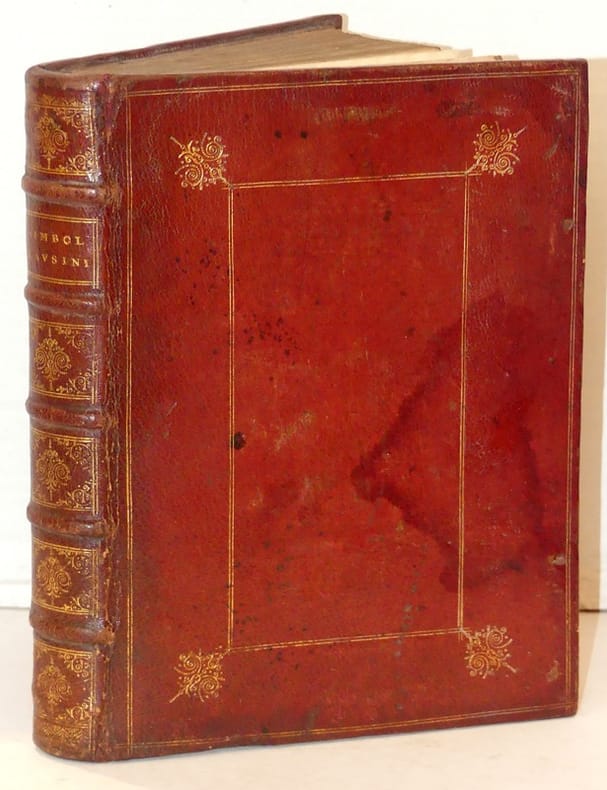
16476532Paris, Simon Piget, 1647. 2 parties en un volume in-4 (225 x 164 mm), 14 ff. n. ch., 230 p.- pp. 231-641, 41 pp. n. ch. Maroquin rouge à la Du Seuil, avec larges fleurons en écoinçons et double filet doré encadrant les plats, dos à nerfs orné, tranches dorées, le feuillet e4 et le dernier feuillet, tous deux blancs, sont en déficit, mouillure sur le premier plat de reliure et mouillure angulaire sur les 8 premiers feuillets, petites rousseurs éparses (reliure de l’époque).
18346002Paris Dénain et Delamare 1834 In-8 + In-4° Ensemble de 48 livraisons qui composent un ensemble de 10 volumes ( Il nous manque 1, voire 2 livraisons dans le premier volume consacré à l' histoire ancienne de l'Egypte ). L'histoire de la campagne de Napoléon occupe les volumes 3 à 8 inclus. Avec les deux rares Atlas comprenant en tout 309 planches et 3 cartes ( manque la planche 228 ). Il Manque encore une suite de 160 portraits pour que l'ouvrage soit tout à fait complet. Tout est en brochage d'époque. un manque de papier au dos d'un des Deux atlas, ( couvertures beiges Chez Ducollet et Renouard à la date de 1839)
19364825DBChicago, University of Chicago Press, 1936. Gross-Folio, 4° (Textband). XLVIII S., 209 S. (Kommentarband). Mit 100 farbige Illustrationen in Chromolithografie. Leinenbände mit Deckelillustrationen. Bildbände in Kartonschuber. + Wichtig: Für unsere Kunden in der EU erfolgt der Versand alle 14 Tage verzollt ab Deutschland / Postbank-Konto in Deutschland vorhanden +, 4825DB 3 Bände.
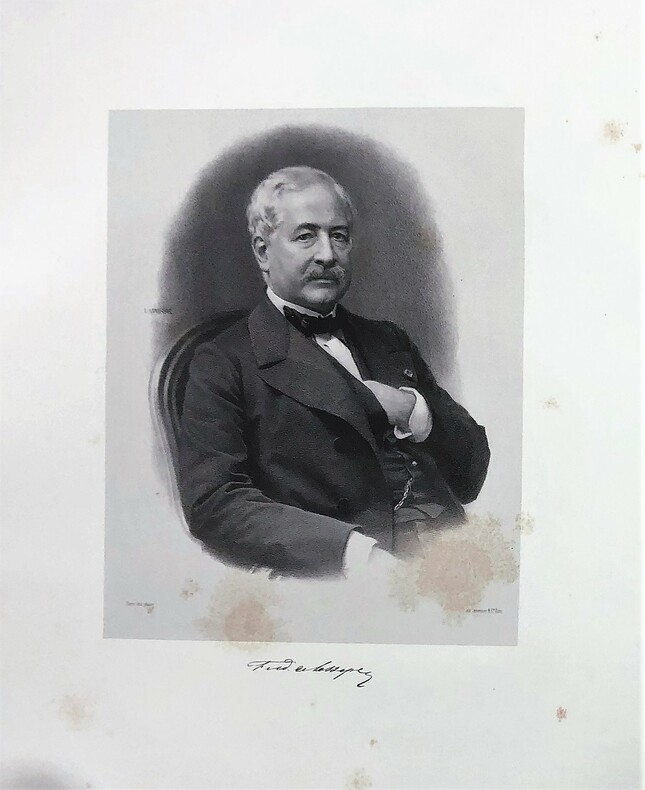
1870PHO-642Paris, Paul Dupont, E. Lachaud, s.d. [1870]. Grand in-folio (580 x 410 mm). Relié pleine toile violette éditeur, dos lisse , titre doré sur le premier plat, vue d'Égypte sur le dernier plat,petit manque au dos , quelques rousseurs Illustration composée d'un portrait de Ferdinand de Lesseps lithographié d'après une photographie de Pierre Petit, d'une carte lithographiée en couleurs et de vingt-cinq planches dessinées par Riou et lithographiées en couleurs par Cicéri, Morel-Fatio et Jules Didier.
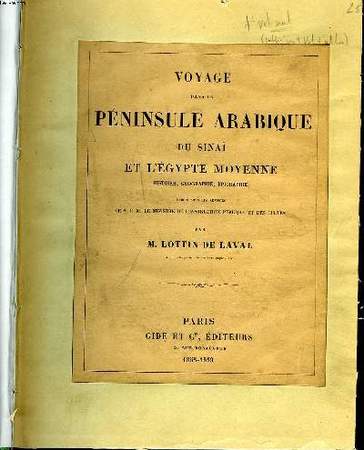
GIDE ET CIE. 1855-1859. In-4 Carré. Relié. Bon état. Couv. convenable. Dos satisfaisant. Mouillures. 355 Pages + 1 carte dépliante. Titre doré sur pièce de titre verte. Relié Dos toilé /papier à la cuve. Ouvrage de bibliothèque avec code collé sur le dos, annotation et petit tampon en page de titre. Histoire, géographie, épigraphe publié sous les auspices de S.E.M Le ministre de l'instruction publiques et des cultes.
1859RO40087175GIDE ET CIE. 1855-1859. In-4. Relié. Bon état, Couv. convenable, Dos satisfaisant, Mouillures. 355 Pages + 1 carte dépliante. Titre doré sur pièce de titre verte. Relié Dos toilé /papier à la cuve. Ouvrage de bibliothèque avec code collé sur le dos, annotation et petit tampon en page de titre.. . . . Classification Dewey : 962-Egypte et Soudan