19 171 résultats
Royal quarto. Pp. xi, 41. Plus frontispiece and 32 plates, many of which are folding, bound at end. Includes 3 plates in colour. With 8 figures in the text. Original Erratum slip tipped-in. Indices. Hardcover, bound in the original publisher's cloth and printed boards, edges trifle rubbed, spine ends slightly frayed. A very good copy in fine internal condition with all the wonderful plates rather crisp. ~ First edition. Archaeological Survey of Egypt, 22nd Memoir. The monochromatic plates are printed in collotype, one of the most accurate and attractive methods of photomechanical tonal printing processes. Highly skilled and expensive process, it cannot produce more than a limited number of impressions. It has been used for single-sheet prints and luxury portfolios, and since the 1950s has been abandoned by all except a few small specialist firms. [Provenance:] From the library of renowned Egyptologist Prof. Dr. Joris Frans Borghouts (1939-2018).
Two parts in one volume. Crown quarto. Paginated consequitevly. Pp. 9, 13-161; 165-302. Original stiff wrappers printed in red. In good condition, very good interior. ~ First edition. Supplément aux Annales du service des antiquités de l'Égypte, 16. One of Daumas' most important monographs.
Re-edited by Dr. Zaky Iskander, 3 vol. in-4 br., General Organisation for Government Printing Offices, Cairo, 1975, I : The Mastaba pf Neb-Kaw-Her, 94 pp., figures 25, plates LI ; II : Mastabas of Ny-ankh-Pepy and Others, 65 pp., Figures LIX, plates LXXXVII ; III : Mastabas of Princess Hemet-Rc and Others, 138 pp., figures 43, plates LVII Full set. Good condition (original tear on one cover, otherwise good copy) Anglais
29 fascicles. Quarto. Pp. 672. Twenty fascicles are uniformly bound in the original publisher's printed wrappers. In a very good condition. ~ First edition. Volume VI. Fascicles 21-29 are provided in facsimile scanned in high resolution from the original. [Provenance:] Renowned Egyptologist Prof. Dr. Joris Frans Borghouts' (1939-2018) working copy. With a small inscription at corner of each cover and some annotations. The first fascicle is heavilly used and consequently worn. It is heavily annotated and marked in pencil, sometime in pen, and includes extended notes on a leaf of paper, loosely inserted. The notes, cross-references, and possible corrections make this volume a unique copy which allows a very rare, private insight into the thought process of this great scholar. All other fascicles are in fine condition.
Royal octavo. Pp. xiv, 465, (8). Plates. Hardcover, bound in the original publisher's printed boards. In mint condition. Excellent copy, practically new. ~ First edition. Orbis Biblicus et Orientalis, 113.
Quarto. Pp. xiii, 268. Original printed wrappers, bit shabby, remnants of clear tape on back; some stamps and cancellations. Good ex-lib copy. ~ First edition. Original doctoral dissertation. Publications de la Faculte des Lettres et Sciences Humaines de l'Universite de Lille; Institut de Papyrologie et d'Égyptologie, I.
Folio. Comprising of a suite of 35 collotype plates accompanied by a leaf of text. Placed inside original portfolio, browned, stained, lacks ties; short closed tear to blank margin of one leaf. In good condition. ~ First edition. First 3 plates are with very neat scholarly annotations in pencil.
Four volumes. Quarto. Pp. x, 358; viii, 359; ix, 459; vii, 367. Each volume with appendix of plates bound at end. Numerous text illustrations. Hardcover, uniformly bound in the original publisher's full cloth, black lettering, spines slightly faded. In fine condition. Excellent set. ~ First edition.
Imperial folio. Pp. xl, plus 108 plates and 16 plans, many of which are double-page or folding. Hardcover, bound in the original publisher's duo-colour cloth, colour plate mounted on cover, spine gilt. In fine condition. Excellent copy. ~ First edition. From the library of renowned Egyptologist Prof. Dr. Heerma van Voss (1923-2015) with his charming bookplate inside cover.
Imperial folio. Pp. xiv, including half-title, plus 23 large plates, mostly folding (ca. 50x80 cm), including Key Plan and 2 larger fold-outs, one spanning 50x120 cm. Placed in the original half cloth portfolio with cloth ties, narrow faded patch at bottom. In a very good condition, excellent plates. ~ First edition. The University of Chicago, Oriental Institute Publication, LXXIV.
Two volumes in four. Crown quarto. Pp. viii, 107; xiii, 109-251; vi, 166; xv, 168-304. Text figures. Uniformly bound in the original publisher's stiff wrappers. In mint condition, as new. ~ First edition. [Provenance:] Unused, from the library of Egyptologist Prof. Dr. Herman De Meulenaere (1923-2011).
Very Good English Original 1/4 leather bound. Spine with five compartments, second and fourth are Ottoman lettered gilt. Roy. 8vo. (25 x 17 cm). In Ottoman script. 432, [4] p. First Edition. 4th volume of 10. This set is published between 1896-1938. Hejra: 1314 = Gregorian: 1896. Ozege: 5302 / 4. Rare. Evliya Çelebi seyahatnamesi. Vol. 4.
Boards with moderate wear and darkening to extremities. Hinges weakening. ; 12mo; 505, 88 pages
Very Good Arabic First book of three of the first edition of this early set on Egyptian working class and Arabian labour, printed in Cairo by one of the pioneer intellectual Amin Izz al-Din, (1921-2001). This rare book includes the formative period of the Egyptian working class especially between the years 1882-1919, from the British occupation of Egypt in 1882 which was crystallized many of the economic trends which had been maturing since the era of Muhammad Ali Pasha of Kavala (1769-1849), to Tawra [i.e. The Egyptian Revolution of 1919] which was a countrywide revolution against the British occupation of Egypt and Sudan. It was carried out by Egyptians from different walks of life in the wake of the British-ordered exile of the revolutionary Egyptian Nationalist leader Saad Zaghlul, and other members of the Wafd Party in 1919. Before the Revolution, by 1914 foreign capital represented 70 per cent of the total capital invested in Egypt. According to Izz al-Din, from 1899 to 1903 at least eight workers' associations were formed, mainly under Greek, Italian and Armenian leadership. But the steady expansion of capitalist relations of production in Egypt and the continuing British occupation provided the conditions which soon led to the appearance of native Egyptian working-class organization and leadership. The crash of 1907 produced a sharp rise in the cost of living and provided the economic incentive for another round of working-class struggle. At the same time, the Egyptian national movement was about to assert itself as a significant new political force. The conjuncture of these factors was the basis for sustained struggle and organization of native Egyptian workers. [.] The strike wave led to the formation of new and more soundly organized unions. There were 43 trade unions functioning in 1919-1920: 19 in Cairo, 18 in Alexandria, and 6 in Port Said, Damietta, Damanhour and Mahalla al-Kubra. [.] In the mid-1920s many enterprises fired workers and attempted, with some success, to disregard or revise agreements reached with trade unions in the first years after the 1919 uprising. There were series of strikes in 1927 in response to these actions - the Alexandria Water Company, Alexandria Tram Company, railway porters, silk weavers, Cairo cigarette workers and Suez Canal workers at Port Said. But by 1927 the number of trade unions had dropped to 62 with a total membership of somewhat more than 21,000. (Source: Formation of the Egyptian Working Class / MERIP). Amin Izz al-Din was a thinker and historian of the Egyptian trade union movement and a prominent historian of the Egyptian labour movement. He was one of the most prominent popular and labour leaders, and he has spent his life serving this movement. Izz al-Din held various leadership positions in the interest of workers and social security, as well as political organizations, as he previously worked in the Office of Arab Affairs at the Presidency of the Republic, and contributed to drafting labour legislation in 1970 and laying the foundations on which the Federation of Egyptian Workers was based. Bachelor of Arts from Cairo University, and a Masters degree from Oxford University British Labour Studies: A number of books have been written, foremost of which is "The History of the Egyptian Working Class", in 3 parts. Half leather bound in Egyptian style raised six bands to spine, Arabic lettered gilt in second and fourth. 'Abdelzehar Bnding' stamp on back endpaper. Demy 8vo. (21 x 14 cm). In Arabic. 213, [1] p. OCLC 23517320.
Boards with light rubbing to extremities. Internally a nice and tight copy. Small pinhole to title page. ; Fold out maps in NF condition; 16mo 6" - 7" tall; xx, 955 pages
Very Good Arabic Half leather bound in Egyptian style raised six bands to spine, Arabic lettered gilt in second and fourth. 'Abdelzehar Binding' stamp on back endpaper. Roy. 8vo. (24 x 17 cm). In Arabic. 179, [1] p. First Arabic edition of Kartun's 'Africa! Africa! A continent rises to its feet' which describes the struggle for freedom in British colonial Africa in the face of horrible pressures. ABOUT THE AUTHOR: Kartun was the improbable combination of a leftist activist, a captain of industry, a Daily Worker journalist and an author of spy thrillers. Kartun was the son of a Russian-French father and a Polish-English mother. He was born into the world of the cultured bourgeoisie, his uncle being the pianist and conductor Léon Kartun. His father had left Paris Conservatoire when he realized that he would not be one of the great violinists of his generation, and went on to become a successful designer and trader of jewelry. He was sent to England for his schooling, first to a prep school in Redhill, where the combination of being bookish, Jewish, and French proved a hindrance to popularity, and then to St Paul's, where he instead flourished and claimed to be the school's first Jewish boy. As what should have been his sixth form years coincided with a temporary reversal of his father's fortunes, and he was set to work in an advertising agency, later on finding himself working a job on writing scripts for B movies for MGM, where he met Claude Cockburn (see separate entry). Becoming a contributor to Cockburn's scurrilous newssheet The Week merely led him into the Communist Party for the next two decades of his life. Bad eyesight confined him to civilian duties during the war but he wrote several books while in the Communist Party, including Tito's plot against Europe: The story of the Raik Conspiracy (1949), This is America (1947), and Africa, Africa! (1954). He became foreign editor of The Daily Worker, writing for the Party on a wide range of allied themes. He contributed a piece on the French political scene in April 1946 for Raji Dutt's Labour Monthly, when he replaced his brother, Clemens Dutt in March 1945 and joined the staff of the Daily Worker for the first time as its European correspondent, based in Paris. He was initially expelled from France by the Ministry of the Interior only a few hours after arriving! Kartun later covered the birth of the state of Israel, being present during the Siege of Jerusalem in April 1948. (Source: Independent - Obituary: Derek Kartun). [FIRST ARABIC EDITION OF 'AFRICA! AFRICA!' BY EDITOR OF THE DAILY WORKER] Ifriqiyah! Ifriqiyah! Qarat taqif ali qidmihâ. [i.e. Africa! Africa! A continent rises to its feet]. Translated by Ahmed Fouad Balbaa; Review by Hassan Lotfi Al-Manfalouti. ???????-??????? ???? ??? ??? ?????? One copy located in OCLC: 949535161 (Fondation du Roi Abdul-Aziz Al Saoud pour les Etudes Islamiques et les Sciences Humaines / King Abdul-Aziz Al Saoud Foundation for Islamic Studies and Human Sciences - Casablanca).
Very Good Arabic Early Arabic translation and the first Egyptian edition of "Une E?te? africain" novel by Dib, printed in 1959 firstly in French, translated by Egyptian translator Mohammad Bukhârî. An African summer is an early novel about his childhood and youth by Dib and it retains the realistic mode of expression in his description of a people in revolt. Mohammed Dib was an Algerian author, playwriter, and intellectual who was a member of the Generation of '52 - a group of Algerian writers which included Albert Camus and Mouloud Feraoun. In 1959, he was expelled from Algeria by the French authorities for his support for Algerian independence, and also because of the success of his novels (which depicted the reality of life in colonial Algeria for most Algerians). Instead of moving to Cairo as many Algerian nationalists had, he decided to live in France, where he was allowed to stay after various writers (including Camus) lobbied the French government. In contemporary full red imitation leather bdg. Arabic letter gilt on front board. 12mo. (16,5 x 12,5 cm). In Arabic. 172, [4] p., two b/w plates. Chipping on imprint page, overall a very good copy. Copy with no date and press details. First Edition, thus. OCLC 77732316. OCLC shows another Arabic copy printed in "Al-Sûrî" in 196? titled 'Sayf Ifrîqî'.
19285265Kairo, Dar Al Kutub, 1928. 4 Bll. 32 (1 doppelblattgr.) Tafeln. Gr.-4°. OHLwd. (etw. gebräunt und leicht bestoßen, Gebrssprn.).
18589253Leipzig, Wigand, 1857 - 1858. 4 Teile in 2 Bdn. VIII, 249 S., 1 Bl., VI, 331; X, 278, VIII, 316 S. 7 lithograph. Tafeln. Gr.-8°. HLdr. der Zeit mit Rückentitel (kl. Gebrssprn.).
19347117Leipzig, Brockhaus Verlag (1924, 1927, ), 1924, 1927, 1934. (5. / 7. und 1. Auflage) Mit 3 Titelbildern, 413 Abbildungen auf Tafeln nach photographischen Aufnahmen von Harry Burton, 1 Karte und 1 Skizze. ill. OLwd.-bde, 260; 303; 240 S., Gr.8° (3 Bände zus.) [5 Warenabbildungen]
32813Paris Hachette 1858. Petit in-8. Edition originale. 378 p. + Table + Catalogue de l'Editeur. Couverture conservée sous très belle reliure en demi-chagrin à coins avec dos à nerfs et caractères dorés. Parfait état.
Six parts in three, bound in one. Quarto. Pp. 127-138; (ii), 179-200; 242-271, (ii) Index. Plus a full-page sketch map of the Eastern Delta printed in several colours. With 3 text figures. Original monograph printed wrappers, small inscription, spine ends worn. In a very good condition. ~ First edition thus. Reprinted from The Journal of Egyptian Archaeology, 1918. Sir Alan Henderson Gardiner (1879-1963). From the library of Egyptologist Prof. Baudouin van de Walle (1901-1988). Beinlich-Seeber 8293.
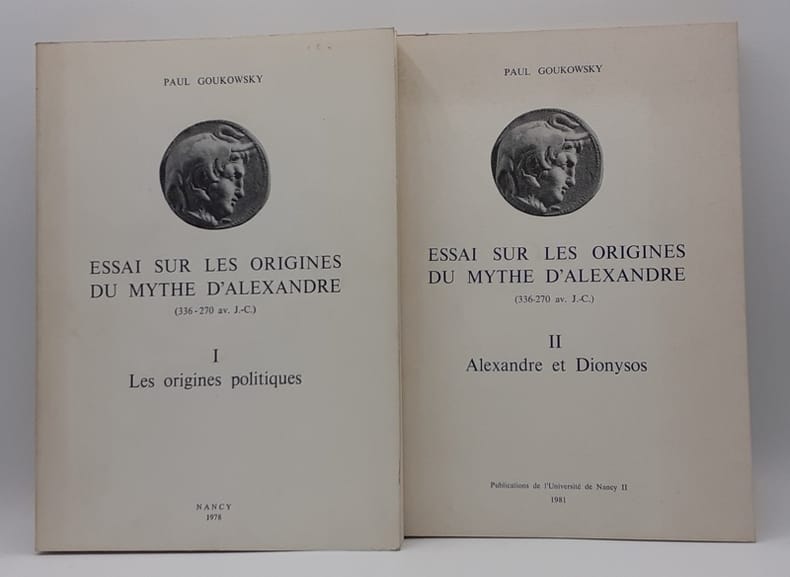
591166Nancy, Université de Nancy II, 1978-1981. 2 vol. in-8 broché, couv. ill., 360 et 198 pp., fig. en n/b. in-t., carte, notes critiques, indices. Epuisé chez l'éditeur.
186051461ABCöln, J.M. Heberle, 1860. Ca. 22 x 13 cm. LI S., (5) Seiten, 280 Seiten, mit 47 Holzschnittillustrationen. Halbleinenband des 20. Jhdts. mit Rückenschild.
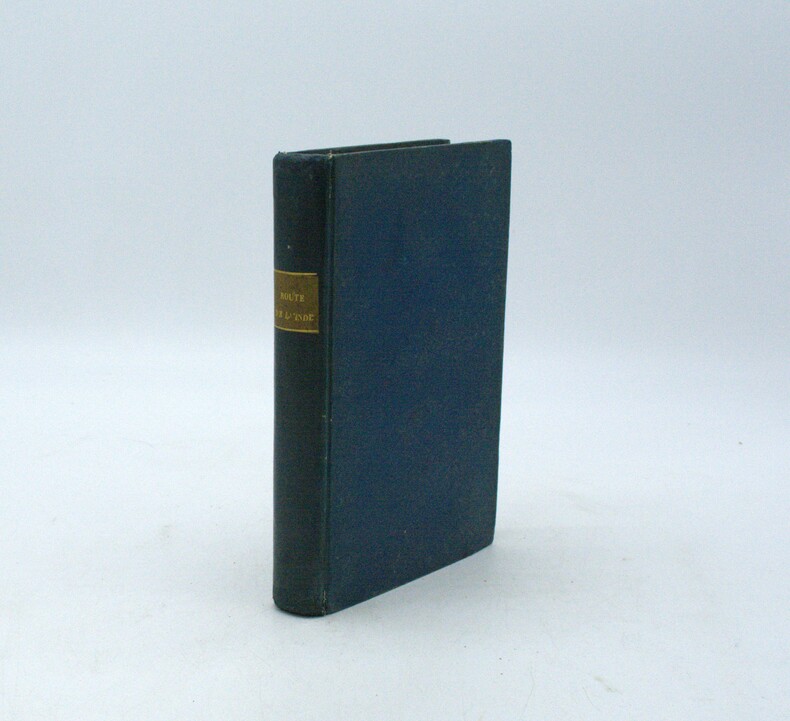
1799PHO-1973Paris, Carteret et chez Dentu, An VII (1799), in-8, VIII-457pp., relié papier bleu, dos lisse avec pièce de titre, , petits frottements, quelques rousseurs, pages d’index courtes en marges.