Cyril of AlexandriaBiblio.com
1 898 résultats
0198268106New. Brand new and still unused unknown
19621883309Walter De Gruyter 1962. Hardcover. Used-Very Good. Cloth. Octavo. Seven volumes in eight books. Text in Latin and Greek. Reprint of the 1896-1902 edition. Mild shelf wear to boards. Altogether a complete set in Very Good condition. Walter De Gruyter hardcover
1682PW1341London:: Printed by M. Flesher for Thomas Fickus 1682. 1682. 8vo. 54 166 pp. Original calf boards rebacked with calf new endleaves; small tear to lower corner of p. 165 far from text block. Signed by Alfred Keene 1839. First English edition. This is one of the first books Norris published. "Norris John 1657–1712 Church of England clergyman and philosopher was born on 2 January 1657 at Collingbourne Kingston Wiltshire the third surviving child of John Norris bap. 1614 d. 1682 and his wife Elizabeth d. 1696. His father was vicar of Collingbourne Kingston under the Commonwealth and he moved to the living of Aldbourne Wiltshire in 1660. Norris was educated at Winchester College and entered Exeter College Oxford in 1676. A keen student at both Winchester and Oxford he early abandoned his inherited Calvinism and concentrated his reading on Platonist authors. On graduating BA in 1680 he was appointed a fellow of All Souls by Archbishop Sancroft on the recommendation of Thomas Jeames the warden during a dispute with the fellows over the filling of the vacancies in the college. Norris always retained a great esteem for All Souls and the college in turn erected a bust of h His early writings show him to have been at that time a strong tory and high-churchman but also show that he deliberately turned aside from political involvement. All the writings that he considered to be worth preserving were included in A Collection of Miscellanies which appeared in 1687. im in the Codrington Library when this was built in the following century. . . . Norris's writings have tended to be neglected by historians of philosophy partly perhaps because of Locke's dismissive attitude and partly because many of his theories are so close to those of Malebranche that it is difficult to disentangle their influence. He has been better treated by historians of literature who see his poetry much of which continues to be republished as marking especially clearly the transition from the spirit of the Renaissance to that of modern times. Much of Norris's poetry which has its roots in the metaphysical tradition is somewhat laboured. At his best however he has a lyrical spirit . . . In private life Norris seems to have been a kindly person a devoted parish clergyman and the friend and supporter of several of the learned ladies of his time. In the history of English thought he is a transitional figure. In contrast to the Cambridge Platonists he adopted wholeheartedly the Cartesian dualism of mind and matter. His theory of knowledge was a Cartesian Platonism similar to that of Malebranche to whose more developed theories he was at times too inclined to defer. In the history of English philosophy religion and literature he deserves to be remembered." – DNB. Lowndes The Bibliographer's Manual of English Literature vol. 3 p. 928. See: W. J. Mander The Philosophy of John Norris. Printed by M. Flesher, for Thomas Fickus, 1682. hardcover
1682PW1341London:: Printed by M. Flesher for Thomas Fickus 1682. 1682. 8vo. 54 166 pp. Original calf boards rebacked with calf new endleaves; small tear to lower corner of p. 165 far from text block. Signed by Alfred Keene 1839. First English edition. This is one of the first books Norris published. "Norris John 1657–1712 Church of England clergyman and philosopher was born on 2 January 1657 at Collingbourne Kingston Wiltshire the third surviving child of John Norris bap. 1614 d. 1682 and his wife Elizabeth d. 1696. His father was vicar of Collingbourne Kingston under the Commonwealth and he moved to the living of Aldbourne Wiltshire in 1660. Norris was educated at Winchester College and entered Exeter College Oxford in 1676. A keen student at both Winchester and Oxford he early abandoned his inherited Calvinism and concentrated his reading on Platonist authors. On graduating BA in 1680 he was appointed a fellow of All Souls by Archbishop Sancroft on the recommendation of Thomas Jeames the warden during a dispute with the fellows over the filling of the vacancies in the college. Norris always retained a great esteem for All Souls and the college in turn erected a bust of h His early writings show him to have been at that time a strong tory and high-churchman but also show that he deliberately turned aside from political involvement. All the writings that he considered to be worth preserving were included in A Collection of Miscellanies which appeared in 1687. im in the Codrington Library when this was built in the following century. . . . Norris's writings have tended to be neglected by historians of philosophy partly perhaps because of Locke's dismissive attitude and partly because many of his theories are so close to those of Malebranche that it is difficult to disentangle their influence. He has been better treated by historians of literature who see his poetry much of which continues to be republished as marking especially clearly the transition from the spirit of the Renaissance to that of modern times. Much of Norris's poetry which has its roots in the metaphysical tradition is somewhat laboured. At his best however he has a lyrical spirit . . . In private life Norris seems to have been a kindly person a devoted parish clergyman and the friend and supporter of several of the learned ladies of his time. In the history of English thought he is a transitional figure. In contrast to the Cambridge Platonists he adopted wholeheartedly the Cartesian dualism of mind and matter. His theory of knowledge was a Cartesian Platonism similar to that of Malebranche to whose more developed theories he was at times too inclined to defer. In the history of English philosophy religion and literature he deserves to be remembered." – DNB. Lowndes The Bibliographer's Manual of English Literature vol. 3 p. 928. See: W. J. Mander The Philosophy of John Norris. Printed by M. Flesher, for Thomas Fickus, 1682. hardcover books
4 vols., 8vo., First Edition thus, with frontispieces and numerous sepia-toned photographs as plates; pictorial boards, terracotta cloth backs lettered in gilt, brown endpapers, a fine set in publisher's board slip-cases. With uniform personal bookplate on front paste-downs. COMPLETE SETS IN THIS CONDITION ARE VERY SCARCE.
Pages 425-452. Features: Wonderful one-page colour Guinness ad entitled "Guinness for Strength" shows farmer pushing huge wheelbarrow loaded with veggies - presumably in the spirit of promoting wartime home food growing; Map of great R.A.F. bombing raid on Lubeck; Five graphic air photos of R.A.F.-inflicted bomb damage to Rostock; Five photos of bomb damage in Valetta, Malta; Three photos of terrible smoke and fire on Rangoon's waterfront as the great oil refineries of Syriam and the Burma Company's oil warehouse are destroyed before the Japanese arrive; Two photos of Nazi reprisal bomb damage in Bath; Photo of six R.A.F. men returning from the spectacular raid on the Diesel works at Augsburg, including Squadron-Leader J.D. Nettleton, V.C.; Photo of British-Italian prisoner exchange at Alexandria; Photo of smiling returing British POWs at Cairo Station; Five photos of the King and Queen visiting Canadian Armoured Division "Sansom's Rough Riders" (named after Major-General E. Sansom; Commandos and Their Raids - article with two photos of Major Lord Lovat and his landing force before their successful reconnaissance raid near Boulogne; Two photos of Scottish Command forces practicing marine landing excercises jumping off barges, some with scaling ladders; Two pages of illustrations of battle drill under the most rigorous and realistic conditions; Nine photos on two-page spread illustrated the H.M.S. "Illustrious" at sea again, carrying American fighter planes - Grumman Martlets; photo of 'Dodge'ems' used to move aircraft on aircraft carrier deck; Magnificent centerfold aerial photo of R.A.F. bomb damage inflicted upoin the city of Lubeck - a mile of roofless houses, great blasted areas and ruined war factories; Six photos illustrate novel U.S. method of rapidly fabricating a 173' submarine chaser at the Defoe Yards at Bay City, Michigan; Two great photos compare the instrument panels of an Me. 109 fighter and a Halifax bomger; Two-pages of illustrations wonderfully explain the mechanism behind aircraft dials - "Marvels of Lilliputian engineering for delicate modern aero instruments; Photos of eleven personalities of the week include General H. Giraud, Rifleman John Beeley, V.C., Sec.-Lieut. C. Ward Gunn, V.C.,Lieut.-Colonel C.G.W. Anderson, V.C., Lieut.-Colonel A.E. Cumming, V.C., and Princess Elizabeth in Girl Guide uniform; Drake's Globe-Cup sold at Christies (large photo); Classy half-page Rover car ad; Nice colour Johnnie Walker ad on back cover shows shipyard outside window; more nice vintage ads. This copy was never stapled. Clean and unmarked with moderate wear. A quality copy of this vintage issue. Book
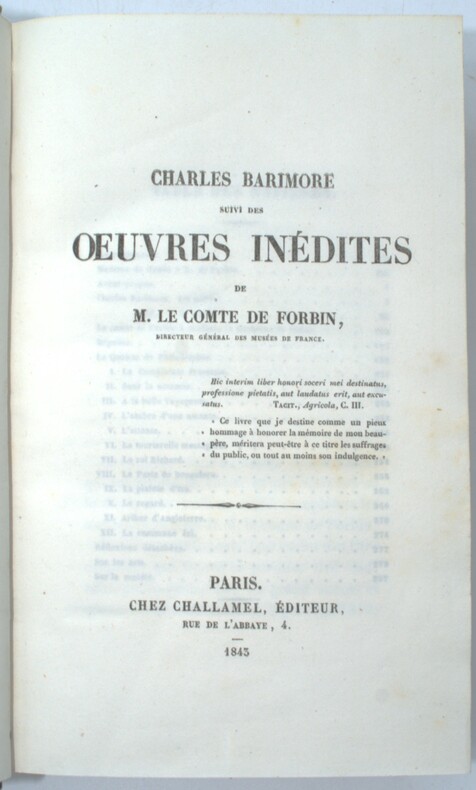
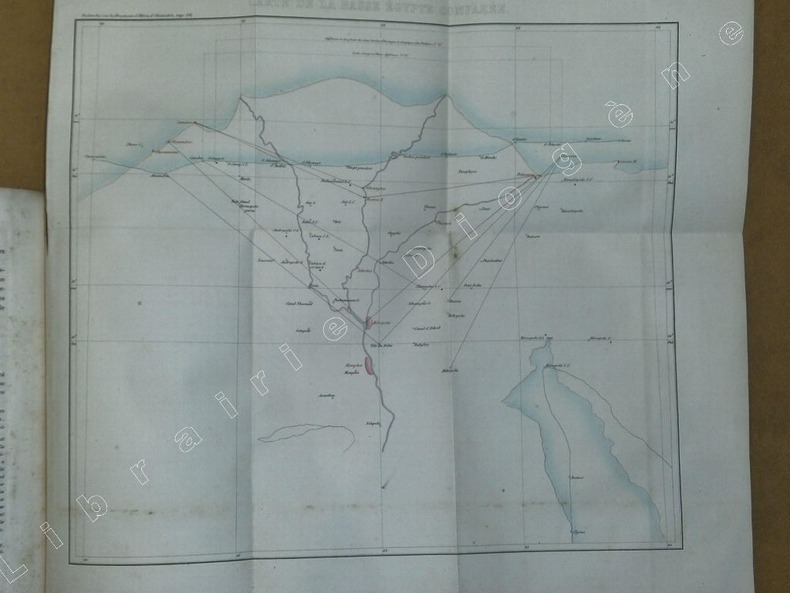
1819PHO-1484Paris, Challamel et Imprimerie Royale, Delaunay libraire,1843 et 1819, 1 vol.in 8*, 298pp. et 460 pp., une planche dépliante in fine, relié demi chagrin vert, dos à nerfs avec auteur et titre.
202413880<p>London: Simon & Schuster UK 2024. 1st Edition 1st Printing. Hardcover. New/New. 1st Printing. Signed to signature page. Unread new copies. Matched Number. <br /><br /></p> Simon & Schuster UK hardcover
Q-0198268106Clarendon Press. Hardcover. New. New. In shrink wrap. Looks like an interesting title! Clarendon Press hardcover
2021x-0367457938CRC Pr I Llc 2021. Hardcover. New. 280 pages. 9.25x6.18x0.56 inches. CRC Pr I Llc hardcover
1975LC1156Acervo Cultural Editores Colección Valores en el tiempo 1975. Hardcover. Near Fine/No Jacket. Buenos Aires Acervo Cultural Editores Colección Valores en el tiempo 1975-1977. 145 x 205 cm 390 372 456 448 389 pp. Sin las sobrecubiertas. 5 tomos encuadernados en cuero con detalles en dorado. Únicamente el quinto tomo presenta roces leves en el dorado. Sin marcas de lectura. Pequeña rotura en la página 309 del tercer tomo. The Book Cellar & Henschel. <br/> <br/> Acervo Cultural Editores, Colección Valores en el tiempo hardcover
19292139401Breslau: Marcus 1909-1929. VII, (4), 409, (7), 426; VI, (2), 331, (1); (4), 187, (1); (8), 294 Seiten. Gr. 8° (23,5 x 16,5 cm). Grüne Halbleinenbände der Zeit mit goldgeprägtem Rückentitel und gesprenkeltem Schnitt. [Hardcover / fest gebunden].
4092066-nnew. unknown
18964337Georg Reimer / Walter de Gruyter 1896. First Edition. Hardcover. GOOD. Complete in seven volumes bound as eight. d. 1896 - 1930. 8vo brown finished cloth gilt spine lettering red speckled edges. Ex-libris Church Divinity School of the Pacific. Covers show some rubbing occasional wear occasional pencil checks to volume 1 all volumes otherwise sound and unmarked. Heavy item will require additional fees for international shipping. Georg Reimer / Walter de Gruyter hardcover
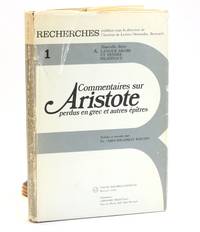
1971508660Dar El-Machreq Editeurs 1971. Hardcover with Dust Jacket. NEAR FINE/Very Good. Critical Arabic text short treatise 'Peri Nou' in Greek introduction in French. xvii 300pp. 8vo sewn binding in gray cloth black stamped lettering. Some light foxing to covers very clean and sharp otherwise with tight binding and crisp pages; DJ creased and torn at front and spine head now wrapped in mylar. Comprised of three ancient Greek commentaries on Aristotle which have survived only in Arabic translation: Traités d'Alexandre d'Aphrodise; Paraphrase des Météorologiques d'Aristote par Olympiodorus traduite par Ḥumain ibn Isḥaq; Paraphrase de 'De Animalibus' d'Aristote par Thémistius. This is the only printed edition of each work and it is quite scarce. 'Ce livre est un recueil de textes de philosophie grecque dont l'original grec est perdu et dont il ne nous reste que cette traduction arabe qui sauve par là des traités importants composés par trois parmi les plus grands commentateurs d'Aristote à savoir: Alexandre d'Aphrodise Olympiodore et Thémistius. Ceux d'Alexandre portent sur des points particuliers de la physique aris-totélicienne outre le fameux traité De Intellectu qui a eu une importance capitale durant tout le moyen âge aussi bien dans la philosophie musulmane que dans la scolastique chrétienne. Toutes les références aux textes originaux d'Aristote sont signalés et les endroits obscurs sont annotés.' From the DJ flap. Dar El-Machreq Editeurs hardcover
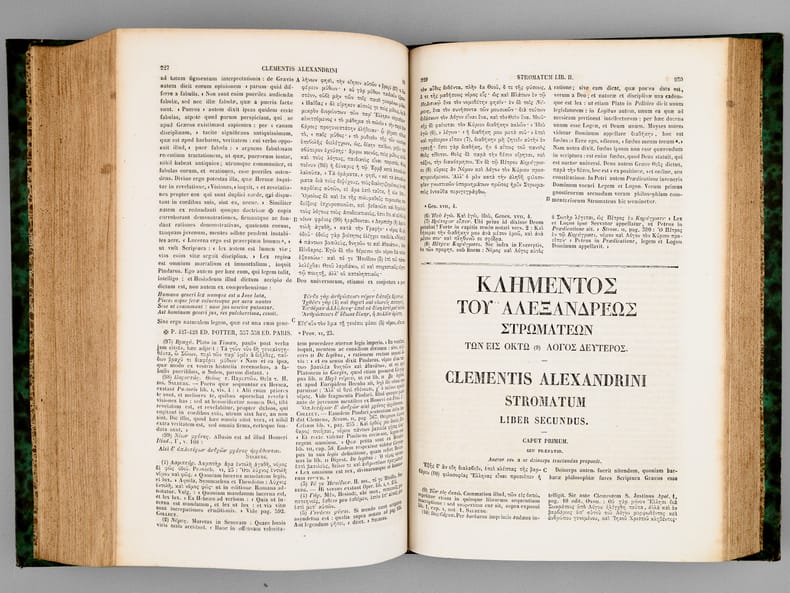
185768667Accedunt D. Nicolai Le Nourry, commentaria in omnes Clementis Alexandrini Libros, Accurante et denuo recognoscente J.P. Migne, 2 vol. in-4 reliure de l'époque demi-chagrin vert, dos à 4 nerfs dorés, Apud J.P. Migne, Petit-Montrouge, 1857, 1388 et 1696 colonnes Rappel du Titre complet : Clementis Alexandrini Opera quae extant Omnia (2 Tomes - Complet) Tomus Prior & Posterior [ Patrologia Graeca Tomus VIII & IX ]
1911150570Brepols January 1911. Hardcover. Very Good. Red buckram ex-library re-bindings on this 4 volume set very solid. Contains biblical commentaries in Latin and Greek of St. Cyril of Alexandria: Vol 71 - the Minor Prophets; Vol 72 - Minor Prophets Matthew Luke; Vol. 73- John; Vol. 74- John Continued plus epistles. Brepols hardcover
21864761-nnew. unknown
Very Good Turkish Original manuscript map of Alexandria Port and its immediate hinterland. Folio. (33 x 41 cm). In Turkish (Modern). Folded. No scale. The manuscript shows Alexandria Port and the Palace of the King Farouk of Egypt, customs shores, ports and harbors, locations of the British ships, radio station, location of SS Ramlah, strait, Great Pass (?), waterfront for the lumber ships, sea current zones and probably entrance and exit routes etc. A very detailed map, decorated with ships. Some repairs with tape, tears, foxing and stains. Overall a good copy.
Very Good Turkish, Ottoman (1500-1928) Original chromolithograph folded map. Oblong atlas folio. (49 x 65 cm). In Ottoman script. Repaired with a band in the contemporary period from its backside. Set including 4 sheets. Other sheets are Basrah, Bagdad, and Qut al-Amare. This is the first sheet including 'Samawah'. Rare. Scale is 1/500.000. Samawah city was settled by the Arab tribe of Banu Quda'a around the 3rd century AD. It is built on both sides of the Euphrates river; there are four bridges in the center of town for crossing between the two sides. The west bank of the city contains the commercial heart of the city and includes the old town and the Jewish quarter, Agd al Yahood. The west bank is the site of the covered market Suq Al Masgoof, which dates to the Ottoman period. The area surrounding the market is the old city with its Byzantine maze of crowded markets and streets. The eastern side of the city including 'Qushla' has a more modern feel and contains a number of estates of apartment blocks built during the 1970s and 1980s, As Samawah Stadium, which is home to the local Muthanna football team Samawa FC, as well as technical colleges and the polytechnic. There too is Al Qushla, the historic "Ottoman Barracks". The most famous attraction of Samawah in the ruins of the ancient Sumerian city of Uruk which dates to 4000 BC. This was the largest city in Sumer, extending over 2 km2. Uruk was not only the largest conurbation of the first urban civilization on earth, but it is also the place where the first written script was discovered, the oldest dating back to 3300 BC. The palm groves of Samawah: Samawah is built on both sides of the Euphrates and is surrounded by hundreds of palm groves that give it a tropical feel, especially in the southern and northern suburbs. These groves provide cool respite from the scorching heat of Mesopotamia and were the inspiration for the famous Iraqi folk song "The Palm of Samawah".
Very Good Turkish, Ottoman (1500-1928) Original map of Kars Fortress. Oblong: 45x57 cm. In Ottoman script. Scale: 1/21000. [PLAN OF KARS FORTRESS] Kars Kal'asi plâni (Based on 1898 discoveries and 1908 practice). A very detailed plan in Ottoman script of Kars Fortress and is environment. Some red markings. Extremely rare.
110033Paris, Amable Costes, Editeur, 1834-1836, 2 tomes reliés en 1 volume in-4 de 280x190x50 mm environ, 1f.blanc,faux-titre, frontispice, titre gravé, une carte dépliante, viij-56-48-24-16-48-28-128-8-80-64-64 pages, 1f.blanc, demi basane fauve et cartonnage marbré, dos lisse portant titres dorés sur pièce de titre rouille, orné de motifs dorés. Contient 134 figures sur acier et 2 grandes cartes. Des rousseurs et pages brunies, couverture très frottée sur le cuir et le cartonnage, début de fente sur un mors externe, mors internes en partie fendus mais la structure reste solide, déchirure restaurée sur la p. 5 de la Campagne de Rome, et p. 3 des Etats Vénitiens, les premières pages ont les bordures fendillées et sont partiellement détachées.
1819PHO-1795Paris, Imprimerie Royale, Delaunay libraire, 1819, 1 vol.in 8, 460 pp., une planche dépliante, relié demi chagrin, dos lisse orné avec titre, tranches jaunes, ex-libris manuscrit
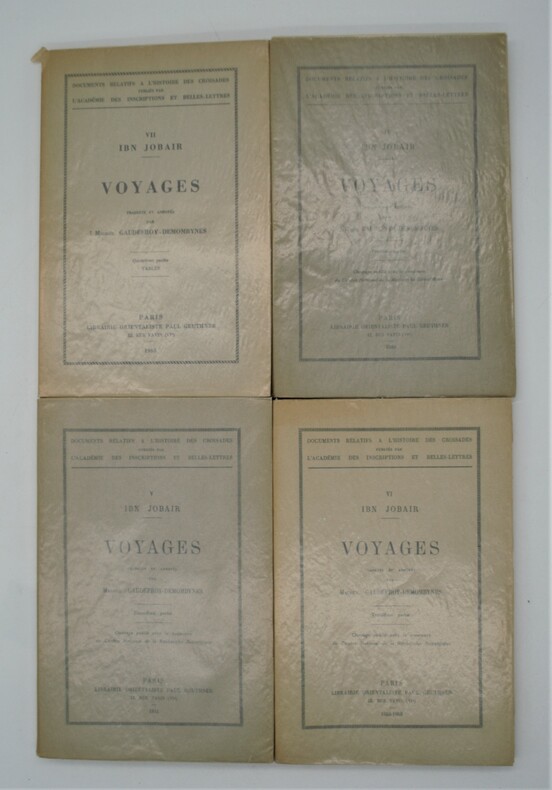
1949PHO-961Paris, Librairie orientaliste Geuthner 1949/1965.Documents relatifs à l'histoire des croisades publié par l’Académie des inscriptions et belles lettres . Quatre volumes in-8°(25x17cm). Brochage éditeur , non rogné , 106pp-158pp-142pp-180pp.
88897Imp. Nationale, 1851, 294 p., broché, environ 28x22cm, couverture restaurée, des rousseurs sur les pages.