Hierocles, Of AlexandriaBiblio.com
1 898 résultats
1170539823.Gpaperback. Good. Access codes and supplements are not guaranteed with used items. May be an ex-library book. paperback
1379738458.Ghardcover. Good. Access codes and supplements are not guaranteed with used items. May be an ex-library book. hardcover
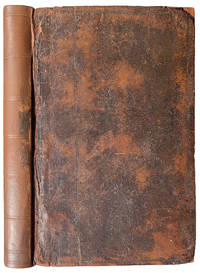
1682PW1341London:: Printed by M. Flesher for Thomas Fickus 1682. 1682. 8vo. 54 166 pp. Original calf boards rebacked with calf new endleaves; small tear to lower corner of p. 165 far from text block. Signed by Alfred Keene 1839. First English edition. This is one of the first books Norris published. "Norris John 1657–1712 Church of England clergyman and philosopher was born on 2 January 1657 at Collingbourne Kingston Wiltshire the third surviving child of John Norris bap. 1614 d. 1682 and his wife Elizabeth d. 1696. His father was vicar of Collingbourne Kingston under the Commonwealth and he moved to the living of Aldbourne Wiltshire in 1660. Norris was educated at Winchester College and entered Exeter College Oxford in 1676. A keen student at both Winchester and Oxford he early abandoned his inherited Calvinism and concentrated his reading on Platonist authors. On graduating BA in 1680 he was appointed a fellow of All Souls by Archbishop Sancroft on the recommendation of Thomas Jeames the warden during a dispute with the fellows over the filling of the vacancies in the college. Norris always retained a great esteem for All Souls and the college in turn erected a bust of h His early writings show him to have been at that time a strong tory and high-churchman but also show that he deliberately turned aside from political involvement. All the writings that he considered to be worth preserving were included in A Collection of Miscellanies which appeared in 1687. im in the Codrington Library when this was built in the following century. . . . Norris's writings have tended to be neglected by historians of philosophy partly perhaps because of Locke's dismissive attitude and partly because many of his theories are so close to those of Malebranche that it is difficult to disentangle their influence. He has been better treated by historians of literature who see his poetry much of which continues to be republished as marking especially clearly the transition from the spirit of the Renaissance to that of modern times. Much of Norris's poetry which has its roots in the metaphysical tradition is somewhat laboured. At his best however he has a lyrical spirit . . . In private life Norris seems to have been a kindly person a devoted parish clergyman and the friend and supporter of several of the learned ladies of his time. In the history of English thought he is a transitional figure. In contrast to the Cambridge Platonists he adopted wholeheartedly the Cartesian dualism of mind and matter. His theory of knowledge was a Cartesian Platonism similar to that of Malebranche to whose more developed theories he was at times too inclined to defer. In the history of English philosophy religion and literature he deserves to be remembered." – DNB. Lowndes The Bibliographer's Manual of English Literature vol. 3 p. 928. See: W. J. Mander The Philosophy of John Norris. Printed by M. Flesher, for Thomas Fickus, 1682. hardcover books
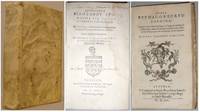
15836293Lutetiae Paris E Typographia Steph. Prevosteau . 1583-85. Two works bound in one volume: 12mo pp. xxiv 347 i. 12mo pp. ii 11 xi 90. Old ink-burn D11-E9 in the first work ie pp. 93-114 particularly noticeable E3-E6. Second work lacks two of the final leaves of text. Text concludes with the errata on verso of H1; H2 and H3 have been extracted; H4 blank as called for by Adams is present. Greek and Latin text. Contemporary limp vellum. Two early ownership inscriptions on title. The clearer of the two reads Ex libris Ioa. Maussaci in an early seventeenth century hand possibly Philippe Jacques de Maussac 1590-1650 president in Montpellier and a Greek scholar he edited Harpocration in 1614 cf. Sandys II p. 287. First edition of the commentary on the Golden Verses of Pythagorus by the fifth-century Neoplatonist Hierocles discovered in the library of François de la Rochefoucauld-Randan and edited and translated by Curterius; bound here with the first edition of Théodore Marcile's Latin translation. Both works were printed by Stephan Prevosteau - he is credited in the colophon of the first work and a variant title page carries his imprint Adams P2312 rather than Nivelles - and pairings of the works are not unknown. The example in the recently dispersed Macclesfield library lot 2711 in part 8 October 2006 was similarly bound in limp vellum and issuing them together may have been Prevosteaus own recommendation to his clients.Adams P2313 & P2314; Brunet III 154-155; Sandys II 105. Book hardcover
1682PW1341London:: Printed by M. Flesher for Thomas Fickus 1682. 1682. 8vo. 54 166 pp. Original calf boards rebacked with calf new endleaves; small tear to lower corner of p. 165 far from text block. Signed by Alfred Keene 1839. First English edition. This is one of the first books Norris published. "Norris John 1657–1712 Church of England clergyman and philosopher was born on 2 January 1657 at Collingbourne Kingston Wiltshire the third surviving child of John Norris bap. 1614 d. 1682 and his wife Elizabeth d. 1696. His father was vicar of Collingbourne Kingston under the Commonwealth and he moved to the living of Aldbourne Wiltshire in 1660. Norris was educated at Winchester College and entered Exeter College Oxford in 1676. A keen student at both Winchester and Oxford he early abandoned his inherited Calvinism and concentrated his reading on Platonist authors. On graduating BA in 1680 he was appointed a fellow of All Souls by Archbishop Sancroft on the recommendation of Thomas Jeames the warden during a dispute with the fellows over the filling of the vacancies in the college. Norris always retained a great esteem for All Souls and the college in turn erected a bust of h His early writings show him to have been at that time a strong tory and high-churchman but also show that he deliberately turned aside from political involvement. All the writings that he considered to be worth preserving were included in A Collection of Miscellanies which appeared in 1687. im in the Codrington Library when this was built in the following century. . . . Norris's writings have tended to be neglected by historians of philosophy partly perhaps because of Locke's dismissive attitude and partly because many of his theories are so close to those of Malebranche that it is difficult to disentangle their influence. He has been better treated by historians of literature who see his poetry much of which continues to be republished as marking especially clearly the transition from the spirit of the Renaissance to that of modern times. Much of Norris's poetry which has its roots in the metaphysical tradition is somewhat laboured. At his best however he has a lyrical spirit . . . In private life Norris seems to have been a kindly person a devoted parish clergyman and the friend and supporter of several of the learned ladies of his time. In the history of English thought he is a transitional figure. In contrast to the Cambridge Platonists he adopted wholeheartedly the Cartesian dualism of mind and matter. His theory of knowledge was a Cartesian Platonism similar to that of Malebranche to whose more developed theories he was at times too inclined to defer. In the history of English philosophy religion and literature he deserves to be remembered." – DNB. Lowndes The Bibliographer's Manual of English Literature vol. 3 p. 928. See: W. J. Mander The Philosophy of John Norris. Printed by M. Flesher, for Thomas Fickus, 1682. hardcover
170915327Typis Academicis Cambridge 1709. 1st Edition . Book Hardcover. Very Good. Full leather with five raised bands. 20 cm. Title page 26 xlii 467 20 p. Engraved vignette at head of Dedication. Leather split around spine and corners worn but binding sound. Block edges red. Some faint foxing on title page and a small worm hole through last 2 blank leaves otherwise clean and tight. A very good copy. Typis Academicis, Cambridge hardcover
16739774London: Printed by J.R. for J.Williams. and are to be sold by Henry Dickinson of Cambridge 1673. 8vo. 2 parts in 1 volume pp. xxxii 433 lxvii 271 i. Greek text with Latin facing some very light spotting and toning. Contemporary gilt-ruled calf rebacked preserving original fully gilt spine headcaps renewed. Faint ecclesiatical ink stamp to title possibly a convent of Discalced Carmelites. Commentary on the Golden Verses of the Pythagoreans composed by the Neoplatonist philospher Hierocles in the fifth-century. The translation is by the 16th century Parisian scholar Joannes Curterius possibly Jean Courtier and Theodore Marcile and our edition also features notes and commentaries by Meric Casaubon son of the renowned classical scholar and philologist Isaac and John Pearson Bishop of Chester. Book Printed by J.R. for J.Williams... and are to be sold by Henry Dickinson of Cambridge, unknown
17099432Cambridge: A. & J. Churchill 1709. Full calf. Very good. 8vo. 30xlii46721pp. Index. Text in Greek & Latin. Orig. calf gilt spine. Hinges starting but quite sound. A. & J. Churchill unknown books
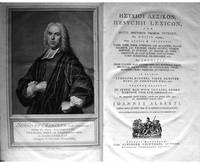
174629152Lugduni Batavorum: apud Samuelem Luchtmans et filium 1746. 2 volumes large folio pp. 12 xl 76 1758 columns; 2 xiii 1 1604 i.e. 1602 columns 44 index; cols. 1515-1516 omitted in pagination engraved frontispiece portrait of Johannes Alberti signed "F. Decker pinx. 1742. Excudit Samuel Luchtmans. I. Houbraken sculps. 1745" title page printed in red and black vignette title device of S. Luchtmans; Greek text printed in double columns with Latin apparatus at bottom; bound without the half-titles in full contemporary calf central panel ruled in gilt and surrounded by double gilt rules and blindstamped borders marbled edges; the whole neatly rebacked gilt lettering direct on gilt-decorated spines; some rubbing at the edges of the covers else very good and sound. Volume II has imprint: Lugduni Batavorum apud Samuelem et Joannem Luchtmans. Volume II was edited by David Ruhnkenius. Hesychius of Alexandria likely belongs to the 5th century B.C. "A Greek dictionary containing a copious list of peculiar words forms and phrases with an explanation of their meaning and often with a reference to the author who used them or to the district of Greece where they were current" EB-11. "He is of the greatest value for the study of Greek dialects and the interpretation of inscriptions" OCD. Brunet III 146. apud Samuelem Luchtmans, et filium unknown
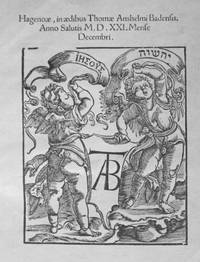
1521D6762Haguenau: Thomas Anshelm Badensis December 1521. First Edition. Hardcover. Very Good. Folio 319 x 203mm. Signatures: a-z in 8s; A-B in 6s. Double column numbered to 776 text in Greek. Woodcut initial beginning letter A. Large woodcut printers device on final leaf by Hans Baldung Grien d.1545 German artist and printmaker is called one of his best works Butsch I p. 48 pl. 75. Period limp vellum neatly rebacked remnants of old index tabs; light staining or wear with use otherwise very good. Few instances of marginalia in Greek mostly in letter A; Armorial bookplate of Reverend William B. Hayne Master of the free grammar school of Hinton Maurice in Devon; sold by Thomas Baker to Cuthbert H. Turner 1860-1930 English ecclesiastical historian and Biblical scholar his ownership inscription dated 1919 Magdalen College Oxford; John Waynflete Carter 1905-1975 English author diplomat and book collector his book label on front pastedown; BL early emblematical bookplate on front pastedown; gilt monogram on covers CML. <br/><br/>First edition printed in a German speaking country of Hesychius Lexicon of obscure Greek words this copy with an interesting scholarly provenance. First Edition printed in a German-speaking country correcting the Aldine edition of 1514. The Lexicon suffered substantial alterations including abridgements and additions on its way from the author to the only surviving manuscript of the fifteenth century. This production gives all-important information about the manuscript and the work of earlier scholars. Hesychius of Alexandria lived in the fifth century A.D. and compiled this dictionary of unusual or difficult Greek words with explanations in Greek. Approximately 51000 entries make it the richest surviving Greek lexicon compiled until the invention of printing. Hesychius Lexicon is of great importance to Ancient Greek studies because it contains countless words and expressions from poetry administration medicine and so on that are otherwise unknown or insufficiently explained. In particular this work preserves numerous words from the Greek dialects that are important not only for Greek but also for Indo-European philology. Staikos says A unique source book Hesychius Lexicon deals mainly with words that exist in unusual forms or have more than one meaning that is to say rare words that were not in everyday use. It also quotes a great many passages from lost works by orators poets historians and medical writers. Excellent survival and passed through many learned hands. Adams H509; Staikos I 348. Thomas Anshelm Badensis hardcover books
174629152Lugduni Batavorum: apud Samuelem Luchtmans et filium 1746. 2 volumes large folio pp. 12 xl 76 1758 columns; 2 xiii 1 1604 i.e. 1602 columns 44 index; cols. 1515-1516 omitted in pagination engraved frontis portrait of Johannes Alberti signed "F. Decker pinx. 1742. Excudit Samuel Luchtmans. I. Houbraken sculps. 1745" title-p. printed in red and black vignette title device of S. Luchtmans; Greek text printed in double columns with Latin apparatus at bottom; bound without the half-titles in full contemporary calf central panel ruled in gilt and surrounded by double gilt rules and blindstamped borders marbled edges; the whole neatly rebacked gilt lettering direct on gilt-decorated spines; some rubbing at the edges of the covers else very good and sound. Volume II has imprint: Lugduni Batavorum apud Samuelem et Joannem Luchtmans. Volume II was edited by David Ruhnkenius. Hesychius of Alexandria likely belongs to the 5th century B.C. "A Greek dictionary containing a copious list of peculiar words forms and phrases with an explanation of their meaning and often with a reference to the author who used them or to the district of Greece where they were current" EB-11. "He is of the greatest value for the study of Greek dialects and the interpretation of inscriptions" OCD. Brunet III 146. <br/><br/> apud Samuelem Luchtmans, et filium unknown books
1391344251.Ghardcover. Good. Access codes and supplements are not guaranteed with used items. May be an ex-library book. hardcover
1521D6762Haguenau: Thomas Anshelm Badensis December 1521. First Edition. Hardcover. Very Good. Folio 319 x 203mm. Signatures: a-z in 8s; A-B in 6s. Double column numbered to 776 text in Greek. Woodcut initial beginning letter A. Large woodcut printers device on final leaf by Hans Baldung Grien d.1545 German artist and printmaker is called one of his best works Butsch I p. 48 pl. 75. Period limp vellum neatly rebacked remnants of old index tabs; light staining or wear with use otherwise very good. Few instances of marginalia in Greek mostly in letter A; Armorial bookplate of Reverend William B. Hayne Master of the free grammar school of Hinton Maurice in Devon; sold by Thomas Baker to Cuthbert H. Turner 1860-1930 English ecclesiastical historian and Biblical scholar his ownership inscription dated 1919 Magdalen College Oxford; John Waynflete Carter 1905-1975 English author diplomat and book collector his book label on front pastedown; BL early emblematical bookplate on front pastedown; gilt monogram on covers CML. <br/><br/>First edition printed in a German speaking country of Hesychius Lexicon of obscure Greek words this copy with an interesting scholarly provenance. First Edition printed in a German-speaking country correcting the Aldine edition of 1514. The Lexicon suffered substantial alterations including abridgements and additions on its way from the author to the only surviving manuscript of the fifteenth century. This production gives all-important information about the manuscript and the work of earlier scholars. Hesychius of Alexandria lived in the fifth century A.D. and compiled this dictionary of unusual or difficult Greek words with explanations in Greek. Approximately 51000 entries make it the richest surviving Greek lexicon compiled until the invention of printing. Hesychius Lexicon is of great importance to Ancient Greek studies because it contains countless words and expressions from poetry administration medicine and so on that are otherwise unknown or insufficiently explained. In particular this work preserves numerous words from the Greek dialects that are important not only for Greek but also for Indo-European philology. Staikos says A unique source book Hesychius Lexicon deals mainly with words that exist in unusual forms or have more than one meaning that is to say rare words that were not in everyday use. It also quotes a great many passages from lost works by orators poets historians and medical writers. Excellent survival and passed through many learned hands. Adams H509; Staikos I 348. Thomas Anshelm Badensis hardcover
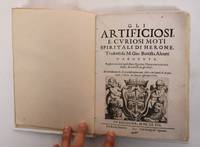
1647179140Bologna: Per Carlo Zenero 1647. Hardcover. VG overall wear and staining to the temporary white boards text/illustrations/diagrams are very clean and clear with light age toning as expected with age. Has been temporarily rebound by an astute amateur most would likely prefer this to be rebound by a more seasoned hand. Bound in simple white boards utility binding only bw illustrated title page 8 103 8 pages bw illustrations and diagrams throughout. Text in Italian. " Aggiontoui dal medesimo Quattro theoremi non men belli. Et il modo con che si fà artificiosamente salir vn canale d'acqua viua ò morta in cima d'ogn'alta torre." - title page translated: Added by the same Quattro theoremi non less belli. And the way in which it is artificially made to rise in a channel of water is dead on top of every high tower. The "Quattro theoremi" p. 87-103--has special title page. Per Carlo Zenero hardcover
0366658565.Ghardcover. Good. Access codes and supplements are not guaranteed with used items. May be an ex-library book. hardcover
0259390127.Gpaperback. Good. Access codes and supplements are not guaranteed with used items. May be an ex-library book. paperback
0484603647.Ghardcover. Good. Access codes and supplements are not guaranteed with used items. May be an ex-library book. hardcover
2020BIBSD0132900642020. Full Leather Bound. NEW. Size: 14.60 x 22.86 cms A Unique Premium Leather-Bound book for elite readers/collectors of old rare books. An Original Leather is being used for binding this book with Golden Leaf Printing and designing on Spine front and Back of the book with edge gilding. WE HAVE MULTIPLE OPTIONS IN COLOR OF LEATHER RED GREEN BLUE MAGENTA TAN PURPLE DEEP BROWN BLACK AND WITH DIFFERENT COLOR LABELS. YOU MAY CHOOSE ANY COLOR OF YOUR CHOICE AND MAIL US. This service is chargeable. Original edition was published in 1912 and this unique edition is Reprinted in 2020 with the help of original edition. Black & white printing on high quality natural shade paper with sewing binding for longer life professionally processed without changing its contents. As these are old books we processed each page manually on computer and make them readable. We give our best to give you the best book but in some cases we have to adjust few pages which are blur or missing or black spots. We hope that you understand these issues in these old treasure. This is an important book for the readers who want to know more about our old treasure. Our dedicated team is trying to bring these rare books back to the shelves. We are also giving service of printing the hard-to-find books which are not listed in our store. Hope you will like it and give your comments and suggestions. Lang: - Latin Vol: - Volume 4 Pages 484. Product Disclaimer: Please be aware that because leather is a natural material slight discoloration or change in texture may be visible. FOLIO EDITION Size 12x19 Inches IS ALSO AVAILABLE ON REQUEST. hardcover
197631291B. G. Teubner. 1976. Hardcover. Very Good in No Dust Jacket dust jacket. Light Foxing. Scholar's bookplate to inner cover G. P. Goold.; Xliv 416 pp; Bibliotheca Scriptorum Graecorum Et Romanorum Teubneriana TEUBNER; 2; 416 pages . 3519014149 . B. G. Teubner hardcover
197631294B. G. Teubner. 1976. Hardcover. Very Good in No Dust Jacket dust jacket. Light Foxing. Scholar's bookplate to inner cover G. P. Goold. Very faint rubbing to front board.; Cxxvi 275 pp; Bibliotheca Scriptorum Graecorum Et Romanorum Teubneriana TEUBNER; 5; 275 pages . 3519014173 . B. G. Teubner hardcover
197631292B. G. Teubner. 1976. Hardcover. Very Good in No Dust Jacket dust jacket. Light Foxing. Scholar's bookplate to inner cover G. P. Goold.; Xxi 366 pp; Bibliotheca Scriptorum Graecorum Et Romanorum Teubneriana TEUBNER; 3; 366 pages . 3519014157 . B. G. Teubner hardcover
197631293B. G. Teubner. 1976. Hardcover. Very Good in No Dust Jacket dust jacket. Light Foxing. Scholar's bookplate to inner cover G. P. Goold.; Xxix 450 pp; Bibliotheca Scriptorum Graecorum Et Romanorum Teubneriana TEUBNER; 4; 450 pages . 3519014165 . B. G. Teubner hardcover
1390772918.Gpaperback. Good. Access codes and supplements are not guaranteed with used items. May be an ex-library book. paperback
1391401964.Ghardcover. Good. Access codes and supplements are not guaranteed with used items. May be an ex-library book. hardcover
B9781015656598Hardback. New. hardcover