Freitag, Klaus / Michels, Christoph (Hg.)Antiquariat.de

1 898 résultats
2014226022Köln: Böhlau 2014. 256 S., 5 s/w-Abb., Lit.verz. 8° Kart. *neuwertig*.
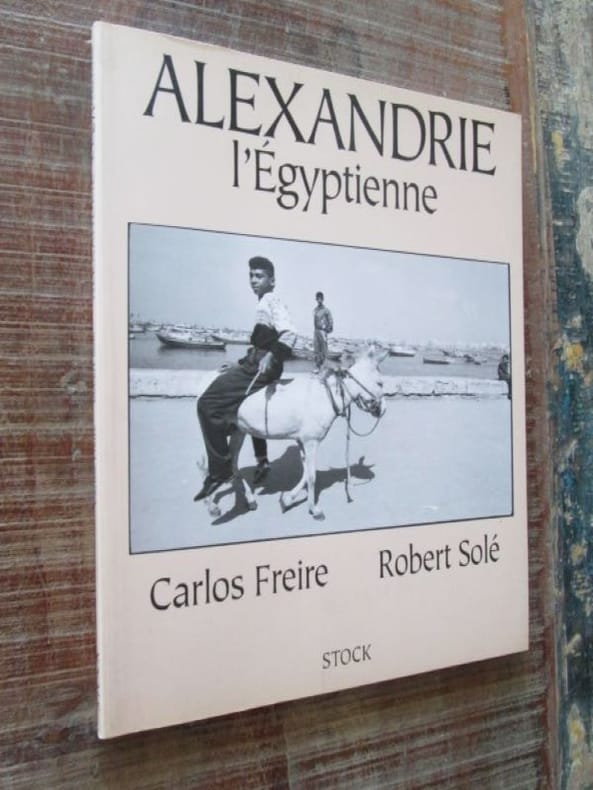
199831256Stock, 1998. In-4 broché (27,5 x 21,3 cm), 95 pages, illustré de photographies de Carlos Freire.- 520g.- Excellent état.
19722133780Oxford: Clarendon Press 1972. XIII, (1), 1116 Seiten. Gr. 8° (24,5 x 17 cm). Orig.-Leinenband mit goldgeprägtem Rückentitel und Orig.-Schutzumschlag. [Hardcover / fest gebunden].
200417720München: Wilhelm Goldmann Verlag, 2004. 542 Seiten , 21 cm kart.,
158pp., in-4, [onuitgegeven thesis ter verkrijging van de graad van licentiaat in de geschiedenis, Katholieke Universiteit Leuven 1996, promotor: Prof.Dr. L.Mooren]
1873AB10-924Wien, K. u. k. Hof- u. Staatsdruckerei, 1873. Halbleinenband der Zeit, gr.-8?, IV, 264 Seiten; exemplar gestempelt, Einband mit Signaturetikett
br. Il 6 novembre 2018, Alexandria Ocasio-Cortez viene eletta alla House of Representatives per il 14° Distretto di New York. È la più giovane donna mai eletta al Congresso degli Stati Uniti. Solo qualche mese prima ha sbaragliato alle primarie democratiche Joe Crowley, uno dei più potenti politici americani. Questa è la storia di una ragazza del Bronx, costretta dalle sue vicende familiari a lavorare 18 ore al giorno come cameriera, che diventa nel giro di pochi mesi uno degli astri nascenti della politica d'oltreoceano. Il Time l'ha inserita nella lista delle 100 persone più influenti del 2019. Attraverso una meticolosa ricerca tra i suoi discorsi pubblici, i suoi tweet, i suoi interventi in Aula, le sue interviste e apparizioni televisive, Francesco Foti racconta con le parole di AOC - come è ormai ribattezzata - la storia, le campagne, le idee, lo stile e il linguaggio di una delle figure politiche più in vista del panorama statunitense e mondiale.
0364076747.Gpaperback. Good. Access codes and supplements are not guaranteed with used items. May be an ex-library book. paperback
Wraps browned. Minor dampstaining to top of textblock. ; Anchor Books; 243 pages
1921R113821Romae [Rome], Karolus de Luigi 1921 526 + [ii] pp., 24cm., text in Latin, bound in modern green cloth hardcover, gilt title on spine (bit sunfaded, small trace of removed label), small stamp, published in the series "Corpus Scriptorum Christianorum Orientalium", text is clean and bright, good condition, R113821
1926R91105Lovanii [Leuven], Marcellus Istas 1926 344 + [i] pp., 25cm., pages still uncut, original 1926-edition, in the series "Corpus Scriptorum Christianorum Orientalium. Scriptores Arabici. Versio" series tertia tomus XIX pars posterior, text in Latin, original softcover (bit used at edges), very good condition, R91105
344 + [i] pp., 25cm., pages still uncut, original 1926-edition, in the series "Corpus Scriptorum Christianorum Orientalium. Scriptores Arabici. Versio" series tertia tomus XIX pars posterior, text in Latin, original softcover (bit used at edges), very good condition, R91105
200052813ABMünchen, Frederking und Thaler, 2000. 26 cm. 201, [14] S., überw. Ill., graph. Darst., Kt. Pp., verg. Rü.-Tit., OU. Sehr guter Zust., sauber erhalten.
200048258München : Frederking und Thaler 2000. 201, [14] S. : überw. Ill., graph. Darst., Kt. ; 26 cm, mit Schutzumschlag Pp., gebundene Ausgabe, Hardcover/Pappeinband
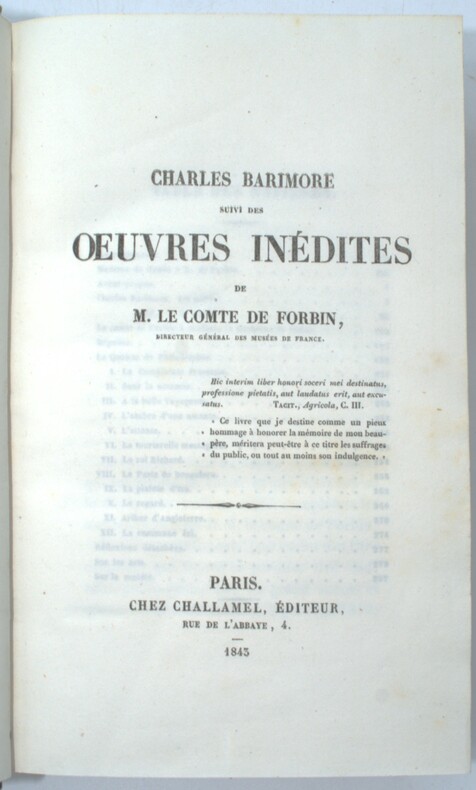
1819PHO-1484Paris, Challamel et Imprimerie Royale, Delaunay libraire,1843 et 1819, 1 vol.in 8*, 298pp. et 460 pp., une planche dépliante in fine, relié demi chagrin vert, dos à nerfs avec auteur et titre.
1819PHO-1795Paris, Imprimerie Royale, Delaunay libraire, 1819, 1 vol.in 8, 460 pp., une planche dépliante, relié demi chagrin, dos lisse orné avec titre, tranches jaunes, ex-libris manuscrit
20092-8498790239Editorial Trotta S.a. 2009. Perfect Paperback. New. Spanish language. 8.98x5.59x0.71 inches. Editorial Trotta, S.a. paperback
1975LC1156Acervo Cultural Editores Colección Valores en el tiempo 1975. Hardcover. Near Fine/No Jacket. Buenos Aires Acervo Cultural Editores Colección Valores en el tiempo 1975-1977. 145 x 205 cm 390 372 456 448 389 pp. Sin las sobrecubiertas. 5 tomos encuadernados en cuero con detalles en dorado. Únicamente el quinto tomo presenta roces leves en el dorado. Sin marcas de lectura. Pequeña rotura en la página 309 del tercer tomo. The Book Cellar & Henschel. <br/> <br/> Acervo Cultural Editores, Colección Valores en el tiempo hardcover
ETRYHERN10722NEW. NEW. Enviamos a todo el mundo por USPS. UPS o DHL. 100% garantia en su compra. We ship worldwide. unknown
20162-8498796105Editorial Trotta S.a. 2016. Paperback. New. Spanish language. 8.98x5.75x0.94 inches. Editorial Trotta, S.a. paperback
20122-8498792428Editorial Trotta S.a. 2012. Paperback. New. Spanish language. 8.98x5.59x0.94 inches. Editorial Trotta, S.a. paperback
New English Paperback. Pbo. Roy. 8vo. (24 x 17 cm). In English and Turkish. 394 p., b/w ills. Contents: Ercoskun, Tülay / Prof. Dr. Musa ÇADIRCI'nin Özgeçmisi ve Yayinlari.; Özden, Nese - Bekir Koç / Prof. Dr. Musa ÇADIRCI ile Söylesi.; Arikan, Zeki / Halit Ziya'nin Izmir Günleri.; Aydin, H.Veli / History of Tobacco Cultivation in the Districts of Siroz and Demirhisar at the Tum of 18th Century.; Bingöl, Sedat / Kriminalistige Dair ilk Yayin Ya da (Antropometri) Mesâha-i Ebdân'a Dair Bir Risale.; Delilbasi, Melek / Ortaçagda Türkiye ve Bati Arasindaki Ticari iliskiler.; Demime, Ömer / Sermaye, Borç ve Alacak iliskileri Açisindan Ankara Esnaf ve Tüccari.; Demiryürek, Mehmet / The Spain Consulate in Smyrna (1786-1806).; Efe, Ayla / Tanzimat'in Misyon ve Vizyonu: Ülkenin Zenginlesmesi, Halkin Refah Seviyesinin Yükseltilmesi.; Gencer, Fatih / Sivas Valisi Resit Mehmet Pasa Döneminde Dogu Eyaletlerinde Merkezîlesme Çabalan (1833-1836).; Gülenç Igdi, Özlem / Ankara Vilayeti Umum Meclisi'nin 1869 Yili.; Kararlan.; Günes, Ihsan / Türk Kadinlarina seçme hakki verilsin mi verilmesin mi?; Haydaroglu, Ilknur / Hatay Fevkalade Albümü.; Hayta, Necdet / Dönemin Gazetelerine Göre 1865 Istanbul-Hocapasa Yangini (Harîk-i Kebîr).; Ilhan, Mehdi / Arthur Leon Horniker, "Ottoman-Turkish diplomatics. A guide to the literatüre," Balkan Studies 7, pp. 134-154, 1966.; Kara, Adem / Kibris Vakiflarinin Önemi ve Kapudan Cafer Pasa Vakfiyesi.; Karaer, Nihat / Mehmet Said Halet Efendi'nin Paris Büyükelçiligi Döneminde (1803-1806) Osmanli-Fransiz Diplomasi iliskileri.; Karsandik, Özlem / Tanzimat Dönemi Osmanli Vilayet Bütçelerinde Gelir Kalemleri: Adana Örnegi.; Keles, Erdogan / Kirim Savasi (1853-1856) ve 1854 Osmanli-Sardunya Ticaret Antlasmasi.; Kiliç, Musa / 1821 Rum Isyani Sonrasinda Fenerlilerin Bürokraside Yeniden istihdamlarinda iki Öncü isim: Istefanaki Vogorides ve Nikolas Aristarki.; Kiliç, Selda / Tunuslu Hayreddin Pasa'nin Islahat'a Dair Görüsleri Ile Ilgili Bir Belge.; Kurt, Yilmaz / Van Eyaletinde Vakif ve Mülk Sahipleri.; Oguz, Mustafa / Midhat Pasa'nin 1877-1878 Osmanli-Rus Harbi Öncesi Balkanlardaki Isyan, Istanbul Konferansi ve Sonuçlari Hakkinda II. Abdülhamid'e Sundugu Rapor.; Öztürk, Mustafa / Osmanli Devlet Anlayisinda "Mahrusa" ve "Mahmiye" Terimlerinin Mana ve Mefhumu.; Seyitdanlioglu, Mehmet / Tanzimat Dönemi'nde Meclis-i Âlî-i Umûmî (1839-1876).; Sönmez, Ali / Türkçe Yayinlanan Ilk Arkeolojik Gezi Rehberi Rehber-i Harâbe-i Bergama Nüsha-i Türkiye.; Sirin, Ibrahim / Seyahatnamelerin Sosyo- Ekonomik, Kültür ve Düsünce Tarihi Yaziminda Yeri ve Önemi.; Yildirim, Mehmet Ali / Tanzimat Döneminde Dârülmuallimîn Mezunlarinin Rüsdiyelere Tayini.
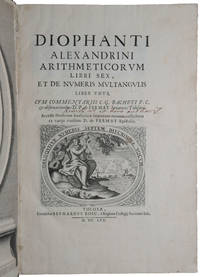
16706238Toulouse: Bernard Bosc 1670. First edition. <p>First edition large-paper issue with the rare engraved portrait of Pierre de Fermat by François Poilly - rare in this edition - and with the editor's presentation inscription on the title page: de Molieres ex dono authoris placing this copy with Louis de Molières Pierre de Fermat's brother-in-law and trésorier de France at Montauban in the year of publication. Prepared by Clément-Samuel de Fermat from his father's marginalia on Bachet's Diophantus the volume prints Fermat's forty-eight number-theoretic observations among them at page 61 the editio princeps of Fermat's Last Theorem - the marginal claim that no power above the second decomposes into two like powers and that a marvellous proof exists which the margin cannot contain. The theorem held for three hundred and fifty-eight years generating algebraic number theory the arithmetic of elliptic curves and modular forms in the course of the search for its proof until Wiles closed it in 1995. A contemporary hand has attempted corrections to Fermat's observation on cube differences at page 135.</p>. Box: 378 x 264 x45 mm. The First Printing of Fermat's Last Theorem. <p>First edition large-paper issue with the engraved portrait of Pierre de Fermat by François Poilly on the leaf facing the title - rarely found in copies of this edition - and with the editor's presentation inscription on the title page. The portrait a fine oval bust set above Fermat's family arms on a chevron three eagles and in base a crescent for the Fermats of Bas-Quercy is the work of one of the leading Parisian printmakers of the second half of the seventeenth century; most copies of the 1670 Diophantus lack it and its presence here together with the generous margins of the large-paper sheets and the inscription immediately below marks the volume as one of the small number of copies Clément-Samuel reserved for the inner circle of the Fermat family and their Toulouse connections. Beneath the printed line naming Pierre de Fermat as Senatoris Tolosani a period hand has added six Latin words: de Molieres ex dono authoris - "to de Molières from the gift of the author." The recipient is Louis de Molières 1610-1687 born at Cahors into the noblesse de robe of Bas-Quercy and established as trésorier de France at the Montauban bureau des finances a post he would hold for forty-two years. His first marriage in 1646 had been to Louise de Fermat c. 1613-c. 1650 Pierre de Fermat's younger sister. Louise had been dead twenty years by the time this copy left the press; Louis had long since remarried a demoiselle de Marqueyret; but the connection between the two robe families of the lower Garonne ran too deep for that to matter. The author named in the inscription is not Pierre - who had died in January 1665 - but Pierre's eldest son Clément-Samuel de Fermat c. 1632-1697 the lawyer and conseiller au parlement who had inherited his father's offices had spent the five years since his father's death transcribing the elder Fermat's mathematical marginalia into publishable form and who oversaw the volume through the Toulouse press of Bernard Bosc in 1670. By sending a large-paper copy to his late aunt's widower - the senior surviving link to his father's family in the generation above his own - Clément-Samuel placed his father's posthumous monument where it most properly belonged.</p> <br /> <br /> <p>The volume is the second edition of Bachet de Méziriac's 1621 Greek-and-Latin Arithmetica of Diophantus of Alexandria expanded by Clément-Samuel with his father's forty-eight mathematical observations and completed by the Doctrinae analyticae inventum novum of the Jesuit Jacques de Billy - a summary account of Fermat's analytical method drawn from the correspondence Billy had maintained with Fermat in the last years. The Arithmetica itself is the foundational work of Greek algebra and of Diophantine analysis setting out 189 problems in indeterminate analysis that had occupied mathematicians from Regiomontanus and Bombelli through Viète and Bachet. Fermat had annotated his personal copy of the 1621 Bachet edition - the copy he acquired in 1636 or 1637 probably through the circle of Carcavi and Mersenne - with marginal notes responding to individual Diophantine problems and in many cases generalising them into new theorems. That original annotated copy is lost. Its contents survive because Clément-Samuel working from his father's papers and almost certainly with the copy itself in hand transcribed the forty-eight observations and printed each at the appropriate point in the Diophantine text. The result is a conflation of the Bachet edition with Fermat's marginalia: Greek and Latin in parallel columns for the Diophantus with Bachet's commentary and Fermat's observation intervening at the relevant problems.</p> <br /> <br /> <p>At its centre - literally and historically - stands the single most consequential marginal note in mathematics. On page 61 of this volume as a commentary on Diophantus Book II Problem VIII the problem of dividing a given square into two smaller squares sits Fermat's observation in nine lines of italic Latin. Against the proposition that every square decomposes into two squares - the problem whose rational solutions are the Pythagorean triples - Fermat remarks that no cube decomposes into two cubes no fourth power into two fourth powers and in general no power higher than the second can be decomposed into two powers of the same kind. He has discovered he adds a truly marvellous proof of this proposition; the narrowness of the margin cannot contain it. This is Fermat's Last Theorem. It is printed here for the first time. The original 1621 Bachet that Fermat annotated no longer exists so the 1670 printing is the sole testimony to how Fermat actually wrote the proposition and the sole source for the evocative remark about the margin.</p> <br /> <br /> <p>The theorem held. For three hundred and fifty-eight years Fermat's claim resisted verification. Leonhard Euler produced the proof for exponent three in 1770 invoking the method of infinite descent that Fermat had set out in other contexts. Sophie Germain in the first decade of the nineteenth century opened a substantial class of exponents - the class of primes now called Sophie Germain primes. Dirichlet and Legendre settled exponent five in 1825. Gabriel Lamé reached exponent seven in 1839 and briefly claimed the full theorem a claim Liouville corrected within weeks by pointing to a failure of unique factorisation in the relevant cyclotomic integers. Ernst Kummer in 1847 working precisely on that failure introduced the ideal numbers that would become the foundation of algebraic number theory and proved Fermat's proposition for all regular primes. By the late nineteenth century Fermat's Last Theorem stood as a celebrated challenge and Paul Wolfskehl's 1908 bequest of a hundred-thousand-mark prize for a valid demonstration kept thousands of amateur attempts flowing to the University of Göttingen through the First World War and the Weimar collapse. The decisive modern move came in 1986 when Gerhard Frey suggested that any counterexample to the Fermat equation would produce a semistable elliptic curve whose properties must contradict the Taniyama-Shimura-Weil conjecture on modular forms. Kenneth Ribet proved the Frey implication the same year. Andrew Wiles working almost alone at Princeton announced a proof of the relevant portion of the modularity conjecture at Cambridge in June 1993; referee Nick Katz identified a subtle error; Wiles and Richard Taylor together closed the gap over fourteen further months; and the finished paper appeared in the Annals of Mathematics in May 1995. Fermat was right.</p> <br /> <br /> <p>The three and a half centuries between statement and proof generated a disproportionate share of modern number theory. Kummer's ideal numbers founded algebraic number theory. The theory of cyclotomic fields the arithmetic of elliptic curves and the whole modern apparatus of modular forms and Galois representations - together forming the present-day Langlands programme - all derive directly or by consanguinity from the long search for Fermat's proof. Wiles's demonstration runs past a hundred pages and invokes techniques Fermat could not have envisaged; the opinion of most specialists is that whatever proof Fermat believed he had was probably in error most likely a descent argument of the kind that works for exponents three and four but cannot be extended. Fermat himself in a 1659 letter to Carcavi set out his method of infinite descent in some detail and applied it to prove that the area of a rational right triangle can never be a square number - a proposition that by a short chain of reasoning implies his Last Theorem for exponent four. Whether that technique could be stretched to the general case is the question to which the answer three hundred and thirty-six years later was Wiles's hundred pages.</p> <br /> <br /> <p>Fermat's engagement with Diophantus ranged far beyond the single marginal note at page 61. Forty-seven further observations thread through the volume responding to Diophantine problems on rational squares Pythagorean right triangles the representation of integers as sums of squares and the arithmetic of cubes. Several of these observations announce theorems of comparable depth. The two-square theorem - that every prime congruent to one modulo four is the sum of two squares in essentially one way - sits among them as do the germ of the four-square theorem later proved by Lagrange the statement that every number is the sum of three triangular numbers and the generalised Fermat equation x2 − Ay2 = 1 the Pell equation which Fermat correctly recognised as always solvable in integers for non-square A. The observation at page 135 - headed OBSERVATIO D.P.F. and placed after Diophantus Book IV Question III - displays Fermat's characteristic fusion of correction and extension. Bachet had offered a partial treatment of the problem of finding two cubes whose difference equals a given number; Fermat shows that Bachet missed an entire further family of solutions which follow from his own method by continued iteration in infinitely many cases. Given the two cubes 8 and 1 whose difference is 7 Fermat produces a second pair of rational cubes with the same difference. His printed solution gives the sides 1265/183 and 1256/183 yielding the cubes 2024284625/6128487 and 1981385216/6128487. The verification is clean: the difference of these two new cubes reduces exactly to 7.</p> <br /> <br /> <p>Across the printed denominators on this page however a contemporary hand has drawn firm lines and written substitutions above the print: 61 in place of 183 for the sides and 226981 in place of 6128487 for the cubes. The substitution is not arbitrary - 183 is three times 61 and 6128487 is twenty-seven times 226981 which is itself 61 cubed. The annotator has evidently noticed that Fermat's fractions appear to contain a common factor of the cube of three and has tried to simplify them by cancelling it. But the correction does not preserve the answer. The revised sides 1265/61 and 1256/61 are each three times larger than their printed counterparts; the revised cubes are each twenty-seven times larger; and the difference of the revised cubes becomes 189 rather than 7. The substitution would solve a scaled version of Fermat's problem - one in which the given cubes were 216 and 27 rather than 8 and 1 - but it does not solve the problem as Fermat poses it on this page. The correction is the work of a contemporary reader who followed Fermat's argument closely enough to recognise the internal structure of the solution and who carried enough confidence to intervene in a freshly printed Toulouse folio but who stopped short of the final verification that would have caught the scaling error. That degree of engagement is itself worth marking. Fermat's observation on Book IV Question III was considered obscure even among the professional mathematicians of the period; the appearance of contemporary manuscript attention to its numerical detail in a copy that left the editor's hands in 1670 places this volume inside the very narrow circle of readers who took Fermat's more technical observations seriously from the moment of publication.</p> <br /> <br /> <p>Two further inserted slips of paper at pages 61 and 197 carry contemporary but more elementary annotations placing this copy plainly in the hands of a seventeenth-century reader working through the mathematics of the volume rather than merely its production. The slip at page 197 - facing the large printed table of eighty-one integer solutions to a Diophantine problem in four variables from Book V - carries calculations in a reader's hand involving the quantities eight hundred and ten thousand a cubic variable and a squared variable in a working attempt at the problem treated above. A later eighteenth-century English hand has added a note on the flyleaf framed as a dismissive verdict on Fermat's mathematical claims. A discreet twentieth-century dealer's mark on page 9 identifies the code of Lucien Scheler 1902-1999 the Parisian antiquarian bookseller and poet whose handling of the book places its modern provenance within a narrow compass of known trade hands.</p> <br /> <br /> <p>The recipient of the 1670 inscription belongs to a world of parliamentary offices and extended family connection that the inscription itself records in six Latin words. Louis de Molières born at Cahors in 1610 served forty-two years as trésorier de France at the Montauban bureau des finances one of the senior royal financial posts in lower Languedoc. His first marriage in 1646 was to Louise de Fermat daughter of Dominique de Fermat - the consul and leather merchant of Beaumont-de-Lomagne - and therefore sister of Pierre and paternal aunt of Clément-Samuel. Louise died in the late 1640s. Louis remarried a demoiselle de Marqueyret and continued as head of one of the prominent parliamentary families of Bas-Quercy until his death in 1687. His son by the second marriage Armand de Molières later served as second président of the Cour des aides at Montauban - the Armand whose name has occasionally been conflated with his father's in later bibliographic sources producing the hybrid 'Louis-Armand' that appears in some modern descriptions. The present inscription is addressed to Louis senior Pierre's brother-in-law and Clément-Samuel's uncle by marriage a man whose household at Montauban sat fifty kilometres north of Pierre's at Toulouse and who by 1670 was the senior family member in the generation linking back to Pierre's parents at Beaumont.</p> <br /> <br /> <p>Pierre de Fermat's reputation does not rest on the Last Theorem alone. A conseiller at the parlement of Toulouse and a magistrate of the Chambre de l'Édit at Castres he was an amateur mathematician in the technical sense only - an amateur who corresponded with Mersenne Pascal Descartes Huygens Wallis Carcavi and Roberval on terms of complete intellectual equality and who made fundamental discoveries in four distinct branches of mathematics. In number theory beyond the Last Theorem he discovered the theorem now called Fermat's Little that for any prime p and integer a not divisible by p the quantity a raised to the power p minus one is congruent to one modulo p stated and used the two-square theorem developed the method of infinite descent as a rigorous technique for negative existence proofs and extended the theory of amicable numbers well beyond the pair 220 and 284 known since antiquity. In analytic geometry his Ad locos planos et solidos isagoge - which he sent in manuscript to Carcavi and Mersenne in 1636 - predated Descartes's Géométrie in composition though not in print. In the calculus of variations his method of adequality supplied a systematic technique for locating maxima minima and tangents that Newton and Leibniz both later acknowledged as precursor. In the summer of 1654 in the correspondence with Pascal that Carcavi preserved he worked out with Pascal the foundations of the mathematical theory of probability solving the problem of the division of stakes in interrupted games of chance. In optics he enunciated the principle of least time - Fermat's principle - which furnished the first variational formulation in physics and served as direct ancestor to the principle of least action and the whole edifice of Lagrangian and Hamiltonian mechanics. Any one of these contributions would secure a reputation; that a sitting magistrate of the Toulouse parlement pursuing mathematics in stolen evening hours made all four is the condition Clément-Samuel set himself to commemorate in this volume.</p> <br /> <br /> <p>Of those four strands the 1670 Diophantus captures chiefly the number-theoretic Fermat and within that only the portion he wrote as marginalia on Bachet. His analytic geometry and his general method of maxima et minima appeared in 1679 as Varia Opera Mathematica again at Toulouse edited again by Clément-Samuel. His complete correspondence and further manuscripts were assembled definitively only in the late nineteenth century by Paul Tannery and Charles Henry whose four-volume Œuvres de Fermat 1891-1912 with a supplementary fifth volume by Cornelis de Waard in 1922 remains the standard scholarly edition. But the 1670 edition is the book in which Fermat's Last Theorem first entered print the book through which Fermat's name reached the working mathematicians of the late seventeenth and eighteenth centuries and the book Euler and Gauss both studied and built on. Its place in the foundational history of number theory is not in dispute. What is less often remarked - and what this particular copy preserves - is the presence in 1670 of readers who took Fermat's more technical observations seriously enough to attempt corrections in the margins even when as at page 135 those corrections did not finally succeed.</p> <br /> <br /> <p>References: Honeyman 885 - Norman 771 - Smith Rara Arithmetica pp. 348-349 - Brunet II 702 - Roberts & Trent Bibliotheca Mechanica p. 108 - Hoffmann 1242 - Weil Number Theory: An Approach through History from Hammurapi to Legendre Birkhäuser 1984 chapters II-IV - Mahoney The Mathematical Career of Pierre de Fermat Princeton University Press second edition 1994 - Goldstein Un théorème de Fermat et ses lecteurs Presses Universitaires de Vincennes 1995 - Singh Fermat's Enigma Fourth Estate 1997 - Wiles 'Modular elliptic curves and Fermat's Last Theorem' Annals of Mathematics 141 1995 pp. 443-551 - Taylor and Wiles 'Ring theoretic properties of certain Hecke algebras' Annals of Mathematics 141 1995 pp. 553-572.</p> <br /> <br/> <br/> <br /> <p>Folio 365 × 246 mm pp. xii 341; 48. Engraved portrait of Pierre de Fermat by François Poilly on the leaf facing the title Fermat in scholarly dress within an oval frame his arms below on the plinth - rarely found in copies of this edition. Engraved allegorical vignette on the title page Orpheus with the lyre encircled by the Virgilian motto obloquitur numeris septem discrimina vocum. Numerous woodcut diagrams in the text. Greek and Latin in parallel columns throughout the Diophantus. Separate pagination for the Inventum novum. Light browning. Contemporary calf gilt fillet on covers spine richly gilt in compartments with gilt-tooled lettering DIOPHANTI / FERMAT edges speckled red binding slightly rubbed. A fine copy.</p> . Bernard Bosc unknown
1627205608.Ghardcover. Good. Access codes and supplements are not guaranteed with used items. May be an ex-library book. hardcover
19981329186Genève: Librairie Droz 1998. Softcover. Octavo; VG-; Paperback; Spine cream with black print; Cover has slight edgewear stray mark across front; Text block has name in ink on front flyleaf else clean and tight; Text in French; xviii 459 pages. 1329186. FP New Rockville Stock. Librairie Droz unknown books