DIOPHANTUS, of AlexandriaBiblio.com
1 898 résultats
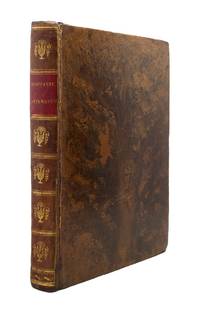
1670105031670. Cum Commentariis C.G. Bacheti…& observationibus D.P. de Fermat…Accessit Doctrinae Analyticae inventum novum collectum ex variis eiusdem D. de Fermat Epistolis. Large engraved vignette on title several finely engraved headpieces & initials & a few woodcut diagrams in the text. 6 p.l. 64 341 48 pp. one leaf of errata. Folio cont. speckled calf carefully rebacked with the orig. spine laid-down light browning as usual two corners discretely repaired spine richly gilt. Toulouse: B. Bosc 1670.<br/> <br/> First edition and a very fine and fresh copy. This edition is the first to contain Fermat’s observations on the Arithmetica of Diophantus the first systematic treatise on algebra; it also contains on H3r the first statement of the celebrated “Last Theorem†which Fermat originally wrote by hand in the margins of his copy of Bachet’s edition of Diophantus 1620. This theorem is the most famous problem in mathematics and remained unsolved for over 325 years until its recent solution by Andrew Wiles. But it should be remembered that Wiles was able to resort to sophisticated 20th-century techniques not available to Fermat. The exact form of Fermat’s proof if indeed he had a genuine one thus remains one of the great unsolved puzzles of mathematics. <br/> <br/> The 1670 edition was published posthumously by Fermat’s son Clement Samuel. It is based on his father’s annotated copy of the Bachet edition of 1621 and contains a major part of Fermat’s work on number theory a branch of mathematics that he virtually created. <br/> <br/> A nice copy with the extremely rare errata leaf. <br/> <br/> ⧠Smith Rara Arithmetica p. 348. unknown
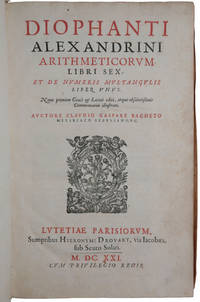
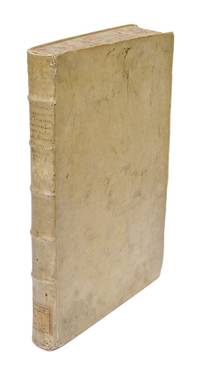
16216237Paris: Hieronymus Drouart 1621. First edition. <p>First edition of the Greek text extremely rare large-paper copy of the foundational work of algebra - the edition that Pierre de Fermat acquired in the mid-1630s and annotated with the forty-eight marginal observations that are the founding documents of modern number theory. Fermat's copy is lost; these are the sheets from the same Paris setting that he had in front of him. Claude Gaspard Bachet de Méziriac a country gentleman of Bas-Quercy whose entry into number theory had come through his 1612 Problèmes plaisants spent several years establishing a corrected Greek text improving Xylander's 1575 Latin translation filling the lacunae correcting errors and generalising Diophantus's procedures; his edition remained standard until Tannery's Teubner text of 1893-1895. Against Problem II.8 at page 85 - on the decomposition of a square into two squares - Fermat wrote the proposition now known as Fermat's Last Theorem closed by Andrew Wiles in 1995 three hundred and fifty-eight years after the margin.</p>. Editio Princeps of the First Systematic Treatise on Algebra. <p>First edition of the Greek text extremely rare large-paper copy of the foundational work of algebra and the book in whose margins Pierre de Fermat wrote the most celebrated annotations in the history of mathematics. Before this volume appeared from the Paris press of Hieronymus Drouart in 1621 the Arithmetica of Diophantus of Alexandria existed in print only in Latin: in Wilhelm Holzmann's pioneering but rough 1575 Basel translation - its translator who hellenized his name as Xylander was a humanist who had taken up algebra as a hobby - and in the partial adaptations Rafael Bombelli had incorporated into his 1572 Algebra after reading a Greek manuscript in the Vatican Library. Claude Gaspard Bachet de Méziriac a country gentleman of Bas-Quercy extraction with classical tastes and no professional mathematical training had come to number theory through mathematical recreations - the puzzles of the Greek Anthology and the Renaissance tradition of mathematical amusement that he had collected in his Problèmes plaisants et délectables qui se font par les nombres Lyon 1612 - and from there to Diophantus. He spent several years before 1621 establishing a corrected Greek text improving Xylander's Latin translation where Xylander had failed to understand his source filling the lacunae of the defective archetype from which all surviving manuscripts descend identifying and correcting numerical errors generalising Diophantus's procedures and appending three books of his own Porismata. The result is both the editio princeps of the Greek text and the standard scholarly edition unsurpassed until Paul Tannery's Teubner Diophantus of 1893-1895 and the single most consequential textual achievement in the early-modern reception of Greek mathematics.</p> <br /> <br /> <p>The copy offered here preserves the edition in its most ambitious form. Ordinary copies of the 1621 Bachet measure approximately 337 by 218 millimetres; this copy measures 353 by 225 placing it squarely within the small large-paper issue that Drouart ran alongside the ordinary impression. It is bound in its original yapped vellum the overhanging edges still intact and flexible; the edges of the text block are sprinkled red in the French manner of the early seventeenth century; the spine carries a handwritten manuscript title in Greek and Latin - Diophanti Alexandreos Arithmetikon kai peri polygonon arithmon bibl. followed by cum Commentariis Cl. Gasp. Bacheti - in a plainly contemporary hand the vellum itself serving as the label. The sheets are fresh crisp and unpressed. The title page printed in red and black carries a fine engraved vignette of a flowering thistle within an oval frame a cherub at either side of the cartouche and two satyrs at the base among fruits and foliage surrounded by the dividing mottoes si frote patere aut and ne tan abstine. Two imprints of the 1621 edition were issued simultaneously one under the name of Hieronymus Drouart sub Scuto Solari and one under the name of Sébastien Cramoisy identical in every other respect; the sheets are from the same setting and no priority between the two has been established. The present copy is the Drouart imprint.</p> <br /> <br /> <p>The Arithmetica itself is the foundational work of Greek algebra. Of the thirteen books that Diophantus's introduction - addressed to one Dionysius arguably Saint Dionysius of Alexandria - promises the Byzantine tradition preserved six in Greek and those are the books printed here. A ninth-century Arabic translation by QustÄ ibn LÅ«qÄ supplying four further books was discovered by Jacques Sesiano in the Astan-i Quds library at Meshed Iran in 1968 - one of the great manuscript finds of the twentieth century. The consensus that has emerged from Sesiano's edition is that the Arabic books correspond to Diophantus's original Books IV through VII and that the six preserved Greek books must be renumbered as Books I through III and after a lacuna Books VIII through X; Books XI through XIII are irretrievably lost. What Bachet had before him in 1621 and what Fermat in his turn would read and annotate was therefore the Byzantine six-book corpus: 189 problems in indeterminate analysis closing with a fragment on the theory of polygonal numbers cast in the older geometrical idiom.</p> <br /> <br /> <p>The introduction explains Diophantus's symbolism which is the first and only occurrence of algebraic notation anywhere in surviving Greek mathematics. He uses abbreviated signs for the unknown quantity corresponding to the modern x and for its powers up to the sixth for subtraction and for equality. The symbols are scribal abbreviations rather than arbitrary conventions but they function as an effective algebraic language intermediate between the purely verbal mathematics of his Greek predecessors and the fully symbolic algebra that would emerge in the sixteenth century with Viète and in the seventeenth with Descartes. Diophantus teaches the multiplication of positive and negative terms and the reduction of an equation to one with only positive terms - the standard form preferred in antiquity which treats negative coefficients as impermissible answers to be moved across the equals sign rather than as legitimate quantities in their own right. Throughout the work he uses the word arithmos rendered by Bachet as numerus to mean what would now be called a positive rational; negative and irrational solutions are never acknowledged.</p> <br /> <br /> <p>The Arithmetica is a collection of approximately two hundred and sixty problems in what is now called indeterminate analysis - the search for rational solutions to polynomial equations that have more unknowns than equations and that therefore admit in general infinitely many solutions to be found by ingenuity rather than algorithm. The problems of Book I are mostly simple illustrations of the algebraic reckoning that Diophantus has just established. The distinctive features of his method emerge in Books II and III which became the seedbed of modern number theory. In three problems of Book II - the first of them the celebrated Problem II.8 on dividing a given square into two squares whose rational solutions are the Pythagorean triples - Diophantus shows how to represent any given square as a sum of two rational squares; any given non-square that is itself the sum of two known squares as a sum of two other squares; and any given rational number as the difference of two squares. The second of these problems presupposes knowledge of one decomposition hinting that not every integer admits such a decomposition - a question Diophantus later addresses by giving the correct necessary condition: the number must not contain a prime factor of the form 4n 3 raised to an odd power. Diophantus states this condition without proof. It was taken up by Fermat proved by Euler and generalised by Gauss into the representation theory that occupies more than half of the Disquisitiones Arithmeticae.</p> <br /> <br /> <p>The Arabic books although not available to Bachet confirm the architecture of Diophantus's project as Bachet had intuited it. Their prefaces state that their purpose is to provide the reader with experience and skill and they extend the basic methods of Books I through III to problems of higher degree reducible to binomial equations. The former Greek Books IV and V now Books VIII and IX solve more demanding problems: one decomposes a given integer into two squares arbitrarily close to each other; another decomposes an integer into three squares excluding the impossible case of integers of the form 8n 7 - a result Diophantus asserts but does not prove and that would not be proved until the eighteenth century. The former Book VI now Book X treats right-angled triangles with rational sides subject to various further conditions. The work closes with a fragment of a separate treatise on polygonal numbers - those that can be arranged as regular polygons of dots: triangular numbers nn 1/2 the squares the pentagonals n3n − 1/2 and so on - differentiated from the Arithmetica proper by its use of geometrical proofs rather than algebraic methods and breaking off in the middle of an investigation of how many ways a given integer can be a polygonal number.</p> <br /> <br /> <p>The textual transmission of the Arithmetica is itself a chapter in the history of the book. In Byzantium where the Greek archetype was preserved Michael Psellus in the eleventh century saw what was perhaps the only surviving copy; Georgius Pachymeres 1240-1310 wrote a paraphrase of Book I; Maximus Planudes c. 1255-1310 wrote a commentary on Books I and II. Cardinal Bessarion rescued the manuscript from Constantinople before its fall in 1453 and Regiomontanus discovered it at Venice about 1463 proposing to make a Latin translation that he never produced. For a century thereafter nothing further was heard of Diophantus. He was rediscovered by Rafael Bombelli 1526-1572 the engineer from Bologna whose day job was draining the Chiana marshes and who read a Greek manuscript of the Arithmetica in the Vatican Library about 1570 translated most of it into Italian for his own use and incorporated one hundred and forty-seven of its problems eighty-one with the same numerical values into his Algebra of 1572 - the book that introduced complex numbers into European mathematics and that Bombelli substantially revised before publication as a consequence of his encounter with Diophantus. Three years later the first complete Latin translation by Wilhelm Xylander appeared at Basel; it was the basis for a free French rendering of the first four books by Simon Stevin 1585. Viète drew thirty-four problems from Diophantus for his Zetetica of 1593 restricting himself to those that did not violate his principle of homogeneity of dimension.</p> <br /> <br /> <p>Bachet's 1621 edition superseded every one of these earlier engagements. He studied the text with a thoroughness that no mere philologist could have equalled: Xylander had all too often failed to make sense of corrupt passages where Bachet succeeded because Bachet could read the mathematics as well as the Greek. He filled lacunae identified and corrected the numerical errors that earlier scribes and Xylander after them had introduced generalised the procedures and devised new problems continuing Diophantus's programme. His great critic and admirer André Weil whose Number Theory: An Approach through History from Hammurapi to Legendre Birkhäuser 1984 remains the standard scholarly account observed that Samuel Fermat's praise of Bachet in the preface to the 1670 reprint was by no means excessive and that Bachet's apparent disadvantage - his imperfect grasp of the new symbolic algebra of Viète - may actually have benefited number theory in the end. Because he could not readily translate Diophantus into the algebraic language then emerging Bachet laid emphasis on those aspects of the text that were most properly arithmetical and prominently among these on questions regarding the decomposition of integers into sums of squares. It was Bachet who asked for the conditions under which an integer is a sum of two or of three squares and who extracted from Diophantus the conjecture that every integer is a sum of four squares and asked for a proof. The questions passed directly to Fermat and through Fermat to Euler Lagrange and Gauss.</p> <br /> <br /> <p>Fermat acquired his copy of the Bachet Diophantus in the mid-1630s probably through the circle of Carcavi and Mersenne in Paris. Over the course of his long judicial career at Toulouse and Castres he annotated it with forty-eight marginal observations each written against a particular problem in Bachet's text that together constitute the founding documents of modern number theory. They include the two-square theorem which states that every prime congruent to one modulo four is the sum of two squares in essentially one way; the conjecture later proved by Lagrange that every integer is the sum of four squares; Fermat's Little Theorem that for any prime p and any integer a not divisible by p the quantity a raised to the power p − 1 is congruent to one modulo p; the method of infinite descent as a rigorous technique for negative existence proofs; and - written in the margin of Problem II.8 at page 85 of this edition adjacent to Diophantus's treatment of the decomposition of a square into two squares - the claim that no cube can be decomposed into two cubes no fourth power into two fourth powers and in general no power higher than the second into two powers of the same kind together with the famous remark that he had discovered a truly marvellous proof of this proposition which the narrowness of the margin could not contain. The proposition is Fermat's Last Theorem. It resisted proof for three hundred and fifty-eight years until Andrew Wiles closed it in a one-hundred-page paper in the Annals of Mathematics in 1995 using techniques - the theory of modular forms the arithmetic of semistable elliptic curves the Galois representations emerging from the Langlands programme - that Fermat could not have envisaged. Fermat's annotated copy the physical object on which he wrote those forty-eight notes has been lost for over three centuries; its contents survive because Clément-Samuel de Fermat working from his father's papers in the years after the elder Fermat's death in 1665 transcribed the observations and printed each at the appropriate point in Bachet's text in the 1670 Toulouse reprint the companion item in the present catalogue. Every surviving copy of the 1621 Bachet therefore bears in a material sense the weight of Fermat's missing copy: these are the sheets from the same setting of the same edition in the same Greek and Latin and with the same commentary against which Fermat was reading and writing.</p> <br /> <br /> <p>The decisive turn in the reception of Fermat's programme came a century after his death when Leonhard Euler produced the proof of the Last Theorem for exponent three in 1770 invoking the method of descent Fermat had developed for other purposes. Sophie Germain in the first decade of the nineteenth century opened a substantial class of exponents; Dirichlet and Legendre settled exponent five in 1825; Kummer's introduction of ideal numbers in the 1840s addressed to the failure of unique factorisation in the relevant cyclotomic integers founded algebraic number theory and proved Fermat's proposition for all regular primes. By the late nineteenth century the Last Theorem had become the most celebrated unsolved problem in mathematics and the whole of twentieth-century algebraic number theory and arithmetic geometry can be read as a cumulative response to the challenge Fermat set down in the margin of a page that is printed in this very edition. The two-square theorem the four-square theorem the little theorem and the sum of three triangular numbers all passed through similar cycles of Fermat's claim delayed demonstration and subsequent theoretical elaboration - and each of them like the Last Theorem itself began its public life as a marginal note in Fermat's copy of Bachet's 1621 Diophantus.</p> <br /> <br /> <p>The Arab reception of Diophantus although largely lost is documented by bibliographical sources that Bachet could not have known. Al-NadÄ«m's Fihrist of 987/988 records that QustÄ ibn LÅ«qÄ c. 900 wrote a commentary on three and a half books of the Arithmetica and that AbÅ«'l-WafÄ' 940-998 wrote both a commentary and a book of proofs of the propositions Diophantus had used; a commentary by Ibn al-Haytham with marginal notations by Ibn YÅ«nus is also attested but has not survived. The most substantial surviving witness to the Arab Diophantus is the algebra of al-KarajÄ« in early eleventh-century Baghdad which absorbed a third of the problems from Diophantus's Book I all the problems from Book II beginning with II.8 and almost all of Book III. In the Latin West problems of Diophantine type first appeared in Leonardo of Pisa's Liber Abbaci of 1202 transmitted from Arabic sources during Leonardo's journeys around the Mediterranean. The long chain from the lost Greek archetype through Byzantium Venice Rome Basel and Paris to the copies of Bachet's 1621 edition that passed into the working libraries of seventeenth-century mathematicians is reconstructed here in a single volume.</p> <br /> <br /> <p>Bachet himself having seen the Arithmetica through the press in 1621 retired to his country estate married and apparently gave up all mathematical activity beyond a second edition of his Problèmes plaisants that incorporated material originally intended for a treatise on arithmetic which he never wrote. He died in 1638 three years before his election to the Académie française and a generation before his work would reach its full consequence through Fermat's marginalia. Almost nothing is known about the life of Diophantus himself. He quotes Hypsicles fl. c. 150 BC and is quoted by Theon of Alexandria c. AD 364 and a date around AD 250 is generally accepted; that would place him in late Hellenistic Alexandria at the chronological edge of the tradition of Greek mathematical creativity that had begun with Thales. The Byzantine epigram that gives his age at death as eighty-four extrapolated from a series of Diophantine conditions on the years of his boyhood youth marriage and the birth and death of his son is textually reliable but biographically useless. What survives of him is the mathematics.</p> <br /> <br /> <p>The book's working life in the seventeenth and early eighteenth centuries can be measured by the hands through which it passed. Isaac Newton owned a copy Harrison 524 now at Trinity College Cambridge and referred to Diophantus in his mathematical notebooks. Leibniz studied the work. Euler began his revival of Fermat's number-theoretic programme in the 1730s by working through the Observationes in the 1670 reprint of precisely this edition. The continuous research that culminated in Gauss's Disquisitiones Arithmeticae of 1801 and from there in the whole nineteenth-century elaboration of algebraic and analytic number theory runs back through Euler and Lagrange to Fermat's marginalia and through Fermat's marginalia to Bachet's 1621 printing of the Greek text. Large-paper copies such as the one offered here were produced in small numbers - probably as presentation copies for Bachet's dedicatees and for purchase by serious mathematicians who wanted the generous margins for their own annotations. The sheets of this copy are unpressed and the state of preservation exceptional; the contemporary yapped vellum binding with its handwritten Greek and Latin spine title in a seventeenth-century hand is the same working binding in which the volume left the Paris trade in 1621.</p> <br /> <br /> <p>References: Honeyman 891 - Smith Rara Arithmetica pp. 348 and 368 - Brunet II 702 - Weil Number Theory: An Approach through History from Hammurapi to Legendre Birkhäuser 1984 chapters I-III - Heath Diophantus of Alexandria: A Study in the History of Greek Algebra Cambridge second edition 1910; Dover reprint 1964 - Sesiano Books IV to VII of Diophantus' Arithmetica in the Arabic Translation attributed to QustÄ ibn LÅ«qÄ Springer 1982 - Bashmakova Diophantus and Diophantine Equations Mathematical Association of America 1997 - Mahoney The Mathematical Career of Pierre de Fermat Princeton University Press second edition 1994 - Goldstein Un théorème de Fermat et ses lecteurs Presses Universitaires de Vincennes 1995 - Singh Fermat's Enigma Fourth Estate 1997 - Wiles 'Modular elliptic curves and Fermat's Last Theorem' Annals of Mathematics 141 1995 pp. 443-551.</p> <br /> <br/> <br/> <br /> <p>Folio 353 × 225 × 40 mm pp. 12 32 451 1 blank 58 2 errata. Title printed in red and black with large engraved allegorical vignette flowering thistle within oval cartouche cherubs above and satyrs below mottoes si frote patere aut and ne tan abstine. Greek and Latin in parallel columns throughout the Arithmetica. Woodcut historiated initials. Book headings in large capitals Greek capitals for the Greek heads. Separate signatures and pagination for Bachet's Porismatum libri tres pp. 1-32 and for the polygonal numbers fragment pp. 1-58 at the end followed by two leaves of errata. Contemporary yapped vellum the overhanging edges intact edges of the text block sprinkled red handwritten manuscript title on the spine in Greek and Latin in a period hand directly on the vellum. A fine crisp fresh unpressed copy with the full generous margins of the large-paper issue. The Drouart imprint; the Cramoisy imprint issued simultaneously from the same sheets differs only in the bookseller's name on the title page and no priority between the two has been established.</p> . Hieronymus Drouart unknown
167069414Toulouse: Bernard Bosc 1670. Full Description:<br> <br> DIOPHANTUS OF ALEXANDRIA. Diophanti Alexandrini Arithmeticorum libri sex et De numeris multangulis liber unus. Cum commentariis C.G. Bachet V.C. et observationibus D.P. de Fermata . accessit Doctrinae analyticae inventum novum Toulouse: Bernard Bosc 1670.<br> <br> First edition of Fermat's notes and second edition of Bachet's Diophantus. Quarto 13 x 8 1/4 inches; 330 x 215 mm. xii 64 341ie 343 1 blank 48 pp. Bound without the scarce errata at the end also not present in the Norman copy. Pages 55/56 bound after page 57/58 in the preliminaries. Two leaves are both numbered 335/336 but collation is correct and text is complete. Leaf fii is bound after fiii in the final section. Latin Xylander's translation and Greek text in parallel columns. Separate pagination for De Numeris multangulis. Allegorical engraved title vignette featuring Orpheus playing the lyre. Handsome engraved headpieces and historiated initials. Numerous woodcut illustrations and ornaments.<br> <br> Contemporary tree calf. Spine stamped and ruled in gilt. Red morocco spine label lettered in gilt. Board edges tooled in gilt. All edges marbled. Marbled endpapers. Outer hinge of front cover repaired. Some slight rubbing to boards. Leaves sporadically toned and slightly foxed. Some minor light pencil marginalia. Signature A trimmed about 3 mm short on bottom margin but does not look supplied. A small paper flaw tear to inner margin of leaves Aaiii-Cciv not much larger than a pencil point and not affecting text. Evidence of a removed bookplate on front pastedown. Overall a very attractive and tall copy.<br> <br> This publication contains the first edition of Fermat's number theorems edited partially from his letters after his death in 1665. "Fermat was the first European to make extensive contributions to the theory of numbers taking up the challenge in number theory posed in Diophantus' Arithmetica. Fermat owned a copy f the editio princeps of Diophantus's work 1621 edited by Bachet de Mériziac and published with Xylander's Latin translation. Fermat took issue with Bachet's statements writing his own results for the most part in the margins of his copy. Five years after Fermat's death his son Claude Samuel published a second edition of Bachet's Diophantus adding to it his father's marginal notes. The remainder of Fermat's notes contained a large number of theorems on the theory of numbers only one of which he proved himself; the rest were proven in the eighteenth century" Norman.<br> <br> Diophantus of Alexandria fl 250 AD was the first mathematician to introduce symbolism into Greek algebra. The French scholar Bachet de Méziriac first published his edition of the Arithmetica of Diophantus in 1621 and it was the chief source of the many books on mathematical recreations issued during the seventeenth century.<br> <br> Norman I; 777. Honeyman 893.<br> <br> HBS 69414.<br> <br> $35000. Bernard Bosc unknown
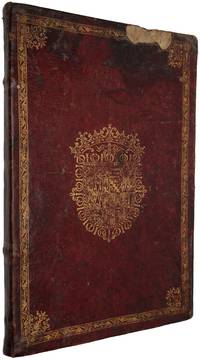
15756346Basel: Eusebius Episcopius & Heirs of Nikolaus Episcopius 1575. First edition. <p>First edition of Diophantus - the first printing of the Arithmetica in any language in any form - owned annotated and signed by Giovanni Camillo Gloriosi 1572-1643 Galileo's successor in the chair of mathematics at the University of Padua. Gloriosi's mathematical annotations dating from 1611 and 1612 revise and correct the calculations of Diophantus and of his Latin translator Xylander; the long note at page 59 against Proposition II.19 is the working source for Gloriosi's 1613 Ad theorema geometricum Venice Baglioni whose publication with Galileo's recommendation secured the Padua chair in October of that year. After Gloriosi's death the library passed for five hundred gold coins to Ramiro de Guzmán Viceroy of Naples who bound the books in red morocco with his armorial. Bouza's 2024 catalogue of thirty-five Gloriosi books surviving in Madrid libraries records signatures only; this copy stands apart by the density of its 1611-1612 marginalia and by the direct textual link between the note at page 59 and pages 28-29 of the printed Ad theorema geometricum.</p>. Hardcover. Giovanni Gloriosi's Signed and Annotated Copy of the First Systematic Treatise on Algebra. <p>First edition of Diophantus - the first printing of the Arithmetica in any language in any form - owned annotated and signed by Giovanni Camillo Gloriosi 1572-1643 Galileo's successor in the chair of mathematics at the University of Padua and subsequently acquired from Gloriosi's estate for five hundred gold coins by Ramiro de Guzmán Duke of Medina de las Torres and Viceroy of Naples who bound the book in red morocco with the combined armorial of himself and his wife Anna Carafa de Stigliano on the covers. When Antonio Favaro undertook his 1904 study of Gloriosi in the series on Galileo's acquaintances and correspondents he posed what seemed a straightforward question - what had become of the mathematician's books and papers - and reported that every effort he had made to trace them had been entirely in vain. The present copy bound in the viceroy's unmistakable red morocco and carrying Gloriosi's signature on the last leaf with extensive mathematical annotations in his hand is distinguished among the now-identified survivors of that library by the density of the annotations and by their demonstrable bearing on Gloriosi's own published mathematical work.</p> <br /> <br /> <p>Gloriosi was a Neapolitan Jesuit-trained and came to mathematics through the algebraic tradition rather than through natural philosophy. In 1604 a friar asked Galileo to write on his behalf for a lectureship in mathematics; the appointment did not materialise but the correspondence opened a cordial if occasionally pointed relationship between the two men. By 1606 Gloriosi was in Venice moving in the circle around Paolo Sarpi and Giovanfrancesco Sagredo where he also met Antonio Santini and Marino Ghetaldi who introduced him to the algebra of François Viète - the immediate and decisive influence on his reading of Diophantus. In October 1613 with Galileo's recommendation and on the strength of his first publication Ad theorema geometricum Venice: Tommaso Baglioni 1613 Gloriosi was nominated to the chair Galileo had just vacated at Padua. He held the post until 1622 returning thereafter to Naples where he lived as a private gentleman maintained correspondence with the mathematical communities at Padua Venice Bologna and the Roman College and continued to exchange letters with Galileo until at least 1635. He died in January 1643 leaving four surviving letters to Galileo as the record of a thirty-year intellectual acquaintance.</p> <br /> <br /> <p>Gloriosi's annotations transform the copy from a bibliographical rarity into a document of working mathematical scholarship. Dating from 1611 and 1612 - the two years immediately preceding the Ad theorema geometricum and the Padua appointment - they fall into two kinds. Many are brief marginal identifiers a single Latin word most often Theorema placed beside the statement of a particular proposition to fix its status in the flow of Diophantus's argument. The majority however are substantive mathematical calculations in Gloriosi's fine italic hand revising extending and in a number of cases correcting the work of Diophantus and of the book's Latin translator and commentator Wilhelm Holtzmann of Augsburg Xylander. They are concentrated in Book II and in the later books in which the more intricate indeterminate problems occur and they are dense enough in places to fill margins on both sides of the printed page. Where Xylander's own calculation has gone astray Gloriosi writes out the corrected arithmetic to several orders of fractional precision; where a proposition requires a generalisation Diophantus had not offered he supplies it.</p> <br /> <br /> <p>The most consequential of these annotations occupies the lower margin of page 59 against Proposition 19 of Book II - the problem that asks a given number to be divided into three parts such that each part on donating a specified fraction of itself plus a fixed number of units to the next yields three equal results. For the number 80 with the fractions one-fifth one-sixth and one-seventh and the added units 6 7 and 8 respectively Xylander's solution failed: the parts summed to 80 but the distribution did not in fact satisfy the equations. Gloriosi noted the failure precisely - aequatio facta est ad 16 2/3 cum fieri debebant ad 26 2/3 the equation had been set at 16 2/3 when it should have been set at 26 2/3 - and then in the same annotation recorded the three correct fractional parts 1N 9530/363 10200/363 and 9310/363 obtained from the corrected equation. He rejected the possibility that Diophantus himself had erred insisting that the Alexandrian would not have proposed a problem without knowing its solution and argued instead that the Greek text had been mutilated in transmission. The task he set himself was to recover a solution using as Diophantus's method required a single hypothesis. This is exactly the reconstruction carried out on pages 28-29 of the Ad theorema geometricum of 1613 - the annotation and the printed text correspond point by point in the equation in the numerator 9530 over the common denominator 363 and in the subsequent reasoning - and the book prints no other source for the reconstruction. The margin of the present copy is the working source.</p> <br /> <br /> <p>The causal chain is tight. The marginal notes of 1611-1612 fed into the printed argument of 1613 the printed argument of 1613 supplied the published credential on which Galileo's recommendation built and the appointment to the Padua chair followed in October of the same year. The book at hand is therefore not merely an annotated copy of a famous mathematical work but the physical support for the single published achievement that elevated Gloriosi into the most visible Italian chair of mathematics. That it emerged from a library thought lost - and emerged intact bound by a seventeenth-century viceroy with the annotations complete and legible - is among the more unusual recoveries of the last generation of rare-science-book scholarship.</p> <br /> <br /> <p>Favaro's search had run up against a problem he could not solve from the evidence then available. Gloriosi had died a private gentleman in Naples; his nephew in Tomasini's words in the 1644 Elogia was a stranger to the study of letters who disposed of the entire library at a single stroke for five hundred gold coins to the viceroy. The viceroy then transferred the books to Spain and after his own death in 1668 the collection dispersed into the Madrid book trade where the Gloriosi association was no longer visible to anyone not already looking for it. Fernando Bouza working from Tomasini's text and from the catalogue records of Spanish libraries reconstructed the trajectory in a 2024 article in Galilæana and catalogued thirty-five printed books once belonging to Gloriosi almost all of them in Madrid - at the Biblioteca Nacional de España the Biblioteca Histórica of the Universidad Complutense the Biblioteca Francisco de Zabálburu and the Real Academia de Bellas Artes de San Fernando - together with a further two outside Madrid a 1521 Alfonsine Tables rebound in the eighteenth century and a 1545 Cardano Ars Magna sold at the 1861 Guglielmo Libri auction at Sotheby's. In each of the thirty-five Madrid books Gloriosi is identified by his characteristic signature alone set on the title verso or after the colophon; Bouza does not describe any of them as carrying substantive mathematical annotation. The present copy stands apart from that group in two respects: the density of Gloriosi's 1611-1612 marginalia and the specific point-for-point correspondence between the note on page 59 and pages 28-29 of the printed Ad theorema geometricum which ties this particular volume to a particular publication in a way no other survivor has yet been shown to do.</p> <br /> <br /> <p>Ramiro Núñez de Guzmán 1600-1668 second Duke of Medina de las Torres by marriage to Anna Carafa and son-in-law of the Count-Duke of Olivares served as Viceroy of Naples from 1637 to 1644 and was one of the most powerful Spanish grandees of his generation. His library-building followed the pattern common to seventeenth-century Italian viceregal courts in which the acquisition of a scholar's entire legacy was an act of cultural prestige as well as of intellectual collecting. The red morocco binding with his armorial stamps - exclusive bindings known to collectors as medines combining the viceroy's quartered arms on one cover with those of Anna Carafa REVOLUTA FOECUNDANT the Carafa stars and crescent on the other - was presumably executed in Naples or in Madrid after the purchase. Of the small number of these bindings that survive the one on the present volume is identical in tool format and armorial layout to that on the Bodleian sammelband Rigaud.e.148 which contains Gloriosi's own copies of Galileo's Sidereus nuncius 1610 and Il Saggiatore 1623 Giulio Cesare La Galla's 1612 De phoenomenis in orbe lunae Francesco Sizzi's 1611 Dianoia astronomica and Mario Guiducci's 1620 Lettera al padre Tarquinio Galluzzi. Taken together the sammelband and the present copy demonstrate that the viceroy bound the mathematical and the Galilean-astronomical portions of Gloriosi's library in a single uniform style and that Gloriosi himself had studied Galileo's principal works at first hand.</p> <br /> <br /> <p>After Medina de las Torres's death in 1668 the library began to disperse. The principal buyer was William Godolphin c. 1634-1696 the English diplomat and Catholic convert then resident at the court in Madrid whose prominent ownership inscriptions identify a substantial block of former Guzmán books. The present Diophantus was not among them. A second buyer identified only as 'Ãlvarez' signed his name on the title page; the inscription survives covered by a contemporary paper slip that has been preserved in place. The same 'Ãlvarez' signature appears on three other former Guzmán books currently traceable in the Spanish antiquarian market and in one of them - a 1600 Brescia edition of Alessandro Manerba's Moralis sylva - Godolphin's own title-page inscription overlaps Ãlvarez's showing that the two were contemporaries and that Ãlvarez transferred part of his collection on to Godolphin. The absence of Godolphin's characteristic title-page or colophon signature from the present copy indicates that Ãlvarez acquired the book directly from the viceroy's dispersal and retained it and that it never entered Godolphin's library. Ãlvarez is therefore the third known owner standing between Guzmán and the Earls of Macclesfield from whose library at Shirburn Castle the book came to the market as lot 636 in the 2005 sale.</p> <br /> <br /> <p>The edition Gloriosi annotated was in 1611-1612 the only printed Diophantus in existence. Wilhelm Holtzmann of Augsburg 1532-1576 who Hellenised his name as Xylander was a classical philologist and professor of Greek at Heidelberg and his Latin Arithmetica of 1575 was the first complete European rendering of the text. The Greek editio princeps would not appear for another forty-six years when Bachet de Méziriac printed it in Paris in 1621 item 20 in this catalogue Bachet's own large-paper copy. Xylander worked from a single Byzantine manuscript derived like every surviving Greek witness from a single lost archetype and the manuscript was in André Weil's phrase marred throughout by the numerical errors of professional scribes who had not been mathematicians. He laboured for several years under these conditions supplied the text with a running Latin commentary - the Xylandri sections set beneath each Diophantine proposition in the present volume - and dedicated the book to his pupil Prince Ludwig of Württemberg. Thomas Heath writing in 1910 observed that Xylander's achievement had been inadequately appreciated by later commentators largely because the book itself was so rare: Nesselmann preparing his 1842 Algebra der Griechen was unable to find a copy at all. The translation's immediate and enormous influence on the shaping of European algebra as Heath put it ran through Bombelli Stevin Viète and - through Bachet's 1621 reprinting with improvements - Pierre de Fermat. Xylander himself did not live to see that influence take hold: he died the year after publication.</p> <br /> <br /> <p>The Arithmetica itself composed at Alexandria in approximately AD 250 is the first systematic treatise on algebra and the founding text of the tradition now called Diophantine analysis: the search for rational or integer solutions to polynomial equations in several unknowns. Diophantus introduced the earliest sustained symbolism in Greek mathematics - a character for the unknown for its powers up to the sixth and for the operations of addition and subtraction - and treated roughly two hundred and sixty problems whose solutions though always given in specific numerical terms tend to suggest general methods. The work was originally in thirteen books. Six survived in Greek transmitted by Byzantine scholars from Michael Psellus through Maximus Planudes whose scholia on the first two books Xylander prints alongside the text to the codex Cardinal Bessarion rescued before the fall of Constantinople and that Regiomontanus discovered at Venice; four further books surfaced in 1968 in a ninth-century Arabic translation by QustÄ ibn LÅ«qÄ dispersing the suspicion that the ancient numbering had corresponded straightforwardly to the surviving Greek sequence. Three books remain lost. The Arab reception had in fact been considerable: al-NadÄ«m's index of the sciences 987-988 lists commentaries by QustÄ ibn LÅ«qÄ and by AbÅ«'l-WafÄ' and a substantial fraction of the problems in al-KarajÄ«'s algebra are drawn directly from Diophantus's first three books.</p> <br /> <br /> <p>Xylander's volume prints at the end a fragment of the only other surviving work by Diophantus - a treatise on polygonal numbers which is differentiated from the Arithmetica by its use of geometric proofs and which breaks off in the middle of its investigation of the number of ways in which a given number can be expressed as a polygonal. The full transmission history of both texts from Bessarion and Regiomontanus through Bombelli's partial assimilation in his 1572 Algebra 271 problems of which 147 were taken directly from Diophantus to Viète's Zetetica of 1593 and on to Bachet's definitive 1621 edition runs entirely through this 1575 volume. It was in the margins of a copy of Bachet's 1621 reprint that Pierre de Fermat in the mid-1630s wrote the forty-eight observations that founded modern number theory - among them on page 85 against Problem II.8 on the decomposition of a square into two squares the proposition now known as Fermat's Last Theorem whose proof by Andrew Wiles in 1995 closed a gap that had stood for three hundred and fifty-eight years. The 1670 reprint of Bachet's edition with Fermat's observations printed in the margins the book that carried the Last Theorem into circulation is item 19 in this catalogue.</p> <br /> <br /> <p>Auction records since Honeyman list only three other copies of the 1575 Xylander; each is in a nineteenth- or twentieth-century binding and none has significant provenance. OCLC records eight copies in North American libraries. Copies in contemporary armorial bindings with identifiable early mathematical ownership are essentially unrecorded in commerce of the last century and the present volume - the Gloriosi copy in the Medina de las Torres binding standing as the material support for the 1613 Ad theorema geometricum and for the Padua appointment that followed it - is without known parallel.</p> <br /> <br /> <p>Almost nothing is known of the life of Diophantus. He quotes Hypsicles and so must have worked after roughly 150 BC; he is quoted in turn by Theon of Alexandria and so must have worked before AD 364. The conventional placement around AD 250 rests on a single passage in an eleventh-century Byzantine letter and on the absence of Diophantus's name from the commentaries of Pappus. His place of birth is unknown his teachers unknown and the fourteen-line Greek epigram in the Palatine Anthology that purports to record his age at death is generally regarded as a mathematical exercise rather than a biographical document.</p> <br /> <br /> <p>References: Adams D-652 - DSB IV 110-19 - Honeyman 890 - Norman 641 - Macclesfield 636 this copy - Bouza 'The mathematician and the viceroy' Galilæana XXI 1 2024 pp. 201-220 - Favaro Amici e corrispondenti di Galileo Galilei. IX. Giovanni Camillo Gloriosi 1904 - Tomasini Elogia virorum literis et sapientia illustrium 1644 - Heath Diophantus of Alexandria: A Study in the History of Greek Algebra 2nd ed. 1910 - Heath A History of Greek Mathematics 1921 vol. II pp. 448-517 - Weil Number Theory: An Approach Through History from Hammurapi to Legendre 1984 - Katz & Parshall Taming the Unknown 2014 ch. 4 - Schappacher 'Diophantus of Alexandria: a text and its history' IRMA Strasbourg - Smith Rara Arithmetica p. 348.</p> <br /> <br/> <br/> <br /> <p>Folio 307 × 200 mm pp. xii 152. Printer's device on title legend Episcop woodcut initials printed marginal notes. Occasional foxing light damp stains to blank corners of some leaves. Mid-seventeenth-century red morocco with gilt arms of the Duke of Medina de las Torres and his wife on the covers elaborate gilt borders and corner fleurons spine gilt; damage to upper edge of front board affecting gilt border.</p> . / Hardcover. Eusebius Episcopius & Heirs of Nikolaus Episcopius unknown
0243989857.Gpaperback. Good. Access codes and supplements are not guaranteed with used items. May be an ex-library book. paperback
1992R119025Turnhout, Brepols 1992 xl + 302pp., 25cm., publisher's hardcover binding in green cloth with gilt lettering, text is clean and bright, very good condition, [text in Greek, introduction and notes in Latin], in the series "Corpus Christianorum series Graeca" volume 24, R119025
199041911Panepistemio Ioanninon. 1990. Softcover. Very Good. Some pages lightly tanned. Scholar's name to ffep D. Gerber.; 118 pages . 9602200871 . Panepistemio Ioanninon paperback
0265731607.Ghardcover. Good. Access codes and supplements are not guaranteed with used items. May be an ex-library book. hardcover
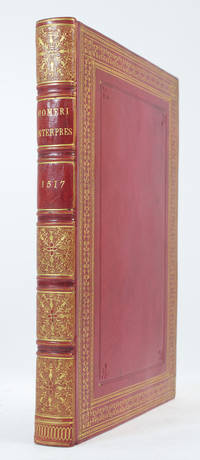
151766901Editio Princeps and the First Book Printed at the press of the Greek Gymnasium HOMER. DIDYMUS OF ALEXANDRIA. LASCARIS Janus editor. Homeric Scholia on the Iliad. Homeri interpres pervetustus in Greek. Edited by Janus Lascaris Rome: Vittore Carmelio and/or Zacharias Callierges for Angelo Colocci at the Press of the Greek Gymnasium caballini montis gymnasium. Not before 7 September 1517. Editio Princeps and the first book that was printed at the press of the Greek Gymnasium in Rome. Folio 10 1/2 x 7 3/4 inches; 265 x 197 mm. 172 leaves. Text in Greek. With "To the Reader" and "Address to Pope Leo X" which is dates 7 September 1517 in Latin. Colophon and register in Greek. This is the Longleat Beriah Botfield copy. We were not able to locate any copies besides the present copy at auction in the past fifty years and only one library on OCLC with a copy. Beautifully bound in early 19th Century straight-grain morocco by Francois Bozerian His stamp "Rel. F. Bozerian jeune" at bottom of the spine. Boards tooled in gilt and blind. Spine elaborately stamped and lettered in gilt. Boards edges gilt. Gilt dentelles. All edges gilt. Silk endpapers. Blue silk page marker. Two old circular previous ownership stamps on recto of first leaf not affecting text. Stamps are one of which is red and one of which is black are from the Seminaire des Missions Etrangeres. "Pope Leo X Giovanni de' Medici called Janus Lascaris to Rome to found a Greek College in 1513 and three years later it began to issue Greek texts principally edited by Lascaris. The printer was once thought to be Angelo Colocci a rich Roman proponent of Greek learning in whose house the press almost certainly operated but it was most likely Vittore Carmelio Hobson foreman to Callierges first printer of Greek at Rome or Callierges himself Layton. The types were designed by Lascaris cut possibly by Callierges and first used in 1494-96 by Lorenzo di Alopa at Florence to print books Lascaris edited. Cf. A. Hobson 'The Printer of the Greek Editions "In gymnasio Mediceo ad Caballinum montem"' Studi di biblioteconomia e storia del libro in onore di Francesco Barberi Rome: 1976: 331-335; E. Layton The 16th-century Greek Book in Italy pp.323-329; D.E. Rhodes 'The Printing of a Group of Greek Books in Rome' Studies in Early Italian Printing London: 1982 pp.111-113; Barker Greek Script pp.74-75. This first edition of the Homeric scholia on the Iliad has no author attribution although it is sometimes given erroneously to Didymus c.65 B.C.-10 A.D. It was a standard text in the study of Homer and clearly a required text for the students at the Greek Gymnasium." Christies 2002 HBS 66901RSL. $40000 Vittore Carmelio and/or Zacharias hardcover books
100150Bologna typis Laelii a Vulpe 1769. Large folio. LXIV 520 pp. The title with engr. vignette with a wolf. Fine engr. vignettes and initial letters and an engr. facsmile example from the MSS. Minor foxing spotting pp. 335-337. Contemporary vellum spine with raised bands and with handwritten title in ink library paper label at lower compartment fine marbled edges. Book plate of Bibliotheca Rosales Bername. From the library of Bengt Lassen. OCLC 43192384. Hoffman p. 546. First printing of â€De trinitate†written against Arianism in the 4th century. Greek and latin paralleltext. Didymus the Blind from Alexandria c. 310-395 is one of the Greek fathers. He was a learned student of Origen and an ascetic blind since the age of four and one of the principal opponents of Arianism. In 553 the Second Council of Constantinople however condemned his works along with those of Origen and Evagrius and many of his works were therefore not copied during the Middle Ages and subsequently lost. The â€De trinitate†was also considered lost when Johannes Aloysius Mingarellius found a MSS of it. This is the first printing both of the original Greek text and of the Latin translation by Mingarellli who also added a life of Didymus. Bengt Lassen 1908-74 var hovrättsrÃ¥d och Ã¥ren 1953-73 VD för Norstedts förlag. Han var en duktig latinist och hade en fin samling romerska författare. Han figurerar i bakgrunden i Maria Langs deckare â€Mördarens bokâ€. hardcover
1544542690.Ghardcover. Good. Access codes and supplements are not guaranteed with used items. May be an ex-library book. hardcover
20121354946PN. New. 2012. Soft Cover. Date is original print. This is a reprint edition. . PN paperback
20121354374PN. New. 2012. Soft Cover. Date is original print. This is a reprint edition. . PN paperback
1996290599PN. New. 1996. Soft Cover. Date is original print. This is a reprint edition . PN paperback
19981309486PN. New. 1998. Soft Cover. Date is original print. This is a reprint edition . PN paperback
20121355039PN. New. 2012. Soft Cover. Date is original print. This is a reprint edition. . PN paperback
20121354481PN. New. 2012. Soft Cover. Date is original print. This is a reprint edition. . PN paperback
1967732839PN. New. 1967. Soft Cover. Date is original print. This is a reprint edition. . PN paperback
20121354915PN. New. 2012. Soft Cover. Date is original print. This is a reprint edition. . PN paperback
1990237667PN. New. 1990. Soft Cover. Date is original print. This is a reprint edition . PN paperback
1986776971PN. New. 1986. Soft Cover. Date is original print. This is a reprint edition. . PN paperback
1967733199PN. New. 1967. Soft Cover. Date is original print. This is a reprint edition. . PN paperback
1965727644PN. New. 1965. Soft Cover. Date is original print. This is a reprint edition. . PN paperback
1961714792PN. New. 1961. Soft Cover. Date is original print. This is a reprint edition. . PN paperback
1992257576PN. New. 1992. Soft Cover. Date is original print. This is a reprint edition . PN paperback