DURAND (Jean-Baptiste).Livre Rare Book
857 résultats
1802PHO-1460Paris, Henri Agasse, 1802 , TEXTE et ATLAS , texte : 2 vol. in-8 de LVI-359-[1]-383pp. ,relié demi cuir , dos lisse avec titre et tomaison, plats frottés , coins et coupes usés , manque la page de titre ,XXXI,XXXV à XLVIII , 334 à 337 au tome 1 et les page 245 à 252 au tome 2 et Un ATLAS in-4°, viii-[4]-67 pp.; 43 planches (44), relié demi veau , dos lisse , quelques défauts à la reliure , petites rousseurs à l’atlas et papier légèrement bruni.
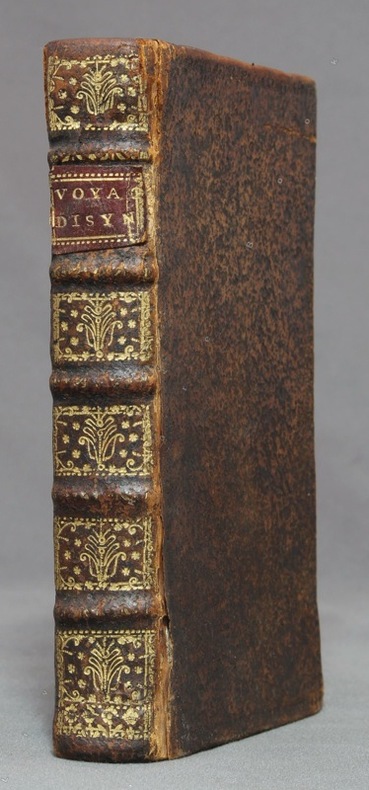
171411152A Paris, chez Arnoul Seneuze et chez Raoul Morel, 1714. In-12 de [12]-298 pages, pleine basane mouchetée, dos à 5 nerfs orné de fleurons, étoiles, roulettes, filets et titre dorés, étiquette de titre bordeaux, tranches mouchetées. Ex-libris Abraham Diodati au verso du titre. Mors fendus en tête et en queue, quelques rousseurs.
210600Paris, Durand, Pissot, 1751 2 parties en un vol. in-12, x-258-[2]-314 pp., avec 5 planches zoologiques hors-texte, basane fauve marbrée, dos à nerfs orné de fleurons à froid, armes en pied, encadrement de simple filet à froid sur les plats, armes au centre, tranches mouchetées (reliure de l'époque). Coiffes et mors restaurés.
19046480[Mali, Côte d'Ivoire, Guinée], 1904. 1904 1 vol in-8 oblong (210 x 265 mm) de : [24] ff. comportant chacun 4 photographies (95 x 65 mm) et 1 supplémentaire (110 x 65 mm) collée au dos sur dernier plat. Un total de 97 photographies. Pleine toile de percaline rouge à dos et à coin estampés à froid, titre orné Kodak Souvenirs sur le premier plat, dos muet.
1376026Ansterdam: J. L. de Lorme, Libraire sur le Rockin à l'enseigne de la Liberté, 1698 1 volume in-12 (16,5 x 11 cm), frontispice sur cuivre gravé par B. Picart, page de titre, (8)-402 p. [la relation de voyage du sieur de Montauban occupe les p.360-402] , (2) p. (catalogue de livres nouveaux qui se trouvent chez J. L. De Lorme); page de titre (L'Art de Voyager Utilement), (2)-51 p. Reliure d'ép. dos à 4 nerfs orné, coiffe sup. et coins usés, rel. frottée, bon état. Sabin 11274.
est381T10Hand Colored 21 x 15.5 inches Typus orarum maritimarum Guineæ, Manicongo, & Angôlæ... - Delineatio orarum maritimarum, terræ vulgo indigetatæ Terra do Natal. [Amsterdam, 1596]. 2 feuilles, chacune de 390 x 530 mm. Superbe exemplaire de l'une des cartes les plus décoratives figurant la moitié sud du continent africain, gravée par van Langren pour l'Itinerario de Linschoten. Les deux feuilles sont ornées de magnifiques cartouches de titre style Renaissance. Les mers sont traversées de lignes de rhumbs, de roses des vents, de navires et de monstres marins, tandis que les terres sont décorées de petites vignettes figurant des éléphants, des lions, ainsi qu'une scène représentant l'empereur chrétien Prester John. La feuille figurant la partie ouest de l'Afrique est ornée de deux vues des possessions portugaises de Sainte-Hélène et de l'Ascension, et des armoiries du Portugal décorant le cartouche de titre en latin et hollandais. La feuille figurant la partie orientale de l'Afrique est l'une des premières à représenter cette partie de l'Afrique. Elle s'étend de Doara à R. do Infante, et montre l'ile de Madagascar. Très bel exemplaire aquarellé. Tooley, MCC n°29,
18854504633Sydney: Thomas Richards Government Printer 1885. Slight rubbing to binding in handsome & original condition; interior lightly foxed in places; map with repaired tear; images all bright and crisp. Large square folio with a folding map three coloured lithograph plates 33 original silver albumen photographs 283 x 212 mm mounted on card with printed captions and borders and two superb panoramas one of them double-page 240 x 553 mm and the other on four sheets 242 x 1053 mm; original dark blue grained morocco binding bevelled edges spine banded and sides with multiple borders in gilt front cover lettered in gilt all edges gilded. <p><p>This rare and sumptuous album published in very small numbers and illustrated with actual photographs has been called the first example of Australian photo-journalism: 'the most magnificent example of an Australian work in this genre the high point in relation to which all other examples can be considered' Holden. It is most impressive as an ethnographic album one of the first such produced in the South Pacific. A special copy was delivered to Her Majesty the Queen as "a keen supporter of photography." </p> <p>The photographs all date from the 1884 expedition when Commodore Erskine proclaimed a British protectorate over the south coast of New Guinea. Although unattributed at the time all images were made by the New South Wales Government Printing Office and were chiefly the work of Augustine Dyer 1873-1923. Principally intended as a visual record the album shows the importance of the Hood Lagoon area of Papua New Guinea in British and Australian ambitions with six depictions of the region effectively a sixth of the finished work.</p> <p>The superb series of ethnographic and exploration photographs commemorating the 1884 expedition was printed and the albums assembled in Sydney in a small edition for presentation. Sir James Erskine R.N. 1838-1911 in 1885 was Private Secretary to Lord Northbrook the first Lord of the Admiralty and became Commodore of the Australian Station in January 1882. Erskine leased "Carthona" the grand Gothic-revival house built on Darling Point in 1841 for the explorer Sir Thomas Mitchell. In the 1880s it was owned by the solicitor Arthur Mansfield Allen but he was offering it to be let fully furnished in June 1884 and Erskine is known to have been resident there soon after.</p> <p>It is a piece of photo-reportage unmatched by any other work of this time and place. Through the positioning of images of the official ceremonies alongside topographical views of the surrounding areas the photographs themselves become a true part of the narrative: the first photographic images of the meeting between Imperial forces and Hood Bay chiefs. One of the remarkable images is a scene on board HMS Nelson as Erskine addressed some of the assembled tribal elders 'Commodore addressing Chiefs on board HMS Nelson Hood Bay' one seen grasping an ebony staff. Erskine had handed out a number of the staffs to local chiefs as "an emblem of authority in the form of an ebony stick with a florin let in at the top the Queen's Head being uppermost and encircled by a band of silver" Lyne New Guinea pp. 13 114-118.</p> <p>The motivation for the Australian Squadron's to New Guinea expedition under Erskine's command was imperialistic: "The Imperial Government. decided to take steps to establish a Protectorate over that part of the southern shores of new Guinea to the east of the territory claimed by the Netherlands with the double object of preventing any foreign occupation of the country and of protecting the inhabitants from aggression.". This declaration of the expedition's objective belies the tone of much of Erskine's Narrative which reads more like a travelogue than an official account. "Picturesque" is the most often used descriptive term along with such passages as "the striking variety and beauty of the colour in the adjacent water were enchanting and struck the beholder with wonder and admiration." Similarly Erskine's own speech considered for many years as a "Declaration of Rights" for New Guinea contrasts strongly with the text of the Proclamation itself. The latter is couched in formal imperial language whereas the former looks ahead in more open terms to the real benefits that the tribesmen might expect and is very specific regarding the protection offered by Her Majesty Queen Victoria: "look upon white persons whom the Queen permits to reside amongst you as your friends .". </p> <p>A full list of the images can be seen at hordern.com.</p> <p>The photographs are: 1 "Port Moresby from the Mission Station." Four-sheet panorama. 2 "H.M.S. 'Nelson' at Port Moresby S.W." 3 "General View of Settlement at Port Moresby N.N.E." 4 "Commodore shaking hands with Native Chief 'OBE Vagi' on board H.M.S. 'Nelson' at Port Moresby." 5 "Native Village Port Moresby W." 6 "Ethel Island and landing-place at Native Village Port Moresby S.W." 7 "Native Houses Port Moresby." 8 "Native Village Port Moresby S." 9 "Native Village Port Moresby N.W." 10 "Hoisting Flag at Port Moresby N.W." 11 "Yule Island from Delena Hall Sound N.W." 12 "Landing-place at Delena Hall Sound N." 13 "Hoisting flag at Delena Hall Sound." 14 "Koloka the Queen of the Lolo Tribe at Delena." 15 "Landing at Motumotu." 16 "Landing at Motumotu." 17 "Firing the Feu de joie Motumotu." 18 "New Guinea Chief Motumotu." 19 "Native Village Kerepunu Hood Lagoon S.W." 20 "Commodore reading Proclamation at Kerepunu Hood Lagoon W." 21 "H.M.S. 'Espiegle' saluting Flag Hood Lagoon." 22 "Scene near Kerepunu Hood Lagoon N.E." 23 "A Chief's House Kerepunu Hood Lagoon S.W." 24 "Commodore addressing Chiefs on board H.M.S. 'Nelson' Hood Bay." 25 "Argyll Bay W.N.W." Two-sheet panorama. 26 "Commodore reading Proclamation at Argyll Bay N.W." 27 "H.M.S. 'Nelson' saluting Flag at Mission Station Suau Stacey Island South Cape." 28 "View from Stacey Island N." 29 "Native Village Suau S.W." 30 "Native House at Suau." 31 "View from Dinner Island China Strait - H.M. Ships 'Nelson' and 'Espiegle' at anchor N.W." 32 "View from Dinner Island S.W." 33 "Natives on board H.M.S. 'Nelson' at Dinner Island." 34 "View from Anchorage N. side of Teste Island W. by N." 35 "West end of Teste Island from Anchorage S.W."</p> </p> . Provenance: A Paré "Elgin" Durban Rd. Wynberg South Africa pencil inscription on front flyleaf. Thomas Richards, Government Printer unknown