201 résultats
1862WRCAM32497Milledgeville: Boughton Nisbet & Barnes 1862. 1581pp. Contemporary three quarter calf and boards. Minor wear to extremities small chip in spine. Moderate foxing. Overall very good. The acts of the Georgia assembly for the relevant period. A useful resource regarding Georgia's management of state affairs in the early years of the Confederacy. Scarce. DE RENNE II p.643. PARRISH & WILLINGHAM 2778. Boughton, Nisbet, & Barnes hardcover books
1826WRCAM32400Milledgeville Ga 1826. 248pp. Original plain wrappers. Spine perished foxed. Else fine uncut and untrimmed. The collected Georgia laws for the relevant session. DE RENNE I p.398. unknown books
1803WRCAM31627Washington City: William Duane & Son 1803. 32pp. Dbd. Light tanning. Very good. An appeal to Congress transmitted by Henry Dearborn for reimbursement due the Georgia militia for services rendered while defending the state against Creek Indian incursions. Contains much on Creek wars. Scarce. DE RENNE I p.315. SHAW & SHOEMAKER 5342. OCLC 10530192. William Duane & Son unknown books
1860WRCAM32507Augusta Ga.: Steam Press of Chronicle & Sentinel 1860. 13pp. Original printed wrappers detached. Faint stain but very good. The Cotton Planters' Association decrying the fact that Georgia has ceased to be the "First Cotton State in the Union" petitions the state for support in finding better and cheaper supplies of fertilizer and in protecting farmers from fraudulent fertilizer suppliers. Not in De Renne. Steam Press of Chronicle & Sentinel unknown books
1860825171860. GEORGIA. Minutes of the Union Society: Being an Abstract of Existing Records From 1750 to 1858. Comprising also Chronological lists of its Officers Members and Beneficiaries with the Anniversary Addresses of Hon. T.U.P. Charlton Col. Howell Cobb etc. Savannah: John M. Cooper & Co. 1860. 29 4 206 9 1 22 24 28pp. Orig. cloth. Very good or better. DE RENNE II p.615. PARRISH & WILLINGHAM 7930. OCLC 5634157 ref. A useful survey of Union Society records. There seems to be a question surrounding potential later issues. De Renne cites 1860 as the only publication date while Parrish & Willingham claim 1861. It is almost certain there were two issues of the present work the present copy being the earlier one without the latest entry dated "1861." An early Confederate imprint. Scarce. Parrish & Willingham locate only seven copies of the later issue. OCLC does not differentiate between potential issues. unknown
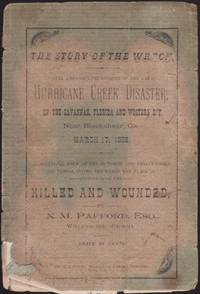
188836170Savannah: Byck & Selig 1888. First Edition. Wraps. Fair. Wraps. Approximately 7.5" x 4". 11 pages 1 page blank. Front cover faded with small edge tears chips and corner creases. Illustrated back cover lightly soiled creased torn and edge chipped. Fragile title and preface pages are spotted edge torn chipped creased and detached no loss of print. Entire booklet creased with several small puncture holes. Very minimal loss of partial letters in the text<br /> <br /> The poem tells the story of one of the worst the train wrecks in Georgia on the Savannah Florida and Western Railway. It lists the people who died and brief information about them and their families. Oddly this wreck is not listed during an internet search of the biggest train wrecks in Georgia. Not in Derenne Georgia catalog. Scarce and obscure. Fair only. Byck & Selig unknown
189415751894. Edwards Georgie Hortense <br /> Manuscript for a Noted Genealogy Authored by a Descendant of Mary Todd Lincoln circa 1894<br /> 19 pp. typed carbon leaves printed rectos only plus title page inside pale green thin card wrappers originally three brad-bound only one brad remaining held with paper clips. About good as wrappers are moderately chipped and stained.<br /> <br /> This is a typed draft with copious handwritten amendments for an oft-reprinted genealogical history “Historic Sketches of the Edwards and Todd Families and Their Descendants 1523-1895.†Originally printed in 1894 and updated several times afterward the book was authored by Georgie Hortense Edwards secretary of the Springfield Illinois Chapter of the National Society Daughters of the American Revolution and a granddaughter of Elizabeth Todd Edwards sister of Mary Todd Lincoln. The history goes back to Georgie’s “great great great great grandfather Robert Todd†and argues that “what is known of the antecedents of the Todd family is most honorable.â€<br /> <br /> Small collection also includes two first person accounts as relayed to Edwards as passed down through her family regarding "Lincoln and Duff Armstrong Murder trial.the information I have my Father and Mother has told me." The Duff Armstrong trial is a well-known case where Abraham Lincoln proved in court that a witness was lying when that witness claimed to have seen the murder take place "under the light of the moon." Lincoln produced an almanac which showed the moon that night had already set at the time of the "witnessed murder". Edwards backed up this account saying ".Father and Mother had been to a camp meeting and had gotten home around eleven p.m. and the moon had gone down it is true Abe secured an almanac and prove to the court that there was no moon shining at that time when this happened." <br /> <br /> A rare set of manuscripts. OCLC shows that only two institutions have the first printing of "Historic Sketches" and about 30 have later reprints while none have any drafts. We find no record of the anecdotal re-telling of the Duff Armstrong case. unknown
183434357New York: Thomas Illman 1834. First Edition. Map. Good. Map. Approximately 15" x 13" wider margins than other copies. Colored map shows Cherokee Tribal lands in North Georgia. A couple of very small edge tears on the right center edge not affecting content. Map is clean and in good condition. Entered according to an act of Congress in the year 1834 by Thos. Illman. Pencil note in the upper left corner on the verso states "From Burr's "A New Universal Atlas" Phillips No. 771 New York 1835 D.S. Stone/Thomas Illman Plate No. 52." Drawn before the forced removal of the Cherokee Indian Tribe in North Georgia. Thomas Illman unknown
1850354298Milledgeville 1850. 34pp. Dbd. Scattered foxing. Very good. 34pp. Dbd. Consists largely of a discussion of the recently proposed "act for the admission of California into the Union" and the effects such a move would have on slavery. The main thrust of the resulting resolutions was an affirmation of the need for the fugitive slave law. An important part of the debates over the fate of the Union in 1850. DE RENNE p.532 unknown
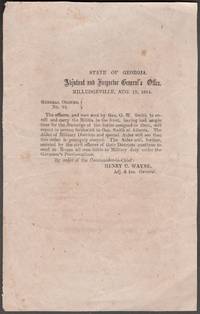
186435142Milledgeville: State of Georgia 1864. First Edition. Broadside. Very good. Broadside 9.5" x 6". Printed on the front side only. Light toning and wear to the paper. <br /> <br /> Parrish and Willingham 2888 . 2887 states No. 24 issued at Atlanta but gives no date. 2888 states Nos. 1-31; 7 January - 13 October 1864. Order reads; "The officers and men sent by G. W. Smith to enroll and carry the Militia to the front having had ample time for the discharge of the duties assigned to them will report in person forthwith to Gen. Smith at Atlanta. The Aides of Military Districts and special Aides will see that this order is promptly obeyed. The Aides will further assisted by the civil officers of their Districts continue to send to Macon all men liable to Military duty under the Governor's Proclamations."<br /> <br /> By order of the Commander-in-Chief Henry C. Wayne Adj. & Ins. General. [State of Georgia] unknown
185435614Griffin Georgia: Self published 1854. Hardcover. Good. 12mo. 1 vi 180 pages 1. Brown cloth hardcover with blind stamped designs on the covers and gilt lettered title on the spine. Cloth lightly worn on the edges. A small bit of brown staining to the bottom corner edges of some of the pages. Old pencil inscription by the previous owner on the yellow right front flyleaf. Scarce and obscure publication. Not listed in the Georgia Derenne catalog. <br /> <br /> Sabin 80104. From the New Georgia Encyclopedia Jennie Knight Emory Univ.<br /> <br /> Before the Civil War 1861-65 the only Unitarian churches in Georgia were located in Augusta and Savannah. Following disagreements with the national association of Unitarians over the abolition of slavery the Augusta church closed in the 1840s while the Savannah church closed in 1859. Similarly southern Universalists often differed with their northern counterparts about abolition. There were more small active Universalist churches than Unitarian churches in Georgia before the war yet no congregations remained active afterward. A large Universalist missionary effort in the Southeast began in 1891 and attracted many new converts but after the Great Depression of the 1930s Universalist membership declined again. Self published hardcover
1850WRCAM31124Milledgeville 1850. 34pp. Dbd. Scattered foxing. Very good. Consists largely of a discussion of the recently proposed "act for the admission of California into the Union" and the effects such a move would have on slavery. The main thrust of the resulting resolutions was an affirmation of the need for the fugitive slave law. An important part of the debates over the fate of the Union in 1850. DE RENNE p.532. unknown books
1821WRCAM32408Milledgeville: Grantland & Orme 1821. 40ii pp Dbd. All leaves loose. Edge wear and chipping heavier to first leaf. Evenly toned. Good. The laws of Georgia passed at the relevant session. "This is the original edition of this scarce work" - De Renne. OCLC locates only one copy at the University of Texas at Austin. DE RENNE I p.376. OCLC 48543920. Grantland & Orme unknown books
1817WRCAM32374Milledgeville Ga.: S. & F. Grantland 1817. 164v pp. with 143 and 144 repeated in pagination. Dbd. First leaf lightly toned. Contemporary ownership signature at head of first leaf. Overall internally clean. Very good. The acts of the Georgia assembly for the relevant period. Of particular importance are the provisions for the disposition of lands lately acquired or about to be from the Creeks and Cherokees. "The Penal Code of December 20 1817 is printed on pp.92-143 repeated" - De Renne. A scarce Georgia imprint. DE RENNE I p.360. CHECKLIST OF SESSION LAWS p.46. S. & F. Grantland unknown books
1849WRCAM54037Augusta Ga 1849. iv96113-192pp. Contemporary three-quarter calf and marbled boards spine gilt. Extremities worn spine chipped front board detached rear joint tender and partially split. Two 20th-century bookplates on front endpapers small ink library deaccession stamp on rear blank some toning. Good. An almost-complete run of the seventh year of this rare southern agrarian periodical. THE SOUTHERN CULTIVATOR was an important southern agricultural manual published in Georgia from 1843 until the 1880s when it acquired other periodicals and changed its name. Unlike many of its contemporaries the periodical was published throughout the Civil War though it moved from Augusta then to Athens after the war and then finally to Atlanta. The subtitle describes the work and its goal: "a Semi-monthly Journal devoted to Southern agriculture designed to improve the mind and elevate the character of the tillers of the soil and to introduce a more enlightened system of culture." Present here are eleven of the twelve issues for 1849 each 16pp. lacking only issue seven. A rare run of an important southern agricultural publication. hardcover books
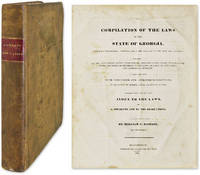
1831589071831. Milledgeville 1831. 1st ed. Milledgeville 1831. 1st ed. 1831 Compilation of Georgia Law Georgia. Dawson William C. Compiler. A Compilation of the Laws of the State of Georgia Passed by the General Assembly Since the Year 1819 to the Year 1829 Inclusive: Comprising All the Laws Passed Within Those Periods Arranged Under Titles With Marginal Notes And Notes of Reference to the Laws Or Parts of Laws Which are Amended or Repealed: To Which are Added such Concurred and Approved Resolutions As are Either of General Local or Private Nature: Concluded With a Full and Ample Index to the Laws and a Separate One to the Resolutions. Milledgeville: Published by Grantland and Orme 1831. 488 150 xxix pp. Text in parallel columns. Quarto 10" x 8". Contemporary sheep blind fillets to boards lettering piece and blind fillets to spine. Light rubbing to boards and extremities corners bumped a few minor scuffs and stains to boards hinges starting. Toning and light foxing to text faint dampstaining in places to margins internally clean. A desirable copy. $400. First edition. This was the fifth digest of Georgia state laws preceded by others from 1801 1802 1812 and 1821. It is digested alphabetically by topic. Babbitt Hand-List of Legislative Sessions and Session Laws 87. unknown books
1829WRCAM32413Milledgeville: Camak & Ragland 1829. 26pp. Gathered signatures stitched. Minute edge wear. Overall internally clean. Very good unopened and untrimmed. Self-styled second edition after the first of the same year with corrections. A series of combative essays lambasting the Kehukee Association one of the largest Baptist societies in the region. Published under the pseudonym of "Nehemiah." A scarce Georgia imprint. OCLC locates only eight copies of the first edition. Not in De Renne. OCLC 13070208. Camak & Ragland unknown books
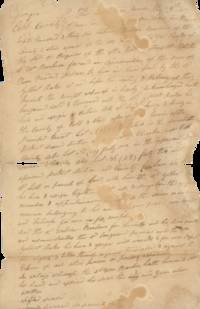
1836List2949Clarke Cobb and Harris Counties Georgia 1836. Three documents. One four-page document measuring 5 x 8 ¾ inches likely previously a single sheet; water stained with some tearing at folds very good. One double-sided document measuring 8 x 10 inches; water stained and folded with large tears at folds possibly with part missing good. One single-sided document measuring 7 ¾ x 12 ¾ inches. Water stained and folded with large tears at folds much damage to margins good. Overall good. Three legal documents in which William Barber buys and sells plots of land shortly following the establishment of Cobb County. In 1834 and 1835 Barber buys plots from John Gann and Elizabeth Kennon for $100 each and in 1836 sells land to Gilbert Rake for $500. Gann is possibly the plantation owner Cobb County pioneer and State Senator. <br /> <br /> These land contracts date to a time at which a small number of Cherokee—whose territory included present-day Cobb County—had voluntarily left the area following the Indian Removal Act of 1830 while a majority had not done so. The Indian Removal Act required Indigenous people east of the Mississippi River to cede their land to Euro-Americans and move west of it to so-called Indian Territory now Oklahoma. In 1835 the US government met with a group of Cherokee claiming to represent the tribe in New Echota Georgia and signed a removal treaty. When the majority of the tribe viewing the treaty as illegitimate refused to move voluntarily the US government sent the military to intervene.<br /> <br /> Of interest to historians of Cobb County and land dealings between its early Euro-American residents during the removal of its Indigenous population. unknown
1810WRCAM32385Milledgeville Ga 1810. 1762xv pp. Gathered signatures stitched. Moderate edge wear. Heavy foxing minor dampstaining occasional minor tears. Good. The acts of the Georgia assembly for the relevant session including legislation on the lottery county management and personal petitions. Rare. OCLC locates only four copies. DE RENNE I p.340. SHAW & SHOEMAKER 20205. OCLC 10269041. unknown books
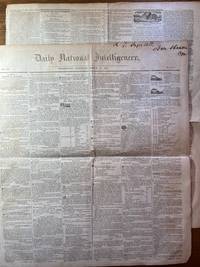
183236785Washington DC: Gales & Seaton 1832. Newspaper. Good. Newspaper. Approx. 21" x 18." 4 pages. Two folds. Sheets are detached. Newspaper has light toning. Name of R. J. Ingersoll New Haven Con" written top of issue. Possibly the same Ingersoll that served 4 terms in Congress from 1825-1833. <br /> <br /> Entire contents of page 2 concern "The Cherokee Case. Opinion of the Supreme Court delivered by Mr. Chief Justice Marshall January Term 1832. Samuel A. Worcester vs. The State of Georgia." The case is also printed on the first column of page 3. Supreme Court case of Samuel Worcester. From the Brittannica website: <br /> <br /> Worcester v. Georgia involved a group of white Christian missionaries including Samuel A. Worcester who were living in Cherokee territory in Georgia. In addition to their missionary work the men were advising the Cherokee about resisting Georgia's attempts to impose state laws on the Cherokee Nation a self-governing nation whose independence and right to its land had been guaranteed in treaties with the United States government. In an effort to stop the missionaries the state in 1830 passed an act that forbade "white persons" from living on Cherokee lands unless they obtained a license from the governor of Georgia and swore an oath of loyalty to the state. Worcester and the other missionaries had been invited by the Cherokee and were serving as missionaries under the authority of the U.S. federal government. They did not however have a license from Georgia nor did they swear a loyalty oath to that state. Georgia state authorities arrested Worcester and several other missionaries. After they were convicted at trial in 1831 and sentenced to four years of hard labour in prison Worcester appealed to the U.S. Supreme Court.<br /> <br /> Worcester argued that Georgia had no right to extend its laws to Cherokee territory. He contended that the act under which he had been convicted violated the U.S. Constitution which gives to the U.S. Congress the authority to regulate commerce with Native Americans. The Constitution also bars the states from passing laws that alter the obligations of contracts-in this case treaties. Several treaties between the Cherokee and the U.S. government recognized the independence and sovereignty of the Cherokee Nation. Furthermore Worcester argued that the Georgia laws violated an 1802 act of Congress that regulated trade and relations between the United States and the Indian tribes.<br /> <br /> The Supreme Court agreed with Worcester ruling 5 to 1 on March 3 1832 that all the Georgia laws regarding the Cherokee Nation were unconstitutional and thus void. Writing for the court Chief Justice John Marshall held that "the Indian nations had always been considered as distinct independent political communities retaining their original natural rights as the undisputed possessors of the soil." Even though Native Americans were now under the protection of the United States he wrote that "protection does not imply the destruction of the protected." Marshall concluded:<br /> The Cherokee Nation then is a distinct community occupying its own territory.in which the laws of Georgia can have no force and which the citizens of Georgia have no right to enter but with the assent of the Cherokees themselves or in conformity with treaties and with the acts of Congress. The whole intercourse between the United States and this Nation is by our Constitution and laws vested in the Government of the United States.<br /> <br /> Georgia however ignored the decision keeping Worcester and the other missionaries in prison. Eventually they were granted a pardon and were released in 1833. Pres. Andrew Jackson declined to enforce the Supreme Court's decision thus allowing states to enact further legislation damaging to the tribes. The U.S. government began forcing the Cherokee off their land in 1838. In what became known as the Trail of Tears some 15000 Cherokee were driven from their land and were marched westward on a grueling journey that caused the deaths of some 4000 of their people.<br /> <br /> The Supreme Court agreed with Worcester ruling 5 to 1 on March 3 1832 that all the Georgia laws regarding the Cherokee Nation were unconstitutional and thus void. Writing for the court Chief Justice John Marshall held that "the Indian nations had always been considered as distinct independent political communities retaining their original natural rights as the undisputed possessors of the soil." Even though Native Americans were now under the protection of the United States he wrote that "protection does not imply the destruction of the protected." Marshall concluded:<br /> The Cherokee Nation then is a distinct community occupying its own territory.in which the laws of Georgia can have no force and which the citizens of Georgia have no right to enter but with the assent of the Cherokees themselves or in conformity with treaties and with the acts of Congress. The whole intercourse between the United States and this Nation is by our Constitution and laws vested in the Government of the United States.<br /> <br /> Georgia however ignored the decision keeping Worcester and the other missionaries in prison. Eventually they were granted a pardon and were released in 1833. Pres. Andrew Jackson declined to enforce the Supreme Court's decision thus allowing states to enact further legislation damaging to the tribes. The U.S. government began forcing the Cherokee off their land in 1838. In what became known as the Trail of Tears some 15000 Cherokee were driven from their land and were marched westward on a grueling journey that caused the deaths of some 4000 of their people. Gales & Seaton unknown
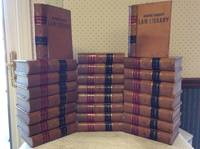
18471233456Georgia 1847. 1st Edition. Leather bound. Fair. A complete run of the first 24 volumes of the State of Georgia's offical law reports. FIRST EDITIONS FIRST PRINTINGS OF THESE RARE PRE-CIVIL WAR GEORGIA IMPRINTS. Vol. I was published in New York but Vol. II was published in Savannah Vols. 3-20 in Athens GA and Vols. 21-24 in Columbus GA. The set is bound in matching leather but some bindings are damaged. Each volume has a law library name stamped on the covers; the front boards of Vols. I and VI are detached; the spines of Vols. I IX and XX are torn; most volumes have a strip of brown cloth tape across the top of the spine. ATTENTION: many bindings are fragile so one can expect other covers to detach. Other than some very minor foxing scattered throughout the set the interior pages are clean tight and unmarked. Offered as-is and no returns accepted. Buyer should understand they may need to rebind these books. These reports on various law cases were standard volumes in Georgia courts but the vast majority were destroyed during the Civil War As with other works from this era antebellum printings from Georgia are today rarely found. unknown
181935648Milledgeville: S. Grantland 1819. First Edition. Leather bound. Fair. Octavo. iv 463 pages. Polished sheepskin leather binding with red leather title label on the spine. A brown piece of linen tap used at the top and at the bottom of the spine. Covers rubbed. Internal hinges in good condition. Some arithmetic written on the right front flyleaf. "Augusta Wylie King 1929" written in blue pen on the verso of the right front flyleaf. Light toning and foxing to the contents. A few pages have ink splotches. Newspaper clipping stored between pages 342 343 has left stains to the pages. <br /> <br /> Contents include sections on "Free Negroes" and a section on "Slaves". 11 page list of subscriber names by county located in the back. Subscriber names are listed alphabetically by county. List includes the name of Daniel Ross of the Cherokee Nation. Fair.<br /> <br /> Shaw & Shoemaker 47639; Not in Sabin; Derenne Georgia Catalog Vol. I page 366 - "Probably printed in Philadelphia for notice of copyright on Sept. 28 1819 by Mathew Carey & Son as proprietors in Eastern District of Pa. appears on verso of the title page. S. Grantland unknown
181332691Augusta: Adams & Duyckinck 1813. Leather bound. Good. Large quarto. 6 708 pages 20 page index. Brown calf leather binding with gilt stamped red label on spine. Leather binding is worn with a small area of dried ink on the spine partially obscuring the title on the red label. Old ink inscription of "Madison County Georgia" hand written on right front free end paper. Right front free end paper starting to come loose. Moderate to heavy toning and foxing to pages. Contents include laws regarding slaves and Thomas Jefferson's peace treaty at Fort Wilkinson in 1802 with the Creek Indians. <br /> <br /> Derenne Vol. I page 346; Sabin 13574. Adams & Duyckinck unknown
181235763Augusta: Printed by Adams & Duyckinck 1812. First Edition. Leather bound. Fair. Quarto. 4 708 pages 18 page index. Full brown calf leather binding with gilt stamped title on red leather spine label. Leather boards rubbed on the edges and scuffed on the back. Boards are slightly bowed. Darkened section of leather on the front cover. Leather head of spine is edge worn. Moderate toning to the text. Previous owner inscription on right front flyleaf. <br /> <br /> Contents include laws relating to Slavery and free Negroes. Also included is a Creek Indian treaty - "Treaty at Fort Wilkinson in 1802". This treaty was signed during the Thomas Jefferson administration by James Wilkinson Benjamin Hawkins Andrew Pickens and several of the Creek Chiefs Warriors etc. Fair. <br /> <br /> Derenne Vol. I page 346; Sabin 13574. Printed by Adams & Duyckinck unknown
186237602Bibb County Georgia 1862. Neat ink manuscript on recto and verso of a single leaf folded for recording 7-1/2" x 12-1/2." Written entirely as a contemporary duplicate copy by the Notary Public. With docketing sheet old folds separating. Very Good.<br/><br/> The deed was made "in the second year of the independence of the Confederate States of America." For the sum of $2700 Cherry conveys to the Confederate States 27 acres "in the Macon Reserve" boundaries described with a map attached not present here reserving to Cherry a right of way through the lands. Witnessed by Benjamin V. Iverson. unknown books