201 résultats
1843WRCAM41656Milledgeville Ga 1843. 558pp. Stitched as issued. Titlepage lightly soiled; bottom portion with some chipping and slight loss. Scattered foxing and toning heavily in spots. Light dampstaining to last few leaves. Good. Lengthy record of the proceedings of the Georgia House of Representatives for the relevant session indexed. Not in DeRenne; no individual copies listed on OCLC. Scarce. unknown books
1843WRCAM54035Augusta Ga 1843. 4208pp. Contemporary black morocco and marbled boards rebacked in 20th-century buckram. Boards quite rubbed edges worn. Institutional bookplate on front pastedown one-fourth of titlepage lacking filled with blank paper with seven letters supplied in manuscript facsimile some toning and foxing ink stain to bottom margin of some leaves top corner of last leaf torn costing about twelve lines of text in the third column. Good. The entire first year run of this rare bi- weekly southern periodical published in Georgia from 1843 until the 1880s when it acquired other periodicals and changed its name. THE SOUTHERN CULTIVATOR was an important southern agricultural manual that unlike many of its contemporaries was published throughout the Civil War though it moved from Augusta then to Athens after the Civil War and then finally to Atlanta. The subtitle describes the work and its goal: "a Semi-monthly Journal devoted to Southern agriculture designed to improve the mind and elevate the character of the tillers of the soil and to introduce a more enlightened system of culture." Present here are the first twenty-six issues of the periodical each 8pp. each preceded by the titlepage and an Index. Individual issues of the magazine are scarce but the entire first year is positively rare. SABIN 88334. hardcover books
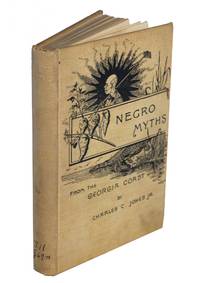
1888177281888. Jones Charles C. Negro Myths from the Georgia Coast 1888 presenting a late nineteenth-century compilation of African American folklore recorded in the Gullah dialect of the Georgia and South Carolina coastal region with direct relevance to the study of Black oral traditions linguistic history and post-emancipation cultural expression. The volume gathers fable-like narratives often centered on anthropomorphic animals that reflect storytelling traditions rooted in African diasporic heritage and adapted within enslaved and freed communities of the coastal South. Its use of Gullah a Creole language shaped by West African linguistic structures and English situates the work within ongoing efforts of the period to document vernacular speech and preserve forms of cultural expression that had developed under slavery and persisted into Reconstruction and beyond.<br /> <br /> Jones Charles C. Negro Myths from the Georgia Coast. Boston and New York: Houghton Mifflin and Company 1888. First edition. The text is rendered in Gullah dialect reflecting the linguistic patterns of African American communities along the Georgia and South Carolina coasts including areas around Savannah and Charleston. Jones raised in a plantation environment and familiar with the regional speech patterns compiled these narratives as part of a broader nineteenth-century interest in folklore and dialect studies contributing to early written records of Gullah language and storytelling traditions.<br /> <br /> Single volume. Ex libris. Minor foxing to the front pastedown and bumped corners; overall very good condition. A late nineteenth-century printed record of African American folklore and language from the coastal South documenting narrative forms and speech patterns that remain central to the study of Gullah culture and linguistic history. unknown
1864WRCAM32567Milledgeville Ga 1864. 174pp. Original printed wrappers. Wrappers stained scuffed along lower portion of spine. Age- toned. Else very good. Lists the variety of legislation considered by the Georgia Assembly in the third year of the Civil War from the reorganization of the state militia to the development of a state navy. Also includes laws regulating stills and exempting from taxation cotton and other property from Confederate states. Continuously paginated but with a separate titlepage for the extra session. PARRISH & WILLINGHAM 2780. DE RENNE II p.666. unknown books
1808WRCAM32382Milledgeville: Printed by D.L. Ryan 1808. 4173pp. Half title. Later half sheep and paper boards. Titlepage and final text leaf detached. Tanned and foxed. Good only. Scarce printing of acts passed at a special session of the Georgia Assembly in May 1808. The legislation enacted included laws regarding the state militia a lottery to raise funds to build a church in Savannah and several acts regarding judicial procedures. OCLC locates only two copies at the University of Virginia and the University of Washington. DE RENNE I p.335. MACDONALD CHECKLIST OF SESSION LAWS p.46. SHAW & SHOEMAKER 15096. OCLC 10603318. Printed by D.L. Ryan hardcover books
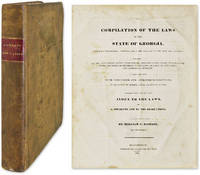
1831589071831. Milledgeville 1831. 1st ed. Milledgeville 1831. 1st ed. 1831 Compilation of Georgia Law Georgia. Dawson William C. Compiler. A Compilation of the Laws of the State of Georgia Passed by the General Assembly Since the Year 1819 to the Year 1829 Inclusive: Comprising All the Laws Passed Within Those Periods Arranged Under Titles With Marginal Notes And Notes of Reference to the Laws Or Parts of Laws Which are Amended or Repealed: To Which are Added such Concurred and Approved Resolutions As are Either of General Local or Private Nature: Concluded With a Full and Ample Index to the Laws and a Separate One to the Resolutions. Milledgeville: Published by Grantland and Orme 1831. 488 150 xxix pp. Text in parallel columns. Quarto 10" x 8". Contemporary sheep blind fillets to boards lettering piece and blind fillets to spine. Light rubbing to boards and extremities corners bumped a few minor scuffs and stains to boards hinges starting. Toning and light foxing to text faint dampstaining in places to margins internally clean. A desirable copy. $600. First edition. This was the fifth digest of Georgia state laws preceded by others from 1801 1802 1812 and 1821. It is digested alphabetically by topic. Babbitt Hand-List of Legislative Sessions and Session Laws 87. unknown
180960420Milledgeville GA 1809. Partly printed document 6 5/8 x 8 inches employing several sizes and styles of type the text enclosed within an ornamental border and with a seal attached picturing an arm brandishing a sword. Irwin a native of North Carolina moved as a child with his family to the Georgia back county and served with his father and brother during the American Revolution; as governor he signed the act rescinding the fraudulent Yazoo land law. "His leadership patriotism and impartiality were recognized and honored throughout his career" DGB. Marbury is best remembered for his role in the publication of Georgia's first official digest of laws Digest of the Laws of the State of Georgia 1802. Some browning but very good. Folded. A nice example of early and somewhat crude Georgia letterpress printing. #7651. <br/><br/> unknown books
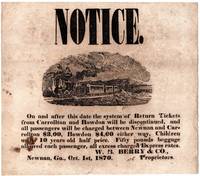
187012823Newnan Ga: October 1 1870. Broadside 7.75 x 9 inches with engraved vignette at center. Old folds moderate foxing and dust-soiling light staining. Short closed tear to bottom edge. Overall very good. A delightful mid-19th-century Georgia railroad broadside advertising changes to the ticketing system for one of the southern rail lines owned by William Byrd Berry. Here rates for travel between Berry's hometown of Newnan and Carrollton or Bowdon are specified and the rates for children under the age of 10 are noted as half price. Further the broadside stipulates baggage is capped at fifty pounds and the excess will be charged "Express rates." The work is signed in type by "W.B. Berry & Co." and dated October 1 1870 in Newnan. The text is enhanced with a striking central vignette of a locomotive pulling several railcars through a mountainous region. William Byrd Berry 1831-1902 was a prominent businessman and landowner born and raised in Newnan Georgia. He served as president of various banks and was involved in a number of railroad interests in the state. As far as we can tell the present broadside is unrecorded. October 1 unknown
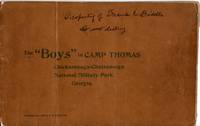
189813100Chattanooga TN: Sidebottom & Kerr 1898. 48pp. Slim oblong octavo. Original orange-tan wrappers printed in black stapled. Wrappers soiled creased and chipped with contemporary ownership inscription on front wrapper. First and last leaves detached from text block text block itself detached from wrappers. Good only. A scarce historical photobook that doubles as a catalogue for a Chattanooga photography studio at the outset of the Spanish-American War. Named after Union General George H. Thomas Camp Thomas was a massive temporary military training facility established at the Chickamauga Battlefield in Georgia during the Spanish-American War. The camp hosted up to 70000 troops but became a national scandal after deadly disease outbreaks. The work features seventy total monotone photographs from third-page to full-page with brief printed captions and plate sizes memorializing various scenes at Camp Thomas in 1898. The subjects of the photographs include military structures scenes on the training ground soldiers from various state units in small and large groups soldiers hosting local visitors the large corral of horses at the camp monuments inside the camp / national park views of the natural scenery and more. According to explanatory text on the inside front wrapper "the main idea is to show by photograph such scenes of every day occurrence; routine work both on and off duty as will give nearest a correct idea of what the life of a soldier in camp is made of or as you would see him were you on the grounds in person."<br /> <br /> The rear wrapper reveals an additional motivation for the publication of the work in the form of instructions for ordering any of the photographs featured within. Such is the reasoning behind the plate sizes listed by each example. The Chattanooga studio Sidebottom & Kerr states that "Every Plate in this Book was made expressly for it and having the negative can furnish upon short notice photograph of any plate." The company offers to send the catalogue free of charge to anyone east of the Rocky Mountains. A scarce and unusual photobook that does double duty as a Tennessee photographic studio's order book. OCLC reports just eight total institutional holdings. Sidebottom & Kerr unknown
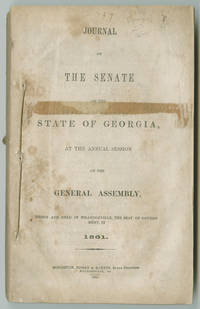
1861WRCAM53708Milledgeville Ga 1861. 351pp. Stitched gatherings. Dust soiling and adhesive residue to outer leaves. Toning and foxing. Good. An uncommon journal of proceedings in the Georgia state Senate in their first session after Secession. The work includes a defiant and animated message from the Governor Joseph E. Brown as well accounts of the measures taken by Georgia to integrate itself into the Confederacy and to prepare for war. PARRISH & WILLINGHAM 2811. unknown books
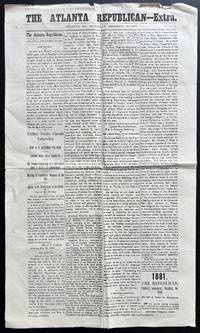
18805904Atlanta: December 18 1880. About very good. Broadside newspaper extra 19 x 11.25 inches. Old folds and creases a bit wrinkled minor soiling minor fraying and light staining to top edge tiny hole at center crossfold. An extraordinarily rare broadside newspaper extra from the only Republican paper in the state of Georgia to survive the end of Reconstruction. The Atlanta Republican was issued weekly between 1874 and 1886 and was devoted to Republican Party causes during Reconstruction. The present extra issue is a ringing endorsement of Hon. Amos T. Akerman 1821-1880 the Republican nominee to a recent open circuit judgeship in the state. Akerman was a Dartmouth-educated jurist who moved south to practice law. He settled in Georgia in 1850 and true to his surroundings owned several slaves and served as a colonel in the Confederate Army. Following the war Akerman became an advocate for Reconstruction and freedmen's rights served as U.S. Attorney for Georgia and eventually worked as President Grant's attorney general crusading against the first incarnation of the Ku Klux Klan during the early 1870s. Though a Republican in Reconstruction Georgia Akerman remained a largely popular figure in the state.<br /> <br /> The present broadside documents a meeting by the Atlanta Bar in which they speak glowingly about the "ability learning and integrity" of Akerman praise his "unswerving fidelity to the Republican Party at the most stormy and trying periods of the struggles of the South" and note both his "manly services in the cause of the true national and human and sentiments and principles in the trying days of reconstruction" and "valuable services to the cause of Republicanism during the last fifteen years." The work also mentions Akerman's volunteer services during a supposed "negro insurrection" in Georgia in the mid-1870s in which Akerman's work "resulted in restoring peace and satisfying the impassioned and infuriated whites that there was no insurrection attempted or contemplated." The Bar calls for united support for Akerman and the broadside concludes with an article about a "Committee of Lawyers appointed to press the claims of Mr. Akerman for the Circuit Judgeship." Despite the strong support statewide Akerman was never able to accept the judgeship had it been offered to him; unfortunately he died three days after the issuance of the present newspaper extra. Still the broadside remains an interesting example of the waning though remaining Republican influence in very late-to-post-Reconstruction Georgia.<br /> <br /> The present newspaper extra is not in the collection of the American Antiquarian Society nor in OCLC but one is apparently located at the University of Georgia's broadside collection. December 18 unknown
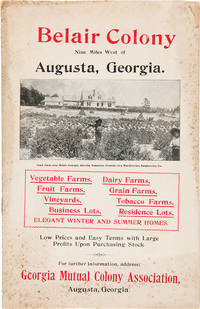
1897WRCAM55574N.p. likely Augusta Ga 1897. 173pp. plus a sample stock certificate from the Georgia Mutual Colony Association laid in. In-text illustrations. Tall octavo. Original pictorial wrappers. Front wrapper soiled around the edges upper corner of front wrapper chipped. Text a bit tanned but clean. Very good. An uncommon promotional for a small agricultural community developed in Georgia in the last decade of the 19th century. The work touts the "extraordinary suitability of the Belair lands for settlement into a prosperous suburban farm and town colony.surrounded by the most favorable conditions and attractive environments." The Belair Colony was comprised of 4000 acres of land near Augusta and most of the directors of the board were Augusta businessmen. The text includes a description of the area in and around Belair and has chapters on the "Plan of Colonization" and the "System of Farming Recommended." The work has numerous photographic illustration showing the Belair railroads housing in the area a "famous spring" in Belair local farmlands watermelon and cantaloupe dealers in Augusta the Richmond County Agricultural Society building a cluster of pears grown near Belair the Augusta high school and fields of sugar cane pears peaches and a poultry farm near Belair. The last three pages include samples of the stock application the title bond and one page of promotional text about Augusta. A sample stock certificate is laid in. OCLC records two physical copies of this rare promotional at Augusta University and the University of Georgia. OCLC 13997010. unknown books
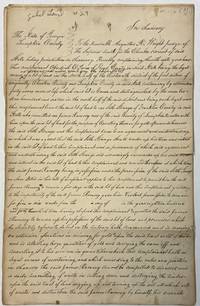
184441397Lumpkin County Georgia 1844. Folio 8" x 12-3/4". Three leaves: 1 1 blank 1 1 blank 2 pp. Completely in ink manuscript. Light tanning old folds minor wear and some short splits at fold edges. Prepared and signed by William H. Underwood as Solicitor for the complainant. Very Good.<br /> <br /> From 1805 through 1832 Georgia used a lottery system to distribute land taken from the Cherokee and Creek Indians. The Georgia Gold Rush began in 1829 and continued through the early 1840s. Separate Gold Lotteries in 1832 and 1833 divided lots into 40 acres and distributed them. The Georgia Gold Rush was the second significant gold rush in the United States and was particularly significant in the county seat of Dahlonega Lumpkin County where it began soon spreading through the North Georgia Mountains. Due to the significant amount of mined gold Congress established the Dahlonega Mint in 1838. By the early 1840s gold became less plentiful and many miners migrated to California for the California Gold Rush. "Dahlonega Gold Museum" Roadside Georgia website accessed on Wayback Machine Internet Archive October 2025; Wikipedia.<br /> Judge A. R. Wright issued a ruling 15 April 1844 enjoining Ramsey "from committing future waste spil or destruction in and upon the lot of land" until further order of the Court and required him to appear and respond to the complaint.<br /> Obadiah E. Payne a/k/a Paine 1807-1892 was a farmer from Floyd County Seth Strange c.1804-1881 was a farmer from Franklin County and James Ramsey c.1798-1869 was a farmer from Cherokee County doing gold mining in Lumpkin County for a time. United States Federal Census records on Ancestry website.<br /> William Henderson Underwood 1779-1859 was a Georgia lawyer a Captain in the War of 1812 and was elected Judge of the Western Circuit of Georgia in 1825. "Sketches of Georgia Lawyers. . . William Henderson Underwood" The Weekly Telegraph 14 June 1867 page 2.<br /> Augustus Romaldus Wright 1813-1894 was an American politician and lawyer who served in the U.S. House of Representatives from 1857-1859 served in the First Confederate Congress organized "Wright's Legion" of Georgia Volunteers and served as a colonel in the Georgia 38th Infantry C.S.A. President Lincoln offered him a position of provisional governor of Georgia in 1864 if the state withdrew from the Confederacy which it did not. "Wright Augustus Romaldus" online Biographical Directory of the United States Congress. unknown
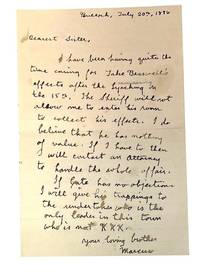
1886954441886. Very Good. Small single sheet. 17 x 11 cm. Handwritten in ink. Single horizontal fold in center with 2 cm. tear on right end. Several individual letters are smeared tears perhaps toward the bottom of the letter. Envelope not present. Text of the letter: "Dearest Sister I have been having quite the time caring for Jake Braswell's effects after the Lynching in the 15th. The Sheriff will not allow me to enter his room to collect his effects. I do believe that he has nothing of value. If I have to then I will contact an attorney to handle the whole affair. If Cate has no objections I will give his trappings to the undertaker who is the only leader in this town who is not KKK. Your loving brother Marcus" Above the word "Lynching" murdering is penciled in. Handwritten in pencil on back and signed in pencil. "Letter to the Hon. Gov. Henry D. McDaniel about Jake Braswell's murder in Bullock Georgia 1886 was Returned un-answered. Marcus." A contemporary newspaper account in an Indiana newspaper reported that Braswell had "horribly mistreated" Dolly Woods a 6 year old white girl who identified Braswell as her assailant after his capture. Braswell reportedly was given the choice of being burned or hanging himself. When he did not follow through on hanging himself Braswell was involuntarily hung and his body riddled with bullets. It is unclear how Marcus and his sister were related or otherwise connected to Braswell. unknown
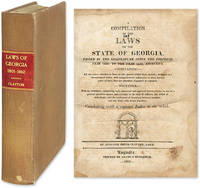
1812616541812. Augusta: Printed by Adams & Duyckinck 1812. Augusta: Printed by Adams & Duyckinck 1812. 1812 Compilation of Georgia Law Georgia. Clayton Augustin Smith Compiler. A Compilation of the Laws of the State of Georgia Passed by the Legislature Since the Political Year 1800 To the Year 1810 Inclusive. Containing All the Laws Whether in Force or Not Passed Within Those Periods Arranged in a Chronological Order With Comprehensive References to Those Laws or Parts of Laws That are Amended Suspended or Repealed: Together with an Appendix Comprising Such Concurred and Approved Resolutions As Are of a General Operative Nature And as Relate to the Duty of Officers The Relief of Individuals And the Settlement of Boundary Between Counties And this State with North Carolina: Concluding with a Copious Index to the Whole. Augusta: Printed by Adams & Duyckinck 1812. vi 708 20 pp. Includes four pages of testimonials. Quarto 10" x 8". Later buckram calf lettering piece to spine endpapers renewed. Some rubbing to extremities light fading to spine later owner bookplates to front pastedown and free endpaper one of Ellis Merton Coulter. Light browning and foxing to text occasional dampstaining. Early annotations to front endleaf interior otherwise clean. A solid copy with a nice provenance. $900. First edition. This was the third digest of Georgia state laws preceded by others from 1801 and 1802. It is digested alphabetically by topic. Ellis Merton Coulter 1890-1981 was a notable American historian of the South and a founding member of the Southern Historical Association. He was known for his glorification of the Old South belief in white supremacy and segregation. Catalogue of the Wymberley Jones De Renne Georgia Library I:346. Babbitt Hand-List of Legislative Sessions and Session Laws 86. unknown books
183830020New York: Harper and Brothers 1838. First Edition. Full calf. Fair. Octavo. 2 vii 414 pages 2 pages ads. Illustrated with 59 maps by James Smith and printed by N. Currier's Lith. N. Y. Brown leather binding with leather title label on the spine. Leather is lightly rubbed on the edges and joints. Front hinge cracked. Rear flyleaf removed. Light to moderate foxing and damp-stains to the text. Old ink inscription of "Marcus A. Bell Atlanta Geo. Oct. 14th 1854" written on the front paste down. Rubber stamp of "A. H. Waite Jr. 1701 W. Paces Ferry Rd. N.W. Atlanta Georgia" located below the inscription. Marcus Bell's name is also written top of the preface page page 2 and page 8 map section. Marcus A. Bell was an attorney from Atlanta and is listed in the book "Pioneer Citizens History of Atlanta" published in 1902. His name was listed on the 1851 Atlanta register. <br /> <br /> Derenne p.462; Willingham and Harwell Georgiana #30. Harper and Brothers unknown
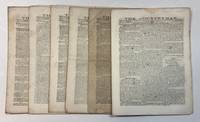
186241734Turnwold Putnam County Ga. 1862. Each issue a folio sheet folded to 8 pp. Each page 9-1/4" x12." Each number printed in three columns per page. No. 12 with a persistent corner chip and occasional small loss. Light foxing. Very Good. EACH ISSUE $250 OR THE ENTIRE RUN FOR $1000<br /> <br /> Crandall does not record Numbers 4 and 5; but AAS which says The Countryman was "suspended intermittently" evidently owns them. Its first printing was March 18 1862. The articles cover an array of subjects including of course much on the War: <br /> This interesting Confederate weekly was printed at Turnwold Turner's Putnam County plantation probably the only wartime newspaper so printed. "Joel Chandler Harris was an apprentice for Joseph Addison Turner. In 1862 Turner decided to produce a newspaper from his home at Turnwold Plantation. In fact in a more-than-semi-autobiographical book Harris wrote called On the Plantation he explains that the printing office for The Countryman was established 'in an outhouse.'. . . As was the typical arrangement for the time Harris worked for Turner in exchange for clothing and boarding at the Turnwold Plantation for the four plus years he apprenticed there. As a printer's devil Harris was responsible for setting and inking the type for the paper on the hand-press individually placing the letters so they were spaced appropriately for printing" "Joel Chandler Harris and The Wren's Nest" December 3 2020 Blog site of American Writers Museum accessed May 01 2026. <br /> Crandall 5152. Not in Parrish & Willingham. unknown
1893WRCAM53817N.p. either New York or Washington D.C. 1893. 45pp. Original printed front wrapper rear wrapper lacking. Unobtrusive institutional ink stamp on front wrapper. Minor toning to paper. Good. A rare pamphlet comprising the defendant's response to the United States Supreme Court in a case regarding funds for the care of former slaves that were supposed to be paid out of the estate of Gazaway B. Lamar according to his will. The plaintiffs argue for the $100000 bequeathed to them in Mr. Lamar's will funds intended "to be devoted to establishing and sustaining one or more hospitals in Augusta and Savannah for colored persons.who have been slaves and their descendants giving preference to those which once belonged to or were hired by me." The respondents' attorney Joseph H. Coates breaks his argument down into five points and in summation states that there simply isn't enough left in the estate to satisfy the claim. The plaintiff's circuit court appeal is present in OCLC in only one copy but there are no physical copies in OCLC of this response from the defendants. OCLC 576732450 digital reproduction. unknown books
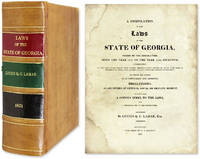
1821589031821. Augusta: Published by T.S. Hannon 1821. Augusta: Published by T.S. Hannon 1821. 1821 Compilation of Georgia Law Georgia. Lamar Lucius Q.C.A. Compiler. A Compilation of the Laws of the State of Georgia Passed by the Legislature Since the Year 1810 to the Year 1819 Inclusive: Comprising All the Laws Passed Within Those Periods Arranged Under Appropriate Heads With Notes of Reference to Those Laws Or Parts of Laws Which Are Amended or Repealed: To Which Are Added Such Concurred and Approved Resolutions As Are Either of General Local or Private Moment: Concluding with a Copious Index to the Laws And a Separate One to the Resolutions. Augusta: Published by T.S. Hannon 1821. iv 1300 pp. Quarto 10-1/2" x 8-1/2". Recent period-style imitation sheep raised bands and lettering pieces and gilt fillets to spine marbled endpapers. Light rubbing to extremities owner bookplate to front pastedown. Light to moderate browning foxing and occasional marginal damp staining internally clean. $1000. First edition. This was the fourth digest of Georgia state laws preceded by others from 1801 1802 and 1812. It is digested alphabetically by topic. Babbitt Hand-List of Legislative Sessions and Session Laws 86. unknown books
183830021New York: Harper and Brothers 1838. First Edition. Leather bound. Fair. Octavo. 2 2 pages advertisements vii 414 pages 4 pages ads 2. Illustrated with 59 maps by James Smith. plates. Brown polished leather binding with leather title label on the spine. Rear joint split lower spine. Light edge wear to the boards. Leather spine is dry scratched and darkened. Heavy toning to the end papers. Moderate foxing to the text. Georgia historian Charles C. Jones Jr. illustrated book plate on the front paste down. <br /> <br /> De Renne p.462; Willingham and Harwell Georgiana #30. Harper and Brothers unknown
186137603Sumter County GA 1861. Manuscript document 7-1/2" x 25." Neat ink manuscript listing after the prefatory sentence quoted in our title 57 names in the first column and names 58-64 in the second column. Similar flourishes in the names suggest that at least many were written in an identical hand. The two columns are separated by a rule in manuscript. Old folds Very Good.<br/><br/> Allen Sherrod Cutts listed as Captain heads this list of 64 volunteers. Cutts raised this Battery of Artillery at the outbreak of the War. The Battery arrived in Virginia after the First Battle of Bull Run and saw action at the Battle of Dranesville. In 1862 Cutts expanded the Battery to a Battalion the 11th Georgia Artillery Battalion as its commander. <br/> Cutts was promoted to Major Lieutenant Colonel both in 1862 and colonel April 1864. The Battalion served in the Artillery Reserve of the Army of Northern Virginia under General Pendleton in the Seven Days Battles; and it fought at Antietam Fredericksburg Chancellorsville and Gettysburg. After the War Cutts entered politics as a Democrat was mayor of Americus-- the County Seat of Sumter County-- and a member of the Georgia General Assembly.<br/>Speicher THE SUMTER FLYING ARTILLERY 2009. Wikipedia article on Cutts. unknown books
1884280East Tennessee Virginia and Georgia Railway Company O'Brien John F. General Superintendent and Flippen T. D. Auditor. <i>East Tennessee Virginia and Georgia Railway Company List No. 14. List of Stations and Names of Agents. </i>ETV&G Railway Office of the Auditor Knoxville January 31 1884. A broadside directory listing the agents by name and by town for the East Tennessee Division and branches for the Alabama division the Atlanta division and the Brunswick division and branches. A broadside sheet 34 cm x 36 cm black ink on white paper fold creases otherwise very good. The ETV&G railway became part of the Southern Railway in 1894. The ETV&G made Knoxville Tennessee a wholesaling center as it provided both passenger and freight rail service to many small communities in Appalachia. East Tennessee, Virginia and Georgia Railway Company books
189553704Augusta GA: Augusta Litho. Co. 1895. First edition. Oblong 8vo. 76 pp. Illustrated portraits scenes of Augusta and the unit's training camp from 1893; profusely illustrated with local ads some illustrated. Includes a brief historical sketch by Charles C. Jones unit rosters biographical sketches for the officers of the Civil War Years a two-page sketch on the unit's Civil War battle flag and a wealth of other information. The unit served throughout the war as a company in the Cobb Legion Army of Northern Virginia. Not in Nevins or Broadfoot. Dornbusch lists no publications for this unit. OCLC locates one copy Georgia. Original illustrated wrappers spine ends chipped. Very good. 509. <br/><br/> Augusta Litho. Co.) unknown books
187656290Macon GA: Macon & Brunswick Railroad Press of Francis Hart & Co. New York 1876. First edition. 8vo. 74 pp. Illustrated engraved views some in text one plate two large folding maps; engraved view on rear wrapper. De Renne catalogue II p. 762 but lacks maps and wrappers. OCLC locates two copies New York Public Virginia. Original printed salmon wrappers eroded at base of spine. Attractive copy of this elaborate promotional. 3796. <br/><br/> Macon & Brunswick Railroad (Press of Francis Hart & Co., New York) unknown books
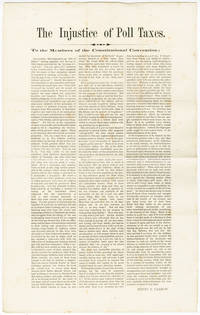
1867WRCAM56202Atlanta 1867. Broadside 15 3/4 x 10 inches. Text printed in three columns. Old folds. Minor foxing spotting and creasing. Very good. An eloquent appeal against the disenfranchising poll tax by a southern champion of Reconstruction. Henry Pattillo Farrow issued this appeal on behalf of the poor of all races in Georgia at a critical moment in the history of Reconstruction and the future of voting rights in the state while the Reconstruction Constitutional Convention was meeting. Georgia led the way in making the poll tax a bulwark against fundamental change in race relations in the South. Despite the opposition presented in this broadside the poll tax was retained in the final draft of the Georgia Reconstruction constitution adopted in 1868 and was carried over in the 1877 revision. <br> <br> After serving in the Confederate Army Farrow was a Georgia state attorney general and a federal district attorney who strove to cooperate with northern efforts at Reconstruction and ensure the state's compliance with the Sherman Reconstruction Bill. Here he argues for removal of a provision in the proposed Reconstruction constitution for the state of Georgia which permitted the imposition of a poll tax for "educational purposes." In part Farrow's statement on the poll tax reads: <br> <br> "There is in the humble judgment of the writer no species of taxation ever assessed by any government more violative of the principles of the science of political economy and of common sense than taxation of that kind. A poll or per capita tax is not upon property; is not upon a profession a trade or a business; but it is a tax on man's inalienable rights - 'life liberty and the pursuit of happiness.' All who are in the enjoyment of those inestimable and inalienable rights ought aid in supporting the Government which protects those rights. There is no disputing that self-evident axiomatic proposion sic. Yet can a man be so poor so destitute as to live without yielding some return in the way of tax to the Government which protects him Can you point to a single citizen of Georgia white or black who pays no tax You can not do it." <br> <br> Scarce with only seven institutional copies recorded in OCLC at Yale Duke Williams College University of West Georgia University of Michigan Vanderbilt and the American Antiquarian Society. Hummel adds a copy at the University of Georgia. A fine example of early and ultimately unsuccessful resistance to the institution of poll taxes in the South. HUMMEL 594. OCLC 191231416 166645823 86110718. unknown books