1 366 résultats
New English Paperback. Roy. 8vo. (24 x 17 cm). In Turkish. 313 p., color ills. Altay communities: Language and literature issues. International Symposium on Altay Communities (3.: 20-22 July 2015: Antalya).
New English Paperback. Roy. 8vo. (24 x 17 cm). In English, Turkish, and Kazakh. 415 p., color and b/w ills., 1 map. Based on proceedings of the "International Symposium on Altai Communities : Migrations and Emergence of Nations" held in Istanbul on 18-19 July 2011. Introduction. Altay communities: Migrations and emergence of nations. Over the course of history, the Altay region has been known as a place where many nomadic tribes and peoples lived, as a kind of simmering pot where common values of civilization, to include professions and crafts, were formed and which were then spread from here by means of various clans and branches to other geographic areas. In this context, the Altay Communities book, which is the product of the symposium supported by ISTESOB, contains 45 scholarly articles in Turkish, English, Russian, Kyrgyz and Kazakh related to the goods and items produced as values of civilization by the peoples who emerged from Altay, their migrations and distribution to various lands and their position as a nation among the others in the world's geography.
Fine English Paperback. Roy. 8vo. (24 x 17 cm). In English and Turkish. [viii], 472 p. Altay dünyasinda gündelik hayat. Proceedings of the 45 Meeting of the Permanent International Altaistic Conference. June 22-27, 2003.= Uluslararasi Sürekli Altayistik Konferans¿ Bildirileri. 22-27 Haziran 2003.
Very Good English Paperback. Pbo. Roy. 8vo. (24 x 17 cm). B/w ills. 12 p. Explanation of positions and benefits of horses found in excavations of Altai, Bazirik Excavations in the terms of Turkic burial customs. Altayda Bazirik Hafriyatinda çikarilan atlarin vaziyetini Türklerin defin merasimi bakimindan izah.
New English Paperback. Pbo. Demy 8vo. (21 x 14 cm). In Turkish. 239 p., ills. Altaylar'a dogru.
Fine Turkish Paperback. Roy. 8vo. (24 x 17 cm). In Turkish. 240 p., b/w ills. Altaylarda kanli günler."
Fine Turkish Paperback. Roy. 8vo. (24 x 17 cm). In Turkish. [xv], 394, [1] p., 49 numerous b/w plates. Altin Ordu ve çöküsü. Translated by Hasan Eren. The history and fall of the Golden Horde. Second Edition. TURCOLOGY Central Asia The Golden Horde Kazan Principality Archeology Sculptures Epigraphy Inscriptions.
Very Good Turkish Paperback. Roy. 8vo. (24 x 17 cm). In Turkish. [xv], 394, [1] p., 52 numerous b/w plates. Altinordu ve çöküsü. Translated by Hasan Eren. Second Edition. The Golden Horde was a Mongol and later Turkicized khanate established in the 13th century and originating as the northwestern sector of the Mongol Empire.
1985X116867Tbilisi, Mecniereba 1985 199 + [1] pp., 21cm., text in Georgian, with a second title page in Russian ("Istorija strany Aluank"), original softcover, good condition, ["History of Aluant country", Georgian text translated from Armenian, with a summary in Russian], cfr. OCLC 22664589, X116867
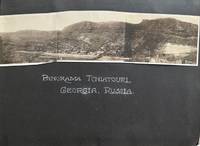
192558598Tchiatouri Georgia & Wallace ID: Georgian Manganese Mining Co. Day Mining Co. ca. 1925-1929. Thick oblong 4to. 11.75 x 8.25 x 2.25 in. 168 pp unpaginated. on thick black paper stock. With 635 silver gelatin photographs sized from 2 x 3 in. up to 8 x 10 in. with the majority sized 3.25 x 5.25 in. nearly all annotated below in neat white ink lettering some w/ annotations somew/in negative indicating negative number those partially lifed from black paper have ink & pencil annotations on versos matching the white ink captions some are RPPC’s w/ captions w/in the negatives at lower fore-edges of image and also present is an 8 page folded manuscript inventory documenting about 400 of the photos closely matching most of the captions. Contemporary flexible black calf Badger post-binder black enamel coated screw-posts a few leaves loose others proud some photos overlapping occasional closed tears a few inner joints neatly repaired at gutter still an outstanding exemplar. This exceptional album provides an essential documentary record of the Soviet era Caucasus of Georgia Azerbaijan Armenia and Abkhazia just a few years after the 11th Red Army invaded Georgia and after a one-week offensive Georgian Bolsheviks took over the country. The album opens with a composite panoramic photo of Tchiatouri notably without the rusting overhead tramways installed by Stalin during the 1950’s. Following the formation of Georgia SSR Tchiatouri and the surrounding regions held some of the largest metallurgical grade manganese in the World and in the 1920’s the Georgian Manganese Company. The subsequent photos depict several of the homes occupied by mine personnel the surrounding region and the main company offices. Many of the photos focus on the local peasants bazaars markets Georgian families fruit markets animal markets and more. Additional photos depict the foreign ex-patriot life in Batum Batumi Adjara with birds-eye views of the city Orthodox churches converted at the time to a Men’s Club as well as tea and banana plantations. Still more photos show Armenian refugees Jewish cigarette boys wine merchants carrying wine in pig skins ox carts horse-drawn street cars village blacksmiths gypsy fortune tellers trained bears and even the local kerosene vendor wagon. Mining operations in Seminoff and Karuto are shown with ore being hauled by ox cart loaded onto rail cars ore crushing mill as well as views of Perevisi Chokruti Shukrut and other ore bearing plateaus their Karuto house. Of additional interest are the photos of the Tchiatouri Monastery a cliffside still functioning convent known as the Mgviemevi Convent featuring a 13th-Century two-nave basilica native village and connecting ore tramways. A series of photos is also devoted to the old Sachakari Modinakhe Castle ruins both inside and out fortifications and local cave dwellings all much more severely damaged decades later in the 1991 earthquake. The compiler has also included photos of the market homes and street scenes in Tiflis as well as the old Roman Walls the local prison Kurdish homes and camel herds along the railway to Moscow scenes along the railroad line between Tiflis & Baku and the Caspian sea port of Russian caviar at Petrovsk. The Harriman Georgian Manganese Co. maintained offices in Moscow and in fact W. Averell Harriman 1891-1986 himself negotiated with Leon Trotsky prior to Lenin’s death and the rise of Stalin forcing him into exile in 1929 for the Manganese mining rights. Many of the photos reveal an extended winter trip through Moscow with a visit to the Kremlin the newly built Lenin’s tomb Red Square the Bolshoi Grand Theater and even a visit to the Polish & Russian Border. After a short trip through France in the midst of rebuilding and Great Britain the couple voyage to Greece Turkey and Palestine. Photos depict Turkish sailboats mosques and street views in Samsun Turkey Constantinople from the Bosphorus the Galata Bridge the Sultan’s palace and Seraglio the Hagia Sophia as well as the old walls. While traveling by rail through Syria and Palestine a series of photos is captioned that the railroad was “made famous by Lawrence in the Revolt of the Desert these pictures taken between Damascus and Tiberius.†The visit through Palestine shows farms Jerusalem the Dome of the Rock Wailing Wall street scenes and the Church of the Nativity. This is followed by tour down the Nile visits to the Pyramids as well as later stops in Somalia Sri Lanka Singapore Saigon Indo-China Hong Kong and Japan. The album is unsigned without ownership markings and has been attributed to Jack Powers and his wife Ruth Fitzgerald Powers 1895-1967 by an unrelated family who held the album. In addition at the rear of the album there are numerous photos of the Day-Hale Co. hunting trips on the Locksaw River in Idaho which included Henry Day Jack Powers E.L. Hale and Dr. Max Smith with Powers clearly identified and closely matching several of the photos depicted in the other parts of the album. Powers began working as a machinist and mechanic with an auto dealership before World War I but by the early 1920’s was actively working as machinery trouble-shooter for Tamarack Custer Mining Co. ad Day Mining Co. subsidiary and also worked as a specialist on compressors. Harriman and his younger brother Roland owned mining operations in Soviet Georgia copper mines in Silesia oil fields in Iran and even a power plant in Poland but after the stock market crash in 1929 they merged with their biggest competitor to become Brown Brothers Harriman & Co. He is perhaps best remembered for development of the Sun Valley Lodge and ski resort in Ketchum Idaho. See: Strishkov & Levine The Manganese Industry of the U.S.S.R. 1986 pp. 7-10; Day Mines Inc. Manuscript Group 306 Records 1921-1985 Univ. of Idaho Special Collections & Archives; Rudy Abramson Spanning the Century: The life of W. Averell Harriman 1891-1986 1992. Georgian Manganese Mining Co., Day Mining Co., unknown
New Turkish Original bdg. HC. Roy. 8vo. (24 x 17 cm). 2 volumes set: (292 p.; 370 p.). Anadolu Beylikleri hakkinda arastirmalar I-II: Vol. I: C?oban-Ogullari Beyligi. Candar-Ogullari Beyligi. Mesaliku?'l-ebsar'a go?re Anadolu Beylikleri. Vol. II: Eratna devleti. Kadi Burhaneddin Ahmed ve devleti. Mutahharten ve Erzincan Emirligi. ISBNs: 9789751600851 / 9789751600868.
Fine English Paperback. Cr. 8vo. (20 x 14 cm). In Turkish. 194, [50] p., b/w ills. Anadolu'da Türk damgasi; koç heykel - mezar taslari ve Türkler'de koç - koyun meselesi. TURKOLOGY Turkish culture Symbols Mythology Central Asia Shamanism Folklore.
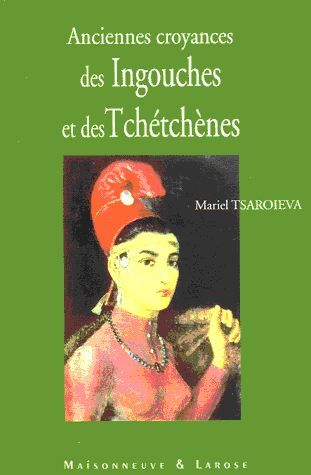
2005110771P., Maisonneuve & Larose, 2005, gr. in-8°, 423 pp, 27 illustrations, 16 pl. en couleurs hors texte, une carte, biblio, broché, couv. illustrée, bon état
2005X76782Paris, Maisonneuve & Larose 2005 423pp., 24cm., br., bon état, X76782
423pp., 24cm., br., bon état, X76782
In-8° (cm. 25,3x16,2), pp. 6 (da p. 249 a p. 254) + 4 FIGURE di CRANI in 2 TAVOLE litografiche (Imp. A. Roux, Lyon) fuori testo. (2 crani dalla necropoli di Samthavro presso Tiflis, e 2 dal "tumulus de Corveissiat - Ain). Brossurina verdolia editoriale muta. CHANTRE, archeologo, antropologo e naturalista, docnete, editore della rivista Materiali per la storia primitiva e naturale dell'uomo (15 vol.). Dal 1873 al 1913 partecipò a vari viaggi di studio in Grecia e Turchia (1873), Russia, Caucaso e Crimea (1879), Asia Minore (1881), Europa centrale (Italia, Austria 1883), Russo Armenia (1890) in Turchia asiatica (1892), Cappadocia e Cilicia (1893-1894), Egitto (1897 e 1905), Tripolitania (1907-1908), Tunisia ed Algeria (1908-1913). EstratTo ignoto a SBN. Ottimo es.
Fine English Paperback. 4to. (30 x 21 cm). In English. [iv], 120, [1] p., 7 color plates, 34 b/w plates in text, 1 folding map. The handbook of Turkish culture supplement to vol. II, section of the history of art. TURCOLOGY Turkish / Turkic art Turkestan Central Asia History of art Turkish culture Turkish history Archaeology Buddhism Manichaeism.
New New English Original bdg. Dust wrapper. Roy. 8vo. (23 x 17 cm). In English. 622, [1] p., color and b/w ills. This book has been reprinted on the basis of the book 'Azerbaijani poetry. An anthology' published by Progress Publisher in Moscow, 1977. Anthology of Azerbaijani poetry. (Azerbaijani classics). Edited by Neil McGowan. Translated by Tom Botting et alli.
Moscou, 1893, 8vo stralcio con copertina posticcia muta, pp. 43/56 con 3 tavole in fototipia. - !! ATTENZIONE !!: Con il termine estratto (o stralcio) intendiamo riferirci ad un fascicolo contenente un articolo, completo in se, sia che esso sia stato stampato a parte utilizzando la stessa composizione sia che provenga direttamente da una rivista. Le pagine sono indicate come "da/a", ad esempio: 229/231 significa che il testo è composto da tre pagine. Quando la rivista di provenienza non viene indicata é perché ci è sconosciuta. - !! ATTENTION !!: : NOT A BOOK : “extract” or “excerpt” means simply a few pages, original nonetheless, printed in a magazine. Pages are indicated as in "from” “to", for example: 229/231 means the text comprises three pages (229, 230 and 231). If the magazine that contained the pages is not mentioned, it is because it is unknown to us.
New Turkish Paperback. Cr. 8vo. (20 x 14 cm). In Turkish. 194 p., b/w ills. Apsuwa Fuat: Içimden onlari anlatmak geldi.
Fine English Paperback. Roy. 8vo. (23 x 16 cm). In English and Turkish. 78 p., b/w ills., 24 color plates. Nahçivan'da arkeolojik arastirmalar, 1998. [= Archaeological survey in nakhichevan, 1998].
Fine English Paperback. Pbo. Roy. 8vo. (24 x 17 cm). In English and Turkish. 78, [2], xxiv p., 53 numerous color plts. Archaeological survey in Nakhichevan.= Nahçivan'da arkeolojik arastirmalar.
1991LFA-126740210N° 269 (Juin 1991) : 86 pages, format 215 x 285 mm, illustré, broché couverture couleurs, bon état
1992LFA-126740216N° 276 (Février 1992) : 78 pages, format 215 x 285 mm, illustré, broché couverture couleurs, bon état
New New English Original bdg. Dust wrapper. Large roy. 8vo. (23 x 18 cm). In English. 293, [4] p., color and b/w ills. Architects of Baku. Late XIX - early XX centuries. Baku is built in a single architectural - planinng gasp during 25 years, from 1880-1914. All historic blocks, main motorways of the city have been formed around the ancient city of Icherisheher. A number of architects, including Gasin Bey Hajibababeyov, Gafar Izmialov, Ziverbey Ahmadbeyov, E. I. Skibinsky, Fon der Nonne, P. Stern, I. Edel, A. Eichler and other have created architectural palette owing to local customers and oil-tycoons, such as H. J. Taghiev, Musa Naghiev, Shamsi Asadullaev (he was called the king of oil and kerosene) Isa bey Hadjinski, Teymur Bey Ashurbeyov and many others.