BEUCLER, André.Livre Rare Book

1 366 résultats
89065Paris, Editions Emile-Paul Frères 1931, 210x140mm, frontispice, 84pages, broché, couverture rempliée. Edition originale sur papier vélin Lafuma, numérotée n.° 839 / 1650. Bel exemplaire.
191933046Paris, Emile-Paul, Collection " Ceinture du Monde ", 1931. In-8 broché (20 x 15 cm), couverture illustrée et rempliée, 107 pages, illustré d'un frontispice sous serpente, réalisé par Pierre GUASTALLA. Edition originale : Un des 1500 exemplaires numérotés sur vélin Lafuma-. Pierre GUASTALLA. (1891-1968) est un peintre, illustrateur, graveur sur cuivre, xylographe et lithographe français. - Exemplaire en très bon état.
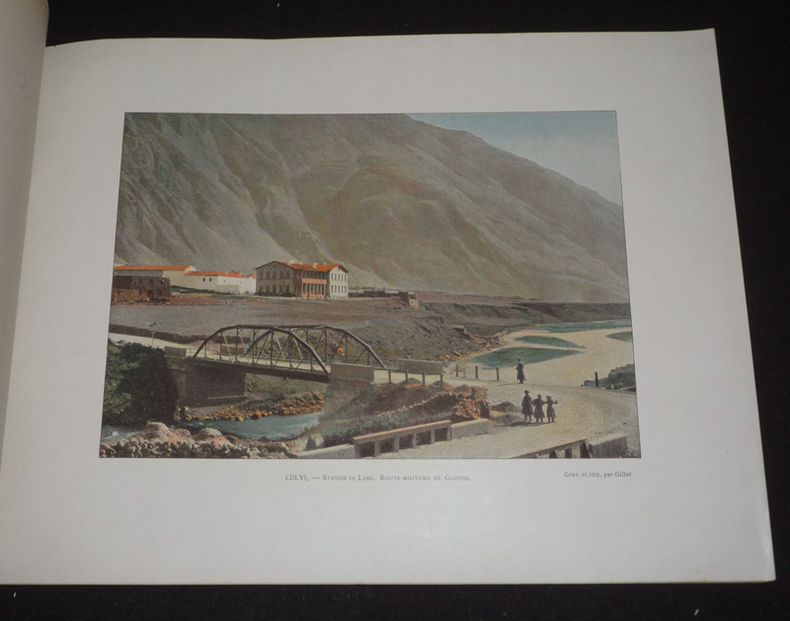
mz431L. Boulanger, éditeur Autour du monde Fascicule In-4 (32 x 24,3 cm), format à l'italienne, fascicule, non paginé, sans date, gravures en couleurs ; bords des plats brunis, bel état. Livraison a domicile (La Poste) ou en Mondial Relay sur simple demande.
1992X71464Paris, Peeters 1992 533pp. + 4 tables ajoutées, 24cm., in the series "SELAF" no.332, br., bel état, X71464
Lausanne, Editions Rencontre 1969. In-8 relié plein cartonnage illustrée de l'éditeur, 192 pages. Photos en noir d'Armand DERIAZ.Collection "l'atlas des voyages" .
xxii + 614pp. Illustraed with 39 maps & 8 plates out of text + one large folding map loose in rear pocket, 24cm., publisher's hardcover with gilt lettering, reprint of the original Cambridge University Press 1953-edition, text and interior are clean and bright, good condition, weight: 1.2kg., X111390
Milano, 1942, stralcio con copertina posticcia muta, pp. 589/596 con una cartina e numerose fotografie. - !! ATTENZIONE !!: Con il termine estratto (o stralcio) intendiamo riferirci ad un fascicolo contenente un articolo di rivista, sia che esso sia stato stampato a parte utilizzando la stessa composizione sia che provenga direttamente da una rivista. Le pagine sono indicate come "da/a", ad esempio: 229/231 significa che il testo è composto da tre pagine. Quando la rivista di provenienza non viene indicata é perchè ci è sconosciuta. - !! ATTENTION !!: : NOT A BOOK : “estratto” or “stralcio” means simply a few pages, original nonetheless, printed in a magazine. Pages are indicated as in "from” “to", for example: 229/231 means the text comprises three pages (229, 230 and 231). If the magazine that contained the pages is not mentioned, it is because it is unknown to us.
Mm 135x210 Brossura editoriale di pp. 127, in buono stato. SPEDIZIONE IN 24 ORE DALLA CONFERMA DELL'ORDINE.
533pp. + 4 tables ajoutées, 24cm., in the series "SELAF" no.332, br., bel état, X71464
Good Turkish Paperback. Some foxed. Cr. 8vo. (20 x 14 cm). In Turkish.1 b/w portrait, 38 p. Rare. First Edition. Celâl Sahir Erozan. Hayati ve eserleri.
New English Paperback. Pbo. Roy. 8vo. (23 x 16 cm). In Turkish. 314 p. Cengiz Aytmatov kitabi. Collected articles on Cnegiz Aytmatov, (1928-2008). TURKISH LITERATURE Author Kyrgyz culture. 314 p.
New Turkish Paperback. Roy. 8vo. (24 x 17 cm). In Turkish. 60 p., color ills. Cengiz Han ve mirasçilari. Büyük Mogol Imparatorlugu. [Exhibition booklet]. Sabanci University, Sakip Sabanci Museum, 7 December 2006 - 8 April 2007. Edited by Samih Rifat.
Very Good English In contemporary hardcover made as saved original covers on cloth's faces. Roy. 8vo. (24 x 17 cm). In Turkish. [iii], 124, [5] p. Cengiz Han'dan Stalin'e. veya 1-) Sevkulceysî bir manevranin teselsül ve tehavvülü. 2-) (Komünizm - Fasizim mücadeleleri) 1205-1939. Translator: Süruri Akalin.
New English Paperback. Pbo. Roy. 8vo. (24 x 17 cm). In English. [x], 173, [1] p. Central Asian monuments.
New English Paperback. Pbo. 4to. (24 x 20 cm). In English. 684 p. Ills. "Since the time I became a lecturer, I have always desired to be a different and out of the ordinary academic. I have wanted to be different for my students; I have avoided things everyone does and desired to tell them that there is a real world outside that is not comparable to what the course books teach. I have advised them to think objectively and scientifically, read and assess the proper sources to reach for the truth, use their reasoning skills, and read and study much if they choose to have an academic career like I did. I have also advised them to absolutely experience abroad. As a researcher, writer, traveler. To get to know a country, introduce it, and observe th truths about it within its borders".
Very Good English Modern full dark red leather bound with traditional embossing. Roy. 8vo. (23 x 16 cm). In German. [viii], 351 p. First German Edition. This copy from Zeki Velidi Togan's library. Ármin Vámbéry, also known as Arminius Vámbéry was a Hungarian Turkolog and traveller. Vámbéry was especially attracted by the literature and culture of the Ottoman Empire including Turkey. After spending about a year in Constantinople, he published a German-Turkish dictionary in 1858. Later, he also published various other linguistic works. He also learned some twenty other Turkish languages and dialects. Returning to Budapest in 1861, he received a stipend of a thousand florins from the academy, and in the autumn of the same year, disguised as a Sunni dervish, and under the name of Reshit Efendi, he set out from Constantinople. His route lay from Trebizond on the Black Sea to Tehran in Persia, where he joined a band of pilgrims returning from Mecca, spending several months with them traveling across Central Iran (Tabriz, Zanjan, and Kazvin). He then went to Shiraz, through Ispahan, and in June, 1863, he reached Khiva (Central Asia). Throughout this time, he succeeded in maintaining his disguise as "Reshit Efendi," so that upon his arrival at Khiva he managed to keep up appearances during interviews with the local khan. Together with his band of travelers, he then crossed Bokhara and arrived at Samarkand. Initially, he aroused the suspicions of the local ruler, who kept him in an audience for a full half-hour. Vámbéry managed to maintain his pretences, and left the audience laden with gifts. Upon leaving Samarkand, Vámbéry began making his way back to Constantinople, traveling by way of Herat. There he took leave of the band of dervishes and joined a caravan to Tehran, and from there, via Trebizond and Erzurum, to Constantinople, arriving there in March 1864. This was the first successful journey of its kind undertaken by a European; and since it was necessary to avoid suspicion, Vámbéry could not take even fragmentary notes, except by stealth. After a long and perilous journey he arrived back at Pest in May 1864. He went to London to arrange the English language publication of his book about the travels. "Travels in Central Asia" and its Hungarian counterpart "Közép-ázsiai utazás" were published in 1865. Thanks to his travels Vámbéry became an internationally renowned writer and celebrity. He became acquainted with members of British social elite. The Ambassador of Austria in London gave him a letter of recommendation to the Emperor, who received him in an audience and rewarded Vámbéry's international success by granting him professorship in the Royal University of Pest.
24786Genève, Perret-Gentil 1963, 213x148mm, 45pages, broché sous jaquette. Bel exemplaire.
Fine English Original cloth bdg. Large roy. 8vo. (25 x 17,5 cm). In English. 579 p., 54 numerous b/w plates and musical scores. Ethnic origins and history of the Chuvash.; Chuvash folksongs collections.; Hungarian studies of Chuvash folk music.; Dialects and melody types of Chuvash folk-music.; Musical features of Chuvash folksongs: Note-sets, forms, melodic lines, metre, rythym, syllable-number.; Experimentation by instrumental measurement.; Songs relating to the life and customs of the Chuvash people.; The Chuvash language, The origins of Chuvash, its development, dialects and literary usage, The phonetic system and the method of transcription followed in this volume.; Stylistic and poetic features of the songs.; How the songs were collected, systematized and edited.; Explanations of symbols.; Order of tunes.; Chuvash folksongs (1-350); English translation of the song-texts. Notes.; Hungarian translation of the song-text.; Indexes.; Bibliography. MUSIC Ethno-musicology Turkology Chuvash peoples Central Asia Folk culture Ballad.
New English Original bdg. HC. 4to. (30 x 21 cm). In Turkish with English abstracts. 2 volumes set: (660 p.; 663 p.), b/w and color ills. CIEPO 22 Symposium: Comite International des Etudes Pre-Ottomanes et Ottomanes, 4-8 October 2016, Trabzon, Turkey.= CIEPO 22 Sempozyum. Uluslararasi Osmanli Öncesi ve Osmanli Çalismalari Komitesi. Bildiriler kitabi. 2 volumes set.
New English Paperback. Pbo. Demy 8vo. (21 x 14 cm). In English and Turkish. 1-217 pp. articles in Turkish; 218-437 pp. articles in English. Circassian Exile, 147th anniversary: May 21, 1864.= Büyük Çerkes Sürgünü, 147. yil: 21 Mayis 1864. Contents: Foreword.; For the historians and diaspora Cherkassians who ignore the forced exile and genocide, Prof. Dr. KEmal Karpat.; Emigrants of the Caucasus, (1860-1870), Prof. Dr. Abdullah Saydam.; "Biscuits for the distressed Circassians': The Great Circassian immigration in British archival documents, (February 1864- May 1865), Dr. Nazan Çiçek.; The tragedy of 1864, Doç. Dr. Cahit Aslan.; The Circassian Genocide, Antero Leitzinger.; The Circassians: A forgotten genocide?, Stephen D. Shenfield.; Between exoticism, geopolitics and ignorance: The search for a post-colonial Circassian history, Irma Kreiten.; Circassians in history, Paul B. Henze.; The defeat and deportation of the Circassians, Doç. Walter Richmond.; The Russian final subjugation of Northwestern Caucasus: Colonial atrocities and European responsibilities, Irma Kreiten.; The settlement of Caucasia emigrants via Samsun and Trabzon ports, Doç. Dr. Ayse Pul.; Circassian world: Responses to the new challenges, Sufian Zhemukhov. CAUCASUS & CENTRAL ASIA Circassian culture Circassians Politic - Social history Tsarist Russia Russian relations.
Fine English Paperback. Pbo. Demy 8vo. (22 x 14 cm). Bilingual in English and Turkish. 19, 19 p., 10 numerous b/w photos. Circassians in Istanbul.= Istanbul Çerkesleri.
In 8, pp. 56 + (56). Intonso. Br. ed. Traduzione francese, seguita dalla versione originale in arabo, di questo studio del patriarca Macaire sulla conversione al Cristianesimo della Georgia nel IV secolo. La Georgia fu uno dei primi stati cristiani, seconda solo all'Armenia. All'inizio del VI secolo la Chiesa georgiana si separo' da Roma (come qualla armena).
Fine Turkish Paperback. Cr. 8vo. (20 x 14 cm). In Turkish. 175 p. Cografyanin dirilisi. Modern travels in the Middle East and Central Asia.
New English Paperback. Pbo. Roy. 8vo. Mint. [xii], 91, [1] p. In English. Colors in the Turkish beliefs and national customs yellow-red-green. The people and communities originated from the Turkish race were spread from two main streams: Oghuz and Kipchak - The Oghuz group consisted of twenty four tribes who were referred in many national sources started with Mahmud of Kashgar. The Kipchak originated communities who settled in Asia from North East to North West, in Eastern Europe -even in Western Europe-, and in Caucasus were divided also into 24 groups. The Kipchaks like Oghuzs had 24 different seals (damga, tamga, tamka), however we do not have related scientific public opinion unfortunately. Regarding the relations of Turkish communities settled in Anatolia with the other communities coming from the same origin, the historic, sociological and ethnographic sources are necessary to be restudied.