Comision del Mapa Geologico de EspanaBiblio.com
1 605 résultats
1390876098.Gpaperback. Good. Access codes and supplements are not guaranteed with used items. May be an ex-library book. paperback
1396031936.Ghardcover. Good. Access codes and supplements are not guaranteed with used items. May be an ex-library book. hardcover
1391804805.Ghardcover. Good. Access codes and supplements are not guaranteed with used items. May be an ex-library book. hardcover
139661916X.Ghardcover. Good. Access codes and supplements are not guaranteed with used items. May be an ex-library book. hardcover
1396479082.Ghardcover. Good. Access codes and supplements are not guaranteed with used items. May be an ex-library book. hardcover
1391101421.Gpaperback. Good. Access codes and supplements are not guaranteed with used items. May be an ex-library book. paperback
1391306767.Ghardcover. Good. Access codes and supplements are not guaranteed with used items. May be an ex-library book. hardcover
1391437977.Gpaperback. Good. Access codes and supplements are not guaranteed with used items. May be an ex-library book. paperback
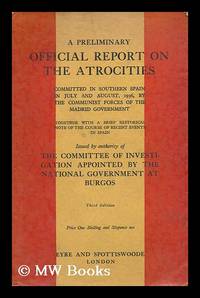
1936185428London : Eyre and Spottiswoode 1936. Third Edition. Paperback. Very good copy in the original stiff-card wrappers; edges slightly nicked and dust-dulled as with age. Particularly and surprisingly well-preserved; tight bright clean and strong.; 8vo 8"" - 9"" tall; 71 pages; Physical desc.: 71 p. 16 leaves of plates ; 25 cm. Subject: Spain --History --Civil War 1936-1939. London : Eyre and Spottiswoode paperback
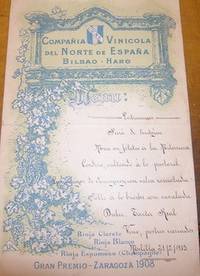
68-5025Zaragoza Spain: Compania Vinicola Del Norte De Espana Bilbao 1913. 4to. Folded Card. Very Good. Scarce. En Francais. Stamped on verso. Inked Menu items. Illustrated. Zaragoza, Spain: Compania Vinicola Del Norte De Espana Bilbao, 1913. unknown
19346677Madrid: Ferrocarriles del Norte de España y de Madrid a Zaragoza y Alicante lo edeitan 1934.- 145 p.: Profusión de estados varios plegados; 4° mayor 27 x 205 cm; Excelente impresión sobre papel ahuesado de alta calidad; Cartulina Ed.- Compañía de los Ferrocarriles del Norte de España y de Madrid a Zaragoza y a Alicante.- RARO. La cubierta anterior con ligeras rozadura. FERROCARRILES TRANSPORTES RED VIARIA Y OBRAS PÚBLICAS EN GENERAL Libro en español Ferrocarriles del Norte de España y de Madrid a Zaragoza y Alicante paperback
2026x-9819825652World Scientific Publishing Co Pte Ltd 2026. Hardcover. New. 440 pages. 6.00x0.69x9.00 inches. World Scientific Publishing Co Pte Ltd hardcover
16154007Ãvila and La Horcajada 1615. <p>Manuscript on parchment 380 x 270 mm. 18. Complete. Contents: ff. 1r-4v: Regla in Spanish in 30 numbered sections inconsistent numbering on ff. 3v-4v in a rounded script in brown ink the first page slightly larger up to 27 lines. F. 1r: incipit first four lines in large lettering with very large calligraphic initial: En el nombre de dios todo poderoso padre y hijo y espiritu sancto tres personas y una esencia. Section 30 f. 4v added in a slightly later hand. The word Cruz symbolized by a red Maltese cross. Text on ff. 2r-2v underlined in red. Calligraphic initials some with marginal extensions in brown purple or red. Marginal drawings of prickly foliage some in the shapes of fantastic animals. Later marginal notes opposite many sections. Ff. 5r-5v: Heading: Este es traslado de un testimonio followed by two notarial subscriptions on f. 5v one partially in cursive signed and dated Ãvila 11 May 1527 the other in italic partly faded including the date 1615. F. 6r: A cerca de la procession de la Resurrection. After an introductory portion in a small round early 16th-century hand in brown ink the text continues from f. 4v with sections 32-37 of the Regla of which sections 33-37 are in a later sixteenth-century hand; these sections ruled through with light diagonal lines. Signatures or notes in lower margin. F. 6v: blank except for five lines heavily cancelled in red. Ff. 7r-7v: five paragraphs in a fine upright italic hand the first and third with headings in red La orden que han de tener en la procession de la Resurxection sic en la faded and illegible…; La orden que sea de tener en la procession de la Resurretion sic en el domingo de pascua es la siguente. Followed on f. 7v by a note in a different hand dated from La Horcajada 21 May 1550. Ff. 7v-8v and back inner cover: later additions some quite faded. A few later marginal annotations throughout.<br /> Rubrication and decoration: headings and line fillers in red a few ornamented line fillers or borders some passages underlined in red or light purple else ruled in dry point numerous calligraphic initials in red or brown ink opening initial with purple filigree extension filling left margin numerous foliate vegetable and zoomorphic ornamental designs in the margins in red purple and brown ink.<br /> Binding: stitched into the original parchment cover with title “Regla de la Pasion†in large letters the R with decorative extensions above a large cross in green ink entwined with the snake and in the margins apparently the instruments of the Passion.<br /> Condition: rubbing and staining vertical crease from folding causing occasional erasure of text outer edge of first page somewhat rubbed affecting legibility of text some words at line ends helpfully written over in a later hand the inks used in the last two leaves quite faded; wrapper worn and darkened with tears at top and 3 small holes in lower cover.<br /> Provenance: Confraternity of the Holy Cross of Horcajada; purchased in France with export license.  <br /> <br /> An early Spanish confraternity manuscript containing the rules and statutes that governed the Confraternity of the Holy Cross referred to as the CofradÃa or Hermandad de la Cruz the word Cruz being supplied by a Maltese cross in red of La Horcajada a town located in Castile y León in the province of Ãvila. As in other Roman Catholic countries confraternities or lay brotherhoods played a vital role in community life in Spain functioning as mutual aid societies and venues for laypeople to express their piety and perform charitable acts. Vernacular manuscript confraternity statutes from the Iberian peninsula surface much more rarely than for example their Italian counterparts although it appears that Spain had a larger number of confraternities proportional to the population especially in Castile y Leon than the other Catholic lands. Virtually every community including small villages had at least one confraternity. While exact numbers of confraternities in sixteenth-century Spain are unknown “studies carried out for a number of cities suggest that the number of confraternities and brotherhoods in the Hispanic kingdoms was larger than elsewhere in Catholic Europe. The reasons behind the extraordinary popularity of confraternities and brotherhoods in the Hispanic kingdoms cannot yet be established however in view of the current state of research on the topic. There has been a tendency for scholars to emphasize the confraternity as a primarily urban phenomenon a reflection perhaps of their early development in Italy where they formed an essential part of civic and urban life. In the Hispanic kingdoms however these institutions were equally important in the religious and social life of the small village. Pastoral visitations carried out by the bishops of Cuenca during the sixteenth century found that `nearly every community had at least one brotherhood’ even small villages of 500 inhabitants. A similar pattern prevailed in villages around Toledo during the late sixteenth century†Callahan pp. 18-19.<br /> <br /> In his article on Spanish confraternities William Callahan further points out their popular nature which “arose from the initiative of the laity rather than the clergy prime examples of the lay piety that began to flourish in late medieval Europe. This piety developed largely on its own uncontrolled by either local bishops or the pope both of whom regarded its manifestations with some suspicion. The resiliency of traditional confraternities and brotherhoods developed from their connection to local religious cultures. It also reflected a fact noted by scholars who have studied specific cities and regions the strongly popular character of membership. There were of course some associations that limited membership to the nobility or clergy but in most cases members were recruited from the popular classes. This was obviously true in the case of peasant villages where only one or two confraternities existed.†pp. 22-23. In spite of the centrality of confraternities to early modern religious life in Spain there is comparatively little modern scholarly literature especially on the rural confraternities. Note the absence for example of any articles on Spain or Portugal in Brill’s recently published Companion to Medieval and Early Modern Confraternities edited by Konrad Eisenbichler.<br /> <br /> This working manuscript bears witness to this central but understudied aspect of Spanish popular religious culture before the restrictions placed on confraternities by the Council of Trent and succeeding Popes. Consulted frequently and contributed to by members of the confraternity the manuscript includes abundant interlinear and marginal additions and corrections and half- or full-page later additions. The town of La Horcajada is identified in the opening page. Ff. 1r to 5v contain the introduction the first 30 statutes and a notarized testimony with heading “Este es traslado de un testimonio†which relates to the apparently recent establishment of the confraternity. The statutes cover admission of new members general rules of comportment requirements of prayer and confession for feast days and for the canonical hours charity for poorer members of the confraternity chants etc. Several paragraphs relate to processions including required habits and admission of non-members into the processions. On f. 6r a paragraph on the procession de la Resurrection is followed by six entries numbered 32 to 37 of which paragraphs 33 to 37 are in a later 16th-century hand. Several light diagonal lines through these five paragraphs may indicate that they were cancelled. The verso f.6v contains only five lines heavily cancelled in red ink and f. 7r continues discussion of the procession of the Resurrection on a feast day the name of the saint is smudged and on Easter Sunday in a different 16th-century upright cursive. This second section of which portions are difficult to read because of fading ends on f. 7v and is followed by a note in a larger hand dated from La Horcajada 21 May 1550. The final leaf and inner back cover contain later additions some quite faded. One late addition in the lower margin of f. 5v is dated 1615.<br /> <br /> The manuscript is decorated in a popular style. Some of the leafy plant designs have a thorny look that may reflect local vegetation. Animals and grotesques include a scorpion-like creature birds and possibly imaginary mammals. A witness to the central role played by religious confraternities in early modern Spain bearing the marks of its use and in original condition it is a rare survival and would repay further study.<br /> <br /> Cf. William Callahan “Confraternities and Brotherhoods in Spain 1500-1800†Confraternitas: The Newsletter of the Society for Confraternity Studies 12:1 2001 17-25. See also William A. Christian Local Religion in Sixteenth Century Spain Princeton 1981; Maureen Flynn Sacred Charity: Confraternities and Social Welfare in Spain 1400-1800 Basingstoke 1989.</p> unknown
0366255886.Ghardcover. Good. Access codes and supplements are not guaranteed with used items. May be an ex-library book. hardcover
036592427X.Gpaperback. Good. Access codes and supplements are not guaranteed with used items. May be an ex-library book. paperback
1273789512.Gpaperback. Good. Access codes and supplements are not guaranteed with used items. May be an ex-library book. paperback
1274118042.Gpaperback. Good. Access codes and supplements are not guaranteed with used items. May be an ex-library book. paperback
1276473745.Gpaperback. Good. Access codes and supplements are not guaranteed with used items. May be an ex-library book. paperback
127988861X.Gpaperback. Good. Access codes and supplements are not guaranteed with used items. May be an ex-library book. paperback
1012004244.Ghardcover. Good. Access codes and supplements are not guaranteed with used items. May be an ex-library book. hardcover
1274133440.Gpaperback. Good. Access codes and supplements are not guaranteed with used items. May be an ex-library book. paperback
1274130921.Gpaperback. Good. Access codes and supplements are not guaranteed with used items. May be an ex-library book. paperback
1279544937.Gpaperback. Good. Access codes and supplements are not guaranteed with used items. May be an ex-library book. paperback
1573B556<p>Mexico City 9th day of March1573 size 450 x 320mm</p><p>SIR FRANCIS DRAKE'S ENGLISH PIRATES</p><p>Arrest Warrant For English Pirates Signed By The First Inquisitor of New Spain in 1573</p><p>Remarkable arrest warrant signed by the Inquisitor of New Spain directing the arrest and capture of 5 accused heretics including two English Pirates who had recently completed a daring jail break from prison in Mexico City.</p><p>This is an official arrest warrant dated March 9 1573 ordered by Pedro Moya de Contreras c. 1528-1591 first inquisitor of the newly founded Mexican Inquisition addressed to Don Alonso Sánchez de Miranda Dean of Guadalajara.</p><p>Moya de Contreras arrived in New Spain in 1571 as the newly appointed inquisitor thereafter rising to the office of Archbishop of Mexico City and finally Viceroy of New Spain 1584-1585. This two-fold letter is part of the legacy of the Inquisition in the New World aimed at ecclesiastical authorities and their flock to raise awareness of the rampant menace of Lutheran individuals in Mexico.</p><p>Following the failed attempt by the fabled pirates Francis Drake and John Hawkins to seize San Juan de Ulúa in 1568 about 500 mostly English pirates remained stranded in New Spain. Over the course of the next several years these 500 scattered throughout Mexico where they intermingled with the locals. Some 77 of these fell into the hands of Luis Carvajal the elder alcalde mayor of Tampico. Carvajal a converso was the patriarch of the Carvajal family which was later tragically tortured and murdered by the Inquisition as crypto-Jews. They were delivered to Mexico City as prisoners of war and were given relatively minor sentences of forced labor in various places throughout Mexico.</p><p>With the arrival of Moya de Contreras in 1571 the remaining pirates were no longer considered as mere prisoners of war but as heretics - "Luteranos" - and as such subject to the Inquisition's regulations. In 1572 Pedro Moya de Contreras issued a general order for all remnants of the Hawkins expedition to be apprehended and put to trial in New Spain. As a result about 36 were again rounded up captured and condemned for heresy. This group was processed through the Inquisition's court where they were subjected to a grand auto-da-fe in 1574 the largest ever held.</p><p>Three of these pirates are mentioned in Moya's letter to Don Alonso Sánchez de Miranda:</p><p>"Guillermo de Siles a Frenchman of 24 years of age small in height with pale features with little growth of hair on his face small blue eyes ."</p><p>"Pablo Haquines de la Cruz Paul Hawkins an Englishman who came with the armada of John Hawkins with sturdy shoulders and pale features with little growth of hair on his face of about 20 years of age ."</p><p>"Andres Martin Andrew Martin an Englishman with those from the said armada young man without growth of hair tall and slim with pale features of about 18 years of age."</p><p>The three had escaped from the Jail of the Inquisitor by burrowing under the walls of the cell in the middle of the night an escape which was apparently previously unrecorded. The arrest warrant provides that should anyone contravene the order or give aid to these heretics they will face the prospect of "latae sentenciae excommunication" including the sequestration of their possessions.</p><p>The actions of Pedro Moya de Contreras at that time under the supervision of Pedro de los Ríos chief inquisitor in Mexico clearly reflect all new precepts and creeds from the Tridentine Council 1545-1563 brought along to the New World to reform the Catholic faith.</p><p>The following is an English Translation of the arrest warrant provided by Boris Bruton:</p><p>We doctor don Pedro Moya de Contreras apostolic inquisitor against vile heresy and apostasy for the city of Mexico and Provinces of New Spain by our authority apostolic etc. order you Reverend don Alonso Sanchez de Miranda dean of Guadalajara commissary of this Holy Office to arrest the persons of Gomes de Leon his Majesty's servant or His Majesty's scribe resident of Puebla de Los Angeles a man of about 30 years old very fair of complexion of a good height wearing breeches with a short green cape; and Francisco Gonzales captain resident of Toluca elderly man of about 50 years grey-haired short in size scant beard hooked nose and tanned as though coming from the mountains dressed all in black. And William de Siles Frenchman about 24 years old short fair complected scant blond beard small blue eyes dressed in doublet and pants of coarse cloth; And Pablo Hawkins de la Cruz Englishman one of those who came on the fleet of John Hawkins young man somewhat stooped heavy-set fair beardless about 20 years old. And Andrew Martin Englishman member of the same fleet young man beardless lanky fair about 18 years old. Both of these are fluent in Spanish.</p><p>Last Sunday. All these men last Sunday night the eighth of this month about midnight burrowed through one of the cells of this Holy Office and escaped. These men you may seize and remove from any church or any other sacred exempted place whether in your district or outside of it in your own person or others whom you shall choose by authority of this letter or in prosecution of this our order as authorized on your own authority relaying my own warning and order with respect to all the other towns and cities of your bishopric. You are to order announce and publish this order so that no person whether he be Spanish or indian of whatever class or distinction shall receive hide shelter help on their way give any benefit or supplies or mounts horses to them;</p><p>and anyone who shall have information concerning these felons shall it to you or whomever you will have designated for this. Those who act contrary to this will be liable for prosecution for having received and sheltered heretics and in addition they shall incur the penalty of automatic excommunion excommunion latae sentenciae and forfeiture of all their property. To accomplish all the foresaid we give the power and authority for any person Spanish mestizo indian negro or mulato even if he has not been appointed officially by you to arrest these men as noted so that if anyone has given shelter or concealed them let a report be made of it and send it to us without delay.</p><p>Written in Mexico City the 9th day of March 1573.</p><p>Signed Doctor Moya de Contreras / by order of the Señor Inquisitor / Pedro de los Rios</p><p>Condition Description: ALS 2 ff. both folios tide marked on both left and right margins extending into written area both folios with loss to fore margins but written area unaffected.</p><p>Please go to www.marshallrarebooks.com for many more books on this subject.</p>
2008Q-0520258649University of California Press 2008-11-12. Hardcover. New. New. In shrink wrap. Looks like an interesting title! University of California Press hardcover