Varillas, Antoine (pseud. le sieur de Bonair)Livre Rare Book
102 résultats
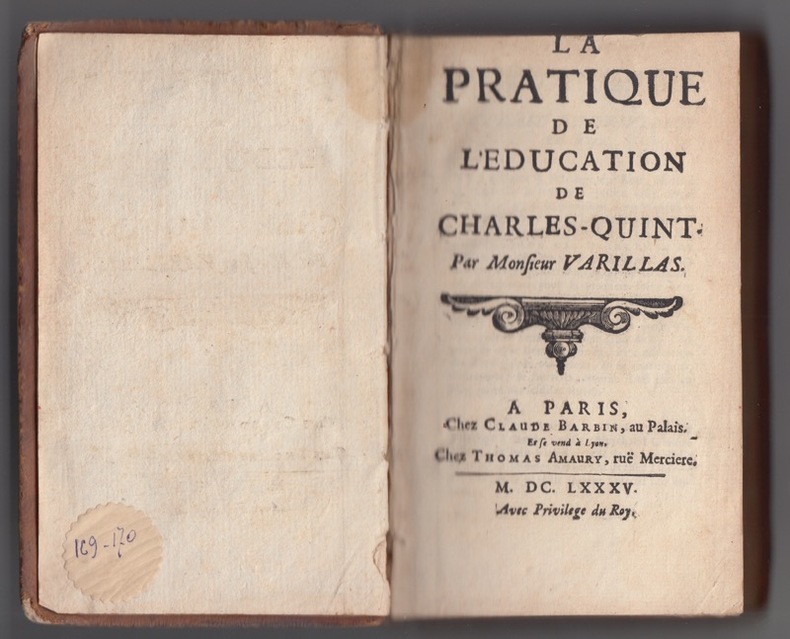
168545771685 Paris : chez C. Barbin, 1685,2 volumes In-12,pleine basane époque, dos à caissons dorés,tome 1: pièces limin. et 378 p.Le titre courant porte : La Pratique de l'éducation des princes. Livre I [-III],tome 2:livre IV:histoire de Mr.de Chievres,392p.,coins et plats frottés,manques aux coiffes, dans l'état,trés rare reunion des 2 ouvrages parus sous le meme titre,
169066091690 amsterdam, Pierre Brunel, 1690. Trois volumes in-12 plein veau brun, dos à nerfs orné de fleurons dorés, titre et tomaison dorés, 216, 210 et 240 pages. Discret travail de vers à deux nerfs et à deux mors, néanmoins bel exemplaire.
1610WRCAM33905The Hague: Hillebrant Iacobsz 1610. 8pp. Large vignette on titlepage. Modern marbled boards. Very good. This pamphlet provides further definitions of the terms of the Twelve Years' Truce between Spain and the Netherlands. While negotiated as a prelude to permanent peace both sides hoped to use the truce from the long and grueling Dutch war of independence to build their military resources. In the end it greatly benefited the Dutch who ended the peace in 1621 greatly strengthened. Rare. Not in EUROPEAN AMERICANA. KNUTTEL 1721. Hillebrant Iacobsz hardcover books
1648WAIaiSPA60The Hague: Widow & Heirs of Hillebrandt Jacobsz van Wouw 1648. 1648. small 4to. ff. 16. woodcut title vignette. disbound. Including references to the West Indies and the West-Indische Compagnie. Alden 648/176 citing pp. 30 in error. The Hague: Widow & Heirs of Hillebrandt Jacobsz van Wouw, 1648. unknown
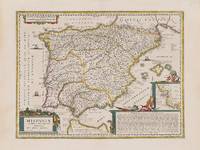
1662200014AG1662. Amsterdam Janssonius c.1662. Original hand-coloured copper engraving. Plate Size: 49.2 cm x 37 cm. Sheet Size: 59.8 cm x 45 cm. Original map. Very good condition. Faint hint of foxing along left fore edge. Centre fold as issued. Latin text on reverse. Koeman I 6000H:1.2. Border with longitudinal and latitudinal information. A richly detailed and very interesting map showing Roman Hispania - the Iberian Peninsula and the Balearic Islands. The three Ancient Roman provinces organised by the emperor Augustus of Hispania Citerior et Tarraconensis Hispania Baetica and Lusitania Hispania are shown on the map. Northern tip of Africa 'Hispania Transfretana Sive Tingitana Qua et Mauritania' pictured also. Relief shown pictorially with rivers mountains and significant towns and cities depicted. Large decorative cartouche with finely detailed Classical allusions in lower right section of map contains an inset box showing the coastal area around 'Gades' Cadiz. Cartouche also lists numerous place names of uncertain location in Latin. Bar-scales within cartouche in top right corner of the map. Decorative title cartouche in lower left corner. Three ships are also pictured suggesting the region's maritime importance. 'Mare Mediterraneum Internum' and 'Ocean Atlanticus Quod et Mare Hesperium Vespertinum Occiduum et Externum' are also listed. Abraham Goos 1590 c. 1643 was a Dutch cartographer publisher and engraver. He made globes maps of North America a comprehensive map of European coastlines and the first printed Hebrew language map of The Holy Land. His first teacher was Jodocus Hondius 15631612 a renowned map-maker whose son-in-law was Johannes Janssonius. After Hondius died his son-in-law Jan Janssonius took over Hondius's business and continued the partnership with Goos. One of Hondius' specialties was the manufacture of globes and Goos and Janssonius continued this regularly modifying them as more geographical information became available. In 1616 he published Nieuw Nederlandtsch Caertboeck an atlas of the Seventeen Provinces in 23 maps and one of the first atlases of the Netherlands; Johannes Janssonius 1588-1664 was a renowned geographer and publisher of the seventeenth century when the Dutch dominated map publishing in Europe. unknown
160814-0-49Barcinonae (Barcelona), Gabrielis Graells & Geraldi Dotil, 1608. Folio (29,5x21cm), mit großer Holzschnittdruckermarke und einigen Holzschnittinitialen, 10 nn. Bll., 806 S., 51 nn. Bll. (Index), 2nn. Bll., 43 S. (Responsum in Syndicatu), flex. Pgmt
16990035921699 Ratisbonne, Mathias Kerner, 1699. Fort volume in-12 (107 X 158 mm) basane brune, dos cinq nerfs, caissons dorés ornés d'un fleuron central et de fers d'angle, coiffes et coupes ornées, tranches jaspées en rouge (reliure de l'époque) ; (2) ff. blancs, titre imprimé en rouge et noir, (2) ff. d'avertissement du libraire, 735 pages, (1) ff. blanc. Petit manque dans l'angle supérieur du premier feuillet blanc, cerne clair allant s'atténuant aux sept premiers feuillets, intéressante note manuscrite (11 lignes) ancienne concernant l'ouvrage à la fin de l'avertissement.
1620222851620 Valencia : Impresso ... en casa de Iuan Chrysostomo Garriz, Año 1620.20x16 cm.IN8 plein velin postereur,dos lisse titré ,tranches rouges, 8 hojas + 550 pp. + 3 hojas. Libro raro. Sólo un ejemplar en el CCBP. [tres cantos, Spain] 16], 550, [6] pages ; 20 cm trés correct,bon état,trés rare
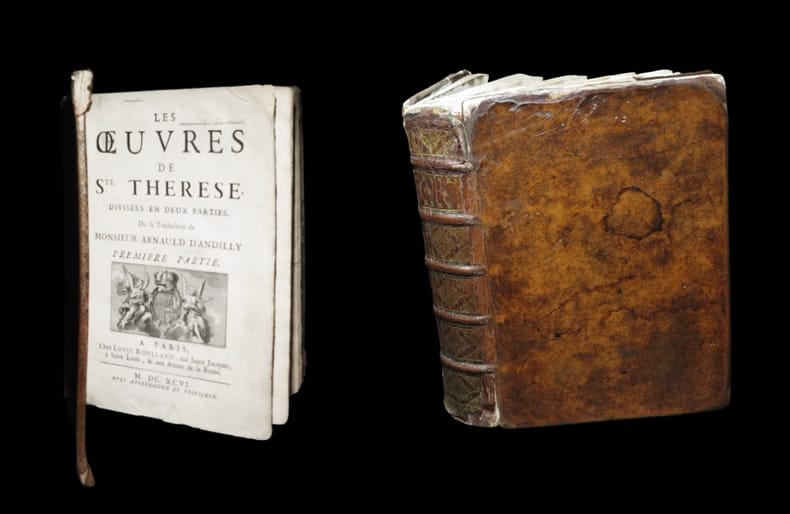
167031777A Paris, chez Louis Roulland, 1696. 2 parties reliées en un fort vol. au format in-4 (268 x 194 mm) de 5 ff. n.fol. et 918 pp. Reliure de l'époque de plein veau glacé et marbré brun, plats jansénistes, dos à nerfs orné de filets gras à froid, caissons d'encadrement dorés, larges fleurons dorés, titre doré, tranches mouchetées.
168194308Amberes [Antwerpen], Juan Bautista Verdussen, 1678 / 1681. [3] Bl., 154 S., [11] Bl.; (9) Bl., 34 S., (2) Bl., (4) Bl., 268, (6+1) Bl.; 12 Kupferstich-Portraits auf Tafeln, Titelholzschnitte (Druckermarke), Schlussstücke u. Zierinitale. 31,5 cm. Leder d. Zeit, auf 6 Bünden mit Rückenschild, Goldprägung u. beidseitigem Supralibros Joannes Josephus Comes de Wildenstein.
1635MC5-592s. l., s. e., s. a. (scritto ca. 1635). in ottavo, [32 p.], brossura un poco fregata, ma in tutto in stato molto buono
162531210Madrid 31 October 1625. Folio 31 cm; 12.125". 4 pp. and 2 blank leaves. <br><br>Diego de Faxardo had been the corregidor of Merida del Campo and he is scheduled to undergo the residencia hearing that will assess his term of office. Here the king gives specific instructions to the residencia judge as to who should be called to testify and who should not.<br>Â Â Â Â This is a certified contemporary copy of the original with the official paper and wax seal now desiccated and detached but present. Very good condition with minimal bleed through. Written in a very clear notarial hand. unknown books
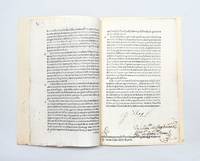
1625154780Madrid. a ultimo de Octubre de mil y seiscientos y venticinco años "last day of October" 1625. Signed royal ordinance for the registration of seamen Important printed state paper signed by the king - "Yo El Rey" - Philip IV 1605-1665 setting out instructions for a large scale registration of sailors in the Spanish royal navy addressing the always pressing issue of impressment. Also signed by one of the king's leading military advisers. Philip is probably best remembered as "a peerless patron"; at Buen Retiro his pleasure palace on the outskirts of Madrid "he was surrounded by a brilliant circle of poets and playwrights - including Lope de Vega Calderón de la Barca Antonio Hurtado de Mendoza Francisco de Quevedo y Luis Quiñones de Benavente" the central hall el Salón de Reinos decorated by his court painters headed by Velásquez. Diccionario Biográfico electrónico. He was somewhat less apt in his policy decisions failing in his efforts at domestic and military reform too reliant on the junta system implemented under his favourite and chief minister Gaspar de Guzmán conde de Olivares. Philip was notably more forward thinking and successful in his handling of the navy to which he applied a "sensible pragmatic approach" Goodman p. 32. Throughout his reign there was no "weakening of the importance attached to naval forces" ibid. p. 156 and the Junta de Armadas was the only such committee to survive the eventual fall of Olivares untouched. The present ordinance created regional administrative officials responsible for the initiation of a registry of mariners and the issue certificates to pilots masters gunners carpenters and other naval tradesmen who for their part were ordered to provide detailed personal information. This data was to be recorded in a ledger a copy of which should be sent to the War Council and regularly updated. Failure to comply could result in a severe fine and two years of exile. The directives were to be implemented "generalmente en estos Reynos in all the territories of the Spanish Empire" thus including Spanish possessions in America and Asia. The creation of this matricula - "a register of all seafaring folk designed to provide central control over their movements and availability for armada service" - is one of the distinctive features of early seventeenth-century Spanish naval organization "Nothing like them would appear anywhere else in Europe until Colbert's famous classes maritimes of the 1660s. Madrid's compulsion would arouse resistance on the coast" ibid. pp. 192-3. The countersignatory Bartolomé Aguilar y Anaya c.1563-c.1630 was an influential military administrator under both Philip IV and his father. He entered the service of Ãlvaro de Bazán marquis of Santa Cruz at the age of 17 taking an active part in his patron's conquest of Portugal his campaigns in the Azores and in the preparation of the Great Armada of 1588. On the death of Santa Cruz his rise continued under the protection of the secretary of war Andrés de Prada who appointed him first officer of the sea section of the war secretariat "primer oficial en la sección de Mar de la SecretarÃa de Guerra" in 1594 DB-e. In 1600 he was granted the formal title of royal secretary and in 1606 himself became secretary of war; during the second decade of the 17th century he was secretary of the board of galleys directing the supply of ammunition for the expedition to Brazil in 1625 at which time he had assumed one of the prized seats on the council of war and in the 1630s he was a member of the highly influential Junta de Armadas. Folio pp. 3 on a single bifolium. Printed order with the king's signature countersigned by his secretary of war Bartolomé Aguilar y Anaya manuscript docketing on the first page. Modern marbled paper wrappers. Light toning some marginal fox spots but overall very good. David Goodman Spanish Naval Power 1589-1665. Reconstruction and Defeat. 1997. unknown
16108272Aranda 1610 Dated July 8 1610. 12 1/8 x 7 7/8 inches. 1pp. Printed paper woodcut seal. Minor creases where folded. Right upper edge a bit rough small split to one crease repaired with acid-free document repair tape small light stain to portion of first two lines but a fine example. As with all other Spanish royal signatures Philip has signed "Yo el Rey" I the King. With the words "El Rey" at the top this document grants permission to the town of Canical to withhold 20000 Maravedis coin of the time from the sum it owes in taxes in order to settle a municipal debt. Includes 18 lines in brown ink in a miniscule script. Next to the King's signature is a mounted printed paper woodcut seal with the emblem of the College of Notaries of Madrid. Countersigned in a bold dark script Jorge de Tovar. At the bottom are three lines by officials of the town of Canical acknowledging the permission granted. Philip III was King of Spain and King of Portugal from 1598 until his death. He inherited essentially a bankrupt nation with a disastrous economy. His father Philip II had drained Spain's resources with her wealth based on the silver mines of Latin America. Spain's internal economy was weak with little industry and a backward agriculture and large estates worked by peasants ruined by excessive taxation. This document is typical of the economic weakness of Spain with the town of Canical requiring monetary help. An attractive official document with bold signatures. unknown books
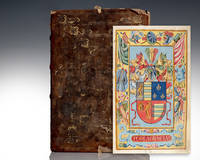
1612148287Valladolid Spain 1612. Rare 17th century elaborately illuminated nobility patent of King Philip III of Spain for the brothers Juan and Alonso de Rivera de la Cerda. Quarto bound in full leather with gilt detailing the patent is comprised of 100 leaves numbered 1-99 in contemporary Arabic numerals written in round Spanish script within a frame ruled in brown ink with decorated seven-line cadel initials and some in text illuminations. Decorated with two full-pages of illumination depicting the Virgin and Child in heaven with the brothers Juan de Rivera de la Cerda and Alonso de Rivera de la Cerda kneeling below and an achievement of arms on pages 1 and 2 with red silk curtains between and a smaller illuminated miniature of the king on page 97. In very good condition with the illuminated pages exceptionally bright with some wear and losses to the leather including to the crown and foot of the spine. King Philip III of Spain 1578–1621 is often regarded as a monarch who shifted the balance of power between the Spanish crown and the nobility in a more collaborative direction. Ascending to the throne at a young age Philip III relied heavily on his favorites particularly the Duke of Lerma to manage the kingdom’s affairs. This reliance on the nobility allowed them to gain significant political influence especially within the royal court. While Philip III did not possess the same autocratic control as his father Philip II his reign marked an era where the Spanish nobility enjoyed a degree of increased prominence albeit through the lens of court politics and patronage. However the resulting factionalism and the concentration of power in the hands of a few noble families eventually led to instability weakening the monarchy's control and contributing to the broader challenges faced by Spain in the early 17th century. hardcover
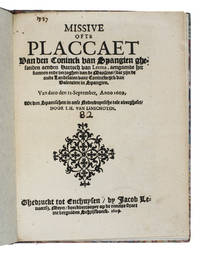
1609ABC_46561Enkhuizen 1609. 4to. Jacob Lenaertsz Meyn Modern marbled paper over boards new endpapers. With an ornamental woodcut title vignette and a woodcut initial. 3 ll. First edition of the Dutch translation by Jan Hughen van Linschoten ca. 1563-1611 of a proclamation decreed on 9 April 1609 by King Philip III of Spain 1578-1621 ordering the Duke of Lerma Francisco Gómez de Sandoval y Rojas 1552/53 - 1625 to expel the Moriscos Spanish muslims who were forced by the Spanish crown and Roman Catholic church to convert into Christianity from Spain. The present decree which was adopted gradually by several Spanish territories first Valencia then Aragon Catalonia Andalusia et cetera provided the Duke of Lerma free reign to carry out the expulsion of the Moriscos by whatever means they see fit to confiscate all their lands and goods and to set an example for everyone who was sympathetic to the Moors. Expelling the Moriscos from Spain however was a real mistake and contributed to the decline of the Spanish reign. The expulsion of the Moriscos led to depopulation and therefore to economic collapse. The present proclamation was therefore of great importance for the Dutch as during the Twelve Years' Truce 1609-1621 the Dutch military war with Spain changed into an economic war. An important decree in the history of the Eight Years' War 1568-1648 between the Dutch Republic and Spain.With some numbers in manuscript on the first two pages. Lacking the blank leaf A4. With a few very minor spots on the first two leaves very slightly browned but overall in good condition.l Knuttel 1630; STCN 830501231; Tiele 790. hardcover
1660140845ca. 1660. Format (Platte): 210 x 165 mm, bis an die Plattenkante beschnitten.
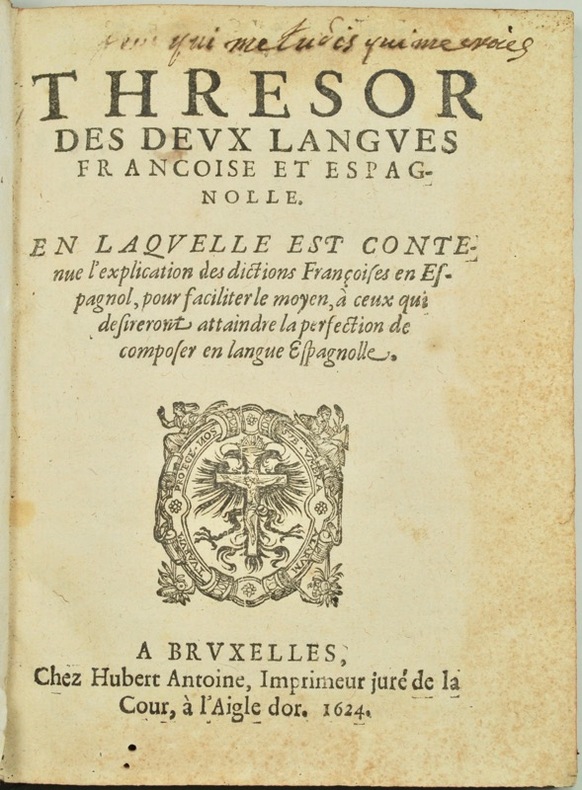
162439718Bruxelles, Hubert Antoine, 1624. Petit in-4 à deux colonnes de (249) ff., veau fauve, dos orné à nerfs, pièce de titre en maroquin rouge, tranches jaspées (reliure de l’époque).
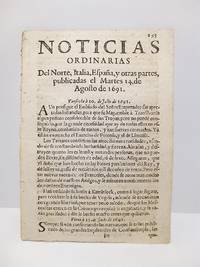
169149135Con Privilegio. En Madrid: PorSebastián de Armendariz Libreo de su Magestad y Curial de Roma. En la imprenta de Antonio Román 1691.- P. 293-304 en total son 12 páginas; 8º 19 x 135 cm; Cubiertas provisionales.- MUY RARO. Excelente estado. HISTORIA DEL SIGLO DE ORO ESPAÑOL Libro en español Sebastián de Armendariz paperback
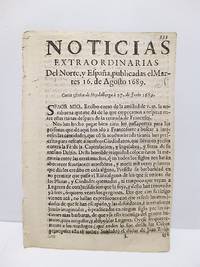
168949136En Madrid: Por Sebastián de Armendariz Librero de Cámara de su Majestad y Curial de Roma En La Imprenta de Antonio Roman. Con las licencias necesarias 1689.- P. 111-122 en total 12 páginas; 8º 188 x 13 cm; Cubiertas providionales.- MUY RARO. Tan solo la primera hoja está muy justa de margen externo pero no toca texto el corte. HISTORIA DEL SIGLO DE ORO ESPAÑOL Libro en español Sebastián de Armendariz paperback
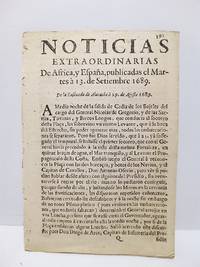
168949139Madrid: Por Sebastian de Armendariz Librero de Camara de su Magestad 1689.- P 191-202 en total son 22 páginas; 8º 189 x 13 cm; Cubiertas provisionales.- MUY RARO. HISTORIA DEL SIGLO DE ORO ESPAÑOL Libro en español Sebastian de Armendariz paperback
1694R59578Toulouse, chez Guillaume-Louis Colomyez 1694 [xxviii +] 448pp.+ frontispice (portrait), 16cm., reliure plein-cuir (cons touchés, quelque smanques au dos), cachet, quelques rousseurs, texte en bon état
1676ALDR0179Wien, Joh. Bapt. Hacque 1676. 12°. Tit., 3 Bll., 74 S., 1 Bl. (Nebentitel zu Pars II), 362 S., 1 Bl. (Emendanda). Mit Kupferstich-Front. Halblederbd. d. Zeit m. Streicheisenverz. auf Rü. u. Deckelbezug aus Kleisterpapier m. goldenem Walzenmuster. Rücken m. Fehlstellen an beiden Kapitalen, Leder abgerieben u. brüchig, Ecken u. Kanten bestoßen u. abgewetzt, Vorderdeckel m. Wurmgang, vord. Spiegel m. gr., gest. Wappenexlibris, Vorsätze im Falz angeplatzt, Schnitt u. mehrere Seiten fleckig (Feuchtigkeitseinwirkung), Ss.11/12 m. Fehlstelle. Zweite, lateinische Ausgabe nach der erstmals 1643 in Madrid erschienenen Originalausgabe in spanischer Sprache. - Juan Eusebio Nieremberg (1595-1658) war ein spanischer Jesuit und Mystiker.
16861235701686 A Cologne, Chez Jean de Clou, 1686 - Seconde édition - 1 volume in-12; reliure pleine basane; dos à 5 nerfs; titre et filets en dorés (effacés par le temps) - 392 pages
1635220214Amsterdam, Blaeu 1635. 350 S. (eigentlich 348 S., da Paginierung von S. 24 auf 27 springt ohne Textverslust). Mit einem Titelholzschnitt, 1 doppelblattgr. Stammtafel und 20 (von 22) doppelblattgroßen, teils mehrfach gefalteten, Kupferkarten von Willem Janszoon Blaeu. Kl.-8°, Pergament d. Z. mit Stehkanten, hs. RTitel u. gechecktem Farbschnitt.