103 résultats
162020747o.Ort. und Drucker. (Tübingen, J.A. Cellius?), 1620. 3 n.n. Bll., 166 SS., das Titelblatt fehlend. 4° (ca. 16 x 19,5 cm), mod. meisterlicher Pappband unter Verwendung geschmackvollem, altrosanem Kleisterpapiers.
1676ALDR0179Wien, Joh. Bapt. Hacque 1676. 12°. Tit., 3 Bll., 74 S., 1 Bl. (Nebentitel zu Pars II), 362 S., 1 Bl. (Emendanda). Mit Kupferstich-Front. Halblederbd. d. Zeit m. Streicheisenverz. auf Rü. u. Deckelbezug aus Kleisterpapier m. goldenem Walzenmuster. Rücken m. Fehlstellen an beiden Kapitalen, Leder abgerieben u. brüchig, Ecken u. Kanten bestoßen u. abgewetzt, Vorderdeckel m. Wurmgang, vord. Spiegel m. gr., gest. Wappenexlibris, Vorsätze im Falz angeplatzt, Schnitt u. mehrere Seiten fleckig (Feuchtigkeitseinwirkung), Ss.11/12 m. Fehlstelle. Zweite, lateinische Ausgabe nach der erstmals 1643 in Madrid erschienenen Originalausgabe in spanischer Sprache. - Juan Eusebio Nieremberg (1595-1658) war ein spanischer Jesuit und Mystiker.
1603953906Frankfurt: Claudius Marne und Johannes Aubris Erben. 1603. Groß-Quart, 37,2 x 22,5 cm. (Der moderne Einband tadellos, innen nur wenig gebräunt, gut erhalten) [5 Warenabbildungen] Seiten 801 - 824. Modernes taubengraues Ganzleinen mit einer montierten verkleinerten Kopie des Titelblatts auf dem Vorderdeckel,
1603953905Frankfurt: Claudius Marne und Johannes Aubris Erben. 1603. Groß-Quart, 37,2 x 22,5 cm. (Der moderne Einband tadellos, innen nur wenig gebräunt, gut erhalten) [6 Warenabbildungen] Titel, 1 Blatt Inhaltsverzeichnis, Seiten 1 - 204. Modernes taubengraues Ganzleinen mit einer montierten verkleinerten Kopie des Titelblatts auf dem Vorderdeckel,
1648WAIaiSPA60The Hague: Widow & Heirs of Hillebrandt Jacobsz van Wouw 1648. 1648. small 4to. ff. 16. woodcut title vignette. disbound. Including references to the West Indies and the West-Indische Compagnie. Alden 648/176 citing pp. 30 in error. The Hague: Widow & Heirs of Hillebrandt Jacobsz van Wouw, 1648. unknown
1609WRCAM33906The Hague: Hillebrant Iacobz 1609. 11pp. Large vignette on titlepage. Modern marbled boards. Very good. The original edition of the official Dutch text of the "Twelve Years' Truce" between the United Provinces and Spain. There are thirty- eight articles of which nine deal with foreign trade. The present issue undoubtedly the first contains a few errors which were corrected in later issues. By this treaty the Dutch agreed to stay out of Spanish controlled possessions in the New World. However it conceded the right of the Dutch to trade in the East Indies and on the basis of this and the breathing room the treaty gave them they were able to rout the Spanish in the 1620s. Savelle calls the Twelve Years' Truce "a great international triumph for all the challengers of the Hispano-Portuguese monopoly" on New World colonization since it marked the first explicit recognition of the right of any non- Iberian people to sail to the Americas. Spain tacitly recognized the right of the Dutch to own colonies in the New World a right which the Dutch French and British vigorously pursued in the ensuing decades. An important treaty and quite scarce. OCLC locates three copies. Not in EUROPEAN AMERICANA. DAVENPORT 28. KNUTTEL 1589. SAVELLE THE ORIGINS OF AMERICAN DIPLOMACY pp.31-34. OCLC 8525118 17751928. Hillebrant Iacobz hardcover books
16670055281667 S.l.n.e., 1667. Petit in-12 (90 X 149 mm) vélin ivoire à petits rabats, dos lisse à coutures apparentes, titre calligraphié au dos à l'encre brune (Reliure de l'époque) ; 323 pp. La calligraphie du titre au dos est postérieure.
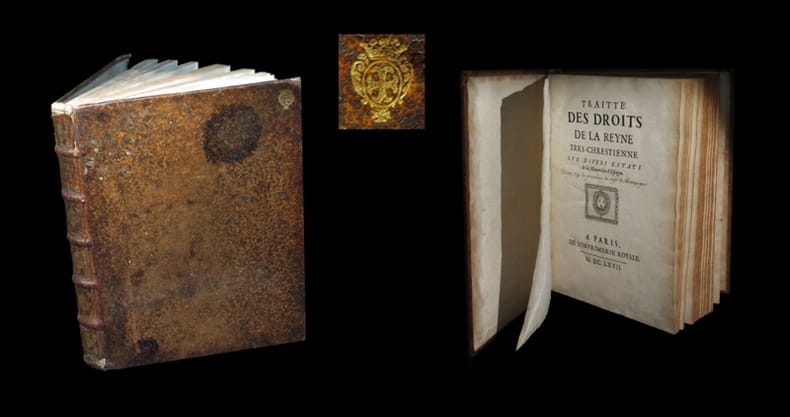
1667J1876Paris, de l'Imprimerie Royale, 1667 ; in-4, 6-280 pp. (manque lapp. de faux-titre), reliure entièrement restaurée plein cuir, (vrai-dos) dos orné à 5 nerfs, sauvegardé sur 3 ficelles, plats sauvegardés aux armes d'archevêque [avec les signes distinctifs d'évêque (peut-être Nicolas-Joseph de Paris)] (mors fendus, coiffes usées, pièce de titre avec manque, plats frottés, coins enfoncés, pages de garde en simili), tranches marbrées (traces de mouillure sur l'ensemble des marges, côté gouttière), mériterait une nouvelle restauration, avec sauvegarde. 1ère édition. Antoine Bilain, avocat au Parlement de Paris, mort en 1672, publia cet ouvrage, où il explique les droits et les revendications de la couronne d'Espagne sur la Franche-Comté et des Pays-Bas. En 1668, La France entre en guerre contre l'Espagne et les Provinces-Unis, ainsi que la Suède. La guerre se solde par le Traité d'Aix-la-Chapelle et la France doit rendre la Franche-Comté, mais elle garde Lille, Douai, Courtrai et Charleroi. État moyen.
166726270A Paris, de l'Imprimerie royale, 1667. Un vol. au format in-4 (273 x 208 mm) de 3 ff. n.fol. et 280 pp. Reliure de l'époque de plein veau moucheté havane, armes dorées portées dans l'angle supérieur droit du premier plat, dos à nerfs orné de filets gras à froid, doubles caissons d'encadrement dorés, large décor fleuronné doré, titre doré, palette dorée en queue, tranches mouchetées.
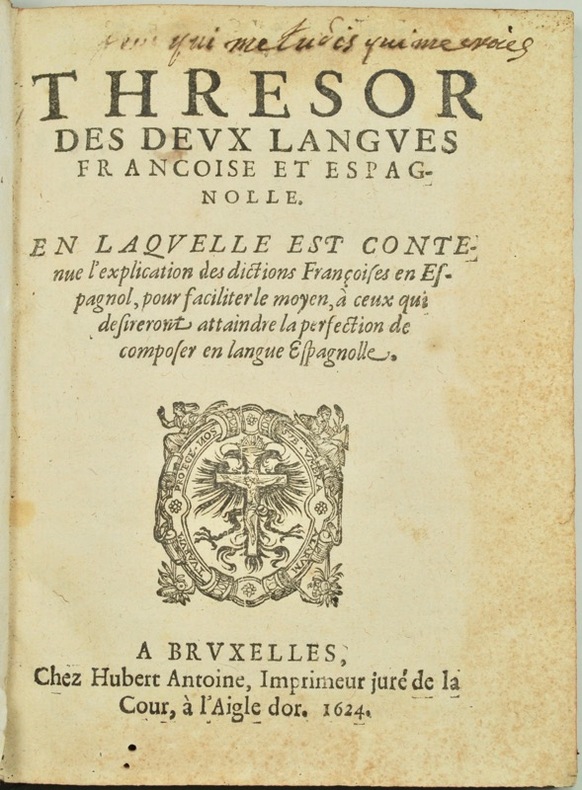
162439718Bruxelles, Hubert Antoine, 1624. Petit in-4 à deux colonnes de (249) ff., veau fauve, dos orné à nerfs, pièce de titre en maroquin rouge, tranches jaspées (reliure de l’époque).
1652R51924Monachii [Munich], Formis & Impensis Nicolai Henrici [Nicolaus Henricus] 1652 3 parts in 1 volume: [4bl.] [28] 226 pp. & pp.4 - 115 [16] pp. & [10] 340 [10] [10] pp. & 286 [54] pp., full-page engraved title-page (Melchior Küsell sculpt.), engraved printer's device at verso of last page, in folio, percament (with some stains, corners bit bumped), text in latin, printed in two columns, few annotations in margin, vague stain of humidity on first 16 pages (not affecting text nor engraved titlepage), 2 small library stamps on titlepage, good copy, [ARIAS Franciscus S.J., born in Seville 1533, died in 1605, cfr. De Backer-Sommervogel I cols.540-547 no.8 & Dictionnaire de Spiritualité I-844], [contains; Tomus I. Qui Est De Christi D.N. Titulis, T.II : Qui Est De Theologicis, Aliisque Praecipuis Domini Nostri Virtutibus Imitandis, T.III : Qui Est De Reliquis Domini Nostri Virtutibus Imitandis; Nec Non De Gravitate Et Damnis Peccati Mortalis]
16183509Ohne Ort und Drucker, 1618. 1 Bll., 33 S. Kl.-8°. Mod. Pp.
16108272Aranda 1610 Dated July 8 1610. 12 1/8 x 7 7/8 inches. 1pp. Printed paper woodcut seal. Minor creases where folded. Right upper edge a bit rough small split to one crease repaired with acid-free document repair tape small light stain to portion of first two lines but a fine example. As with all other Spanish royal signatures Philip has signed "Yo el Rey" I the King. With the words "El Rey" at the top this document grants permission to the town of Canical to withhold 20000 Maravedis coin of the time from the sum it owes in taxes in order to settle a municipal debt. Includes 18 lines in brown ink in a miniscule script. Next to the King's signature is a mounted printed paper woodcut seal with the emblem of the College of Notaries of Madrid. Countersigned in a bold dark script Jorge de Tovar. At the bottom are three lines by officials of the town of Canical acknowledging the permission granted. Philip III was King of Spain and King of Portugal from 1598 until his death. He inherited essentially a bankrupt nation with a disastrous economy. His father Philip II had drained Spain's resources with her wealth based on the silver mines of Latin America. Spain's internal economy was weak with little industry and a backward agriculture and large estates worked by peasants ruined by excessive taxation. This document is typical of the economic weakness of Spain with the town of Canical requiring monetary help. An attractive official document with bold signatures. unknown books
1663Bostonbookfair1Manuscript. 17th century 1663-1695<br /><p>Spanish church register of the village of Montánchez is a municipality located in the province of Cáceres Extremadura Spain. Written in several hands on paper. Folio 29 x 22 cm approx. 135 leaves. Characteristic limp vellum binding. Damage to top cover. First leaves wormed else good.</p>
166243613S.l.n.d. (Paris,, , 1662). 3 parties en 1 vol. petit in-8 de (1) f. de titre, 80, 112, (2)-32 pp., veau brun granité, dos orné à nerfs (reliure de l'époque).
16990035921699 Ratisbonne, Mathias Kerner, 1699. Fort volume in-12 (107 X 158 mm) basane brune, dos cinq nerfs, caissons dorés ornés d'un fleuron central et de fers d'angle, coiffes et coupes ornées, tranches jaspées en rouge (reliure de l'époque) ; (2) ff. blancs, titre imprimé en rouge et noir, (2) ff. d'avertissement du libraire, 735 pages, (1) ff. blanc. Petit manque dans l'angle supérieur du premier feuillet blanc, cerne clair allant s'atténuant aux sept premiers feuillets, intéressante note manuscrite (11 lignes) ancienne concernant l'ouvrage à la fin de l'avertissement.
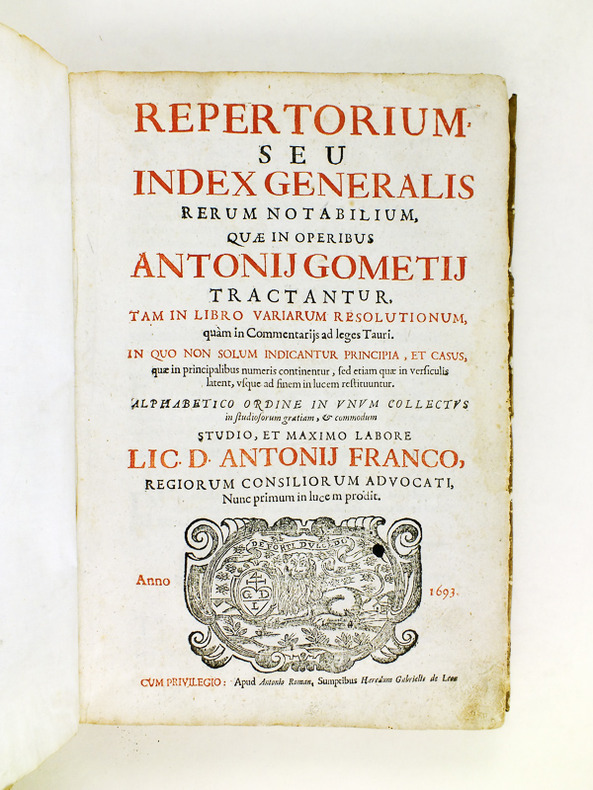
1693453531 vol. in-4 reliure sous vélin de remploi, Apud Antonio Roman, Sumptibus Haeredium Gabrielis de Leon, 1693, 4 ff., 220 pp.. Rappel du titre complet : Repertorium seu Index Generalis Rerum Notabilium quae in operibus Antonij Gometij Tractantur. Tam in Libro Variarum Resolutionum, quam in Comentariis ad leges Tauri [...] Alphabetico ordine in unum collectus [...] Studio, et Maximo Labore Lic. D. Antonij Franco, Regiorum Consiliorum Advocati
16937-3-658Den Haag, Henry van Bulderen, 1693. 12°(14x8cm), 184 S., 176 S., 228 S., Pegamenteinband mit Rs.
16154007Ávila and La Horcajada 1615. Manuscript on parchment 380 x 270 mm. 18. Complete. Contents: ff. 1r-4v: Regla in Spanish in 30 numbered sections inconsistent numbering on ff. 3v-4v in a rounded script in brown ink the first page slightly larger up to 27 lines. F. 1r: incipit first four lines in large lettering with very large calligraphic initial: En el nombre de dios todo poderoso padre y hijo y espiritu sancto tres personas y una esencia. Section 30 f. 4v added in a slightly later hand. The word Cruz symbolized by a red Maltese cross. Text on ff. 2r-2v underlined in red. Calligraphic initials some with marginal extensions in brown purple or red. Marginal drawings of prickly foliage some in the shapes of fantastic animals. Later marginal notes opposite many sections. Ff. 5r-5v: Heading: Este es traslado de un testimonio followed by two notarial subscriptions on f. 5v one partially in cursive signed and dated Ávila 11 May 1527 the other in italic partly faded including the date 1615. F. 6r: A cerca de la procession de la Resurrection. After an introductory portion in a small round early 16th-century hand in brown ink the text continues from f. 4v with sections 32-37 of the Regla of which sections 33-37 are in a later sixteenth-century hand; these sections ruled through with light diagonal lines. Signatures or notes in lower margin. F. 6v: blank except for five lines heavily cancelled in red. Ff. 7r-7v: five paragraphs in a fine upright italic hand the first and third with headings in red La orden que han de tener en la procession de la Resurxection sic en la faded and illegible.; La orden que sea de tener en la procession de la Resurretion sic en el domingo de pascua es la siguente. Followed on f. 7v by a note in a different hand dated from La Horcajada 21 May 1550. Ff. 7v-8v and back inner cover: later additions some quite faded. A few later marginal annotations throughout.Rubrication and decoration: headings and line fillers in red a few ornamented line fillers or borders some passages underlined in red or light purple else ruled in dry point numerous calligraphic initials in red or brown ink opening initial with purple filigree extension filling left margin numerous foliate vegetable and zoomorphic ornamental designs in the margins in red purple and brown ink.Binding: stitched into the original parchment cover with title "Regla de la Pasion" in large letters the R with decorative extensions above a large cross in green ink entwined with the snake and in the margins apparently the instruments of the Passion.Condition: rubbing and staining vertical crease from folding causing occasional erasure of text outer edge of first page somewhat rubbed affecting legibility of text some words at line ends helpfully written over in a later hand the inks used in the last two leaves quite faded; wrapper worn and darkened with tears at top and 3 small holes in lower cover.Provenance: Confraternity of the Holy Cross of Horcajada; purchased in France with export license. An early Spanish confraternity manuscript containing the rules and statutes that governed the Confraternity of the Holy Cross referred to as the Cofradía or Hermandad de la Cruz the word Cruz being supplied by a Maltese cross in red of La Horcajada a town located in Castile y León in the province of Ávila. As in other Roman Catholic countries confraternities or lay brotherhoods played a vital role in community life in Spain functioning as mutual aid societies and venues for laypeople to express their piety and perform charitable acts. Vernacular manuscript confraternity statutes from the Iberian peninsula surface much more rarely than for example their Italian counterparts although it appears that Spain had a larger number of confraternities proportional to the population especially in Castile y Leon than the other Catholic lands. Virtually every community including small villages had at least one confraternity. While exact numbers of confraternities in sixteenth-century Spain are unknown "studies carried out for a number of cities suggest that the number of confraternities and brotherhoods in the Hispanic kingdoms was larger than elsewhere in Catholic Europe. The reasons behind the extraordinary popularity of confraternities and brotherhoods in the Hispanic kingdoms cannot yet be established however in view of the current state of research on the topic. There has been a tendency for scholars to emphasize the confraternity as a primarily urban phenomenon a reflection perhaps of their early development in Italy where they formed an essential part of civic and urban life. In the Hispanic kingdoms however these institutions were equally important in the religious and social life of the small village. Pastoral visitations carried out by the bishops of Cuenca during the sixteenth century found that `nearly every community had at least one brotherhood' even small villages of 500 inhabitants. A similar pattern prevailed in villages around Toledo during the late sixteenth century" Callahan pp. 18-19.In his article on Spanish confraternities William Callahan further points out their popular nature which "arose from the initiative of the laity rather than the clergy prime examples of the lay piety that began to flourish in late medieval Europe. This piety developed largely on its own uncontrolled by either local bishops or the pope both of whom regarded its manifestations with some suspicion. The resiliency of traditional confraternities and brotherhoods developed from their connection to local religious cultures. It also reflected a fact noted by scholars who have studied specific cities and regions the strongly popular character of membership. There were of course some associations that limited membership to the nobility or clergy but in most cases members were recruited from the popular classes. This was obviously true in the case of peasant villages where only one or two confraternities existed." pp. 22-23. In spite of the centrality of confraternities to early modern religious life in Spain there is comparatively little modern scholarly literature especially on the rural confraternities. Note the absence for example of any articles on Spain or Portugal in Brill's recently published Companion to Medieval and Early Modern Confraternities edited by Konrad Eisenbichler.This working manuscript bears witness to this central but understudied aspect of Spanish popular religious culture before the restrictions placed on confraternities by the Council of Trent and succeeding Popes. Consulted frequently and contributed to by members of the confraternity the manuscript includes abundant interlinear and marginal additions and corrections and half- or full-page later additions. The town of La Horcajada is identified in the opening page. Ff. 1r to 5v contain the introduction the first 30 statutes and a notarized testimony with heading "Este es traslado de un testimonio" which relates to the apparently recent establishment of the confraternity. The statutes cover admission of new members general rules of comportment requirements of prayer and confession for feast days and for the canonical hours charity for poorer members of the confraternity chants etc. Several paragraphs relate to processions including required habits and admission of non-members into the processions. On f. 6r a paragraph on the procession de la Resurrection is followed by six entries numbered 32 to 37 of which paragraphs 33 to 37 are in a later 16th-century hand. Several light diagonal lines through these five paragraphs may indicate that they were cancelled. The verso f.6v contains only five lines heavily cancelled in red ink and f. 7r continues discussion of the procession of the Resurrection on a feast day the name of the saint is smudged and on Easter Sunday in a different 16th-century upright cursive. This second section of which portions are difficult to read because of fading ends on f. 7v and is followed by a note in a larger hand dated from La Horcajada 21 May 1550. The final leaf and inner back cover contain later additions some quite faded. One late addition in the lower margin of f. 5v is dated 1615.The manuscript is decorated in a popular style. Some of the leafy plant designs have a thorny look that may reflect local vegetation. Animals and grotesques include a scorpion-like creature birds and possibly imaginary mammals. A witness to the central role played by religious confraternities in early modern Spain bearing the marks of its use and in original condition it is a rare survival and would repay further study.Cf. William Callahan "Confraternities and Brotherhoods in Spain 1500-1800" Confraternitas: The Newsletter of the Society for Confraternity Studies 12:1 2001 17-25. See also William A. Christian Local Religion in Sixteenth Century Spain Princeton 1981; Maureen Flynn Sacred Charity: Confraternities and Social Welfare in Spain 1400-1800 Basingstoke 1989. unknown books
16154007Ãvila and La Horcajada 1615. <p>Manuscript on parchment 380 x 270 mm. 18. Complete. Contents: ff. 1r-4v: Regla in Spanish in 30 numbered sections inconsistent numbering on ff. 3v-4v in a rounded script in brown ink the first page slightly larger up to 27 lines. F. 1r: incipit first four lines in large lettering with very large calligraphic initial: En el nombre de dios todo poderoso padre y hijo y espiritu sancto tres personas y una esencia. Section 30 f. 4v added in a slightly later hand. The word Cruz symbolized by a red Maltese cross. Text on ff. 2r-2v underlined in red. Calligraphic initials some with marginal extensions in brown purple or red. Marginal drawings of prickly foliage some in the shapes of fantastic animals. Later marginal notes opposite many sections. Ff. 5r-5v: Heading: Este es traslado de un testimonio followed by two notarial subscriptions on f. 5v one partially in cursive signed and dated Ãvila 11 May 1527 the other in italic partly faded including the date 1615. F. 6r: A cerca de la procession de la Resurrection. After an introductory portion in a small round early 16th-century hand in brown ink the text continues from f. 4v with sections 32-37 of the Regla of which sections 33-37 are in a later sixteenth-century hand; these sections ruled through with light diagonal lines. Signatures or notes in lower margin. F. 6v: blank except for five lines heavily cancelled in red. Ff. 7r-7v: five paragraphs in a fine upright italic hand the first and third with headings in red La orden que han de tener en la procession de la Resurxection sic en la faded and illegible…; La orden que sea de tener en la procession de la Resurretion sic en el domingo de pascua es la siguente. Followed on f. 7v by a note in a different hand dated from La Horcajada 21 May 1550. Ff. 7v-8v and back inner cover: later additions some quite faded. A few later marginal annotations throughout.<br /> Rubrication and decoration: headings and line fillers in red a few ornamented line fillers or borders some passages underlined in red or light purple else ruled in dry point numerous calligraphic initials in red or brown ink opening initial with purple filigree extension filling left margin numerous foliate vegetable and zoomorphic ornamental designs in the margins in red purple and brown ink.<br /> Binding: stitched into the original parchment cover with title “Regla de la Pasion†in large letters the R with decorative extensions above a large cross in green ink entwined with the snake and in the margins apparently the instruments of the Passion.<br /> Condition: rubbing and staining vertical crease from folding causing occasional erasure of text outer edge of first page somewhat rubbed affecting legibility of text some words at line ends helpfully written over in a later hand the inks used in the last two leaves quite faded; wrapper worn and darkened with tears at top and 3 small holes in lower cover.<br /> Provenance: Confraternity of the Holy Cross of Horcajada; purchased in France with export license.  <br /> <br /> An early Spanish confraternity manuscript containing the rules and statutes that governed the Confraternity of the Holy Cross referred to as the CofradÃa or Hermandad de la Cruz the word Cruz being supplied by a Maltese cross in red of La Horcajada a town located in Castile y León in the province of Ãvila. As in other Roman Catholic countries confraternities or lay brotherhoods played a vital role in community life in Spain functioning as mutual aid societies and venues for laypeople to express their piety and perform charitable acts. Vernacular manuscript confraternity statutes from the Iberian peninsula surface much more rarely than for example their Italian counterparts although it appears that Spain had a larger number of confraternities proportional to the population especially in Castile y Leon than the other Catholic lands. Virtually every community including small villages had at least one confraternity. While exact numbers of confraternities in sixteenth-century Spain are unknown “studies carried out for a number of cities suggest that the number of confraternities and brotherhoods in the Hispanic kingdoms was larger than elsewhere in Catholic Europe. The reasons behind the extraordinary popularity of confraternities and brotherhoods in the Hispanic kingdoms cannot yet be established however in view of the current state of research on the topic. There has been a tendency for scholars to emphasize the confraternity as a primarily urban phenomenon a reflection perhaps of their early development in Italy where they formed an essential part of civic and urban life. In the Hispanic kingdoms however these institutions were equally important in the religious and social life of the small village. Pastoral visitations carried out by the bishops of Cuenca during the sixteenth century found that `nearly every community had at least one brotherhood’ even small villages of 500 inhabitants. A similar pattern prevailed in villages around Toledo during the late sixteenth century†Callahan pp. 18-19.<br /> <br /> In his article on Spanish confraternities William Callahan further points out their popular nature which “arose from the initiative of the laity rather than the clergy prime examples of the lay piety that began to flourish in late medieval Europe. This piety developed largely on its own uncontrolled by either local bishops or the pope both of whom regarded its manifestations with some suspicion. The resiliency of traditional confraternities and brotherhoods developed from their connection to local religious cultures. It also reflected a fact noted by scholars who have studied specific cities and regions the strongly popular character of membership. There were of course some associations that limited membership to the nobility or clergy but in most cases members were recruited from the popular classes. This was obviously true in the case of peasant villages where only one or two confraternities existed.†pp. 22-23. In spite of the centrality of confraternities to early modern religious life in Spain there is comparatively little modern scholarly literature especially on the rural confraternities. Note the absence for example of any articles on Spain or Portugal in Brill’s recently published Companion to Medieval and Early Modern Confraternities edited by Konrad Eisenbichler.<br /> <br /> This working manuscript bears witness to this central but understudied aspect of Spanish popular religious culture before the restrictions placed on confraternities by the Council of Trent and succeeding Popes. Consulted frequently and contributed to by members of the confraternity the manuscript includes abundant interlinear and marginal additions and corrections and half- or full-page later additions. The town of La Horcajada is identified in the opening page. Ff. 1r to 5v contain the introduction the first 30 statutes and a notarized testimony with heading “Este es traslado de un testimonio†which relates to the apparently recent establishment of the confraternity. The statutes cover admission of new members general rules of comportment requirements of prayer and confession for feast days and for the canonical hours charity for poorer members of the confraternity chants etc. Several paragraphs relate to processions including required habits and admission of non-members into the processions. On f. 6r a paragraph on the procession de la Resurrection is followed by six entries numbered 32 to 37 of which paragraphs 33 to 37 are in a later 16th-century hand. Several light diagonal lines through these five paragraphs may indicate that they were cancelled. The verso f.6v contains only five lines heavily cancelled in red ink and f. 7r continues discussion of the procession of the Resurrection on a feast day the name of the saint is smudged and on Easter Sunday in a different 16th-century upright cursive. This second section of which portions are difficult to read because of fading ends on f. 7v and is followed by a note in a larger hand dated from La Horcajada 21 May 1550. The final leaf and inner back cover contain later additions some quite faded. One late addition in the lower margin of f. 5v is dated 1615.<br /> <br /> The manuscript is decorated in a popular style. Some of the leafy plant designs have a thorny look that may reflect local vegetation. Animals and grotesques include a scorpion-like creature birds and possibly imaginary mammals. A witness to the central role played by religious confraternities in early modern Spain bearing the marks of its use and in original condition it is a rare survival and would repay further study.<br /> <br /> Cf. William Callahan “Confraternities and Brotherhoods in Spain 1500-1800†Confraternitas: The Newsletter of the Society for Confraternity Studies 12:1 2001 17-25. See also William A. Christian Local Religion in Sixteenth Century Spain Princeton 1981; Maureen Flynn Sacred Charity: Confraternities and Social Welfare in Spain 1400-1800 Basingstoke 1989.</p> unknown
1610WRCAM33905The Hague: Hillebrant Iacobsz 1610. 8pp. Large vignette on titlepage. Modern marbled boards. Very good. This pamphlet provides further definitions of the terms of the Twelve Years' Truce between Spain and the Netherlands. While negotiated as a prelude to permanent peace both sides hoped to use the truce from the long and grueling Dutch war of independence to build their military resources. In the end it greatly benefited the Dutch who ended the peace in 1621 greatly strengthened. Rare. Not in EUROPEAN AMERICANA. KNUTTEL 1721. Hillebrant Iacobsz hardcover books
1630PHO-1828En Zaragoza, Por Ivan de Lanaja Impressor, año 1630. In-folio, velin XIX° siècle, titre manuscrit sur le dos. Titre gravé, (13) ff., 1128 pp., (20) ff., mouillures, gardes renouvellées , titre gravé remonté, restaurations marges des trois premiers feuillets, manque un f. préliminaire(errata), restaurations et manques de papier aux trois derniers feuillets.
161414318Madrid: Juan de la Cuesta 1614. 293x214mm. 11½x8½". Madrid Juan de la Cuesta 1614. En folio 294 x 214mm. 4 hojas. Escudo real en xilográfia grabado ena portada. Guardas de papel. Edición original estado B de esta interesante pragmática contra la corrupción en la Monarquía Hispánica en concreto contra la venta de cargos de la administración. La premática está fechada en Madrid a 19 de marzo de 1614 y publicada al día siguiente 20 de marzo. La última hoja contiene el bando para el pregón por los pregoneros públicos. Hay otra emisión del mismo impresor en todo igual excepto la disposición tipográfica de la portada. Juan de la Cuesta unknown
1700125431ca.1700. Format (Platte): 203 x 158 mm. Blattgröße: 230 x 163 mm
1660140845ca. 1660. Format (Platte): 210 x 165 mm, bis an die Plattenkante beschnitten.