158 résultats
178520449Manresa: Ignacio Abadal 1785. Folio. 4 ff. <br><br>Royal decree regulating the fine arts republished together with the Manresa printing of an interesting royal decree banning the importation or printing in Spain of Mirabeau's De la Banque d'Espagne dite de St. Charles. Woodcut of the royal coat of arms on title. Palau reports only the Alcalá and Valladolid imprints of this decree. Folded as issued; some foxing and faint waterstaining. Ignacio Abadal unknown books
178521056Vich: Juan Dorca y Morera 1785. Folio. 4 ff. 1 blank f. <br><br>Finds that local manufacture of linen and textiles is beneficial and removes restrictions on it; the "locality" is Vich near Barcelona. The title-page has a nifty woodcut of the royal arms. Originally printed in Madrid. Modern half vellum over burgundy cloth sides by Brugalla. Contemporary inked notation at top right corner of title-page. Very good. Juan Dorca y Morera hardcover books
180424389Barcelona: Juan Francisco Piferrer 1804. Folio. 4 ff. <br><br>Reprinting in Barcelona of this royal decree promulgated 19 July 1804 and first published in Madrid. Regulating the gold braid and other ornaments worn by liveried servants and concerning uniforms of coachmen and runners. With a woodcut of the royal arms on the title-page. Folded and never sewn; as issued. Juan Francisco Piferrer unknown books
177924392Madrid: Pedro Marin 1779. Folio. 4 ff. <br><br>Announcing strict enforcement of the law that prohibits importation of all outer and under garments manufactured abroad. A woodcut of the royal arms on the title. Removed from a bound volume; a few wormholes. Pedro Marin unknown books
177524386Madrid: Pedro Marin 1775. Folio. 3 ff. <br><br>Exempts master dyers and wool- and silk-loomers from military service. Woodcut of the royal arms on title. Lightly in later wrappers; small ownership stamp eradicated from title-page. A very good exemplar. Pedro Marin unknown books
177824388Madrid: Pedro Marin 1778. Folio. 6 ff. <br><br>Royal decree forbidding importation of caps gloves stockings sashes and other goods made of linen wool and cotton. A very nice woodcut of the royal arms on the title. Disbound with a bit of pinhole worming not affecting text; lightly laid into later wrappers. Pedro Marin unknown books
1773WRCAM30245Madrid: Juan de San Martin 1773. 21317pp. Engraved title vignette. Folio. Contemporary plain wrappers. Internally bright and clean. Very good. A detailed Spanish administrative document clarifying the payment of military pensions and other benefits to soldiers and officers serving throughout Spain's colonial holdings including the Americas and the Philippines. Contains information on the process of obtaining a pension schedules for both the army and navy and a host of other details. Often reprinted this is a most important Spanish document offering good evidence of Spain's reputed meticulous colonial record keeping. Quite rare. OCLC locates only four copies. OCLC 17642777 32404569. PALAU 251040. Juan de San Martin unknown books
1790403582Seville: Imprenta Mayor de la cuidad 1790. 4to 302 x 211 mm. 4pp. Unbound folded sheets. Tears to folds. Red cloth slipcase. FIRST EDITION OF THE SEVILLE PRINTING OF THE 1790 ROYAL ACT PROHIBITING THE RUNNING OF THE BULLS: ". considering the bad consequences that it have and will always come from the overindulgence by the King's people when the bulls run . through the streets day and night; and with the receipt of the news by our King of the recent misfortunes from some of these amusements . desiring to cut these pernicious deaths wounds and other excesses . we instruct our Council to take the appropriate measures to contain such damage." The printed provision concludes with a note from Martin Perez referencing the original document located in the Senior Notary office and accompanied by a signature presumably of Perez. Only one copy of this notice has appeared at auction in at least the last fifty years according to the available databases and Worldcat/OCLC list only two copies. <br/><br/> Imprenta Mayor de la cuidad hardcover books
177120394Zaragoza: Imprenta Real 1771. Folio. 4 pp. <br><br>Royal decree original promulgated in Madrid 10 September 1771 permitting free entry into Spain of foreign grains including wheat and maize. A woodcut of the royal arms on the title. <br>Â Â Â Â <br>Â Â Â Â Palau 239456ii. Half vellum with caramel cloth sides by Brugalla. Excellent copy. Imprenta Real hardcover books
18413584Madrid: Boix 1841. Small folio. 4 vols. in 2. I: 6 ff. 335 1 blank pp. II: 1 f. 334 i.e. 332 pp. 1 index f. III: 1 f. 319 1 blank pp. 1 f. IV:1 f. 147 1 blank pp. 1 f.; 105 1 31 1 pp. all indices. <br><br>Handsome mid-19th century edition of the first comprehensive compilation of the laws of the Spanish Indies. Antonio Rodríguez de León Pinello compiled it by 1635 but it circulated only in manuscript until Fernando Jiménez de Paniagua brought it up to date and saw the result through the press in 1681. Prior to the publication of this massive work it was common practice for lawyers and courts in the various legal districts of the New World i.e. audiencias to compile in manuscript the laws in force in order that they might be used as precedents. Upon publication of this code the number of precedents did not as might have been expected decrease via "regularization" but instead increased: The courts continued to accept the cases and laws on point in the old local manuscript compilations and also those contained in the Recopilación! In sum this is a major work for all collections of international and Hispanic-specific law.<br>Â Â Â Â The first edition is very uncommon in today's marketplace meaning most scholars and collectors must settle for a later edition such as this fifth which has the happy advantage of being handsomely printed in double-column format. This copy is attractively bound as well. <br>Â Â Â Â <br>Â Â Â Â Palau 137466; Sabin 68390. Victorian acid-stained sheep with gilt spines extra. Tape adhered to title-pages at inner margin; some other old repairs. Ownership signatures on title-page. All edges marbled. A nice set. Boix unknown books
16154007Ávila and La Horcajada 1615. Manuscript on parchment 380 x 270 mm. 18. Complete. Contents: ff. 1r-4v: Regla in Spanish in 30 numbered sections inconsistent numbering on ff. 3v-4v in a rounded script in brown ink the first page slightly larger up to 27 lines. F. 1r: incipit first four lines in large lettering with very large calligraphic initial: En el nombre de dios todo poderoso padre y hijo y espiritu sancto tres personas y una esencia. Section 30 f. 4v added in a slightly later hand. The word Cruz symbolized by a red Maltese cross. Text on ff. 2r-2v underlined in red. Calligraphic initials some with marginal extensions in brown purple or red. Marginal drawings of prickly foliage some in the shapes of fantastic animals. Later marginal notes opposite many sections. Ff. 5r-5v: Heading: Este es traslado de un testimonio followed by two notarial subscriptions on f. 5v one partially in cursive signed and dated Ávila 11 May 1527 the other in italic partly faded including the date 1615. F. 6r: A cerca de la procession de la Resurrection. After an introductory portion in a small round early 16th-century hand in brown ink the text continues from f. 4v with sections 32-37 of the Regla of which sections 33-37 are in a later sixteenth-century hand; these sections ruled through with light diagonal lines. Signatures or notes in lower margin. F. 6v: blank except for five lines heavily cancelled in red. Ff. 7r-7v: five paragraphs in a fine upright italic hand the first and third with headings in red La orden que han de tener en la procession de la Resurxection sic en la faded and illegible.; La orden que sea de tener en la procession de la Resurretion sic en el domingo de pascua es la siguente. Followed on f. 7v by a note in a different hand dated from La Horcajada 21 May 1550. Ff. 7v-8v and back inner cover: later additions some quite faded. A few later marginal annotations throughout.Rubrication and decoration: headings and line fillers in red a few ornamented line fillers or borders some passages underlined in red or light purple else ruled in dry point numerous calligraphic initials in red or brown ink opening initial with purple filigree extension filling left margin numerous foliate vegetable and zoomorphic ornamental designs in the margins in red purple and brown ink.Binding: stitched into the original parchment cover with title "Regla de la Pasion" in large letters the R with decorative extensions above a large cross in green ink entwined with the snake and in the margins apparently the instruments of the Passion.Condition: rubbing and staining vertical crease from folding causing occasional erasure of text outer edge of first page somewhat rubbed affecting legibility of text some words at line ends helpfully written over in a later hand the inks used in the last two leaves quite faded; wrapper worn and darkened with tears at top and 3 small holes in lower cover.Provenance: Confraternity of the Holy Cross of Horcajada; purchased in France with export license. An early Spanish confraternity manuscript containing the rules and statutes that governed the Confraternity of the Holy Cross referred to as the Cofradía or Hermandad de la Cruz the word Cruz being supplied by a Maltese cross in red of La Horcajada a town located in Castile y León in the province of Ávila. As in other Roman Catholic countries confraternities or lay brotherhoods played a vital role in community life in Spain functioning as mutual aid societies and venues for laypeople to express their piety and perform charitable acts. Vernacular manuscript confraternity statutes from the Iberian peninsula surface much more rarely than for example their Italian counterparts although it appears that Spain had a larger number of confraternities proportional to the population especially in Castile y Leon than the other Catholic lands. Virtually every community including small villages had at least one confraternity. While exact numbers of confraternities in sixteenth-century Spain are unknown "studies carried out for a number of cities suggest that the number of confraternities and brotherhoods in the Hispanic kingdoms was larger than elsewhere in Catholic Europe. The reasons behind the extraordinary popularity of confraternities and brotherhoods in the Hispanic kingdoms cannot yet be established however in view of the current state of research on the topic. There has been a tendency for scholars to emphasize the confraternity as a primarily urban phenomenon a reflection perhaps of their early development in Italy where they formed an essential part of civic and urban life. In the Hispanic kingdoms however these institutions were equally important in the religious and social life of the small village. Pastoral visitations carried out by the bishops of Cuenca during the sixteenth century found that `nearly every community had at least one brotherhood' even small villages of 500 inhabitants. A similar pattern prevailed in villages around Toledo during the late sixteenth century" Callahan pp. 18-19.In his article on Spanish confraternities William Callahan further points out their popular nature which "arose from the initiative of the laity rather than the clergy prime examples of the lay piety that began to flourish in late medieval Europe. This piety developed largely on its own uncontrolled by either local bishops or the pope both of whom regarded its manifestations with some suspicion. The resiliency of traditional confraternities and brotherhoods developed from their connection to local religious cultures. It also reflected a fact noted by scholars who have studied specific cities and regions the strongly popular character of membership. There were of course some associations that limited membership to the nobility or clergy but in most cases members were recruited from the popular classes. This was obviously true in the case of peasant villages where only one or two confraternities existed." pp. 22-23. In spite of the centrality of confraternities to early modern religious life in Spain there is comparatively little modern scholarly literature especially on the rural confraternities. Note the absence for example of any articles on Spain or Portugal in Brill's recently published Companion to Medieval and Early Modern Confraternities edited by Konrad Eisenbichler.This working manuscript bears witness to this central but understudied aspect of Spanish popular religious culture before the restrictions placed on confraternities by the Council of Trent and succeeding Popes. Consulted frequently and contributed to by members of the confraternity the manuscript includes abundant interlinear and marginal additions and corrections and half- or full-page later additions. The town of La Horcajada is identified in the opening page. Ff. 1r to 5v contain the introduction the first 30 statutes and a notarized testimony with heading "Este es traslado de un testimonio" which relates to the apparently recent establishment of the confraternity. The statutes cover admission of new members general rules of comportment requirements of prayer and confession for feast days and for the canonical hours charity for poorer members of the confraternity chants etc. Several paragraphs relate to processions including required habits and admission of non-members into the processions. On f. 6r a paragraph on the procession de la Resurrection is followed by six entries numbered 32 to 37 of which paragraphs 33 to 37 are in a later 16th-century hand. Several light diagonal lines through these five paragraphs may indicate that they were cancelled. The verso f.6v contains only five lines heavily cancelled in red ink and f. 7r continues discussion of the procession of the Resurrection on a feast day the name of the saint is smudged and on Easter Sunday in a different 16th-century upright cursive. This second section of which portions are difficult to read because of fading ends on f. 7v and is followed by a note in a larger hand dated from La Horcajada 21 May 1550. The final leaf and inner back cover contain later additions some quite faded. One late addition in the lower margin of f. 5v is dated 1615.The manuscript is decorated in a popular style. Some of the leafy plant designs have a thorny look that may reflect local vegetation. Animals and grotesques include a scorpion-like creature birds and possibly imaginary mammals. A witness to the central role played by religious confraternities in early modern Spain bearing the marks of its use and in original condition it is a rare survival and would repay further study.Cf. William Callahan "Confraternities and Brotherhoods in Spain 1500-1800" Confraternitas: The Newsletter of the Society for Confraternity Studies 12:1 2001 17-25. See also William A. Christian Local Religion in Sixteenth Century Spain Princeton 1981; Maureen Flynn Sacred Charity: Confraternities and Social Welfare in Spain 1400-1800 Basingstoke 1989. unknown books
181336362colophon: Cadiz: en la Imprenta Tormentaria á cargo de Juan Domingo Villegas 1813. 8vo 21.5 cm; 8.125". 2 281385 15 pp. fold. plts. numbered xxxix lxviii. <br><br>At the base of the title-page of this infantry manual is printed "Reimpreso por disposicion del . . . señor don Carlos Doyle teniente general de los reales exercitos." => That is Lt. Gen. Charles William Doyle 17701842 ordered this work to be printed.<br>Â Â Â Â Doyle was an Irish-born British lieutenant-colonel who in 1808 was ordered to Portugal to help fight Napoleon in the Peninsular Campaign. He very successfully aided the Spanish army in instilling discipline and organizing light infantry and was made a lieutenant general in the Spanish army. In 1811 Britain ordered him home but when he reached Cadiz Sir Henry Wellesley convinced him to command a camp at which a new army was being organized for action in the south of Spain. Again he was highly successful in his military instruction of new troops and as a result was promoted to full colonel in the British army; he remained in Spain till the end of the war in 1814.<br>Â Â Â Â The present work extracted from the larger one of the same title printed at Madrid by the Imprenta Real in 1808 was clearly printed for the instruction of Doyle's southern army.<br>Â Â Â Â At the rear of the volume are => 30 folding plates setting forth various dispositions and movements of infantry troops; clear careful verbal explanations of these precede them.<br>Â Â Â Â Searches of NUC WorldCat and the CCPBE locate => only three copies worldwide of which only one is in the U.S. West Point.<br>Â Â Â Â Provenance: Contemporary signature of "Velez" on title-page. <br>Â Â Â Â <br>Â Â Â Â Not in Palau. On Doyle see: DNB online. Dark brown speckled calf black gilt-lettered title-label a little chipped to gilt-ruled spine marbled endpapers; binding lightly rubbed. Age-toning and general light soiling occasionally a dog-ear or a spot all plates clean well-attached and whole at folds. => A very sound very good copy. en la Imprenta Tormentaria á cargo de Juan Domingo Villegas unknown books
177833498Madrid: Pedro Marin 1778. 4to 28 cm; 11". 2 ff. 19 1 blank 262 pp. <br><br>The seed of the Enlightenment idea of free commerce landed in Spain in the 1770s and blossomed in 1778 just two years after Adam Smith published Wealth of Nations strongly advocating free trade. Here are the laws and regulations that enable and allowed free trade in the Spanish empire. <br>Â Â Â Â <br>Â Â Â Â Sabin 68890; Palau 255843; Goldsmiths'-Kress 11717; Medina BHA 4845. Text block loose in a later limp vellum binding. The engraving of the royal arms and the title-page dust-soiled as are the last three leaves. Worming in the lower margins of all leaves. A less than pristine copy and priced accordingly. Pedro Marin hardcover books
177436365Madrid: En la Imprenta de Pedro Marin 1774. Small 8vo 15 cm; 6". 4 including initial blank ff. 182 pp. <br><br>There were two 1774 editions of this manual for the Spanish cavalry and dragoons: one was a quarto with folding plates the other this pocket unillustrated octavo clearly the more personal portable production and the one more vulnerable to destruction. It begins with general trumpet and drum calls for field camp and battle and proceeds to those specific for certain maneuvers for the dragoons etc. It then moves on to formations and ends with instructions for movements on foot and for the use of carbines.<br>Â Â Â Â Searches of NUC WorldCat and CCPBE locate => only two copies of this octavo edition worldwide in the national libraries of Spain and Chile. <br>Â Â Â Â <br>Â Â Â Â Not in Palau but see 255857 for the quarto edition. Contemporary mottled sheep with gilt spine extra and marbled endpapers; spine chipped binding lightly abraded. Front hinge inside open; text block firmly attached to binding. Some very light waterstaining and one short marginal note; a nice clean copy. En la Imprenta de Pedro Marin unknown books
2012136415Malaga Spain: Centro de Arte Contemporaneo de Malaga 2012. Hardcover. VG. Beige paper boards pink & illus. dust jacket 119 pp. many color illus. incl. 2 loose & folded posters. Text is in Spanish and English. Issued in conjunction with a 2012-2013 exhibition featuring the work of British abstract sculptor Richard Deacon b. 1949. Two posters depict "I Remember 1" and "I Remember 2." Centro de Arte Contemporaneo de Malaga hardcover books
1808WRCAM51826Madrid 1808. Small sheet folded into a square 3 3/4 x 3 3/4 inches. A few small worm holes one larger at bottom left corner not affecting seal. Top portion of seal text obscured by residual wax. Good. Paper seal intended for use on Spanish government documents and letters by the King Ferdinand VII in 1808. This seal must date from the short period that Ferdinand was king in 1808 from March to May. His predecessor Charles IV had abdicated after a popular uprising and Napoléon forced Ferdinand to stand down after only two months. Ferdinand was kept prisoner in France until 1813 when he was eventually restored to the throne. He then ruled until 1833 during which time Spain lost most of its overseas colonial territories to local revolution. unknown books
182745152Barcelona: Juan Francisco Piferrer 1827. Nueva Edicion. Two volumes bound in one; small 12mo 15cm.; full contemporary sheep marbled endpapers; xvi150; 2xv1156pp. Boards a bit scuffed with some brief peeling of leather corners bumped else Very Good internally fine. Contemporary owner's brief ink and pencil notes to final leaf of text and rear free endpaper. Includes recipes for dyes stains inks lacquers varnishes stain removers perfumes toothpaste and drinks and liqueurs. Juan Francisco Piferrer unknown books
199490737Tuscaloosa:: University of Alabama Press. Near Fine in Near Fine dust jacket. 1994. Hardcover. 0817305890 . First edition. Light foxing on top edge else near fine in a near fine dust jacket. . University of Alabama Press, hardcover books
19949032Tuscaloosa: University of Alabama Press 1994. 1st. Hardcover. Book fine Dust jacket fine. Includes bibliographical references and index. Bound in the publisher's original cloth. <br/><br/> University of Alabama Press hardcover books
1772EPL79Madrid: Por Joachin Ibarra 1772. Paperback. Near Fine. Single page 149-150. Spanish imprint which dealt with the Conspiracy of the Catiline 65-62 B.C. This particular page dealing with the War of Jugurtha. Printed in Italic type with printed notes in Roman. Wide and clean margins; a good solitary specimen of this important work in Latin literature. Size: 350 x 255mm. <br/><br/> Por Joachin Ibarra paperback books
181737583London: Printed by Thomas Davison Whitefriars for Longman Hurst Rees Orme and Brown 1817. First thus. xv 261 1; vii i 232 pp. 2 vols. 8vo. Bound in full contemporary brown polished calf spines rubbed brown binder's ticket on front pastedowns "Bound by Smith 49 Long Acre" in each volume; front joint of vol. I starting fixing to preliminaries else very good. First thus. xv 261 1; vii i 232 pp. 2 vols. 8vo. Inscribed Twice. INSCRIBED on the first blank leaf of volume I "With the author's best regards March 1834 London" and on the title page of both volumes "To my dear Aunt Mrs. Moore E.V. Holland." Lady Holland's Aunt Mrs. Moore of NYC was Clement C. Moore's mother. <br/>The first volume containing the account of Lope de Vega's life and writings was first published in 1806; this is the first two volume edition and the first containing the treatment of Guillen de Castro. Printed by Thomas Davison, Whitefriars for Longman, Hurst, Rees, Orme and Brown unknown books
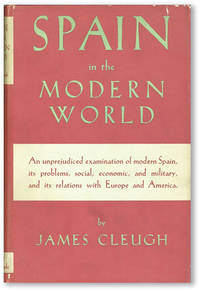
195244812London: Eyre & Spottiswoode 1952. First Edition. Octavo 22cm; red cloth with titles stamped in gilt on spine; dustjacket; x2791pp. Some offsetting and faint foxing to endpapers upper edge of textblock slightly dusty else Near Fine and clean throughout. Dustjacket is unclipped gently spine-sunned and lightly edgeworn slightly dusty overall with the rear flap mis-folded and several short tears to extremities; Very Good. An "unprejudiced examination of the contemporary Spanish state in all its aspects" including sections on the land the Spanish people and their social history their constitution economic and military problems and approach to foreign relations. Eyre & Spottiswoode unknown books
16108272Aranda 1610 Dated July 8 1610. 12 1/8 x 7 7/8 inches. 1pp. Printed paper woodcut seal. Minor creases where folded. Right upper edge a bit rough small split to one crease repaired with acid-free document repair tape small light stain to portion of first two lines but a fine example. As with all other Spanish royal signatures Philip has signed "Yo el Rey" I the King. With the words "El Rey" at the top this document grants permission to the town of Canical to withhold 20000 Maravedis coin of the time from the sum it owes in taxes in order to settle a municipal debt. Includes 18 lines in brown ink in a miniscule script. Next to the King's signature is a mounted printed paper woodcut seal with the emblem of the College of Notaries of Madrid. Countersigned in a bold dark script Jorge de Tovar. At the bottom are three lines by officials of the town of Canical acknowledging the permission granted. Philip III was King of Spain and King of Portugal from 1598 until his death. He inherited essentially a bankrupt nation with a disastrous economy. His father Philip II had drained Spain's resources with her wealth based on the silver mines of Latin America. Spain's internal economy was weak with little industry and a backward agriculture and large estates worked by peasants ruined by excessive taxation. This document is typical of the economic weakness of Spain with the town of Canical requiring monetary help. An attractive official document with bold signatures. unknown books
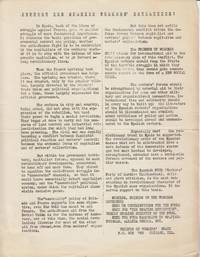
193630957Chicago: Friends of Workers Spain. 1936-1937. First Edition; First Printing. Broadside. Single leaf 8½ x 11" printed on one side a fund-raising letter for the POUM English lanuage newspaper The Spanish Revolution edited by Charles and Lois Orr Americans in Barcelona. Very good with a small chip at lower right corner retained. ; Small 4to 9" - 11" tall; 1 pp . Friends of Workers Spain unknown books
1957139216Glendale CA: Allied Artists 1957. Collection of 4 vintage black-and-white studio still photographs from the 1957 film. Included are two film still photos and two advertisement layout photos. Mimeo snipes once affixed to the versos of the film stills detached but present. <br/><br/>Director Corman at his noir-est. The Black Widows a teenage girl gang led by Helen Spain an early favorite of Russ Meyer suspect Barbara Kenney of killing one of their members. Barbara is the sometimes girlfriend of the leader of rival gang and the two gangs prepare for warfare. As the gangs prepare the stories of their private lives unfold and every aspect of family dysfunction is represented showcasing an example of the mid-century "juvenile delinquency" scare. <br/><br/>8 x 10 inches advert photos slightly larger. Very Good plus overall with a corner crease to one film still photo and minor creasing to others. <br/><br/>Complete collation details available on request. <br/><br/>Grant US. Lyons US. Martin 382. Selby US. Spicer US. Allied Artists unknown books