158 résultats
16154007Ávila and La Horcajada 1615. Manuscript on parchment 380 x 270 mm. 18. Complete. Contents: ff. 1r-4v: Regla in Spanish in 30 numbered sections inconsistent numbering on ff. 3v-4v in a rounded script in brown ink the first page slightly larger up to 27 lines. F. 1r: incipit first four lines in large lettering with very large calligraphic initial: En el nombre de dios todo poderoso padre y hijo y espiritu sancto tres personas y una esencia. Section 30 f. 4v added in a slightly later hand. The word Cruz symbolized by a red Maltese cross. Text on ff. 2r-2v underlined in red. Calligraphic initials some with marginal extensions in brown purple or red. Marginal drawings of prickly foliage some in the shapes of fantastic animals. Later marginal notes opposite many sections. Ff. 5r-5v: Heading: Este es traslado de un testimonio followed by two notarial subscriptions on f. 5v one partially in cursive signed and dated Ávila 11 May 1527 the other in italic partly faded including the date 1615. F. 6r: A cerca de la procession de la Resurrection. After an introductory portion in a small round early 16th-century hand in brown ink the text continues from f. 4v with sections 32-37 of the Regla of which sections 33-37 are in a later sixteenth-century hand; these sections ruled through with light diagonal lines. Signatures or notes in lower margin. F. 6v: blank except for five lines heavily cancelled in red. Ff. 7r-7v: five paragraphs in a fine upright italic hand the first and third with headings in red La orden que han de tener en la procession de la Resurxection sic en la faded and illegible.; La orden que sea de tener en la procession de la Resurretion sic en el domingo de pascua es la siguente. Followed on f. 7v by a note in a different hand dated from La Horcajada 21 May 1550. Ff. 7v-8v and back inner cover: later additions some quite faded. A few later marginal annotations throughout.Rubrication and decoration: headings and line fillers in red a few ornamented line fillers or borders some passages underlined in red or light purple else ruled in dry point numerous calligraphic initials in red or brown ink opening initial with purple filigree extension filling left margin numerous foliate vegetable and zoomorphic ornamental designs in the margins in red purple and brown ink.Binding: stitched into the original parchment cover with title "Regla de la Pasion" in large letters the R with decorative extensions above a large cross in green ink entwined with the snake and in the margins apparently the instruments of the Passion.Condition: rubbing and staining vertical crease from folding causing occasional erasure of text outer edge of first page somewhat rubbed affecting legibility of text some words at line ends helpfully written over in a later hand the inks used in the last two leaves quite faded; wrapper worn and darkened with tears at top and 3 small holes in lower cover.Provenance: Confraternity of the Holy Cross of Horcajada; purchased in France with export license. An early Spanish confraternity manuscript containing the rules and statutes that governed the Confraternity of the Holy Cross referred to as the Cofradía or Hermandad de la Cruz the word Cruz being supplied by a Maltese cross in red of La Horcajada a town located in Castile y León in the province of Ávila. As in other Roman Catholic countries confraternities or lay brotherhoods played a vital role in community life in Spain functioning as mutual aid societies and venues for laypeople to express their piety and perform charitable acts. Vernacular manuscript confraternity statutes from the Iberian peninsula surface much more rarely than for example their Italian counterparts although it appears that Spain had a larger number of confraternities proportional to the population especially in Castile y Leon than the other Catholic lands. Virtually every community including small villages had at least one confraternity. While exact numbers of confraternities in sixteenth-century Spain are unknown "studies carried out for a number of cities suggest that the number of confraternities and brotherhoods in the Hispanic kingdoms was larger than elsewhere in Catholic Europe. The reasons behind the extraordinary popularity of confraternities and brotherhoods in the Hispanic kingdoms cannot yet be established however in view of the current state of research on the topic. There has been a tendency for scholars to emphasize the confraternity as a primarily urban phenomenon a reflection perhaps of their early development in Italy where they formed an essential part of civic and urban life. In the Hispanic kingdoms however these institutions were equally important in the religious and social life of the small village. Pastoral visitations carried out by the bishops of Cuenca during the sixteenth century found that `nearly every community had at least one brotherhood' even small villages of 500 inhabitants. A similar pattern prevailed in villages around Toledo during the late sixteenth century" Callahan pp. 18-19.In his article on Spanish confraternities William Callahan further points out their popular nature which "arose from the initiative of the laity rather than the clergy prime examples of the lay piety that began to flourish in late medieval Europe. This piety developed largely on its own uncontrolled by either local bishops or the pope both of whom regarded its manifestations with some suspicion. The resiliency of traditional confraternities and brotherhoods developed from their connection to local religious cultures. It also reflected a fact noted by scholars who have studied specific cities and regions the strongly popular character of membership. There were of course some associations that limited membership to the nobility or clergy but in most cases members were recruited from the popular classes. This was obviously true in the case of peasant villages where only one or two confraternities existed." pp. 22-23. In spite of the centrality of confraternities to early modern religious life in Spain there is comparatively little modern scholarly literature especially on the rural confraternities. Note the absence for example of any articles on Spain or Portugal in Brill's recently published Companion to Medieval and Early Modern Confraternities edited by Konrad Eisenbichler.This working manuscript bears witness to this central but understudied aspect of Spanish popular religious culture before the restrictions placed on confraternities by the Council of Trent and succeeding Popes. Consulted frequently and contributed to by members of the confraternity the manuscript includes abundant interlinear and marginal additions and corrections and half- or full-page later additions. The town of La Horcajada is identified in the opening page. Ff. 1r to 5v contain the introduction the first 30 statutes and a notarized testimony with heading "Este es traslado de un testimonio" which relates to the apparently recent establishment of the confraternity. The statutes cover admission of new members general rules of comportment requirements of prayer and confession for feast days and for the canonical hours charity for poorer members of the confraternity chants etc. Several paragraphs relate to processions including required habits and admission of non-members into the processions. On f. 6r a paragraph on the procession de la Resurrection is followed by six entries numbered 32 to 37 of which paragraphs 33 to 37 are in a later 16th-century hand. Several light diagonal lines through these five paragraphs may indicate that they were cancelled. The verso f.6v contains only five lines heavily cancelled in red ink and f. 7r continues discussion of the procession of the Resurrection on a feast day the name of the saint is smudged and on Easter Sunday in a different 16th-century upright cursive. This second section of which portions are difficult to read because of fading ends on f. 7v and is followed by a note in a larger hand dated from La Horcajada 21 May 1550. The final leaf and inner back cover contain later additions some quite faded. One late addition in the lower margin of f. 5v is dated 1615.The manuscript is decorated in a popular style. Some of the leafy plant designs have a thorny look that may reflect local vegetation. Animals and grotesques include a scorpion-like creature birds and possibly imaginary mammals. A witness to the central role played by religious confraternities in early modern Spain bearing the marks of its use and in original condition it is a rare survival and would repay further study.Cf. William Callahan "Confraternities and Brotherhoods in Spain 1500-1800" Confraternitas: The Newsletter of the Society for Confraternity Studies 12:1 2001 17-25. See also William A. Christian Local Religion in Sixteenth Century Spain Princeton 1981; Maureen Flynn Sacred Charity: Confraternities and Social Welfare in Spain 1400-1800 Basingstoke 1989. unknown books
1699107920Madrid May 28 1699. Rare elaborately illuminated nobility diploma signed by King Charles II of Spain appointing Don Martin Damian Mendizabal the title of Marquis of Torre Gines. Quarto bound in full red contemporary velvet covered boards with two metal clasps containing five illuminated leaves two fully illuminated in color with the Royal coat of arms and portrait of King Charles II text in Spanish. Signed by King Charles II "Yo el Rey" and additionally signed by several Royal secretaries. Bound with a printed manuscript of the Oath of Fidelity to the King of Spain with Royal stamps dated 1701 and with two autograph letters laid in the first dated September 17 1701 and signed by Philip V and the second addressed to the Marquis. Exceptionally rare. Referred to as 'the Bewitched' and 'El Hechizado' Charles II of Spain was the last Habsburg ruler of the Spanish Empire. He died childless in 1700 with no immediate Habsburg heir. His will named his successor as 16-year-old Philip of Anjou grandson of Louis XIV and Charles's half-sister Maria Theresa and disputes over the inheritance led to the War of the Spanish Succession. hardcover books
1893236066London: Chiswick Press 1893. No. 11 of 13 copies printed on vellum there were also 88 copies printed on paper. Title with vignette numerous woodcut illustrations and large initial capitals. 1 vols. Folio 12-3/4 x 8-7/8 in.; 32.4 x 22.5 cm. Loose as issued in publisher's decorated board portfolio with maroon velvet straps in publisher's maroon morocco-backed clamshell box with printed label on upper cover; box worn a few rust marks on upper board. No. 11 of 13 copies printed on vellum there were also 88 copies printed on paper. Title with vignette numerous woodcut illustrations and large initial capitals. 1 vols. Folio 12-3/4 x 8-7/8 in.; 32.4 x 22.5 cm. One of 13 Copies on Vellum. This work consists of two important ordinances issued by the Spanish monarchy on November 20 1542 and June 4 1543. Under the active influence of Bartolomeo de las Casas "friend of the Indians" the new laws had the special design of ensuring better treatment of the Indians limiting the distribution of their lands and above all protecting them against enslavement by the conquering Spaniards. <br/><br/>"Las Leyes Nuevas" are reprinted here in this fine facsimile from the copy on vellum in the British Museum and are followed by an English translation. Much of the book is taken up by the historical Introduction by Henry Stevens who denounces the Spanish mistreatment of the Indians. Ironically the Spanish crown was later forced to rescind the new laws by colonists who were outraged at having to give up their right to a quota of enslaved Indian laborers.<br/><br/>A magnificent and impressive production by the Chiswick Press one of only 13 printed on vellum. Chiswick Press unknown books
39080Single quarto manuscript document signed by Queen Isabella of Spain dated 20 November 1501. With "La Reyna" at the top and signed "Yo la Reyna." The letter is for a credit to Isabella's chamberlain Sancho de Paredes for various supplies services and expenditures. Matted and framed opposite a portrait of Isabella. The entire piece measures 19 inches by 20.5 inches. Rare and desirable signed by Queen Isabella. Isabella I was Queen of Castile. She was married to Ferdinand II of Aragon. Their marriage became the basis for the political unification of Spain under their grandson Holy Roman Emperor Charles V. After a struggle to claim her right to the throne she reorganized the governmental system brought the crime rate to the lowest it had been in years and unburdened the kingdom of the enormous debt her brother had left behind. Her reforms and those she made with her husband had an influence that extended well beyond the borders of their united kingdoms. Isabella and Ferdinand are known for completing the Reconquista and for supporting and financing Christopher Columbus' 1492 voyage that led to the opening of the New World and to the establishment of Spain as the first global power which dominated Europe and much of the world for more than a century. Isabella was granted the title Servant of God by the Catholic Church in 1974. unknown books
1520WRCAM17720Augsburg 1520. 4pp. Small quarto. Later plain paper boards. Marginal tears and old fold marks with slight discoloration else very good. "After the death of Ferdinand II Charles V succeeded to the Kingdom of Spain. In 1517 he proceeded to Spain which he left in 1520. At his departure he was very unpopular; he made this speech when he left and said 'That he did not see the happy faces with which he had been received.' He also mentions America in the following words: 'He might have been satisfied with the Spanish Empire the Balearic Islands and Sardinia the Kingdom of Sicily Italy and a large part of Germany and Gaul AND THAT OTHER GOLD-BEARING WORLD'" - Maggs. <br> <br> EUROPEAN AMERICANA locates only two copies at The New York Public Library and the Bibliothèque Nationale. There is also a Rome edition of which a copy is located at Harvard. The present copy appears to be the only one offered for sale in this century. EUROPEAN AMERICANA 520/17. MAGGS BIBLIOTHECA AMERICANA I:33 this copy. PALAU 44419. ROTHSCHILD 3137. hardcover books
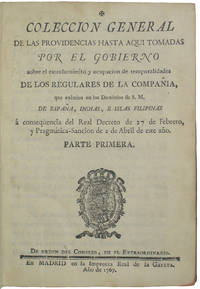
178444155Madrid: En la Imprenta Real de la Gazeta 1784. First edition. Contemporary mottled calf compartments decorated in gilt red morocco spine label titled in gilt sewn in green silk ribbon marbled endpapers. A very good copy head band worn with a small chip and a tiny split at the joint owner's bookplate and booksellers engraved plate on front pastedown contents quite bright and clean. 104 91 135 144 4 74 pp. 4to. Five volumes bound in one. Parts 1 2 3 set in condensed type; parts 4 and 5 in expanded type. Royal decrees from Charles III and instructions decisions and regulations issued by the Consejo en el Extraordinario and its president the Conde de Aranda and others--concerning the expulsion of the Jesuits. "These collections contain the documents relative to the expulsion of the Jesuits from the Spanish dominions and the confiscation of their property including the names of the colleges and houses of the order the application of the confiscated property &c. A complete series consists of five parts which are rarely found together. Our collation is of parts I. to III. only" Sabin 14304. Part 4 p. 75-127 contains the papal brief "Dominus ac Redemptor" by Clement XIV in Latin and Spanish. Earlier versions containing parts or all of the first three sections are not all that uncommon but those containing all five parts remain relatively rare. Other than this copy only two others have appeared in the auction records of ABPC and RBH since 1953 the first at the John B. Stetson sale at Parke Bernet and the second at Bonhams in a modern binding and dampstained. Palau 56516. See Sabin 14304. Medina BHA: IV 4228. En la Imprenta Real de la Gazeta unknown books
15076Queen of Castile 1474-1504 and a Catholic Monarch who ruled jointly with her husband Ferdinand II of Aragon. 1 page Document Signed "Yo La Reina" at the top of the page and dated December 1501. The Spanish Inquisition was originally intended in large part to ensure the Catholic orthodoxy of those who converted from Judaism and Islam. This regulation of the faith of the newly converted was intensified after the royal decrees issued in 1492 and 1501 mandated that Jews and Muslims convert to Catholicism or face exile from Spain. <br/><br/>While the Spanish Inquisition had begun in 1478 it was in full force by the time of this document's creation. With the goal of cleansing all non Catholic sentiment from the Spanish nation King Ferdinand and Queen Isabella issued the Edict of Alhambra that required the force exile of all non-Catholics from Spain. The additional decree issued in October of 1501 further mandated the public destruction of non-Christian texts.<br/><br/>This Document Signed is dated only two months later in the months when the Spanish began to enact trials questioning and enforcement of the banishment of non-Catholics. It marks an important moment in history. Mounting tape marks on verso. Document has minor age related toning and fold lines not affecting text. Some writing also wraps onto the verso fold. Measures approximately 8x11". In very good condition. unknown books
1600WRCAM34111Madrid 1600. 4pp. Folio. Later plain wrappers. Minute dust soiling. Very good. In a half morocco and cloth box. Four contracts between the sundry kings of Spain and certain conquistadors. "The agreements are with Rodrigo de Bastidas of Santo Domingo for the colonization of the Province and Port of Santa Marta in 1524 with Don Gonzalo Ximinez de Quesada in 1569 for the discovery of the New Kingdom of Granada with Captain Don Diego Fernandez de Cerpa in 1568 for the discovery and colonisation of the province of La Guayana Caura and New Andaluzia and with Panfilo de Narvaez in 1526 for the discovery of Florida" - BIBLIOTHECA AMERICANA. The terms of the agreements generally discuss rights granted by the Crown to the relevant explorer and stipulate what the explorer is required to provide the Crown in return. Gold and other precious metals top the lists. When originally catalogued by Maggs the official signature at the end of the last agreement was attributed to Baltasar Lopez de Castro; but on the original cataloguing present with the text a later hand has suggested Antonio Fernandez de Castro. <br> <br> Good evidence of the terms under which the conquistadors operated in the New World including Florida. Extremely rare. Not on OCLC nor in Palau or Servies. MAGGS BIBLIOTHECA AMERICANA I:109 this copy. MAGGS BIBLIOTHECA AMERICANA VI:177 this copy. hardcover books
1783WRCAM20839London 1783. 10pp. printed in double-column format in parallel French and English. Small quarto. Dbd. Some old minor ink underscoring. Else very good. Untrimmed. In a half morocco box. The official English publication of the preliminary articles of peace between Spain and England. By this treaty an armistice was concluded Britain gave back the Floridas to Spain and Spain restored the Bahamas to England. AMERICAN CONTROVERSY 83-44. DAVENPORT 170. unknown books
1783WRCAM15743Paris 1783. 8pp. Tall folio designed to be folded with docket title sideways on last leaf. Later marbled boards leather label. Near fine. A French printing of the treaty between Spain and England adopted as part of the general peace of Sept. 3 1783. Through this treaty Spain reacquired the Floridas and the Mediterranean island of Minorca while Britain retained Gibraltar and acquired the Bahamas. This printing is unrecorded so far as we can discover. It seems to have been printed for the use of the French commissioners at the time of signing and is in folio form with docket printed on the side so that it could be folded and put in a file. It probably represents a printing during the later stages of the negotiation process. OCLC locates only microfiche copies made from an original in the Public Archives of Canada. Rare. DAVENPORT 174. OCLC 19494242. A different printing of this treaty is recorded as: SERVIES 598. SABIN 96558. PALAU 339315. hardcover books
1803WRCAM40396Madrid: En la imprenta de la Viuda de Ibarra 1803. 2xxxvi19498pp. Folio. Contemporary Spanish calf spine gilt leather label. Lightly rubbed at extremities boards lightly scuffed. Contents bright and clean. Near fine. Administrative regulations for Spanish colonial rule in the Americas and the Philippines. These laws represent the last ditch efforts of the Spanish monarchy to bring reform to the administration of their colonial holdings in the Americas. Six years later in 1809 the first declaration of independence from Spanish rule would be signed in Quito in modern Ecuador which would be the first spark of the movement for independence across Spain's American colonies. With this ORDENANZA Spain hoped to restructure and reform colonial rule in such a way to prevent that from happening. A nice piece of Spanish-American history. MEDINA BHA 5971. PALAU 202973. En la imprenta de la Viuda de Ibarra hardcover books
18495749Madrid: La Viuda de Burgos 1850 i.e. 1849. 8vo signed in 4s 22.1 cm 8.65". 761 1 blank pp. <br><br>Bound for presentation by Queen Isabella. Complete budgetary accounting for the year 1850 issued by the Spanish government printed by a woman printer of Madrid and here in an early example of the work of noted Madrid binder Ginesta.<br>Â Â Â Â Binding: Signed presentation binding by Miguel Ginesta II of Madrid of oxblood straight-grain morocco covers framed in double gilt fillets surrounding gilt-stamped arabesques and the gilt-stamped coat of arms of Queen Isabella II of Spain; spine with gilt-stamped title and arabesques. Board edges and turn-ins gilt-stamped pink moiré endpapers all edges gilt.<br>Â Â Â Â Provenance: Infante Duc de Montpensier sixth son of King Louis Philippe husband of the Infanta Maria Louisa Queen Isabella's sister with his bookplate. <br>Â Â Â Â <br>Â Â Â Â Palau 236716. Binding as described above covers showing only very minor wear spine slightly faded. Front pastedown with bookplate described above. Pages gently age-toned a few showing mild foxing but most clean. Very attractive. La Viuda de Burgos unknown books
1795689451795. Madrid 1795. Folio 11-3/4" x 8". Madrid 1795. Folio 11-3/4" x 8". King Carlos IV Organizes Spain's Lucrative Silver Mines of Potosi Spain. Real Banco de San Carlos de Potosi. Real Cedula de Incorporacion de el Banco de Potosi a la Real Hacienda y Ordenanzas Para su Regimen y Gobierno: Con Arreglo a las Leyes de Indias y Demas Reales Disposiciones que al Margen se Citan: de Orden de S.M. Madrid: En la Imprenta de Don Benito Cano 1795. xii 67 107 pp. Final 107 un-numbered pages are charts and tables 4 folding. Folio 11-3/4" x 8". Contemporary tree sheep gilt fillets to boards gilt fillets to spine recased endpapers renewed. Moderate rubbing to extremities with some loss to gilding spine abraded corners bumped and lightly worn. Light toning to text somewhat heavier in places faint dampstaining to preliminaries and a few other leaves light edgewear to one of the folding tables. A handsome copy $2500. Only edition. The Bank of Potosi was organized to manage the network of mines in Potosi a mountain in present-day Bolivia. Worked by a brutally exploited force of indigenous workers later supplemented by African slaves these mines were one of the greatest sources of Spain's wealth for nearly 200 years. The Real Cedula de Incorporacion prints the certificate of incorporation granted by King Carlos IV and the charter outlining the bank's purpose organization and regulation. OCLC locates 12 copies in North America 1 in a law library Library of Congress. Sabin A Dictionary of Books Relating to America 68224. unknown books
1783WRCAM15744Bilbao 1783. 10pp. Quarto. Modern half morocco and marbled boards. Very good. A rare Spanish edition of the preliminary articles of peace between Spain and England which ended their conflict in the American Revolution. The primary impact of this treaty was to return the Floridas to Spain thus setting the stage for conflicts between the United States and Spain on its southern and western borders and ending twenty years of British control of the Floridas which had effectively been lost when Galvez seized Pensacola in 1781. DAVENPORT 170. SERVIES 597 Madrid ed. hardcover books
1609WRCAM33906The Hague: Hillebrant Iacobz 1609. 11pp. Large vignette on titlepage. Modern marbled boards. Very good. The original edition of the official Dutch text of the "Twelve Years' Truce" between the United Provinces and Spain. There are thirty- eight articles of which nine deal with foreign trade. The present issue undoubtedly the first contains a few errors which were corrected in later issues. By this treaty the Dutch agreed to stay out of Spanish controlled possessions in the New World. However it conceded the right of the Dutch to trade in the East Indies and on the basis of this and the breathing room the treaty gave them they were able to rout the Spanish in the 1620s. Savelle calls the Twelve Years' Truce "a great international triumph for all the challengers of the Hispano-Portuguese monopoly" on New World colonization since it marked the first explicit recognition of the right of any non- Iberian people to sail to the Americas. Spain tacitly recognized the right of the Dutch to own colonies in the New World a right which the Dutch French and British vigorously pursued in the ensuing decades. An important treaty and quite scarce. OCLC locates three copies. Not in EUROPEAN AMERICANA. DAVENPORT 28. KNUTTEL 1589. SAVELLE THE ORIGINS OF AMERICAN DIPLOMACY pp.31-34. OCLC 8525118 17751928. Hillebrant Iacobz hardcover books
18413584Madrid: Boix 1841. Small folio. 4 vols. in 2. I: 6 ff. 335 1 blank pp. II: 1 f. 334 i.e. 332 pp. 1 index f. III: 1 f. 319 1 blank pp. 1 f. IV:1 f. 147 1 blank pp. 1 f.; 105 1 31 1 pp. all indices. <br><br>Handsome mid-19th century edition of the first comprehensive compilation of the laws of the Spanish Indies. Antonio Rodríguez de León Pinello compiled it by 1635 but it circulated only in manuscript until Fernando Jiménez de Paniagua brought it up to date and saw the result through the press in 1681. Prior to the publication of this massive work it was common practice for lawyers and courts in the various legal districts of the New World i.e. audiencias to compile in manuscript the laws in force in order that they might be used as precedents. Upon publication of this code the number of precedents did not as might have been expected decrease via "regularization" but instead increased: The courts continued to accept the cases and laws on point in the old local manuscript compilations and also those contained in the Recopilación! In sum this is a major work for all collections of international and Hispanic-specific law.<br>Â Â Â Â The first edition is very uncommon in today's marketplace meaning most scholars and collectors must settle for a later edition such as this fifth which has the happy advantage of being handsomely printed in double-column format. This copy is attractively bound as well. <br>Â Â Â Â <br>Â Â Â Â Palau 137466; Sabin 68390. Victorian acid-stained sheep with gilt spines extra. Tape adhered to title-pages at inner margin; some other old repairs. Ownership signatures on title-page. All edges marbled. A nice set. Boix unknown books
181336362colophon: Cadiz: en la Imprenta Tormentaria á cargo de Juan Domingo Villegas 1813. 8vo 21.5 cm; 8.125". 2 281385 15 pp. fold. plts. numbered xxxix lxviii. <br><br>At the base of the title-page of this infantry manual is printed "Reimpreso por disposicion del . . . señor don Carlos Doyle teniente general de los reales exercitos." => That is Lt. Gen. Charles William Doyle 17701842 ordered this work to be printed.<br>Â Â Â Â Doyle was an Irish-born British lieutenant-colonel who in 1808 was ordered to Portugal to help fight Napoleon in the Peninsular Campaign. He very successfully aided the Spanish army in instilling discipline and organizing light infantry and was made a lieutenant general in the Spanish army. In 1811 Britain ordered him home but when he reached Cadiz Sir Henry Wellesley convinced him to command a camp at which a new army was being organized for action in the south of Spain. Again he was highly successful in his military instruction of new troops and as a result was promoted to full colonel in the British army; he remained in Spain till the end of the war in 1814.<br>Â Â Â Â The present work extracted from the larger one of the same title printed at Madrid by the Imprenta Real in 1808 was clearly printed for the instruction of Doyle's southern army.<br>Â Â Â Â At the rear of the volume are => 30 folding plates setting forth various dispositions and movements of infantry troops; clear careful verbal explanations of these precede them.<br>Â Â Â Â Searches of NUC WorldCat and the CCPBE locate => only three copies worldwide of which only one is in the U.S. West Point.<br>Â Â Â Â Provenance: Contemporary signature of "Velez" on title-page. <br>Â Â Â Â <br>Â Â Â Â Not in Palau. On Doyle see: DNB online. Dark brown speckled calf black gilt-lettered title-label a little chipped to gilt-ruled spine marbled endpapers; binding lightly rubbed. Age-toning and general light soiling occasionally a dog-ear or a spot all plates clean well-attached and whole at folds. => A very sound very good copy. en la Imprenta Tormentaria á cargo de Juan Domingo Villegas unknown books
1783WRCAM20585Madrid: En la Imprenta Real 1783. 494pp. in Spanish and French plus a map. Small quarto. Original plain wrappers. Spine bit chipped. A crisp near fine copy. In a half morocco and cloth case. This is the official Spanish printing of the treaty in which England and Spain make peace in the American Revolution. England gives the Floridas back to Spain and Spain returns the Bahamas to England. The navigation of the Belize and Hondo rivers is made common to both nations. They also settle all hostilities concerning the Revolution a necessary component of the final Peace of 1783. England's returning Florida to Spain provided the U.S. with a headache not resolved until the U.S. purchased Florida from Spain in 1819. The engraved map depicts the Hondo and Belize rivers. DAVENPORT 174. SABIN 96558. PALAU 339315. SERVIES 598. En la Imprenta Real hardcover books
1660WRCAM35380London: Printed by John Bill and Christopher Barker 1660. Broadside 13 1/2 x 10 3/4 inches. Affixed at corners to a slightly larger sheet. Near fine. Archivally matted protected with mylar sheet. An early diplomatic proclamation by the recently restored British monarch King Charles II and part of his efforts to encourage British colonial and commercial expansion. Though not formally at war hostilities existed between Britain and Spain especially concerning the harassment of commerce at sea and colonies in the Caribbean. Five years earlier the English under Cromwell had seized Jamaica from Spain and in 1656 Spain lent their support to Charles II's restoration to the throne. In this document Charles II proclaims that "all prisoners ships goods merchandize sic or whatsoever else taken upon one another either by any of our subjects or the subjects of our said dear brother since said time of our arrival in England be and shall be upon due proof thereof redelivered and restored." At the same time Charles II was negotiating with the Portuguese against Spanish interests in the New World especially with regard to Jamaica which the British ultimately retained. WING C3287. Printed by John Bill and Christopher Barker unknown books
177436365Madrid: En la Imprenta de Pedro Marin 1774. Small 8vo 15 cm; 6". 4 including initial blank ff. 182 pp. <br><br>There were two 1774 editions of this manual for the Spanish cavalry and dragoons: one was a quarto with folding plates the other this pocket unillustrated octavo clearly the more personal portable production and the one more vulnerable to destruction. It begins with general trumpet and drum calls for field camp and battle and proceeds to those specific for certain maneuvers for the dragoons etc. It then moves on to formations and ends with instructions for movements on foot and for the use of carbines.<br>Â Â Â Â Searches of NUC WorldCat and CCPBE locate => only two copies of this octavo edition worldwide in the national libraries of Spain and Chile. <br>Â Â Â Â <br>Â Â Â Â Not in Palau but see 255857 for the quarto edition. Contemporary mottled sheep with gilt spine extra and marbled endpapers; spine chipped binding lightly abraded. Front hinge inside open; text block firmly attached to binding. Some very light waterstaining and one short marginal note; a nice clean copy. En la Imprenta de Pedro Marin unknown books
16108272Aranda 1610 Dated July 8 1610. 12 1/8 x 7 7/8 inches. 1pp. Printed paper woodcut seal. Minor creases where folded. Right upper edge a bit rough small split to one crease repaired with acid-free document repair tape small light stain to portion of first two lines but a fine example. As with all other Spanish royal signatures Philip has signed "Yo el Rey" I the King. With the words "El Rey" at the top this document grants permission to the town of Canical to withhold 20000 Maravedis coin of the time from the sum it owes in taxes in order to settle a municipal debt. Includes 18 lines in brown ink in a miniscule script. Next to the King's signature is a mounted printed paper woodcut seal with the emblem of the College of Notaries of Madrid. Countersigned in a bold dark script Jorge de Tovar. At the bottom are three lines by officials of the town of Canical acknowledging the permission granted. Philip III was King of Spain and King of Portugal from 1598 until his death. He inherited essentially a bankrupt nation with a disastrous economy. His father Philip II had drained Spain's resources with her wealth based on the silver mines of Latin America. Spain's internal economy was weak with little industry and a backward agriculture and large estates worked by peasants ruined by excessive taxation. This document is typical of the economic weakness of Spain with the town of Canical requiring monetary help. An attractive official document with bold signatures. unknown books
173936319London: Printed for T. Cooper. 1739. 63 1 blank pp. Bound in modern vellum. Early leaves dusted minor scattered foxing. Else Very Good. <br/><br/> "In Spanish and English and relates principally to affairs in America" Sabin with particular emphasis on Florida. The book charges that the King of England authorized Captains of the ships 'Pompey Galley' and 'Fortune' to cruise the Florida coast and collect loot from ship-wrecks. With a force of 600 men the English overpowered Spaniards who were guarding their own collection of salvaged loot and "did rob about 400000 pesoes without any other pretense but that of their greediness." <br/> The Madrid printing in Spanish issued earlier in 1739.The document sets forth Spanish grievances dating from the early 1700s relating to conflicts in the New World-- from Newfoundland to Florida and the West Indies. The conflicts came to a head in the War of Jenkins' Ear commenced in October 1739. <br/>Sabin 17026. Servies 334. Bartlett John Carter Brown Library 618. ESTC N27944. Printed for T. Cooper... unknown books
1923313637Madrid: E. Gonzalez y Cia Fototipia 1923. Pochoir title page and back wrapper by Larraya plate of posters in full color ornamental dedication leaf 28 illustrations from photographs 1 folding. 15 leaves with text in Spanish and English. 1 vols. Oblong 4to. Cloth spine glazed yellow pictorial boards preserving wrappers. Some minor soiling chips at edges of back wrapper generally fine. Pochoir title page and back wrapper by Larraya plate of posters in full color ornamental dedication leaf 28 illustrations from photographs 1 folding. 15 leaves with text in Spanish and English. 1 vols. Oblong 4to. Sport & Wine in Jerez Spain. "The merchant the sportsman the man of business or the man of leisure will always find a welcome in Jerez." Lavishly produced album of the sherry wine and brandy house of Marqués del Mérito in Jerez documenting in equal parts the wine-making activities of the firm and the sporting traditions of the lands around Jerez de la Frontera including pigsticking in the swamps stag and ibex hunting waterfowling and bird shooting with numerous pictures of the bag of princely hunting parties. Uncommon and striking. E. Gonzalez y Cia, Fototipia unknown books
1790403582Seville: Imprenta Mayor de la cuidad 1790. 4to 302 x 211 mm. 4pp. Unbound folded sheets. Tears to folds. Red cloth slipcase. FIRST EDITION OF THE SEVILLE PRINTING OF THE 1790 ROYAL ACT PROHIBITING THE RUNNING OF THE BULLS: ". considering the bad consequences that it have and will always come from the overindulgence by the King's people when the bulls run . through the streets day and night; and with the receipt of the news by our King of the recent misfortunes from some of these amusements . desiring to cut these pernicious deaths wounds and other excesses . we instruct our Council to take the appropriate measures to contain such damage." The printed provision concludes with a note from Martin Perez referencing the original document located in the Senior Notary office and accompanied by a signature presumably of Perez. Only one copy of this notice has appeared at auction in at least the last fifty years according to the available databases and Worldcat/OCLC list only two copies. <br/><br/> Imprenta Mayor de la cuidad hardcover books
1786WRCAM10734London: Printed by T. Harrison and S. Brooke 1786. 15pp. printed in double-column format in parallel English and French. Small quarto. Modern half calf and marbled boards. Near fine. The 1783 treaty between Spain and England had been concluded as part of the general ending of the American War of Independence and left a number of points unresolved. This document settles issues relating to South America Central America and the Caribbean. Specific points include a British pledge to evacuate the land of the "Mosquito" Indians in Belize and other Spanish possessions in return for the right to gather fruits and wood "without even excepting mahogany." OCLC locates five copies. A scarce treaty with significant ramifications for colonial Latin America. DAVENPORT 175. OCLC 12651227. Printed by T. Harrison and S. Brooke hardcover books