(Scotland), IslayBiblio.com
1 584 résultats
101939028X.Ghardcover. Good. Access codes and supplements are not guaranteed with used items. May be an ex-library book. hardcover
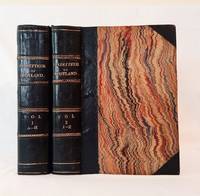
1848B6267Edinburgh: A. Fullarton & Co. 1848. Hardcover. Very Good. Scattered foxing; Contemporary half balck calf marbled baords. With numerous steel engravings. ; Large 8vo 9" - 10" tall; lxiv814;ii852 pages . A. Fullarton & Co hardcover
1019614765.Ghardcover. Good. Access codes and supplements are not guaranteed with used items. May be an ex-library book. hardcover
1024663078.Ghardcover. Good. Access codes and supplements are not guaranteed with used items. May be an ex-library book. hardcover
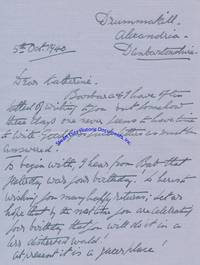
5554WORLD WAR II IN SCOTLAND. ALS. 6pgs. October 5 1940. Drummakill Alexandria Dunbartonshire. An autograph letter signed Hector and written during World War Two. The author discusses hosting evacuated children and the fact that Scotland has so far been lucky in avoiding air raids. Our first lot of 3 boys are no longer with us. One of them the nicest lad died last Xmas from appendicitis the other two took themselves off to a farm as they objected to being kept in order! But lately I hear they returned home to Clydebank. Whether we get others depends on the severity of air raids! So far Scotland has really been lucky in this respect. Of course there are some here & there. We hear the hum sometimes usually at night and have heard bombs exploding but quite a bit away! But you never can tell when it might not be a bigger affair!! It is wonderful how England is standing up to her ordeal & the amazing cheerfulness of people with it all. I have a cousin & her husband in London & she writes now & then saying that life is noisy in London! But she manages to do a lot of war work often taking it to their air raid shelter. But I believe people get used even to the sound of many guns!. Clydebank where the two remaining boys had returned home would suffer a deadly blitz the following year. In fine condition and including the original mailing envelope sent to Chevy Chase Maryland. unknown
19474'Paris le 27 December 1815'. 1p. 8vo. Headed 'Copy' and with a Britannia watermark implying an official origin. On aged and worn paper with chipping and loss at head and tail. Reads: 'Monsieur Le Comité de Montagnards d'Ecosse ayant deputé My Lord <Lattom> Les Colls. Macdonall et Mackenham et Mr James Hamilton pour faire l'hommage a Sa M. Le Roi de France d'un exemplaire original des Poesies d'Ossian en langue celtique L'Ambassadeur d'Angleterre profitte de l'intervention de Mr. Le Premier Gentilhomme de la Chambre pour faire connaitre cette intention a Sa Majesté et prier S. Exce. de vouloir bien le faire savoir quand le Roi daignera les recevoir L'Ambassadeur &c'. It is not clear whether the group was an informal one or an established club. Minimal information available evn in Googlebooks snippets and perhaps more information is to be sought in Ken Crockett's 'Mountaineering in Scotland: The Early Years'. 2015. Perhaps someone could let me know. 'Paris le 27 December 1815'. unknown
21969March 1761. Three pages folio fold marks closed tears minor damage text clear and complete. List giving Date of the Gift and then a brief description. For example "1716 Febrry 27 Gift of the Chamberlaincy of Fyfe. To the Earl of Rothes" the list concluding on Page 3 "1755 Decem.17 Pension of £500 out of the Lordship of Ross in favours of Sir Henry Monie Bart." Three such records are finally listed under the heading "Chancery Record" the first being "1707 Gift to the Earl of Roseberry of the Island of Garrie upon the Firth of Forth" followedin the same year by the gift of "the Island or Rock called the Bass at themouth of the Firth." Total gifts listed c.55 12 of which have a cross beside them in the left margin most involving Fen Duties. March 1761 unknown
18626Without place or date. On paper watermarked 'R MUNN & Co 1838'. . 4pp. 4to. Bifolium. In good condition on lightly aged and worn paper and wrapped in a leaf carrying the name 'Miss Sandham' possible recipient. Neatly and closely written out over the whole four pages. Beneath the heading: 'May be easily made out in three weeks'. Almost all of the first three pages are given over to a description of the eighteen stages of the tour with the number of miles and observations beginning and ending at Edinburgh and taking in Stirling Crieff Aberfeldy Killin Inverary Dalmally Oban Ballachulish Fort William Inverness Blair Atholl Perth and a few other places. As an example: 'Ballahulish to Fort William 14 miles Cross the Ferry - follow the side of Loch Linnhe & Loch Eil to Ft. William where is a good Inn. They say there is a better Inn at Corpach where the Steamer starts through the Caledonian Canal. - Shld. be more convenient at least - see if possible part of Glen Nevis.' The second part of the document beginning at the end of the third page begins: 'There is a mail coach from Inverness to Edinburgh in which I wd advise you to travel between Aviemore & Blair Atholl. The rest of this route you had better travel slowly & deliberately in an open Droskey i.e. Droshky . You cannot take too many cloaks & shawls - the waiters are generally slow & the Landlords for the most part greedy. The Beds as a general rule are clean tho' the sheets are often damp if the chambermaids be not well looked after - you may be always sure of good eggs & good milk. & the tea is better than the coffee -'. The text continues with more information concerning inns and food before turning to the weather the 'simple rule' regarding which is 'that if during breakfast the mists rise on the mountain side it will be a fair day if they fall a wet one. Put no confidence in Lowland prognostics even in the landlord respecting the weather . In short always suspect the sincerity of a highland Landlord in an inferior Inn in a well frequented road'. The document ends: 'Andersons is the best guide Book - it has a capital map & much curious information - legends &cc.' Without place or date. [ On paper watermarked 'R MUNN & Co | 1838'. ] unknown
183620657Eyre & Spottiswoode - Public Record Commission 1836. 1st edition. Hardback. Cloth spined boards - Blind stamped cloth G. xxx675pp xxx603pp boards rubbed slight browning to the paper Ex-Library with bookplates & stamps text block clean hinges weak common with these heavy volumes a fair set Transcriptions of the surviving Royal papers relating to Scotland from the reign of Henry VIII. Uncommon. Complete Scottish volumes. Eyre & Spottiswoode - Public Record Commission hardcover
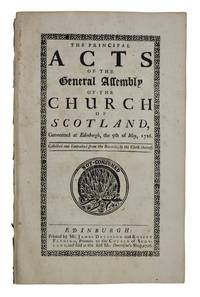
1726AQ30924Edinburgh: Printed by Mr. James Davidson and Robert Fleming 1726. 21pp 17. Disbound. Scattered spotting. The primary acts of the General Assembly of the Church of Scotland for 1726 including inter alia an ‘Act appointing a solemn National Fast’ an ‘Act making an Alteration in the Form of Commissions from Universities’ and an ‘Act regulating Transportations of Ministers settled in Highland Congregations’. The Assembly was instituted in 1560 the year of the Scottish Reformation which marked the beginning of the Protestant Church of Scotland. . Folio. Printed by Mr. James Davidson and Robert Fleming unknown
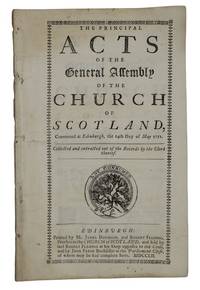
1752AQ30925Edinburgh: Printed by Mr. James Davidson and Robert Fleming 1752. 27pp 13. Disbound. Scattered spotting title page and initial leaf detached head of text-block shaved - loss to running title. The primary acts of the General Assembly of the Church of Scotland for 1752 including inter alia an ‘Act regulating the Meetings of Synods in respect of the late Act of Parliament changing the Kalendar’ and an ‘Act concerning Presbyteries neglecting to send up their Opinions upon Overturestransmitted to them’. The Assembly was instituted in 1560 the year of the Scottish Reformation which marked the beginning of the Protestant Church of Scotland. . Folio. Printed by Mr. James Davidson, and Robert Fleming unknown
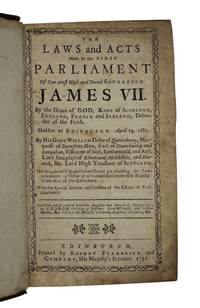
1731AQ35301Edinburgh: Printed by Robert Freebairn 1731. 875pp 1. Each session of Parliament has a separate title page. Contemporary gilt-ruled sheep contrasting red morocco lettering-piece. Heavily rubbed joints starting foot of spine worn. Early ownership inscription to recto of FFEP head of text-block shaved with occasional loss to running-title initial four gatherings dampstained at foot very small hole to leaf Mm7 touching text without loss of sense. A duodecimo reprinting laws and acts of Parliament relating to the governance of Scotland enacted from 1685 up to the Act of Union during the reigns of James VII William and Mary and Queen Anne. ESTC T134395. 12mo. Printed by Robert Freebairn unknown
14279Edinburgh. 13 February 1836. 3pp. folio. On two loose leaves each with one torn edge. The blank reverse of the second leaf is addressed in manuscript to 'The Bank of Scotland Edinbr' with two postmarks and pencil docketting. The heading is followed by a long list of those present beginning with 'Mr THOMAS MILLAR for the Incorporation of Skinners and Furriers' and ending with 'ALEXANDER WRIGHT Esq. chose Preses'. There follows a minute of the meeting by 'ALEX. WRIGHT' beginning: 'Colonel MACDONALD after explaining to the Meeting the circumstances which induced Mr DUNSMURE and him to call them together proposed that a Committee should be appointed to frame a circular to the Creditors requesting them to be upon their guard not to commit themselves prematurely or without due inquiry to approve of Mr. LABOUCHERE's Report'. Wright's statement is followed by one by 'WM. MACDONALD Convener' beginning: 'The Committee in reference to the prefixed Minute beg to acquaint you that the Meeting in question was called in consequence of it having come to the knowledge of several gentlemen deeply interested as Creditors in the affairs of the City that parties opposed to the general interest of the Creditors were taking active measures to work upon their fears as to their prospect of ultimate payment with the view of inducing them to accede to the composition proposed by Mr LABOUCHERE.' The third page carries a mandate form which has not been completed. According to a parliamentary report 'In January 1836 the Right honourable H. Labouchere Vice-President of the Board of Trade visited Edinburgh and Leith in compliance with the wishes of Lord Melbourne and the Chancellor of the Exchequer as expressed in their letter to him of 25th September 1835 on the subject of the financial affairs of the city'. Labouchere subsequently produced a report recommending the restructuring of the 'debt now due on account of the docks at Leith'. No other copy traced. Edinburgh. 13 February 1836. unknown
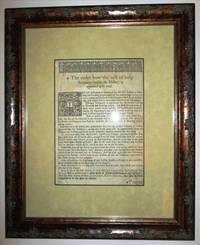
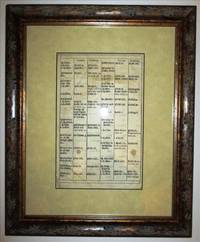
16362189Loose-leaf. Good -/Fair. Archivally matted and framed decorated page from a damaged copy of the 1636 Scottish Book of Common Prayer which was influential on the American Book of Common Prayer. <br /><br />The decorated page is very fragile and shows evidence of minor tears in the upper left corner and the bottom right. As is evidenced in the photo the page is decorated by an elaborate header more than 1" high. After the page title follows a delicately illustrated capital T.<br /><br />The text gives instructions on how the Old and New Testaments are to be read throughout the year.<br /><br />Accompanied by a certificate of authenticity. A very nice portion of the scarce first edition of the Scottish Book of Common Prayer. Makes an excellent gift. Edinburgh: Printed by Robert Young 1636. First edition. #2189 Printed by Robert Young hardcover
1739AQ19694Edinburgh: Printed by T. Lumisden and J. Robertson for J. Jaffray Book-seller in Stirling 1739. xviii 19-331pp 3. ESTC T79910. Bound with: Acts and Proceedings of the Associate Presbytery Met at Edinburgh May 1739. Edinburgh. Printed for J. Jaffray 1739. First edition. vi 7-60pp. ESTC T79917. And: ERSKINE Ebenezer. The sovereignty of Zion's King; in some discourses upon psalm ii. 6. Edinburgh. Printed by Alexander Alison for David Duncan 1739. First edition. 84pp. ESTC T75161. Copies recorded at four locations in the British Isles BL Edinburgh Oxford and St. Andrews and one further in Australia Melbourne. And: GUTHRIE James. The great danger of backsliding and Defection From Covenanted Reformation-Principles. In a sermon on Isaiah lvii. 13 14. Edinburgh. Printed by Thomas Lumisden and John Robertson for George Paton 1739. First edition 22pp. ESTC T76485. Copies recorded at five locations in the British Isles BL Edinburgh Glasgow Mitchell and NLS none elsewhere. And: HEUGH Hugh. Shaftsbury's Ghost conjur'd: or a letter to Mr. Francis Hutcheson Professor of Moral Philosophy in the University of Glasgow. Edinburgh s.i. 1738. First edition. 42pp. ESTC T180801. Copies recorded at three locations in the British Isles Edinburgh Glasgow and NLS and a further three in North America Newberry Presbyterian College and Princeton. And: SEWARD William. Drop-head title: Copy of a letter from Mr. William Seward in answer to a letter sent him by his Brother the Reverend Mr. Thomas Seward at Genoa. London s.n. 1739. First edition. 7pp 1. ESTC N67249. Copies recorded at two locations in the British Isles Lambeth and Wesley and a further two in North America Michigan and New York Historical Society. And: A vindication of the Church and Kingdom of scotland from any accession to the murder of King Charles I. Edinburgh. Printed for James Forest 1718. First edition. 27pp 1. ESTC T178779. Copies recorded at four locations in the British Isles BL Edinburgh Glasgow and NLS and a further three in North America Duke Folger and Yale. 8vo. Contemporary calf contrasting red morocco lettering-piece. Extremities heavily rubbed. Pen-trials to front endpapers occasional spotting and light dust-soiling damp-staining throughout second mentioned work with closed horizontal tear to final leaf. A sammelband of seven works predominantly printed at Edinburgh in the first half of the eighteenth-century and concerned with Presbyterianism in Scotland. Highlights include: Two remarkably scarce sermons one by influential dissenting minister and a founder of the Secession church Ebenezer Erskine 1680-1754; the other by James Guthrie c.1612- 1661 a Church of Scotland minister exempted from general pardon following the Restoration and subsequently executed on charges of high treason in part for being complicit in issuing a public testimony against religious toleration and regulations previously agreed to by Church and State. The first published work of Hugh Heugh son of John Heugh 1688-1731 minister of Kingoldrum criticising the teaching methods of moral philosopher Francis Hutcheson 1694-1746 during his tenure at the University of Glasgow. . First edition. Printed by T. Lumisden and J. Robertson, for J. Jaffray Book-seller in Stirling unknown
1826AQ17433Duneidin i.e. Edinburgh: Clodh-Bhuailte le Iain Collie 1826. 72pp. Original publisher's powder blue paper wrappers. Rubbed chipping to spine upper joint splitting remnants of stitching to wrapper edges. Several small worm-trails - occasional touching text without loss of sense lightly spotted. An early nineteenth-century Gaelic translation of Church of Scotland catechism prepared for the General Assembly for the use of schools printed two years after their formation of an education committee to address the shortfall in educational establishments across the nation. . 12mo. Clodh-Bhuailte le Iain Collie unknown
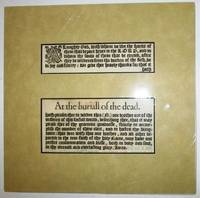
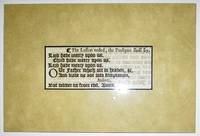
16362185First edition. Loose-leaf PORTION of a page from a damaged 1636 edition of the Scottish Prayer Book. With archival quality mat the item measures 9.25" x 9.5". Please view photograph to see two windows of text that displays the beginning of the prayer as it appeared at the bottom of one page and the remainder of the text from the beginning of the subsequent page. The prayer begins with an elaborately decorated capital A. The prayer shows a distinct Calvinist tendency and though intended for the Burial service is suitable for every day. <br /><br />The complete text is as follows:<br />"Almighty God with whom do the spirits of them that depart hence in the LORD and in whom the souls of them that be elected after they be delivered from the burden of the flesh be in joy and felicity: We give thee hearty thanks for that it hath" <br />beginning of the next page which has this large headline: "At the buriall of the dead." <br />"hath pleased thee to deliver this N. our brother out of the miseries of this sinfull world beseeching thee that it may please thee of thy gracious goodness shortly to accomplish the number of thine elect and to hasten thy Kingdome: that wee with this our brother andall other departed in the true faith of thy holy Name may have our perfect consummation and blisse both in body and soul in thy eternall and everlasting glory. Amen."<br /><br />Very Good . Archivally matted from the scarce first printing of the Scottish Book of Common Prayer which was influential on the American Book of Common Prayer. Accompanied by a certificate of authenticity. Makes an excellent gift. Edinburgh: Printed by Robert Young 1636. Printed by Robert Young
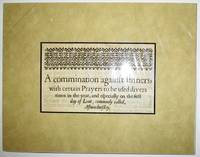
16362190A portion of a leaf from a damaged 1636 Scottish book of Common Prayer. This portion of a page includes a heavily decorated band that is 1 and 1/16th" tall above the following text starting as a large headline and decreasing in size:<br />"A commination against sinners with certain Prayers to be used divers times in the year and especially on the first <i>day of Lent commonly called Ashwednesday.</i>" Including the archive quality mat the entire item measures 10" x 7.25". <br />This page is in <b>Very Good </b> condition from the very scarece first printing of the Scottish Book of Common Prayer which was influential on the American Book of Common Prayer. Accompanied by a certificate of authenticity. Edinburgh: Printed by Robert Young 1636. Printed by Robert Young
16362184Edinburgh: Printed by Robert Young 1636. First edition. Loose-leaf. Very Good . Archivally matted instructions from the first printing of the Scottish Book of Common Prayer which was influential on the American Book of Common Prayer. Accompanied by a certificate of authenticity. A very nice copy of this service standard from the very scarce first edition of the Scottish Book of Common Prayer. Printed by Robert Young
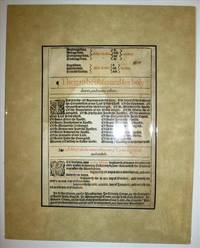
16362192Loose-leaf: "These to be observed for holy dayes and none other." Fair. Individual leaf from a 1636 book for the Church of Scotland that contained "Usage Instructions from The Booke of Common Prayer and Administration of the Sacraments." The page is in good condition considering its age. The top third and right side have a water stain that does not impede reading of the text. Two decorated capitals and red ink interspersed with the black most pages of this edition are black text only. There is also at least one small bookworm hole. These indications of age confirm the authenticity of the leaf and enhance its aesthetics and uniqueness. Each leaf is accompanied by a certificate of authenticity. Archivally matted for framing and accompanied by a certificate of authenticity. Makes an excellent gift. Edinburgh: Printed by Robert Young 1636. Robert Young hardcover
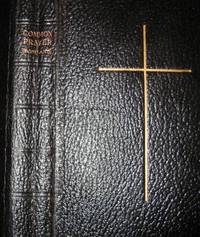
1912717Edinburgh: Cambridge University Press 1912. First edition. Leather Bound. Near Fine. 5 x 7 1/4 inches. lvi 698 numbered pages a 4 leaves lacking a1 initial blank b 16 leaves C 8 leaves 1-21 in 16s 22 14 leaves. All page edges rouged and gilt. An interesting unrecorded variant of Griffiths 1912/2 and 1912/3. Bound in full flexible black leather with gilt cross on front cover and gilt "Common Prayer Scotland / Cambridge" on spine. Pasted inside the rear cover is a manuscript letter dated 18th March 1913 from E.H. Dowden the niece of the noted Irish poet professor and literary critic Edward Dowden whose brother was Bishop of Edinburgh addressed "Dear Dr. Hart" regarding the new Scottish BCP and the effect of the printer's strike upon it and the Scottish Chronicle noting "how useful your American Revision Reports have been" and the current state of revision of the Lectionary among other related subjects also included is a letter from James Pott American agent for Cambridge Univ. Press notifying Dr. Hart of the forwarding of the New Scottish BCP. From the library of Samuel Hart which experienced a fire that damaged a number of books. As a result items from Hart's library are extremely rare. Samuel Hart 1845-1917 was dean of the Berkeley Divinity School the unofficial "middle way" seminary of the Episcopal Church at Middletown Connecticut. In 1886 he became the third custodian of the Standard Book of Common Prayer. In 1892 he became secretary of the House of Bishops. In 1898 he became the fourth historiographer of the Episcopal Church. He served in all three of these offices until his death. In 1893 he was elected Bishop of Vermont but he declined the office. A unique association copy with related correspondence. Cambridge University Press unknown
16362204Single leaf from a damaged 1636 edition of the Book of Common Prayer Church of Scotland. Archivally matted page that gives instruction regarding the reading of the Psalms including precise instructions for leap years. Heavily decorated with a wide top border and delicately illustrated capital T. An historic leaf from the first printing of the Scottish Book of Common Prayer which was infulential on the American Book of Common Prayer. Accompanied by a certificate of authenticity. Very good. Loose-leaf with mat.<br />A nice leaf from the very scarce first edition of the Scottish Book of Common Prayer. Makes an excellent gift. #2204 Robert Young
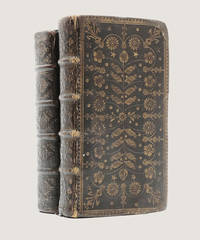
171614942Edinburgh; Printed by James Watson One of His Majesty's Printers 1716. 1716. Two imprints in two volumes the Bible divided across both volumes and signed continuously the Psalms bound to end of volume two and signed independently. Duodecimo n. p. sig. A-Y12 Z1-2; Z3-12 2A-2S12 2T10 A-C12. The New Testament has a letterpress title-page. This copy lacks the two engraved title-pages to the Old and New Testaments reported by some institutional cataloguers otherwise complete. We locate both one volume and two volume copies in institutional libraries and copies with and without the Psalms. Both volumes bound in near-uniform black full morocco Scottish herringbone bindings. Volume one on four raised bands star and thistle ornaments within triple fillets to compartments; central herringbone panel in star thistle and wheel design within fleur-de-lis and pyramid roll borders to boards; pyramid rolls to turn-ins; marbled end-papers; all edges gilt; olive-green silk place-marker mounted to headband. Volume two on four raised bands; gilt floral tooling within triple fillets to compartments; thistle star and wheel herringbone panel surrounded by thistles stars and fleur-de-lis within fillet and pyramid roll border; floral rolls to board edges and turn-ins; marbled end-papers. Elaborate calligraphic bookplate in black green and red ink of Sarah McKie 'written at Edinburgh the XIIIth August 1735' to front free end-paper of volume one; pencil ownership inscription of one 'J. S. Muir 1888' to verso. Neat ownership inscription of one 'Stewart' dated December 5 1721 to front free end-paper of volume two. Later pencil annotation to foot of volume one T8v. Corners bumped slight rubbing to joints of raised bands on volume one shelf-wear to edges of boards but bindings otherwise bright neat and very solid. A few spots of occasional toning to contents of both volumes text-blocks very occasionally frayed and nicked to edges; one end-leaf of volume one repaired sympathetically with like paper; slight loss to corner of C1 affecting catchword only loss to corner of A2 A5 of Psalms affecting text; spots of ink to N1 of Bible ink stains to title-page B1v B2r of Psalms; 2R gathering of Bible and B C gatherings of Psalms cut close to fore-edge affecting text. Contents used but serviceable bindings both well-preserved examples. A curious pair of volumes bound in very similar herringbone style perhaps even from the same workshop but with no tools in common. The division of the volumes midway through the Psalms at Z2 is such an unusual choice which appears to differ from institutional copies in two volumes that this bookseller concludes they must be intended as a pair. Herringbone bindings were the dominant form of decorative binding in early eighteenth-century Scotland evolving from late-seventeenth century panel bindings. The thistle and pyramid tools on display here are peculiarly Scottish features. An excellent example of fine Scottish binding of the early eighteenth-century. ESTC T91732; T91831. Edinburgh; Printed by James Watson, One of His Majesty's Printers, 1716. hardcover
16362188Edinburgh: Printed by Robert Young 1636. First edition. Loose-leaf. Very Good . Archivally matted and framed from the first printing of the Scottish Book of Common Prayer which was influential on the American Book of Common Prayer. Accompanied by a certificate of authenticity. A very nice portion of the scarce first edition of the Scottish Book of Common Prayer. Makes an excellent gift. Printed by Robert Young unknown
14009Without place or date but with reference to 'George Salmond Writer Glasgow'. Early nineteenth-century. 2pp. 4to. On leaf untidily torn from an album resulting in a ragged edge with minor loss of text a few parts of words. On aged and chipped paper. The document is headed 'Forgery of the Commercial Bank of Scotlands Guinea Note' and begins: As a few off these Forged Notes have made their appearance in Glasgow <th>e following directions are given to enable the public to distinguish the forged from the genuine Notes.' A detailed description follows with small illustrations given of the shapes of the letter 'B' in forgery and genuine note with other illustrations of a thistle both with and 'without prickles'. The document ends: 'It is requested that if any of these forged Notes are presented the same and those offering them may be detained and proceeded with according to the Law and that notice may be immediately sent to George Salmond Writer Glasgow who will pay the expenses and liberally remunerate those giving any information which may be of Service or may lead to Conviction of offenders.' No other copy traced either on COPAC or WorldCat. The Scottish guinea note was introduced in 1758 and discontinued in 1828. The book 'Rambling Recollections of Old Glasgow' by 'Nestor' contains a reference to 'Mr. George Salmond long Procurator-Fiscal at Glasgow' who 'kept an album or rather nigrum containing a collection of forged notes with notices of the results to the persons implicated in their forgery or issue. There seldom was a Circuit in Glasgow where there were not several men or women sentenced to death for such crimes and several expiated their offences on the scaffold'. Salmond was Procurator-Fiscal by 1826 so this item would appear to date from before then. Without place or date, but with reference to 'George Salmond, Writer, Glasgow'. Early nineteenth-century. unknown