8 176 résultats
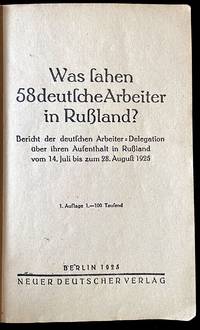
192542907Berlin Neuer Deutscher Verlag 1925. 1st edition. Original 3-color printed wrappers 12mo 176 pages. Foreword by the Dutch trade union official Edo Fimmen 1882-1942. <br> Fimmen was committed to a workers’ united front and was chairman of the The International Federation of Trade Unions also known as the Amsterdam International from 1919 to 1923. He was also a member of International Workers' Aid and through his friendship with Willi Münzenberg an important supporter of the International Red Aid and the League against Imperialism and Colonial Oppression. <br> Widely-read among Anti-fascists in Germany in the years leading up to Hitler's win in the Reichstag this work includes numerous photo plates with travel impressions and a list of the delegation members. <br> In her recent history of East Germany “Beyond the Wall†historian Katia Hoyer discusses the importance of this book in building a positive image of the newly founded Soviet Union among German Communists including Jews who would soon begin to flee to the USSR in large numbers as the Nazi noose tightened.<br> She notes that “a 1925 brochure called ‘What Did 58 German Workers See in Russia’ became instrumental in creating a paradisiacal image of the Soviet Union. It was inspired by the communist Hermann Remmele who had led a group of his comrades on a grand tour of sorts through Russia. <br> The pamphlet was based on their reports and boasted of 'female workers who proudly talked of their equal treatment' and of wages that were '33 per cent higher' if one takes into account that workers lived rent-free and had excellent healthcare. All of this must have made the Soviet Union seem like the promised land to the unemployed and the destitute as well as to idealist intellectuals. <br> Having experienced the First World War and its appalling consequences older German communists wanted to believe there was a better alternative and saw the Soviet Union as a beacon of hope especially after the waves of arrests in Berlin in 1933. For most German political refugees who fled to the USSR after Hitler took power their time in Moscow began as a great adventure†page 15.<br> She notes that later however “Hermann Remmele the leader of the group that penned the propaganda brochure ‘What Did 58 German Workers See in Russia’ was to endure a fate that would stand in for many German communists. Once a darling of the Soviet political elite Grigory Zinoviev had called him 'the best and most precious asset of the German party. the gold of the proletariat' he was arrested in Russia in May 1937 on charges of spying and sabotage. Two years later he was sentenced to death and shot on the same day 7 March 1939.<br> His son Helmuth died on his way to a gulag in Siberia and his wife Anna would succumb to health problems caused by a horrific spell in Moscow's Butyrka prison†page 19.<br> SUBJECTS: Labor and laboring classes -- Soviet Union. Economic history. Labor – Working class -- Economic conditions -- 1917-1945. URSS -- Conditions e´conomiques -- 1917-1945. OCLC: 5918896. Cover rubbed with tear loss to one letter chip at base of spine and small chip at lower margin of front cover. Internally very good condition Good- Condition overall. B Holo2-162-27-XX-. Berlin, Neuer Deutscher Verlag unknown
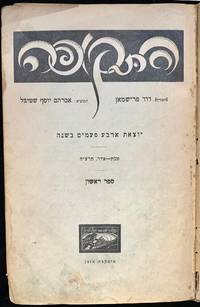
191843090Moskvah Moscow : A.Y. Shtibel 1918. First edition. Original boards 8vo 678 pages. 26 cm. In Hebrew. Title translates as “The Season.â€<br> Rare volume 1 published in the USSR of the quarterly literary magazine Ha-Tekufah. Includes essays by Simon Dubnow poetry short stories translations and articles.<br> Ha-Tekufah was a “Hebrew periodical devoted to literary scientific and social subjects which appeared first as a quarterly then as an annual intermittently between 1918 and 1950. Ha-Tekufah received the financial backing of Abraham Joseph Stybel a philanthropist who had placed David Frischmann in charge of launching Hebrew literary projects on an unprecedented large scale. Accordingly Frischmann established both the Stybel publishing house and launched Ha-Tekufah serving as the editor of both projects. The first volume of Ha-Tekufah appeared in Moscow early in 1918 before the Bolshevik regime had decided to suppress Hebrew literature. Frischmann published the works of the world's best authors and scholars. The literary standards of the periodical were high. Frischmann encouraged young authors for example Eliezer Steinman. In all respects and not least for its beautiful graphic work Ha-Tekufah was a rare phenomenon in Hebrew literature.†Jewish Virtual Library.<br> SUBJECTS: Hebrew literature Modern -- Periodicals. Hebrew literature Modern. OCLC: 25586768<br> Boards separated and pages edgeworn. Lacks backtrip spine covering. Good Condition internally. YID-46-7-’. Moskvah [Moscow] : A.Y. Shtibel unknown
1957216902Moskva: Izdatel'stvo Akademiya Nauk SSSR 1957. First Edition. Hardback. Very good copy in the original title-blocked cloth. Spine bands and panel edges slightly dulled and dust-toned as with age with minor staining to front and rear boards. Remains particularly well-preserved overall; tight bright clean and strong. Errata slip to rear flyleaf. ; 8vo 8"" - 9"" tall; 238 pages; Physical desc.: 238 p. facsim 25 cm. Subject: Russia -- History -- To 1533 Moskva: Izdatel'stvo Akademiya Nauk SSSR hardcover
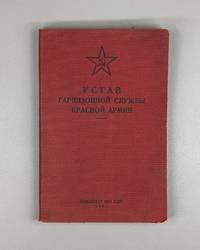
194143962988396586<p>УÑтав гарнизонной Ñлужбы КраÑной армии. Ðародный комиÑÑариат обороны Союза ССР. МоÑква: Воен. изд-во 1941. 135 Ñ.: ил.; 17 Ñм. ÐœÑÐ³ÐºÐ°Ñ Ð¾Ð±Ð»Ð¾Ð¶ÐºÐ°. Хорошее ÑоÑтоÑние.</p><p></p><p>Charter of the Garrison Service of the Red Army Ustav garnizonnoj sluzhby Krasnoj armii. People's Commissariat of Defense of the USSR. Moscow: Voen. izd-vo 1941. 135 p.: ill.; 17 cm. Softcover. Good condition. This is the official military manual defining the duties and procedures of the garrison service within the Workers' and Peasants' Red Army. Published at the onset of the Great Patriotic War by the central Military Publishing House Воен. изд-во this compact field-format document outlines regulations for maintaining order security and military discipline in populated areas garrisons organizing guards ceremonies and daily routines for troops stationed away from the front lines. The 1941 edition is a primary source reflecting the standardized military protocols of the pre-war and early war period aimed at ensuring combat readiness and discipline during total mobilization. It includes schematic illustrations detailing procedures and formations. A copy in good condition is a significant collectible for the study of Soviet military regulations and daily army life during WWII.</p> Military Publishing House paperback
INCLUDES A LETTER WITH DEDICATION SIGNED BY EDITOR. RARE memorial book of the Jewish community of Vileika district, annihilated at the outbreak of the Russo-German war in 1940. This book is divided in two sections, Hebrew and Yiddish, and synopsis in English. Includes many b&w photographic plates. 275x215mm. 326 pages. Red cloth Hardcover. Gilt lettering on front cover and spine. Cover corners and spine edges bumped. Rear cover slightly stained. Bump-mark on front cover. Ex-library copy with stamps. Rear whitepage wrinkled. Library sticker on front inner cover and rear whitepage. Pen writing on Hebrew title page and rear inner cover. Tape residues on inner cover. Tape between pages 122-123 and 126-127. Text block edges yellowing. [SUMMARY]: This extremely rare monograph on an extinct Jewish community is in good condition. PLEASE NOTE: This item is overweight. We may ask for extra shipping costs.
IN YIDDISH. THIS VOLUME ONLY. RARE copy of the comprehensive monograph on the infamous massive wave of violence against the Jewish population in Ukraine during the crucial years before the incorporation of most of Ukraine into the Soviet Union, written by the noted Jewish scholar Elias Tcherikover. This is the first volume of a larger series on the pogrom-movement in Ukraine (Die Geschichte der Pogrom-Bewegung in der Ukraine 1917-1921). Contains several b&w plates of photographs and posters. This important study was written in Yiddish, and has yet to be translated to English. 230x155mm. 330 pages. Grey Hardcover with black lettering on front cover and spine. Cover slightly stained. Front cover curved. Cover corners and edges, and spine edges bumped. Spine upper edge tattered. Few page/s corner/s slightly bumped. Pages yellowing, some pages age-stained. [SUMMARY]: This extremely rare study of the history of the Ukrainian pogroms during the Russian civil war is otherwise in good condition.
8vo; Kiev: Kultur-lige, 1928.Cloth, 8vo, 23 cm, 69 pages. Includes fold-out "Tabele fun ortografishe forshlagn." Subject: Yiddish language -- Orthography and spelling. JTSA keeps their copy in their restricted collection. Paper browning with some damp stains, bound in later boards, with original paper covers intact. Good Condition. Scarce (heb-1-25)
1st edition. Original Cloth, Large 8vo; 508 pages; In Yiddish & Hebrew. Title translates as, "Memorial Book for the Community of Sarny." Memorial volume for the Jewish community of Sarny. Maps on the endpapers of the Sarny ghetto and White Russia. Frontis photo of town memorial grave. A history of the community, its institutions and prominent members. Includes numerous portraits & other photos. Very Good Condition. (yiz-5-5)
VIII-202 pagine. Brtossura editoriale. INVIO autografo dell'autore alla pagina bianca. Erminio Mariani fu addetto commerciale prima a Pietrogrado e poi, dopo la Rivoluzione, a Mosca fino alla metà degli anni 20. Fu il più acuto osservatore ed analista delle trasformazioni economiche sovietiche e dei piani di Lenin. Questo volume, fuori commercio, era appunto la prima analisi della NEP. Mariani fu uno dei fautori (oltre che artefice) del riavvicinamento tra regime fascista e regime sovietico. Raro.
19491054881949 N° 1 - Janvier 1949 - Grand in-folio (environ 30x42cm), broché couverture illustrée - Revue mensuelle illustrée - Très belles reproductions photographiques - 2 pages de photos dépliantes milieu d'ouvrage
Original Wrappers. 8vo. 166 pages. 21 cm. First Edition. In Ukrainian. "Although his first poems were written in 1916, Osmachka began his literary career while he was a student at the Kyiv Institute of People's Education from 1920 to 1923. He belonged to the literary organizations Aspys and Lanka [Later known as 'Maisternia Revoliutsiinoho Slovaâ' (Workshop of the Revolutionary Word) or MARS] and published his first collection of poetry, Krucha (The Precipice) , in 1922; it was followed by two more collections, Skytski vohni (The Scythian Fires, 1925) and Klekit ([Crane's] Clacking, 1929) . Like other members of MARS he was attacked and arrested for his 'unpolitical' literary works, but managed to save himself from execution by feigning insanity. During the 1930s he faced constant persecution by the authorities and was unable to publish any works. During the Second World War he fled to Western Ukraine, then to displaced persons camps in Germany, and finally to the United States. Osmachka's personal ordeal had lasting effects on him, and until his death he suffered from a persecution complex. Nonetheless he resumed his literary career in 1943 in Lviv with the publication of his fourth collection of poetry, Suchasnykam (To My Contemporaries) . In the displaced persons camps, where he was a member of the MUR literary organization, he published his epic poem, written in octaves, Poet (Poet, 1946) , as well as his first prose work, Starshyi Boiaryn (The Best Man, 1946)." (Encyclopedia of Ukraine. ) Subjects: Ukraine; Fiction; Short Stories. OCLC lists 2 copies worldwide. (Cleveland Pub. Libr. , Toronto Pub. Libr. ) Light age toning and edgewear. Very good contion. Scarce and important (UKR-1-29)xx
FT) Original Stapled Wrappers. 8vo. 24 pages. In Russian. Title translates to English as, Diary of a Social Democrat. Menshevik journal edited by Plekhanov published sporadically from 1905-1911 containing open letters and polemics on various subjects. CONTENTS: Nashe Polozhenie [Our Position]. French title across top-margin: Le Journal dun Socialdemocrate. OCLC lists one copy (National Library of Israel) . Edges darkened, but paper is not fragile and all text is clear. Very Good Condition. (RUS-11-26a)
Original Wrappers. 8vo. 67 pages. 21 cm. First Edition. In Ukrainian. Written by Theodore Pestushko under the pseudonym Yurko Stepovvy. A fictionalized account of the authorâs experiences with the Steppe Division of the Ukrainian National Republic Army. Active in the later part of the Ukrainian Revolution, the UNR was a largely peasant based army fighting against Bolsheviks in Western Ukraine. Pestushko became a leading member of the Organization of Ukrainian Nationalists, and wrote about the movement for Ukrainian Independence upon settling in the United States after World War II. Subjects: Ukraine -- History -- Revolution, 1917-1921 -- Fiction. OCLC lists 14 copies worldwide. Some age toning and edgewear. Backstrip has tears, and is partially absent. Internally very good. (UKR-1-28) xxx
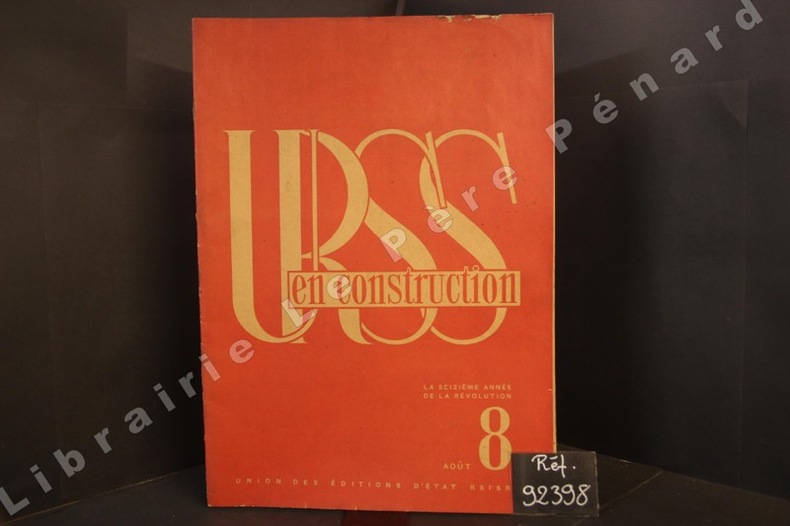
1933923981933 N° 8 - Août 1933 - Grand in-4 illustré - 30x42cm - Revue mensuelle illustrée - Très belles reproductions photographiques - Dépliant de reproduction photographique au centre de l'ouvrage
IN HEBREW. 245x185mm. 47+35+679 pages. Gilt hardcover. Cover yellowing, rubbed, slightly curved and slightly stained. Spine worn. Text block edges stained. Inner cover yellowing and age stained. Binding partly visible between inner cover and pages. Few pages slightly age stained - no damage to text. Pages yellowing. Else in good condition. PLEASE NOTE: This item is overweight. We may ask for extra shipping costs.
RARE HEBREW novel by the Lithuanian member of the Haskalah movement Mordechai Plongian, also known as the author of several religious and secular books. This book, inspired by the blood libel in Damascus, documents a case of blood libel that took place somewhere within the Russian empire during the 18th century. The book is written in the elevated and flowery Hebrew of the Haskalah movement. 190x130mm. VI+96 pages. Red cloth Hardcover with gilt lettering on spine. Ex libris sticker on endpaper. Pages slightly yellowing, some pages slightly age-stained. [SUMMARY]: Save for some light wear, this rare edition of an early Hebrew novel is in good condition.
Fine English Original bdg. HC. Roy. 8vo. (24 x 17 cm). In Crimean Turkish (Cyrillic script) and Russian. 320 p. Rakamlar saatlik eteler. Kirimtatar halkinin öz-özüni cedvelge aluvi (1966, 1971, 1973-1974 ss). Tarihi vesikalar.= Slori svidetelstvuyut. Po materialam samoperepisi Krimskotatarskogo naroda (1966, 1971, 1973-1974 gg). Ismoruchni documenti. Details of the population census of the people after the Crimean exile, 1963-1974.
1950Paris, Garnier, 1880. Carte dépliante (60 x 45) sous chemise (16 x 10.5). Echelle mille de 60 au degré. Très rare et en très bon état.
239216Paris, Librairie Valois, 1931 fort vol. in-8, XIX pp., 744 pp., typographie en petit corps, broché.
Mm 140x225 Pubblicazione senza data di stampa, ma anno 1933 o '34. Volume in piena tela rossa con scriite in nero impresse al piatto e al dorso, 431 pagine con tavole in nero ad intercalare il testo e 6 cartine più volte ripiegate in chiusura del libro. Prefazione di Virginio Gayda. Le condizioni sono ottime con le legature ben salde; spedizione in 24 ore dalla conferma dell'ordine.
1967209461967 Paris, Témoignages-Edition-Diffusion, (1967), 5 volumes cartonnages simili cuir rouge de l'éditeur sous jaquettes rhodoïd, titre et médaille dorés sur les premiers plats de couverture, titre, sous-titres et tomaisons dorés sur les dos, 22,2 x 31,5 - 388, 312, 592, 452 et 508 pages, texte sur 4 colonnes, planches en couleurs, cartes en couleurs, nombreuses illustrations photographiques en noir, bibliographie et sources, table des cartes pour chaque volume, chronologie générale à la fin du tome 5. Tome 1 - 1941 : Guerre-éclair à l' Est. Tome 2 - 1942 : De la retraite à Stalingrad. Tome 3 - 1943 : L' Armée Rouge contre-attaque. Tome 4 - 1944 : Les soviétiques à l'offensive, du Cercle Polaire au Danube. Tome 5 - 1945 : De la Vistule à Berlin. Traduit de l'Italien par Jacques Imbert. Dos du tomes 2 très légèrement éclairci, petit manque sur le bord supérieur du dos des jaquettes rhodoïd des tomes 1 et 4, bons exemplaires.
3158JAPON - In-8 broché - N° 1 à 3 (1957 à 1959) - 5 à 13 ( 1961 à 1969) -16 & 17 (1972 & 1973) , soit 14 années - Ex. très propres
JAPON - In-8 broché - N° 1 à 3 (1957 à 1959) - 5 à 13 ( 1961 à 1969) -16 & 17 (1972 & 1973) , soit 14 années - Ex. très propres
213837Paris, Chapelot, 1913 in-8, VIII-505 pp., 7 planches, 5 cartes dépliantes, broché.
210493Paris, Dumaine, 1867 in-8, 379 pp., 14 planches dont 1 dépliante, 3 cartes dépliantes, demi-basane fauve, dos lisse orné de filets dorés (reliure de l'époque). Dos passé et frotté. Coupes et coins usés. Cachets (annulés).