LONDON, JackBiblio.com

23 852 résultats
15534n.p. n.d. Quarto : 119pp. : in half morocco slipcase : Sept. 30 1904; A.L.S. 2 pages : To R.W. Gilder. The original autograph manuscript of London's ground breaking story about boxing. The manuscript is heavily corrected throughout in London's hand showing considerable evidence of re-writing. The first page is rubber stamped August 31 1904 and last page signed by the author and dated Sep. 30 1904 suggesting he took just one month to write the story. <br /> <br /> In the letter accompanying the manuscript London offers the story to Richard Watson Gilder editor of the "Century Magazine". He describes the story as "a transcript from the life of the western end of my own town Oakland. And the fight if nothing else is real." <br /> <br /> Gilder declined the story and it was serialised in Metropolitan Magazine U.S. and The Tatler London both in April 1905 and then published in book form by Macmillan in June 1905 illustrated by Henry Hutt and decorated by T.C. Lawrence. While it did not reach the spectacular success of Call of the Wild 1903 or The Sea-Wolf 1904 The Game 1905 was the first literary treatment of prize fighting and is credited with starting the genre. <br /> <br /> Categorised as a novel in Walker and Sisson 9 in the letter London is adamant that it is not a short story - "This thing somehow just got away with me." - and refers to it twice as a "transcript from life". He is aware that he is breaking ground "The prize ring has never been understandingly done into literature - and when it has been attempted it has been a description of a contest between world champions by a man who didn't know anything about it." <br /> <br /> That Jack London knew something about boxing is well documented. He learned the art of pugilism as a young man and as a sportswriter he covered many fights. He countered charges that the story was "unbelievable" by sending news clippings to his critics to prove that a boxer could smash in the back of his skull by falling to the mat from a hard blow. And he claimed that the lightweight champion of the world Jimmy Britt liked the story "on account of its trueness to life" Book of Jack London II 10-11 as quoted in Walker and Sisson p.13. <br /> <br /> Having closely compared the manuscript to the Metropolitan Magazine and first US editions 91 textual differences have been noted. Most of these are between the manuscript and both print versions. However there are a number of cases where the Metropolitan Magazine version follows the manuscript and a handful of occasions where all three differ. One of the most interesting differences is the last line of the manuscript which was omitted in the print versions.<br /> <br /> Running to 119 pages this is the longest of the few Jack London manuscript remaining in private hands. <br /> <br /> Provenance: Sotheby's - New York April 2004 - The Maurice F. Neville Collection. Included at the sale with a signed association copy see item #15535. <br /> Marjorie Wiggin Prescott sale 6 February 1981 lot 230 all except the 1919 reprint<br /> Unnamed consignor sale American Art Association 11 March 1930 lot 227 manuscript and letter only. unknown
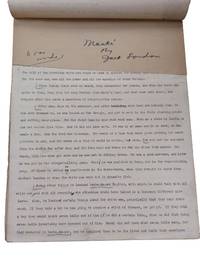
190815538Glen Ellen California 1908. Very good. Double space typed manuscript : ribbon copy on paper watermarked "Saxon Bond" : 13pp. : Jack London's name address and word count 6233 words typed at the top of first page : several pencil corrections and revisions apparently in London's hand 21 words : the setting copy with editorial corrections printer's marking in pencil and "Hampton's Magazine" stamped to head of each page : p. 5 cut in two between lines of text and then pinned together a previous cataloguer posited this might be the result of an editorial change but I see little evidence for that : a strip of brown paper section of a wrapper with "Mauki by Jack London. 6000 words" in his hand : this strip and the leaves stapled at the top : housed in a red half morocco slipcase. Mild soiling and toning the first leaf detached at the top from the rhs staple.<br /> <br /> Provenance: Lazare M. Kaufmann sale Christies 20th May 1988 Lot 206; Sotheby's April 2004 The Maurice F. Neville Collection. “Mauki†holds significant literary and historical importance for the South Pacific particularly in its depiction of colonial labour practices and indigenous resistance during a period of intense imperial activity. The narrative sheds light on the brutal labour trade often referred to as “blackbirding†in which Pacific Islanders were coerced or kidnapped into indentured servitude on plantations in Australia Fiji and elsewhere.<br /> <br /> Written in 1907 during London's cruise of the South Pacific in the Snark "Mauki" was first published by Hampton's Magazine in December 1908 and was collected in South Sea Stories in 1911. This is the setting copy i.e. the manuscript copy sent to publisher from which the publisher's printer sets the type. It is one of a handful of Jack London manuscripts to come onto the market in the past 50 years.<br /> <br /> The plot<br /> Like many of London's South Sea stories "Mauki" paints a brutal and extreme picture of the South Pacific at the turn of the twentieth century. In it the central character is a homesick Malaitan first kidnapped by another tribe and then indentured to the Moongleam Soap Company. He runs away again and again stealing guns and tobacco in one instance killing and eating a San Cristobal boy. With each re-capture his indentured time is increased as a means of punishment until finally considered incorrigible he is sent to remote Lord Howe Atoll under the oversight of a German plantation manager named Bunster who has something "wrong in his head". The brutal and sadistic Bunster pitilessly tortures the now seemingly compliant Mauki burning him with cigarettes knocking him about and flaying him with a mitt made from the skin of a stingray. Bunster's sadism is not only physical but psychological as well. He is the only white man in the story that refuses to acknowledge and respect Mauki's tambos taboos. <br /> <br /> The tables are turned however when Bunster is laid low by fever and just as he begins to recover Mauki exacts his revenge: "The house deserted he entered the sleeping-room where the trader lay in a doze. Mauki first removed the revolvers then placed the ray fish mitten on his hand. Bunster's first warning was a stroke of the mitten that removed the skin the full length of his nose.When Mauki was done he carried the boat compass and all the rifles and ammunition down to the cutter which he proceeded to ballast with cases of tobacco. It was while engaged in this that a hideous skinless thing came out of the house and ran screaming down the beach till it fell in the sand and mowed and gibbered under the scorching sun. Mauki looked toward it and hesitated. Then he went over and removed the head which he wrapped in a mat and stowed in the stern-locker of the cutter."<br /> <br /> The characters derived from life<br /> One of London's gorier tales "Mauki" is also a tale of heroism rough justice and personal meaning. It is also based in reality. In the papers of the Western Pacific High Commission held at the University of Auckland Library in New Zealand there is a forty-three page collection of documents surrounding a Dutch trader called Munster who faced deportation for troublesome behaviour:<br /> <br /> "On January16 1909 the Levers’ vessel Malekula arrived under the command of Charles Butchart to take on copra and deliver supplies. Munster the worse for drink was in Butchart’s words “chasing a Malaita native round the deck saying he would take his life.†Munster fought with members of the crew bit one person’s thumb threatened to shoot some natives and actually fired upon them. Matters escalated with Munster swearing at the crew and “threatening to shoot everyone in the ship.†Eventually he made his way to shore where the fighting continued to such an extent that passenger Joseph Dickinson disabled Munster by shooting him in the foot. Thereafter Munster fled to the bush and the ship departed to file a complaint and record depositions in Tulagi." <br /> Keith Newlin 2022 "Jack London and the Colonial Pacific" p.261<br /> <br /> London scholar Keith Newlin has shown that Munster was nominally the agent in charge at Ugi when the London party visited from 2–4 July 1908. No doubt London invented the specific cruelties that the fictional Bunster levied on the fictional Mauki but the real-life Munster was arguably insane and cruel.<br /> <br /> The inspiration for Mauki was also a real person a cook mentioned in Charmian London's account but how London came to know of his experiences is less clear. One of the compelling features of Mauki's character in the story are his multiple escape attempts due to homesickness. This idea may have originated with the stories told to the London's by their interpreter Bopu. It would seem the fictional Mauki may be a conglomeration of labourers and labour practices that the London's learned about and witnessed on their travels. As Newlin points out "Jack London scholars typically accept his portrayal of Melanesian labor conditions as factual and his descriptions have formed the basis of nearly all discussions of blackbirding and plantation conditions." but it is also wise to remember that Jack London wrote fiction ".and like all fiction writers he exaggerated and otherwise distorted the facts in pursuit of his fictional agenda—in this story to magnify the brutality of the colonial overseer and to portray the inner nobility of the laborer." Newlin p.265-6.<br /> <br /> The inner nobility or heroism of Mauki receives thoughtful treatment in Jeanne Campbell Reesman's 2006 article "Rough Justice in Jack London's 'Mauki'". Reading Mauki through the lens of naturalism she finds personal meaning is the hero's greatest possession and that living and acting according to his personal ethic makes him resemble a romantic or idealistic hero more than the standard naturalistic one p.65-66. Reeseman concludes that the moral of the story is "Respect your tambos no matter what and do what is right—if your desire is to live and not merely to survive." p.68.<br /> <br /> Legacy <br /> The character Mauki’s repeated escapes and ultimate triumph over the German overseer Bunster can be read today through the lens of indigenous resistance to colonial oppression offering a rare for its time narrative that elevates a Pacific Islander’s agency. As Jeanne Campbell Reesman notes London “dwells more upon the savagery of the Melanesians†but also critiques the “moral degradation of the whites with their laxity alcoholism and racist stupidity.†This dual critique underscores the story’s significance as a commentary on the destructive impact of brutal labour practices on both the oppressed and the oppressors.<br /> <br /> “Mauki†also occupies a pivotal place in Jack London’s oeuvre as a bridge between his adventure-driven narratives and his socially conscious critiques of injustice. It geographically expands his exploration of survival and individualism to the South Pacific region where the story is significant for its historical grounding its critique of colonial labour practices and its contribution to a literary tradition that amplifies Pacific Islander voices. Despite its limitations “Mauki†remains a powerful testament to London’s ability to engage with global issues making it a vital part of his legacy and a meaningful contribution to the literature of the South Pacific<br /> The popularity of London’s storytelling with its elements of action and conflict waned with the rise of the high modernist aesthetic in the early twentieth century. For a long time the modernists with their focus on narrative experimentation and psychological interiority dominated the literary landscape and were considered more ‘artful’ than naturalists like London. Despite this London scholarship has grown considerably over the past few decades and he is now held as one of the great American writers of the late nineteenth/early twentieth century. The upcoming 30-volume Oxford University Press Collected Works of Jack London is sure to cement London’s place in the canon of English language literature.<br /> <br /> <br /> References<br /> Jeanne Campbell Reesman 2006 "Rough justice in Jack London's 'Mauki'" Studies in American Naturalism Summer & Winter 2006 Vol. 1 Nos. 1 & 2<br /> Keith Newlin 2022 "Jack London and the Colonial Pacific" American Literary Realism Volume 54 Number 3 Spring 2022 pp.255-274 Article<br /> With thanks to Kenneth K. Brandt Editor 2006–present The Call: The Magazine of the Jack London Society Boston MA and Executive coordinator 2014–present Jack London Society Boston MA. unknown
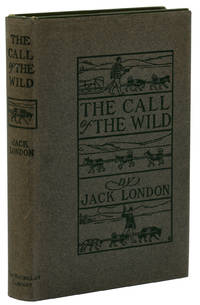
1903110942New York: The Macmillan Company 1903. First edition of one of the most desirable classics in American literature. Octavo original pictorial green cloth pictorial endpapers top edge gilt. With 18 full-page color illustrations by Philip R. Goodwin and Charles Livingston Bull. Association copy inscribed by the author on the half-title page "To Elinor Glyn:- My most popular but my own heart goes out to some <span class="match">of</span> my sociological screeds. Jack London Mar. 1 1911." The recipient Elinor Glyn was a British novelist and scriptwriter who specialized in romantic fiction which was considered scandalous for its time. Her first book The Visits of Elizabeth was published the same year as London's first book. She later moved to California and became one of the first female writers of movie screenplays. She popularized the concept of the It-girl and had tremendous influence on early 20th-century popular culture and possibly on the careers of notable Hollywood stars such as Rudolph Valentino Gloria Swanson and especially Clara Bow. In near fine condition with light shelfwear. Housed in a custom half morocco clamshell box. Signed first editions of this classic title are scarce. The Call of the Wild is "one of the first American novels to examine the quest of the pioneering individual who breaks away from the sheltered environment of civilization and is romantically compelled to find freedom in nature. In the early part of the century this was considered the American dream" Parker 16. Named by Modern Library's as one of the 100 greatest novels of the twentieth century. The Macmillan Company hardcover books
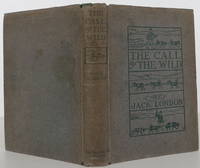
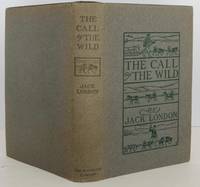
1903375544New York: Macmillan 1903. First edition first issue July 1903. Color frontispiece with bound tissue guard; two-color illustrated title page; illustrated endpapers. 231 3pp. 1 vols. 8vo. Green cloth decoratively stamped in black red and gilt. Fine copy in fine pictorial dust jacket. First edition first issue July 1903. Color frontispiece with bound tissue guard; two-color illustrated title page; illustrated endpapers. 231 3pp. 1 vols. 8vo. Along with White Fang one of the two great novels for which the author seems destined to be remembered. His empathy for animals combined with his appreciation of the Darwinian lessons of life here overcome London's occasionally simplistic political agenda resulting in a classic tale for both children and adults. BAL 11876; Sisson & Martens p. 13 Macmillan unknown
191515817Philadelphia: The John C. Winston Company 1915. First Edition. PRESENTATION & ASSOCIATION COPY<br /> <br /> Octavo : 891pp. : photo image frontispiece The Heavy Sledge sculpture by Mahonri Young : illustrated : inscruibed by Sinclair to London at first free endpaper. Original red cloth lettered in gilt with blind stamped border. Below Sinclairs inscription is the calling card of Charmian London's Jack's widow presenting this copy inscibed in pencil on both sides"With my compliments Mrs Jack London I found two! Over! / See Jack London preface. Writing soon. C.K. L." " and Jack London's signature in pencil pasted in at the foot of p.5 at the end of his introduction. <br /> <br /> "It was.in Hawaii of all places that Jack produced his most moving call to arms the introduction to The Cry for Justice.Sinclair.considered it one of the finest things Jack ever did and said that some paragraphs'might be carved upon his monumnet'" Kershaw Jack London: A Life p.180 Oddly or from Charmian's note perhaps not a copy of this book with an identical Sinclair inscription was sold at Swann Galleries on 12 November 1987 lot 209 BAL 11961<br /> <br /> Provenance: Willard S. Morse bookplateSotheby's - New York April 2004 - The Maurice F Neville Collection; Private collection Sydney Australia. The John C. Winston Company unknown
195300524461Upton Sinclair 1953. First Edition. Unknown. Very Good/No Jacket. 4to - over 9¾" - 12" tall. Believed to be the last of Upton Sinclair's unpublished book-length manuscripts in private hands AMERICAN FABLES is a uniquely important piece of American literary history. Sinclair's body of work dealt with numerous issues and trends in American life society and politics during this era but often as part of a larger character-driven narrative. AMERICAN FABLES was his signal attempt to synthesize these key threads by combining sections of his work with that of other authors. The work takes the form of 30 'Fables' seventeen of which are Sinclair thirteen by others including such prominent American authors and friends Jack London Sinclair Lewis Lincoln Steffens and John Reed. Also included are contributions by Cornelius Vanderbilt Jr the noted anarchist Prince Kropotkin E. W. Scripps Harry Price Prynce Hopkins and others. Sinclair's own seventeen 'Fables' are taken from or based on previously published works authored 1923-48 with new unpublished material composed in 1952. The thirteen 'Fables' of the other authors Jack London Sinclair Lewis et al. are mostly from between the wars but range from 1899 Kropotkin - a bit of an outlier to 1951. This work has been much discussed for decades among Sinclair scholars. It has been described as Sinclair's attempt to create a politically-layered fictionalized history of America between the wars told through key stories taken from his own work and that of others. From what Sinclair told Ron Gottesman it was intended as a domestic 'prequel' of sorts to the Lanny Budd series. It was an outgrowth of several earlier drafts conceived of it is said as an American equivalent to the 'Arabian Nights' or 'One Thousand and One Nights'. Gottesman indicated that after Sinclair worked through a number of drafts for the better part of a decade under a different title see below finishing and sending this 'final' draft to Sinclair's literary agent Bertha Klausner right around the time of the publication of THE RETURN OF LANNY BUDD in 1953 which was the culmination of the enormous series of eleven volumes begun with WORLD'S END in 1940. Sinclair had expected Viking to publish the work or to easily find another publisher. But this was not to be as Senator Joseph McCarthy's incendiary attacks against the Left created such a hostile environment that it intimidated all potential publishers of this new work by the avowed Socialist and one-time Democratic nominee to be Governor of California. After that first flurry of submissions and what Sinclair described to Gottesman as somewhat panicked rejections the work sat forgotten for years in the files of Sinclair's literary agent Bertha Klausner until it was returned to Sinclair in the 1960's. FORMAT: The work is 400 pages typed on white watermarked paper 8.5 x 11 inches with 350 of the 400 leaves bearing holograph additions corrections and excisions mainly by Upton Sinclair but some in the hand of his wife author Mary Craig Sinclair 1 page entirely in holograph. The vast majority of typed leaves are ribbon copies. Pagination is almost entirely supplied by hand correcting the prior typed pagination. The COLLATION is 1-2 17-54 54a 55-189 190-1 192 193a-193b 194-215 261-17 218-263 263a 264-267 267a 268-284 285-99 300-425. PROVENANCE: The estate of Upton Sinclair; by inheritance to his son David by inheritance to David's wife Jean Sinclair. Ink stamp of Sinclair's literary agent Bertha Klausner on title/index leaf. Upton Beall Sinclair Jr. 1878-1968 pioneering muckraker American novelist winner of the Pulitzer Prize author of the influential novel THE JUNGLE which created such public controversy about the meat packing industry that it is in large part credited with the passing of the Pure Food and Drug Act and ultimately to the creation of the Food and Drug Administration FDA. Outside his literary work Sinclair was notable in many fields. He was in some ways a precursor to Bernie Sanders an avowed Socialist who was the Democratic nominee for Governor of California in 1934 running on the EPIC platform End Poverty in California. He and Mary Craig produced Sergei Eisenstein's landmark 'Que Viva Mexico' in 1930-32. He was a pioneer in such diverse fields as nutrition and health cooperative living investigative journalism self-publishing free speech and civil liberties etc. etc. Sinclair's relationships with the authors of the other work included here were often of long-standing. As examples: Jack London had been President of the Intercollegiate Socialist Society with Upton Sinclair as his Vice President and he and Sinclair were lifelong friends. In fact London's futuristic novel THE IRON HEEL 1908 was written in response to Sinclair's THE INDUSTRIAL REPUBLIC 1906 and provided the introduction to Sinclair's pioneering anthology of literature on social protest THE CRY FOR JUSTICE 1915. London also was one of the subjects of Sinclair's anti-alcohol book THE CUP OF FURY 1956. Sinclair Lewis served for two months as janitor of Upton Sinclair's abortive co-operative colony Helicon Hall in Englewood Cliffs NJ which Sinclair established win 1906 with profits from THE JUNGLE it burned down in 1907. BIBLIOGRAPHIC REFERENCES: For discussion of this item and its earlier unfinished incarnations from the prior decade see Gottesman and Silet 'The Literary Manuscripts of Upton Sinclair' #A26. See also G&S A26a-f describing six earlier drafts dating from the 1940's of what became this work under the working titles 'American Nights' Entertainments'. Upton Sinclair unknown
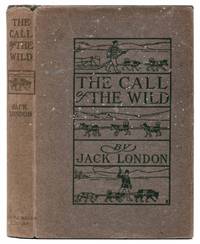
1903140940250New York: The Macmillan Company 1903. First Edition. Fine/Fine. First edition first printing of the author's best-loved work. Bound in publisher's ribbed green cloth decoratively stamped; top edge gilt. A fine copy with previous owner name to half-title page and trivial rubbing to cloth at extremities and a tiny nick to the edge of the front board. In a Fine dust jacket with faint toning to spine and a tiny mark to the rear panel and spine. A fantastic copy but more importantly an honest copy with no restoration or funny business: the offsetting from white "snow" of boards onto verso of dust jacket suggesting this copy has not been married to its jacket a sentiment echoed by the freshness of the book itself. Housed in a custom quarter-leather folding case. The Macmillan Company unknown books
190315815New York: The Macmillan Company 1903. Proof Copy. PROOF COPY IN WRAPPERS FOR THE FRIST EDITION INSCRIBED BY LONDON AND WITH HIS CORRECTIONS/REVISIONS.<br /> <br /> Softcover : pp. x 280 : original printed tan wrappers : red half morocco slipcase. Wrapper s little worn ; head of spine chipped foot of top joint separating 35mm; some creasing; bookplate to verso of upper wrapper. With a presentation insciption by London incorporating the printed half title: "Dear Madeline. With best love Respectfully yours The Person of the Abyss Jack London" crossing out the printed"people" and writing in "Person". This pre-publication copy printed six months before the first edition does not yet have the illustrations from photographs nor a list of illustrations; page numbers in the the two page table of contents are represented by zeros; and some chapters do not have the beginning quotations as in the published version of October 1903. There are markings corrections deletions and other revisions by London in pencil on 13 pages 16 words in his hand most notably a 13-word insertion on p.273.<br /> <br /> In the summer of 1902 London was given the chance to go to South Africa to report on the post war situation there. Arriving in England he found the assignment cancelled. Instead he disappeared into London's East End to investigate and "expose the underside of capitalism." "In late September just seven weeks after arriving in England Jack finished The People of the Abyss H.G. Well's term for the urban poor. It was a triumph of impassioned reporting. Outrage underscored every one of itssixty-three thousand words. 'Of all my books ' he would later write 'I love most The People of the Abyss. No other book of mine took so much of my young heart and tears as that study of the economic degradation of the poor.'" Alec Kershaw Jack London: A Life p.119 BAL 11877; Sisson & Martens p.16<br /> <br /> Provenance: Frederick W Skiff bookplate; Sotheby's - New York April 2004 - The Maurice F. Neville Collection; Private collection Sydney Australia. The Macmillan Company unknown
190819461London: London Transport 1908-1915. 1030 by 1550mm 40.5 by 61 inches. Next stop Westminster Enamel tube sign with wooden frame. Rare pre-First World War station sign for Westminster tube station. This large enamel sign can be dated to between 1908 to 1915 when the bull's-eye design a solid red disk with a horizontal bar containing the text was adopted by all the various separate underground railway companies. It would be the first time that a coherent graphic design was adopted for the whole of the disparately owned and run network. The bull's-eye design would be superseded when in 1915 the then Underground's publicity manager Frank Pick commissioned the calligrapher Edward Johnston to design a company typeface. His subsequent design: the red circle and blue bar. It is still in use to this day and has rightly become synonymous with London and its famous transport system. London Transport, unknown
1891186281London: S. Guiterman and Co. 1891. Insight into the capital's history An exceptional display catalogue of large-format albumen photos. Numerous Victorian London locations are shown populated with smartly dressed pedestrians horse-drawn carriages and smoky steamboats going about their daily business. The album was produced by Guiterman and Co. a wholesaler for importing photographic paper and cameras printed textiles steam toy models and other technological devices. Guiterman and Co. likely made this volume to allow customers to create their own selection of photographs. Several images are annotated with their dimensions and the other sizes in which they were available. The images themselves were copyrighted as is clearly stated at the front of the volume. That such services were popular is evidenced in the photographs themselves which show multiple "photographic publishers". The particularities of Victorian city living abound in the photographs. Horse-drawn omnibuses with advertisements on their sides are present in many images each with a top-hatted conductor on the rear staircase. Flower-sellers line the streets of Holborn and human billboards parade down Regent Street. Several buildings including Westminster Abbey are darkened with soot from coal fires. Tower Bridge is shown in its early stages of being built. In King William Street two small boys appear to be in the process of robbing a parcel van. Details from the photographs date them to around 1891. An image showing the Bank of England includes an omnibus displaying an advert for the "German Exhibition" a showcase of electrical technology held that year in Frankfurt. In the Strand a poster advertises the double-bill of Ellen Terry's Nance Oldfield and The Corsican Brothers which opened at the Lyceum in May 1891. The weather conditions and foliage in the photographs suggest that they were taken over several months; Greenwich Park and Observatory are shown both in the sunshine and covered in snow. Folio album 418 x 318 mm. 159 half plate sepia-toned albumen photographs 150 x 200 mm numbered and captioned in pencil some annotated in red ink; 5 photographs grouped on final leaf ranging from full plate to snapshot 286 x 228 mm to 94 x 92 mm. Original black morocco-grain cloth recently rebacked and recornered to style using black leatherette gilt lettering to front cover. Housed in black cloth archival box. Occasional spots of wear to edges faint damp stain to front cover edges and endpapers foxed some photographs peripherally toned and creased. In very good condition. hardcover
19031704203MacMillan 1903. 1st Edition. Hardcover. Fine/Near Fine. A fine first edition in a near fine dust jacket with a check signed by Jack London laid in. Some soiling on some pages. Housed in a custom-made collector's slipcase. MacMillan hardcover books
19031704203MacMillan 1903. 1st Edition. Hardcover. Fine/Near Fine. A fine first edition in a near fine dust jacket with a check signed by Jack London laid in. Some soiling on some pages. Housed in a custom-made collector's slipcase. MacMillan hardcover
0148351903 Book. Fine. Hardcover. 1st Edition. 12mo - over 6¾ - 7¾" tall. Incredible Fine Copy In Like Jacket First Edition July 1903 Without Wear.Original Advertisement laid In. Amazing Condition.New Movie Remake with Harrison Ford.Book Housed in Beautiful Solander Case. 1903 Hardcover
0148351903 Book. Fine. Hardcover. 1st Edition. 12mo - over 6¾ - 7¾" tall. Incredible Fine Copy In Like Jacket First Edition July 1903 Without Wear.Original Advertisement laid In. Amazing Condition.New Movie Remake with Harrison Ford.Book Housed in Beautiful Solander Case. 1903 Hardcover books
19031808030MacMillan 1903. 1st Edition. Hardcover. Near Fine/Near Fine. A near fine first edition in a near fine unrestored dust jacket. Housed in a custom-made collector's slipcase. MacMillan hardcover books
19031808030MacMillan 1903. 1st Edition. Hardcover. Near Fine/Near Fine. A near fine first edition in a near fine unrestored dust jacket. Housed in a custom-made collector's slipcase. MacMillan hardcover
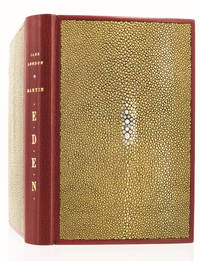
192188954Paris 1921. Fine. The exceptionally rare first French edition of Jack London's masterpiece Paris s. d. 1921 13.5 x 20.3 cm Relié First edition of the French translation one of 25 numbered copies on pur fil the only copies printed on deluxe paper. Blood red morocco binding gilt title lengthwise gold stingray boards framed in morocco gilt decorative paper endleaves original wrappers preserved top edge gilt an elegant binding signed Boichot. Front free endpaper slightly toned otherwise a handsome untrimmed copy. Illustrated with original woodcuts by Jean-Gabriel Daragnès. hardcover
184838150London: W. Bulmer & Co. and others 1848. Together 10 volumes First Series: vols. I-VII; Second Series: vols. I-III all published 4to. Seven engraved titles 174 engraved plates 92 hand-coloured; 10 folding after Hooker Withers Drake Barbara Cotton C.J. Robertson Lady Broughton and others engraved by W. Say W. Clark and others numerous illustrations. A few plates trimmed close in the first series as usual. First series: Early tree calf covers bordered in gilt spine gilt with morocco lettering piece marbled endpapers and edges. Second Series: Early half calf and marbled paper covered boards.<br/> <br/>Provenance: Howe Peter Browne 2nd Marquess of Sligo armorial stamp on spines of first series; William Willoughby Cole 3rd Earl of Enniskillen armorial bookplate in second series<br/> <br/>A rare complete run of the most important British pomological and botanical journal of its day and a showcase for the talents of some of the greatest botanical artists working in Britain at the time.<br/> <br/>The Horticultural Society of London was founded by Sir Joseph Banks John Wedgwood and others in 1804 and become The Royal Horticultural Society in 1861. The Transactions the leading horticultural journal of its time contains valuable contributions on fruits and vegetables particularly peaches strawberries apricots cherries and gooseberries by T. A. Knight George Lindley James Barnet and Robert Thompson and others. William Hooker no relation to Sir William served as botanical artist to the Horticultural Society now the Royal Horticultural Society from 1812 until he retired in 1820. The present work includes a good selection of plates taken from his fruit paintings which according to Blunt and Stearn reveal him to have been "one of the greatest pomological artists of all time" The Art of Botanical Illustration p. 233. There are also some excellent examples of the work of Sarah Drake including a particularly fine folding plate of the orchid Cattleya guttata and Augusta Withers the luminous quality of the fruit in the Ickworth Imperatrice Plum plate is remarkable who combined their talents to such memorable effect in James Bateman's Orchidaceae of Mexico and Guatemala London: 1837-1843 As usual this set a mixed edition: vols. 1-2 third edition; vol. 3 second edition; vols. 4-7 and second series vols 1-3 first edition.<br/> <br/>Dunthorne 142; Great Flower Books 1990 p. 160; Nissen BBI 2387. W. Bulmer & Co. [and others] unknown books
40808London The Horticultural Society 1820-1848. Ten volumes in ten. 4to 28.5 x 22.5 cm. Engraved titles with woodcut vignettes; more than 3000 pp.; 175 engraved plates several larger folded of which 91 finely hand-coloured; three folding tables several text figures. Contemporary uniform half calf over marbled boards. Spines with five gilt-ornamented bands; compartments with gilt title and volume number. Speckled edges. = A very rare set with all plates published of the most important British botanical journal of its day and a showcase for the talents of some of the greatest botanical artists then at work. As is often the case this set is a mixed edition: the first three volumes are second and third editions the remaining volumes first editions. The present work includes a good selection of plates taken from the fruit paintings William Hooker no relation to Sir William. Hooker served as botanical artist to the Horticultural Society now the Royal Horticultural Society from 1812 until he retired due to ill-health in 1820. According to Blunt and Stearn 1990 a study of the originals in the Lindley Library at the RHS reveal him to have been "one of the greatest pomological artists of all time". There are also fine examples of the work of a Miss Drake and Mrs Withers. Several uncoloured plates and title pages cleaned. Some few plates a bit trimmed. Provenance: Armorial bookplate "Murus aeneus concientia sana" of the British plant collector and breeder Edmund Giles Loder 1849-1920 mounted on the front pastedowns. "He developed hybrid rhododendrons from crosses between R. fortunei and R. griffithianum. The plants were named the Loderi hybrids and group in his honour. Three Loderi King George Loderi Pink Diamond and Loder's White have received the Award of Garden Merit from the Royal Horticultural Society. He developed the garden at his home at Leonardslee extensively" Wikipedia. Some foxing and offsetting restricted to several plain plates only. A few plates shaved as usual. A few bindings skilfully restored. An excellent set rarely seen complete. Blunt and Stearn 1990: The Art of Botanical Illustration p. 233; Nissen BBI 2387. hardcover
192188954L'édition française ilustrée | Paris s. d. [1921] | 13.5 x 20.3 cm | Relié
190815816London: Everatt & Co 1908. First U.K. Edition First Printing. PRESENTATION COPY Octavo : pp. viii 374 : original dark blue cloth with decoration in blind and lettered in gilt : inscribed by London on the front free endpaper : affixed inside fron cover a small news clipping photograph of London captioned in pencil incorporating his printed name : "Jack London as her looked Sep 6 1910." Endpapers tanned; cracked at hinges; light wear to extremities. The inscription reads " Dear Comrade sweet:- Please remember this is fiction - a warning to all socialists to guard against such a thing happening. Yours for the Revolution Jack London."<br /> <br /> "An apocalyptic vision of the future The Iron Heel is the story of an oligarchy of American capitalists who seize power at the very moment when a socialist voctory seems inevitable at the polls. The Iron Heel's enduring power comes from its prohecy rather than its prose. As a prediction of how organised labour wouild be crushed by those wose interests it endangered it was chillingly accurate. It was not to be an oligarchy of capitalist bosses however against whom the European ledft would be pitted in the coming decades but the forces of fascism" Kershaw Jack London pp. 164-65. BAL 11908; Hanna 2225; Rideout p. 293; Sargent p.71; Beliler 1978 p. 126.<br /> <br /> Provenance: Sotheby's - New Yprk April 2004 - The Maurice F. Neville Collection; Private collection Sydney Australia. Everatt & Co unknown
190380129New York:: The Macmillan Company 1903. First edition. publisher's olive decorated cloth t.e.g in pictorial dust jacket. Preserved in a custom quarter morocco slipcase and chemise. About a fine copy in what is asserted to be the earliest dust jacket which has minor restoration at the extremities and some interior tissue strengthening at the folds. 8vo. Illustrated by Philip R. Goodwin and Charles Livingston Bull. BAL 11876. The Macmillan Company, hardcover
19037986New York: The Macmillan Company 1903. First edition. Fine/Very Good . First printing with "July 1903" on the copyright page. A Fine copy in Very Good dust jacket. Complete with the frontispiece and ten color plates. Publisher's pictorial green cloth stamped in color. Pinpoint burn mark to p. 135. A clean fresh copy throughout. Dust jacket with subtle tissue reinforcement to verso at folds. Some faint white paint spatters to front panel. A very attractive example of London's beloved novel.<br /> <br /> A Klondike Gold Rush adventure novel told from the point of view of the dog Buck The Call of the Wild is also a consideration of the thin line that separates "civilized" creatures from their primal origins. Though he begins life as the pampered and much-loved pet of a California gentleman Buck is stolen and forced into service as a sled dog in the Alaska Yukon. The lowest-ranking member of his pack Buck faces abuse from his incompetent human owners as well as violence within his team as the dogs jockey for higher positions that aide their survival. Ultimately Buck must relinquish his individualistic tameness to find his place as a trustworthy team leader and he must tap into the most primitive tendencies that lay dormant inside him. Fine in Very Good dust jacket. The Macmillan Company unknown
1844215132London: John Murray 1844. Hardcover. Covers worn to the boards at the corners top edges darkened paper tanning but with very little foxing overall most volumes have unopened pages a sturdy very good set. Photographs upon request. 14 volumes. Each volume has several fold out maps and plates Tightly rebound in green cloth with sturdy dark green buckram spines John Murray hardcover
1903007 - 944 - 980<p><strong>Publisher and Year</strong>: New York: The Macmillan Company 1903</p><p><strong>Edition</strong>: First edition first printing with the copyright page stating "Set up electrotyped and published July 1903" and lacking any statement of reprinting. In the original dust jacket entirely unrestored. BAL 11876</p><p><strong>Condition and Description</strong>: Octavo; publisher's forest-green cloth; front cover stamped in white black red and gilt; top edge gilt; illustrated endpapers; 231 pp. 2 pp. advertisements. All plates and illustrations are present. Modest wear to the boards. Gilt bright. Tips lightly pushed. Tight hinges and binding. Toning to the endpapers from the jacket flaps. Contemporary owner's name and date in ink to the front free endpaper "F.L. Beatty / 1903". Else free of prior owner markings. Clean pages with occasional imperfections including unfolded corners to pages 79 135 139 and to the plate facing page 169; a small stain to the lower edge of the plate facing 215; and light offsetting from a bookmark to the gutter of page 18. The dust jacket has tanning to the spine as usual with the dark green ink faded to brown; small losses to the edges tips and spine ends without affecting the printed design or lettering; a short closed tear to the upper rear panel; and transfer of the "snow" from the front board and spine to the blindside reflecting the long union of book and jacket. More pictures available upon request.</p><p><em>"He was mastered by the sheer surging of life the tidal wave of being the perfect joy of each separate muscle joint and sinew in that it was everything that was not death that it was aglow and rampant expressing itself in movement flying exultantly under the stars."</em></p><p>Inventory ID: 007 - 944 - 980</p> The Macmillan Company hardcover