London JackABAA

850 résultats
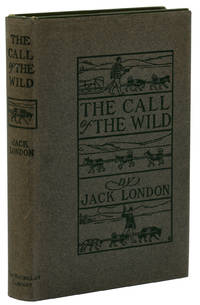
1903110942New York: The Macmillan Company 1903. First edition of one of the most desirable classics in American literature. Octavo original pictorial green cloth pictorial endpapers top edge gilt. With 18 full-page color illustrations by Philip R. Goodwin and Charles Livingston Bull. Association copy inscribed by the author on the half-title page "To Elinor Glyn:- My most popular but my own heart goes out to some <span class="match">of</span> my sociological screeds. Jack London Mar. 1 1911." The recipient Elinor Glyn was a British novelist and scriptwriter who specialized in romantic fiction which was considered scandalous for its time. Her first book The Visits of Elizabeth was published the same year as London's first book. She later moved to California and became one of the first female writers of movie screenplays. She popularized the concept of the It-girl and had tremendous influence on early 20th-century popular culture and possibly on the careers of notable Hollywood stars such as Rudolph Valentino Gloria Swanson and especially Clara Bow. In near fine condition with light shelfwear. Housed in a custom half morocco clamshell box. Signed first editions of this classic title are scarce. The Call of the Wild is "one of the first American novels to examine the quest of the pioneering individual who breaks away from the sheltered environment of civilization and is romantically compelled to find freedom in nature. In the early part of the century this was considered the American dream" Parker 16. Named by Modern Library's as one of the 100 greatest novels of the twentieth century. The Macmillan Company hardcover books
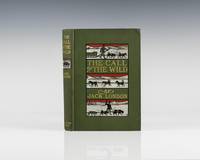
1903140940250New York: The Macmillan Company 1903. First Edition. Fine/Fine. First edition first printing of the author's best-loved work. Bound in publisher's ribbed green cloth decoratively stamped; top edge gilt. A fine copy with previous owner name to half-title page and trivial rubbing to cloth at extremities and a tiny nick to the edge of the front board. In a Fine dust jacket with faint toning to spine and a tiny mark to the rear panel and spine. A fantastic copy but more importantly an honest copy with no restoration or funny business: the offsetting from white "snow" of boards onto verso of dust jacket suggesting this copy has not been married to its jacket a sentiment echoed by the freshness of the book itself. Housed in a custom quarter-leather folding case. The Macmillan Company unknown books
19031704203MacMillan 1903. 1st Edition. Hardcover. Fine/Near Fine. A fine first edition in a near fine dust jacket with a check signed by Jack London laid in. Some soiling on some pages. Housed in a custom-made collector's slipcase. MacMillan hardcover books
0148351903 Book. Fine. Hardcover. 1st Edition. 12mo - over 6¾ - 7¾" tall. Incredible Fine Copy In Like Jacket First Edition July 1903 Without Wear.Original Advertisement laid In. Amazing Condition.New Movie Remake with Harrison Ford.Book Housed in Beautiful Solander Case. 1903 Hardcover books
19031808030MacMillan 1903. 1st Edition. Hardcover. Near Fine/Near Fine. A near fine first edition in a near fine unrestored dust jacket. Housed in a custom-made collector's slipcase. MacMillan hardcover books
184838150London: W. Bulmer & Co. and others 1848. Together 10 volumes First Series: vols. I-VII; Second Series: vols. I-III all published 4to. Seven engraved titles 174 engraved plates 92 hand-coloured; 10 folding after Hooker Withers Drake Barbara Cotton C.J. Robertson Lady Broughton and others engraved by W. Say W. Clark and others numerous illustrations. A few plates trimmed close in the first series as usual. First series: Early tree calf covers bordered in gilt spine gilt with morocco lettering piece marbled endpapers and edges. Second Series: Early half calf and marbled paper covered boards.<br/> <br/>Provenance: Howe Peter Browne 2nd Marquess of Sligo armorial stamp on spines of first series; William Willoughby Cole 3rd Earl of Enniskillen armorial bookplate in second series<br/> <br/>A rare complete run of the most important British pomological and botanical journal of its day and a showcase for the talents of some of the greatest botanical artists working in Britain at the time.<br/> <br/>The Horticultural Society of London was founded by Sir Joseph Banks John Wedgwood and others in 1804 and become The Royal Horticultural Society in 1861. The Transactions the leading horticultural journal of its time contains valuable contributions on fruits and vegetables particularly peaches strawberries apricots cherries and gooseberries by T. A. Knight George Lindley James Barnet and Robert Thompson and others. William Hooker no relation to Sir William served as botanical artist to the Horticultural Society now the Royal Horticultural Society from 1812 until he retired in 1820. The present work includes a good selection of plates taken from his fruit paintings which according to Blunt and Stearn reveal him to have been "one of the greatest pomological artists of all time" The Art of Botanical Illustration p. 233. There are also some excellent examples of the work of Sarah Drake including a particularly fine folding plate of the orchid Cattleya guttata and Augusta Withers the luminous quality of the fruit in the Ickworth Imperatrice Plum plate is remarkable who combined their talents to such memorable effect in James Bateman's Orchidaceae of Mexico and Guatemala London: 1837-1843 As usual this set a mixed edition: vols. 1-2 third edition; vol. 3 second edition; vols. 4-7 and second series vols 1-3 first edition.<br/> <br/>Dunthorne 142; Great Flower Books 1990 p. 160; Nissen BBI 2387. W. Bulmer & Co. [and others] unknown books
19031508068MacMillan Company 1903. 1st Edition. Hardcover. Near Fine/Very Good. A near fine first edition correct statement on copyright page in a very good original dust jacket that is unrestored rare thus. Housed in a custom-made collector's slipcase. MacMillan Company hardcover books
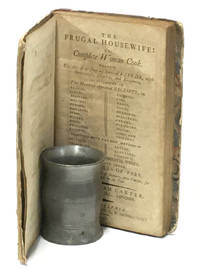
17966886Philadelphia: Printed by James Carey 83 N. Second-Street 1796. Duodecimo 16 x 10 cm. xiii 14-132 pages. Index. Illustrated with three plates; two engravings depicting carving and a third woodcut depicting "Arrangement of a Supper Table". ~ Third American edition first printing. Carter's popular English cookbook circa 1765 became one of the very earliest cookery books printed in the United States. The American printings preceding this one were: Boston: Edes & Gill of 1772 Lowenstein 4 and New York: Berry & Rogers of 1792 Lowenstein 7 and 1795 Lowenstein 8b. The Edes & Gill issue of 1772 was just the second American cookbook following the 1742 Alexandria printing of Eliza Smith's Compleat Housewife. The two Berry & Rogers printings contained a number of changes which better reflected the American context of these books and which greatly influenced Amelia Simmons in the creation of her foundational American Cookery of 1796. In a statement "To the readers" page ii it is explained that the sections on Gravies and Sauces has been moved to the front and indexed for reference within the other recipes "as the chief excellence of all cookery consists in a perfect acquaintance with the making of Gravies and Sauces". Contemporary half calf over marbled boards untitled gilt-ruled spine; joints and extremities rubbed. Lightly age-toned with some light foxing scattered spotting darkening at edges. Ink ownership signature "Samuel H. Tumler" to rear paste-down. Rare. OCLC locates twenty-three copies; Evans 30168; Lowenstein 15; not in Cagle; this printing not in Bitting. Printed by James Carey, 83, N. Second-Street hardcover books
1913303825New York The Century Co. 1913. 1913. First edition "Published August 1913". 8vo. Frontispiece and 7 illustrations by H.T. Dunn. Original gilt stamped dark green cloth. Very good-fine. No dust jacket. 343 pages. Enclosed in a 1/2 red morocco slipcase with chemise. Boldly signed and inscribed by Jack London on the page before half title: "Dear Jim: Hope you don't get thirsty reading this. Don't you admire the expensive paper Century Co. uses for front sheets. Sincerely yours Jack London Sept. 9 1913." With Jack London's wolf bookplate tipped on the front pastedown. Inscribed by Authors. 1st Edition. Hardcover. Very Good/No Jacket. New York, The Century Co., 1913. hardcover books
191222680EGlen Ellen Sonoma County CA 1912. Original Autograph Letter Signed by Jack London to his friend poet George Sterling. 3 pages 8†x 5†dated July 13 1912. With the postmarked envelope which is addressed by Charmian London to George Sterling Carmel-by-the-Sea CA - which is crossed out with “Bohemian Club San Francisco†at the bottom of the address. The text of the letter indicates that it was written on board the ship Dirigo toward the end of the voyage and reads in full: “133 days at sea On board Ship Dirigo 145 W. Long. 42 N. Lat. July 13 1912. Blessed Greek: Just to let you know we’re back. Expect to see you at Jinks and later at ranch to tell you all about the voyage. Say - never let him know it - I’ve forgotten the name of our partner in the tent at Bohemian Grove. You and I are third owners each in the outfit. Only I don’t know what I’ll have to bring. A cot Blankets of course. Find out from him and have a letter at Glen Ellen giving me his name and all essential data. Of course you’ll be at the Jinks. I haven’t had a drink for 144 days! Wolf. Charmian sends love. Say: this time you shall not escape me. You must play pinochle. Greatest two-handed game invented.†Creases from folding else fine. The voyage London speaks of is that of a 148 day sail from Baltimore to Seattle aboard the windjammer Dirigo he took with his wife Charmian. The Bohemian Club is a private club in San Francisco which has a restricted campground called Bohemian Grove in nearby Monte Rio. On August 18 1904 Jack London went with his close friend the poet George Sterling to "Summer High Jinks" at the Bohemian Grove. Subsequently London was elected to honorary membership in the Bohemian Club and took part in many activities. Other noted members of the Bohemian Club during this time included Ambrose Bierce Gelett Burgess Allan Dunn John Muir Frank Norris and Herman George Scheffauer. George Sterling 1869 - 1926 was an American writer based in the San Francisco California Bay Area and Carmel-by-the-Sea. He was considered a prominent poet and playwright and proponent of Bohemianism during the first quarter of the twentieth century. In addition to Jack London his work was admired by writers as diverse as Upton Sinclair Theodore Dreiser and Sinclair Lewis. The American historian Kevin Starr wrote this about Sterling: “The uncrowned King of Bohemia so his friends called him Sterling had been at the center of every artistic circle in the San Francisco Bay Area. Celebrated as the embodiment of the local artistic scene though forgotten today Sterling had in his lifetime been linked with the immortals his name carved on the walls of the Panama-Pacific International Exposition next to the great poets of the past.†unknown books
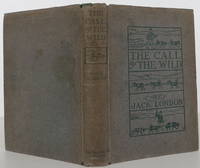
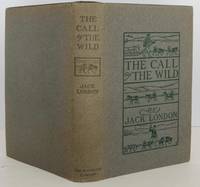
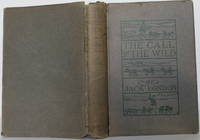
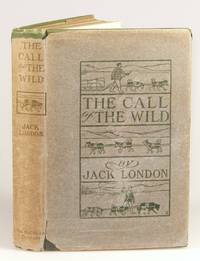
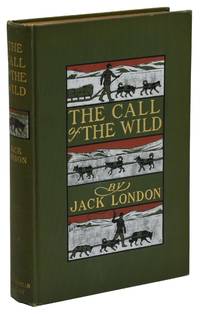
1903003214New York: The Macmillan Company 1903. First edition first printing. Hardcover. Philip R. Goodwin & Charles Livingston Bull. This is a jacketed first edition of perhaps the most iconic work of an archetypally American author and giant of early twentieth century literature. Though Jack London had experienced some preceding success as a writer it was The Call of the Wild written in his mid-twenties that brought him fame. London's tale of a pampered California dog who finds his strength his place and the brutal gift of his freedom in a savage primal North met with immediate popularity and critical acclaim. The first printing quickly sold out and the story has since seen a host of successive editions remaining continuously in print. London's story occupies a pinnacle amid the remarkably prolific output of his short strenuous and celebrated literary life. The story's hero Buck ranks among the most provocative and best known animal protagonists in literature. To the virtues of the story itself the first edition lends a striking aesthetic. The distinctive illustrated binding features vertically scored olive cloth with a classic London dog sled scene in three panels on the front cover in red white and black with gilt print on spine and front cover and a color illustration of the lead sled dog from the front cover repeated on the spine. Within the book is profusely illustrated in color by Philip R. Goodwin and Charles Livingston Bull bound with illustrated endpapers and printed with generous margins its thirty two thousand words more novella-length than novel nonetheless fill 231 pages. The heavy gray paper dust jacket repeats the front cover illustrations and spine illustrations in dark green print. This copy is very good plus in an original dust jacket. The binding remains tight and bright with sharp corners. Minor wear is primarily confined to extremities. The typical abrasion loss of the white "snow" on the front cover and spine is modest. We note a modest forward lean to the binding. The contents remain bright and clean with a crisp feel. We find no previous ownership marks or spotting. The illustrated endpapers frontispiece tissue guard all illustrations and the two-page Macmillan advertisement bound in at the rear are all intact. The untrimmed fore edges and bottom edges remain exceptionally clean with only slight age-toning and the top edge gilt is bright. Searching for internal flaws we note only faint finger smudges at the blank inner margin of page 15. The illustrated dust jacket remains clean with clearly legible print and only perhaps a hint of barely discernible color shift to the spine. The jacket has suffered no repair or reinforcement. It bears unmistakable association with the first edition in the form of color ink from the front cover illustration that has transferred to the front panel verso of the dust jacket. We note chip losses at the spine heel to a maximum .5 inch depth a .25 inch deep strip loss at the spine head modest loss to the corners and fractional wear to the edges and front flap fold. Losses to spine extremities do not impact either title or publisher print. The dust jacket is protected in a removable archival quality clear cover. References: BAL 11876 Woodbridge 19 <br /><br /> The Macmillan Company hardcover books
19034544New York: The Macmillan Company 1903. First edition first <span class="glossaryQtip qTip">issue</span> of one of the most desirable classics in American literature. Octavo original pictorial green cloth pictorial endpapers top edge gilt. Near fine in a the original dust jacket with a few small chips to the crown of the spine and front panel. With 18 full-page color illustrations by Philip R. Goodwin and Charles Livingston Bull. Housed in a custom half morocco clamshell box. The Call of the Wild is "one of the first American novels to examine the quest of the pioneering individual who breaks away from the sheltered environment of civilization and is romantically compelled to find freedom in nature. In the early part of the century this was considered the American dream" Parker 16. Listed by Modern Library as one of the 100 greatest novels of the twentieth century. The Macmillan Company hardcover books
19078515New York. The Macmillan Company 1907. Bound in pictorial decorated brown buckram 8vo. First Edition.This copy inscribed boldly in ink by Jack London to his Sister Ida London Byrne and his Brother-In-Law Jack on the Front free endsheet In a strongbroad hand requiring the majority of the Front Free Endsheet London writes : "Dear Ida & Jack- With love and lots off sic it from your brother Jack London. Oakland Calif. April 171907 " A most ironic spelling error "off for "of " by one of history's great writers ! Accompanying this volume is a postcard loosely laid-in. The front of the postcard is a photograph of Jack and Charmian London outside their home Wake Robin Lodge in Glen Ellen. Portions of the rear of the card present old scrapbook adhesive remnants which obscure portions of the postmark and stamp as well as the address and message. Postmarked Oakland January 1913 day obscured it is addressed to Mrs. Alice shade in San Francisco. The inked message begins "Dear Friend" with the remaining text indecipherable due to adhesive remnant. It is signed "Yours Ida Byrne her married name . Illustrated with 8 colour plates map and additional monochrome drawings ex text by Charles Livingston Bull. Ida London 1870-1914 was the younger daughter of John London Jack's step-father.From the turbulence of their early family life through Jack' meteoric rise to fame and ultimate early death Jack and Ida enjoyed a close and loving relationship with Jack assuming an almost paternal role in the raising of IDA's daughterwhom she had named after Jack's wife Charmian. She and her family often lived at her Brother's ranch in Glen Ellen where her husband Jack Byrnewas employed by London as Personal Assistant and private secretary. In the last years of her life Ira suffered from ill-health and was often confined to an Oakland sanitarium.She eventually died on the operating table in June of 1914. IDA's husband Jack Byrne continued in his Brother-In-Law employee until London's death in 1916. Material inscribed to Jack London's immediate family is exceedingly rare and appears for public sale very infrequently. Very slight lean. Minimal rubbing to covers and spine. Spine titles a bit faded. Corners gently bumped. Scattered mild foxing to prelims moderately so to inscription. One plate mis-paginated. Several page fore-edges trimmed short not affecting text. A Very Good well preserved crisp copy of a deeply personal relic of the London family. The Macmillan Company hardcover books
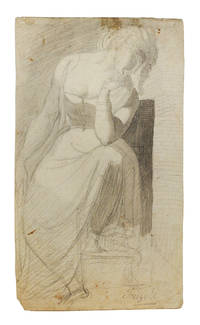
106788London: c. 1795. 11 5/8 x 6 in. 29.5 x 17.2 cm. A contemplative woman seated head resting on her right arm with inscription 'Fuseli' lower right and extensive numbers and sums verso. Pencil and grey wash. Very good. § A lovely drawing very much in the style of Fuseli and surely by a talented artist in the immediate circle of Fuseli and Blake. c. 1795]. 11 5/8 x 6 in. (29.5 x 17.2 cm.). A contemplative woman seated unknown books
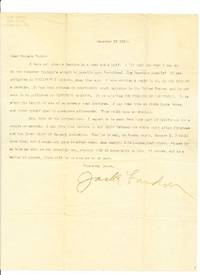
4102To "Comrade Tuck" London references his writings commenting on the fact that he hadn't lectured in a while and suggesting he organize a talk around his answer to Kipling's attack on Socialism. In part "Do you remember Kipling's attack in parable upon Socialism The Bee-Hive parable. I have written a reply to it in the form of a parable. It has been refused by practically every magazine. soon to be published by HAMPTON'S MAGAZINE. entitled THE STRENGTH OF THE STRONG." "The Strength of the Strong" was published in "Hampton's Magazine" Volume 26 March 1911 and later published in book form by Macmillan in 1914. Kipling's attack on socialism in the form of a political parable about bees was first published in "Collier's Weekly" in the United Stated on November 281908 under the title "The Mother Hive" and in the United Kingdom as the "Adventures of Melissa" for "Windsor Magazine" December 1908. In his parable Kipling argued for the need to recognize socialism as an attack against the future of the British Empire and defend against such false progressive ideas. Slightly faded with margin tear to one fold at top not affecting text and two small holes at intersection of vertical and horizontal folds slightly affecting one word. Jack London was a socialist and member of the radical literary group ‘The Crowd' in San Francisco supporting worker's rights and unionization. He became a socialist in 1894 and wove his political perspective into his writings and lectures. Our letter to H.C. Tuck gives evidence to London's political orientation. Referred to here as "Comrade Tuck" Tuck was a socialist leader editor and State Secretary of the Socialist Party of California. In 1910-11 Tuck was arrested for libel having printed some apparently libelous material in various newspaper articles. In 1910 the year he wrote our letter to Tuck London's "Burning Daylight" as well as "Revolution and Other Essays" "Lost Face" and "Theft: A Play in Four Acts" were all published. That same year saw the birth of his daughter and her untimely death just 36 hours later. It was also in 1910 that London purchased the Kohler & Frohling ranch. I. unknown books
1747046963London: H Slater 1747. Third Edition. Softcover. Very Good Condition. Original blue wraps corner of cover and title sliced with section of front wrap lacking; front hinge split browning at edges untrimmed spine degraded. A nice unsophisticated copy of the third edition. viii 95 1. List of books at end.<br/><br/>First published in 1699 as a Country Gentlemen's Vade Mecum it's a sort of satirical guide to avoiding vice while actually being a guide to finding it. Published in some profusion in the second half of the 18th century as Cheats of London Exposed but the early editions are all scarce. Warnings for expecting better conversation in London than in the country for tennis courts the theater trapping cock fights gambling guinea dropping prostitutes etc. Size: Octavo 8vo. Quantity Available: 1. Shipped Weight: Under 1 kilo. Category: Travel & Places; Erotica. Inventory No: 046963. H, Slater unknown books
1905306044New York: Macmillan 1905. First edition second issue. With plate illustrations and decorations by Henry Hutt and T.C. Lawrence. 182 6 ads pp. 8vo. Original green-gray pictorial cloth decorated in white and brown and lettered in red and gilt t.e.g. illustrated endpapers. A few vignette illustrations colored in crayon crayon scribbles to gutter of pp 38-39 staple at bottom of ffep long closed tear to pp. 77-8 spine slightly darkened humorous contemporary ink inscription on front-free endpaper some rubbing and wear to extremities. First edition second issue. With plate illustrations and decorations by Henry Hutt and T.C. Lawrence. 182 6 ads pp. 8vo. Inscribed to London's close friend and early admirer Cloudesley Johns. First edition inscribed by London: "Dear Cloudesley - Who is ethically disinclined to my flimflamming a capitalist society out of a dollar and a half and who therefore as a good socialist must make explanation to another good socialist namely Jack London Glen Ellen July 17/05."<br/><br/>An excellent association copy of Jack London's boxing novel. According to London Cloudesley Johns was the first person who ever wrote him about his work offering praise of the stories "To the Man on Trail" and "The White Silence" in the January and February 1899 issues of the Overland. The resulting friendship lasted until London's death see The Book of Jack London 1899 p. 277ff. "If Jack had no mentor but himself Cloudesley had Jack London - a pugnacious mentor who seldom pulled his punches. Jack's advice was born of his own experience and to Johns as to many other aspiring writers he gave of it freely. They met on several occasions. During London's writing of The Sea Wolf in 1903 Johns came up to Piedmont and the two men sailed up to the mouth of the Sacramento River on Jack's sloop Spray. There they played chess swam shot ducks and mudhens fished talked and wrote. 'The more I see of Cloudesley the more I like him' Jack wrote. 'He is honest and loyal young and fresh understands the discipline of a boat and is a good cook to say nothing of being a good-natured and genial companion'" Walker and Reesman p. 15. BAL 11886; Woodbridge 36; Hartley 1240 Macmillan unknown books
190416006JNew York: Century Magazine January 1904. Original poster which is a handsome and complex image of a straining man on the disordered deck of a ship calling out to an unseen boat with the text: “Ahoy! Take me ashore! A thousand dollars if you take me ashore!†Underneath: “Jack London’s Great Novel. The Sea Wolf. Begins in the January Centuryâ€. Printed in deep rich reds greens and black & white a striking image 12†x 21â€. Small pinholes at top corners a couple tiny tears about fine. Scarce poster. Century Magazine unknown books
1763401992London: William Johnston 1763. Third edition of vol. 1 first editions of vols. 2-6. Some foxing and browning generally a clean and handsome set/From the Collection of Allan B. Kirsner M.D. 6 volumes 8vo. Plates many folding. Modern half leather marbled boards untrimmed. A fine set of this important journal with ten notable contributions in the history of medicine:<br/><br/>HUNTER William 1718-1783. "The history of an aneurysm of the aorta with some remarks on aneurysms in general". Vol I pp. 323-357. First recorded case of arteriovenous aneurysm. Garrison-Morton-Norman 2974. <br/><br/>HUNTER William. "A singular case of the separation of the ossa pubis". Vol. II pp. 321-33 and 415-18. A case of osteomalacic pelvis was reported to Hunter by a country practitioner. Garrison-Morton-Norman 6254. <br/><br/>WHITE Charles 1728-1813. "An account of a new method of reducing shoulders without the use of an ambe which have been several months dislocated in cases where the common methods have proved inefficient". Vol II pp. 373-81. "White's method of reducing shoulder dislocations by means of suspending the patient from the affected arm. This method either reduced the dislocation entirely or moved the head of the humerus into a position where it could be reduced by traditional methods such as applying the surgeon's heel to the axilla" Garrison-Morton-Norman 4407. <br/><br/>BARD John 1716-1799. "A case of extra-uterine foetus". Vol II pp. 369-72. "This description of an abdominal pregnancy successfully operated on by Bard was 'the first scientific paper on a surgical subject to come from the North American Colonies' Earle. John Bard was the father of Samuel Bard" Garrison-Morton-Norman 6155. <br/><br/>HUNTER John. "Appendix to Lynn's The history of a fatal inversion of the uterus". Vol. IV pp. 400-09 and Vol. V pp. 388-93. First accurate description of retroversion of the uterus. Garrison-Morton-Norman 6020. <br/><br/>FOTHERGILL John 1712-1780. "Of a painful affection of the face". Vol. V pp. 129-42. Original description of facial neuralgia. Reprinted in Medical Classics 1940 5 100-06. Garrison-Morton-Norman 4516. <br/><br/>DOBSON Matthew 1731-1784. "Experiments and observations on the urine in a diabetes". Vol. V pp. 298-316. "Dobson proved that the sweetish taste of diabetic urine was produced by sugar an observation following on Willis's discovery of the sweetness of diabetic urine. He also discovered hyperglycemia" Garrison-Morton-Norman 3928. <br/><br/>FOTHERGILL John. "Remarks on that complaint commonly known under the name of the sick head-ach". Vol. VI pp. 103-37. First accurate description of migraine. Garrison-Morton-Norman 4517.<br/><br/>HUNTER William 1718-1783. "On the uncertainty of the signs of murder in the case of bastard children". Vol. VI pp. 266-90. "This essay on the signs of murder in illegitimate children is in Garrison's view the most important early contribution to forensic medicine by a British writer" Garrison-Morton-Norman 1732. <br/><br/> William Johnston hardcover books
1903140941187New York: The Macmillan Company 1903. First Edition. Near Fine. First edition first printing. Original dark green cloth stamped in white black and red lettered in gilt gilt topstain. Near Fine with some rubbing to the white "snow" on the covers light rubbing to cloth and small scuff to rear spine joint extending to the rear board name effaced from verso of front free endpaper. A beautiful copy of Jack London's breakout novel narrated from the perspective of a dog named Buck. The Macmillan Company unknown books
1691D4443Amsterdam: Carel Allard 1691. Hardcover. Very Good. Oblong broadsheets 295 x 380. Lacking title-page and without the 22 pp. accompanying text. 20 large unnumbered engraved plates one with 4 separate scenes etched plates by HUGO ALLARD 4 signed I. VANDEN AVELE 2 signed and JAN LUYKENone signedone with 2-inch tear repaired some minor marginal wear. Original marbled wrappers old paper cover label; cloth folding case. VERY RARE print series illustrating the history of the ascension to the throne of WILLIAM III 1650-1702 and MARY II 1662-1694. The series begins with the Seven Bishops being brought to the Tower of London with a view up the Thames followed by the birth of the Prince of Wales on 10 June 1688 through the entrance of William and Mary into The Hague on 5 February 1691. The series contains several scenes devoted to the festivities surrounding their coronation in London on 11 April 1689. This set of the engravings correspond to Landwehr and appear to have been issued in its original binding without the text; the title-page may have been removed or was not included. Muller considered the 20 plates as a series although he had not seen a bound set with title and the text. Landwehr Splendid Ceremonies 143; Muller 2692. <br/><br/> Carel Allard hardcover books
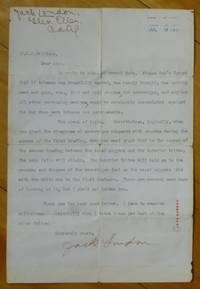
1911146811911. trading in the Solomons One page on "Harbor Rest" stationery dated by ink-stamp July 9 1911. With London's name and address "Glen Ellen Calif." in holograph plus his signature at the end of the letter. The text of this letter we apologize for repeating Jack's language! is: Dear sir:- In reply to yours of recent date. Please don't forget that if tobacco was dreadfully wanted was rarely brought was quickly used and gone etc. that not only pennies but sovereigns and any and all other purchasing mediums would be sedulously accumulated against the day when more tobacco was purchasable. You speak of logic. Nevertheless logically when you grant the cheapness of sovereigns compared with pennies during the course of the first trading then you must grant that in the course of the second trading between the coast niggers and the interior tribes the same ratio will obtain. The interior tribes will hold on to the pennies and dispose of the sovereigns just as the coast niggers did with the white men in the first instance. There are several more ways of looking at it but I shall not burden you. Thank you for your good letter. I love to receive criticisms -- especially when I think I can get back at the other fellow! Sincerely yours signed Jack London Jack wrote this letter during the time in 1911 when he and Charmian were moored in Humboldt Bay on the "Harbor Rest" the house-boat belonging to the former mayor of Eureka H.L. Ricks. They would leave Humboldt Bay four days after Jack wrote this letter heading for Hoopa and the Klamath River ultimately north to Crescent City. There is a great photo at the Huntington of Jack and Charmian posing on board the "Harbor Rest" complete with the boat's name-plate. The recipient was a Boston doctor whose office was on Tremont Row there. We do not know exactly what Dr. Brittain wrote Jack about but it was most likely a "criticism" he had after reading Jack's new book that had just come out the preceding month THE CRUISE OF THE SNARK. This book was the account of Jack and Charmian's voyage aboard their boat The Snark begun in 1907 and planned to last seven years around the world -- but Jack's medical and financial problems cut it short in 1909 after cruising to Hawaii the Solomon Islands Fiji Tahiti and winding up in a hospital in Sydney. Specifically in that book Jack wrote about using the tobacco they had brought to barter for goods on some of the islands see page 289 for an example in the Solomons. Jack's use of "the n-word" was unfortunately not unusual at the time and was especially used by explorers of the South Pacific and of Australia. Our favorite line of the letter is the final one -- revealing Jack's irritation that some doctor in Boston considers himself able to criticize something he knows little about. Like this letter the majority of Jack London's letters were typed. The letter is in very good condition -- with faint evidence at the edges of it having being mounted and with a 1.5-inch tear along an original fold right between "Jack" and "London. unknown books
1917140940929New York: The Macmillan Company 1917. First Edition. Near Fine/Good. First edition. x 184 2 6 ads pp. Publisher's reddish brown cloth with gilt lettering. Near Fine with bright gilt faint tidemark to upper corner of prelims in a Good example of the rare dust jacket unclipped and unsophisticated. Jacket chipped at edges and along spine soiled and lightly dampstained front panel creased front and spine panels still attached at head but nearly separate. London's first posthumously-published work consisting of non-fiction pieces including "Four Horses and a Sailor" Jack's account of a trip in company with Charmian in a horse-drawn carriage from Sonoma County to Oregon. Rare in jacket which reproduces the frontispiece photo. Only 3056 copies printed. The Macmillan Company unknown books
181821989London: Thomas. M'Lean 1818. First edition. leather_bound. Orig. straight-grained maroon morocco broad gilt cover panels with decorative Greek-key border in blind. Very good. Folio 36.7 x 26.2 cm. Half-title engraved portrait frontispiece hand-colored aquatint additional title Grand Vizier plate and 29 hand colored aquatint plates with several watermarked "JWhatman Turkey Mill/1822." Unobtrusive blind stamp to a few leaves small repair plate on verso of image with no affect to latter. Plates fresh very bright and clean with slight offsetting to text leaves. ABBEY TRAVEL 373 Armorial bookplate of Hugh Cecil Earl of Lonsdale. Raised bands spine panels richly gilt in arabesque motifs. Thomas. M'Lean unknown books
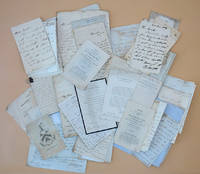
1865443721865. <p>City of London Truss Society. Archive of 65 documents including autograph letters signed mostly to John Colley Taunton d. 1858 printed reports and other ephemera. 1822-65. Some documents soiled or dampstained a few with tears but overall good to very good. Calendar of the archive included.</p> <p> The City of London Truss Society a highly successful British charitable organization began operating in 1807 and continued well into the twentieth century Sir Geoffrey Keynes the well-known surgeon and bibliographer served on the Society's medical staff in the 1930s. A notice published in the Philosophical Magazine in 1813 describes the genesis of the Society:</p> <p> "From the great number of persons among the laboring poor who were afflicted with hernia and for whose relief no adequate provision existed on the 14th of October 1807 Dr. Squire Dr. Herdman John Taunton the Rev. H. G. Watkins James Horton Michael Bartlett Joseph Atkinson John Middleton John Gardner and John Whitford met at the City Dispensary and formed themselves into a Society 'for the relief of the ruptured poor throughout the Kingdom the City of London Truss Society'" Philosophical Magazine 43 1813: 316. </p> <p> John Taunton 1769-1821 surgeon to London's city dispensary was appointed the Truss Society's first surgeon; after his death his son John Colley Taunton took over the post remaining there until his own death in 1858. By 1813 the Society was treating nearly 2000 patients annually; by Taunton's death in 1821 this number had increased to over 3500; and by the end of the nineteenth century the Society was employing three surgeons and seeing over 10000 patients per year. </p> <p>The archive we are offering contains 65 documents of which all but seven are handwritten. Of the 58 handwritten documents the majority are letters to and a few from John Colley Taunton. The most notable correspondent represented here is physiologist and surgeon Benjamin Collins Brodie 1783-1862 whose letter to Taunton advises him on a urinary tract infection in a patient. Four of the letters are from surgeon William Kingdon 1789-1863; two of these recommend poor patients to the Society's care. 31 letters are from Samuel Cartwright 1789-1864 a dentist and one of the vice-presidents of the Truss Society; nearly all of his letters have to do with donations to the Society and several include the exact amounts given. Another group of letters is from Mary Tanner presumably a patient; two of these letters include prescription notes in what is presumably J. C. Taunton's hand. Also included in this archive are three of the Society's annual reports for the years 1862-1864; a printed subscription card; and two printed invitations from the Society addressed to Walter K. Taunton. A complete calendar of the archive is included. Royal College of Surgeons Plarr's Lives of the Fellows Online. </p> <p>. unknown books