16 759 résultats
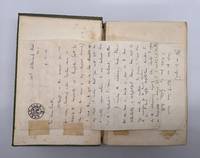
24692Ceremony performed on 12 October 1949. Building commissioned by the London County Council. The present item is rare and its interest is heightened by the fact that it is accompanied by a press release and has the covers covered in what are clearly notes on how to film the ceremony by a press cameraman. Only three copies on COPAC: at the British Library Sheffield Hallam and the Bishopsgate Institute. An 8vo stitched pamphlet of twenty unpaginated pages in printed card wraps. Internally very good. With full page artist’s impressions of the front elevation and ‘the concert hall in its setting’; a page with two photographs of ‘The Working Model’; and six pages of ‘Plans at various levels’. The text consists of a five-page report on the details surrounding the building of ‘The Concert Hall’ by Howard Roberts Clerk of the Council and a full-page ‘Appreciation’ by Felix Aprahamian. Stapled into the front cover is a duplicated press release ‘For the information of the Press’; 1p landscape 8vo by Roberts regarding ‘The Concert Hall Foundation Stone Ceremony’ dated 10 October 1949. Both covers have a vertical fold down the middle. On the front in black ink is a manuscript itinerary not given elsewhere: ‘10.00 MEMBERS TERRACE / CASKET FILLING / 10.30 CONFERENCE ROOM / MODELS IMPRESSIONS / 2.20 P. M. speech’. Above this on the front cover and filling the whole of the back cover is a twenty-two item numbered sequence of notes regarding the ceremony clearly made by a press cameraman. One entry reads: ‘interior of middle concert hall no light’ and others ‘exterior aerial view concert hall / low angle / ditto different angle’. First entry reads ‘Articles to go into cascet sic’ another ‘Mallett sic & Trowl sic’. [Ceremony performed on 12 October 1949. Building commissioned by the London County Council.] paperback
19211956London: Daniel O'Connor 1921. Cloth. A fan copy with playful correspondence: FIRST EDITION incl. two ALS and inscribed portrait of author. 8vo. Original green cloth lettered and ruled in red. Shabby and well-handled grubby finger prints abound cloth worn and split bumped. Hinges and spine cracked foxed. First ALS addressed to "My dear Pratt" taped to front pastedown and second ALS "To Lidgey" taped to ffep Elizabeth Pratt's short reply taped to rear pastedown obituary clippings pasted to title page and facing verso folded print of G L Stampa's 1919 portrait of the author inscribed by Lawrence "with blushes" to Miss Pratt laid in. A poor but unique and nevertheless charming copy. Thurston-born Charles Edward Lawrence 1870-1940 was a novelist and Honorary Secretary of the Savage Club a much-loved and long-standing reader at John Murray and editor of its Quarterly Review. The two holograph letters along with a matching envelope to rear are addressed to Pratt and Elizabeth Pratt "Lidgey" husband and wife it seems. Each was written from John Murray's 50A Albermarle Street address. Pratt's two-page letter 8.iii.23 featuring an Urban Club-stamp is practical and friendly but insistent in tone – "as I'm a cocky beast now that I am Hon. Sec. my word is law" – following up issues about club memberships and informing Pratt he is one of the Special Committee which "meets at the Savage Club at the luncheon hour of 1pm" to discuss "the Shakespeare festival". Written in verse Lawrence's two-page letter to Lidgey 2.ii.22 appears to be a playful response to her own brief lines taped to rear pastedwon a correspondence that revolved around her being the namesake of Lawrence's protagonist in The Iron Bell Elizabeth Pratt. Lawrence hails her as "the Urban Sapho". The artist and Punch cartoonist George Loraine Stampa 1875–1951 was also member of the Savage Club. Daniel O'Connor hardcover
196414349London: Zoological Society of London 1964. First edition. Original Wraps. Very good condition but mild ex-library. small quarto. a series of symposia on highly relevant topics in the zoological field published by the Society in the form of articles by reputable zoologist on the newest research of the time. prefer to sell as a run but possible to sell on individual basis to fill gaps in the series. contact for more information. Zoological Society of London paperback
15925London: Printed and published by George Edward Wright at The Times office Printing-House Square. 1887. For the context of this item see Parnell's entry in the Oxford DNB and T. W. Moody's study 'The Times versus Parnell and Co. 1887-90' in 'Historical Studies VI' ed. Moody; London: RKP 1968. Moody notes that the first three Times articles 7 10 and 14 March 'were quickly reprinted in pamphlet form price one penny' but makes no mention of the present item. On both sides of single 60.5 x 47.5 cm leaf on wove paper with 1887 watermark of 'The Times Taverham Mill'. Folded four times to make a packet with 15 x 12 cm title which reads in full: 'Parnellism and Crime. Facsimile Page from the "Irish World." Reprinted from The Times of June 7 1887. Price One Penny. London: Printed and Published by George Edward Wright at The Times Office Printing-House Square. 1887'. Both sides of the leaf have the running title 'REPRINTED FROM THE TIMES TUESDAY JUNE 7 1887.' One side carries copy from The Times in six columns headed 'PARNELLISM AND CRIME.' and the other carries the facsimile with various facsimile signatures of p.10 from 'THE IRISH WORLD AND AMERICAN INDUSTRIAL LIBERATOR: FEBRUARY 16 1884. - TWELVE PAGES.' The significance of the page according to The Times resides in the fact that it 'contains Patrick Ford's own account of the various "funds for patriotic objects raised by the Irish World during the past eight years" with the formal acknowledgments of the recipients and what purports to be an "audit" of some of the moneys received and disbursed.' Aged and worn but in fair condition considering its ephemeral nature. Scarce: OCLC WorldCat and COPAC only list copies at the British Library in whose entry it is attributed to Anderson Oxford and Cambridge. London: Printed and published by George Edward Wright, at The Times office, Printing-House Square. 1887. unknown
15023University College London University of London. Ramsay's lectures advertised for 18 October 1904 Baly's for 4 November 1904 and 3 February 1905 Inglis's for 17 October 1904 and Wilsmore's for 11 October 1904. 1p. foolscap 8vo. In fair condition aged and worn with stamp label and shelfmark of the Board of Education Library. Signed in type at foot by 'T. GREGORY FOSTER Ph.D. Principal.' Laid out in the usual variety of types and point sizes. The poster gives details of the lectures and cost. Ramsay's course will 'treat of the Chemical aspects of the recent discoveries connected with radio-active matter'; Baly's on Spectroscopy' are dealt with at length his syllabus dealing with 'Historical development and the determination of the modern standards of wave length'; Inglis will lecture on 'Recent advances in inorganic chemistry'; and Wilsmore on 'Electro-Chemistry'. University College, London (University of London). Ramsay's lectures advertised for 18 October 1904, Baly's for 4 November 1904 unknown
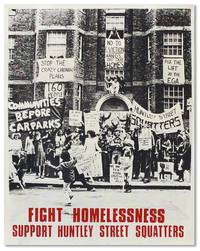
197819872London: S.i. 1978. Original photo-lithographed poster with image printed black on white stock and text silkscreened in red ink at lower edge; measures 45cm x 57cm 17.75" x 22.25". Light wear and shallow creasing to upper right margin roughly 4" with a dash of red ink on verso; Very Good to Near Fine.<br /> <br /> Poster produced by the Huntley Street Squatters who were located at 1-9 Huntley Street in Bloomsbury. In addition to being the center of the London Squatters Union the Huntley Street squat was home to more than 150 squatters and 32 children who occupied the building in 1977-78. The mansion block owned by Camden and Islington Health Authority had lain empty for two years and quickly became a focus for the squatters' movement in London. Led by Piers Corbyn the squatters set up a café hosted festivals and even set up an office which helped to re-house the homeless. After 17 months 300 police officers with bulldozers converged upon the building and evicted all who lived there. A rare poster; no examples in the trade 2014 not listed in OCLC with the only example found by us held at the International Institute of Social History in Amsterdam. S.i. unknown
12513No. 1. March 1949. The Editor 26 Bedford Square WC1 London. Printed by Latimer Trend & Co. Limited Plymouth. 8pp. 4to. Stapled and unbound. In fair condition on aged paper. On the first page the 'object of this Review' is described as 'to provide a forum for discussion in which the organisations represented on the 18-30 Conference and their individual members can express their views on subject of common interest'. On the last page the 18-30 Conference is described as 'a consultative body' inaugurated in November 1946 'established in recognition of the need to provide a forum for discussion on the interests of young citizens in the manifold activities of national life'. Henriques' paper is on pp.3-4 with pp.5-6 carrying 'some opinions of National Service by the conscripts themselves'. Copies of any issues of this magazine are extremely scarce with the only entries on COPAC at Oxford Cambridge the National Library of Scotland and the British Library. From the papers of Sir Basil Henriques. No. 1. March 1949. The Editor, 26 Bedford Square, WC1 [London]. [Printed by Latimer, Trend & Co., Limited, Plymouth.] unknown
25107Alien Office Whitehall. Between 1824 and 1829. All but the last at the London police offices at Bow Street Great Marlborough Street Hatton Garden Queen Square. An interesting collection of eleven items from the reign of George IV giving a view of administration of immigration in London and one item from Manchester Number Six below. The Alien Office was created as a department of the Home Office to implement the Aliens Act 1793 which attempted to control the influx of foreign visitors and refugees caused by the turmoil in France. It ceased to exist following the Registration of Aliens Act 1836. created to control the influx of French refugees and suspected revolutionaries. The present collection of eleven affidavits all signed and witnessed dates from between 1824 and 1829. The material is in good condition lightly aged and worn with one item creased along one edge. Nine of the items are each 1p 4to; the other two Items One and Three are each 1p landscape 8vo. The final item is sworn before two army officers see Eleven. The other ten are signed before the following magistrates at the named police offices: William Beckett Bow Street Three; Sir George Farrant Great Marlborough Street Two; David William Gregorie Queen Square Six Eight and Ten; Edward Markland Queen Square One and Seven; William Lorance Rogers Hatton Garden Nine; William Archibald Armstrong White Queen Square Four and Five. ONE: 24 August 1824. Signed by ‘Charles Anthony Krederer of No. 11 great Cambridge Street Hackney Road. Certifying that ‘he arrived in England from Malta in the year Eighteen Hundred and Eleven and that he hath never since left it’. TWO: 18 October 1824. Signed by ‘Joseph Pozzinakosky of No. 27 South Street Manchester Square’. Certifying that ‘he hath continually resided in this Country for the space of Fifteen years and upwards now last past’. THREE: 23 October 1824. Signed by ‘Francis Jaunay of No. 25 Leicester Square Hotel Keeper’. Certifying that ‘he has resided in this Country since the year 1801 and has been 10 years in the above mentioned Hotel’. Note at foot in Jaunay’s hand with second signature: ‘I have continually reside sic in England the previos sic of the year 1801 to 1815’. FOUR: 25 October 1824. Signed by ‘Bernard Mége of 19 Grafton Street Fitzroy Square’. Certifying ‘that he first came to reside in England in the year 1809 and that he from that time continued to reside in England for upwards of seven years and that since the end of the first seven years he has quitted England only occasionally for short periods of time’. FIVE: 4 November 1824. Signed by ‘Alexandre Vincent Benard of Saint James’s Palace Westminster in the County of Middlesex Sergeant Porter to His Majesty’. Certifying that Benard ‘hath resided in England upwards of Seven years and that for and during thattime he hath not left it even for a single day’. SIX: 22 November 1824. Signed by ‘Martin Schunck of Charlton Row Manchester in the County of Lancaster Merchant’. Certifying that ‘he hath resided in England upwards of Seven Years without during that leaving it even for a single day’. SEVEN: 26 November 1824. Signed by ‘Nicholas Hector Clément of Durham House Chelsea in the County of Middlesex Schoolmaster’. Certifying that ‘he hath resided in England for space of Ten Years and upwards without during that time leaving it for a single day. EIGHT: 6 June 1825. Signed by ‘Claude Marie de Couffon of the Sablonierre Hotel Leicester Square in the County of Middlesex Teacher of Languages’. Certifying that ‘he hath resided in England upwards of Seven Years without during that time leaving it for a single day’. NINE: 17 June 1825. Signed by ‘Peter Caprani of No. 5 Leopards Court Baldwins Gardens in the Parish of Saint Andrew Holborn in the County of Middlesex Merchant’. Certifying that ‘he was born in Como in Italy in the yer one thousand eight hundred and four’ and that he came to live in Holborn in 1816. TEN: 20 June 1826. Signed by ‘Joseph Tresselle of No. 26. Great Pulteney Street Golden Square’. Certifying that ‘he hath resided in England upwards of Ten Years without during that time leaving it for a single day.’ ELEVEN: 5 October 1829. Signed by Lieut-Gen. C. Callander 41 Bryanston Strreet and James Ogilvie Deputy Commissary General 23 Portland Place. Certifying that ‘Mr. Lazarus Joseph is a Native of Germany and has Resided in London above Fifty Years’. [Alien Office, Whitehall.] Between 1824 and 1829. All but the last at the London police offices at Bow Street, Great Marlborough unknown
14031Terms: without date or place. Bagshawe's Note: 13 Old Square Lincoln's Inn. 12 January 1853. Terms and note: 3pp. foolscap 8vo. Bifolium. Docketted by Wiseman on reverse of second leaf 'Cath Standard' with 'Bagshawe Correspondence 1837-64' in another hand. In fair condition on lightly-aged paper. The thirteen terms are headed: 'Mr Richardson on behalf of his firm of Richardson & Sons proposes as follows'. The first two terms read: '1. Mr. Richardson To supply including what he has already paid £1000. as part of the capital for carrying on the Catholic Standard Newspaper. 2 £2000. Capital to be supplied in addition to his £1000. by Cardinal Wiseman or the persons whom he shall appoint.' The covering note signed 'H R Bagshaw' is in a secretarial hand and reads: 'My dear Lord Cardinal The above are the terms which Mr. Richardson proposes. I wish you would consider them and appoint a time and place for taking them into consideration.' From the Wiseman papers. Terms: without date or place. Bagshawe's Note: 13 Old Square, Lincoln's Inn. 12 January 1853. unknown
14784Bournemouth Guardian Ltd. Printers Etc. 194 & 196 Commercial Road Bournemouth. April 1943. 4pp. 8vo. Bifolium. Printed in small type. In fair condition on aged and worn paper with short closed tears at edges of folds. An interesting perspective on the British aviation industry from what Dr T. R. Bromund of Yale University has described as 'the industrial wing of the Empire lobby'. The opening paragraph reads: 'Owing to the recent resignation of the entire Board with one exception of the British Overseas Airways Corporation the public has become dimly aware that British Air Transport is facing a crisis but as yet has little or no idea of the magnitude of the issues involved. It cannot be expected to grasp the inescapable truth that on the result of the handling of these issues may depend the whole future of British Overseas Trade and consequently of the way of life in these Islands. This is no exaggeration as we shall show in the opening paragraphs.' What follows is a brief 'history of British Air Transport since Air Transport became an accomplished fact' the author's contention being that Britain 'finished the last war with a Fighting Air Fleet vastly superior to any other in the world' and that this was 'immediately cut to a mere skeleton and it never seems to have occurred to the Government of the day to regard the air as of the smallest important from a Civil point of view.' After this section on 'Early Struggles' there sections headed 'An Imperial Basis' 'Vital Issues' 'Wanted - A Man' 'The Freedom of the Air' 'Looking Ahead' 'The Sea and the Air' and 'Now'. The author's contention is that 'The Empire which depends for its very existence on military co-operation at the present moment will in the future depend equally on commercial co-operation.' COPAC notes runs of the Bulletin at Cambridge and Trinity College Dublin the latter only beginning in 1948. Bournemouth Guardian, Ltd., Printers, Etc., 194 & 196, Commercial Road [Bournemouth]. April 1943. unknown
15512London: John Bowyer Nichols and Son. 1850. 4pp. 8vo. Bifolium. In fair condition on lightly-aged paper. The first page carries the 'pitch' beginning: 'AN HISTORICAL MAGAZINE has long been the great desideratum of our literature.' The author proceeds to claim that 'THE GENTLEMAN'S MAGAZINE has stepped forward to occupy this vacant post.' The page ends: 'Five numbers of the new undertaking are before the public and present a fair example of what the work will henceforth be. The following important subjects have been treated of in some of the recent articles: -'. The second page carries a list of articles in smaller type ending with a list of people featured in 'The well-known OBITUARY'. The third page carries the 'OPINIONS OF THE PRESS.' in double-column and small type ranging from the 'Taunton Courier' 'The Gentleman's Magazine has been revived with a degree of spirit and talent which promises the best assurance of its former popularity.' to the 'West of England Conservative'. The last page carries an advertisement headed: 'This Day is Published price Six Shillings The Pilgrimages of Walsingham and Canterbury. By Desiderius Erasmus. Translated and illustrated with notes by John Gough Nichols F.S.A.' Scarce: the only copy traced on either COPAC or WorldCat at the British Library. [London: John Bowyer Nichols and Son. 1850.] unknown
13056London: Macmillan & Co. Limited St. Martin's Street. 1909. R. Clay and Sons Ltd. Bread St. Hill E.C. and Bungay Suffolk. 16pp. 12mo. Printed in green with 15 illustrations one on each page except p.2. Stitched. In fair condition on aged paper. Separate 'NOTICE' 1p. 12mo on blue paper loosely inserted informing the public that the firm 'do no retail business whatever' and hoping 'that all orders will be given direct to the local booksellers'. Scarce: no copy on OCLC WorldCat or on COPAC. London: Macmillan & Co., Limited, St. Martin's Street. 1909. [R. Clay and Sons, Ltd., Bread St. Hill, E.C., and Bungay, Suffolk. unknown
7471Anonymous and undated. Circa 1810. On one side of a piece of wove paper roughly 28.5 x 24 cm. On aged somewhat grubby paper with 6 cm closed tear repaired with tape on reverse. Full-length diagrammatic depiction of a British army officer in uniform of the Napoleonic period black boots with spurs tight white breeches green jacket with yellow trim and black hat with red plume holding his sword horizontally in front of his face. A set of thirteen numbered angles are projected from the tip of the blade some bracketed 'all these are strait in Front'. Others are described as 'flat'. Captioned at head 'Drill Motions.' The numbering and handwriting would appear to be in a hand contemporary with the plate but the item is either a forgery or it has been touched up in recent decades as the border plume and some highlighting would appear to be in red felt-tip pen. Docketed at the foot in a twentieth-century hand 'DRILL MOTIONS AT BUNHILL FIELDS.' The Honourable Artillery Company the oldest regiment in the British Army has its old parade ground abutting Bunhill Fields near the City of London. Anonymous and undated. [Circa 1810?] unknown
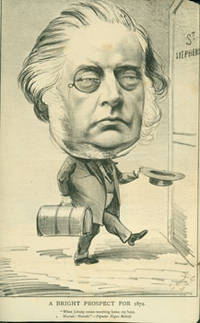
63-3697London UK: The Hornet 1872. Cartoon of John Bright from January 24 1872 printed in a British newspaper The Hornet. 9.5" x 15" Good with minor losses and marginal tears some staining & creasing. Relevant article fixed to verso. [London, UK: The Hornet], 1872. unknown
175931823London: The London Chronicle 1759. First Edition. Newspaper. Very good. Approx. 11" x 8.5" newspaper. Pages 193-200. Three columns. Light wear and toning. Page 197 includes a half-column "Extract of a Letter from New York July 6" reporting on General Amherst's impending assault on Fort Ticonderoga. The London Chronicle unknown
26505'Brief Report': London: Waterlow & Sons Limited Printers London Wall. 1899.' 'A Brief Description': The London School of Economics and Political Science University of London. 10 Adelphi Terrace W.C. March 1901. Both items in fair condition on aged paper with shelfmarks stamps and labels of the Board of Education Reference Library. 'Brief Report': 32pp. foolscap 8vo. In fair condition on lightly aged paper in worn grey printed wraps strengthened at the spine with brown tape. Headings include 'Provision for training in Economics and Political Science' 'Character and Objects of School' 'Methods of Organisation' and 'Property of the School and the Library'. Also the 'complete curriculum of the School' pp.9-17 and list of lecturers pp.17-20. 'A Brief Description': 7pp. 4to. In fair condition on aged and worn paper. Headings include: 'Foundation and Objects of the School' 'Progress of the School' 'Students' 'The Curriculum' 'Studentships and Scholarships' and 'Relation of the School to the University of London.' No copy of either item on COPAC and OCLC WorldCat.only lists two copies of the 'Brief Report' at New York Public Library and the University of Pennsylvania. 'Brief Report': London: Waterlow & Sons Limited, Printers, London Wall. 1899.' 'A Brief Description': The London School of Econo paperback
175935132London: The London Chronicle 1759. First Edition. Newspaper. Very good. Single issue. Approx. 11" x 8.5" newspaper. Pages 619-626. Contents printed in three columns. Light toning to the paper. <br /> <br /> Front page article dated Friday December 28 concerns the East-Indies with an extract from a letter by Lieutenant-Colonel Lawrence dated from camp near Madras Feb. 22 1759. Contents include advertisements of books and publications letters to the editors political narratives etc. The London Chronicle unknown
169935185London: Printed by Edward Jones in the Savoy 1699. First Edition. Newspaper. Good. Newspaper broadsheet. 1 leave 2 pages. Double columns. Paper is lightly toned with edge tears and edge chips not affecting the print. Contents include an article on the Anniversary of the Pope's Coronation; brief articles from Warsaw Vienna Frankfurt Hamburgh Brussels Lee Hague Paris and Plimouth. Advertisements located in the second column on back. Printed by Edward Jones, in the Savoy unknown
19069900031363London: The Times Newspaper 1906. Hardcover. folioFolio size volume bound in 3/4 leather over dark 'pebbled' clothThis periodical which began in 1904 was issued weekly with The Times newspaper. This offering begins with the first issue No. 1 March 1 1905 and concludes with No. 96 December 26 1906. Each issue contains from six to twelve pages of detailed technical industrial and commercial information. There is a comprehensive Index for the period March 1 1905 to Dec. 27 1905 and another such Index for the full year of 1906. Such indices will be invaluable reference tools for scholars. Each issue normally contains a number of special articles followed by Correspondence Notes and Paragraphs Letters to the Editor a section on Railways Industrial Notes Reviews of Technical Books and Minor Articles. Interesting topics include Submarines three-part article The Panama Canal Telephones and Telegraphs: Developments in the U.S. The Electrification of London etc. as well as many period advertisements. The text is printed on newsprint stock which has now browned a bit. The binding of this large heavy volume has been allowed in the past to dry and hence the front joint is partially cracked and the boards show wear to extremities. The binding is still quite dry and must be handled with care. However the contents are clean and unmarked. Given the ephemeral nature of such publications it is quite unusual to find such a complete run and in such good condition the binding notwithstanding. We would ask that if a purchase is contemplated you first enquire as to shipping costs and options for this heavy volume. The Times Newspaper hardcover
19069900030803London: The Times Newspaper 1906. Hardcover. folioFolio size volume bound in 3/4 leather over dark 'pebbled' clothThis periodical which began in 1904 was issued weekly with The Times newspaper. This offering begins with the first issue No. 1 July 18 1904 and concludes with No. 129 December 31 1906. Each issue contains from six to twelve pages of detailed financial banking and commercial information. There is a comprehensive Index for the period July 18 1904 to Dec. 25 1905 and another such Index for the full year of 1906. Such indices will be invaluable reference tools for scholars. Each issue normally contains a leading article followed by a number of special articles and regular columns on the money market the stock exchange freights and shipping and the commercial markets; as well as the stock and share list and summaries of colonial foreign finance and trade including Canada and the United States. Later issues contain The Times Financial and Business Directory as well as many advertisments and Notices of share offerings and stock conversions. The text is printed on newsprint stock which has now browned a bit. The binding of this large heavy volume has been allowed in the past to dry and hence the spine has partially detached at the front joint. The binding is still quite dry and must be handled with care. However the contents are clean and unmarked. Given the ephemeral nature of such publications it is quite unusual to find such a complete run and in such good condition the binding notwithstanding. We would ask that if a purchase is contemplated you first enquire as to shipping costs and options due to the weight and size of this volume. An article in the Feb. 20 1905 issue on 'The Compulsory Working of Patents' has been attributed to Winston Churchill. The Times Newspaper hardcover
19119900042486London: The Times Newspaper 1911. Leather Bound. Folio size volume bound in 3/4 leather over dark 'pebbled' cloth. The text is printed on newsprint stock which has now browned a bit. The binding of this large heavy volume has been allowed in the past to dry and hence the front joint is partially cracked and the boards show wear to extremities. The binding is still quite dry and must be handled with care. However the contents are clean and unmarked. Given the ephemeral nature of such publications it is quite unusual to find such an extensive run and in such good condition the binding notwithstanding. A run of three different supplements special issues from the London Times. The Engineering Supplement runs from January 2 1907 to October 2 1907; the Financial and Commercial Supplement from January 7 1907 to May 6 1907 and the Educational Supplement from September 6 1910 to December 5 1911. The Times Newspaper unknown
191658706London: The London Times 1916. 1st ed. thus. Very Good. oversize. cloth binding c.1150pp. maps Bound volume containing all copies for the period April 1st to June 30th. Inc. many rolls of Honour and day by day accounts of campaigns on all fronts. This volume covers the whole of the Easter Rising in Dublin. An absolute treasure trove for the WWI researcher. Bound runs from 1914-18 are very scarce. Some browning & minor soiling to occasional pages but generally a very good volume The London Times hardcover
191758705London: The London Times 1917. 1st ed. thus. Very Good. oversize. cloth binding c.1100pp. maps Bound volume containing all copies for the period April 2nd to June 30th. Inc. many rolls of Honour and day by day accounts of campaigns on all fronts. This volume covers the first three months of the entry of the US into the War. An absolute treasure trove for the WWI researcher. Bound runs from 1914-18 are very scarce. Some browning & minor soiling to occasional pages but generally a very good volume The London Times hardcover
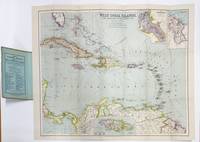
19172161London and Liverpool: George Philip & Son Ltd. 32 Fleet Street E.C. 4 1917. MAP FOLDING MAP. London: George Philip & Son Ltd. 32 Fleet Street E.C. 4 and Liverpool: Philip Son & Nephew Ltd. 20 Church StreetWrapper title: West Indies Philips' Authentic Imperial Maps for Tourists & Travellers sic.<br /> <br /> 3 Inset maps: The Panama Canal; British Guiana; Jamaica<br /> Folding map ; colored relief map; 21 3/16" x 25 ¼" sheet size; 20 1/8" x 23" within the neat line; map contained in a 7 ¼" x 4 ¼" green stiff wrapper the front printed with the title and the rear blank; inside publisher's advertisements for maps; light soiling to wrapper edges with curling a few small splits at map folds; map is bright and crisp; very good plus. LOC 2021668491. The map was produced during WWI and was useful as it noted the shipping routes as well as telegraph lines and undersea cables. <br /> <br /> The northwest of the map pictures the tip of Florida with the Gulf of Mexico; the islands of Cuba; the Bahama or Lucayas Islands; the island of Haiti or Santo Domingo with the Dominican Republic; the island of Porto Rico; the Lesser Antilles consisting of the Leeward and Windward Islands; and the islands of Trinidad and Tobago. The countries of Colombia Venezuela and British Guiana are depicted to the south. The Panama Canal is located in the southwest of the map in Central America along with the countries Honduras Nicaragua Costa Rica and Panama. Shipping approaches to the Panama Canal are noted from various points as well as cables and telegraph lines. George Philip & Son, Ltd. 32 Fleet Street, E.C. 4 unknown
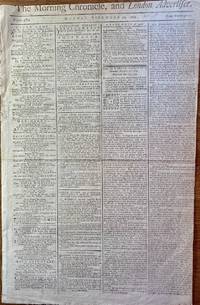
177936790London: Printed by W. Woodfall 1779. First Edition. Newspaper. Good. Newspaper. Single issue removed from a larger gathering. Approximately 18" x 11.5". 4 pages. Three columns. Paper is closely trimmed on the top and side margins with minor loss of print. Print is faded in areas with a few spots to the paper. This issue devotes 3 pages to the Battles and Siege of Savannah in the fall of 1779.<br /> <br /> The first page has two columns regarding the Siege. An article titled "Extract of a Letter from Major-General Prevost commanding his Majesty's forces in the Province of Georgia to the Right Honourable Lord George Germain one of his Majesty's Principal Secretaries of State dated Savannah November 1 1779: received by Captain Shaw Aid de Camp to Major General Prevost. Prevost states ".the very unexpected visit of the Count d' Estaing to this coast with powerful a squadron and considerable body of land troops when known would have excited some uneasiness for our safety; it is with very sincere pleasure I do my self the honour to inform you that we have seen the last of the French fleet this day depart we hope off the coast - got them and their American allies off our hands." <br /> <br /> A daily account of the events is printed on the first page from September 4 to the 24th. The second page is completely covered with the Battle and has entries from September 25 to October 11. Between October 11 and the 18th Prevost writes about removing the women and children to safety; about the fog; Battle lines; cannon fire; the number of forces lost on the enemy side; a truce to bury the dead and care for the wounded including d' Estaing and General Pulaski who later died from his wounds on the 18th etc. The paper also includes 10 translated letters from Prevost Estaing and one letter signed by General Lincoln and d' Estaing. On page 3 is a list of the causalities of the battle. <br /> <br /> The American-French Allied forces were badly beaten at the Siege of Savannah and the British continued occupied Savannah until the end of the Revolution. From American Battlefields dot org:<br /> <br /> In 1778 British policymakers and strategists decided to refocus their efforts on the southern colonies where they believed the crown would enjoy the support of a large Loyalist population. As part of that effort a British army under Lieutenant Colonel Archibald Campbell captured the city of Savannah Georgia on December 29 1778<br /> .<br /> In the fall of 1779 the Americans were determined to take the city back. American forces in the region numbering between 5000 and 7000 men were based in Charleston South Carolina under the command of General Benjamin Lincoln. Lincoln recognized that to recapture Savannah he would need assistance from the French military. On September 3 he learned that Charles Hector Comte d'Estaing was en-route to Savannah bringing with him a fleet of warships and 4000 French soldiers. On September 11 Lincoln left Charleston with a force of his own intent on linking up with d'Estaing. Arriving first d'Estaing began offensive operations against the city on September 16. When fully assembled the Allied force numbered over 5000 men. Defending Savannah was a force of more than 3000 men under the command of General Augustine Prevost. <br /> <br /> On the morning of October 9 the Franco-American Allies launched a major assault. Fog shrouded the battlefield impeding forward progress. Troops became lost in the swamps fronting the Spring Hill Redoubt the Allied objective. d'Estaing had selected the Spring Hill Redoubt under the mistaken impression that it was lightly defended by local Loyalist militia. In reality the Loyalist militia was backed by battle-hardened British Regulars. When the fog lifted the French lines were fully exposed crumbling in the face of a withering and incessant fire from the redoubt's defenders. d'Estaing himself was wounded twice while personally leading the attack. Mortally wounded in the assault was the Polish cavalry mastermind Casimir Pulaski who had done much to shape the mounted forces of the Continental Army. He was shot while trying to lead his horseman through a temporary breach in the British line. During the attack on the Spring Hill Redoubt the Allies lost roughly 1000 men. The British suffered only 150 casualties.<br /> <br /> An hour after leading his forces forward d'Estaing called off the attack recognizing its futility. A week later the French commander sailed away leaving Lincoln behind and the Franco-American Alliance strained. On October 18 Lincoln lifted the siege. Savannah would remain in British hands until the end of the war. Printed by W. Woodfall unknown