5 903 résultats
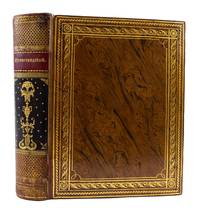
183511052Koblenz: Karl Baedeker. 1835. Second Edition. Hardcover. Very Good. Boards a bit sunned spine label browned and lightly chipped but still readable "Klein's Rheinreise Zweite Auflage". Neat notation with black ink on first blank page dated 1837. Bookplate. Two illustrations and two steel engraved fold out maps. Very light browning to a few single pages not affecting contents. ; This book is the expanded and revised edition of Professor J. A. Klein's Rheinreise. Converted into a guidebook by the legendary bookdealer of Coblenz Germany - Karl Baedeker. The first book to bear his original name Bädeker and the precursor of the entire series. A virtually unique publication - extremely rare ; 16mo 6" - 7" tall; 517 pages . Karl Baedeker hardcover
1817ST18762Halle and Berlin: Hallisches Waisenhaus 1817. 275 x 215 mm. 10 3/4 x 8 3/8". 210 leaves 18 pp. 4 leaves. <br/> REMARKABLY FINE CONTEMPORARY MARBLED CALF covers with complex gilt border composed of plain rules and decorative rolls smooth spine divided into compartments by gilt Greek key rolls top and bottom compartments with all-over gilt scallop design long central panel of black morocco with elaborate gilt vase and floral ornament surrounded by small gilt stars and with red morocco titling label above; FULL SPECKLED CALF DOUBLURES the front doublure with a painted lyre featuring gilt strings sword and wreath the rear with a monopteros with an eternal flame at the center upon a plinth superimposed upon which is an onlaid black morocco label framed in gilt and with gilt lettering "18. Oct. 1813" both doublures framed with red morocco supporting an elegant scrolling gilt band densely gilt turn-ins blue silk moiré endleaves all edges gilt an expert two-centimeter repair at head of spine. With frontispiece 21 portraits and 11 maps three folding one with flap all but one with inserted tissue guard. ◆Joints with slight flaking a hint of wear along tail edges as expected bottom spine compartment faintly rubbed with minor loss of gilt a little oxidation to the wreath on front doublure but A VERY HANDSOME BINDING with only minor condition issues. Light overall browning to plates because of paper content but virtually no foxing and only very occasional some quite faint spotting; THE TEXT itself IN NEARLY PRISTINE CONDITION extraordinarily clean bright and fresh with just one or two negligible imperfections.<br/> <br/> In a wonderful binding with unusual doublures this work commemorates the so-called "Wars of Liberation" that effectively ended French hegemony over Europe and that forced Napoleon into exile. Also known as the War of the Sixth Coalition the conflict took place between 1813-14 following Napoleon's retreat from Russia in 1812. Though the major battles primarily took place in German territory rulers of Russia Prussia Austria Spain Portugal the United Kingdom Sweden and many German States all banded together to oppose France. In March of 1814 the allies entered Paris prompting the French Senate to depose Napoleon and install Louis XVIII as the French sovereign. Although Napoleon would briefly return from his exile on Elba to stage a comeback in 1815 it was short lived and ended in his final defeat. The majority of the text here discusses the events of 1813 and 1814 during the height of the conflict and includes portraits of the major players and maps helping to illustrate the most important battles. This work is beautifully printed on thick white paper and is clearly meant to act as both a chronological record of the events and a memorial to those who liberated the German states from a tyrannical power. The lovely marbled calf binding opens to reveal two exceptional doublures painted in the manner of an antique vase with a lyre wreath and sheathed sword on the front doublure and on the rear a monopteros this latter circular colonnade with an eternal flame bearing a small morocco onlay emblazoned with the date 18 October 1813. This refers to the Battle of Leipzig also called the Battle of Nations fought from 16-19 October--by many accounts the single largest and bloodiest battle of the entire Napoleonic Era. It marked a decisive turning point in the Wars of Liberation and was an obvious source of pride for the German people. Given the momentous nature of the book's content the present grand and beautifully designed binding serves as a suitably striking vehicle of presentation. Hallisches Waisenhaus unknown
18441165Paris, Jules Labitte, 1844 ; 2 vol. in-8 de [3] ff., 422 pp. ; [2] ff., 370 pp., 1 f. bl., reliures de l’époque maroquin à long grain cerise, double encadrement de filets dorés sur les plats, fleurons dans les angles, dos lisses ornés en long, roulette intérieure, tranches dorées.
183071112Gouache. Um 1830. 47,5 x 67 cm.
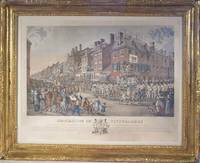
18215065Philadelphia: Published by Joseph Yeager; printed by Charles Woodward 1821. Engraving etching and aquatint with hand-coloring and mezzotint on buff wove paper plate: 50.5 x 66 cm.; image: 42.5 x 59 cm. Second state in which it is added that the view was "taken from M. Carey & Sons Book Store. S.E. corner of 4th and Chestnut Sts". There is no known extant copy of the first state but it is referred to and described in Stauffer & Fielding's American Engravers upon Copper and Steel page 556. "The procession of butchers with their carts carrying meat from a cattle market show was organized to encourage the breeding of cattle and attracted 300000 people if the Philadelphia Gazette is to be believed. It took one hundred carts to carry 86731 pounds of meat including bear and deer meat. The butchers and victualers proudly flew their banner 'We feed the Hungry.'" Nash First City: Philadelphia and the Forging of Historical Memory. ~ "The most popular of local views in aquatint was the light-hearted genre scene The Procession of the Victuallers. This is almost the only such local print of its time. Set in an atmosphere of happy holiday cheer there is in it as well the appeal of dozens of figures drawn from Krimmel 1786-1821 whose simple charm in the flat planar medium is redolent of days long gone. The Procession of the Victuallers drawn by Krimmel in the year of his death 1821 was aquatinted by Joseph Yeager c. 1792-1859 in his only engraving in that mode which has been found. This is lavish in size and in the crowded atmosphere typical of Krimmel. The Philadelphia Gazette of March 16 the day after the event reported that 'What added considerably to the novelty and beauty of the scene was the ascension of several handsome balloons during the line of march.' It has been said that the spectacle was witnessed by 300000; the population of the city at that time was 127000." Snyder Mirror of America. The 1904 auction catalogue of rare Americana from the estate of Moses Polock "the oldest bookseller in the United States" included the original watercolor later sold at Christie's New York in 2008 for $338500 and the descriptions noted that it was "from this that the now very rare engraving was made." There is loss to the margins at the lower right-hand corner and several closed tears intruding into the text or the image; paper restoration is subtle but visible. Some general discoloration but the colors remain quite bright. Framed. Rare. Stauffer & Fielding 3438ii. Published by Joseph Yeager; printed by Charles Woodward unknown books
184258395Dresden, Eduard Pietzsch, 1838-1842. 4°. Mit 3 farb. lithogr. Titeln u. 216 lithogr. Tafeln. Zus. ca. 580 S., HLwd.-Bde. d. Zt. m. etw. Rückenverg. u. goldgepr. Rückentiteln.
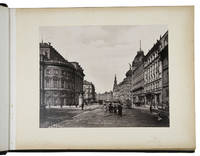
1899ABC_46445Budapest Dresden Innsbruck München: Calderoni és társa Verlag von Stengel & Co Fritz Gratl 1899. Half black leather red buckram sides blind-stamped boards gold-stamped spine with the date "1899" marbled endpapers. Oblong album 32 x 41 cm. Album with 43 photographic prints of various sizes 22 x 16.5 to 30 x 24 cm pasted on thick paperboard. From mountains in Austria to city views and interiors of churches in Budapest Vienna Innsbruck and München: all can be found in the 43 photographic prints in the present album. They were taken in at the end of the nineteenth-century probably in 1897 and 1899 according to blind-stamps in the prints. The photographers of most images are unknown except for the 6 photographs of Innsbruck which were made by the Innsbruck photographer and publisher Fritz Gratl. He likely made some of the other photographs of Austrian mountains towns and the city of Salzburg as well since his other known photographs cover similar subjects. Most prints of Vienna and some of Budapest were published by Stengel and Company in Dresden Germany in 1897. They and also Fritz Gratl were famous printers and publishers of postcards with similar picturesque images and the photographs in the present album are possibly the original images used to make the postcards.22 photos bear the blind stamp of the photographic studio. 4 photos have handwritten captions in pencil. The binding shows some minor signs of wear slight foxing or browning of the outer edges of the paperboards not affecting the photographs some photographs slightly faded or rubbed mostly at the edges not affecting the actual image the paper board of the print of "Budapest - Neues Parlament" has a slightly damaged spot in the lower margin not affecting the integrity of the board or the print. Overall in good condition. An album of 43 photos showing the sights of Hungary Austria and Germany. Calderoni és társa, Verlag von Stengel & Co, Fritz Gratl, hardcover
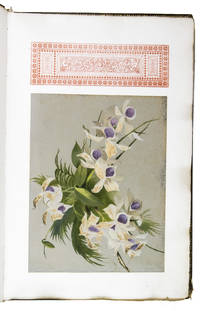
1896ABC_48884Colophon: Amsterdam 1896. Large folio ca. 51 x 33 cm. Calligrafie und Druck von Johan. K. Koning Contemporary gold-tooled burgundy leather the front board with a large gold-stamped monogram as a centrepiece the intertwined initials of the couple: AJ and EdR with the date "24-26 August" above and the year "1896" below lettered in gold both boards show a single fillet frame along the outer edges gold-tooled turn-ins beige watered silk endleaves. Wedding album comprising five manuscript texts of occasional plays 4 in German 1 in Dutch written in a neat cursive in blank ink on thick laid paper each illuminated with a 4-line decorated initial in red blue and white on a gold/bronze field richly decorated with penwork in black ink extending down into the inner margin. Each text is preceded by a letterpress title leaf set in neo-Gothic type also used for the general title several text leaves and the colophon. Further with 1 gouache illustration on grey paper sheet size ca. 32 x 24.5 cm mounted on the first leaf showing a bouquet of flowers 14 printed ephemera relating to the "Polterabend" wedding-eve party and the wedding on single or double leaves in various sizes the wedding announcement/introduction to the wedding-eve party and attached is a photo of the couple in a circular frame of red wax 5 menu cards the lyrics to 6 German songs a musical score by the German composer Wilhelm Aletter 1867-1934 and an announcement of the comic opera Des Teufels Antheil by the French composer Daniel Auber 1782-1871 performed by the Frankfurter Opernhaus on 25 August 1896 in Frankfurt am Main. Also with two manuscript wedding speeches in German written in black ink on paper two mounted albumen prints the first showing two actors dressed as a Frisian farmer and his wife and the other showing a man in Chinese dress 56 large ornamental vignettes printed in red or blue throughout 17 ornamental tailpieces printed in black blue and red and some dried flowers mounted on several leaves. 60 ll. A sumptuously executed wedding album presented to the Dutch groom August Janssen 1865-1918 and his bride Ella de Ridder 1877-1951 produced in honour of their wedding celebrations which took place on 24-26 August 1896 in Frankfurt am Main Germany. Most of the album concerns their "Polterabend" the wedding-eve party similar to present-day bachelor-/bachelorette parties except for the bride and groom joining together in the festivities. The main event now associated with a Polterabend is the smashing of porcelain by the wedding guests in order to bring luck to the couple's marriage but in general the evening is filled with plays and songs written and performed for the couple by their family and friends.A few performing actors were members of the Janssen-family a Dutch business family who had amassed their fortune with the tobacco cultivation in the former Dutch East Indies. They were also known for their generosity and philanthropic activities in the Netherlands. At the head of this family was the German-Dutch merchant Peter Wilhelm Janssen 1821-1903 one of the founders of the Deli Maatschappij in Sumatra and father of the groom who was his second son. His eldest son Christian Wilhelm Janssen 1860-1927 was married to Susanna Dorothea Anna Rehbock 1862-1933. Her brother the Dutch merchant Heinrich Carl Rehbock 1865-1938 was married to Caroline Janssen 1871-1951 one of the five daughters of Peter Wilhelm Janssen. Among the other actors were the brother of the bride Gustave von Ridder 1874-1956 the German playwright Hermann Otto Rudolf Presber 1868-1935 the German lawyer Paul Roediger 1859-1938 and his Dutch wife Julie Louise Charlotte Elink Schuurman 1875-1961 the sisters Anna Maria Humser 1876-1974 and Elisabeth Else Humser 1872-1967 daughters of the German lawyer and politician Gustav Adolph Humser 1836-1918 who was chairman of the Frankfurt city council at the time of the wedding celebration.The groom August Janssen 1864-1918 started his business career at trade offices in Bremen and London. He subsequently left for the former Dutch East Indies where he founded several enterprises. His wealth enabled him to engage in philanthropic activities. For example the municipality of Baarn benefited from his generosity he erected two public swimming pools there at his own expense. The bride Ella Elisabeth de Ridder 1877-1951 was the only daughter of the Belgian-German merchant August Cornelius de Ridder 1837-1911 known for his distinguished art collection of mainly Dutch and Flemish paintings of the 17th century which he built at his house at Kronberg near Frankfurt am Main. The famous Anglo-Hungarian artist Philip Alexius de László 1869-1937 painted Ellas portrait in 1903 in Baarn at the house of Hendrik Cornelis van den Honert 1854-1916 the successor of Peter Wilhelm Janssen as director of the Deli Maatschappij in 1898. De László had also painted her mother Johanna Elisabethe Louise May 1853-1942 around 1898 and two of her children in 1908.A unique wedding album of two members of prominent German-Dutch business families written and printed in 1896 as a special single copy publication. The album was produced in Amsterdam by Johan K. Koning who took care of the calligraphy of the texts and the printing of the divisonal titles explanatory leaves and vignettes.The spine and edges and corners of the boards show signs of wear with some minor loss of material at the foot of the sipne and the tips of the corners of the boards the leather is somewhat faded adn scratched all without affecting the general clarity of the tooling or the integrity of the binding. The watered silk on the first free flyleaf is torn some offsetting to the blank versos of the leaves and some glue residue on the leaves with dried flowers. Otherwise in good condition. hardcover
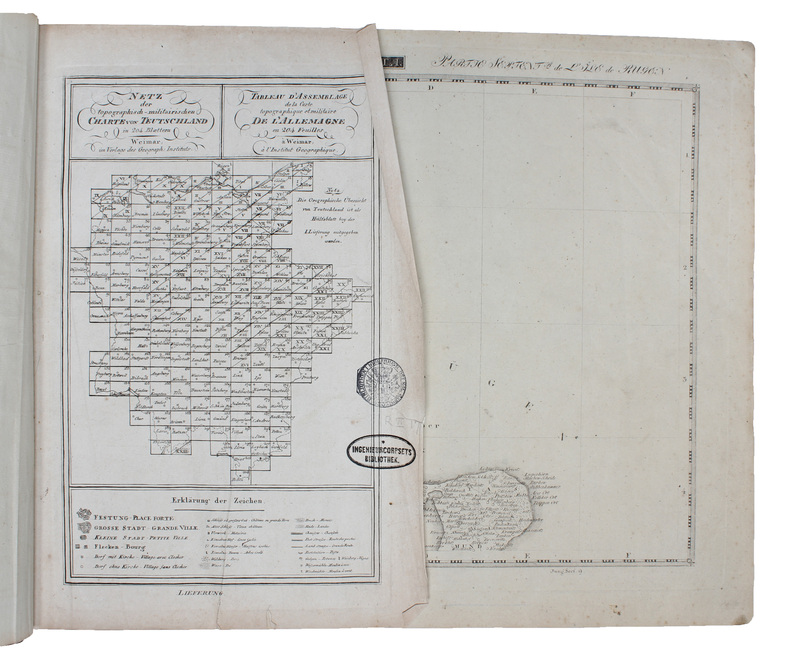
180755735Weimar, Geographischen Instituts, 1807-13. Folio-oblong. (38 x 48 cm.). Contemp hcalf. Spine a little rubbed. A paperlabel pasted on upper part of spine. Corners bumped. Stamp on ""Netz-Karte""/ ""Tableau"". With 3 other ""Netz-Karte"" on verso of Sect. 3,11 a. 14. The engraved title-page (in French) present as Sect. 10. With all 204 engraved plates (203 maps). The maps clean and fine throughout.
180755735Weimar Geographischen Instituts 1807-13. Folio-oblong. 38 x 48 cm. Contemp hcalf. Spine a little rubbed. A paperlabel pasted on upper part of spine. Corners bumped. Stamp on "Netz-Karte"/ "Tableau". With 3 other "Netz-Karte" on verso of Sect. 311 a. 14. The engraved title-page in French present as Sect. 10. With all 204 engraved plates 203 maps. The maps clean and fine throughout. unknown
186938404Wiesbaden : Königl. Regierung, ca. 1869 - ca. 1927. Wohl über 500 Bde ges. Gr. 8°. HLwd. d. Zt. mit verstärkten Ecken u. marmoriertem Einbd. mit marmorierten Schnitten.
183661042München, Joseph Lindauer?sche Buchhandlung (C. T. F. Sauer), 1836. Qu.-4°. Mit 24 lithogr. Tafeln von Gustav Kraus. 21 (1) S., 1 Bl., Beids. illustr. OKart.
1827STLB0051Hamburg, Hoffmann und Campe 1827. Kl.-8°. Schmutztit., Titel m. kl. Vignette (Lyra), 372 S., 1 Bl. (Verlagsanz.). Restaur. Leinenbd. der Zeit m. goldgepr. Rü.titel u. -verzierungen sowie blindgepr. Deckelrahmen. Einbd. abgewetzt, bestoßen u. fleckig, Rü. neu aufgezogen, Vorsätze erneuert, ges. Buchblock wasserrandig, braunfl. u. z. Tl. stärker abgegriffen, m. mehreren hs. Anmerk. auf Titelbll. u. im Text. Goed. VIII, 555, 26. Borst 1526. Erste Ausgabe von Heines Lyrikband mit romantischen Liebesgedichten, der den Ruhm des Schriftstellers begründete und bis heute zu den bedeutendsten Gedichtsammlungen zählt. Mit den vier Widmungsblättern, die in späteren Auflagen wegfielen, an Friedrich Merckel (2), Salomon Heine und Friederike Varnhagen von Ense sowie den häufig fehlenden Vortitelblatt und Verlagsanzeigen. - Das Buch der Lieder umfasst mit Gedichten zwischen 1817 und 1826 Heines Frühwerk. Von den insgesamt 237 enthaltenen Gedichten, waren viele zuvor schon in Zeitschriften veröffentlicht worden. Hier noch in der unzensierten Form, weil viele Formulierungen, die für zu obszön angesehen wurden, in den späteren Auflagen geändert werden mußten. So wurde beispielsweise aus einem Gedichtanfang, der in der vorliegenden, ersten Auflage noch 'Auf deinen schneeweißen Busen, Hab? ich mein Haupt gelegt' (S. 246) hieß, später 'An deine schneeweiße Schulter. Hab? ich mein Haupt gelehnt'.
18287-3-616London, , 1828. 4°(28x22cm), Band 1: 2 nn.S., 14 S., 16 S., 16 S., 16 S., 16 S., 14 S., Band 2: 16 S., 12 S., 16 S., 16 S., 16 S., 28 S., dazugehörige Stahlstiche komplett, Ledereinband
1840141651Leipzig, Wigand, o. J., [1840]. 240, 237, 183, 291, 236, 244, 303, 235, 480, 488 und 128 Seiten. 24,5*16,5 cm. Halblederbände der Zeit.
1880006743Frankfurt Main Germany: Bockelmann"s Kunstverlag 1880. Published in 1880's this beautiful collection contains all 150 single-sided loose engravings showing various cities and major buildings/cathedrals of Germany just prior to the turn of the century. Beautiful set covering most of Germany. Engraved title page and two page index. Engravings are clean. Sides of case are torn/worn. Overall very unique and rare collection of engravings. Individual pages may retail for as much as $50 or more each. Decorative Cloth. Very Good/Slipcase. 4to - over 9¾" - 12" tall. Bockelmann"s Kunstverlag hardcover
181961831ABWiesbaden, Schellenberg, 1819 u. 1821. 4°. XII S., 2 Bl., 66 S., 1 Bl. Mit einem lithogr. Frontispiz, 21 lithogr. Tafeln und 1 mehrfach gefalt. lithograph. Karte von Wiesbaden (44x36 cm) mit einer kleinen Ansicht in der re. unteren Ecke; X, 92 S., 1 Bl. Mit einer lithograph. Frontispiz und 18 lithograph. Tafeln. Moderne braune HLdr.-Bde. im Stil der Zeit mit Rückenschildern, Textband mit Ganzgoldschnitt. 2 Hefte in 2 Bänden (alles Erschienene).
182644632ABLondon, Jennings, 1826. Small folio. With 62 engraved plates, in two states (together 124 plates). Contemp. full brown calf with 2 col. labels, richly gilt, a.e.g.
1802631626Stralsund, Struck, 1765-1802. Folio. Mit 17 gefalteten Tabellen. Pappbände d. Zeit (4), Halbleder d. Zeit (2) u. Halbpergament d. Zt. (2). (Beschabt u. bestoßen, wenige kl. Fehlstellen, Rückenbezüge an 2 Pappbänden erneuert). [2 Warenabbildungen]
1843G121043Hamburg, Johann August Meissner 1843 viii + 339pp., with numerous engravings by Franz Schröder in text (depicting coins), 27x21cm., full leather binding in polished calf, floral filets on both covers, raised decorated spine, marbled endpapers, with an heraldic ex-libris tipped in (baron Surmont), text is clean and bright except for few occasional foxing, [This work is a detailed and systematic study of the "Portugaleser", a large gold coin struck in Hamburg. They were modeled after Portuguse gold coins and were often produced for ceremonial or banking purposes rather than for everyday circulation. Each entry documents inscriptions, imagery, minting authority and historical context. This publication is the first part of a continuation of the publication by Langermann "Hamburgische Münz- und Medaillen-Vergnügens"], a very good copy of this scarce publication, weight: 1.4kg., G121043
187948496ABMünchen, Franz, (1879-1881). 4°. VII, (I), XLVIII, 116 S., 52 S., 68 S.; VII, 92 S., 108 S., 63 S. Mit 250 (von 252) Stahlstichansichten auf 227 (von 229) Tafeln. HLdr.-Bde. der Zeit mit goldgepr. Rückentiteln und etwas Rückenvergoldung. 6 Teile in 2 Bänden.
183832225ABDresden, Eduard Pietzsch und Comp., 1838. 4° (29 x 19,5 cm). Lithograph. Titel, 2 Seiten Vorrede, 1 Blatt Inhaltsverzeichnis, 192 S. Original-Pappband mit dreiseitigem Farbschnitt in Gelb. Zwei Namen auf Vorsatz. Teils etwas gebräunt u./oder braunfleckig (abw. Papierqualitäten), mehrere Blätter leicht feuchtigkeitsrandig. Die Falttafel leider am Falz durchtrennt, an den Rändern teils gebräunt u. feuchtigkeitsspurig. Ansonsten sauber, der Or
1836188740Leipzig, Brockhaus, 1816-1836. In 24 Pp.-, 5 Hldrbdn. d. Zt. sowie 1 Hlwdbd. Einbde. teils beschabt u. bestoßen, m. Rsign. u. St. OU. teilw. eingeb.Gebräunt, mintunter braunfl.
185831654ABDarmstadt, Gustav George Lange, 1858. IV S. + 56 Tafeln und Textanhang (75 Bll.). OHld., Abbildung
18464057Coblentz, Charles Baedeker, 1846. Kl.-8vo. Avec une carte géographique et les plans des villes de Strasbourg, Francfort, Mayence, Coblentz, Bonn, Cologne, Aix-la-Chapelle et Dusseldorf. 4 Bl., XXIV, 309 S. Illustr. OPp.