2 613 résultats
196659137Osnabrück Germany: Stadtisches Museum. As New. 1966. Paperback. FREE UPGRADE to Courier/Priority Shipping Upon Request IN STOCK AND IMMEDIATELY AVAILABLE FOR SHIPMENT - AS NEW THE TEXT BLOCK IS PRISTINE CLEAN UNMARKED AND IN EXCELLENT CONDITION - - Text in German. 180 pp. With 124 ills. 27 x 21 cm. -- with a bonus offer-- . Stadtisches Museum paperback
196959588Coburg Germany: Veste Coburg; Et Al. As New. 1969. Paperback. FREE UPGRADE to Courier/Priority Shipping Upon Request IN STOCK AND IMMEDIATELY AVAILABLE FOR SHIPMENT - AS NEW THE TEXT BLOCK IS PRISTINE CLEAN UNMARKED AND IN EXCELLENT CONDITION - - Text in German. 288 pp. With 126 ills. 25 col. . 21 x 20 cm. -- with a bonus offer-- . Veste Coburg; Et Al paperback
196758727Essen Germany: Villa Hugel. As New. 1967. Paperback. FREE UPGRADE to Courier/Priority Shipping Upon Request IN STOCK AND IMMEDIATELY AVAILABLE FOR SHIPMENT - AS NEW THE TEXT BLOCK IS PRISTINE CLEAN UNMARKED AND IN EXCELLENT CONDITION - - Text in German. 192 pp. With 75 ills. 18 col. . 24 x 17 cm. -- with a bonus offer-- . Villa Hugel paperback
196458746Essen Germany: Villa Hugel. As New. 1964. Paperback. FREE UPGRADE to Courier/Priority Shipping Upon Request IN STOCK AND IMMEDIATELY AVAILABLE FOR SHIPMENT - AS NEW THE TEXT BLOCK IS PRISTINE CLEAN UNMARKED AND IN EXCELLENT CONDITION - - Text in German. 296 pp. With 93 ills. 16 col. 24 x 17 cm. -- with a bonus offer-- . Villa Hugel paperback
196959502Cologne Germany: Wallraf-Richartz-Museum. As New. 1969. Paperback. FREE UPGRADE to Courier/Priority Shipping Upon Request IN STOCK AND IMMEDIATELY AVAILABLE FOR SHIPMENT - AS NEW THE TEXT BLOCK IS PRISTINE CLEAN UNMARKED AND IN EXCELLENT CONDITION - - Text in German. 296 pp. With 196 ills. On 137 pls. 24 x 17 cm. -- with a bonus offer-- . Wallraf-Richartz-Museum paperback
196558825Cologne Germany: Wallraf-Richartz Museum. As New. 1965. Paperback. FREE UPGRADE to Courier/Priority Shipping Upon Request IN STOCK AND IMMEDIATELY AVAILABLE FOR SHIPMENT - AS NEW THE TEXT BLOCK IS PRISTINE CLEAN UNMARKED AND IN EXCELLENT CONDITION - - Text in German. 228 pp. With 237 ills. 21 x 15 cm. -- with a bonus offer-- . Wallraf-Richartz Museum paperback
196558786Duisberg Germany: Wilhelm-Lehmbruck-Museum. As New. 1965. Paperback. FREE UPGRADE to Courier/Priority Shipping Upon Request IN STOCK AND IMMEDIATELY AVAILABLE FOR SHIPMENT - AS NEW THE TEXT BLOCK IS PRISTINE CLEAN UNMARKED AND IN EXCELLENT CONDITION - - Text in German. 226 pp. With 170 ills. 8 col. . 24 x 21 cm. -- with a bonus offer-- . Wilhelm-Lehmbruck-Museum paperback
196658732Stuttgart Germany: Wurttembergischer Kunstverein. As New. 1966. Paperback. FREE UPGRADE to Courier/Priority Shipping Upon Request IN STOCK AND IMMEDIATELY AVAILABLE FOR SHIPMENT - AS NEW THE TEXT BLOCK IS PRISTINE CLEAN UNMARKED AND IN EXCELLENT CONDITION - - Text in German. 200 pp. With one text ill. And 89 ills. On 82 pls. 8 col. . 24 x 21 cm. -- with a bonus offer-- . Wurttembergischer Kunstverein paperback
ria9780849350016_inpMultiple-component retail product. New. New Book; Fast Shipping from UK; Not signed; Not First Edition; Offering insight on physical behavior of polymer solutions intermolecular interactions and the molecular nature of mixtures this three-volume set presents hundreds of data sets including VLE/gas solubility isotherms LLE and HPPE for unknown

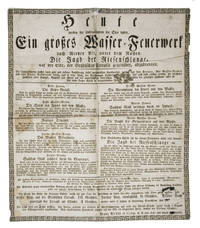
1829D6FA440BWJBFDresden 1829. 1mo broadside 46.7 x 39.1 cm. A rare unique broadside announcing a fireworks display at the river Elbe Dresden organized by Franz Kölbel a famed pyrotechnician from Graz Austria. The show was held on 5 September 1829 and reviewed in the Wiener Zeitschrift für Kunst Literatur Theater und Mode. The paper praised the spectacular rockets "deren ausgeworfenen Sterne so lange fortschimmerten und so hoch in den Lüften hin schwebten dass sie sich unter die wirklichen Sterne zu verlieren schienen". Franz Köbel also sold fireworks at his shop in Graz.Some soiling and staining edges frayed damaged at 2 folds small repairs. Overall in good condition.l Cf. Wiener Zeitschrift für Kunst Literatur Theater und Mode 118 1 Oct. 1829 p. 979; for Kölbel: Steiermärckisches Intelligenzblatt zur Grätzer Zeitung 45 21 March 1842 p. 172; not in KVK; WorldCat. unknown
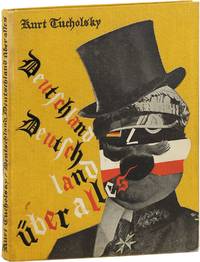
192984810Berlin: Neuer Deutscher Verlag 1929. First German Edition. First Printing cloth issue with 1.-20. Tausend printed on title page. Octavo 24cm; yellow decorative cloth with photomontage by John Heartfield applied to covers and titles stamped in black on spine; yellow topstain; 231pp 5; illus; text is in German. Contemporary October 1929 owner's name penciled to front endpaper; slight forward lean light overall dust-soil to cloth with pictorial elements well-preserved and largely unrubbed; browning to endpapers with mild wear to base of spine; a presentable copy Very Good lacking the rare dustjacket. A powerful piece of social criticism by Tucholsky one of the most prominent German-Jewish authors and journalists of the Weimar Republic. Produced with graphic designer John Heartfield Tucholsky managed to combine vicious attacks on everything he disliked about Germany with a declaration of love for his country. He warned of a government with anti-democratic tendencies and the impending threat of National Socialism - a plea almost to revolutionize a dormant country - though his fears were realized in 1933 when Hitler assumed the position of Chancellor of Germany. Axel Eggebrecht one of Tucholsky's contemporaries said of Deutschland: "If this book were to turn out to be quite a big success it might be realized that the dream of awakening is still very vivid in Germany." Deutschland was listed on the Nazis list of censored books and though it did go through a second printing few enough survived destruction. <br /> <br /> The present example is one of apparently two variant bindings for the first printing with no extablished priority known to us. While the pictorial cloth binding is the variant we have seen and handled most often we note another in yellow cloth without the pictorial elements and titles stamped in black on spine and front cover. A well-preserved example and a high-point of Heartfield's graphic design and layout work. Pachnicke & Honnef 60a-69 p.148-161. Neuer Deutscher Verlag unknown
1650130R86Rome . 1650 248 leaves. Manuscript in Italian on the History of Germany and virtually all of Europe in the momentous era of the 1620's prepared for Pope Urban VIII Maffeo Barberini by the Papal Nuncio to the Holy Roman Emperor. Written in a graceful Italian hand. Folio. 340 mm. Text generally clean but with scattered mold stains. Remains of old vellum binding. Interesting colorful paste paper end sheets. With the bookplate of Elkin Mathews = Charles Elkin Mathews 1851-1921 London publisher bookseller and collector who played an important role in the literary life the English speaking world in the late 19th and early 20th centuries. Also with a circular Sneyd family book plate probably Ralph Sneyd 1793-1870 but perhaps earlier. This work is often attributed to Carlo Carafa an incompetent and criminal administrator who was executed for treason at Castel San Angelo on Mar 4 1561 by Pius IV. but it is certainly by a later Carlo Carafa born in Naples in 1611 who was bishop of Aversa and Papal Nuncio to Switzerland the Republic of Venice and to the Holy Roman Emperor. The Holy Roman Emperor at this time was Ferdinand II 1578-1637 a member of the House of Habsburg. He was also King of Bohemia and King of Hungary. His rule coincided with the Thirty Years' War. Ferdinand's aim as a zealous Catholic was to restore Catholicism as the only religion in the Empire and suppress Protestantism. The Neapolitan Carafa family produced a large number of bishops cardinals and some saints. Cardinals in the Carafa family include with dates of their elevation to Cardinal: Filippo Carafa 1378; Oliviero Carafa 1467; Gianvincenzo Carafa 1527; Carlo Carafa 1555; Diomede Carafa 1555; Alfonso Carafa 1557; Antonio Carafa 1568; Decio Carafa 1611; Pier Luigi Carafa seniore 1645; Carlo Carafa della Spina 1664; Fortunato Ilario Carafa della Spina 1686; Carafa di Belvedere 1764-1830; Francesco Carafa della Spina 1773; and Domenico Carafa della Spina 1844. Biographical and bibliographic confusion among them is rampant. UNIQUE. A wonderful item for further scholarly study. Chest 2/4. (Rome? ?). hardcover
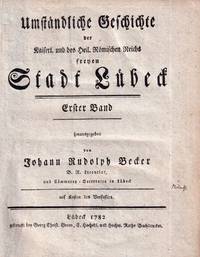
50327Lübeck gedr. bey Georg Christ. Green 1782 / 1784 / 1805. . Einbände beschabt Bd. 1 am oberen Kapital beschäd. Rückenschilder abgesplittert; Besitzvermerke von alter Hd. aV u. T. Bde. 1 u. 3 außerdem mit bibliogr. Notizen. - Bd. 3 mit privatim vorgebund. Frontispiz nach C. J. Milde. - Erste umfassende Darstellung der Stadtgeschichte von den Anfängen bis 1800. - Bd. 1 Abt. 1-7: Von Erbauung der Stadt bis auf die Kirchenreformation 1527 / Bd. 2 Abt. 8-12: Von der Kirchenreformation bis auf den Westphälischen Frieden / Bd. 3 Abt. 13-17; gedruckt bei G. F. J. Römhild: Nach dem Westphälischen Frieden bis auf den Beschluß des 18. Jahrhunderts. - Das Erscheinen des 3. Bandes wurde u.a. durch die Zensur des Historikers u. Domherrn Johann Carl Heinrich Dreyer 1723-1802 verhindert die Druckgenehmigung erst nach seinem Tod erteilt. - Zu dem Juristen u. Historiker J. R. Becker 1736-1815 seit 1773 "Cämmerey-Secretaire" in Lübeck siehe ADB 2 S. 222. - Exemplar von interessanter PROVENIENZ mit hs. Besitzvermerken: Titel aller Bde.: "Mölrath" vermutl. Joh. Christoph Mölrath Archidiakonus u. Prediger an St. Aegidien in Lübeck um 1775; Bd. 1: "Geschenk von Prof. K. W. Nitzsch an G. H. Handelmann 19. Aug. 1862." - a Der Altphilologe u. Historiker Karl Wilhelm Nitzsch 1818-1880 Verfasser beachteter Werke zur deutschen u. römischen Geschichte u. a. Geschichte des Deutschen Volkes bis zum Ausgang der Ottonen a. d. Nachlass; Geschichte der römischen Republik war ordentlicher Prof. in Kiel Königsberg und Berlin sowie Inspektor der Gelehrtenschulen in den Herzogtümern Schleswig u. Holstein in den 1830er Jahren. ADB 23 S. 730-742. - b Der aus Altona stammende Historiker Gottfried Heinrich Handelmann 1827-1891 schriftstellerisch rege war u.a. als Landeskonservator Museumsdirektor u. als Vorsitzender des Anthropologischen Vereins für Schleswig-Holstein tätig. ADB 49 S. 748-749. - Das privat vermutl. durch Handelmann als Frontispiz eingehängte Blatt in der Platte bezeichnet "X für U" hs. ergänzt "Kamin im Brautzimmer des Rathskellers zu Lübek" stammt aus dem Mappenwerk "Lübecker ABC" mit 26 Radierungen nach Zeichnungen von Carl Julius Milde 1857. - Gutes Exemplar des seltenen und selten komplett angebotenen Werkes. Lübeck, gedr. bey Georg Christ. Green, 1782 / 1784 / 1805. unknown
1759AQ19198London: Printed for J. Warcus.and J. Ross 1759. Two volumes bound as one. 2 viii 460; 136pp. With an engraved frontispiece and a further 12 engraved plates 10 folding. Early sheep-backed paper boards. Extremities heavily worn. Very occasional chipping to margins. Contemporary inked ownership inscription of James Wallis to title page dedication page verso of first plate alongside later inscription of Stephen Cummins head of first leaf of text and above caption title of Vol. II; with his occasional marginal annotations primarily recording for easy reference the placement of plates within the volume. An interesting anthology of translations of selected German articles from various late-seventeenth and early-eighteenth century periodicals including numerous by G. Leibniz mathematics mechanics logic philology and Philipp Jacob Sachs a Lewenheimb alchemy medicine. Initially published in parts under the title Acta Germanica or The literary memoirs of Germany &c. London 1742 the first collected two-volume edition appeared in 1743 printed by and for the editor Godfrey Smith. In his dedication to the fourth edition of The laboratory; or School of Arts 1755 Smith notes that he has suspended continuation of Acta Germanica for want of encouragement but hopes 'not only to finish the Second Volume but likewise to compleat my Design'. However no material appears to have been added after 1750 and the present work is a re-issue with cancel title page of the original sheets of Acta Germanica. Volume II is substantially smaller than volume I and has no index or title page but the text concludes with 'Finis'. ESTC records copies at three locations in the British Isles BL Cambridge and Wellcome and a further three in North America American Philosophical Society Boston and Minnesota. ESTC N19480. Second edition. Quarto. Printed for J. Warcus...and J. Ross hardcover
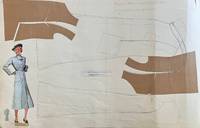
193059525Hannover: Schneidermister ca. 1930-1933. Oblong elephant folio. 23.5 x 14.5 in. 25 leaves unnumbered. Original women’s fashion patterns in pencil throughout many with tipped-in pattern cutouts mounted on the sheets as well as colour images of the finished design tipped-in and mounted manuscript pencil notes & directions in some colour pencil additions to a a few patterns. Stiff limp beige covers black cloth spine title mounted on front cover scutting edgewear repair to corners of front cover corner still a remarkable manuscript w/ tipped-in instructions for taking measurements and fashion by the Nazi Party on first leaf including one entitled “Ein Modewart macht Propaganda.†This German fashion pattern tailoring and pattern manuscript provides an exceptional original artifact of the period when the Nazi Party began to force educational and cultural changes upon German Society against the tailoring and fashion industry in Germany during the early 1930’s. By 1930 Berlin had emerged as an international fashion capital drawing Parisian fashion designers and most of the tailoring schools and fashion houses were operated by generations of Jewish family owners. Tailors and fashion designers were constantly reminded that they must create a wholly Aryan fashion and that they were to avoid French or other outside influences. Despite the pressure most women tailors and fashion designers in the tailoring or cutting schools continued to still draw their influences from Parisian and American couturiers by creating their own patterns and pattern books from which these internationally themed clothing designs could be made. This fashion pattern book by Bode focuses on women’s suits skirts capes coats and knickerbockers. However the Party never succeeded in creating a unique Fashion industry especially because of the drive to dress women in peasant costumes or uniforms even as the Nazi Party would confiscate the assets of over 2700 Jewish fashion houses retailers and manufacturers with 1000’s of tailors and seamstresses forced into labor and concentration camps to produce clothes for military and high society. See: Uwe Westphal Fashion Metropolis Berlin 1836-1939: The Story of the Rise and Destruction of the Jewish Fashion Industry 2019. Schneidermister, hardcover
1617D3698Berlin 16 April 1738. Hardcover. Very Good. Manuscript on vellum in German. 14 leaves 1 blank folio 350 x 243 mm. 17 lines written in a dark brown ink in an ornate gothic bookhand opening leaf with an elaborate penwork border the upper half with densely drawn scrollwork that interlocks with intermittent flower buds each additional leaf with a repeated penwork border of scrolling acanthus in free-form loops that create geometric patterns many in-text penwork flourishes. Fol. 13r signed "Carl" of Charles VI and signed by the scribe notary E. F. F. von Glandorff. In contemporary crimson velvet two holes in the hinges of the leaves where the cord and seal of Charles VI would have appeared slightly thumbsoiled some darkening to vellum; spine rubbed and velvet binding faded at edges. <br/><br/>A fine example of German 18th-century penmanship by Von Glandorff. The three brothers von Bruhl were sons of Heinrich von Bruhl who had been ennobled the previous year and who became Minister of Saxony under King August. hardcover
19482092902141700974Not Available 1948. Soft Cover. Fine. Volume: 2 vols. Not Available paperback
14930005337Nuremberg Germany: Anton Koberger 1493. First edition. Very Good. Woodcuts by the Workshop of Michael Woldgemut & Wilhelm Pleydenwurff. Folio conjoined leaves measuring approximately 455mm by 320mm very minor breaks at fold minor soiling matted but not glazed or framed. <br/><br/>LIBER CHRONICARUM is the most famous travel book of the 15th century and the most exhaustively illustrated book of the incunable era. The complete work contains 1809 woodcuts of which only 29 are double-page town views:: these conjoined leaves is one of those 29 town views specifically "Colonia" i.e. Cologne Germany. The verso of leaf XCI is a half-page view of "Augusta" i.e. Augsburg Germany with descriptive text. Also smaller portraits of historical personages including Cleopatra Alexander the Great Herodias L. Pomponius Leoneus and M. Agrippa. et alios Notes: this is from the Latin edition. The German-language edition DAS BUCH DER CHRONIKEN has different woodblock portraits for Pomponius Leoneus and Agrippa. Also the view of Augsburg is only the left half of the scene which is one of the double-page views. Goff S-307; Hain - Cop 14508x; Klebs 889.1; Oates 1026; Procter 2084; BMC II 437 . Woodcuts by the Workshop of Michael Woldgemut & Wilhelm Pleydenwurff. Anton Koberger unknown
1974List3157St. Petersburg Florida: unpublished 1974. Ninety-four typed and photocopied pages measuring 8 ½ x 11 inches in a soft binding. Binding with wear; pages generally excellent to Near Fine. Overall excellent to Near Fine. Annemarie Bliwernitz 1905–2005 née Entz was born in Notzendorf East Prussia. In 1952 after surviving both World Wars she and her husband Bruno 1900–1992 immigrated first to Canada and then to the United States. Offered here is Annemarie’s unpublished memoir written between 1972 and 1974.<br /> <br /> Bliwernitz grew up in a wealthy land-owning country family which she remembers lived far west enough that they did not have to flee the Russians during World War I and was less affected by the postwar economic situation than were city residents. Most of the memoir is taken up by Bliwernitz’s remembrances of World War II and life leading up to it. Of Hitler’s rise she writes:<br /> <br /> “During these years conditions got worse in Germany . A new name came up ‘Adolf Hitler.’ – It was not hard for him to find followers now by the thousands and soon by the millions. He dared to stand up against the Communists with his brown uniformed S.A. men and a new wind seemed to blow over our illfated land. No wonder young people looked up to him and followed the new star nobody had much to lose. . Bruno and brother-in-law Willy after some meetings attended showed up in the new brown uniform also and farmers and laborers seemed to be united in that new idea. – It really changed Germany in a short time nobody could deny that unemployment ceased people got jobs again and housewives and mothers could buy the necessities of life for their families especially food. And it brought us to our feet again also.â€<br /> <br /> Though of course Bliwernitz maintains that the “Concentration Camps and what happened in them was not known to the German people" she mentions that Bruno quickly became an Arbeitsdienstführer—essentially a labor camp overseer—and remembers dissenters being disappeared:<br /> <br /> “As an example I will tell about Bruno’s oldest brother Alfred. He was all against Hitler from the beginning. One day he came home and picked up his neighbor’s paper at his frontdoor and wrote his ideas about Hitler and his lies down with pencil. This neighbor reported him they picked him up and that was the last his family saw of him. They were told ½ year later that he had died in Stuhm West Prussia a Concentration Camp. No explanation to his wife whatsoever. The same destiny happened to my co-worker a highly educated person at the Translation Office. She said in the lavatory where many ladies could hear: Hitler’s big picture in the office should be placed here in the toilet-rooms where it belongs. One of the ‘kind’ co-workers reported her and she came next day only to pick up her belongings and was not seen any more.â€<br /> <br /> While Bruno is sent to the Eastern Front Bliwernitz and their children flee the Russians trying to reach the Americans on the Western Front. Along the way they encounter deserting German soldiers and near Hamburg liberated camp inmates:<br /> <br /> “Shooting started close to us and we heard bombs exploding would we be hit We found out that the Concentration Camp near us had been opened and those freed inmates had shot their guardians. At daybreak we met the first one still in his black and white striped prison-suit kneeling on the ground by the chicken-coop and with his both hands feeding himself out of the bowl with the chicken food. . They came to us begging for a little bit of salt to cook the horse-meat they had cut out of the dead horses lying along the ditches . We talked to them and I remember one told me he was imprisoned because of his religion not to go to any war. He was from Elbing where I had gone to school as a young girl.â€<br /> <br /> The family are reunited with Bruno and shortly before they surrender to the Americans they destroy the evidence of their party involvement: “Bruno’s N.S.D.A.P. membership-card my certificate for the ‘mother’s cross’ the passports of Horst and Juergen showing that they had been students of the Nazi-school in Stuhm etc.†After the German surrender the family is sent back east where they struggle to avoid starvation then return west where they are sent to live in Hardegsen. They finally decide in 1951 to emigrate as life in postwar Germany is simply too difficult but make the mistake of being honest about their history:<br /> <br /> “Another big obstacle for us was that Bruno had been in a member in a Nazi-party though not an active one. But it was still a handicap in those days for any undertaking. We had not kept it secret in our immigration papers and they wanted a detailed description about our political involvement. That we did wrote a long letter in German didn’t have the money for an interpreter and never got an answer. . That was a bitter pill to swallow.â€<br /> <br /> After this they decide to try for Canada instead and this time savvily “didn’t mention any Nazi-party attachmentâ€. This is a success; the family moves to Winnipeg and eventually to St. Petersburg Florida where the narrative was written. Bliwernitz recalls working as a housekeeper which she contrasts with her previous life in which she and her family would not allow maids farm hands or tradesmen to eat at their table with them.<br /> <br /> Of interest to historians of the German civilian experience during the Second World War especially that of women and children. unpublished unknown
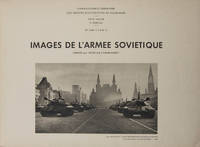
194941912NP: Édition du Service Géographique des T. O. A. 1949. First edition. Hardcover. g- to vg. Oblong folio 11 7/8 x 16 3/4". 50 ie 51 leaves. Original quarter purple cloth over gilt-stamped burgundy paper covered boards with gold lettering to front board.Photo-illustrated title page.<br /> <br /> Edited by the High Command of the French Army in Occupied Germany this work is a pictorial survey of the Red Army from 1941 the beginning of the German invasion to 1949. Includes photographs of the Soviet Military Commanders battle scenes during WWII the political organization weapons and material the satellite armed forces etc.<br /> <br /> Illustrated with no less than 231 photogravures and two b/w illustrations depicting the Order of Lenin and the Soviet Union's coat of arms this book was published as a supplement to "Notes sur l'Armée Russe" also published by the High Command of the French Army in 1949.<br /> <br /> Covers bowed with minor and sporadic soiling. Upper margin of front cover partly creased. Small abrasions to cloth at head of spine. Text and captions in French. Binding in overall good- interior in very good condition. Édition du Service Géographique des T. O. A. hardcover
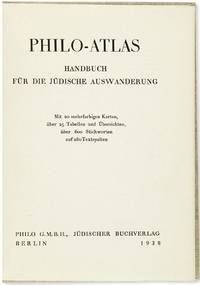
193843457Berlin Philo Verlag 1938. Hardback. 1st edition. Original printed Publisher's linen 8vo 5 283 pages. With 20 colored maps of countries and regions around the world including one world map displaying distances from Berlin. In German. Title translates as "Philo-Atlas: Guide for Jewish Emigration." <br> The Philo Atlas is a remarkable record of its time. Issued barely two weeks prior to the outbreak of Kristallnacht 9/10 November 1938 it appears at first to be nothing but a tourist guide-book. Yet its contents reveal a far more urgent need: An alphabetical survey of countries world-wide with their respective rules for obtaining entry-visas. "These are no tourist formalities for now survival depends on them. Which countries still accept migrants How much money do they demand For which occupations is there a need Which diseases need one be prepared for Where to find local organizations who can assist immigrants" <br> The Jewish-owned Philo Verlag was forcibly closed a month following the publication of this guide by which time the Nazis decided they were no longer willing to permit Jews to leave Germany - even if they could find a country willing to take them in which after the Evian Conference of earlier that summer was even more unlikely. The Jews who remained in Germany were now trapped. <br> Two copies sold at auction in 2018 for $1125 and $1375 each with buyers' premiums. <br> Some wear to boards; backstrip worn internal hinges starting Good Condition overall. An important document of the time. B KH-8-74A. Berlin, Philo Verlag unknown
1959222841959. Photographic album compiled by an African American soldier of the 18th Infantry Regiment 1st Infantry Division in the mid 1950s documents U.S. Army service in West Germany during the early years of military integration following Executive Order 9981. The images identify a Black serviceman within Company H of the 18th Infantry Regiment and record daily life training and social interaction within U.S. Army Europe during the Cold War occupation period. The album supports research into African American military history postwar occupation and the implementation of desegregation policies in overseas deployments.<br /> <br /> Oblong folio photograph album containing 102 vernacular black and white silver gelatin photographs primarily measuring approximately 3.5 x 5 inches some with deckled edges mounted recto and verso on black paper. Several photographs bear the stamp "Foto Proplesch Aschaffenburg" on the verso. Multiple images show the compiler wearing the shoulder insignia of the 1st Infantry Division with additional photographs taken outside a building marked "H Co. / 18th INF" confirming unit identification. Scenes include soldiers equipped with M1 steel helmets and M1 Garand rifles with one image showing a mounted M1919 Browning .30 caliber machine gun during a training exercise. Additional photographs depict military vehicles including jeeps and supply trucks marked with U.S. Army insignia in winter conditions as well as communications activity with a field radio and organized drills involving officers and enlisted men. Numerous images document informal settings including barracks interiors tent encampments cafes and social gatherings with German civilians. A small group of photographs appears to depict family life in the United States including women and children in domestic environments.<br /> <br /> The album was created during a period when U.S. Army units stationed in Europe were among the first to operate under integrated conditions following the gradual implementation of desegregation policies in the late 1940s and early 1950s. Aschaffenburg located in the American occupation zone served as a key base for U.S. forces and the images document both military structure and interpersonal relationships within this environment. The presence of interracial groups in both formal and informal contexts provides visual evidence of changing social dynamics within the armed forces contrasted with ongoing segregation in the United States. Light wear to album and photographs with images clear and well preserved; overall very good condition. This album provides a sustained visual record of African American military service and integration during the early Cold War period. unknown
173351123Frankfurt am Mayn: Bey Stocks seel Erben und Schilling 1733. 8vo. 12 544 40 pp. including index & poem at rear. Title in red & black. Copper-engraved double-page engraved frontisp. of birds-eye view of Medieval Heidelberg 1 large folding copper engraved plate by J.C. Kolb of the famed Heidelberg Tun the gigantic wine barrel in the Heidelberg Castle w/ table set for tasting above the baroque stairs and on top of the massive barrel couple minor closed tears minor fraying to fore-edge of plate. Contemporary vellum binding some soiling darkening to covers & spine minor wear to corners light uniform interior toning still a VG copy. First edition of this fascinating 18th-century history of the town on the Neckar River and the ruin of the famed Heidelberg Castle. Kayser details the destruction wrought on the city and the castle during the Thirty Years War the Reformation and destruction of much of the castle by the French armies in 1693 and 1694. After the 1697 Treaty of Ryswick marked the end of the War of the Grand Alliance Carl Philipp III installed Perkeo of Heidelberg his court jester in the castle to watch over the wine stock and much of the city was reconstructed in the Baroque style. The famous Heidelberg Tun a gigantic wine barrel in the Heidelberg Castle Cellars depicted here in the engraving by Kolb was the third Fass such giant barrel and was built by Carl Philipp in 1728. It would later be replaced in 1751 which is the present surviving barrel in the castle. Bey Stocks seel, Erben und Schilling, hardcover
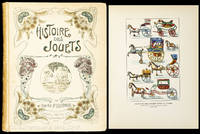
190010347AB1900. Paris Librairie Hachette um 1900. 4°. 316 S. 47 Farbtafeln dv. 1 doppelseitig und zahlr. Ill. Illustrierter Pappband. Einband mit Gebrauchsspuren. Auf dem Innendeckel eingeklebtes Ex Libris "Biblioteka Lancucka". Sauberes gut erhaltenes Exemplar. unknown
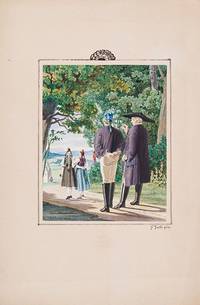
1870200077AG1870. no place c.1870. Original Gouache. Plate Size: 14 cm x 17.5 cm. Sheet Size: 21.6 cm x 32.7 cm. Original 19th century artwork. In excellent condition. Discreet duplicate stamp of 'Regia Berolin.' on reverse. Artist's Beautiful gouache of a traditional verdant rustic setting in southern Germany. Young maids in traditional dress tread the path to church followed by a young male in the company of a solemn fatherly pastor. Ferdinand Justi 2 June 1837 in Marburg Germany - 17 February 1907 in Marburg was a German linguist and Orientalist. He finished his studies of linguistics at the University of Marburg and the University of Göttingen. In 1861 he lived in Marburg where in 1865 he became associate and in 1869 full professor of comparative linguistics and Germanic philology. In addition to his academic work he studied with meticulous precision the life of the Hessian peasants in the last third of the 19th century especially in the immediate and wider area of Marburg on which he wrote his observations and described it in countless sketches and watercolors. One of his main themes included buildings furniture agricultural implements and especially costumes with all its subtleties and accessories. Wikipedia unknown